The right preparation can turn an interview into an opportunity to showcase your expertise. This guide to Equity Planning interview questions is your ultimate resource, providing key insights and tips to help you ace your responses and stand out as a top candidate.
Questions Asked in Equity Planning Interview
Q 1. Explain the difference between stock options and restricted stock units (RSUs).
Stock options and Restricted Stock Units (RSUs) are both forms of equity compensation, but they differ significantly in how they grant ownership and the tax implications for the employee.
Stock Options: These grant the employee the right, but not the obligation, to purchase company stock at a predetermined price (the exercise price or strike price) within a specific timeframe (the vesting period). Think of it like a coupon – you have the option to buy the stock at a discount, but you don’t have to. If the stock price rises above the exercise price, the option becomes valuable, allowing the employee to buy low and sell high. If the stock price stays below the exercise price, the option expires worthless.
Restricted Stock Units (RSUs): These grant the employee actual shares of company stock, but these shares are typically subject to vesting conditions. This means the employee doesn’t fully own the shares until they’ve met certain criteria, such as working for the company for a specific period. Once the shares vest, the employee owns them outright.
Key Differences Summarized:
- Ownership: Options grant the right to buy; RSUs grant ownership (subject to vesting).
- Cost: Options have an exercise price; RSUs typically have no upfront cost.
- Risk: Options carry more risk as their value depends entirely on the stock price; RSUs have less risk as they are eventually owned shares.
- Tax Implications: Options are taxed upon exercise (income tax on the difference between market price and exercise price) and again upon sale; RSUs are taxed when they vest (ordinary income tax).
Example: Imagine a company grants you options to buy 100 shares at $10 each. If the stock price rises to $20, exercising the options would yield a profit of $1000 before taxes. With RSUs, receiving 100 shares that vest at a market price of $20 would result in an immediate tax liability upon vesting.
Q 2. Describe the process of designing an equity compensation plan.
Designing an equity compensation plan is a multifaceted process requiring careful consideration of several factors. It’s crucial to align the plan with the company’s overall business strategy and goals.
1. Define Objectives: What are the goals of the equity plan? Attract and retain talent? Incentivize performance? Align employee interests with shareholder interests? Clearly stated objectives guide all subsequent decisions.
2. Target Employee Groups: Who will receive equity awards? Will it be all employees, key executives, or specific teams? The design will differ based on the target group’s role and contribution.
3. Choose Award Type: Stock options, RSUs, performance shares, or a combination? The choice depends on risk tolerance, tax implications, and desired employee incentives.
4. Determine Grant Size and Vesting Schedule: How many shares or options will be granted? Over what period will they vest (e.g., 4 years with a 1-year cliff)? Vesting schedules should incentivize long-term commitment.
5. Set Performance Metrics (If Applicable): For performance-based awards, define clear, measurable, achievable, relevant, and time-bound (SMART) goals. This ensures equity is awarded based on demonstrable achievements.
6. Establish Administration Procedures: How will the plan be administered? Who will manage it? What processes are in place for grant, vesting, and exercise?
7. Legal and Regulatory Compliance: Ensure the plan complies with all relevant securities laws and regulations, including those governing insider trading and disclosure requirements. This often requires consulting with legal counsel.
8. Board Approval: The plan must be approved by the company’s board of directors.
Throughout the process, regularly review and adjust the plan as the company’s circumstances evolve. A well-designed equity plan is a dynamic tool, not a static document.
Q 3. How do you determine the fair market value of equity awards?
Determining the fair market value (FMV) of equity awards is critical for tax purposes and accounting. Several methods exist, but the most common and reliable approach involves using a professional valuation firm.
Methods for Determining FMV:
- Comparable Company Analysis: This compares the company to publicly traded companies with similar characteristics. The valuation is based on the market capitalization and other financial metrics of the comparables.
- Discounted Cash Flow (DCF) Analysis: This method projects the company’s future cash flows and discounts them back to present value. This is more complex and relies on numerous assumptions about future performance.
- Precedent Transactions Analysis: This examines the prices paid in recent transactions involving similar companies. This method is useful if comparable public companies are scarce.
Professional Valuation: Independent valuation firms possess the expertise and resources to employ the most appropriate valuation methodology, considering factors like industry, growth stage, and financial performance. They often use a combination of methods to reach a more robust conclusion.
Factors Affecting FMV:
- Company performance: Strong financial performance generally increases FMV.
- Market conditions: A bullish market typically results in higher valuations.
- Industry trends: Positive industry trends enhance valuation.
- Company risk profile: Higher risk companies generally have lower valuations.
It’s crucial to use a reputable valuation firm to ensure the FMV is defensible and meets regulatory standards. Inaccurate FMV can lead to significant tax and accounting problems.
Q 4. Explain the tax implications of stock options for employees.
The tax implications of stock options are complex and depend on several factors, primarily whether the options are Incentive Stock Options (ISOs) or Non-Qualified Stock Options (NQSOs).
Incentive Stock Options (ISOs):
- Exercise: No tax is owed at the time of exercise, but the difference between the market price and the exercise price (bargain element) is taxed as a preferential capital gains tax if held for at least two years from grant date and one year from exercise date.
- Sale: Any profit upon the sale of the shares is subject to long-term capital gains tax rates (if held longer than one year from exercise).
Non-Qualified Stock Options (NQSOs):
- Exercise: The difference between the market price and the exercise price at the time of exercise is treated as ordinary income, subject to income tax rates.
- Sale: Any profit above the market price at exercise is taxed as a capital gain (short-term or long-term depending on holding period).
Important Considerations:
- Alternative Minimum Tax (AMT): ISOs can trigger AMT liability, even if no tax is due under regular income tax rules.
- Tax withholding: Employers may withhold taxes when options are exercised.
- State Taxes: State tax laws vary concerning the taxation of stock options.
Example: If you exercise NQSOs with a bargain element of $10,000, you will owe income tax on this $10,000 immediately. If you later sell the shares for a profit, you’ll also pay capital gains tax on that profit.
It is highly recommended to consult with a tax professional to understand the specific tax implications of your stock options.
Q 5. What are the different types of equity awards?
Several types of equity awards exist, each with its own features and implications.
1. Stock Options: As described earlier, these give employees the right to buy company stock at a predetermined price. They come in two main types: ISOs and NQSOs.
2. Restricted Stock Units (RSUs): These grant the employee shares of company stock, subject to vesting conditions.
3. Performance Shares: These awards vest only if the company achieves pre-defined performance goals. This aligns employee incentives directly with company success.
4. Performance Stock Units (PSUs): Similar to RSUs, but the number of shares awarded depends on the achievement of specific performance criteria.
5. Stock Appreciation Rights (SARs): These grant the employee the right to receive the increase in the stock price over a specified period. They don’t require the employee to purchase shares.
6. Phantom Stock: This award pays the employee a cash amount equal to the increase in the value of a specified number of shares over a defined period. It mimics the benefits of owning stock without granting actual ownership.
The choice of equity award type depends on the company’s strategic objectives, risk appetite, and the desired level of employee engagement and alignment.
Q 6. How do you account for equity-based compensation on the financial statements?
Equity-based compensation is accounted for using the fair value method under generally accepted accounting principles (GAAP). This means the expense is recognized over the vesting period of the award.
Accounting Process:
- Determine Fair Value: At the grant date, the fair value of the equity award is determined using the methods described previously.
- Allocate Expense: The total fair value is then allocated as an expense over the vesting period (e.g., if the vesting period is four years, the expense is recognized over four years). This is often done using a straight-line method.
- Record Expense: The allocated expense is recognized in the income statement each period as compensation expense. This reduces net income.
- Balance Sheet: The cumulative expense is also reflected on the balance sheet as an increase in additional paid-in capital until the vesting of RSUs or exercise of stock options, when the appropriate accounts are adjusted.
Example: If a company grants 1000 RSUs with a fair value of $10 each, and the vesting period is 4 years, the compensation expense will be $2,500 per year ($10,000/4). This amount is added to the income statement as compensation expenses, reducing net income in each year.
Proper accounting for equity-based compensation is crucial for presenting a true and fair view of the company’s financial performance. Failure to comply with GAAP could have severe implications.
Q 7. What are some common challenges in equity plan administration?
Equity plan administration presents several challenges, requiring careful planning and execution.
1. Valuation Complexity: Accurately determining the fair market value of equity awards can be challenging, especially for privately held companies. Inaccurate valuation can lead to significant tax and accounting issues.
2. Compliance and Regulatory Changes: Keeping up with constantly evolving securities laws and regulations is essential to avoid legal and financial penalties.
3. Data Management and Tracking: Maintaining accurate records of grants, vesting schedules, exercises, and tax implications for numerous employees can be complex and require robust systems.
4. Tax and Accounting Complexity: The tax implications of equity awards are intricate and vary depending on the type of award and jurisdiction. Errors can result in costly penalties.
5. Employee Communication: Clearly explaining the details and implications of equity awards to employees is critical to avoid misunderstandings and dissatisfaction.
6. System Integration: Integrating equity management systems with payroll, HR, and accounting systems is important for efficiency and accuracy.
7. Reporting and Disclosure: Accurate and timely reporting to regulatory bodies and shareholders is essential for compliance.
Effective equity plan administration requires a combination of robust systems, experienced personnel, and a deep understanding of the relevant laws and regulations.
Q 8. How do you handle equity grants for departing employees?
Handling equity grants for departing employees requires a structured approach that balances the company’s interests with fairness to the employee. The process typically involves a review of the employment agreement and the equity grant agreement to determine the vesting schedule and any applicable forfeiture clauses. If the employee is leaving voluntarily, the company will often accelerate vesting to a certain extent, particularly if the departure is due to a layoff or termination without cause. However, if the employee is terminated for cause (e.g., gross misconduct), the company may retain the right to forfeit the unvested shares. For involuntary departures such as layoffs, the company might offer a more generous acceleration period or a severance package that incorporates the value of the unvested shares. In all cases, clear and concise communication with the departing employee and legal counsel is crucial to ensure compliance and avoid disputes. The company should also update its cap table and equity records accordingly, reflecting the changes to ownership resulting from the departure.
Example: Imagine an employee with 10,000 shares, subject to a four-year vesting schedule with a one-year cliff. If the employee leaves voluntarily after two years, the company might accelerate the vesting of the remaining two years’ worth of shares (5,000 shares), instead of forfeiting them entirely. However, if the employee is terminated for cause, the company may retain all unvested shares.
Q 9. Explain the concept of vesting.
Vesting is the process by which an employee gradually earns ownership of their equity grants over time. It’s a crucial component of equity compensation plans, aligning the employee’s interests with the company’s long-term success. It prevents employees from receiving a full equity stake and then leaving immediately. Think of it like a deferred compensation plan, but instead of receiving cash, the employee receives equity that unlocks over time.
There are several vesting schedules:
- Time-based vesting: Shares vest over a specific period (e.g., four years), often with a ‘cliff’ (a period of time the employee must work before any shares vest). This is the most common type.
- Performance-based vesting: Shares vest only upon achieving predetermined performance goals (e.g., reaching a certain revenue target or completing a specific project). This incentivizes employees to contribute to the company’s success.
- Combination vesting: This combines time-based and performance-based elements.
Example: A four-year vesting schedule with a one-year cliff means that the employee must work for one year before any shares vest. After that year, the remaining shares will vest over the subsequent three years, usually in equal installments.
Q 10. How do you ensure compliance with regulations related to equity compensation?
Ensuring compliance with regulations related to equity compensation is paramount. This involves understanding and adhering to relevant laws and regulations, which vary by jurisdiction. Key areas to consider include:
- Securities laws: Equity grants may be considered securities, triggering registration requirements under securities laws (such as the Securities Act of 1933 and the Securities Exchange Act of 1934). Exemptions may apply, depending on the company’s status and the structure of the grant.
- Tax laws: Both the company and the employee have tax implications related to equity grants. The company may have deductions for equity compensation, while the employee will face income tax upon vesting or sale of shares. Accurate record-keeping is crucial for compliance.
- SOX compliance: Publicly traded companies must comply with the Sarbanes-Oxley Act (SOX), which requires robust internal controls and oversight of financial reporting, including equity compensation accounting.
To ensure compliance, companies typically work with legal and tax professionals to design and administer their equity compensation plans. Regular internal audits and independent reviews can help identify and address potential compliance issues. Accurate record-keeping and meticulous documentation are also crucial.
Q 11. Describe different methods for valuing equity for startup companies.
Valuing equity in a startup can be challenging due to the absence of a readily available market price. Several methods are employed, each with limitations:
- Discounted Cash Flow (DCF) Analysis: This projects the company’s future cash flows and discounts them back to present value. It requires making assumptions about future growth and profitability, which can be subjective.
- Comparable Company Analysis: This compares the startup to publicly traded companies with similar business models. Finding truly comparable companies can be difficult, especially for early-stage ventures.
- Venture Capital Method: This uses a multiple of revenue or other key metrics based on similar deals in the venture capital market. It relies on market data and may not accurately reflect the startup’s specific circumstances.
- Asset-Based Valuation: This method values the company based on the fair market value of its assets, less liabilities. This method is less useful for startups with intangible assets and future growth potential.
It’s often advisable to use a combination of methods to get a more comprehensive view of the company’s value. It’s important to acknowledge the inherent uncertainties involved in startup valuations.
Q 12. What is the difference between performance-based and time-based vesting?
The key difference lies in the conditions under which the equity vests.
- Time-based vesting awards equity based solely on the passage of time, usually measured in years. The employee receives a portion of their equity grants at predetermined intervals regardless of company performance. It’s a straightforward approach, offering predictability.
- Performance-based vesting ties equity grants to specific performance metrics. The employee only earns equity if pre-defined goals (e.g., revenue targets, product launches, profit margins) are met. This strongly incentivizes employees to contribute to the company’s success but introduces a greater degree of uncertainty.
Example: A time-based vesting schedule might grant 25% of equity annually over four years. A performance-based vesting schedule might grant equity only if the company achieves certain milestones (e.g., an IPO within a certain timeframe).
Q 13. How do you model the dilution impact of equity grants?
Modeling the dilution impact of equity grants is essential for understanding how new equity awards affect the ownership percentages of existing shareholders. This typically involves a cap table, a spreadsheet detailing the ownership structure of the company. When new equity is issued, the existing shares are diluted, reducing the ownership percentage of each existing shareholder.
Process:
- Start with the existing cap table: This lists all shareholders, their ownership percentage, and the number of shares they own.
- Determine the number of new shares to be issued: This depends on the size and structure of the equity grants.
- Calculate the total number of shares after the grant: This is the sum of existing shares and the new shares issued.
- Calculate the new ownership percentages: Each shareholder’s new ownership percentage is calculated by dividing their number of shares by the total number of shares after the grant.
- Update the cap table: The updated cap table reflects the new ownership percentages.
Example: If a company has 1,000,000 shares outstanding and issues 100,000 new shares, the total number of shares becomes 1,100,000. A shareholder who previously owned 100,000 shares (10%) will now own 100,000/1,100,000 = 9.09%.
Q 14. How do you communicate equity compensation plan details to employees?
Communicating equity compensation plan details to employees is critical for transparency, engagement, and understanding. The communication should be clear, concise, and easily accessible. Consider these strategies:
- Provide a comprehensive plan summary: This document should explain the key terms of the equity plan, vesting schedules, tax implications, and restrictions. Use plain language, avoiding complex jargon.
- Offer one-on-one consultations: Employees may have individual questions or concerns. Offer opportunities for personalized consultations with HR or legal professionals.
- Use multiple communication channels: This could include email, intranet postings, presentations, or even videos. Multiple methods improve comprehension for all employees, particularly those who might have difficulty understanding written documents.
- Provide ongoing education and updates: The equity plan might change over time. Keep employees informed of any updates or modifications.
- Use visual aids: Charts and graphs can make complex data more understandable. Visualizations can help explain vesting schedules, dilution, and other aspects of equity compensation.
Effective communication fosters trust and understanding, reducing confusion and potential disputes.
Q 15. Describe your experience with equity plan administration software.
My experience with equity plan administration software spans several years and various platforms. I’ve worked extensively with systems ranging from smaller, specialized solutions designed for startups to large-scale enterprise resource planning (ERP) systems incorporating equity management modules. This experience has provided me with a deep understanding of the critical features required for efficient equity plan administration, including grant management, option tracking, vesting schedules, capitalization table maintenance, and reporting capabilities. For instance, I’ve used Carta extensively for managing complex equity structures in high-growth companies, leveraging its features for automated calculations, reporting, and compliance. In other situations, I’ve implemented and customized solutions tailored to specific company needs, integrating with payroll and HR systems for seamless data flow. This involved understanding the nuances of different equity instruments like Incentive Stock Options (ISOs), Non-Qualified Stock Options (NSOs), Restricted Stock Units (RSUs), and performance-based awards, ensuring accurate processing and reporting across all of them.
My proficiency extends to utilizing these software systems to optimize workflows, automate repetitive tasks, and reduce manual errors. For example, I’ve implemented automated email notifications for grant approvals and vesting events, improving communication and efficiency throughout the equity lifecycle.
Career Expert Tips:
- Ace those interviews! Prepare effectively by reviewing the Top 50 Most Common Interview Questions on ResumeGemini.
- Navigate your job search with confidence! Explore a wide range of Career Tips on ResumeGemini. Learn about common challenges and recommendations to overcome them.
- Craft the perfect resume! Master the Art of Resume Writing with ResumeGemini’s guide. Showcase your unique qualifications and achievements effectively.
- Don’t miss out on holiday savings! Build your dream resume with ResumeGemini’s ATS optimized templates.
Q 16. How do you manage equity grants for international employees?
Managing equity grants for international employees introduces significant complexities beyond domestic grants. The key is to understand and comply with the diverse tax laws and regulations of each country where employees reside. This involves careful consideration of withholding taxes, local reporting requirements, and potential currency fluctuations. We need to ensure that the grants are structured to minimize tax liabilities for both the company and the employee while complying with all applicable regulations. This often requires collaboration with international tax advisors and legal counsel to navigate the complexities of international equity administration.
For example, I’ve worked with companies that use specialized global equity management firms to handle the cross-border tax implications and ensure compliance. These firms provide expertise in international tax laws, currency conversion, and local reporting requirements. A crucial aspect is selecting a software that can accommodate international regulations and automatically calculate tax liabilities based on employee location and grant type. Moreover, clear and well-translated communication materials are essential for international employees to understand their equity awards and associated implications.
Q 17. Explain the concept of share repurchase programs.
Share repurchase programs, also known as stock buybacks, are when a company uses its own funds to buy back its outstanding shares from the open market or directly from shareholders. These programs can be used for several strategic reasons. One is to increase the company’s earnings per share (EPS) by reducing the number of outstanding shares. Fewer shares mean that the same earnings are spread across a smaller number of shares, resulting in a higher EPS, which can make the stock appear more attractive to investors.
Another reason is to return capital to shareholders. By repurchasing shares, the company is effectively distributing its cash to shareholders, increasing their ownership percentage and potentially driving up the share price. Companies might also use buybacks to manage their capital structure, reduce debt, or counteract dilution from stock-based compensation programs.
However, it’s important to note that stock buybacks are not always beneficial. If a company repurchases shares at an inflated price, it may be destroying shareholder value. A well-designed repurchase program needs to consider the company’s financial position, growth opportunities, and overall strategic goals.
Q 18. How do you ensure the accuracy of equity-related data?
Ensuring the accuracy of equity-related data is paramount for compliance and maintaining investor confidence. We employ a multi-faceted approach that begins with robust data entry and validation processes. This includes implementing stringent checks and balances at each stage of the equity lifecycle, from grant creation to vesting and exercise. Data is regularly reconciled across multiple systems to identify and resolve discrepancies. For instance, we meticulously compare data from the equity administration software with the company’s financial records and capitalization table to ensure consistency.
Furthermore, regular audits, both internal and external, are conducted to verify data accuracy and compliance. We also rely on automated reporting and analytics to identify trends and potential issues. For example, using data visualization tools allows us to quickly pinpoint anomalies or inconsistencies that might indicate errors. Finally, continuous training for the equity administration team ensures everyone understands the importance of accurate data entry and the processes in place to maintain data integrity.
Q 19. What are some common pitfalls to avoid in equity plan design?
Many pitfalls can arise in equity plan design if not carefully considered. One common mistake is failing to properly align equity compensation with company goals and employee performance. An poorly designed plan may not incentivize the desired behaviors or may lead to unintended consequences, such as excessive risk-taking. Another pitfall is neglecting tax implications, both for the company and the employee. Incorrectly structured equity awards can lead to significant tax burdens that negatively impact both parties.
Ignoring vesting schedules and cliff provisions can also be problematic. Inappropriate vesting periods may fail to retain key employees, while poorly designed cliff provisions can create unintended consequences. Finally, a lack of clear communication about the equity plan to employees can lead to confusion, mistrust, and ultimately, lower employee morale. It’s crucial to have clear, concise, and accessible documentation that explains the plan’s details, terms, and conditions.
Q 20. Describe your experience with equity plan audits.
My experience with equity plan audits includes both participating in and managing them. I’ve worked closely with internal audit teams and external auditors to conduct thorough reviews of equity plan administration processes. These audits encompass various aspects, including verifying the accuracy of equity grants, confirming compliance with relevant regulations (e.g., SOX, IFRS), reviewing the effectiveness of internal controls, and ensuring proper accounting treatment of equity-based compensation. We follow a rigorous audit methodology, utilizing a combination of testing techniques like data analytics, sample testing, and walkthroughs to assess the completeness, accuracy, and reliability of equity-related data and processes.
A crucial part of my role is collaborating with the audit team to remediate any identified issues. This involves developing and implementing corrective actions, documenting improvements to processes, and ensuring that the necessary controls are in place to prevent future issues. For instance, I’ve overseen improvements to data validation processes that significantly reduced errors and improved data integrity.
Q 21. What metrics do you use to measure the effectiveness of an equity compensation plan?
Measuring the effectiveness of an equity compensation plan requires a multifaceted approach, going beyond simply looking at the cost. Key metrics include employee retention rates, employee satisfaction (specifically related to the equity plan), the overall cost of the plan compared to its impact on company performance, and the impact on attracting and retaining top talent. Analyzing the correlation between equity awards and individual performance is also vital.
For example, we might track the number of employees who leave within a specific timeframe after receiving equity awards. A lower turnover rate among employees with equity grants suggests a positive impact. We’d also assess employee feedback through surveys and focus groups to gauge satisfaction with the equity plan and identify areas for improvement. Furthermore, analyzing financial performance metrics like return on equity (ROE) and earnings per share (EPS) in relation to the plan’s cost allows us to evaluate the plan’s overall return on investment. A robust analysis should include benchmarking against industry peers to understand the effectiveness of the compensation plan relative to market standards.
Q 22. How do you handle complex equity situations, like mergers or acquisitions?
Mergers and acquisitions (M&A) significantly impact equity holdings. My approach involves a methodical process to ensure fairness and accuracy for all stakeholders. First, I carefully analyze the terms of the M&A agreement, paying close attention to how existing equity interests will be treated – whether through conversion, exchange, or cash-out. This often requires deep dives into complex legal documents and financial statements. Next, I develop a detailed plan for managing the transition, which includes communication strategies to keep employees and shareholders informed. This might involve sending out detailed information packets or holding town hall meetings. For example, in a recent acquisition I worked on, a key challenge was determining the fair market value of privately held shares within the acquired company. To address this, we employed a combination of discounted cash flow analysis and comparable company analysis to arrive at a valuation that satisfied both sides. Finally, I ensure all post-transaction equity administration tasks are completed meticulously, including updating records and issuing new equity certificates. Post-transaction analysis will also focus on evaluating the success of the integration from an equity perspective.
Q 23. Explain your understanding of various equity incentive plan types (e.g., ESOPs, stock options, RSUs).
Equity incentive plans are crucial for attracting and retaining top talent. Let’s break down some common types:
- Employee Stock Ownership Plans (ESOPs): These plans allow employees to own company stock, typically through a trust. This aligns employee interests with company performance and can be a powerful tool for retention. However, ESOPs involve significant regulatory compliance and administrative overhead.
- Stock Options: These grant employees the right, but not the obligation, to purchase company stock at a predetermined price (the strike price) within a specific timeframe (the vesting period). Stock options incentivize employees to increase company value, as their potential profit depends on stock price appreciation. Consider this scenario: an employee receives options with a $10 strike price. If the stock price rises to $20, they can purchase at $10 and immediately sell at $20 for a profit. However, if the price stays below $10, the options become worthless.
- Restricted Stock Units (RSUs): These are essentially promises to deliver company shares upon meeting certain conditions (vesting). Unlike options, RSUs don’t require any investment from the employee. They provide a simpler and more predictable form of equity compensation. For example, an RSU grant might vest over four years with 25% vesting annually. This means the employee receives 25% of the shares each year for four years, provided they remain employed with the company.
The choice of plan depends on factors like company size, stage of development, and financial situation. For example, a startup might favour RSUs to conserve cash and control dilution.
Q 24. What are the key considerations when setting strike prices for stock options?
Setting the right strike price for stock options is critical. It needs to be attractive enough to incentivize employees but not overly generous to the point of diluting shareholder value excessively. Several key considerations come into play:
- Current Market Price: The strike price is often set at or near the market price of the stock at the grant date, though this isn’t always the case (particularly in private companies).
- Company Valuation: For privately held companies, valuations are critical. A proper valuation model needs to be used to determine a fair market price. Different valuation methodologies exist (e.g. discounted cash flow, comparable company analysis).
- Future Expectations: The strike price should also account for anticipated future growth of the company. A conservative approach often is prudent to protect shareholder value.
- Regulatory Compliance: Regulations such as those from the Securities and Exchange Commission (SEC) and other relevant governmental bodies must be adhered to. Specific rules may relate to option pricing and reporting requirements.
- Employee Retention: The strike price and other features of the option plan (vesting period, term) must be competitive in order to attract and retain talent within the industry.
Getting this balance right requires a thorough understanding of the company’s financial health, industry benchmarks, and regulatory environment.
Q 25. How do you address potential conflicts of interest related to equity grants?
Conflicts of interest can arise in equity grant situations, especially with senior management. To mitigate these risks, I employ several strategies:
- Independent Compensation Committee: A robust compensation committee composed of independent directors oversees the equity grant process, ensuring impartiality and adherence to best practices. This separation helps avoid biased decision-making that might favor insiders at the expense of shareholders.
- Clear Guidelines and Policies: Establishing detailed guidelines and policies for equity grants, including eligibility criteria, grant sizes, and vesting schedules, prevents favoritism and promotes transparency. These policies should be regularly reviewed and updated to ensure they align with market trends.
- Disclosure Requirements: All equity grants must be properly disclosed to shareholders, and conflicts of interest must be explicitly identified and addressed. This transparency maintains accountability and reinforces trust.
- Regular Audits: Internal and external audits of the equity compensation system help identify and prevent potential irregularities or breaches of company policies.
It is imperative to approach equity compensation with utmost integrity and transparency to avoid legal pitfalls and maintain shareholder confidence.
Q 26. How do you stay updated on changes in regulations and best practices in equity compensation?
Staying abreast of changes in equity compensation requires a multi-pronged approach.
- Professional Organizations: Membership in relevant professional organizations (e.g., NASPP) provides access to industry publications, conferences, and networking opportunities to stay informed about regulatory changes and best practices.
- Legal and Regulatory Updates: Closely monitoring updates and guidance from regulatory bodies like the SEC and relevant international regulatory entities is crucial. Understanding potential changes to laws, interpretations, and enforcement is vital to remaining compliant.
- Industry Publications and News: Reading industry publications, attending webinars, and following news related to equity compensation keeps one informed on current trends and emerging issues.
- Continuing Professional Development: Investing in continuing professional development (CPD) courses and certifications demonstrates a commitment to staying current and improves professional standing.
Staying updated is an ongoing process, not a one-time event, particularly in the dynamically changing world of finance and regulations.
Q 27. Describe your experience with financial modeling and forecasting related to equity compensation.
Financial modeling and forecasting are essential for effective equity compensation planning. This involves projecting the potential dilution from equity grants, assessing the impact on earnings per share (EPS), and evaluating the long-term financial implications of various equity incentive plans.
For instance, I’ve used discounted cash flow (DCF) models to value companies and determine fair market value for stock options or RSUs in private equity settings. Spreadsheets, financial modeling software, and even dedicated equity compensation software are typically used for this task. For example, I might create a model that projects the company’s future earnings, incorporates the impact of employee stock options, and then calculates the diluted EPS to understand the financial implications of the plan.
Forecasting future equity needs also relies heavily on workforce planning, and projecting future hiring and retention needs. The output from these models informs strategic decisions related to the design and implementation of effective and sustainable equity compensation programs. The final output is often a comprehensive report that presents the financial impact of equity compensation and presents various scenarios to support management decision-making.
Q 28. How do you ensure the confidentiality and security of equity-related information?
Confidentiality and security of equity-related information are paramount. My approach involves multiple layers of protection:
- Data Encryption: All equity data is encrypted both in transit and at rest, safeguarding sensitive employee and company information. This might use techniques such as TLS/SSL encryption or AES encryption.
- Access Control: Strict access control measures restrict access to equity data based on the principle of least privilege. Only authorized personnel with a legitimate need to access the data are granted permissions. This often utilizes role-based access controls.
- Secure Data Storage: Equity data is stored on secure servers with robust firewalls and intrusion detection systems to prevent unauthorized access. This might include storing data in a cloud environment that complies with relevant security standards and regulations (e.g. SOC 2).
- Regular Security Audits: Regular security audits and penetration testing identify vulnerabilities and ensure that security measures are effective. This identifies potential risks and helps implement appropriate security patches.
- Compliance with Regulations: Adherence to all relevant data privacy regulations (e.g., GDPR, CCPA) ensures the protection of employee data.
Maintaining data security is a continuous process requiring vigilance and proactive measures to protect against both internal and external threats.
Key Topics to Learn for Equity Planning Interview
- Equity Valuation Models: Understand the theoretical underpinnings of different valuation models (e.g., Discounted Cash Flow, comparable company analysis) and their practical application in equity planning.
- Financial Statement Analysis: Master the interpretation of key financial statements (balance sheet, income statement, cash flow statement) to assess a company’s financial health and inform equity planning decisions.
- Capital Structure & Leverage: Explore the impact of different capital structures (debt vs. equity) on a company’s value and risk profile, and its relevance in equity planning strategies.
- Equity Compensation Plans: Learn about various equity compensation schemes (stock options, restricted stock units, etc.), their implications for employees and the company, and how they are designed within an overall equity plan.
- Risk Management in Equity Planning: Understand how to identify, assess, and mitigate risks associated with equity investments and compensation plans.
- Mergers & Acquisitions (M&A) and Equity: Grasp the role of equity in M&A transactions, including valuations, deal structuring, and post-merger integration.
- Corporate Governance & Equity: Explore the link between corporate governance practices and effective equity planning, including shareholder rights and responsibilities.
- Equity and Tax Implications: Understand the tax implications of different equity-based compensation plans and investment strategies.
- Scenario Planning & Sensitivity Analysis: Develop the ability to model different scenarios and assess the impact of various assumptions on equity valuation and planning.
- Problem-Solving & Case Studies: Practice applying your knowledge to solve real-world equity planning problems and analyzing case studies to hone your analytical skills.
Next Steps
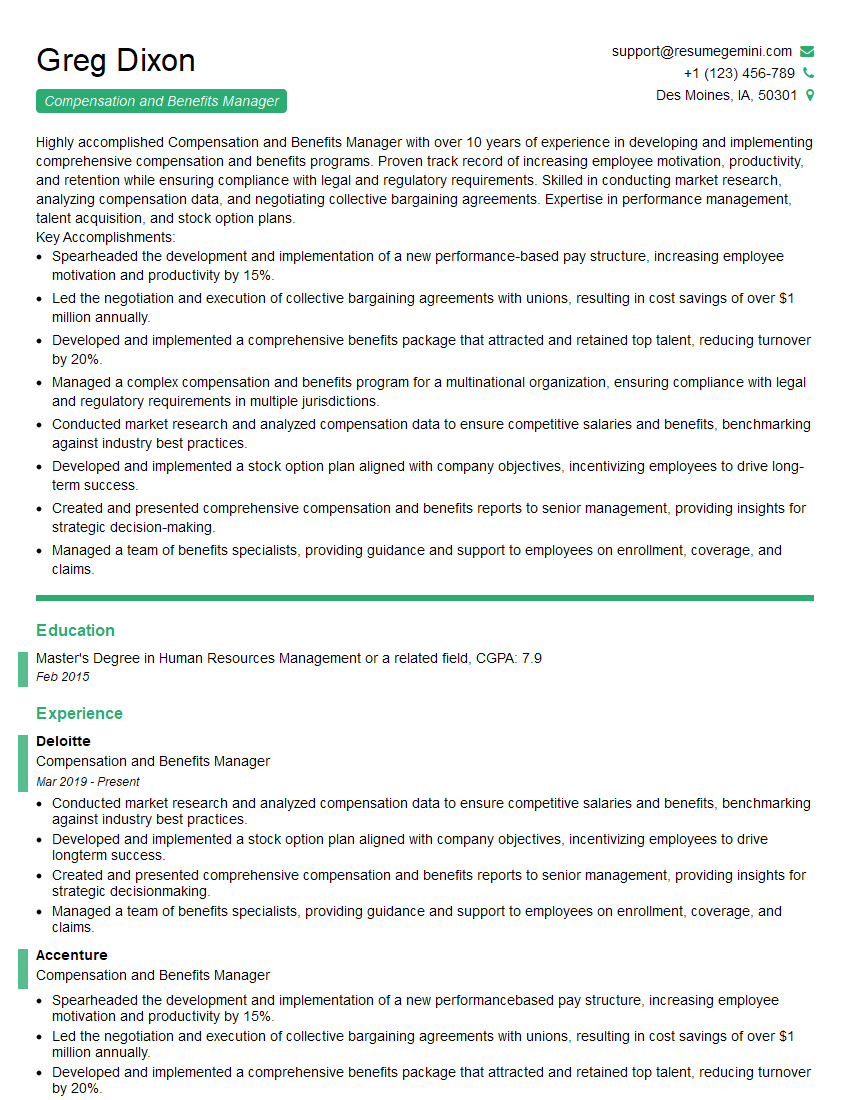
Mastering Equity Planning is crucial for career advancement in finance and related fields, opening doors to high-impact roles with significant responsibility. A strong resume is your key to unlocking these opportunities. Building an ATS-friendly resume is essential to ensure your application gets seen by recruiters. To enhance your resume and increase your chances of landing your dream job, leverage ResumeGemini. ResumeGemini provides a trusted platform for crafting professional resumes, and we offer examples of resumes tailored specifically to Equity Planning to help you get started.
Explore more articles
Users Rating of Our Blogs
Share Your Experience
We value your feedback! Please rate our content and share your thoughts (optional).
What Readers Say About Our Blog
To the interviewgemini.com Webmaster.
Very helpful and content specific questions to help prepare me for my interview!
Thank you
To the interviewgemini.com Webmaster.
This was kind of a unique content I found around the specialized skills. Very helpful questions and good detailed answers.
Very Helpful blog, thank you Interviewgemini team.