Interviews are opportunities to demonstrate your expertise, and this guide is here to help you shine. Explore the essential Experience in science journalism interview questions that employers frequently ask, paired with strategies for crafting responses that set you apart from the competition.
Questions Asked in Experience in science journalism Interview
Q 1. Explain the difference between science writing for a lay audience and a scientific audience.
The key difference between writing science for a lay audience and a scientific audience lies in the level of assumed scientific knowledge and the writing style. For a scientific audience (e.g., researchers, academics), I can assume a deep understanding of terminology, methodologies, and statistical analysis. I can use technical language freely and focus on nuanced details, perhaps including raw data or complex equations. My goal is to present new findings, discuss limitations, and contribute to the scientific discourse.
Conversely, writing for a lay audience (e.g., general public) demands simplification and clarity. Technical jargon needs to be explained or avoided entirely. I must focus on the broader implications of the research, avoiding overwhelming the reader with technical details. The goal is to communicate the essence of the science in an accessible and engaging way, perhaps using analogies or relatable examples to help them understand. For example, explaining the concept of ‘gene expression’ in a scientific paper might involve detailed molecular pathways; however, in a lay article, I would focus on the overall effect on the organism (e.g., ‘turning a gene on or off affects how the body functions’).
Q 2. Describe your experience with fact-checking and verifying scientific information.
Fact-checking and verification are paramount in science journalism. My process usually involves multiple steps. First, I meticulously examine the primary source material – the scientific paper itself, usually published in a peer-reviewed journal. I pay close attention to the methodology, data analysis, and conclusions. Second, I independently verify claims by consulting other reputable sources, such as textbooks, review articles, or other research papers. I look for corroborating evidence or conflicting data. Third, and critically, I contact the authors of the original study to clarify any uncertainties or discuss any aspects that require more explanation. This often involves detailed questions about the experimental design, data interpretation, and potential limitations. For example, I recently reported on a study about a new cancer treatment. During fact-checking, I confirmed the clinical trial details with an independent review board and contacted other researchers working in the same area to gain additional perspectives and assess the study’s overall significance.
Q 3. How do you approach interviewing scientists and other experts for a story?
Interviewing scientists requires careful preparation. Before the interview, I thoroughly research the scientist’s work and the topic at hand. I prepare a list of open-ended questions, aiming to elicit clear, concise answers avoiding leading questions. During the interview, I listen actively, ask clarifying questions, and probe for deeper understanding. I also try to build rapport with the scientist to encourage honest and candid responses. I frequently record the interviews for later transcription and review. For example, while working on a story about climate change, I interviewed a leading climatologist. Rather than simply asking for her opinion on a particular theory, I started by discussing her specific research findings, allowing her to explain her work in her own words, giving me more organic and detailed responses. After the interview, I review and verify the information through additional sources.
Q 4. What strategies do you employ to make complex scientific concepts accessible to a non-scientific audience?
Making complex science accessible involves several strategies. First, I break down complex information into smaller, digestible chunks using plain language. I avoid jargon whenever possible, defining technical terms when absolutely necessary. Second, I employ analogies and metaphors to make abstract concepts more concrete and relatable. For example, explaining quantum physics using relatable analogies like waves in a pond or the double-slit experiment makes it easier for the public to grasp the core ideas, rather than explaining the Schrodinger Equation directly. Third, I use visuals like charts, graphs, and illustrations to help explain data and complex relationships. Finally, I structure my writing to have a clear narrative arc – a beginning, middle, and end that is interesting and engaging to the reader, much like a good story.
Q 5. Describe your experience with different writing styles (e.g., news, feature, blog post).
My experience spans various writing styles. News articles require concise and timely reporting, focusing on the most important findings of recent research. Feature articles delve deeper into a topic, exploring multiple aspects and perspectives. They typically involve more in-depth research and a longer narrative arc. Blog posts allow for more informal and conversational writing, which helps engage the audience with more of a personal touch. For example, I recently wrote a news article about a new COVID-19 variant, focusing on its potential impact. In contrast, I wrote a feature article exploring the history of vaccine development. Lastly, I wrote a blog post about the challenges of science communication, drawing upon my personal experiences to connect with the audience on a more personal level.
Q 6. How do you handle conflicting scientific findings or viewpoints in your writing?
Handling conflicting scientific findings requires careful consideration and nuance. I present multiple viewpoints fairly and honestly, without taking sides. I clearly explain the differences in methodology, data interpretation, or conclusions that lead to contrasting results. I cite the relevant studies, allowing readers to assess the evidence themselves. It’s critical to avoid creating a false equivalence between well-supported findings and less credible assertions. For example, when reporting on the debate surrounding climate change, I would present the overwhelming consensus among climate scientists alongside the arguments from those who question the scientific findings. It’s imperative to clearly explain why the scientific consensus holds more weight, highlighting the rigorous methodology and overwhelming body of evidence supporting it.
Q 7. What are some ethical considerations you keep in mind when reporting on scientific research?
Ethical considerations are central to my work. I always strive for accuracy, fairness, and transparency. This includes properly attributing sources, avoiding plagiarism, and disclosing any potential conflicts of interest. I am mindful of the potential impact of my writing, striving to avoid sensationalism or oversimplification that could mislead the public. I always aim to represent the science accurately and fairly, avoiding bias and promoting critical thinking among my readers. Protecting the privacy of individuals involved in research is another significant consideration, ensuring that I respect their confidentiality. For instance, in reporting on human research studies, I’d always ensure that individual participants cannot be identified, maintaining their anonymity to protect their privacy and comply with ethical guidelines.
Q 8. How do you use data visualization to enhance understanding of scientific information?
Data visualization is crucial in science journalism because it transforms complex scientific data into easily digestible formats for a broader audience. Instead of relying solely on dense text and numbers, visualizations like charts, graphs, and maps allow readers to quickly grasp key trends, patterns, and relationships within the data. This enhances understanding by appealing to visual learners and making the information more engaging.
For example, instead of writing, “The study found a significant positive correlation between increased carbon dioxide levels and rising global temperatures,” I would use a scatter plot showing the direct relationship between these two variables. The visual representation immediately makes the correlation clear and impactful. Another example would be using a geographic map to illustrate the spread of a disease or the impact of a natural disaster. Choosing the right type of visualization is key – a bar chart for comparisons, a line graph for trends over time, a heatmap for geographic data distribution, etc. – to effectively communicate the scientific findings.
Q 9. Describe your experience with using multimedia elements (images, videos, infographics) in your writing.
Multimedia elements are integral to effective science communication. I extensively use images, videos, and infographics to complement my writing and improve reader engagement. High-quality images can illustrate complex processes or experimental setups, making them much more understandable than a textual description. Videos, particularly short explainer videos, are excellent for demonstrating experiments or showcasing research in action. Infographics are powerful tools for summarizing key findings or presenting complex information in a visually appealing and easily digestible format.
For instance, when writing about a new discovery in astrophysics, I might include a stunning image from a space telescope to visually represent the phenomenon. Or, when covering a study on animal behavior, a short video showing the animals’ actions can be much more persuasive and engaging than just a written description. In a piece on climate change, an infographic summarizing the key impacts and projected changes would be incredibly useful for readers to quickly absorb the key information.
Q 10. What is your process for identifying and pitching story ideas in science journalism?
Identifying and pitching story ideas in science journalism requires a multifaceted approach. I begin by regularly monitoring scientific journals, attending conferences, and following leading scientists and research institutions on social media. News releases from universities and research organizations are another rich source of story ideas. I also pay close attention to current events and identify how scientific advancements relate to broader societal issues and public concerns.
Once I have a potential story idea, I conduct thorough background research to ensure its novelty and significance. I then craft a compelling pitch, highlighting the story’s angle, target audience, and potential impact. A strong pitch clearly articulates the story’s scientific basis, its relevance to the general public, and the unique approach or perspective I’ll offer.
For example, I might notice a recent study on the effectiveness of a new cancer treatment. My research would then delve into the specifics of the study, its methodology, and its implications. My pitch would focus on the potential impact on patients’ lives, highlighting any unique aspects of the treatment and its accessibility.
Q 11. How do you stay up-to-date on the latest developments in science and technology?
Staying up-to-date in the rapidly evolving world of science and technology requires a dedicated and multi-pronged approach. I subscribe to leading scientific journals like Nature and Science, both in print and digital formats. I regularly attend scientific conferences and webinars, networking with researchers and keeping abreast of the latest breakthroughs. Following prominent scientists and research institutions on social media platforms like Twitter and LinkedIn provides real-time updates and insights.
Furthermore, I actively use online resources such as preprint servers (like arXiv) to access the latest research findings even before formal publication. I also leverage science news aggregators and websites to synthesize information from multiple sources and identify emerging trends. This combination of traditional and digital methods ensures I stay informed about a wide spectrum of scientific advancements across diverse fields.
Q 12. How do you manage deadlines and work under pressure?
Meeting deadlines and working under pressure are inherent aspects of science journalism. My approach relies on meticulous planning and effective time management. I begin by breaking down large projects into smaller, manageable tasks with clearly defined deadlines for each. This allows me to track progress and prioritize tasks effectively, even when facing tight deadlines.
Prioritization is key – focusing on the most critical elements first ensures that the most important aspects of the story are completed, even if other elements need to be slightly adjusted. I use project management tools to track deadlines, allocate time, and coordinate with editors and other contributors. Moreover, I maintain open communication with editors to manage expectations and ensure alignment on priorities. The ability to work efficiently and effectively under pressure is developed through consistent practice and experience, learning to adapt to changing circumstances and remaining flexible in approach.
Q 13. Explain your experience with using a Content Management System (CMS).
I have extensive experience using various Content Management Systems (CMS), including WordPress and Drupal. My proficiency encompasses content creation, editing, and publishing; managing media assets (images, videos); and utilizing SEO plugins to optimize content for search engines. I am comfortable with different content types, including articles, blog posts, slideshows, and interactive elements. Understanding the backend administration of a CMS allows me to efficiently manage and organize content, ensuring a smooth workflow and streamlined publishing process.
For example, using WordPress, I can easily create and manage categories and tags to organize my articles and improve site navigation. I’m also familiar with using various plugins to enhance functionality, such as adding social media sharing buttons or implementing analytics tracking to measure content performance. This allows for more effective content management and improved content visibility.
Q 14. Describe your experience with SEO and social media optimization for science writing.
SEO (Search Engine Optimization) and social media optimization are vital for maximizing the reach and impact of science writing. For SEO, I use relevant keywords in titles, headings, and body text to improve search engine rankings. I also optimize meta descriptions and image alt text to improve search engine visibility. I am familiar with tools that can help analyze website traffic and identify areas for improvement in SEO performance.
On the social media front, I tailor content for different platforms, understanding the unique characteristics and audience of each. For example, I might use shorter, more visual content for platforms like Instagram and TikTok, while employing longer-form articles and discussions for platforms like Twitter and LinkedIn. Engaging with readers through comments and sharing relevant content contributes to increased visibility and audience engagement. The key is to strategically utilize both SEO and social media techniques to amplify the reach of scientific information and connect with a wider audience.
Q 15. How do you measure the effectiveness of your science writing?
Measuring the effectiveness of science writing isn’t a simple matter of counting clicks or shares. It’s a multifaceted process that requires a combination of quantitative and qualitative methods. Quantitative measures might include website analytics (page views, time spent on page, bounce rate), social media engagement (shares, comments, likes), and readership surveys. These give a sense of reach and initial impact.
However, equally crucial is qualitative assessment. This involves gauging reader understanding. Did the piece successfully convey the scientific concepts? Did it spark interest and curiosity? Feedback forms, reader comments, and even informal conversations can provide invaluable insights here. For instance, if I receive emails from readers expressing that my article helped them understand a complex topic, or inspired them to learn more, it’s a clear indicator of success. Ultimately, effectiveness is about accurate and engaging communication that fosters scientific literacy.
A robust approach would involve employing a mixed-methods strategy: tracking quantitative metrics and actively soliciting and analyzing qualitative feedback.
Career Expert Tips:
- Ace those interviews! Prepare effectively by reviewing the Top 50 Most Common Interview Questions on ResumeGemini.
- Navigate your job search with confidence! Explore a wide range of Career Tips on ResumeGemini. Learn about common challenges and recommendations to overcome them.
- Craft the perfect resume! Master the Art of Resume Writing with ResumeGemini’s guide. Showcase your unique qualifications and achievements effectively.
- Don’t miss out on holiday savings! Build your dream resume with ResumeGemini’s ATS optimized templates.
Q 16. How do you deal with criticism or negative feedback on your work?
Criticism, even negative feedback, is an essential part of the process. I view it as an opportunity for growth and improvement. My first step is always to understand the source of the criticism. Was it a factual inaccuracy? A stylistic issue? Or a matter of interpretation? I carefully analyze the feedback, considering the critic’s perspective and expertise.
If the criticism highlights a genuine error, I take immediate steps to correct it. I might consult the original scientific sources, speak with the scientists involved, or make edits to the published piece (depending on the platform). For stylistic or interpretative concerns, I consider the validity of the points raised. If constructive, I will use the feedback to improve my writing style or clarify my approach in future pieces.
Ultimately, a professional attitude and a commitment to accuracy and clarity are paramount. Responding thoughtfully and addressing valid criticisms helps build credibility and trust with readers.
Q 17. Describe your familiarity with scientific style guides (e.g., Chicago Manual of Style).
I am very familiar with major scientific style guides, particularly the Chicago Manual of Style. I understand its intricacies regarding numerical data presentation, citation formats (author-date system), and the conventions for figures and tables. The Chicago style is a foundational guide, essential for ensuring accuracy and consistency in scientific publications. I also have experience with other styles, such as the APA (American Psychological Association) style, often used in social sciences.
My familiarity extends beyond simply knowing the rules; I understand the reasoning behind them. For example, precise citation methods are critical for intellectual honesty and ensuring that scientific work is appropriately attributed. The specific formatting conventions for figures and tables serve clarity and reproducibility in research. I regularly consult these style guides to ensure the accuracy and professionalism of my work.
Q 18. What software or tools do you use for science writing and research?
My toolkit for science writing and research is diverse. I rely heavily on word-processing software like Microsoft Word or Google Docs, leveraging their features for organization, editing, and referencing. For research, I use online databases such as PubMed (for biomedical literature) and Google Scholar for broader scientific literature searches.
Beyond these staples, I also utilize citation management software such as Zotero or Mendeley to organize and format my references efficiently. For data visualization, if needed, I might use tools like Excel or more specialized software like R or Python with relevant packages for data analysis and visualization. Furthermore, efficient note-taking is crucial, and I utilize digital note-taking apps like Evernote or OneNote to maintain well-organized research notes.
Q 19. Give an example of a successful science story you’ve written and explain your approach.
One successful story I wrote covered the discovery of a new species of deep-sea creature. My approach started with meticulous research. I contacted the lead researchers, understanding the scientific findings, the methodology behind the discovery, and the broader implications for marine biology. Instead of simply reporting the facts, I focused on creating a narrative that would engage the reader.
I incorporated elements of storytelling: the challenges faced by the research team, the excitement of the discovery, and the creature’s unique adaptations. I used vivid language, drawing parallels between the creature’s habitat and more familiar environments to make it relatable. I included high-quality images and illustrations to enhance the visual appeal and help readers visualize this unusual creature in its extreme environment. The result was a piece that was both scientifically accurate and captivating, generating considerable reader interest and sharing.
Q 20. Describe a time you had to overcome a challenge while working on a science story.
A significant challenge I faced was gaining access to information for a story on a highly sensitive environmental issue. The research data was primarily held by a private company, who initially declined my requests for interviews and data access citing concerns about confidentiality and potential negative impacts on their business.
To overcome this, I employed a multi-pronged strategy. First, I prepared a detailed and professional proposal explaining my intentions, emphasizing the public interest aspect of the story and how it would benefit public knowledge on the issue. I highlighted my experience and my commitment to journalistic integrity. Then, I built relationships with experts in the field who were willing to comment on the broader implications of the research without disclosing proprietary data. Finally, I used publically available information to contextualize the research, making the story informative even without the full data set. This ensured that the story was still able to deliver valuable insights.
Q 21. What are your strengths and weaknesses as a science writer?
My strengths lie in my ability to translate complex scientific concepts into accessible and engaging narratives. I possess a strong foundation in scientific principles and a meticulous approach to research and fact-checking. I’m adept at crafting compelling narratives, using storytelling techniques to make science relatable and interesting to a wider audience. I also have a good understanding of different media platforms and how to tailor my writing style to suit the specific audience.
One area I’m continually working on is broadening my expertise in specific scientific niches. Science is vast, and constantly evolving. While my base understanding is strong, consistently expanding my understanding of new breakthroughs and discoveries remains a priority. I also recognize that staying abreast of evolving communication trends and technological advances will be crucial for continued success in this field.
Q 22. How do you ensure accuracy and clarity in your science writing?
Ensuring accuracy and clarity in science writing is paramount. It’s a multi-step process that begins long before the writing even starts. First, I meticulously research the topic, consulting primary sources like scientific papers, data sets, and interviews with researchers whenever possible. I cross-reference information from multiple reliable sources to avoid relying on single points of view or potentially flawed data.
Secondly, I employ a clear and concise writing style, avoiding jargon unless absolutely necessary. If technical terms are unavoidable, I define them clearly within the text. I strive for a storytelling approach, making complex scientific concepts relatable to a broader audience. This involves breaking down intricate processes into smaller, easily digestible parts. For instance, explaining gene editing using a metaphor like editing a book’s text, rather than using complex biological terminology exclusively.
Finally, I rigorously fact-check my work, both during and after writing. This involves double-checking numerical data, verifying quotes, and ensuring that the overall narrative aligns accurately with the scientific evidence. I also always run my articles through a thorough editing process that includes both self-editing and a review by colleagues.
Q 23. Explain your understanding of the peer review process in scientific publishing.
The peer review process is the cornerstone of maintaining scientific rigor in publishing. It’s a system where a manuscript submitted to a journal is evaluated by other experts in the same field before publication. These reviewers, typically anonymous, assess the manuscript’s scientific validity, originality, methodology, and clarity. They scrutinize the data, analyses, and conclusions, looking for potential flaws, biases, or inconsistencies. The process aims to filter out inaccurate, poorly designed, or misleading research.
The editor of the journal then considers the reviewers’ comments and decides whether to accept, reject, or request revisions to the manuscript. This iterative process ensures that only high-quality, scientifically sound research is published. For example, a paper on climate change might be reviewed by experts in climatology, atmospheric science, and possibly even statistics, to ensure the methodology and results are robust and valid. The peer review system, while not perfect, is crucial for maintaining the credibility of scientific publications.
Q 24. Describe your experience with working collaboratively with editors, designers, and other team members.
Collaboration is essential in science journalism. I have extensive experience working with editors, designers, and other team members to create engaging and informative science stories. With editors, I work closely on developing the narrative arc, ensuring the clarity and accuracy of the writing, and meeting publication deadlines. The editor provides valuable feedback, refining the structure and tone of my pieces.
I collaborate with designers to ensure the visual elements of the story (charts, graphs, illustrations) enhance the readers’ understanding and enjoyment. This often involves explaining the data and its implications to the designer so they can appropriately represent it visually. Furthermore, I’ve worked with photographers, videographers, and fact-checkers on multimedia projects, ensuring each team member’s expertise contributes to a cohesive final product. This collaborative spirit leads to a higher quality end product and builds a strong team.
Q 25. What are your salary expectations?
My salary expectations are commensurate with my experience and skills in the field of science journalism, and competitive within the relevant market range. I am open to discussing a specific salary based on the details of the position and benefits package offered.
Q 26. Why are you interested in this specific science journalism position?
I am deeply interested in this specific science journalism position because of [mention specific aspects of the job description and company that appeal to you, e.g., the focus on environmental science, the organization’s commitment to public engagement, the opportunity to work with a specific team or mentor]. My skills and experience in [mention relevant skills and experience, e.g., explaining complex scientific topics in clear and engaging ways, working with multimedia formats, producing long-form feature articles] align perfectly with the requirements of this role. I believe my passion for communicating science effectively would allow me to make a valuable contribution to your team.
Q 27. What are your career goals in science journalism?
My career goals in science journalism encompass broadening my knowledge base to cover various scientific disciplines, and improving my ability to communicate scientific advancements to a diverse audience. I aim to produce high-impact science journalism that not only informs but also inspires readers. I envision myself eventually leading a team of science journalists or becoming a recognized authority in science communication, perhaps through teaching or mentoring others.
Q 28. Do you have any questions for me?
Yes, I have a few questions. First, could you elaborate on the specific reporting responsibilities of this role? Secondly, what opportunities are there for professional development and growth within the company? Finally, can you describe the team dynamics and collaborative environment?
Key Topics to Learn for a Science Journalism Interview
- Understanding Scientific Concepts: Demonstrate your ability to grasp complex scientific information and translate it into accessible language for a general audience. This includes understanding the scientific method and different research methodologies.
- Effective Communication Skills: Showcase your writing and verbal communication skills. Prepare examples of how you’ve explained complex scientific topics clearly and concisely, whether through writing, presentations, or interviews.
- Journalistic Ethics and Accuracy: Highlight your knowledge of journalistic ethics, including fact-checking, source verification, and avoiding bias. Be ready to discuss how you ensure accuracy and integrity in your reporting.
- Storytelling and Narrative Structure: Explain your approach to crafting compelling narratives around scientific discoveries and research. Discuss how you build engaging stories that capture the audience’s interest.
- Adaptability and Research Skills: Show your ability to quickly learn new scientific concepts, conduct thorough research, and adapt your writing style to different audiences and platforms (print, online, broadcast).
- Data Visualization and Interpretation: Demonstrate your understanding of how to present scientific data effectively, whether through charts, graphs, or other visual aids.
- Digital Media and Online Platforms: Discuss your experience using various digital platforms for science communication, including social media, blogs, and websites. Show you understand SEO and content optimization for online audiences.
Next Steps
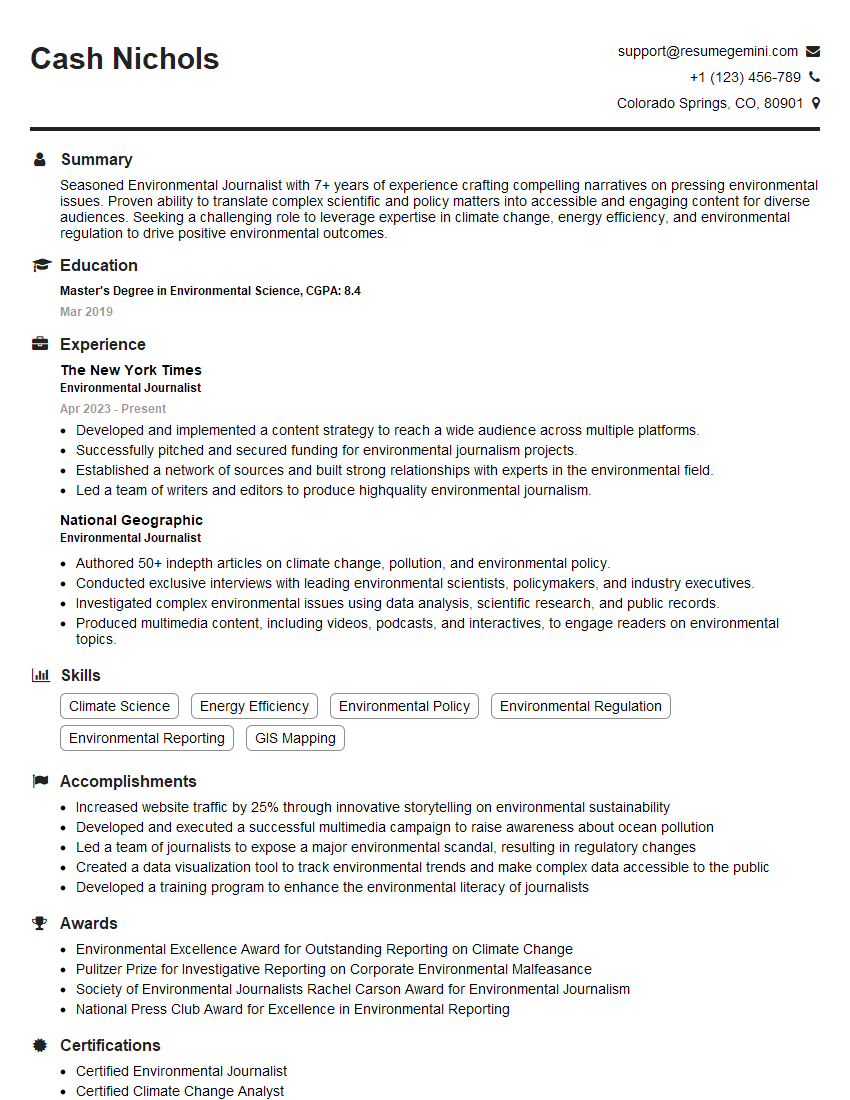
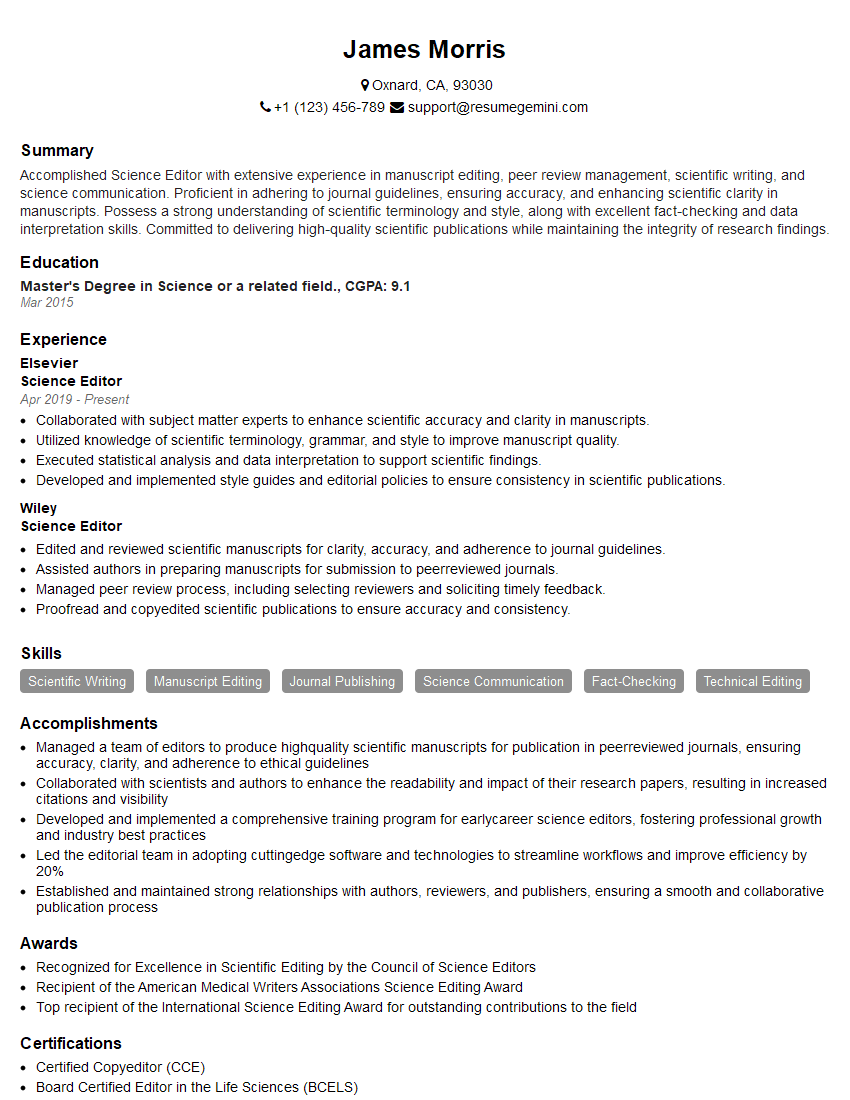
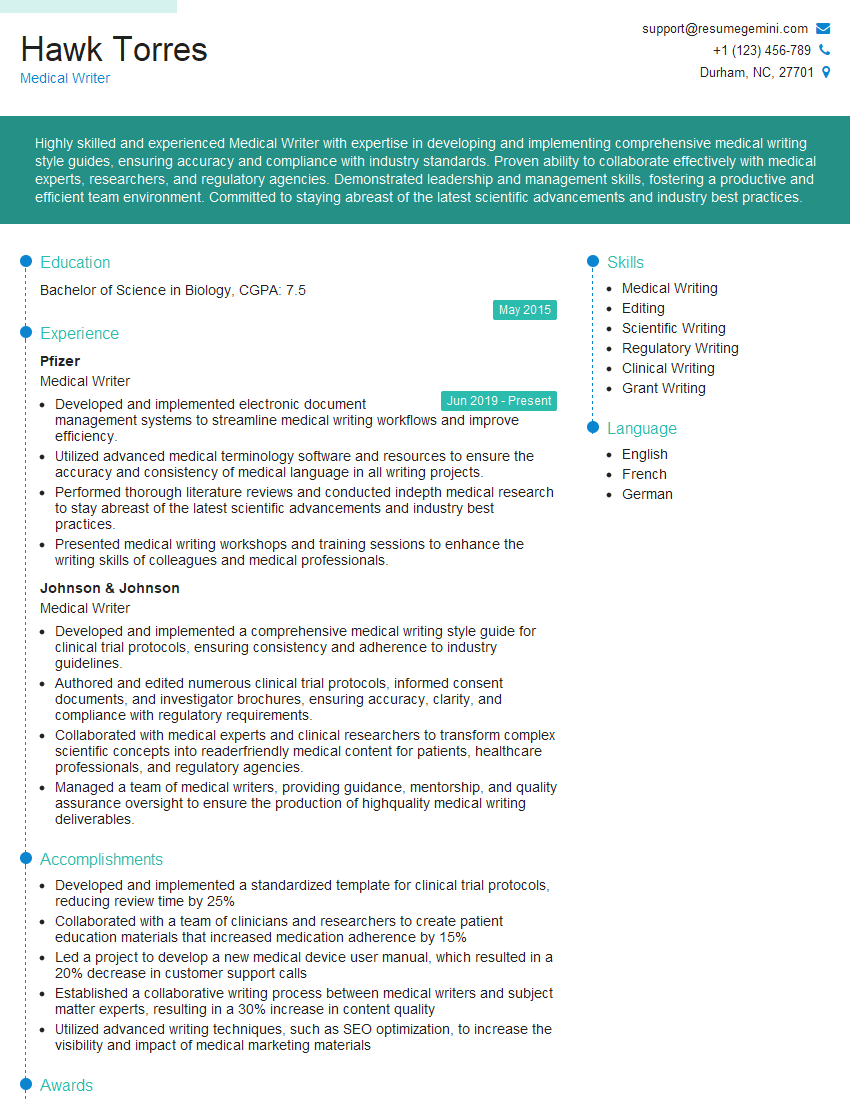
Mastering science journalism opens doors to a fulfilling career at the forefront of scientific communication, impacting public understanding and shaping scientific discourse. To maximize your job prospects, crafting an ATS-friendly resume is crucial. This ensures your application is effectively screened by Applicant Tracking Systems used by many organizations. We highly recommend using ResumeGemini to build a powerful and professional resume tailored to your experience. ResumeGemini provides valuable tools and resources, including examples of resumes specifically designed for candidates with experience in science journalism, to help you stand out from the competition.
Explore more articles
Users Rating of Our Blogs
Share Your Experience
We value your feedback! Please rate our content and share your thoughts (optional).
What Readers Say About Our Blog
To the interviewgemini.com Webmaster.
Very helpful and content specific questions to help prepare me for my interview!
Thank you
To the interviewgemini.com Webmaster.
This was kind of a unique content I found around the specialized skills. Very helpful questions and good detailed answers.
Very Helpful blog, thank you Interviewgemini team.