Cracking a skill-specific interview, like one for Experience in working with architectural lighting, requires understanding the nuances of the role. In this blog, we present the questions you’re most likely to encounter, along with insights into how to answer them effectively. Let’s ensure you’re ready to make a strong impression.
Questions Asked in Experience in working with architectural lighting Interview
Q 1. Explain the difference between illuminance and luminance.
Illuminance and luminance are both measures of light, but they describe different aspects. Think of it like this: illuminance is how much light falls on a surface, while luminance is how much light that surface reflects or emits.
Illuminance (measured in lux) quantifies the amount of luminous flux (light energy) incident on a surface per unit area. It’s essentially how bright the light source makes a surface appear. A high illuminance means a lot of light is hitting the surface. For example, a brightly lit office desk would have high illuminance.
Luminance (measured in candelas per square meter, or cd/m², often referred to as nits), on the other hand, measures the luminous intensity emitted or reflected from a surface in a particular direction per unit area. It’s what your eye actually perceives as brightness. A highly reflective white surface under high illuminance would have a high luminance, while a dark surface under the same illuminance would have a much lower luminance. Consider a computer screen: its luminance determines how bright it appears to you, even if the illuminance in the room changes.
In short, illuminance is about the incident light, while luminance is about the perceived brightness of a surface.
Q 2. Describe your experience with various lighting control systems.
Throughout my career, I’ve worked extensively with a range of lighting control systems, from simple on/off switches to sophisticated, networked systems. My experience encompasses:
- Relay-based systems: These are economical for smaller projects but lack the flexibility of more advanced systems. I’ve used these for straightforward applications, such as controlling individual luminaires in a small retail space.
- DALI (Digital Addressable Lighting Interface): I’m highly proficient with DALI systems, which offer excellent control and flexibility. I’ve used them in larger projects to individually dim or switch thousands of LED fixtures, achieving precise lighting scenes and energy savings. This allows for intricate control schemes, like zoning and timed sequences.
- KNX (Konnex): This open standard system provides seamless integration with other building management systems (BMS). I’ve worked on projects where KNX controls lighting, security, and HVAC, providing a centralized and energy-efficient management solution for the entire building.
- Wireless control systems (Zigbee, Bluetooth, Wi-Fi): These systems offer increased flexibility in retrofitting or controlling lighting in hard-to-reach areas. I’ve implemented wireless controls in several museum projects, where flexibility was essential for changing exhibition lighting requirements.
My experience extends to programming and commissioning these systems to ensure optimal performance and integration with the overall design concept. I’m comfortable troubleshooting and resolving issues across all of these systems.
Q 3. How do you calculate the required lighting levels for different spaces?
Calculating required lighting levels depends heavily on the space’s function and intended use. We use lighting design standards and codes (such as IES, CIE, or local building codes) as a starting point. These standards often provide recommended illuminance levels in lux for various tasks and environments. For example, an office space would require higher illuminance than a residential hallway.
The process typically involves:
- Identifying the space’s function: Is it an office, retail space, museum, or residential area? This determines the appropriate illuminance levels.
- Consulting relevant standards: Referring to the IES Lighting Handbook or similar resources to find recommended illuminance levels for the specific space type.
- Considering the ambient light: Natural daylight significantly impacts the required artificial lighting. We use daylight harvesting strategies to reduce artificial lighting needs during the day.
- Calculating the luminaire output: We use software like DIALux to simulate the lighting design and calculate the required number and type of luminaires based on their luminous flux and the desired illuminance level.
- Accounting for light loss factors: These factors consider various losses, including light absorption by the materials in the space, luminaire depreciation, and room surface reflectance.
- Verifying with photometric calculations: Software simulations allow us to fine-tune the design and ensure that the chosen lighting fixtures provide the necessary illumination levels.
For instance, designing a surgical operating room would require significantly higher illuminance levels (often exceeding 1000 lux) than a hotel lobby (which might range from 150-300 lux). Each space needs a tailored approach.
Q 4. What are the key considerations for designing energy-efficient lighting systems?
Designing energy-efficient lighting systems is crucial for sustainability and cost savings. Key considerations include:
- High-efficacy luminaires: Choosing LED lighting is essential; they offer significantly higher efficacy (lumens per watt) than traditional lighting technologies such as incandescent or fluorescent lamps.
- Energy-efficient controls: Implementing occupancy sensors, daylight sensors, and dimming controls can significantly reduce energy consumption. For example, lighting can automatically switch off when a room is unoccupied or dim in response to available daylight.
- Light-pollution reduction: Using shielded luminaires that direct light downwards reduces light trespass and minimizes energy waste. This improves both energy efficiency and environmental impact.
- Efficient design: Optimizing the lighting layout and fixture placement minimizes energy use by focusing light where it’s needed. Carefully planned illumination can significantly reduce the overall power requirements.
- Use of daylight harvesting: Designing spaces that maximize the use of natural daylight can dramatically reduce the reliance on artificial lighting, especially during daytime hours.
- Choosing appropriate color temperature: The color temperature of the light source impacts energy usage and visual comfort. Selecting appropriate color temperatures for different spaces can optimize both energy efficiency and visual appeal.
By considering these factors, we can create lighting systems that are both aesthetically pleasing and environmentally responsible.
Q 5. What software are you proficient in for lighting design (e.g., DIALux, AGi32, Revit)?
I’m proficient in several lighting design software packages, including:
- DIALux evo: I use DIALux extensively for lighting simulations and calculations. It’s a powerful tool for analyzing light levels, energy consumption, and glare. I rely on it heavily for initial concept development, client presentations, and final design documentation.
- AGi32: I’ve used AGi32 for more complex projects requiring detailed photometric analysis and rendering. It’s particularly useful for visualizing lighting effects and creating high-quality presentations.
- Revit: I’m skilled in using Revit for integrated building design, including lighting. This allows for seamless coordination with other building systems and provides a comprehensive model for documentation and construction.
My expertise in these software packages allows me to create accurate, efficient, and visually appealing lighting designs for a wide range of projects.
Q 6. Explain your process for creating a lighting design scheme.
My process for creating a lighting design scheme is iterative and collaborative. It involves:
- Understanding the client’s needs and vision: This initial phase involves discussions with clients, architects, and other stakeholders to define the project goals, budget, and aesthetic preferences.
- Site analysis and space planning: A thorough site visit and analysis of the space’s architecture, existing infrastructure, and surrounding environment are crucial to inform the lighting design.
- Concept development and sketching: This involves brainstorming different lighting approaches and creating preliminary sketches or renderings to visualize the lighting scheme.
- Lighting calculations and simulations: I use software like DIALux or AGi32 to perform detailed lighting calculations and simulations to ensure adequate illuminance levels and minimize glare and energy consumption. This may involve several iterations to optimize the design.
- Fixture selection and specification: Based on the simulations and client preferences, I select and specify the appropriate luminaires. This considers factors such as efficiency, aesthetics, and maintenance requirements.
- Presentation and client review: I present my lighting design proposal to the client, explaining the design rationale and addressing any concerns or feedback.
- Construction documents and specifications: I prepare detailed construction documents, including specifications, drawings, and schedules, to guide the installation of the lighting system.
- Commissioning and testing: I oversee the installation and commissioning of the lighting system to ensure it performs according to design specifications.
Throughout this process, communication and collaboration are paramount to ensuring the final design meets the client’s expectations and functional requirements.
Q 7. How do you incorporate sustainable lighting practices into your designs?
Incorporating sustainable lighting practices is a core element of my design philosophy. My approach focuses on:
- Energy efficiency: Prioritizing high-efficacy LED lighting and energy-efficient controls, like occupancy sensors and daylight harvesting, is essential for minimizing energy consumption and reducing the carbon footprint.
- Material selection: Choosing luminaires and materials with recycled content or those that can be easily recycled at the end of their life cycle contributes to reducing environmental impact.
- Minimizing light pollution: Employing shielded luminaires that direct light downwards helps reduce light trespass and protects the night sky. This reduces energy waste and maintains a respectful environmental balance.
- Long-term maintenance and lifespan: Specifying robust and durable luminaires with a long lifespan reduces the need for frequent replacements and minimizes waste. The selection of long-lasting, high-quality LEDs also extends the longevity of the entire lighting system.
- Sustainable procurement: I prioritize sourcing materials and luminaires from manufacturers committed to sustainable practices and responsible sourcing.
By adopting these strategies, I aim to create lighting systems that are not only aesthetically pleasing and functional but also environmentally responsible and contribute to a more sustainable future.
Q 8. Describe your experience with different types of light sources (LED, fluorescent, incandescent).
My experience spans across a wide range of light sources, each with its unique characteristics and applications. Incandescent lighting, while warm and aesthetically pleasing, is notoriously inefficient due to its high heat output and short lifespan. I’ve used them primarily in situations requiring a specific vintage aesthetic, acknowledging the energy penalties involved. Fluorescent lighting, once the industry standard, offers better efficiency than incandescent but can suffer from a less desirable color rendering and a slower start-up time. I’ve found them practical for general illumination in spaces where energy efficiency is a primary concern but color accuracy is less critical. LEDs, however, are my current go-to. Their high efficiency, long lifespan, and the vast array of color temperatures and color rendering indices available make them incredibly versatile. I’ve used LEDs extensively in projects ranging from retail spaces requiring vibrant color reproduction to museum installations needing precise and consistent light levels for artifact preservation. Selecting the appropriate light source always involves a careful consideration of the budget, desired aesthetic, energy efficiency requirements, and the specific needs of the space.
Q 9. How do you handle lighting design challenges in complex spaces?
Complex spaces present unique lighting challenges, requiring a multi-faceted approach. I start by conducting thorough site surveys, analyzing the space’s geometry, existing infrastructure, and intended use. For instance, in a large atrium with high ceilings, I would consider a combination of ambient lighting, accent lighting to highlight architectural features, and task lighting for specific areas. I utilize sophisticated 3D modeling software to simulate the lighting effects and ensure even illumination without creating harsh shadows or glare. This allows for iterative design refinement and client feedback before any implementation begins. Careful consideration is also given to the interaction of natural light with artificial lighting. In one project, a challenging cathedral-like space was addressed using a layered approach that incorporated daylight harvesting strategies alongside carefully placed LED fixtures to create a harmonious and inspiring ambiance, avoiding any potential conflict.
Q 10. What are your strategies for managing lighting projects within budget and timeline constraints?
Managing lighting projects within budget and timeline demands a highly organized and proactive approach. From the outset, I create detailed project budgets, breaking down costs for materials, labor, and software. Value engineering plays a crucial role; we often explore alternative solutions to achieve the desired aesthetic without compromising quality. For example, substituting custom-designed fixtures with readily available, high-quality alternatives can save significant costs. We establish clear timelines with milestones and regularly monitor progress. Consistent communication with clients and contractors is vital to address any potential issues or delays promptly. In one instance, we faced an unexpected delay in the delivery of a key lighting component. By proactively communicating this to the client and exploring alternative solutions, we managed to minimize the project’s overall delay, exceeding client expectations.
Q 11. Explain your understanding of color rendering index (CRI) and its importance.
The Color Rendering Index (CRI) is a crucial metric that indicates how accurately a light source renders the colors of objects compared to a reference source (usually sunlight). A CRI of 100 represents perfect color rendering, while lower values indicate poorer color reproduction. The importance of CRI varies depending on the application. For example, in retail settings or art galleries, a high CRI (typically above 90) is essential to ensure accurate color representation of products or artworks. In other applications, such as hallways or parking lots, a lower CRI might be acceptable. Selecting the right CRI is a key decision in lighting design, as it directly impacts the atmosphere and perceived quality of the space. Understanding CRI allows me to choose light sources that appropriately emphasize the intended colors and textures within a space.
Q 12. How do you address glare and light pollution in your designs?
Addressing glare and light pollution is a significant aspect of responsible lighting design. Glare can be mitigated through careful fixture selection, using diffusers and baffles to control light distribution, and strategically positioning luminaires to avoid direct line of sight. Light pollution, the excessive or misdirected artificial light, is minimized through techniques such as using shielded fixtures, directing light downward, and employing appropriate light levels. For example, using low-wattage LED fixtures with controlled beam angles minimizes light trespass into surrounding areas. In one residential project, I implemented strategically placed uplighting to illuminate trees, creating a beautiful nighttime ambiance without causing unwanted light spill into neighboring properties. This commitment to responsible lighting design not only enhances the environment but also aligns with sustainable design practices.
Q 13. What are your preferred methods for presenting lighting design concepts to clients?
I prefer a multi-sensory approach to presenting lighting design concepts. I begin with detailed renderings and simulations that visually showcase the lighting effects in the space. These are often supplemented with physical scale models incorporating actual lighting samples. This allows clients to experience the atmosphere firsthand. I also utilize lighting mood boards to demonstrate color temperatures and lighting scenes, giving clients a tangible sense of the potential ambiance. Finally, I present a comprehensive report detailing the technical specifications, budget breakdown, and timeline. This combined approach ensures that clients fully understand the proposed design, making the decision-making process efficient and transparent. The combination of visual and tangible elements ensures better client comprehension and allows for more effective communication.
Q 14. Describe your experience with daylight harvesting techniques.
Daylight harvesting is a crucial aspect of sustainable lighting design. It involves maximizing the use of natural light to reduce reliance on artificial lighting. My experience includes utilizing various techniques, from strategically placed windows and skylights to automated shading systems that optimize natural light penetration. I also incorporate light shelves and reflective surfaces to distribute daylight more effectively within a space. For instance, in an office building, I might design a system that uses sensors to adjust the artificial lighting levels based on the amount of available daylight, resulting in significant energy savings. Integration of daylight harvesting is not just about energy efficiency but also enhances occupant well-being by providing access to natural light, improving mood and productivity. Incorporating daylight harvesting is a key component in achieving environmentally sound and cost-effective lighting solutions.
Q 15. How do you collaborate with architects and other design professionals?
Collaboration with architects and other design professionals is paramount in architectural lighting. It’s a highly collaborative process, not a solitary endeavor. I believe in proactive communication and early integration into the design process. This starts with attending initial design meetings to understand the overarching vision, the architect’s intent, and the project’s specific goals.
My approach involves active listening, asking clarifying questions, and offering lighting solutions that complement the overall aesthetic and functionality. I use digital tools like BIM (Building Information Modeling) software to visualize lighting schemes within the 3D model, allowing for real-time feedback and adjustments. This visual representation aids in bridging communication gaps and ensures everyone is on the same page.
For example, on a recent museum project, early collaboration with the architect and curator helped us subtly highlight key artifacts while maintaining a consistent, mood-setting ambient light. We even used dynamic lighting to showcase specific exhibits at different times of the day. Regular meetings, shared design documents, and mock-ups are crucial for refining the design until we achieve a unified and impactful result.
Career Expert Tips:
- Ace those interviews! Prepare effectively by reviewing the Top 50 Most Common Interview Questions on ResumeGemini.
- Navigate your job search with confidence! Explore a wide range of Career Tips on ResumeGemini. Learn about common challenges and recommendations to overcome them.
- Craft the perfect resume! Master the Art of Resume Writing with ResumeGemini’s guide. Showcase your unique qualifications and achievements effectively.
- Don’t miss out on holiday savings! Build your dream resume with ResumeGemini’s ATS optimized templates.
Q 16. What are the key considerations for designing lighting for accessibility?
Designing for accessibility in lighting is crucial for inclusivity. Key considerations include providing adequate illumination levels to avoid glare and harsh shadows, especially in high-traffic areas. This ensures ease of navigation for people with visual impairments. We should consider using appropriate color temperatures – warmer tones are often more comfortable and less harsh on the eyes.
Furthermore, we need to design for contrast. Sufficient contrast between the foreground and background is essential, reducing the risk of tripping or stumbling. This involves selecting appropriate luminance ratios and using strategically placed lighting to accentuate pathways and highlight potential obstacles. We also need to be mindful of light pollution and minimize disruptive brightness changes that can be challenging for people with photosensitive epilepsy.
For instance, I recently worked on a project for a community center. We used wayfinding lighting – low-level, consistent illumination along corridors and walkways, guiding people effortlessly. In the main hall, we incorporated adjustable lighting to cater to different events, ensuring optimal illumination without causing discomfort.
Q 17. Explain your understanding of lighting zoning and its application.
Lighting zoning divides a space into distinct areas with specific lighting requirements. Each zone serves a different purpose and demands a tailored lighting approach. This is crucial for efficiency and flexibility. It’s like dividing a play into acts and scenes – each has its own lighting needs to set the mood and focus the action.
For example, in a restaurant, we might have zones for the dining area (ambient lighting, possibly with accent lighting on artwork), the bar area (brighter, more energetic lighting), and restrooms (functional lighting, ensuring safety and visibility). We achieve this by using different fixture types, light levels, and color temperatures within these designated zones. The application of lighting zoning allows for better control over the atmosphere, energy consumption, and user experience. It’s about creating layers of light to sculpt the space and evoke specific emotions.
A well-designed zoning strategy is documented and communicated using lighting plans and schedules. These plans illustrate the boundaries of each zone, specify the fixture types and their positioning, and list the target illuminance levels.
Q 18. Describe your experience with different lighting fixture types and their applications.
My experience encompasses a wide range of lighting fixture types, each with its unique applications. Recessed downlights are versatile and ideal for general illumination, while track lighting offers flexibility for adjustable spotlights, perfect for highlighting artwork or merchandise. Pendant lights create focal points and add a decorative element. Linear lighting is perfect for accentuating architectural features, providing ambient light or task lighting in office spaces.
Surface-mounted fixtures are useful when recessed lighting isn’t feasible, and outdoor lighting fixtures, such as bollards and wall-mounted lanterns, need to be weather-resistant and durable. LED strip lighting is excellent for under-cabinet lighting, creating ambient backlighting, or outlining architectural details. I also have experience with specialized fixtures like theatrical lighting and fiber optic lighting for unique applications.
The choice of fixture is driven by factors like the aesthetic, functionality, energy efficiency, and the specific needs of the space. For instance, in a modern office building, I might opt for sleek, energy-efficient LED downlights for general illumination and integrated linear lighting for task lighting. But in a traditional hotel lobby, I might use elegant chandeliers and sconces to create a warm and inviting atmosphere.
Q 19. How do you select appropriate lighting fixtures based on the project requirements?
Selecting appropriate lighting fixtures involves a careful consideration of several factors. The first step involves a thorough understanding of the project’s requirements. This means working closely with the client and design team to determine the intended function of the space, the desired aesthetic, and the budget.
Next, we must assess the architectural characteristics of the space. Ceiling heights, wall finishes, and the overall style of the building significantly influence lighting fixture selection. Energy efficiency is a major consideration, and I always look for fixtures with high energy efficiency ratings. This involves a deep understanding of different light sources, such as LEDs, CFLs, and incandescent bulbs, weighing their pros and cons regarding energy use, lifespan, and color rendering.
Finally, we consider factors such as light levels, color temperature, and color rendering index (CRI). The CRI indicates how accurately colors appear under the light source – a higher CRI means more natural and vibrant colors. For example, a retail space would benefit from high CRI lighting to showcase products accurately, while a cozy restaurant might employ warmer color temperatures to enhance ambiance.
Q 20. How do you ensure the safety and compliance of lighting installations?
Ensuring the safety and compliance of lighting installations is a non-negotiable priority. This begins with meticulously following all relevant building codes and electrical safety regulations. These regulations vary by location but are focused on aspects such as proper wiring, the use of approved fixtures, and appropriate safety features.
We rigorously test all fixtures to ensure they meet safety standards and are properly grounded. We also need to carefully plan for emergency lighting, ensuring adequate illumination in case of power failure. Regular maintenance and inspection of lighting systems are crucial for long-term safety and reliability. Proper documentation of the installation process, including fixture specifications, wiring diagrams, and test results, are key elements for compliance.
In the event of issues or non-compliance, I have a system of documenting, reporting, and rectifying all problems immediately to ensure the system is always safe and meets all regulations. My priority is always to maintain the highest safety standards throughout the project lifecycle.
Q 21. What are the latest trends and technologies in architectural lighting?
The architectural lighting field is constantly evolving. One of the most significant trends is the increasing adoption of LED technology. LEDs offer superior energy efficiency, longer lifespans, and greater design flexibility compared to traditional light sources. We are seeing a rise in smart lighting systems that allow for remote control and automation of lighting schemes. This allows for customized lighting scenes and energy savings through occupancy sensing and scheduling.
Human-centric lighting (HCL) is gaining traction. HCL focuses on optimizing lighting to improve human well-being and productivity by adjusting color temperature and light levels to mimic natural daylight cycles. We are also seeing a growth in the use of dynamic lighting, which allows for changes in light color and intensity to create engaging and interactive environments. Finally, the use of sustainable and eco-friendly materials in lighting fixture manufacturing is becoming increasingly important.
For instance, I recently incorporated a smart lighting system into a large office space, reducing energy consumption by 30% and providing employees with customizable lighting settings. We also used HCL to improve employee mood and productivity. These trends are reshaping how we approach lighting design, enabling us to create more functional, sustainable, and human-centered environments.
Q 22. Explain your experience with lighting simulations and renderings.
Lighting simulations and renderings are crucial for visualizing and analyzing a lighting design before implementation. My experience encompasses using software like DIALux evo, Relux, and AGi32 to create photorealistic renderings and energy simulations. This allows clients to experience the design virtually, understand the impact of different lighting fixtures and arrangements, and make informed decisions early in the process. For example, on a recent museum project, we used DIALux to simulate the impact of different LED color temperatures on the artwork, ensuring optimal presentation and visitor experience. We also utilized energy analysis tools within the software to optimize energy efficiency and meet sustainability goals. The simulations helped us fine-tune the lighting layout to minimize glare and maximize visual comfort, ultimately resulting in a design that was both aesthetically pleasing and energy-efficient.
Beyond basic illumination, these simulations also allow us to analyze factors like luminance, illuminance, and glare, ensuring compliance with relevant standards and codes. We can also simulate different scenarios, like daylight integration or emergency lighting, ensuring the design accounts for all aspects of the building’s needs. The final renders are often incorporated into presentations for clients, enabling easier communication and a shared understanding of the proposed design.
Q 23. Describe your experience with commissioning lighting systems.
Commissioning lighting systems involves a systematic process of verifying that the installed lighting system performs according to the design specifications. My experience includes conducting on-site inspections, testing the functionality of individual fixtures and controls, and verifying the overall illumination levels and energy consumption. This process often involves using light meters and other testing equipment to measure illuminance, luminance, and color temperature. We also verify the operation of control systems, including dimming capabilities, occupancy sensors, and daylight harvesting strategies.
A key aspect of commissioning is documenting all findings and generating reports that detail any discrepancies between the design and the as-built conditions. This documentation ensures that any necessary corrections are made before the final project handover. For example, on a large office building project, we identified a discrepancy in the dimming curves of certain fixtures during commissioning. This was addressed immediately by working with the installer to reprogram the control system, ensuring the lighting scheme functioned as intended.
Successful commissioning reduces the risk of costly rework, ensures compliance with regulations, and provides an assurance of quality and performance to the client. It is a critical step to guarantee the long-term success of the lighting system.
Q 24. How do you integrate lighting with other building systems (e.g., HVAC, fire alarm)?
Integrating lighting with other building systems is crucial for creating a cohesive and efficient building environment. This involves coordination with other engineers and consultants from the beginning of the project. For instance, integrating lighting with the HVAC system can optimize energy consumption by using occupancy sensors to reduce lighting levels in unoccupied zones, while simultaneously reducing HVAC operation in those same zones. This coordination often requires the use of Building Management Systems (BMS) that allow for centralized control and monitoring of various systems.
Integration with fire alarm systems is critical for safety. Emergency lighting must be properly interconnected with the fire alarm system to ensure that it functions correctly in the event of a fire. This might involve ensuring that emergency lighting is activated automatically during a fire alarm and that the emergency lighting circuits are appropriately protected. Similarly, integration with security systems might involve using lighting to enhance security by providing appropriate illumination in exterior spaces or utilizing lighting control systems to adjust lighting levels based on security protocols.
Effective coordination requires detailed communication and collaboration. We frequently utilize BIM (Building Information Modeling) software to model the interactions between different building systems and to identify potential conflicts early in the design process. This proactive approach prevents costly clashes and delays during construction.
Q 25. How do you manage changes and revisions in a lighting design project?
Managing changes and revisions in a lighting design project is a critical aspect of successful project delivery. We use a robust change management process that involves clearly documenting all requests for changes, assessing their impact on the budget, schedule, and design intent, and obtaining client approval before implementing them.
We employ version control, using software to track revisions and maintain a history of changes. This allows us to easily revert to previous versions if necessary and ensure that all stakeholders are working with the most up-to-date version of the design. Clear communication is key. We make sure all parties – the client, contractors, and other consultants – are informed about changes and their potential consequences. We often hold regular meetings to review progress and address any emerging issues. This proactive approach minimizes confusion and ensures that the project remains on track.
We utilize a collaborative platform (e.g., BIM 360) to share design files and communicate updates. This ensures everyone is working from the same source and minimizes the risk of errors due to outdated information. The process also includes a formal change order system to track and approve any modifications to the project’s scope and budget.
Q 26. Describe your experience with troubleshooting lighting system issues.
Troubleshooting lighting system issues requires a systematic approach. My experience involves using a combination of visual inspection, testing equipment, and diagnostic tools to identify and resolve problems. This might involve checking the power supply, inspecting wiring and connections, testing individual fixtures, and analyzing control system data.
For example, if a section of lighting is not working, we might first check the circuit breaker to see if it’s tripped. If the breaker is fine, we might then use a multimeter to check the voltage at the fixture and trace the wiring to identify any breaks or shorts. If the issue is with the control system, we might use diagnostic software to identify any errors or malfunctions. The process often involves working closely with electricians and other contractors to effectively diagnose and resolve the problem. We prioritize safety and ensure that all work is conducted according to relevant safety regulations. A detailed log of troubleshooting steps and solutions is maintained for each project to aid future maintenance and support.
Q 27. How do you stay updated on the latest codes and regulations related to lighting?
Staying updated on the latest lighting codes and regulations is essential for responsible and compliant practice. I regularly review publications from organizations like the Illuminating Engineering Society (IES), the International Code Council (ICC), and relevant national and local authorities. I participate in industry conferences and workshops to learn about the latest advancements in technology and regulations.
Subscription to industry journals and online resources provides access to the most current information on code changes and best practices. We also maintain a library of relevant codes and standards within our office to ensure easy access to information when needed. This continuous learning ensures that our designs meet the highest standards of safety, efficiency, and compliance. We conduct internal training sessions to disseminate this information to the entire team. This includes keeping up-to-date on energy efficiency standards, sustainable lighting practices, and the latest developments in LED technology and control systems.
Q 28. Describe a challenging lighting design project and how you overcame the challenges.
One particularly challenging project involved designing the lighting for a historic theater. The main challenge was balancing the need to preserve the building’s historical integrity with the requirement to provide modern, energy-efficient lighting that met current safety standards. The existing wiring was outdated and unreliable, and many of the original fixtures were beyond repair.
We overcame these challenges by employing a phased approach. First, we conducted a thorough assessment of the existing infrastructure and documented all aspects of the electrical system. We then worked closely with historical preservationists to identify appropriate replacement fixtures that were both aesthetically compatible with the building’s architecture and met modern energy efficiency standards. This required extensive research to locate fixtures that matched the original style while incorporating energy-efficient LED technology. We also designed a new control system that seamlessly integrated with the existing infrastructure while addressing issues of safety and reliability. This meticulous process involved careful coordination with contractors, preservationists, and the client, resulting in a lighting scheme that successfully harmonized historical preservation with modern functionality and efficiency. The final result was a beautifully illuminated theater that preserved its historical character while meeting current lighting standards.
Key Topics to Learn for Architectural Lighting Interview
- Light Sources & Technologies: Understanding different lighting technologies (LED, incandescent, fluorescent, etc.), their applications, and their pros & cons in architectural settings. Consider energy efficiency, lifespan, and color rendering index (CRI).
- Illumination Design Principles: Mastering concepts like ambient, accent, and task lighting; understanding the impact of light levels (lux), color temperature (Kelvin), and light distribution on space perception and mood.
- Software & Tools: Familiarity with relevant design software (e.g., Dialux, Revit, AGi32) for lighting simulations, calculations, and visualizations. Be prepared to discuss your experience with specific software packages.
- Lighting Control Systems: Knowledge of various control systems (dimmer switches, occupancy sensors, daylight harvesting) and their integration into architectural projects to optimize energy efficiency and user experience.
- Code Compliance & Regulations: Understanding relevant building codes and safety standards related to lighting design and installation. This includes aspects of energy efficiency and accessibility.
- Project Management & Collaboration: Discuss your experience collaborating with architects, engineers, and contractors; highlight your ability to manage timelines, budgets, and client expectations within lighting projects.
- Problem-Solving & Troubleshooting: Be ready to discuss instances where you’ve encountered and resolved lighting design challenges, demonstrating your analytical and problem-solving skills.
- Sustainability & Energy Efficiency: Discuss your experience with sustainable lighting practices, including energy-efficient lighting design and the use of renewable energy sources.
Next Steps
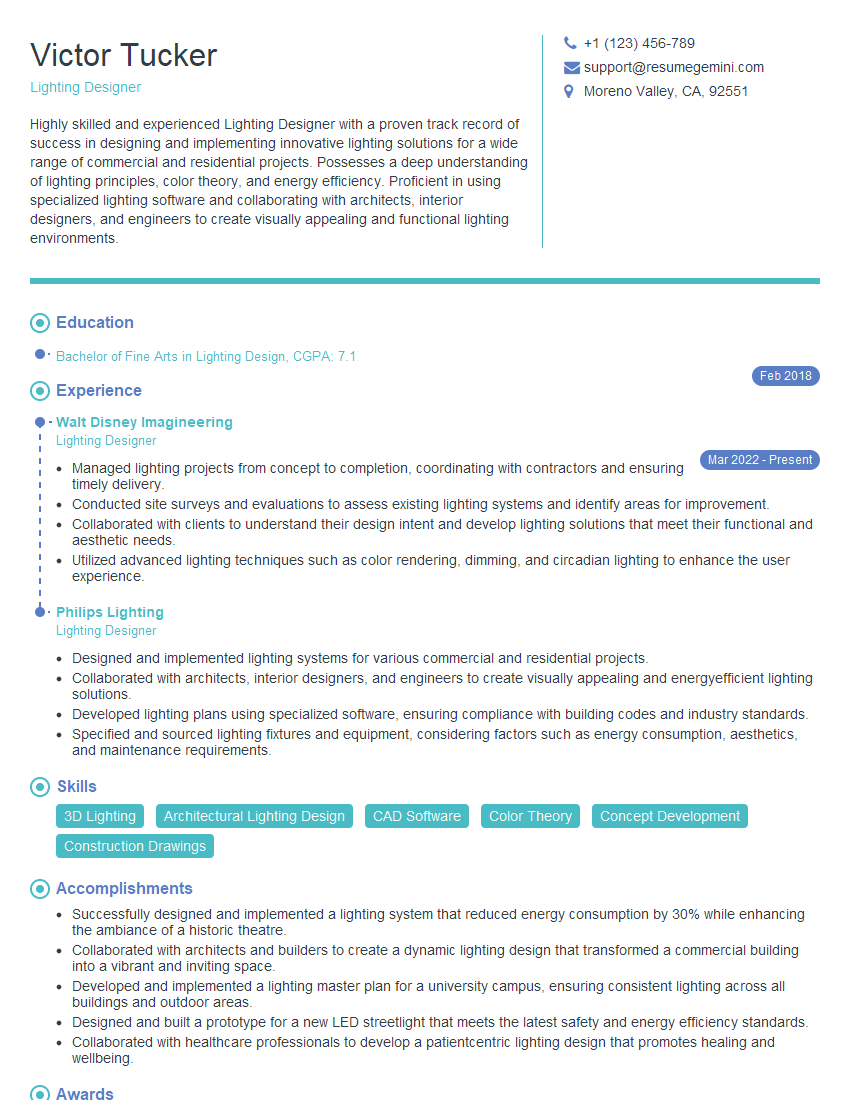
Mastering architectural lighting principles and demonstrating practical experience is crucial for career advancement in this exciting field. A strong resume is your first impression – make it count! Create an ATS-friendly resume that highlights your skills and accomplishments effectively. ResumeGemini is a trusted resource to help you build a professional and impactful resume. We provide examples of resumes tailored to architectural lighting experience to guide you through the process. Investing time in crafting a compelling resume significantly improves your job prospects. Let ResumeGemini help you shine!
Explore more articles
Users Rating of Our Blogs
Share Your Experience
We value your feedback! Please rate our content and share your thoughts (optional).
What Readers Say About Our Blog
To the interviewgemini.com Webmaster.
Very helpful and content specific questions to help prepare me for my interview!
Thank you
To the interviewgemini.com Webmaster.
This was kind of a unique content I found around the specialized skills. Very helpful questions and good detailed answers.
Very Helpful blog, thank you Interviewgemini team.