The thought of an interview can be nerve-wracking, but the right preparation can make all the difference. Explore this comprehensive guide to Experience in working with energy efficiency measures interview questions and gain the confidence you need to showcase your abilities and secure the role.
Questions Asked in Experience in working with energy efficiency measures Interview
Q 1. Explain the difference between energy efficiency and energy conservation.
While both energy efficiency and energy conservation aim to reduce energy consumption, they differ significantly in their approach. Energy efficiency focuses on doing more with less energy. It involves using technology and design to improve how efficiently we use energy. Think of it like getting more miles per gallon in your car – you’re using the same amount of fuel, but getting a better result. Energy conservation, on the other hand, focuses on using less energy overall. It emphasizes reducing energy demand by changing behavior and using less of an energy source. Think turning off lights when you leave a room or lowering your thermostat – you are actively consuming less energy.
For example, replacing an old incandescent light bulb with an LED bulb is energy efficiency (doing more with less energy because the LED bulb produces more light per watt). Turning off that same light bulb when leaving the room is energy conservation (using less energy altogether). Both contribute to energy savings, but their methods differ considerably.
Q 2. Describe your experience conducting energy audits.
I have extensive experience conducting energy audits for a diverse range of building types, including commercial offices, industrial facilities, and residential homes. My approach is always systematic and data-driven. It typically involves a thorough site visit to assess the building’s energy systems, including HVAC, lighting, and plug loads. This includes visually inspecting equipment, checking utility bills, and using energy-monitoring tools to capture real-time data. I then analyze this data using specialized software (discussed in a later answer) to pinpoint areas of energy waste. For example, during an audit of a commercial building, I identified significant energy losses due to inefficient HVAC system operation and poorly insulated windows. This led to recommendations for upgrading the HVAC controls, installing high-performance windows, and improving building envelope insulation.
Beyond the technical aspects, I place a strong emphasis on client communication and collaboration. Explaining findings clearly, tailoring recommendations to the client’s budget, and addressing their concerns are crucial for successful implementation of the energy-saving measures suggested.
Q 3. What energy efficiency technologies are you most familiar with?
My expertise encompasses a wide range of energy-efficient technologies. I’m highly familiar with:
- High-efficiency HVAC systems: Including variable refrigerant flow (VRF) systems, heat pumps, and geothermal systems.
- LED lighting: I’ve worked with various LED technologies, including smart lighting controls to optimize lighting schedules and reduce energy consumption.
- Building automation systems (BAS): Proficient in programming and troubleshooting BAS to optimize building operation and reduce energy waste.
- Building envelope improvements: This includes high-performance windows, improved insulation, and air sealing techniques.
- Renewable energy technologies: I have experience working with solar photovoltaic (PV) systems and wind turbines, assessing their feasibility and integration into existing systems.
My understanding extends beyond merely the technology itself; I’m well-versed in their lifecycle cost analysis, helping clients understand the long-term return on investment of these technologies.
Q 4. How do you identify and quantify energy savings opportunities?
Identifying and quantifying energy savings opportunities involves a multi-step process. It begins with a thorough data collection phase, analyzing utility bills, operational data, and conducting on-site measurements. Then, I use energy modeling software (detailed later) to simulate different scenarios and predict energy savings associated with proposed improvements. This process involves:
- Data Analysis: Identifying energy consumption patterns and pinpointing areas of high energy use.
- Energy Modeling: Using software to simulate various energy-efficiency upgrades and predict their impact on energy consumption.
- Cost-Benefit Analysis: Evaluating the cost of implementing the upgrades against the projected energy savings and other benefits, such as improved indoor environmental quality.
- Prioritization: Ranking potential energy-saving measures based on their cost-effectiveness and feasibility.
For instance, in one project, energy modeling revealed that replacing outdated HVAC equipment would yield the highest return on investment compared to other possible upgrades, guiding the client’s decision-making process.
Q 5. What software or tools do you use for energy modeling and analysis?
I routinely use several software and tools for energy modeling and analysis. These include:
- EnergyPlus: A widely used whole-building energy simulation program that allows for detailed modeling of building energy performance.
- eQuest: Another powerful energy modeling software commonly used for LEED certification.
- IES VE: A comprehensive software suite with features for energy modeling, daylighting analysis, and other building performance simulations.
- Data acquisition and monitoring systems: I frequently use data loggers and building management system (BMS) data to collect real-time energy usage information.
The choice of software depends on the project’s complexity and specific requirements. My proficiency across various platforms allows me to select the best tools for each project.
Q 6. Explain your understanding of building codes and energy standards (e.g., ASHRAE, IECC).
My understanding of building codes and energy standards, such as ASHRAE (American Society of Heating, Refrigerating and Air-Conditioning Engineers) and IECC (International Energy Conservation Code), is crucial to my work. I’m familiar with the latest requirements and best practices for energy-efficient building design and construction. This includes knowledge of:
- ASHRAE 90.1: This standard specifies minimum energy efficiency requirements for various building types.
- IECC: This code sets energy efficiency requirements for new construction and alterations. It’s adopted and enforced at the state and local levels, meaning its specific requirements can vary geographically.
- LEED (Leadership in Energy and Environmental Design): I understand LEED rating systems and how energy efficiency contributes to achieving different LEED certification levels.
I incorporate these standards into my energy audits and recommendations, ensuring that proposed improvements comply with all applicable regulations and best practices. This is vital for client compliance and maximizing the long-term benefits of the energy-efficiency measures.
Q 7. Describe your experience with commissioning and retro-commissioning.
I have significant experience in commissioning (Cx) and retro-commissioning (RCx) of building systems. Commissioning is the process of verifying that building systems are installed and operating according to the design intent. It ensures that systems are functioning optimally from the outset. Retro-commissioning, on the other hand, is a systematic process of identifying and correcting operational problems in existing buildings. It helps to optimize existing building systems to improve efficiency and reduce energy consumption.
My approach to both Cx and RCx includes a thorough review of design documents, on-site inspections of building systems, and performance testing. I use data analysis and advanced diagnostics to identify operational inefficiencies. For instance, during an RCx project, I discovered that a faulty control valve in an HVAC system was leading to significant energy waste. After correcting the valve issue, we achieved a substantial reduction in energy consumption and improved building comfort.
I view Cx and RCx as integral parts of any comprehensive energy efficiency strategy, as they ensure building systems are performing as intended and that energy-saving measures are producing their expected results.
Q 8. How do you prioritize energy efficiency projects based on ROI?
Prioritizing energy efficiency projects based on Return on Investment (ROI) is crucial for maximizing resource allocation. We calculate ROI by comparing the cost of implementing a measure against the savings it generates over its lifetime. A higher ROI indicates a more financially attractive project.
My approach involves a multi-step process:
- Data Collection: Gathering comprehensive data on energy consumption, costs, and potential savings for each project. This includes analyzing utility bills, performing energy audits, and using energy modeling software.
- ROI Calculation: For each project, we calculate the net present value (NPV) and internal rate of return (IRR). NPV considers the time value of money, while IRR represents the discount rate that makes the NPV zero. Simple payback period is also considered, showing how quickly the initial investment is recouped.
- Risk Assessment: We evaluate potential risks associated with each project, such as technological uncertainty, implementation challenges, and market volatility. These risks are factored into the ROI calculation, adjusting the expected returns accordingly. For instance, a project with high technological risk might require a higher ROI threshold for approval.
- Prioritization: We rank projects based on their ROI, NPV, and IRR, considering the risk profile. Projects with higher ROI and lower risk are typically prioritized. We might also consider strategic alignment – for instance, a project with slightly lower ROI might be prioritized if it aligns with broader sustainability goals.
- Sensitivity Analysis: Finally, we conduct a sensitivity analysis to assess how changes in key assumptions (e.g., energy prices, equipment lifespan) affect the ROI. This helps us understand the robustness of our projections and make more informed decisions.
For example, in a recent project, we compared installing LED lighting versus upgrading HVAC systems. While the HVAC upgrade had a higher upfront cost, its significantly larger long-term energy savings resulted in a substantially higher overall ROI, making it the higher priority project despite the initial investment.
Q 9. How do you communicate technical information to non-technical audiences?
Communicating complex technical information to non-technical audiences requires clear, concise language and the use of visuals. I avoid jargon and technical terms whenever possible, replacing them with simple analogies and relatable examples.
My strategies include:
- Visual Aids: I use charts, graphs, and infographics to present data in an easily digestible format. A well-designed infographic can convey complex information much more effectively than dense paragraphs of text.
- Storytelling: I frame technical information within a narrative context, using real-world examples and case studies to illustrate key concepts. For instance, instead of explaining the principles of heat transfer, I might describe how better insulation in a building can reduce energy costs and improve comfort.
- Analogies and Metaphors: I use simple analogies to explain complex ideas. For example, I might compare electricity flow to water flowing through pipes to help people understand concepts like voltage and current.
- Interactive Presentations: Engaging presentations with Q&A sessions allow for immediate clarification and feedback. Demonstrations or hands-on activities can further enhance understanding.
- Tailoring the Message: I adapt my communication style to the audience’s level of understanding and their specific interests. A presentation to executives will focus on high-level financial impacts, while a presentation to maintenance staff might emphasize operational considerations.
For example, when explaining the benefits of a building automation system to a building owner, I might start with a simple analogy: “Think of it like a smart thermostat for your entire building – it automatically adjusts heating and cooling based on occupancy and weather, saving you money and improving efficiency.”
Q 10. Describe a time you had to overcome a challenge in an energy efficiency project.
In one project, we aimed to implement a comprehensive energy management system (EMS) in a large manufacturing facility. We encountered significant resistance from the plant floor supervisors who were concerned about the system’s complexity and potential disruption to their daily operations. They were accustomed to their existing, less efficient, methods and wary of change.
To overcome this, we implemented a phased approach:
- Pilot Program: We started with a pilot program in a smaller section of the plant, demonstrating the system’s capabilities and addressing specific concerns. This allowed us to showcase immediate benefits and build trust.
- Training and Support: We provided extensive training to the plant floor staff, ensuring they understood how to use the system effectively and were comfortable troubleshooting minor issues. We also established a dedicated support team to assist them.
- Data Visualization: We created clear dashboards that presented energy consumption data in an easy-to-understand format, enabling supervisors to monitor progress and identify areas for improvement. This helped to demonstrate the value of the system in a tangible way.
- Continuous Feedback: We maintained open communication with the plant floor staff, soliciting their feedback and incorporating their suggestions into the system’s implementation. This fostered a sense of ownership and commitment.
By actively addressing concerns, providing adequate training, and demonstrating the system’s value, we successfully overcame initial resistance and achieved significant energy savings. The project ultimately delivered a much higher ROI than initially projected due to the increased buy-in from the staff.
Q 11. What are some common barriers to implementing energy efficiency measures?
Several common barriers hinder the implementation of energy efficiency measures. These include:
- Upfront Costs: The initial investment for energy efficiency upgrades can be substantial, often deterring organizations with limited budgets. This is especially true for large-scale projects.
- Lack of Awareness: Many organizations lack awareness of the available energy efficiency technologies and their potential benefits. This can lead to missed opportunities for cost savings and improved sustainability.
- Payback Period Concerns: Organizations may be hesitant to invest in measures with long payback periods, even if the long-term savings are significant. This requires strong financial modeling and communication to address.
- Operational Challenges: Implementing energy efficiency measures can disrupt ongoing operations, leading to temporary production losses or other inconveniences. Careful planning and communication are vital to minimize such disruptions.
- Lack of Skilled Workforce: There may be a shortage of skilled personnel to design, install, and maintain energy efficiency equipment. This can delay project implementation and increase costs.
- Regulatory and Policy Barriers: Regulatory hurdles, unclear energy codes, or lack of government incentives can impede the adoption of energy efficiency measures.
- Data Availability: Lack of reliable energy consumption data can make it difficult to identify areas for improvement and assess the effectiveness of implemented measures.
Addressing these barriers requires a multi-faceted approach involving financial incentives, educational programs, technical assistance, and strong policy support.
Q 12. How do you ensure the accuracy and reliability of your energy data?
Ensuring the accuracy and reliability of energy data is critical for effective energy management. This involves a combination of meticulous data collection, verification, and analysis.
My approach includes:
- Metering and Monitoring: Implementing accurate metering systems to capture energy consumption at various points within the facility. This includes installing smart meters and utilizing data acquisition systems to capture data automatically.
- Data Validation: Regularly verifying the accuracy of metering data by comparing it with utility bills and historical consumption patterns. Identifying and investigating any significant discrepancies.
- Data Cleaning: Cleaning and correcting the data to remove errors, outliers, and inconsistencies. This often involves using statistical methods and data quality checks.
- Calibration and Maintenance: Regular calibration and maintenance of metering equipment to ensure continued accuracy. This is critical for long-term data reliability.
- Data Storage and Management: Using secure and efficient data storage and management systems to ensure data integrity and accessibility. This includes utilizing database systems and cloud-based platforms.
- Benchmarking: Comparing energy consumption data against similar facilities or industry benchmarks to identify areas for improvement. This helps to put your energy usage in context.
For instance, we might use statistical process control (SPC) charts to monitor energy consumption and identify anomalies that might indicate equipment malfunction or other issues. This proactive approach helps ensure that energy data remains reliable and supports informed decision-making.
Q 13. Explain your understanding of life-cycle cost analysis.
Life-cycle cost analysis (LCCA) is a method for evaluating the total cost of ownership of an asset or system over its entire lifespan. This goes beyond just the initial purchase price, considering all costs associated with operation, maintenance, repair, and eventual disposal or replacement.
LCCA considers several key elements:
- Initial Investment Costs: The costs associated with purchasing and installing the asset.
- Operational and Maintenance Costs: The ongoing costs of operating and maintaining the asset, including energy consumption, labor, and materials.
- Repair and Replacement Costs: The costs associated with repairing or replacing components of the asset during its lifespan.
- Disposal Costs: The costs associated with properly disposing of the asset at the end of its useful life.
- Discount Rate: A rate used to discount future costs to their present value, reflecting the time value of money.
We use LCCA to compare the total costs of different options, enabling informed decisions. For example, a more expensive piece of equipment with higher energy efficiency might have a lower overall LCCA than a less expensive, less efficient alternative, due to lower long-term operational costs. It helps avoid the “penny-wise, pound-foolish” approach where the initial savings are dwarfed by higher long-term costs.
Q 14. What are some best practices for energy management in industrial settings?
Best practices for energy management in industrial settings involve a holistic approach encompassing technology, processes, and people:
- Energy Audits and Assessments: Regular energy audits to identify areas of energy waste and prioritize improvement projects. This could involve infrared thermography, blower door tests, and detailed energy modeling.
- Process Optimization: Improving the efficiency of industrial processes to minimize energy consumption. This may involve streamlining production workflows, optimizing equipment settings, and improving material handling.
- Equipment Upgrades: Replacing outdated and inefficient equipment with more energy-efficient alternatives, including motors, compressors, and lighting. Consider variable speed drives for improved motor efficiency.
- Building Envelope Improvements: Improving the building envelope to reduce heat loss or gain, through insulation, air sealing, and improved window glazing.
- Waste Heat Recovery: Recovering waste heat from industrial processes and using it for other purposes, such as space heating or process heating.
- Building Automation Systems (BAS): Implementing a BAS to monitor and control energy consumption in real-time. This allows for automated adjustments based on occupancy, weather conditions, and other factors.
- Employee Training and Engagement: Educating employees about energy efficiency best practices and empowering them to identify and report energy waste. A culture of energy conservation is crucial.
- Data Monitoring and Analysis: Continuously monitoring energy consumption data and analyzing trends to identify opportunities for improvement. Key performance indicators (KPIs) are essential for tracking progress and measuring success.
In summary, a successful energy management strategy in an industrial setting requires a blend of technological upgrades, process optimization, employee engagement, and robust data-driven decision-making. It’s a continuous improvement process that requires commitment and dedication.
Q 15. How do you stay up-to-date with the latest energy efficiency technologies and trends?
Staying current in the rapidly evolving field of energy efficiency requires a multi-pronged approach. I leverage several key strategies to ensure I’m always abreast of the latest technologies and trends.
- Professional Organizations and Conferences: Active membership in organizations like ASHRAE (American Society of Heating, Refrigerating and Air-Conditioning Engineers) and attendance at industry conferences provide access to cutting-edge research, best practices, and networking opportunities with leading experts. For example, I recently attended a conference on smart building technologies and learned about the latest advancements in building automation systems that optimize energy consumption.
- Industry Publications and Journals: I regularly read leading publications such as Energy Efficiency Magazine and peer-reviewed journals to stay informed on the latest research findings and technological breakthroughs. This allows me to critically evaluate new technologies and determine their practical applicability.
- Online Resources and Webinars: I utilize online resources, such as the websites of the Department of Energy (DOE) and Environmental Protection Agency (EPA), as well as industry-specific webinars, to access a wide range of information on energy efficiency policies, incentives, and emerging technologies. Recently, a webinar on the implementation of renewable energy sources in commercial buildings greatly expanded my knowledge in that area.
- Continuing Education: I actively participate in continuing education courses and workshops to maintain and enhance my expertise in energy efficiency. This ensures that I am proficient in utilizing the most up-to-date tools and methodologies.
This combined approach ensures that I remain at the forefront of this dynamic field, enabling me to provide the most effective and innovative solutions for my clients.
Career Expert Tips:
- Ace those interviews! Prepare effectively by reviewing the Top 50 Most Common Interview Questions on ResumeGemini.
- Navigate your job search with confidence! Explore a wide range of Career Tips on ResumeGemini. Learn about common challenges and recommendations to overcome them.
- Craft the perfect resume! Master the Art of Resume Writing with ResumeGemini’s guide. Showcase your unique qualifications and achievements effectively.
- Don’t miss out on holiday savings! Build your dream resume with ResumeGemini’s ATS optimized templates.
Q 16. What is your experience with energy performance contracts (EPCs)?
Energy Performance Contracts (EPCs) are a financing mechanism where energy efficiency improvements are paid for through the guaranteed energy savings they generate. I have extensive experience in all aspects of EPCs, from initial feasibility studies and energy audits to project implementation and performance verification.
My experience includes:
- Developing detailed EPC proposals: This involves conducting thorough energy audits, identifying cost-effective measures, developing financial models to demonstrate guaranteed savings, and negotiating favorable contract terms.
- Managing EPC projects: I have overseen numerous EPC projects, from smaller-scale retrofits to large-scale facility upgrades, ensuring projects are completed on time and within budget while meeting the guaranteed savings targets. For instance, I successfully managed an EPC project for a large manufacturing facility, resulting in a 20% reduction in energy consumption.
- Performance verification and reporting: I use sophisticated measurement and verification (M&V) techniques to accurately track energy savings and demonstrate the success of the implemented measures. This often involves collecting and analyzing energy consumption data, adjusting for external factors, and preparing comprehensive reports for stakeholders.
My success with EPCs stems from a strong understanding of energy efficiency technologies, financial modeling, and project management, as well as a commitment to building strong relationships with clients and contractors.
Q 17. Describe your experience with different types of energy audits (e.g., walk-through, detailed).
Energy audits are crucial for identifying energy-saving opportunities. I’m experienced in both walk-through and detailed audits, understanding their strengths and limitations.
Walk-through audits are a quick, cost-effective assessment of a building’s energy use, identifying low-hanging fruit. They involve visually inspecting the building’s systems and identifying obvious inefficiencies. For example, identifying missing weather stripping around doors or malfunctioning HVAC equipment. This is suitable for preliminary evaluations or smaller properties.
Detailed audits are more comprehensive, involving detailed data collection and analysis. This includes reviewing utility bills, inspecting equipment, and potentially using specialized equipment to measure energy flows. For example, using infrared cameras to identify thermal leaks or blower door tests to measure building airtightness. These are best for larger facilities or when aiming for significant energy savings. A detailed audit can uncover hidden problems that a walk-through might miss, such as faulty insulation or inefficient lighting systems.
I tailor the audit type to the client’s needs and budget, always ensuring the appropriate level of detail is achieved to identify and quantify the potential energy savings effectively.
Q 18. How do you measure and verify energy savings?
Measuring and verifying energy savings is crucial to demonstrate the success of implemented energy efficiency measures. This is typically done using Measurement and Verification (M&V) protocols, often following the IPMVP (International Performance Measurement and Verification Protocol).
My approach includes:
- Establishing a baseline: Accurately measuring energy consumption before implementing any measures. This involves collecting historical utility data and normalizing it to account for variations in weather, occupancy, and operational changes.
- Implementing the energy efficiency measures: This may include anything from installing LED lighting to upgrading HVAC equipment.
- Monitoring energy consumption post-implementation: This involves collecting post-implementation data, often using automated data logging systems. It is important to continue collecting baseline data for a period after improvements are made to ensure accurate comparison.
- Analyzing data and calculating savings: This involves comparing pre- and post-implementation data, accounting for external factors and using appropriate statistical methods to isolate the impact of the efficiency measures. Often, regression analysis is used to account for varying weather impacts on energy use.
- Reporting results: Preparing comprehensive reports that clearly demonstrate the achieved energy savings, highlighting the return on investment.
I utilize various M&V methods depending on the project’s complexity, such as the before-and-after method for simpler projects or the calibrated energy modeling approach for more complex scenarios.
Q 19. Explain your understanding of different energy efficiency financing mechanisms.
Energy efficiency projects often require significant upfront investment. Several financing mechanisms can help overcome this barrier.
- Energy Performance Contracts (EPCs): As discussed earlier, these contracts pay for improvements through guaranteed energy savings. This eliminates upfront costs for the client.
- Utility Rebates and Incentives: Many utility companies offer rebates and incentives to encourage energy efficiency improvements. These can significantly reduce the project cost.
- Government Grants and Loans: Various government agencies offer grants and low-interest loans for energy efficiency upgrades. These programs can provide crucial financial support.
- Tax Credits and Deductions: Several tax incentives are available at the federal and state levels for investing in energy-efficient technologies. These can substantially lower the tax burden for the client.
- Green Bonds and Private Investment: These financing options are gaining traction, offering alternative avenues for funding energy efficiency projects.
I am familiar with these options and help clients navigate the complexities of securing funding, ensuring the most suitable approach is chosen based on the project’s characteristics and the client’s financial situation. For example, I recently helped a client secure a combination of utility rebates and a low-interest loan to fund a comprehensive energy efficiency retrofit of their office building.
Q 20. What is your experience with energy data visualization and reporting?
Effective energy data visualization and reporting are crucial for communicating project progress, identifying areas for improvement, and demonstrating the value of energy efficiency investments. My experience encompasses the use of various tools and techniques to achieve this.
I use software such as Excel, specialized energy management systems (EMS), and data visualization platforms like Tableau or Power BI to create insightful reports and dashboards. These tools enable me to transform raw energy data into actionable insights. For instance, I might create a dashboard showing real-time energy consumption, identifying peak usage periods, and highlighting areas where significant savings can be achieved.
My reports typically include:
- Clear visualizations of energy consumption patterns: Using charts and graphs to illustrate trends over time.
- Key performance indicators (KPIs): Such as energy consumption per square foot, energy cost savings, and return on investment.
- Benchmarking data: Comparing the client’s energy performance against industry standards or similar facilities.
- Recommendations for further improvements: Based on the data analysis and visualization.
These reports are tailored to the specific needs and technical understanding of the audience, ensuring that the information is both accurate and readily understandable. This effective communication is key to sustaining client engagement and securing buy-in for further efficiency initiatives.
Q 21. How do you incorporate sustainability into your energy efficiency projects?
Sustainability is an integral part of my approach to energy efficiency. It’s not just about saving energy but reducing the overall environmental impact of buildings and operations. I incorporate sustainability in the following ways:
- Promoting renewable energy sources: Integrating solar photovoltaic (PV) systems, wind turbines, or other renewable energy sources to reduce reliance on fossil fuels. This not only reduces carbon emissions but also often lowers operating costs in the long run.
- Reducing water consumption: Implementing water-efficient fixtures and systems, and using rainwater harvesting techniques. Water conservation is intrinsically linked to energy efficiency, particularly in areas like heating and cooling.
- Using sustainable building materials: Specifying materials with low embodied carbon, such as recycled content materials or sustainably harvested timber. This reduces the overall environmental footprint of the building throughout its lifecycle.
- Waste management and recycling: Implementing strategies for waste reduction, reuse, and recycling during construction and building operation.
- Considering the whole lifecycle: Assessing the environmental impacts of energy efficiency measures throughout their entire lifecycle, from manufacturing and installation to decommissioning and disposal. This incorporates a life-cycle assessment approach to ensure environmentally responsible decisions.
By integrating these considerations into every project, I aim to create buildings and systems that are not only energy-efficient but also environmentally responsible and contribute to a more sustainable future. For example, a recent project involved upgrading a building’s lighting to LEDs and incorporating solar panels, resulting in significant reductions in both energy consumption and carbon emissions.
Q 22. What are the key performance indicators (KPIs) you use to track energy efficiency progress?
Tracking energy efficiency progress requires a robust set of Key Performance Indicators (KPIs). These metrics provide quantifiable data to measure the success of implemented measures and inform future strategies. We typically focus on a combination of energy consumption KPIs, cost savings KPIs, and operational KPIs.
- Energy Consumption KPIs: These directly measure reductions in energy use. Examples include kilowatt-hour (kWh) reduction per square foot, percentage reduction in total energy consumption year-over-year, and changes in energy intensity (kWh/unit of production).
- Cost Savings KPIs: These track the financial benefits of energy efficiency improvements. Examples include total cost savings in dollars, return on investment (ROI) of implemented measures, and payback period.
- Operational KPIs: These assess the impact of energy efficiency measures on building operations. Examples include reduction in equipment downtime, improvement in indoor environmental quality (IEQ) metrics like temperature consistency, and increased occupant satisfaction scores.
For instance, in a recent project involving a large office building, we tracked kWh/square foot reduction alongside the ROI of LED lighting upgrades. This dual approach allowed us to demonstrate both the environmental and financial benefits to stakeholders.
Q 23. Describe your experience with energy modeling software (e.g., EnergyPlus, eQuest).
I have extensive experience using energy modeling software, primarily EnergyPlus and eQuest. These tools are invaluable for simulating building performance under different scenarios and optimizing energy efficiency strategies. My experience spans from creating detailed building models – inputting geometry, materials, HVAC systems, and schedules – to running simulations and analyzing the results to identify areas for improvement.
For example, in one project, we used EnergyPlus to model the impact of different window glazing options on a new hospital design. The simulations revealed that high-performance glazing significantly reduced heating and cooling loads, leading to substantial energy savings and a smaller HVAC system. This saved the client considerable capital costs and reduced long-term operational expenses.
Beyond simple simulations, I’m proficient in using these tools for more complex analyses like life-cycle cost assessments and parametric studies, which allow us to explore a range of design choices and identify the most cost-effective solutions.
Q 24. How do you manage stakeholder expectations in energy efficiency projects?
Managing stakeholder expectations is crucial for successful energy efficiency projects. It involves clear communication, realistic goal setting, and proactive problem-solving. I approach this by:
- Setting clear and achievable goals: We collaborate with stakeholders early on to establish realistic targets based on a thorough assessment of the building’s energy use and potential for improvement. This prevents unrealistic expectations and ensures buy-in from everyone involved.
- Regular communication and reporting: We provide regular updates on project progress, including key performance indicators (KPIs), challenges encountered, and solutions implemented. Transparency builds trust and allows us to address concerns promptly.
- Addressing concerns proactively: We anticipate potential challenges and develop mitigation strategies. For example, if a measure requires significant upfront investment, we clearly articulate the long-term cost savings and ROI to address concerns about initial expenses.
- Celebrating successes: Highlighting milestones achieved and showcasing the positive impact of the project reinforces the value of energy efficiency and maintains stakeholder enthusiasm.
In one instance, we had to manage expectations regarding a significant boiler upgrade. By clearly demonstrating the long-term ROI through detailed financial modeling and emphasizing the improved reliability and reduced maintenance costs, we successfully secured stakeholder approval, even though the upfront investment was substantial.
Q 25. What is your experience with building automation systems (BAS)?
My experience with Building Automation Systems (BAS) includes design integration, programming, and optimization. BAS are essential for monitoring and controlling building systems, providing real-time data on energy consumption and allowing for adjustments to optimize performance.
I’ve worked with various BAS platforms, including Tridium Niagara, Schneider Electric, and Siemens. My experience includes developing control sequences to optimize HVAC operations, lighting schedules, and other building systems based on occupancy and environmental conditions. This often involves integrating data from various sensors and devices to create a holistic view of building performance.
For example, in a recent project, we integrated a new BAS with existing building systems. Through careful programming and optimization, we achieved a significant reduction in energy consumption by implementing demand-based ventilation and optimized lighting controls. The improved system also provided valuable data for ongoing monitoring and performance analysis.
Q 26. Explain your understanding of different energy efficiency standards and certifications.
My understanding of energy efficiency standards and certifications is comprehensive. I’m familiar with various national and international standards, such as LEED (Leadership in Energy and Environmental Design), BREEAM (Building Research Establishment Environmental Assessment Method), and Energy Star. These standards provide frameworks for designing, constructing, and operating energy-efficient buildings.
LEED, for example, provides a point-based system that rewards projects for incorporating various energy-efficient measures, such as high-performance building envelopes, efficient HVAC systems, and renewable energy sources. Energy Star offers a rating system for appliances and buildings, providing a benchmark for energy performance. Understanding these standards is critical for designing and implementing projects that meet specific requirements and achieve certification.
I also have experience with local building codes and regulations, which often incorporate energy efficiency requirements. This understanding is crucial for ensuring compliance and achieving optimal energy performance within regulatory frameworks.
Q 27. How do you evaluate the environmental impact of energy efficiency projects?
Evaluating the environmental impact of energy efficiency projects goes beyond simple energy savings. We use a life cycle assessment (LCA) approach to account for the environmental impacts of materials, manufacturing, construction, operation, and disposal of building components and systems. This holistic perspective provides a complete picture of the environmental benefits.
For instance, while installing energy-efficient lighting may reduce operational energy consumption, we also consider the environmental impact of manufacturing and disposing of the lighting fixtures. Using LCA tools, we can compare different options, such as LED versus fluorescent lighting, to identify the most environmentally preferable choice considering both operational and embodied energy.
We also quantify greenhouse gas emissions reduction, which is a key indicator of a project’s climate impact. This data is essential for demonstrating the environmental benefits of energy efficiency projects and meeting sustainability goals.
Q 28. Describe your experience with developing and implementing energy management plans.
Developing and implementing energy management plans involves a systematic approach to identifying opportunities for energy savings, prioritizing measures, and tracking performance. I typically follow a phased approach:
- Energy Audit and Assessment: This initial phase involves a thorough analysis of the building’s energy use, identifying areas of high consumption and potential for improvement.
- Energy Efficiency Measures Identification: Based on the audit findings, we identify potential energy efficiency measures, considering factors such as cost-effectiveness, feasibility, and environmental impact.
- Plan Development: We develop a comprehensive energy management plan outlining prioritized measures, timelines, responsibilities, and budget allocation.
- Implementation: This phase involves implementing the selected energy efficiency measures, ensuring proper installation and commissioning.
- Monitoring and Verification: Ongoing monitoring of energy consumption, coupled with regular reporting and verification, is critical for evaluating the effectiveness of implemented measures and identifying any needed adjustments.
For example, in a recent project involving a manufacturing facility, we developed an energy management plan that included implementing energy-efficient motors, optimizing HVAC controls, and implementing a building automation system. The plan resulted in a significant reduction in energy consumption and operational costs, exceeding the initial projections.
Key Topics to Learn for Experience in working with Energy Efficiency Measures Interview
- Energy Audits and Assessments: Understanding the process of conducting energy audits, identifying energy waste, and analyzing energy consumption patterns in buildings or industrial processes. Practical application: Interpreting energy audit reports and proposing cost-effective solutions.
- Building Envelope Improvements: Knowledge of insulation materials, window technologies, air sealing techniques, and their impact on energy efficiency. Practical application: Evaluating the effectiveness of different building envelope upgrades and calculating potential energy savings.
- HVAC Systems and Optimization: Familiarity with different HVAC systems (heating, ventilation, and air conditioning), their operation, and maintenance best practices for maximizing energy efficiency. Practical application: Troubleshooting common HVAC issues and recommending energy-efficient upgrades or replacements.
- Lighting Technologies and Controls: Understanding various lighting technologies (LED, CFL, etc.), their energy efficiency ratings, and the benefits of smart lighting controls. Practical application: Designing energy-efficient lighting systems for different spaces and calculating return on investment (ROI).
- Renewable Energy Integration: Knowledge of renewable energy sources (solar, wind, geothermal) and their integration into buildings or industrial facilities. Practical application: Evaluating the feasibility and cost-effectiveness of incorporating renewable energy systems.
- Energy Management Systems (EMS): Understanding the role of EMS in monitoring and controlling energy consumption. Practical application: Utilizing data from EMS to identify areas for improvement and optimize energy usage.
- Legislation and Regulations: Awareness of relevant energy efficiency standards, codes, and regulations. Practical application: Ensuring compliance with applicable regulations and leveraging incentives for energy efficiency projects.
- Life Cycle Cost Analysis (LCCA): Ability to perform LCCA to compare the total cost of ownership of different energy efficiency measures over their lifetime. Practical application: Justifying energy efficiency investments based on long-term cost savings.
Next Steps
Mastering energy efficiency measures is crucial for a successful career in a sustainable and increasingly energy-conscious world. Demonstrating this expertise through a well-crafted resume is key to unlocking exciting opportunities. An ATS-friendly resume is essential for getting your application noticed by recruiters. ResumeGemini can help you create a professional and impactful resume that highlights your skills and experience in this field. Examples of resumes tailored to experience in working with energy efficiency measures are available to guide your resume creation process.
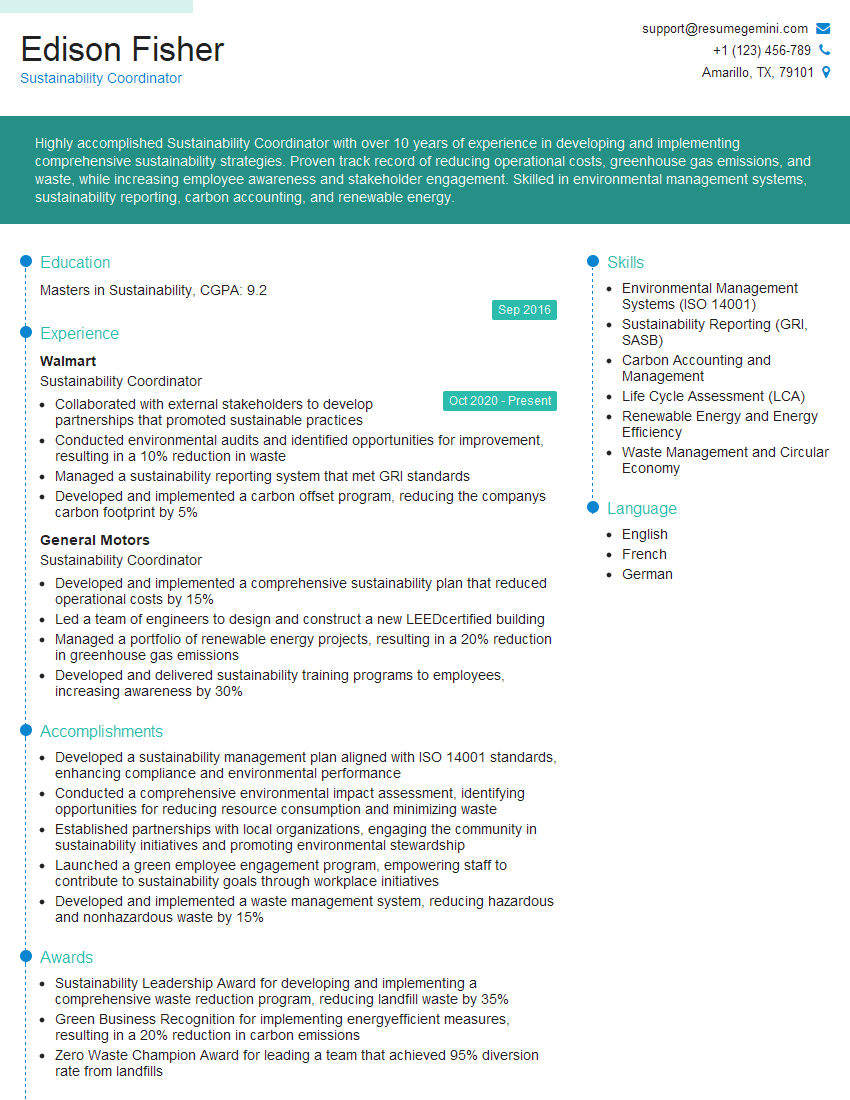
Sustainability Coordinator Resume Sample
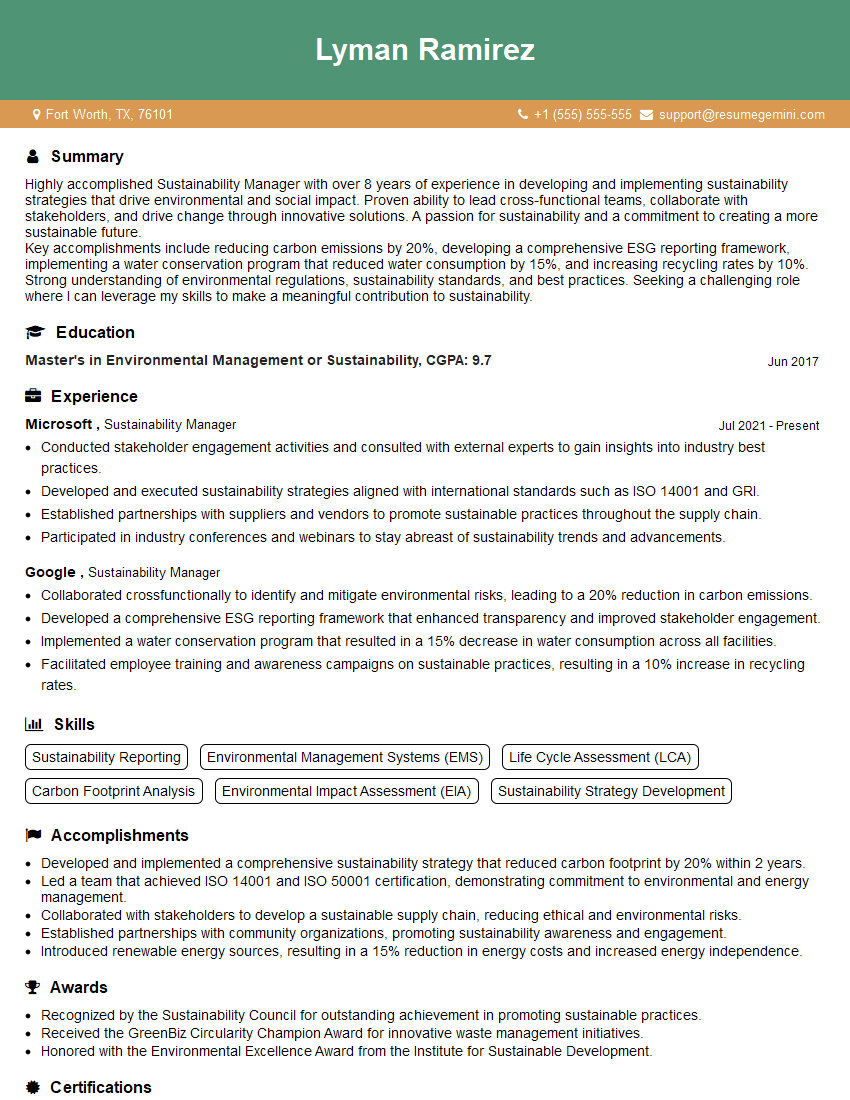
Sustainability Manager Resume Sample
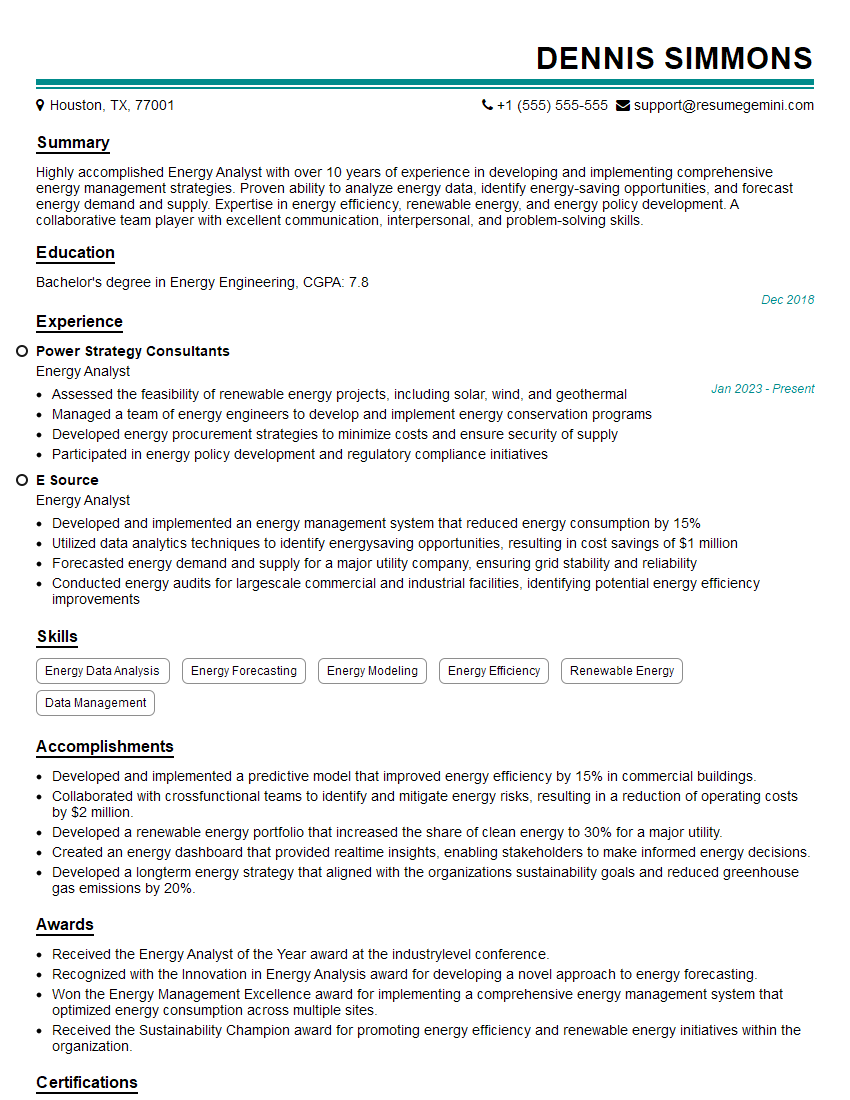
Energy Analyst Resume Sample
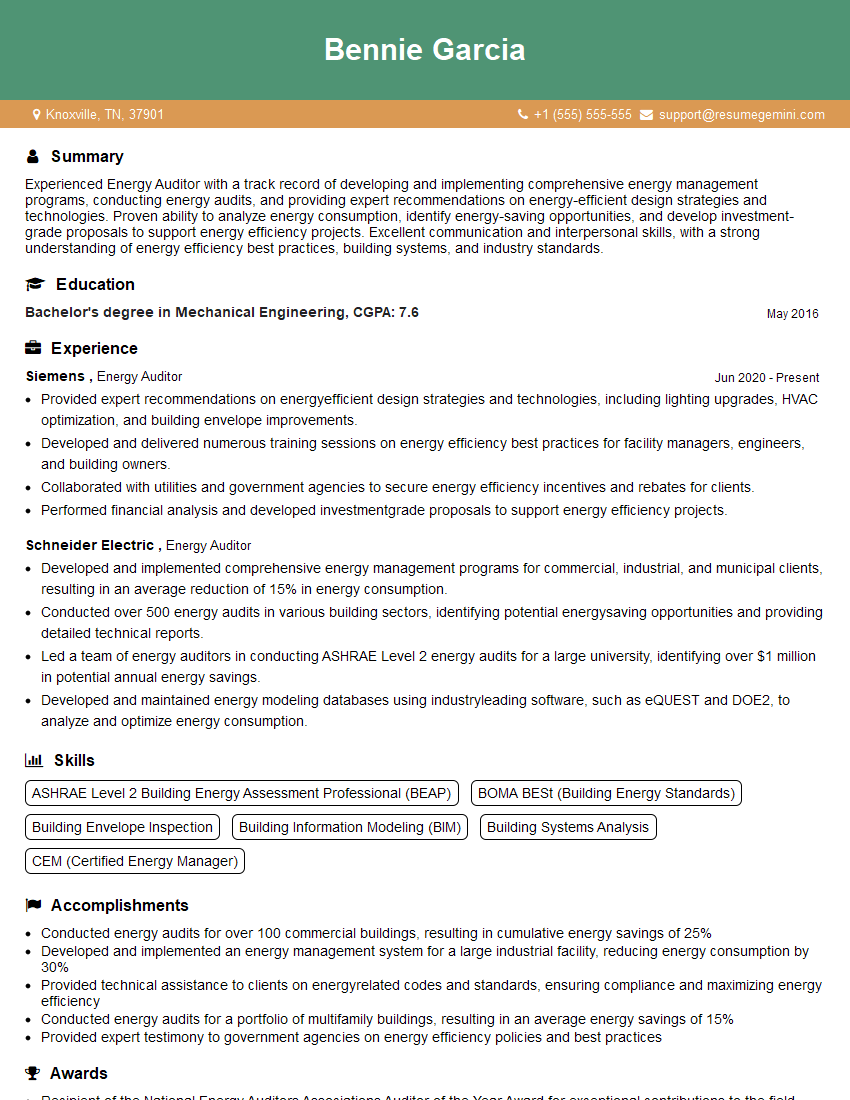
Energy Auditor Resume Sample
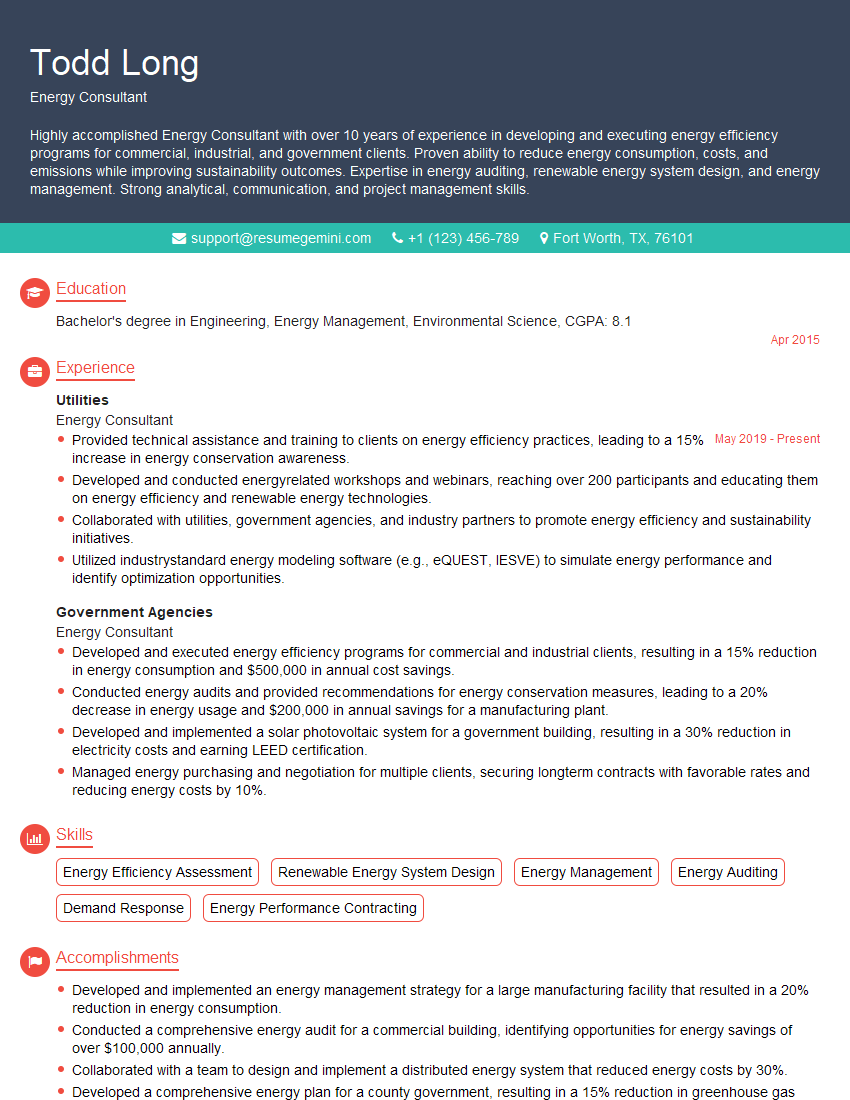
Energy Consultant Resume Sample
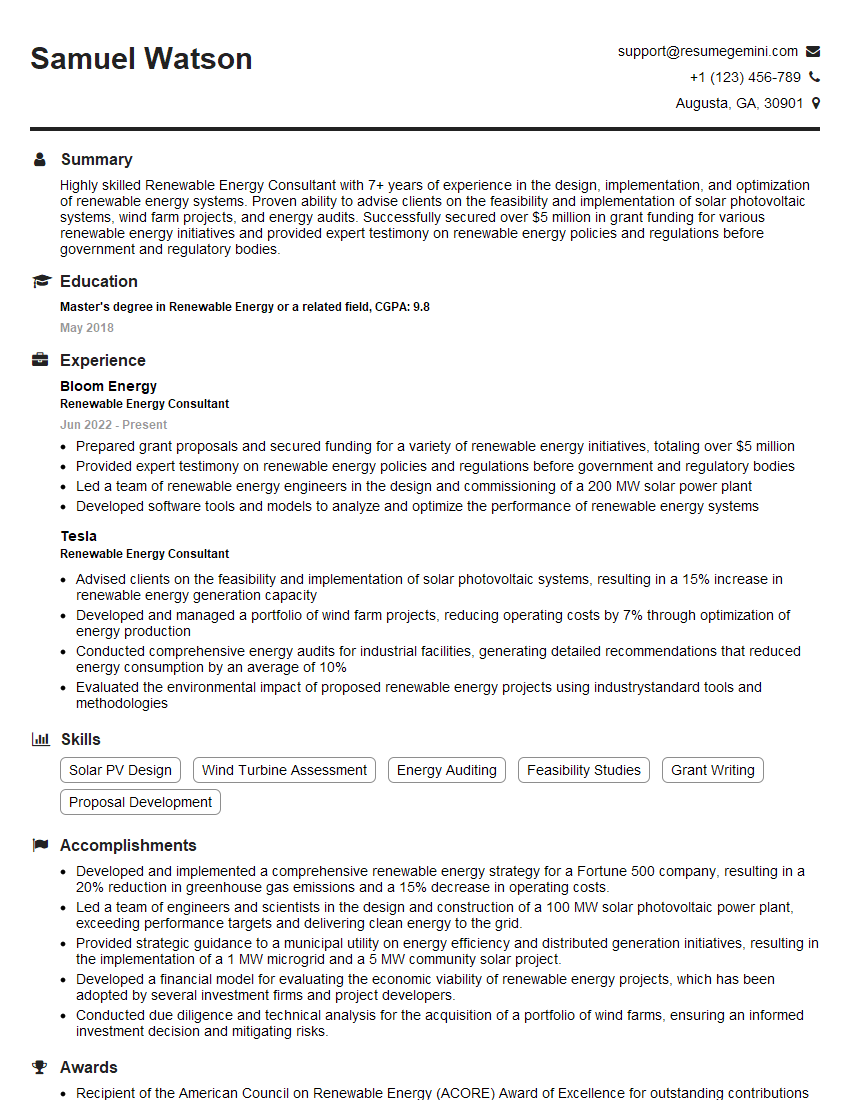
Renewable Energy Consultant Resume Sample

Sustainability Consultant Resume Sample
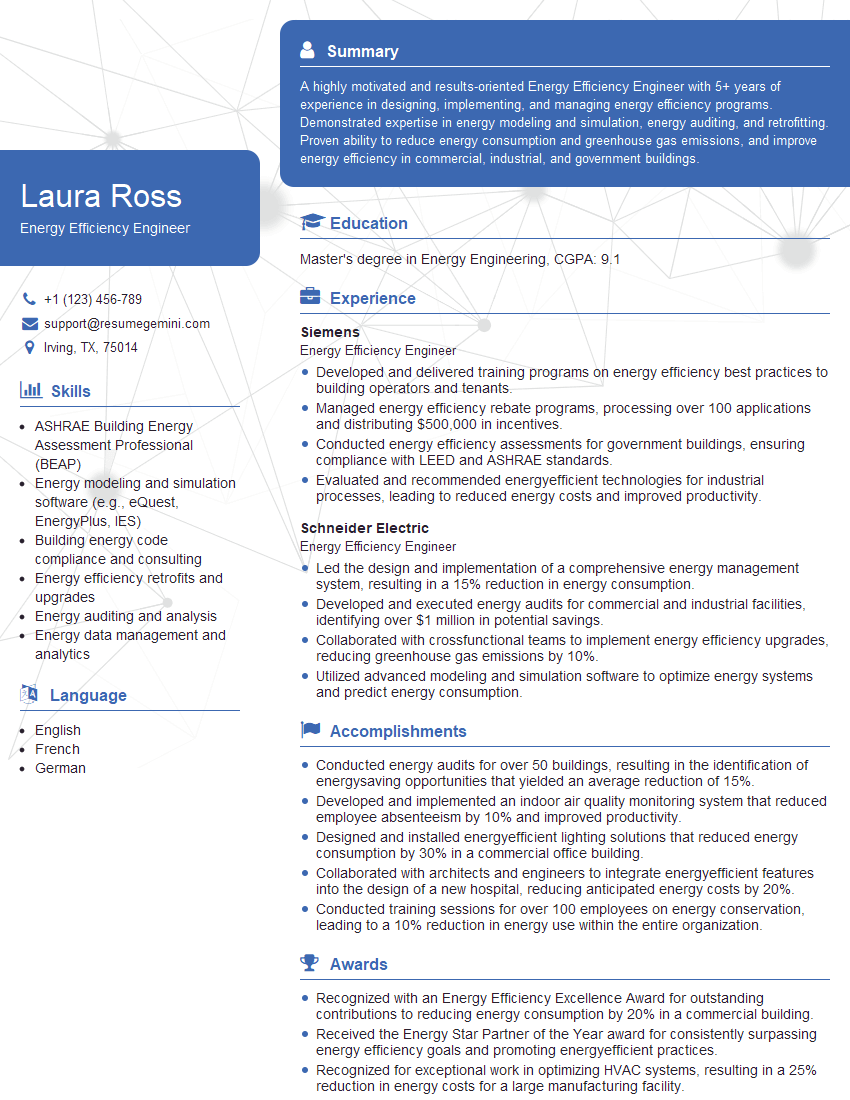
Energy Efficiency Engineer Resume Sample
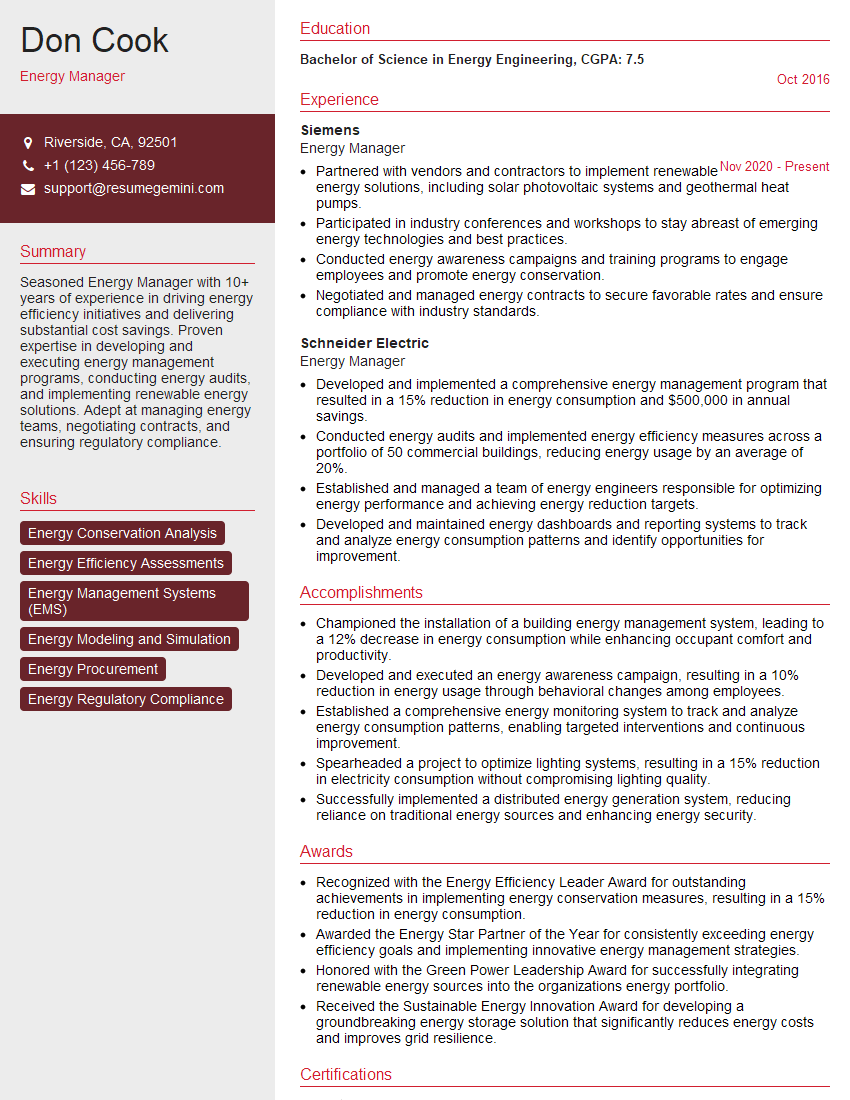
Energy Manager Resume Sample
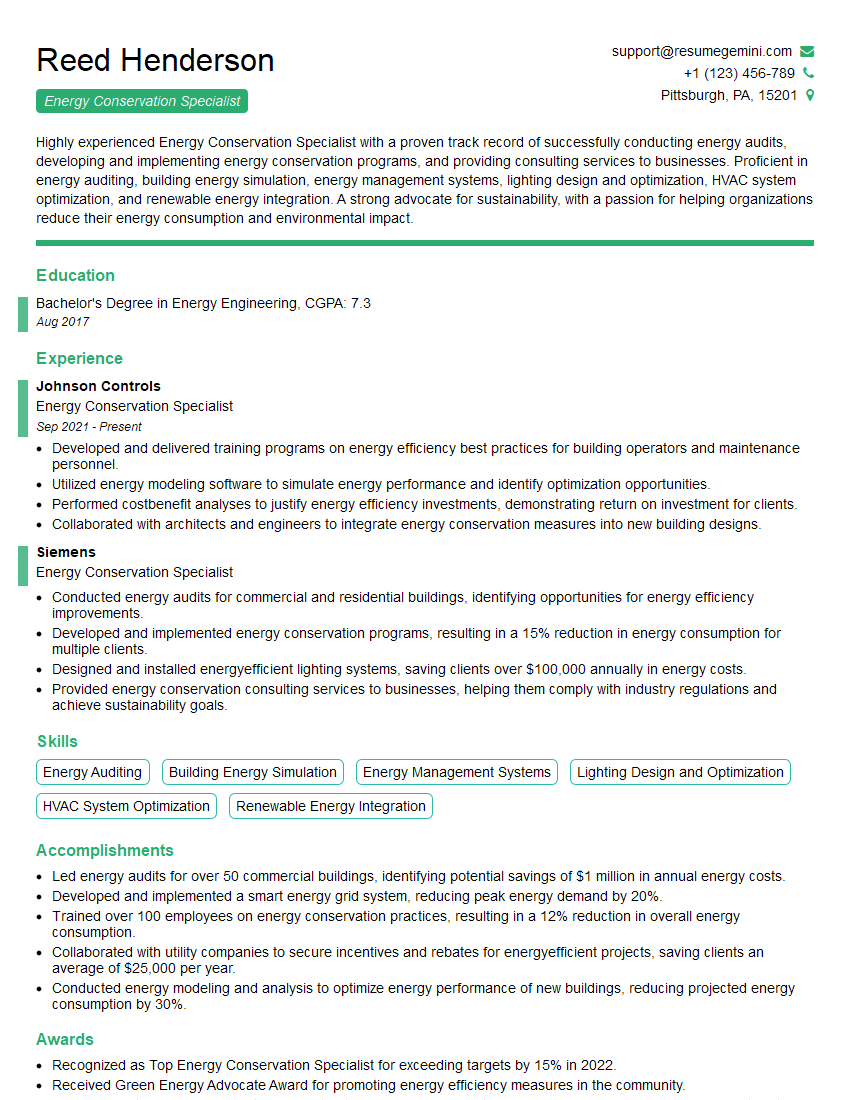
Energy Conservation Specialist Resume Sample
Explore more articles
Users Rating of Our Blogs
Share Your Experience
We value your feedback! Please rate our content and share your thoughts (optional).
What Readers Say About Our Blog
To the interviewgemini.com Webmaster.
Very helpful and content specific questions to help prepare me for my interview!
Thank you
To the interviewgemini.com Webmaster.
This was kind of a unique content I found around the specialized skills. Very helpful questions and good detailed answers.
Very Helpful blog, thank you Interviewgemini team.