Every successful interview starts with knowing what to expect. In this blog, we’ll take you through the top Experience in working with incandescent lighting interview questions, breaking them down with expert tips to help you deliver impactful answers. Step into your next interview fully prepared and ready to succeed.
Questions Asked in Experience in working with incandescent lighting Interview
Q 1. Explain the operating principle of an incandescent light bulb.
An incandescent light bulb operates on a simple principle: resistive heating. Electric current passes through a thin filament wire, typically made of tungsten, within a sealed glass bulb. The filament’s high resistance causes it to heat up intensely, reaching temperatures of around 2,500°C (4,532°F). This intense heat causes the filament to emit light, primarily in the infrared and visible spectrum. Think of it like this: the electricity is converted into heat, and the heat produces light. The higher the current, the hotter the filament, and the brighter the light.
Q 2. What are the advantages and disadvantages of incandescent lighting compared to LEDs and CFLs?
Incandescent lighting, while familiar and having a warm aesthetic, has significant drawbacks compared to LEDs and CFLs.
- Advantages: Incandescent bulbs offer a simple, inexpensive design and provide an instant, warm-toned light, much appreciated in some settings. They also dim smoothly, unlike some LEDs or CFLs.
- Disadvantages: Incandescents are notoriously inefficient, converting only about 10% of the electrical energy into visible light; the rest is wasted as heat. This inefficiency leads to high energy costs. Their lifespan is significantly shorter than LEDs or CFLs. Furthermore, they produce considerable heat, which can be problematic in enclosed spaces. Compared to LEDs and CFLs, their luminous efficacy is vastly lower.
LEDs and CFLs offer far greater energy efficiency and longevity, making them environmentally and economically preferable in most applications.
Q 3. Describe different types of incandescent filaments (e.g., tungsten, carbon).
While tungsten is the most common filament material in modern incandescent bulbs due to its high melting point (3422°C) and relatively good efficiency, historically other materials were used.
- Tungsten: The dominant choice today due to its high melting point, enabling higher operating temperatures and thus brighter light output. It provides a reasonable balance between lifespan and brightness.
- Carbon: Used in early incandescent bulbs, carbon filaments had lower melting points and were less efficient than tungsten. They burned out much more quickly and were far less bright for the same power consumption.
Other experimental materials have been explored but none have matched tungsten’s overall performance and availability.
Q 4. How does the filament temperature affect light output and lifespan?
Filament temperature is crucial in determining both light output and lifespan. A higher temperature results in greater light output but significantly shortens the bulb’s lifespan. This is because higher temperatures accelerate the process of filament evaporation, leading to thinning and eventual breakage.
Think of it like this: running a car engine at maximum RPM for extended periods will generate more power but drastically reduce its lifespan. Incandescent bulb manufacturers carefully balance these factors to optimize both brightness and reasonable lifespan. A typical tungsten filament operates at around 2500-3000°C, a carefully determined temperature balancing brightness and longevity.
Q 5. Explain the concept of luminous efficacy in incandescent bulbs.
Luminous efficacy, expressed in lumens per watt (lm/W), measures how effectively a light source converts electrical power into visible light. Incandescent bulbs have a notoriously low luminous efficacy, typically ranging from 10 to 20 lm/W. This means that for every watt of electricity consumed, only 10 to 20 lumens of visible light are produced. The rest is lost as heat. This low efficacy is a major reason for their inefficiency compared to modern LEDs and CFLs.
For example, a 60-watt incandescent bulb might produce around 800 lumens, while a 10-watt LED bulb can achieve similar brightness (800 lumens) with significantly less energy consumption. The LED has a much higher luminous efficacy.
Q 6. What are the common causes of incandescent bulb failure?
Incandescent bulb failures primarily stem from filament breakage. This can be caused by several factors:
- Evaporation: High operating temperatures cause tungsten atoms to evaporate from the filament over time, gradually thinning it until it breaks. This is the most common cause of failure.
- Mechanical Shock: Vibrations or physical shocks can cause the fragile filament to snap.
- Voltage Fluctuations: Excessive voltage surges can overheat the filament and lead to immediate burnout. Conversely, significantly low voltage can increase the operating time required to produce adequate brightness and may cause early failure.
- Gas Leakage: A tiny leak in the bulb’s glass envelope can reduce the internal pressure, causing a shorter lifespan.
Q 7. How does the voltage affect the brightness and lifespan of an incandescent bulb?
Voltage directly impacts both brightness and lifespan of an incandescent bulb. Higher voltage increases the current flowing through the filament, leading to higher temperatures, increased brightness, and a dramatically shorter lifespan. Conversely, lower voltage reduces the current, dimming the bulb and potentially extending its lifespan (though it may produce insufficient light).
A simple analogy is a candle flame – a stronger draft (higher voltage) will make the flame brighter but also consume the wax (filament) faster; a weak draft (lower voltage) will dim the flame and potentially make it last longer. Incandescent bulbs are designed to operate at their rated voltage for optimal performance and lifespan.
Q 8. Describe different bases and sockets used with incandescent bulbs.
Incandescent bulbs come in a variety of bases and sockets, designed to ensure a secure and reliable connection to the electrical supply. The most common are the Edison screw (ES) and bayonet (B) types, categorized by their size and voltage rating.
- Edison Screw (ES): This is the most prevalent type, featuring a threaded screw base that twists into the socket. Common sizes include E12 (candelabra), E14 (miniature), E26 (medium), and E39 (Mogul). The number represents the diameter of the base in millimeters. You’ll see E26 sockets used frequently in household lamps and fixtures.
- Bayonet (B): Bayonet mounts use two pins that slot into the socket and then twist to lock into place. They are less common in the US but frequently found in some European applications. B22 is a common bayonet base size.
- Other Bases: Less common types include bi-pin bases (two pins at the bottom), often found in automotive applications or specialty lighting, and various specialized bases for specific fixtures.
It’s crucial to match the bulb base to the socket to prevent damage to both the bulb and the fixture. For example, trying to force a larger E26 bulb into an E12 socket will likely break the socket or the bulb.
Q 9. What safety precautions should be taken when working with incandescent lighting?
Safety is paramount when working with incandescent lighting. Incandescent bulbs generate significant heat, posing burn risks, and improper handling can lead to electrical shock or fire hazards. Always follow these precautions:
- Turn off the power: Before handling any bulb or fixture, always switch off the power at the breaker box or remove the fuse. Never assume a fixture is off; double-check.
- Allow bulbs to cool: Incandescent bulbs can remain extremely hot after being switched off. Allow them to cool completely before handling to avoid burns.
- Use insulated tools: When working with electrical connections, use insulated screwdrivers and pliers to protect yourself from electrical shock.
- Handle bulbs carefully: Avoid touching the glass portion of the bulb, especially when it’s hot, as fingerprints can reduce its lifespan.
- Proper disposal: Incandescent bulbs are fragile and contain small amounts of mercury in some cases. Dispose of them properly according to local regulations, typically in designated glass recycling bins.
- Use appropriate ladders and tools: When replacing high-up bulbs, use a sturdy ladder and appropriate tools to reach them safely.
Remember, even a seemingly minor misstep can lead to serious consequences. Prioritizing safety is not optional; it’s essential.
Q 10. How do you troubleshoot a malfunctioning incandescent lighting fixture?
Troubleshooting a malfunctioning incandescent lighting fixture involves systematic checks to pinpoint the problem. It often comes down to a faulty bulb, a loose connection, or a damaged fixture.
- Check the bulb: The first step is to check if the bulb is burned out. Try replacing it with a new bulb of the same type and wattage. If the new bulb works, the problem was the old bulb.
- Inspect the socket: Examine the socket for any loose wires, burned contacts, or signs of damage. If you find loose connections, carefully tighten them. If there’s significant damage, the socket might need to be replaced. Be sure to turn off the power first.
- Check the wiring: If the socket looks okay, check the wiring leading to the fixture. Look for loose connections or broken wires at the fixture’s connection points and at the switch. Again, always turn off the power before making any wiring checks.
- Test the switch: Sometimes the problem is with the switch itself. Try replacing the switch. If that solves the issue, the original switch was faulty.
- Inspect the breaker or fuse: Make sure the circuit breaker for that circuit isn’t tripped or the fuse isn’t blown. If it is, reset the breaker or replace the fuse.
If none of these steps resolve the problem, it’s time to call a qualified electrician. Electrical work can be dangerous if not done correctly.
Q 11. Explain the differences between various incandescent bulb wattages and lumens.
Wattage and lumens are two key characteristics of incandescent bulbs, often confused but fundamentally different. Wattage (measured in Watts) indicates the amount of electrical power the bulb consumes, while lumens measure the amount of visible light the bulb produces.
Higher wattage generally means more light (more lumens) and more heat, but the relationship is not linear. A 60-watt bulb will produce more lumens (light) and more heat than a 40-watt bulb. However, different bulb designs and technologies can influence the lumen output for a given wattage. A 60W standard bulb will provide different lumens than a 60W halogen bulb, for example.
Examples: A 60-watt incandescent bulb might produce approximately 800 lumens, while a 100-watt bulb might produce around 1600 lumens. These numbers are approximations, and the exact lumens will vary slightly between brands and bulb designs. Always check the packaging for specific lumen output.
It is important to note that lumens are the true measure of brightness, while wattage only measures energy consumption. When comparing bulbs, it’s more useful to focus on lumens to compare their actual light output.
Q 12. Describe different dimming methods for incandescent bulbs.
Dimming incandescent bulbs controls the amount of light output, providing flexibility and ambiance. There are primarily two methods:
- Resistive Dimmers: These are the most common type of dimmer switches. They reduce voltage by using resistors, which converts some of the electricity into heat, leading to a loss of efficiency. This is why incandescent bulbs with a dimmer get warmer. In simpler terms, it throttles the power sent to the bulb.
- Triac Dimmers: More advanced than resistive dimmers, triacs use electronic switches that vary the flow of current to the bulb, offering smoother dimming control with less heat loss than resistive dimmers. They provide finer control over the brightness levels.
Choosing the right dimmer: Always check the dimmer switch’s specifications to ensure it’s compatible with the wattage and type of incandescent bulb being used. Using an incompatible dimmer can damage the bulb or the dimmer itself. Moreover, some dimmer switches are only designed to work with incandescent bulbs while others can handle LED or CFL bulbs.
Q 13. What are the environmental concerns associated with incandescent lighting?
Incandescent lighting, while providing warm and pleasant light, poses significant environmental concerns:
- High Energy Consumption: Incandescent bulbs convert a significant portion of their energy input into heat, rather than light, making them very inefficient. This leads to higher electricity bills and increased greenhouse gas emissions from power generation.
- Short Lifespan: They have a relatively short lifespan compared to other lighting technologies (LEDs and CFLs), meaning frequent replacements are necessary, contributing to waste.
- Heat Generation: Excessive heat contributes to higher cooling costs, especially in warm climates, further increasing energy usage.
- Mercury (in some cases): While generally not a major concern, some incandescent bulbs may contain small amounts of mercury in their construction. Improper disposal can release this mercury into the environment.
These factors have led to the phasing out of incandescent bulbs in many regions in favor of more energy-efficient alternatives.
Q 14. How does the use of a dimmer switch impact the lifespan of an incandescent bulb?
Using a dimmer switch with an incandescent bulb significantly impacts its lifespan. Dimming reduces the voltage supplied to the bulb. While seemingly extending the life, in practice, frequent dimming, particularly to very low light levels, often shortens the lifespan. The filament of the bulb is stressed by the on/off cycling and low voltage fluctuations during dimming, leading to earlier failure than it would at full brightness. However, keeping the bulb at a consistently dimmed level *can* slightly extend lifespan, compared to frequent full-brightness use, but the effect is usually minor and not always consistent.
Think of it like driving a car. Constantly accelerating and decelerating wears out the brakes faster than driving at a consistent speed. Similarly, fluctuating the voltage on an incandescent bulb with a dimmer stresses the filament, affecting the lifespan.
Q 15. What are the differences in heat output between various wattages of incandescent bulbs?
The heat output of an incandescent bulb is directly proportional to its wattage. A higher wattage bulb produces significantly more heat. Think of it like this: a 100-watt bulb is essentially a tiny, efficient electric heater that also produces light. The higher the wattage, the more electricity is converted into both light and heat. A 60-watt bulb will be noticeably cooler than a 100-watt bulb, and a 25-watt bulb will produce considerably less heat than either.
- 25-watt bulb: Generates minimal heat, suitable for small spaces or task lighting where heat buildup isn’t a concern.
- 60-watt bulb: Produces moderate heat, often used for general room lighting.
- 100-watt bulb: Generates significant heat, and is generally not recommended for enclosed fixtures without adequate ventilation.
The difference in heat output isn’t just a matter of feeling; it impacts the safety and longevity of fixtures. Always check the fixture’s wattage rating to ensure it can handle the heat produced by the bulb.
Career Expert Tips:
- Ace those interviews! Prepare effectively by reviewing the Top 50 Most Common Interview Questions on ResumeGemini.
- Navigate your job search with confidence! Explore a wide range of Career Tips on ResumeGemini. Learn about common challenges and recommendations to overcome them.
- Craft the perfect resume! Master the Art of Resume Writing with ResumeGemini’s guide. Showcase your unique qualifications and achievements effectively.
- Don’t miss out on holiday savings! Build your dream resume with ResumeGemini’s ATS optimized templates.
Q 16. How do you calculate the total wattage of an incandescent lighting system?
Calculating the total wattage of an incandescent lighting system is straightforward: you simply add up the wattage of each individual bulb. For example, if you have three 60-watt bulbs and two 100-watt bulbs, the total wattage is (3 * 60) + (2 * 100) = 380 watts.
It’s crucial to know the total wattage when planning a lighting system. This information is necessary to determine the appropriate circuit breaker size and wiring capacity. Overloading a circuit can lead to overheating and potential fire hazards.
Total Wattage = (Number of Bulbs x Wattage per Bulb) + ... (Repeat for all bulb types)Consider this example: You have a room with five 40W bulbs and two 60W bulbs. The total wattage is: (5 * 40) + (2 * 60) = 320W.
Q 17. Explain the importance of proper ventilation for incandescent lighting fixtures.
Proper ventilation is crucial for incandescent lighting fixtures, especially those with higher-wattage bulbs, to prevent overheating and potential fire hazards. Incandescent bulbs generate a significant amount of heat as a byproduct of light production. If this heat is trapped within an enclosed fixture, the temperature can rise dramatically, potentially damaging the fixture itself, shortening the lifespan of the bulb, and even creating a fire risk.
Adequate ventilation allows for the dissipation of heat, keeping the fixture and surrounding materials at a safe operating temperature. This is particularly important for recessed fixtures installed in ceilings or walls, where heat can accumulate quickly. Always follow the manufacturer’s instructions regarding ventilation requirements for your specific fixture.
Think of it like an oven: if you don’t open the vent, the heat builds up. The same is true for incandescent lights. Proper ventilation acts as a safety mechanism.
Q 18. Describe different types of incandescent fixtures (e.g., recessed, pendant, track lighting).
Incandescent lighting fixtures come in a variety of styles, each designed for specific applications and aesthetic preferences. Some common types include:
- Recessed lighting: These fixtures are mounted directly into the ceiling, providing a clean, flush appearance. They are often used for ambient lighting and are available in various sizes and finishes.
- Pendant lighting: These fixtures hang from the ceiling, often featuring a decorative shade or fixture. They are frequently used as statement pieces or task lighting over kitchen islands or dining tables.
- Track lighting: This system consists of a track mounted to the ceiling or wall, with individual light heads that can be adjusted to direct light where needed. Highly versatile for accent and task lighting.
- Table and Floor Lamps: These portable fixtures use incandescent bulbs and offer flexibility in placement.
- Wall sconces: Mounted on walls, these offer ambient or accent lighting.
The choice of fixture depends on the desired lighting effect, the architectural style of the space, and practical considerations, such as ceiling height and available wiring.
Q 19. How do you choose the appropriate incandescent bulb for a specific application?
Choosing the right incandescent bulb for a specific application involves considering several factors:
- Wattage: Determines the brightness and heat output. Higher wattage equals brighter light and more heat.
- Base type: Ensures compatibility with the fixture (e.g., E26, E12). Incorrect base type will prevent proper installation.
- Shape and size: Influences the light distribution and aesthetic appeal. Consider the size of the fixture and the desired light beam angle.
- Intended use: A high-wattage bulb is suitable for a large room, while a low-wattage bulb might suffice for a small area or a nightlight.
For instance, a small desk lamp might use a low-wattage bulb (e.g., 25-40 watts) for task lighting, while a large living room chandelier may use several higher-wattage bulbs (e.g., 60-100 watts) for ambient lighting. Always consult the fixture’s specifications for the maximum allowable wattage.
Q 20. What are the typical lifespan ranges for different types of incandescent bulbs?
The lifespan of an incandescent bulb, typically measured in hours, varies depending on its wattage and usage. Higher-wattage bulbs tend to have shorter lifespans due to the increased heat generated. While precise numbers can vary by manufacturer, here’s a general guideline:
- 25-watt bulb: Can last for 2,500 hours or more.
- 40-watt bulb: Typically lasts for 1,500-2,000 hours.
- 60-watt bulb: Often lasts around 1,000-1,500 hours.
- 100-watt bulb: May only last for 750-1,000 hours.
These are estimates, and actual lifespan can be affected by factors such as voltage fluctuations, frequency of switching on and off, and environmental conditions. Frequent on/off cycles tend to shorten bulb lifespan.
Q 21. Explain the concept of color temperature in incandescent bulbs.
Color temperature in incandescent bulbs refers to the apparent color of the light they emit, measured in Kelvin (K). Unlike LEDs or CFLs, incandescent bulbs don’t have a wide range of color temperatures. They primarily produce a warm, yellowish-white light. The color temperature is heavily influenced by the filament’s temperature; the hotter the filament, the whiter (though still yellowish) the light becomes. The color temperature is generally between 2700K and 3000K.
Lower Kelvin values (e.g., 2700K) indicate warmer, more yellowish light, while higher Kelvin values (e.g., 3000K) represent slightly cooler, whiter light. However, the differences are subtle compared to the wide color temperature range available with other bulb types.
Think of a candle flame: its light is warm and yellowish, similar to the light from an incandescent bulb. The color temperature isn’t as significant a factor when choosing incandescent bulbs as it is with other technologies.
Q 22. How does the size and shape of an incandescent bulb affect its light distribution?
The size and shape of an incandescent bulb significantly impact its light distribution. Think of it like a flashlight; a narrow, focused beam comes from a smaller, reflective bulb, while a wider, more diffused light comes from a larger, less reflective one.
For instance, a standard A-shaped bulb provides a relatively even, omnidirectional light spread. Its clear glass and simple design allow light to radiate in all directions. Conversely, a PAR (Parabolic Aluminized Reflector) bulb, often used in spotlights, has a parabolic reflector that focuses the light into a concentrated beam. The shape of the bulb and the reflector work together to precisely control the direction and intensity of the light. A globe-shaped bulb, on the other hand, tends to diffuse light more softly, creating a gentle, ambient glow suitable for softer lighting needs.
The filament’s placement within the bulb also plays a role. A filament positioned centrally will distribute light more evenly than one positioned off-center, which might cast more light in one direction. Therefore, the combination of the bulb’s overall shape, the reflector’s design (if present), and the filament’s position all contribute to the final light distribution pattern.
Q 23. Describe different methods for disposal of incandescent bulbs.
Disposing of incandescent bulbs responsibly is crucial due to the presence of small amounts of mercury in some older models. While the amount is significantly less than in fluorescent bulbs, it’s still important to handle them carefully.
- Local Recycling Programs: Many municipalities offer specialized recycling programs for light bulbs. Check with your local waste management authority to see if such a program exists in your area. They often have designated drop-off locations or will pick up hazardous waste on certain days.
- Retailer Take-Back Programs: Some retailers who sell light bulbs participate in take-back programs. They will often accept used bulbs, even if they weren’t purchased from their store, allowing for convenient disposal. Inquire at your local hardware store or lighting supply store.
- Hazardous Waste Facilities: If local recycling or retail programs are unavailable, hazardous waste facilities are an appropriate alternative. These facilities are equipped to handle hazardous materials safely and responsibly.
- Proper Packaging: Regardless of disposal method, always secure the bulbs to prevent breakage during transport. Wrapping them carefully in newspaper or cardboard before placing them in a sturdy container is recommended.
Improper disposal, like throwing them in the regular trash, can lead to environmental contamination. Following these guidelines ensures responsible handling and reduces the risk of mercury exposure.
Q 24. What is the impact of incandescent lighting on energy consumption?
Incandescent lighting is notorious for its high energy consumption. They generate heat rather inefficiently – only about 10% of the energy used is converted into light; the remaining 90% is lost as heat. This is in stark contrast to more energy-efficient alternatives like LEDs or CFLs.
Consider a 60-watt incandescent bulb. It consumes 60 watts of electricity, but only about 6 watts of that energy actually produces light. The other 54 watts are wasted as heat. This inefficiency contributes to higher electricity bills and increases reliance on energy production, leading to a larger carbon footprint.
The high energy consumption is primarily due to the way incandescent bulbs work: they heat a filament until it glows. This process is inherently inefficient, and the heat generated is often unwanted and even detrimental in certain applications. The significant difference in energy efficiency between incandescent and modern lighting technologies makes the latter much more attractive from an environmental and economic perspective.
Q 25. What are the regulations and standards related to incandescent lighting?
Regulations and standards surrounding incandescent lighting have evolved significantly in recent years, driven largely by energy efficiency concerns. Many countries have phased out or are phasing out the production and sale of traditional incandescent bulbs in favor of more energy-efficient options.
For example, the EU implemented regulations that effectively banned the sale of standard incandescent bulbs in several phases, starting in 2009. Similar initiatives have been undertaken in other regions of the world. These regulations are often tied to energy-efficiency standards and aim to reduce overall energy consumption and greenhouse gas emissions. While some niche incandescent bulbs (for specific applications like halogen bulbs) might still be available, they often must meet stricter efficiency requirements.
The specific regulations vary by country and region, so it is important to refer to the local authorities or relevant standards organizations for precise information about current legislation.
Q 26. Explain the process of replacing an incandescent bulb in different types of fixtures.
Replacing incandescent bulbs involves relatively straightforward steps, but the process can differ slightly depending on the fixture type.
- Standard Lamp/Table Lamp: Simply unscrew the old bulb and screw in the new one, ensuring a secure connection. Make sure the electricity is switched off before handling bulbs.
- Ceiling Fixtures: These vary greatly, but generally involve accessing the bulb via a pull chain (if available), a removable glass shade (or diffuser), or by releasing a retaining clip or ring. Always turn off the power switch to avoid electrical shock before performing any maintenance.
- Recessed Lighting: Recessed lights often require removing a trim ring or cover to access the bulb socket. Ensure the circuit breaker for that specific light is turned off before proceeding. Sometimes, the fixture may require more complex disassembly, necessitating a trained electrician.
Before replacement always check the bulb type and wattage to ensure compatibility with the fixture to avoid overheating and potential fire hazards.
Q 27. How do you determine the correct replacement bulb for a given fixture?
Determining the correct replacement bulb involves checking the existing bulb’s specifications or the fixture’s labeling. Look for information like:
- Wattage (W): Indicates the power consumption. This should match or be less than the fixture’s maximum wattage rating.
- Base Type (e.g., Edison screw, bayonet): The type of fitting that screws into or clicks into the socket. This must be compatible with the fixture’s socket.
- Bulb Shape (e.g., A, G, PAR): The physical shape of the bulb affects light distribution. While a visually similar replacement might work, it is better to stick to the specified shape.
- Voltage (V): Ensure the voltage matches your local power supply (usually 120V in North America, 230V in Europe, etc.).
If the information isn’t on the bulb itself, check the fixture’s label or manual. If you can’t identify the correct replacement, take the old bulb to a lighting store for assistance. Never exceed the fixture’s maximum wattage rating to prevent overheating and potential fire hazards.
Q 28. Describe your experience with troubleshooting and repairing common incandescent lighting problems.
Troubleshooting incandescent lighting problems often involves systematic checks.
- Bulb Failure: The simplest problem is a burnt-out bulb. Try replacing it with a new bulb of the correct type and wattage. If the problem persists, the issue lies elsewhere.
- Loose Connections: Check that the bulb is correctly screwed into the socket and that the wiring connections within the fixture are secure. Loose connections can lead to intermittent lighting or no light at all.
- Blown Fuse or Tripped Breaker: If none of the bulbs in a particular circuit work, the problem could be a blown fuse in the fuse box or a tripped breaker in the breaker panel. Check and reset if necessary.
- Faulty Switch: A faulty switch can prevent power from reaching the bulb. This requires more advanced testing with a multimeter to determine if the switch is functioning correctly.
- Wiring Problems: If you suspect a wiring issue, it is vital to switch off the power supply at the mains and consult a qualified electrician. Attempting repairs without proper training can be extremely dangerous.
My experience has shown that while many incandescent lighting issues are relatively simple to solve, diagnosing electrical problems requires a level of care and safety awareness that always places safety as the top priority. A trained electrician is necessary for any advanced work.
Key Topics to Learn for Incandescent Lighting Interview
- Understanding Incandescent Technology: Explore the fundamental principles behind incandescent lighting – filament construction, thermal radiation, and the relationship between voltage, current, and light output. Consider the differences between various filament types and their applications.
- Practical Applications and Installations: Discuss your experience with installing and maintaining incandescent lighting systems in various settings (residential, commercial, industrial). This includes wiring techniques, fixture selection, and safety protocols.
- Troubleshooting and Repair: Detail your experience diagnosing and resolving common issues such as burnt-out filaments, loose connections, and ballast problems. Highlight your problem-solving skills and ability to identify the root cause of malfunctions.
- Energy Efficiency and Alternatives: While incandescent lighting is less efficient, demonstrate your understanding of its limitations compared to newer technologies (LED, CFL). Discuss the energy consumption calculations and cost implications.
- Safety Regulations and Codes: Showcase your knowledge of relevant safety regulations and codes pertaining to incandescent lighting installation and maintenance. Discuss proper handling procedures to minimize risk of burns or electrical shock.
- Specific Fixture Types and Applications: Discuss your experience with various incandescent fixtures, such as reflector lamps, globe bulbs, and decorative bulbs, and their applications in different lighting designs.
Next Steps
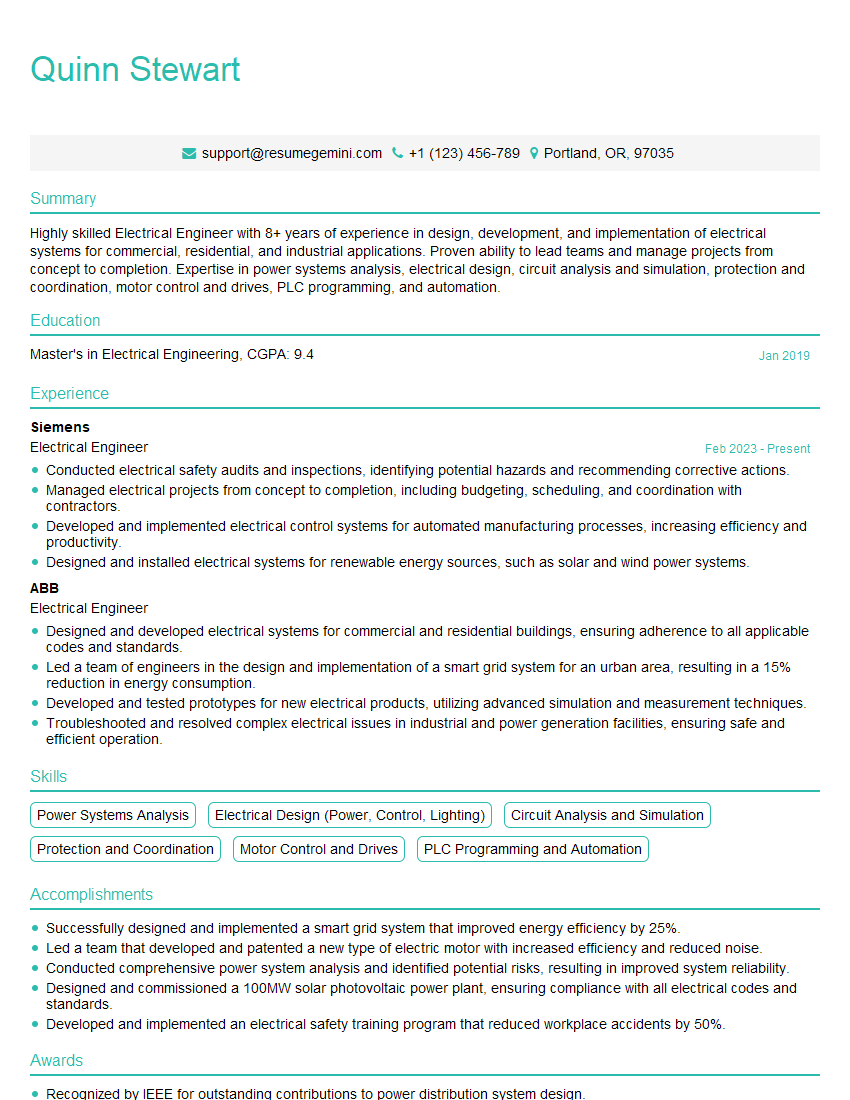
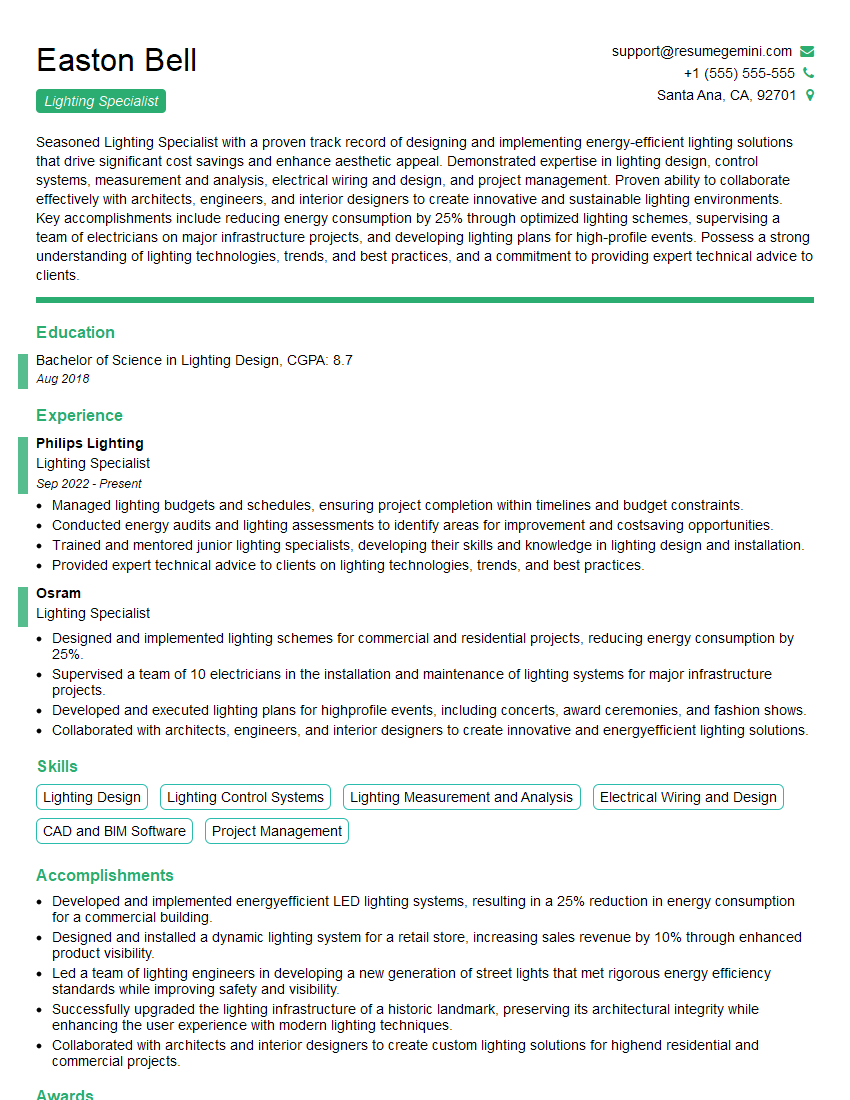
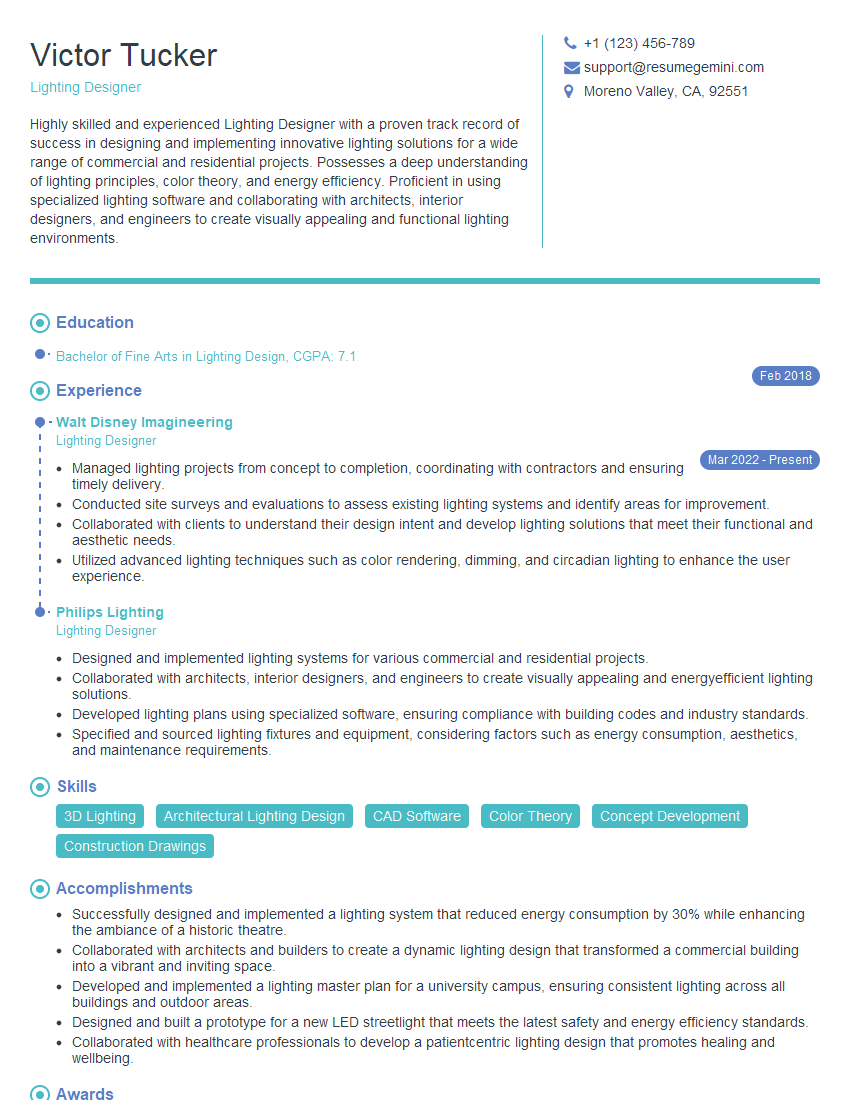
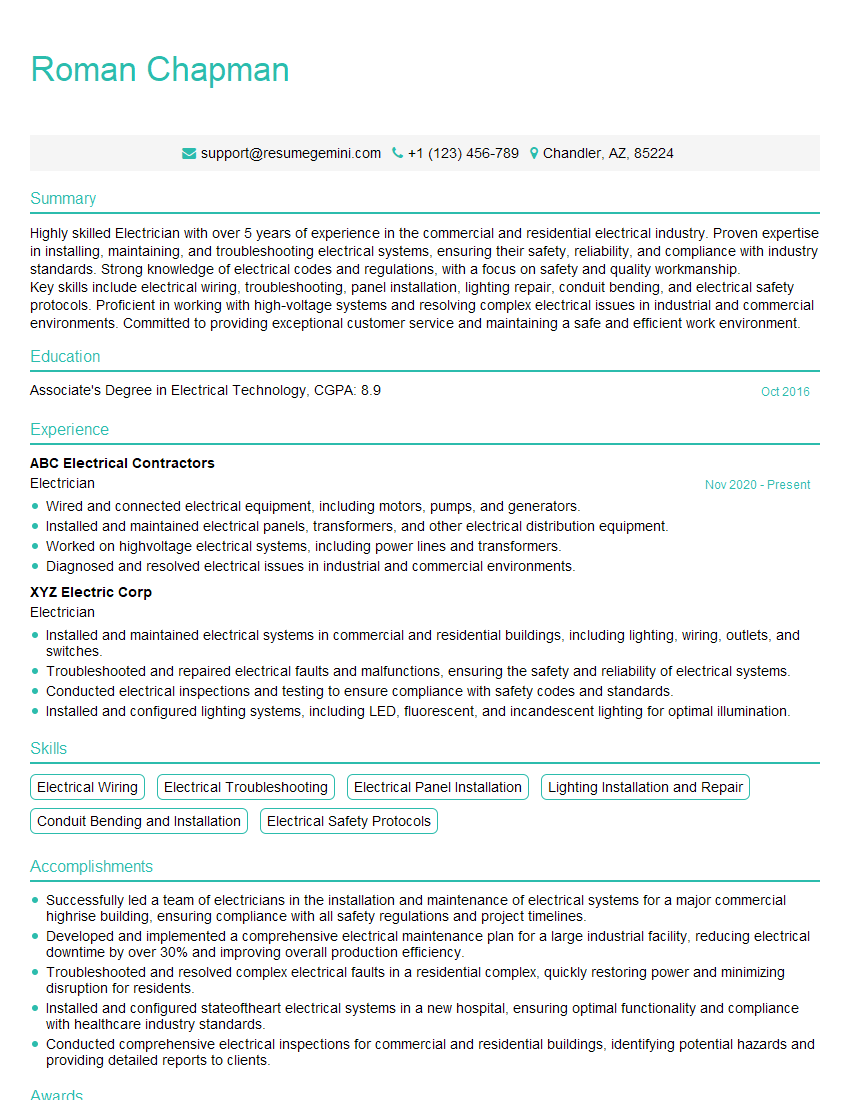
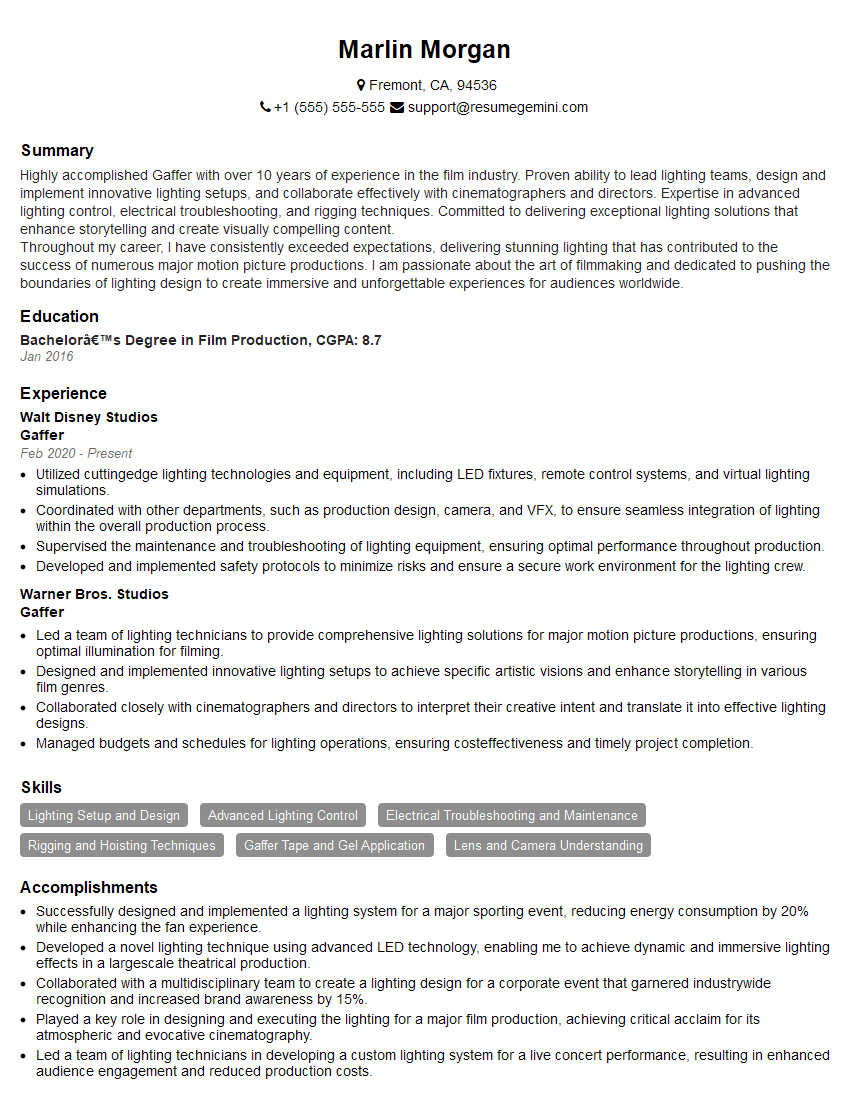
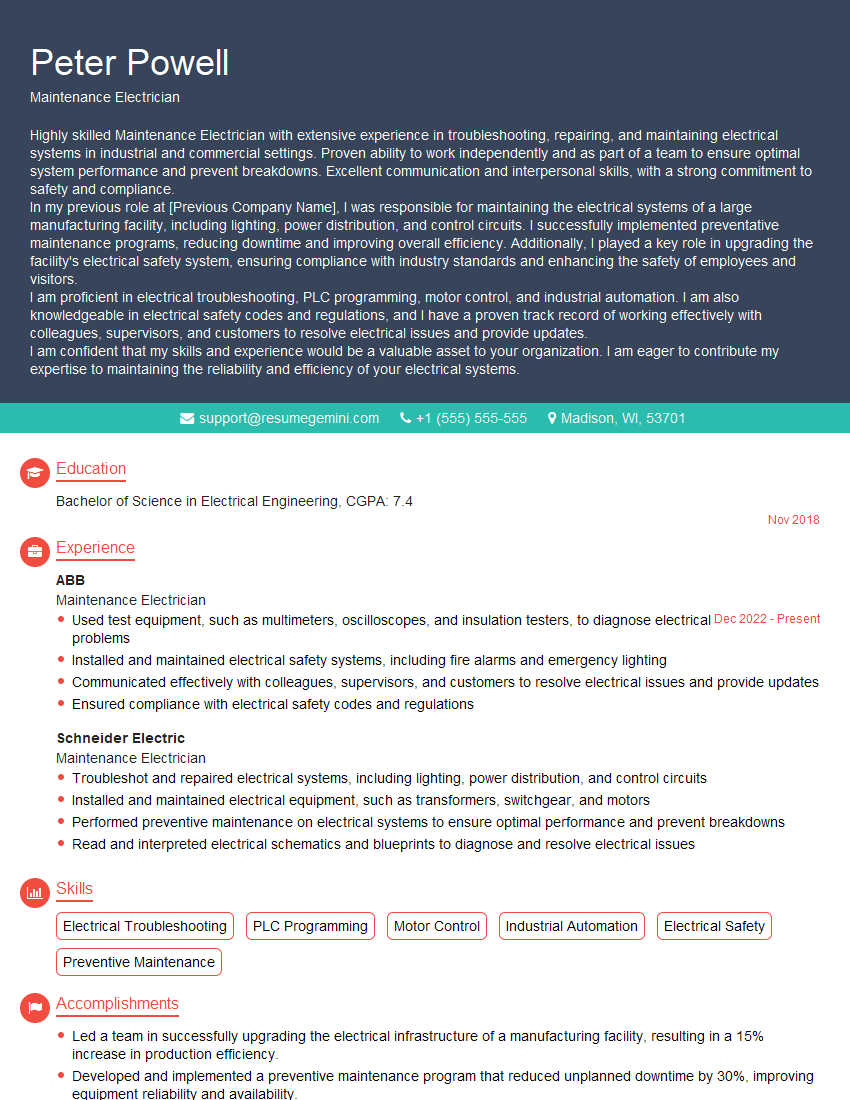
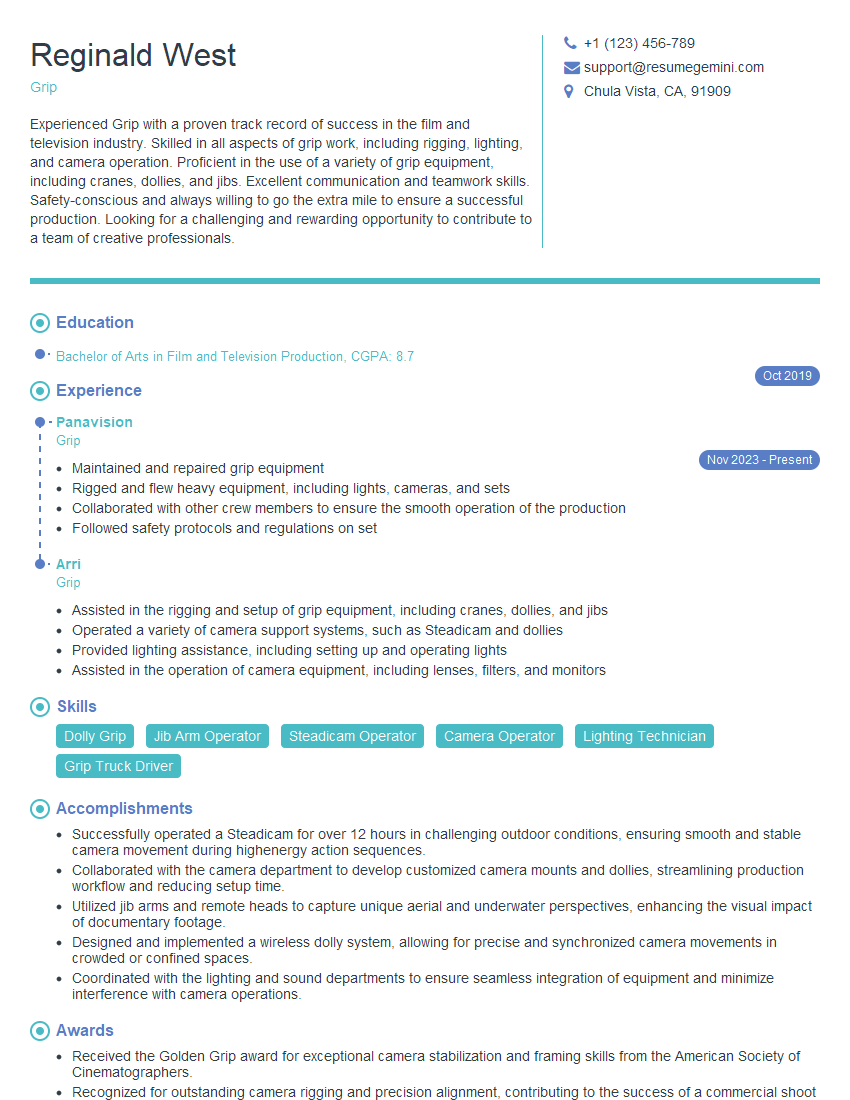
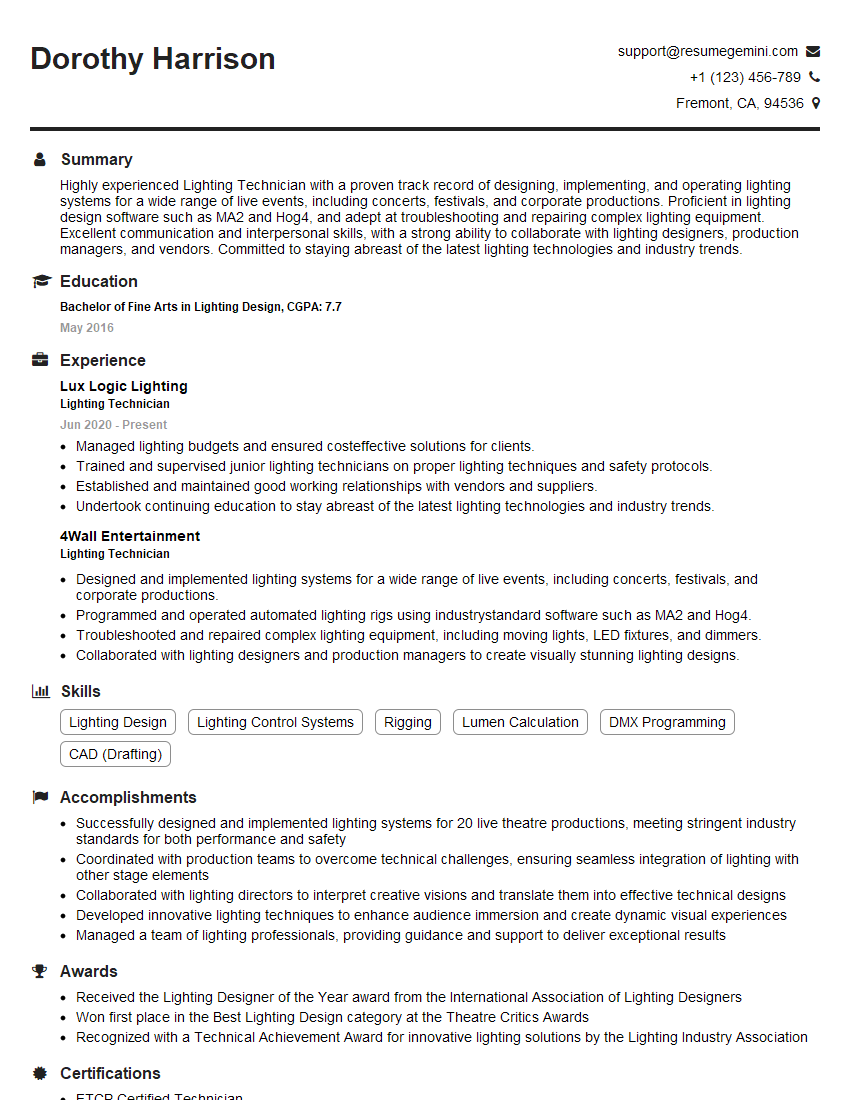
Mastering the intricacies of incandescent lighting, even in a transitioning market, demonstrates valuable foundational knowledge in electrical systems and problem-solving, opening doors to various roles in electrical work, maintenance, and even historical preservation projects. To boost your job prospects, create an ATS-friendly resume that highlights your skills and experience effectively. ResumeGemini is a trusted resource that can help you build a professional and impactful resume, showcasing your expertise in incandescent lighting. Examples of resumes tailored to this specific experience are available on ResumeGemini to help guide you.
Explore more articles
Users Rating of Our Blogs
Share Your Experience
We value your feedback! Please rate our content and share your thoughts (optional).
What Readers Say About Our Blog
To the interviewgemini.com Webmaster.
Very helpful and content specific questions to help prepare me for my interview!
Thank you
To the interviewgemini.com Webmaster.
This was kind of a unique content I found around the specialized skills. Very helpful questions and good detailed answers.
Very Helpful blog, thank you Interviewgemini team.