The right preparation can turn an interview into an opportunity to showcase your expertise. This guide to Experience with data center installations interview questions is your ultimate resource, providing key insights and tips to help you ace your responses and stand out as a top candidate.
Questions Asked in Experience with data center installations Interview
Q 1. Explain the process of rack and stack server installation.
Rack and stack server installation is the process of physically installing servers into a rack within a data center. It’s a crucial step that requires precision and adherence to best practices to ensure optimal performance and system stability. Think of it like building with LEGOs, but with far more sophisticated components and potential consequences for errors.
- Planning and Preparation: This initial phase involves reviewing server specifications, rack layout diagrams, and ensuring sufficient power and network connectivity are available at the designated rack location. We also check for any potential physical obstructions.
- Rack Preparation: We ensure the rack is properly grounded and the mounting rails are securely installed. Cable management arms are affixed to aid in organizing the cabling later.
- Server Installation: Using the correct tools, we carefully slide the server into the rack, ensuring its alignment with the mounting rails. We double-check the server is firmly seated and level. During this step, attention to weight distribution is paramount, especially when working with heavier servers.
- Cabling: Once the server is mounted, we connect the necessary power cables, network cables, and other peripherals. We use color-coded cable management techniques to maintain clarity and avoid any tangled mess.
- Post-Installation Checks: After cabling, we power on the server, run initial diagnostics and check for any errors. We then proceed to verify network connectivity and check for proper boot sequence.
- Documentation: Each server’s physical location, IP address, network details, and power connections are meticulously documented for future reference and troubleshooting.
For instance, in a recent project installing 50 new servers, we used a pre-planned rack layout to ensure efficient space utilization and simplified cabling. This methodical approach prevented any installation issues and ensured a smooth transition for our client.
Q 2. Describe your experience with data center cabling and termination.
Data center cabling and termination encompass the entire process of installing and connecting the network cables (e.g., fiber optic, copper) that form the backbone of data center communication. Proper cabling is essential for optimal network performance, reliability, and scalability. Think of it as the veins and arteries of your data center – crucial for proper function.
- Cable Selection: The choice of cable type depends on factors like distance, bandwidth requirements, and budget. Fiber optics are preferred for long distances and high bandwidth applications, while copper is used for shorter distances.
- Termination: This is the process of preparing the ends of cables for connection. It requires precision and specialized tools. Incorrect termination can lead to signal loss and connectivity issues. For fiber, this often involves cleaving the fiber and using fusion splicing or mechanical connectors. For copper, this involves crimping connectors onto the cable.
- Testing: After termination, cables are thoroughly tested to ensure connectivity and signal quality using OTDRs (Optical Time Domain Reflectometers) for fiber and cable testers for copper. This helps identify any breaks or faults before the cables are put into service.
- Cable Management: Proper cable management is critical for airflow and maintainability. Techniques like using cable trays, Velcro straps, and labels are used to keep cables organized and prevent tangling.
In a previous project, we implemented a structured cabling system using fiber optics for inter-rack connectivity, ensuring high bandwidth and minimizing signal loss across the entire data center. This approach enhanced network performance and streamlined future expansion plans.
Q 3. How do you ensure proper grounding and bonding in a data center?
Proper grounding and bonding in a data center is crucial for protecting equipment from electrical surges and ensuring personnel safety. Grounding diverts excess electrical energy to the earth, preventing damage to sensitive electronics. Bonding equalizes the electrical potential between different metal components, preventing voltage differences that could lead to sparks or electrical shock.
- Grounding: This involves connecting the metal frames of racks, equipment, and the building’s structure to a dedicated grounding system, typically a grounding rod driven deep into the earth. This creates a low-resistance path for stray electrical currents.
- Bonding: This connects the metal frames of different equipment racks and other metallic structures together, ensuring they are at the same electrical potential. This prevents voltage differentials that could damage sensitive equipment.
- Regular Inspection: Grounding and bonding connections should be regularly inspected and tested to ensure they are still effective. Corrosion or loose connections can compromise the system’s effectiveness.
We use specialized grounding and bonding equipment and adhere to industry best practices, such as IEC standards, to ensure a robust and reliable grounding system. In one instance, we discovered a corroded grounding connection during a routine inspection, preventing a potential power surge that could have caused significant damage.
Q 4. What are the key considerations for data center power distribution?
Data center power distribution involves the efficient and reliable delivery of power to all equipment within the data center. This is critical for ensuring system uptime and preventing outages. Think of it as the circulatory system of the data center, delivering the lifeblood of electricity to every component.
- Redundancy: Data centers employ redundant power supplies and pathways to ensure that if one power source fails, another is immediately available. This can involve using multiple power feeds from different substations or employing generator backups.
- Power Distribution Units (PDUs): These units distribute power from the main power source to individual racks and equipment. They often provide monitoring and management capabilities to track power usage and identify potential issues.
- Capacity Planning: Careful planning is required to ensure sufficient power capacity is available to meet current and future needs. This involves estimating the power requirements of all equipment and incorporating a safety margin.
- Monitoring: Power usage is constantly monitored using tools like PDU monitoring software and building management systems (BMS). This allows for proactive identification and resolution of potential power problems.
In my experience, we employed a modular UPS system with N+1 redundancy, ensuring continuous power even during grid failures. We also implemented a sophisticated power monitoring system, enabling proactive alerts for potential power imbalances or overloads.
Q 5. Explain your experience with UPS systems and generators.
Uninterruptible Power Supplies (UPS) and generators are critical components of a data center’s power infrastructure, providing backup power during outages. UPS systems provide short-term power backup, while generators provide longer-term power support.
- UPS Systems: These systems use batteries to provide temporary power during brief outages, allowing for a graceful shutdown of equipment or a seamless switch to a backup power source. Different UPS types offer varying levels of protection and runtime.
- Generators: These are used to provide extended power backup during prolonged outages, often powering the entire data center or critical sections of it. Regular maintenance and testing are crucial to ensure reliable operation.
- Integration: UPS systems and generators are typically integrated into a comprehensive power management system, enabling automated switching between power sources during outages.
- Maintenance: Regular maintenance, including battery testing and generator run-time testing, is essential for ensuring the reliability and readiness of these systems.
In one project, we installed a large-scale UPS system with a capacity sufficient for a 15-minute runtime, coupled with multiple diesel generators capable of powering the entire data center for days. We also developed a robust testing and maintenance schedule to ensure their continued reliable operation.
Q 6. How do you monitor and manage environmental conditions in a data center?
Monitoring and managing environmental conditions in a data center is crucial for maintaining optimal equipment performance and preventing hardware failures. This involves controlling temperature, humidity, and airflow to create a stable environment.
- Temperature and Humidity Control: Precise temperature and humidity control are essential to prevent overheating and condensation, which can damage equipment. This is typically achieved using Computer Room Air Conditioners (CRACs) and Computer Room Air Handlers (CRAHs).
- Airflow Management: Proper airflow is crucial for dissipating heat generated by equipment. This involves using raised floors for cabling and airflow management, along with hot and cold aisle containment.
- Environmental Monitoring Systems: Sensors throughout the data center monitor temperature, humidity, and airflow. This data is collected and analyzed using Building Management Systems (BMS), alerting personnel to any anomalies.
- Redundancy: Redundant environmental control systems are typically employed to ensure continued operation even if one system fails.
We implemented a sophisticated BMS in a recent project, providing real-time monitoring and alerts for temperature, humidity, and power conditions. This allowed for immediate response to environmental changes and prevented potential hardware issues.
Q 7. Describe your experience with fire suppression systems in data centers.
Fire suppression systems are a critical safety feature in data centers, protecting valuable equipment and preventing catastrophic data loss. These systems are designed to extinguish fires quickly and effectively, minimizing damage and downtime.
- Types of Systems: Several fire suppression system types are used in data centers, including gaseous systems (e.g., inert gases like Argonite, FM-200), pre-action systems, and water mist systems. The selection depends on the specific risks and the type of equipment being protected.
- System Design: System design involves careful consideration of the data center’s layout, equipment locations, and potential fire hazards. This includes the placement of suppression agents and the design of discharge nozzles.
- Regular Inspections and Testing: Fire suppression systems require regular inspections and testing to ensure they are functioning properly and are ready to respond in case of a fire. This includes checking agent levels, inspecting nozzles, and performing system activation tests.
- Integration with Other Systems: Fire suppression systems are typically integrated with other data center systems, such as environmental monitoring systems and security systems, enabling coordinated responses to emergencies.
In my experience, we’ve designed and implemented several gaseous fire suppression systems in data centers, meticulously selecting the most appropriate agent and system design for each unique environment. We always prioritize thorough testing and regular maintenance to ensure the system’s readiness for any eventuality.
Q 8. What are your experiences with different cooling technologies (e.g., CRAC, CRAH)?
My experience encompasses a wide range of data center cooling technologies, primarily focusing on Computer Room Air Conditioners (CRACs) and Computer Room Air Handlers (CRAHs). CRACs are typically larger, self-contained units that handle cooling for larger spaces, often found in older or larger data centers. They’re robust but can be less efficient than newer technologies. CRAHs, on the other hand, offer more flexibility and often integrate better with building management systems (BMS). They’re modular and allow for more precise temperature control, making them suitable for high-density deployments. I’ve worked extensively with both, overseeing installations, maintenance, and troubleshooting. For example, in one project, we migrated from an aging CRAC system to a CRAH-based solution, improving cooling efficiency by 15% and reducing energy consumption significantly. This involved careful capacity planning, phased implementation to minimize downtime, and rigorous testing to ensure optimal performance. I also have experience with liquid cooling technologies, which are increasingly important for high-performance computing environments, involving direct-to-chip cooling or immersion cooling techniques. These offer higher cooling densities, which is critical in high-density server deployments and where traditional air cooling struggles.
Q 9. How do you plan for data center capacity and scalability?
Data center capacity and scalability planning requires a holistic approach, considering current needs and future growth. It starts with a thorough assessment of existing infrastructure and projected workloads. This involves analyzing server power requirements, network bandwidth demands, storage capacity needs and environmental factors (power usage effectiveness, PUE). I typically use modeling tools and forecasting techniques to project future capacity requirements, considering factors like server upgrades, application growth, and business expansion. Scalability is planned by designing modular infrastructure, allowing for easy addition of racks, power, and cooling capacity without extensive disruption. For example, in a recent project, we implemented a phased rollout of new server hardware, ensuring seamless integration with the existing infrastructure while providing ample capacity for the next three years of anticipated growth. We ensured that the network infrastructure, power distribution, and cooling systems could support the gradual increase in server density and power consumption. This approach allowed for cost-effective scaling while minimizing the risk of downtime.
Q 10. Explain your experience with data center security protocols and access control.
Data center security is paramount. My experience includes implementing and managing a variety of security protocols, focusing on access control, network security, and physical security. Access control involves implementing robust authentication mechanisms, such as multi-factor authentication (MFA), role-based access control (RBAC), and biometric access. Network security involves deploying firewalls, intrusion detection/prevention systems (IDS/IPS), and regular security audits. I’ve implemented and managed security information and event management (SIEM) systems to monitor security logs and identify potential threats. For instance, I was instrumental in securing a data center against unauthorized access by implementing a layered security approach, including physical security measures like mantrap systems, video surveillance, and access card readers, in conjunction with robust network security protocols such as firewalls and intrusion detection systems. This layered approach minimizes vulnerabilities and increases the overall security of the data center.
Q 11. Describe your experience with virtualization technologies in a data center context.
Virtualization is a core component of modern data center operations, significantly improving efficiency and resource utilization. My experience includes deploying and managing various virtualization platforms, such as VMware vSphere, Microsoft Hyper-V, and Citrix XenServer. This involves designing and implementing virtual machine (VM) infrastructure, managing virtual networks, and optimizing resource allocation. I’ve worked on projects involving server consolidation, disaster recovery planning, and cloud integration using virtualization technologies. For example, I led a project to consolidate over 100 physical servers onto a smaller number of virtual hosts, resulting in significant cost savings in terms of hardware, power, and cooling. This also improved server utilization and simplified management.
Q 12. How do you troubleshoot network connectivity issues in a data center environment?
Troubleshooting network connectivity issues requires a systematic approach. I typically start by isolating the problem, using tools like ping, traceroute, and network monitoring software. This helps identify the affected network segment and pinpoint the source of the issue. Then, I check cable connections, network configurations, and routing tables. I’ve also used packet analyzers (like Wireshark) to inspect network traffic and identify potential problems. For example, during a recent outage, I used traceroute to identify a faulty router causing connectivity problems between two data center segments. Replacing the router quickly resolved the issue. Documenting troubleshooting steps is crucial for future reference and to improve incident response times.
Q 13. What is your experience with remote hands support in data centers?
Remote hands support is crucial for managing data centers, especially for geographically dispersed facilities. My experience includes coordinating and overseeing remote hands activities, ensuring efficient and safe access to physical equipment. This involves clearly documenting the tasks, providing remote access to technicians, and verifying completion of the work. Effective communication and clear instructions are essential to minimize risk and ensure efficient resolution. For example, I’ve coordinated remote hands support for server replacements, network upgrades, and hardware repairs, ensuring minimal disruption to operations. Proper documentation and communication with the remote hands team are key to successful remote support.
Q 14. How do you manage data center physical security and access control?
Managing data center physical security and access control requires a multi-layered approach. This includes physical barriers like fences, security cameras, and access control systems (ACS) with card readers and biometric authentication. Regular security audits and penetration testing are crucial to identify vulnerabilities. I’ve implemented systems like mantraps, which require two-factor authentication before allowing entry into sensitive areas. Environmental monitoring is another important aspect, ensuring temperature, humidity, and power are within acceptable ranges. For example, in a recent project, I implemented a comprehensive physical security plan that included 24/7 surveillance, access control systems with multi-factor authentication, and intrusion detection systems, reducing the risk of unauthorized access and enhancing the overall security posture of the data center.
Q 15. What are your experiences with different types of data center infrastructure (e.g., modular, traditional)?
My experience encompasses both traditional and modular data center infrastructures. Traditional data centers are characterized by their monolithic design, with individual components like servers, storage, and networking equipment housed in separate racks within a large, centralized facility. This approach often involves significant upfront capital investment and longer deployment times. I’ve been involved in several projects using this model, focusing on efficient space utilization and cable management within these large spaces. For example, one project involved optimizing a legacy data center by implementing a structured cabling system and improving cooling efficiency to reduce energy consumption.
Modular data centers, on the other hand, offer a more flexible and scalable approach. They utilize prefabricated, standardized modules that can be easily assembled and deployed, often with integrated power, cooling, and networking infrastructure. This allows for faster deployment times, easier expansion, and greater adaptability to changing business needs. I’ve worked extensively with containerized data centers, deploying them for disaster recovery sites and edge computing locations. In one project, we deployed several containerized modules to quickly establish a temporary data center following a natural disaster, minimizing downtime for a critical client.
Career Expert Tips:
- Ace those interviews! Prepare effectively by reviewing the Top 50 Most Common Interview Questions on ResumeGemini.
- Navigate your job search with confidence! Explore a wide range of Career Tips on ResumeGemini. Learn about common challenges and recommendations to overcome them.
- Craft the perfect resume! Master the Art of Resume Writing with ResumeGemini’s guide. Showcase your unique qualifications and achievements effectively.
- Don’t miss out on holiday savings! Build your dream resume with ResumeGemini’s ATS optimized templates.
Q 16. Explain your understanding of data center redundancy and failover mechanisms.
Data center redundancy ensures high availability and minimizes downtime by incorporating backup systems and failover mechanisms. This is achieved through several key strategies. For example, redundant power supplies (RPS) provide backup power in case of a primary power failure. Redundant network connections using technologies like spanning tree protocol (STP) prevent single points of failure within the network.
Failover mechanisms automatically switch operations to backup systems when a primary component fails. For instance, if a server fails, a virtual machine (VM) can instantly fail over to another server within a cluster, thanks to features like clustering and load balancing. I’ve worked with several high-availability systems using techniques such as geographically distributed data centers to ensure business continuity even during catastrophic events. This might involve real-time replication of data between primary and secondary sites, which offers near-zero downtime in case of a disaster at one location. Think of it like having a backup copy of your important files stored safely in a separate location – in the event something happens to your main files, you have a copy ready to go.
Q 17. How do you ensure compliance with relevant industry standards (e.g., TIA-942)?
Compliance with industry standards, such as TIA-942 (Telecommunications Infrastructure Standard for Data Centers), is paramount to ensuring the safety, reliability, and efficiency of a data center. TIA-942 outlines requirements for the physical infrastructure, including power, cooling, cabling, and security. My experience in ensuring compliance involves a multifaceted approach.
Firstly, I thoroughly review and adhere to the specifications during the design phase, including space planning, power distribution, and cabling infrastructure. Secondly, during construction and deployment, I rigorously monitor adherence to these standards, employing regular quality checks and inspections to ensure all systems are built to specification. Finally, I maintain thorough documentation of the implemented systems and ensure that all ongoing maintenance activities uphold these standards. For example, I always verify that power redundancy systems meet TIA-942 guidelines, ensuring that we have sufficient backup power for critical loads and sufficient runtime for generators. In my experience, this meticulous approach not only minimizes risks but also simplifies audits and ensures long-term operational efficiency.
Q 18. Describe your experience with data center migration and relocation projects.
I have extensive experience in data center migration and relocation projects, from planning and assessment to execution and post-migration support. These projects often involve complex logistical challenges and require meticulous planning to minimize downtime and data loss. A typical project involves several key steps.
First, we conduct a comprehensive assessment of the current data center infrastructure and the target environment, outlining a detailed migration plan. Second, we execute the migration in phases, ensuring that the process is carefully managed and monitored. This might involve utilizing tools for data replication and transfer, minimizing the downtime of critical applications during the process. Third, after the migration is complete, we conduct thorough testing and validation to ensure that everything is operating as expected. Fourth, we provide post-migration support, addressing any issues that may arise after the migration is complete. For instance, one project involved migrating a large enterprise data center to a new cloud provider. The success of this undertaking hinged on a meticulously detailed plan, with rigorous testing of the cloud-based systems and seamless integration of applications and data. It was crucial to account for network latency, data replication strategies, and failover plans in this particular scenario.
Q 19. What are the key performance indicators (KPIs) you monitor in a data center?
Key Performance Indicators (KPIs) in a data center are crucial for assessing performance, identifying potential problems, and ensuring operational efficiency. These metrics fall under several categories.
- Power Usage Effectiveness (PUE): Measures the ratio of total energy consumed by the data center to the energy used by IT equipment. A lower PUE indicates higher energy efficiency.
- Mean Time Between Failures (MTBF): Indicates the average time between failures of a system. Higher MTBF suggests greater reliability.
- Mean Time To Repair (MTTR): Measures the average time it takes to restore a failed system. Lower MTTR signifies faster resolution of issues.
- Uptime: Percentage of time the data center is operational. High uptime is a key objective.
- Network Latency: The delay in data transmission across the network. Low latency is essential for performance.
Regular monitoring of these KPIs allows for proactive identification and resolution of potential issues, preventing disruptions and ensuring optimal performance. For example, a sudden increase in PUE might indicate a problem with the cooling system, allowing for timely intervention and avoiding potential hardware failures. It’s critical to continuously analyze these data points and adapt our operational strategies as needed.
Q 20. How do you handle data center emergencies and unplanned outages?
Handling data center emergencies and unplanned outages requires a well-defined incident response plan and a dedicated team trained to handle such situations. The first step is a swift assessment of the situation to identify the root cause of the outage. This might involve checking power supplies, networking equipment, cooling systems, and server status. Our team uses a structured incident management system.
Once the cause is identified, we implement the appropriate corrective actions, which may include bringing backup systems online, restoring power, or repairing failed hardware. During the outage, we communicate regularly with stakeholders, keeping them updated on the progress and the estimated time to resolution. After the outage, we conduct a thorough post-incident review to analyze what happened, identify areas for improvement, and update our emergency response plan accordingly. This ensures that we are better prepared to handle similar situations in the future. For instance, a recent power outage highlighted a gap in our generator runtime capacity. As a result, we invested in additional generator capacity and extended the fuel storage to ensure more resilience against prolonged power failures.
Q 21. Explain your experience with data center documentation and change management.
Comprehensive data center documentation and change management are vital for ensuring smooth operations and maintaining compliance. Data center documentation includes detailed diagrams of the physical infrastructure, including cabling, power distribution, and equipment layouts. It also includes technical specifications of all hardware and software components. In addition, detailed configuration settings and operational procedures are meticulously documented.
Change management involves a structured process for implementing changes to the data center infrastructure or applications. This usually starts with a Change Request, which is then reviewed and approved before the change is implemented. Once implemented, the changes are documented and any issues are addressed immediately. We use a ticketing system and version control to track changes and maintain a history of all alterations. This meticulous approach minimizes the risk of errors, ensures that changes are implemented smoothly, and maintains the integrity of the data center environment. A well-documented change helps in easily troubleshooting incidents by tracing back the changes made before the issue arose. Proper documentation and change management is like having a well-organized recipe for running a complex system, making it easier to maintain, upgrade, and troubleshoot.
Q 22. Describe your experience with various racking and cabling standards.
Racking and cabling are fundamental to data center organization and efficiency. My experience encompasses various standards, including EIA-310 (for rack dimensions) and ANSI/TIA-568 (for structured cabling). I’m proficient in both 19-inch and 23-inch rack deployments, understanding the importance of proper weight distribution, airflow management, and cable organization within the rack. This involves using various cable management techniques like cable ties, Velcro straps, and labeled patch panels to ensure neatness and prevent signal interference.
- EIA-310: This standard defines the physical dimensions of racks, ensuring interoperability between equipment from different vendors. I’ve worked extensively with racks conforming to this standard, optimizing space utilization by carefully planning equipment placement and considering future expansion.
- ANSI/TIA-568: This standard defines the cabling infrastructure, including the use of structured cabling systems, patch panels, and various cable types (e.g., fiber optic, copper). My experience includes designing and implementing these systems, ensuring proper labeling, documentation, and testing to guarantee network performance and maintainability. For example, I’ve implemented 10 Gigabit Ethernet and 40 Gigabit Ethernet networks using standards-compliant cabling and patch panels.
- Best Practices: Beyond standards, I prioritize best practices such as color-coding cables for easier identification, using appropriate cable lengths to prevent excessive slack, and employing proper grounding techniques to prevent electrical surges.
Q 23. What is your experience with deploying and managing network switches and routers in a data center?
Deploying and managing network switches and routers is a core competency. My experience spans various vendor platforms (Cisco, Juniper, Arista) and includes the entire lifecycle, from initial planning and configuration to ongoing maintenance and troubleshooting. This involves selecting the appropriate hardware based on network requirements (bandwidth, latency, security), configuring routing protocols (OSPF, BGP), implementing VLANs for network segmentation, and securing devices through access control lists (ACLs).
For example, in a recent project, we deployed a Cisco Nexus 9000 data center fabric to support a high-performance computing environment. This involved meticulous planning of the network topology, configuration of virtual switching systems (VSS) for redundancy and high availability, and rigorous testing to ensure performance met our stringent requirements. I also have experience managing these networks using automation tools like Ansible to streamline configuration and reduce human error.
Example Ansible task: - name: Configure switch interface ios_config: commands: - interface GigabitEthernet1/1 - description 'UpLink to Core' - ip address 192.168.1.1 255.255.255.0Q 24. How do you plan for and execute data center expansion projects?
Data center expansion projects require meticulous planning and execution. My approach involves a phased methodology, beginning with a thorough needs assessment. This includes analyzing current capacity, projecting future growth, and identifying potential bottlenecks. Once the needs are defined, I develop a detailed plan that encompasses hardware procurement, network design, physical infrastructure upgrades, and migration strategies.
- Needs Assessment: This phase involves analyzing server utilization, network traffic, storage capacity, and power consumption to determine the extent of the expansion.
- Design & Planning: This phase focuses on designing the new infrastructure, including network topology, rack layout, power distribution, and cooling requirements. I use modeling tools to simulate the expanded environment and identify potential issues.
- Implementation: This involves the physical installation of new hardware, network configuration, and migration of existing services. This is done in a phased approach to minimize downtime and ensure a smooth transition.
- Testing & Validation: Rigorous testing is crucial to verify the stability and performance of the expanded infrastructure before bringing it into full production.
For instance, in a recent expansion, we implemented a phased rollout of new server racks, ensuring seamless integration with the existing infrastructure. This minimized disruption to ongoing operations and allowed for thorough testing at each stage.
Q 25. Explain your understanding of different types of data center cooling systems (e.g., air, liquid).
Data center cooling is critical for maintaining optimal operating temperatures and preventing equipment failure. I’m familiar with various cooling systems, including air-based and liquid-based solutions. Air cooling systems use Computer Room Air Conditioners (CRACs) or Computer Room Air Handlers (CRAHs) to circulate cool air throughout the data center. Liquid cooling offers higher density and efficiency by directly cooling the server components using liquid coolants.
- Air Cooling: This is a common and relatively cost-effective solution, but it becomes less efficient at higher densities. I’ve worked with various CRAC/CRAH units, understanding their capacity, redundancy mechanisms, and the importance of proper airflow management within the data center.
- Liquid Cooling: This method is more efficient at higher densities and can handle higher heat loads. I’ve worked with direct-to-chip liquid cooling solutions, understanding the complexities of coolant distribution, heat exchanger design, and monitoring systems.
- Hybrid Approaches: Many data centers employ a hybrid approach, combining air and liquid cooling to optimize efficiency and cost-effectiveness. I’ve evaluated and implemented such hybrid solutions, understanding the trade-offs and benefits of each approach.
Choosing the right cooling system depends on factors like server density, power consumption, and budget constraints. In my experience, proper planning and implementation of any cooling system requires attention to airflow patterns, temperature monitoring, and redundancy to ensure system reliability.
Q 26. Describe your experience with data center automation and orchestration tools.
Automation and orchestration are essential for efficient data center management. My experience includes using tools like Ansible, Puppet, Chef, and Terraform to automate various tasks, from provisioning servers and configuring networks to deploying applications and managing security policies. This drastically reduces manual intervention, minimizes human error, and improves operational efficiency.
- Infrastructure as Code (IaC): I’ve extensively used tools like Terraform to define and manage data center infrastructure as code, enabling repeatable deployments and version control of configurations.
- Configuration Management: Tools like Ansible and Puppet are used to manage the configuration of servers and network devices, ensuring consistency and reducing the risk of configuration drift.
- Orchestration: I’ve experience using orchestration platforms to automate complex workflows, such as deploying applications across multiple servers or managing the lifecycle of virtual machines.
For example, we used Ansible to automate the deployment and configuration of hundreds of servers in a recent project. This ensured consistent configurations across all servers, reducing deployment time and improving reliability.
Q 27. How would you approach troubleshooting a power outage in a data center?
Troubleshooting a power outage requires a systematic and methodical approach. My strategy involves a layered approach, starting with immediate actions to mitigate the impact, followed by detailed investigation to identify the root cause and prevent recurrence.
- Immediate Actions: First priority is to ensure the safety of personnel and equipment. This includes activating emergency power systems (UPS) and generators, assessing the extent of the outage, and communicating with relevant stakeholders.
- Identify the Source: Investigate the power distribution system, checking breakers, circuit panels, and power feeds. Review power monitoring systems and logs to pinpoint the failure point.
- Diagnostics & Repair: Once the source is identified, engage appropriate technicians for repairs. This may involve replacing faulty components, restoring power lines, or coordinating with external power providers.
- Root Cause Analysis: After restoring power, conduct a thorough investigation to understand the underlying cause. This may involve reviewing maintenance logs, performing equipment testing, and analyzing historical data.
- Preventative Measures: Implement preventative measures to reduce the likelihood of future outages. This could include upgrading power infrastructure, improving redundancy, enhancing monitoring systems, and implementing disaster recovery plans.
A real-world example involved a power outage caused by a faulty transformer. We immediately switched to backup power, identified the problem using our monitoring system, and coordinated with the utility provider for repair. Following the incident, we implemented a more robust preventative maintenance schedule and upgraded our power monitoring capabilities.
Key Topics to Learn for Data Center Installations Interviews
- Physical Infrastructure: Understanding rack layouts, cabling (fiber and copper), power distribution units (PDUs), and uninterruptible power supplies (UPS) systems. Consider practical scenarios like troubleshooting power outages or optimizing cable management.
- Environmental Control: Knowledge of HVAC systems, temperature and humidity monitoring, and their impact on server performance and reliability. Think about how you’d address a critical temperature breach in a live environment.
- Network Infrastructure: Familiarity with network switches, routers, firewalls, and their placement within the data center. Consider scenarios involving network segmentation, redundancy, and troubleshooting connectivity issues.
- Security Considerations: Understanding physical security measures (access control, surveillance), data security protocols, and compliance regulations (e.g., HIPAA, PCI DSS). Be prepared to discuss risk mitigation strategies.
- Project Management Aspects: Experience with planning, scheduling, budgeting, and coordinating with vendors and contractors during installation projects. Think about how you’d manage timelines and resources effectively.
- Troubleshooting and Problem Solving: Demonstrate your ability to identify and resolve technical issues efficiently and effectively, using systematic approaches. Be ready to discuss examples from your experience.
- Documentation and Reporting: Knowledge of creating and maintaining detailed documentation, including as-built drawings, network diagrams, and operational procedures. This demonstrates attention to detail and organizational skills.
Next Steps
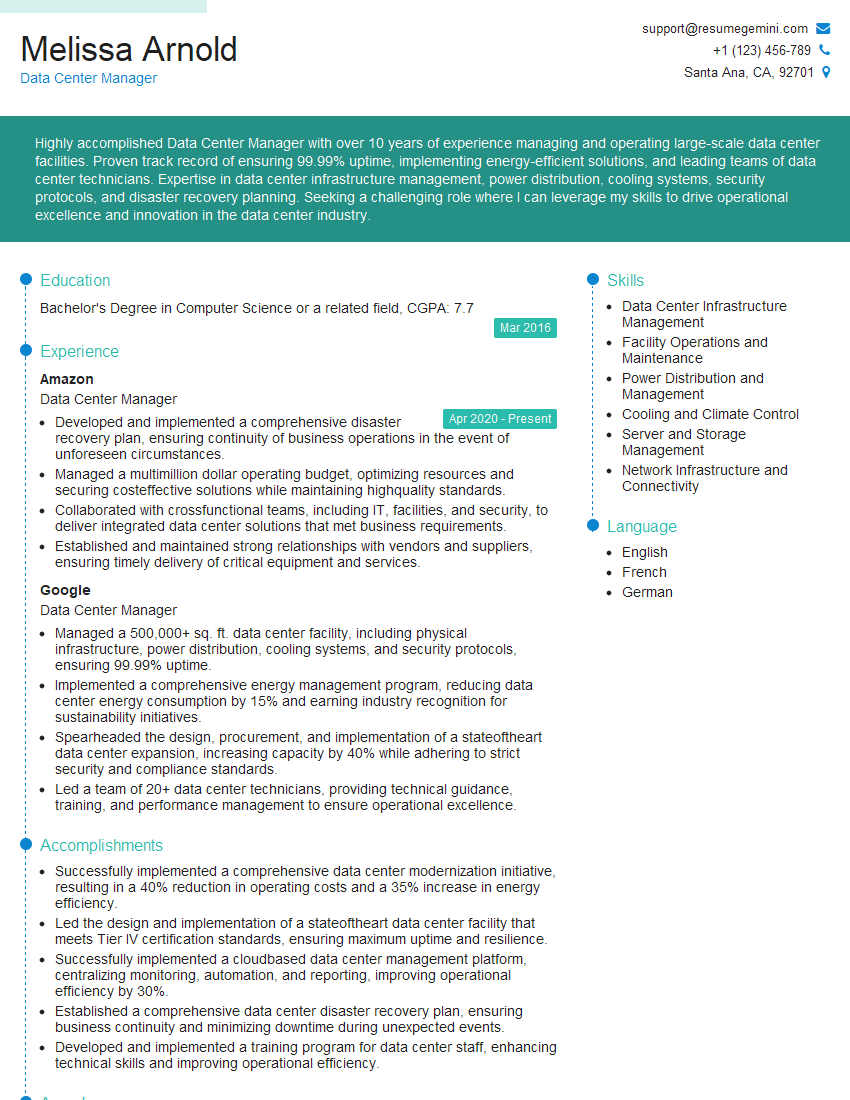
Mastering data center installations expertise significantly boosts your career prospects, opening doors to high-demand roles with excellent compensation and growth potential. A strong resume is your key to unlocking these opportunities. Creating an ATS-friendly resume is crucial for getting your application noticed. ResumeGemini is a trusted resource that can help you build a compelling and effective resume that highlights your skills and experience in data center installations. Examples of resumes tailored to this field are available within ResumeGemini to guide you.
Explore more articles
Users Rating of Our Blogs
Share Your Experience
We value your feedback! Please rate our content and share your thoughts (optional).
What Readers Say About Our Blog
To the interviewgemini.com Webmaster.
Very helpful and content specific questions to help prepare me for my interview!
Thank you
To the interviewgemini.com Webmaster.
This was kind of a unique content I found around the specialized skills. Very helpful questions and good detailed answers.
Very Helpful blog, thank you Interviewgemini team.