Are you ready to stand out in your next interview? Understanding and preparing for External Dosimetry interview questions is a game-changer. In this blog, we’ve compiled key questions and expert advice to help you showcase your skills with confidence and precision. Let’s get started on your journey to acing the interview.
Questions Asked in External Dosimetry Interview
Q 1. Explain the principles of external dosimetry.
External dosimetry is the measurement of ionizing radiation exposure from sources outside the body. It’s crucial for protecting individuals working in environments with potential radiation hazards, like nuclear power plants, hospitals using radiation therapy, and research facilities. The fundamental principle revolves around using radiation detectors to quantify the amount of radiation energy deposited in a specific volume, usually a phantom or a personal dosimeter, simulating the radiation interaction with human tissue. This allows us to estimate the dose received by individuals, enabling appropriate risk mitigation and management.
Think of it like measuring the intensity of sunlight. We don’t directly measure the sun’s energy, but we can measure the amount of sunlight hitting a specific surface area – this measurement is analogous to external dosimetry. The bigger the surface and the stronger the sun, the greater the energy deposited. Similarly, a larger dose will result from stronger radiation fields and longer exposure times.
Q 2. Describe different types of external radiation detectors used in dosimetry.
Several types of radiation detectors are used in external dosimetry, each with its strengths and limitations. Common examples include:
- Thermoluminescent Dosimeters (TLDs): These are small crystals (usually lithium fluoride) that store energy when exposed to radiation. Heating them releases this energy as light, the intensity of which is proportional to the radiation dose received. TLDs are relatively inexpensive, robust, and provide a good overall dose assessment.
- Optically Stimulated Luminescence Dosimeters (OSLDs): Similar to TLDs, OSLDs store energy upon radiation exposure. However, instead of heat, a laser stimulates the release of light, offering higher sensitivity and reusability compared to TLDs.
- Film Badges: These utilize photographic film that darkens upon radiation exposure, the degree of darkening correlating with the dose. They are a simpler, more established technology but less sensitive and more prone to errors from environmental factors like light and humidity.
- Electronic Personal Dosimeters (EPDs): These are sophisticated devices that provide real-time radiation monitoring. They offer immediate dose readings but require regular calibration and may be more susceptible to environmental influences and damage.
The choice of detector depends on factors such as the type of radiation being monitored, required sensitivity, budget, and the need for real-time monitoring or retrospective dose assessment.
Q 3. What are the limitations of various personal dosimeters?
Personal dosimeters, while invaluable, have limitations. Some key limitations include:
- Energy Dependence: Some dosimeters respond differently to various radiation energies, leading to underestimation or overestimation of the actual dose. For example, a film badge might be less sensitive to low-energy photons compared to high-energy photons.
- Directional Dependence: The response of a dosimeter may vary depending on the angle of incident radiation. This is especially true for film badges and some TLD configurations.
- Environmental Effects: Temperature, humidity, and light can affect the readings of some dosimeters, leading to inaccurate results. For example, high temperatures can affect the performance of TLDs.
- Limited Dose Range: Dosimeters have a limited measurable dose range. Exceeding this range can saturate the detector, leading to an inaccurate reading or no reading at all.
- Readout errors: Human error in the reading and interpretation of dosimeter data can also lead to inaccurate results. This is especially relevant for TLD and film badges which require laboratory analysis.
Understanding these limitations is crucial for appropriate interpretation of dosimetry results and risk assessment.
Q 4. How do you calibrate and maintain dosimeters?
Calibration and maintenance are vital for ensuring the accuracy of dosimeters. The procedure typically involves:
- Calibration: Dosimeters are calibrated using traceable radiation sources with known dose rates. This establishes a relationship between the detector’s response and the actual radiation dose. Calibration procedures vary depending on the dosimeter type and regulatory requirements. National standards laboratories provide traceable calibration services.
- Regular Checks: Routine inspections ensure the dosimeter’s physical integrity and functionality, checking for any signs of damage or malfunctions.
- Proper Storage: Dosimeters should be stored under appropriate conditions to minimize environmental effects. This may involve specific temperature and humidity control.
- Record Keeping: Meticulous records must be kept for each dosimeter, including its calibration history, usage history, and any repairs or replacements. This ensures traceability and accountability.
Calibration is often conducted at regular intervals (e.g., annually or as specified by regulatory bodies) to maintain accuracy. Proper calibration and maintenance are critical for reliable dose estimations.
Q 5. What are the regulatory requirements for external dosimetry?
Regulatory requirements for external dosimetry vary depending on the country and the specific industry. However, common elements include:
- Dose Limits: Regulatory bodies (e.g., NRC in the US, IAEA internationally) establish dose limits for occupational exposure to ionizing radiation, which must be adhered to. These limits are often differentiated based on the type of radiation and the individual’s age and profession.
- Dosimetry Programs: Organizations employing workers potentially exposed to radiation are often required to implement comprehensive dosimetry programs. This includes providing personal dosimeters, monitoring radiation levels, and maintaining accurate records.
- Record Keeping: Detailed records of individual radiation exposures must be maintained for each worker. These records must be readily accessible for inspection by regulatory authorities.
- Training and Education: Workers must receive adequate training on radiation safety and the use of personal dosimeters.
- Incident Reporting: Any incidents involving significant radiation exposures must be promptly reported to the relevant authorities.
Non-compliance with these regulations can result in significant penalties and legal repercussions. Adherence to these standards is paramount for ensuring worker safety and public health.
Q 6. Explain the concept of effective dose and equivalent dose.
Effective dose and equivalent dose are both important metrics used in radiation protection, but they account for different aspects of radiation exposure:
- Equivalent Dose (HT): This considers the type and energy of radiation. Different types of radiation have different biological effectiveness. For example, alpha particles cause more damage per unit of energy deposited than beta particles or gamma rays. The equivalent dose is calculated by multiplying the absorbed dose (in Gray, Gy) by a radiation weighting factor (WR) specific to the type of radiation:
HT = WT * D, whereHTis equivalent dose,WTis radiation weighting factor, andDis the absorbed dose. - Effective Dose (E): This metric takes into account both the type and energy of radiation (as in equivalent dose) and the sensitivity of different organs and tissues to radiation. Some organs are more sensitive to radiation than others (e.g., bone marrow is more radiosensitive than skin). The effective dose is calculated by multiplying the equivalent dose in each organ or tissue by a tissue weighting factor (wT) and summing the results. This provides a single value representing the overall health risk from the radiation exposure:
E = Σ wT * HTwhereEis the effective dose,wTis the tissue weighting factor, andHTis the equivalent dose to a specific tissue.
In short, equivalent dose considers the type of radiation, while effective dose considers both the type of radiation and the sensitivity of different organs and tissues, providing a more comprehensive measure of health risk.
Q 7. How do you interpret dosimetry reports?
Interpreting dosimetry reports requires careful attention to detail and an understanding of the terminology used. A typical report will include:
- Personal Information: The worker’s name, identification number, and the period of monitoring.
- Dose Values: The reported dose will be expressed in units of Sieverts (Sv) or millisieverts (mSv) for effective dose and in units of Sieverts (Sv) or millisieverts (mSv) for equivalent dose, along with the type of radiation detected.
- Calibration Information: Details on the dosimeter’s calibration, including the date and the calibration facility.
- Uncertainty: The report will state the uncertainty associated with the dose measurement.
- Compliance Status: The report will indicate whether the measured dose is within regulatory limits.
If any dose values exceed regulatory limits, further investigation is required to identify the source of exposure and implement corrective actions. The report should also specify whether the dosimeter is still usable or requires replacement. Clear communication of results, including uncertainty quantification, is key to effective radiation protection.
Q 8. Describe the process of investigating a high dose event.
Investigating a high dose event in external dosimetry is a critical process requiring a swift and thorough response. It begins with immediate actions to ensure the safety of the individuals involved and the environment. This involves evacuating the area if necessary and implementing emergency procedures. Next, a detailed reconstruction of the event is undertaken. This involves gathering information from multiple sources: interviews with witnesses, review of radiation monitoring equipment readings from the time of the incident (both personal and area monitors), and analysis of work procedures to determine what went wrong. A crucial step is the precise determination of the radiation source, its type, and the duration and geometry of exposure. This information is then used to model the event and estimate the dose received by each individual. Physical dosimeters, such as TLDs or film badges worn by individuals, are analyzed to obtain a quantitative measurement of the dose. The results are then compared against the modeled dose to ensure consistency and accuracy. Any discrepancies necessitate further investigation. Finally, a comprehensive report is generated documenting the incident, the investigation process, the estimated doses, and any recommendations for preventing similar incidents in the future. For example, a high dose event could stem from an accidental release of radioactive material in a nuclear medicine facility, prompting detailed assessment of the source’s characteristics, location of personnel, and type of radiation emitted (gamma, beta, X-ray, etc.), to precisely recreate the dose received.
Q 9. What are the different types of radiation weighting factors and how are they used?
Radiation weighting factors (wR) are dimensionless coefficients used to account for the different biological effectiveness of various types of ionizing radiation. They are applied to the absorbed dose to obtain the equivalent dose, a quantity that better reflects the potential harm from radiation exposure. The weighting factor for different radiation types reflects the relative biological effectiveness (RBE) – essentially, how much more damaging a specific type of radiation is compared to a reference radiation (usually X or gamma rays). For example, alpha particles have a higher wR (20) than gamma rays (1) because alpha particles cause more damage to DNA for a given absorbed dose. We have different types of weighting factors according to what quantity is being calculated. The main ones are:
- Radiation weighting factor (wR): Used to calculate equivalent dose (H) from absorbed dose (D). The formula is: H = Σ wR DR, where the sum is over all types of radiation, R. This accounts for different biological effects based on the type of radiation.
- Tissue weighting factor (wT): Used to calculate effective dose (E) from equivalent dose (H). The formula is: E = Σ wT HT, where the sum is over all tissues and organs, T. This accounts for the varying radiosensitivity of different organs and tissues.
These factors are crucial for radiation protection because they allow for a more accurate assessment of the health risks associated with exposure to various types of ionizing radiation.
Q 10. Explain the difference between film badges and thermoluminescent dosimeters (TLDs).
Both film badges and thermoluminescent dosimeters (TLDs) are passive dosimetry devices used to measure external radiation exposure, but they operate on different principles.
- Film badges utilize photographic film that darkens when exposed to ionizing radiation. The degree of darkening is proportional to the radiation dose received. They are relatively inexpensive but offer limited sensitivity and dynamic range, and are susceptible to environmental factors (temperature, humidity, light) that could affect film density readings. The film is processed after a period of wear, typically a month, and results are obtained as an assessment of the total dose.
- Thermoluminescent dosimeters (TLDs) contain materials (usually lithium fluoride crystals) that store energy when exposed to ionizing radiation. Upon heating, this stored energy is released as light, the intensity of which is proportional to the absorbed dose. TLDs offer higher sensitivity and a wider dynamic range compared to film badges, and are less affected by environmental factors. They can be reused after processing. Individual crystals can be analyzed for different radiation types.
In summary: TLDs are generally preferred due to their superior sensitivity, wider range, and reusability, while film badges offer a cheaper but less accurate solution.
Q 11. How do you assess the uncertainty in dosimetry measurements?
Assessing uncertainty in dosimetry measurements is vital to ensure the reliability of radiation protection programs. Uncertainty arises from various sources, including:
- Calibration uncertainties: Inaccuracies in the calibration of dosimeters contribute to uncertainty.
- Measurement uncertainties: Random errors in the reading process, background radiation fluctuations and statistical variations in the number of events counted.
- Dosimeter-specific uncertainties: Energy dependence of the dosimeter, fading (loss of signal over time), and other dosimeter-specific properties introduce uncertainties.
- Environmental factors: Temperature, humidity, and pressure can affect dosimeter readings.
Uncertainty is typically quantified using statistical methods, often expressed as a standard deviation or a confidence interval. For example, a dosimeter reading of 1 mSv might have an associated uncertainty of ±0.1 mSv, signifying a 95% confidence interval of 0.9 mSv to 1.1 mSv. The total uncertainty is usually a combination of all contributing sources, carefully propagated through all the equations. To reduce overall uncertainty, several steps can be adopted: using carefully calibrated instruments, implementing quality control procedures, employing several measurement methods when possible, and using accurate models for assessment of radiation exposure.
Q 12. Discuss the limitations of passive dosimetry techniques.
Passive dosimetry techniques, such as film badges and TLDs, while convenient and widely used, have several limitations:
- Limited information: They provide only a cumulative dose over a certain period, not a real-time measurement of the radiation exposure. This means we don’t know when exposure occurred or whether it was uniform. They usually measure only the total dose regardless of radiation type.
- Energy dependence: The response of passive dosimeters to radiation varies with the energy of the radiation. This can lead to inaccurate measurements if the energy spectrum of the radiation field is unknown or varies significantly.
- Environmental sensitivity: Certain passive dosimeters can be affected by environmental factors (temperature, humidity, light, pressure), leading to inaccuracies in the measurements.
- Limited dynamic range: Some passive dosimeters have limited dynamic ranges, restricting their applicability in situations involving high doses or dose rates.
- Delayed measurement: Results are obtained only after the dosimeters have been processed, which could introduce delays in implementing appropriate radiation safety interventions.
These limitations highlight the need to consider these methods’ restrictions when choosing the appropriate radiation protection tools.
Q 13. What are the advantages and disadvantages of using active dosimetry?
Active dosimetry involves real-time measurement of radiation using electronic instruments, offering advantages over passive methods.
- Advantages: Real-time monitoring enables immediate assessment of radiation levels, which is crucial for rapid response during emergencies or unexpected exposures. They often provide more information, such as dose rate and radiation type. Active systems offer a wider dynamic range and are less sensitive to environmental conditions in most cases. They typically provide higher accuracy and better energy response than passive methods.
- Disadvantages: Active dosimeters are typically more expensive and complex than passive dosimeters. They may require more specialized training for operation and maintenance. Battery life and instrument failure are potential concerns. Dependence on power sources (battery or mains power) is also a concern, whereas passive systems do not require any external source of power. Data can be easily lost if memory is not properly backed up. Data manipulation is possible if the instrument’s security features are weak.
The choice between active and passive dosimetry depends on the specific application and the desired level of detail and response time.
Q 14. Explain the concept of ALARA principle in relation to external dosimetry.
The ALARA principle (As Low As Reasonably Achievable) is a cornerstone of radiation protection, guiding the minimization of radiation exposure to individuals and the public. In relation to external dosimetry, ALARA means implementing all reasonable measures to reduce external radiation dose levels to the lowest possible values. This involves a multifaceted approach.
- Time: Minimizing the time spent in radiation fields. This could involve using remote handling equipment or implementing shorter work cycles in high-radiation areas.
- Distance: Increasing the distance from radiation sources reduces the dose received, following the inverse square law.
- Shielding: Using appropriate shielding materials (e.g., lead, concrete) to attenuate radiation. This could involve designing radiation shielding for equipment or using personal protective equipment.
- Engineering Controls: Designing processes and equipment to minimize radiation exposure through engineering solutions.
The ALARA principle is not about eliminating all radiation exposure—it’s about balancing the benefits of a process (e.g., medical procedures or industrial work) with the risk of radiation exposure. Proper implementation of the ALARA principle relies heavily on robust external dosimetry techniques to monitor and optimize radiation protection measures.
Q 15. What are the potential health effects of external radiation exposure?
The health effects of external radiation exposure depend on several factors: the type and energy of the radiation, the dose received, and the duration of exposure. Low doses generally produce no immediate noticeable effects, but can increase the risk of long-term health problems like cancer. Higher doses can cause acute radiation syndrome (ARS), characterized by nausea, vomiting, fatigue, and potentially death. The severity of ARS depends on the dose received. For example, a high dose exposure to gamma radiation might lead to immediate nausea and vomiting, followed by bone marrow suppression, increased risk of infection and bleeding, and potentially organ failure. Lower doses from prolonged exposure, such as from working near a poorly shielded x-ray machine, may manifest later in life as an increased risk of developing specific cancers, leukemia being a common example. The body’s natural repair mechanisms handle some damage, but significant damage can lead to irreversible cellular changes.
Career Expert Tips:
- Ace those interviews! Prepare effectively by reviewing the Top 50 Most Common Interview Questions on ResumeGemini.
- Navigate your job search with confidence! Explore a wide range of Career Tips on ResumeGemini. Learn about common challenges and recommendations to overcome them.
- Craft the perfect resume! Master the Art of Resume Writing with ResumeGemini’s guide. Showcase your unique qualifications and achievements effectively.
- Don’t miss out on holiday savings! Build your dream resume with ResumeGemini’s ATS optimized templates.
Q 16. Describe the different types of radiation sources encountered in occupational settings.
Occupational settings can expose workers to various radiation sources. X-rays are used extensively in medical imaging and industrial applications. Gamma rays, emitted by radioactive isotopes, are used in radiotherapy, industrial gauging, and nuclear medicine. Beta particles, emitted by radioactive decay, are less penetrating than gamma rays but still pose a risk. Neutron radiation, highly penetrating and very damaging, is encountered in nuclear reactors and particle accelerators. Alpha particles, while highly ionizing, are less penetrating and pose a greater risk if inhaled or ingested rather than from external exposure. Understanding the specific radiation type is crucial in determining appropriate shielding and safety measures. For instance, lead shielding is effective against X-rays and gamma rays, whereas neutron shielding often requires materials like water or concrete.
Q 17. How do you manage and store dosimeters appropriately?
Proper dosimeter management is crucial for accurate radiation monitoring. Dosimeters should be stored in a cool, dry place, away from direct sunlight, extreme temperatures, and strong magnetic fields. These environmental factors can affect dosimeter readings, leading to inaccurate results. They should be stored in their original packaging or in a designated storage container, ensuring that they remain free from damage or contamination. Before issue, dosimeters should be inspected for any signs of damage; damaged dosimeters should be replaced. Additionally, accurate record-keeping is vital, including date of issue, individual assigned, and date of return. A clear, well-organized system allows for easy traceability and efficient management of dosimeters. Proper labeling is also critical for easy identification of each dosimeter and its assigned personnel.
Q 18. Discuss the importance of quality control in external dosimetry.
Quality control in external dosimetry is paramount to ensure accurate and reliable radiation monitoring. This involves regular calibration of dosimeters using a traceable standard, periodic audits of the dosimetry service, and participation in intercomparison programs. Calibration ensures that the dosimeters are accurately measuring the radiation dose. Audits verify that procedures are followed correctly and that equipment is functioning properly. Intercomparison programs, where dosimeters are sent to different laboratories for independent measurement, validate the accuracy and reliability of dosimeter readings. Without rigorous quality control, the data may not be reliable, leading to potentially inaccurate assessment of radiation exposure. This is critical for determining health risks and ensuring the safety of workers.
Q 19. Describe the procedures for handling and disposing of contaminated dosimeters.
Handling and disposing of contaminated dosimeters requires stringent safety protocols to prevent cross-contamination and protect personnel. Contaminated dosimeters should be treated as radioactive waste and managed according to relevant regulations. This typically involves placing the dosimeter in a sealed container, clearly labeling the container with appropriate warning signs indicating radioactive material and the type of contamination, and then following the established procedures for waste disposal based on local and national regulations. Personnel handling contaminated dosimeters should wear appropriate personal protective equipment (PPE) such as gloves, lab coats, and eye protection. Specific procedures may involve using specialized tools and containers to prevent accidental spillage or exposure. The contaminated dosimeter should be transported and stored in a way to minimize the risk of exposure to other personnel.
Q 20. Explain the different methods for calculating effective dose.
Effective dose calculation considers both the type of radiation and the radiosensitivity of different organs. The calculation involves multiplying the absorbed dose in each organ or tissue by a tissue weighting factor (wT) that reflects its relative sensitivity to radiation-induced cancer. The sum of these products gives the effective dose. For example, the absorbed dose to the lungs from a specific exposure might be multiplied by wT for the lungs (0.12). The same calculation is done for all organs and tissues exposed, and the values summed up. This accounts for the different biological effects of radiation depending on where the radiation is deposited within the body. The formula simplifies to: Effective dose (E) = Σ (wT x DT), where wT is the tissue weighting factor and DT is the average absorbed dose in tissue T. This calculation provides a single number that represents the overall health risk associated with a given radiation exposure.
Q 21. What are the reporting requirements for radiation exposure incidents?
Reporting requirements for radiation exposure incidents vary depending on the location and regulatory framework. Generally, any significant radiation exposure incidents exceeding predefined dose limits must be reported to the relevant regulatory authorities, such as the Nuclear Regulatory Commission (NRC) in the United States or equivalent bodies in other countries. This typically involves providing detailed information on the incident, including the individuals exposed, the dose received, the cause of the exposure, and the measures taken to mitigate the situation. The report should be submitted within a specified timeframe. Failure to report significant incidents can lead to serious consequences, including fines and legal action. Thorough investigation and documentation are essential for understanding the cause of the incident and improving safety protocols to prevent similar occurrences.
Q 22. How do you ensure compliance with radiation safety regulations?
Ensuring compliance with radiation safety regulations in external dosimetry is paramount. It’s a multifaceted process involving meticulous record-keeping, adherence to established protocols, and proactive monitoring. This begins with a thorough understanding of the relevant regulations, such as those set forth by the Nuclear Regulatory Commission (NRC) in the US or similar bodies internationally. We must ensure that all personnel working in radiation environments are properly trained and equipped with appropriate personal dosimeters, such as thermoluminescent dosimeters (TLDs) or optically stimulated luminescence (OSL) dosimeters, calibrated to the specific radiation type and energy range.
Regular calibration and quality control checks of our dosimetry system are critical. This ensures accurate measurements and reliable data. We also maintain detailed records of each individual’s dosimeter readings, comparing them against regulatory limits. Any exposure exceeding established limits triggers a prompt investigation to identify the cause and implement corrective actions. This might involve modifying procedures, improving shielding, or providing additional training. Finally, regular audits and inspections are essential to validate our compliance and identify areas for improvement. Think of it like a rigorous quality control system, but for radiation safety.
Q 23. Explain the role of external dosimetry in radiation protection programs.
External dosimetry plays a crucial role in radiation protection programs by providing a quantitative assessment of an individual’s external radiation exposure. It acts as a primary tool for monitoring worker safety and ensuring compliance with regulatory limits. Essentially, dosimeters act as personal radiation monitors, recording the amount of ionizing radiation a worker receives. This data provides critical information for risk assessment and helps identify potential hazards in the work environment. Imagine a construction worker working near a source of radiation – the dosimeter objectively quantifies the radiation dose the worker is exposed to.
The data collected from external dosimetry is essential for several purposes: It allows for the timely identification of any overexposures, enabling immediate intervention to mitigate further risk. It forms the basis for epidemiological studies that contribute to our understanding of long-term health effects associated with radiation exposure. Furthermore, this data is essential for demonstrating compliance to regulatory bodies during inspections and audits, ensuring the safety of the workforce and the public.
Q 24. Discuss the importance of training and education in external dosimetry.
Training and education are foundational to effective external dosimetry. It’s not enough to simply provide workers with dosimeters; they need to understand how these devices work, how to properly wear and handle them, and how to interpret the results. This training must cover the basics of radiation physics, health effects of radiation exposure, and radiation protection principles. It should also include specific instruction on the use of the dosimetry system employed in their work environment, including the types of dosimeters used, reporting procedures, and the interpretation of dosimetry reports.
Regular refresher training is critical, particularly when new regulations are implemented, new technologies are introduced, or when changes in work practices might alter exposure levels. For example, a shift in work location or a change in the source of radiation would require retraining to ensure continued safety. Effective training goes beyond simple lectures; it incorporates practical exercises and hands-on experience to reinforce learning and enhance competence. We utilize scenarios, mock radiation events, and quizzes to ensure that employees understand the importance of accurate dosimetry and safe work practices.
Q 25. How do you communicate dosimetry results to workers?
Communicating dosimetry results to workers requires clarity, accuracy, and sensitivity. Results are typically presented in a clear and concise report, specifying the measured dose in standard units like millisieverts (mSv) or other appropriate units for the specific type of dosimeter used. The report should clearly identify the reporting period and the individual’s personal details. We also explain the significance of the results in plain language, avoiding technical jargon that may confuse the worker.
If a dose exceeds established limits, a detailed explanation of the exceeding dose, along with the necessary steps to prevent future occurrences, is crucial. This communication should not be solely written; we prioritize direct interaction with the worker to address any concerns or questions. We explain the results in a non-judgmental manner, emphasizing the importance of safety and collaboration to prevent future events. If additional medical evaluations or monitoring is necessary, we carefully explain why and how it will be done, ensuring the worker feels supported and informed.
Q 26. Describe your experience with different dosimetry systems.
Throughout my career, I’ve had extensive experience with various dosimetry systems, including thermoluminescent dosimeters (TLDs), optically stimulated luminescence (OSL) dosimeters, and electronic personal dosimeters (EPDs). TLDs utilize the property of certain crystals to store energy upon exposure to radiation and release it as light when heated. OSL dosimeters work on a similar principle, using light stimulation to release stored energy. EPDs offer real-time dose readings, providing immediate feedback on exposure levels.
Each system has its advantages and disadvantages. TLDs are robust and reliable, but provide only a cumulative dose reading. OSL dosimeters offer higher sensitivity and better energy response. EPDs, while providing real-time data, are susceptible to environmental factors and may require more frequent calibration. My experience involves not just using these systems but also in evaluating their performance, selecting the most appropriate system based on the specific application and radiation field, and troubleshooting any issues that might arise.
Q 27. Explain the challenges in measuring external radiation exposure in complex environments.
Measuring external radiation exposure in complex environments presents significant challenges. Inconsistent radiation fields, multiple radiation sources, and scattering from various materials all contribute to measurement difficulties. For instance, imagine trying to measure radiation exposure in a nuclear power plant – it is extremely complex due to varied sources of radiation and different materials that scatter and attenuate radiation. The presence of shielding materials can influence dose measurements, potentially leading to underestimation if not accounted for properly.
These complexities require sophisticated dosimetry techniques and modelling to accurately determine the actual dose received. It often involves using computational models to simulate the radiation transport and energy deposition in the complex geometry of the environment. Calibration of dosimeters should be performed under conditions that accurately reflect the expected field conditions, including considering angular dependence and energy spectrum. This is a very challenging aspect of the field that demands a high level of technical expertise and detailed knowledge of radiation physics.
Q 28. How do you stay current with advances in external dosimetry techniques and regulations?
Staying current in external dosimetry necessitates a continuous learning process. I actively participate in professional organizations such as the Health Physics Society, attending conferences, workshops and webinars to learn about the latest advancements in measurement techniques and regulatory changes. I regularly review relevant scientific publications and regulatory updates to ensure my knowledge is up-to-date. Participation in professional development courses allows me to stay abreast of new dosimeter technologies, data analysis software, and computational modelling tools.
Furthermore, I maintain a strong network with colleagues in the field, engaging in discussions and sharing experiences to stay informed about emerging challenges and best practices. This continual learning ensures that our radiation safety program remains at the forefront of safety standards, using the most advanced tools and techniques, safeguarding the health of our workforce and maintaining compliance with all regulations.
Key Topics to Learn for External Dosimetry Interview
- Radiation Detection and Measurement: Understand different types of radiation detectors (e.g., Geiger-Müller counters, scintillation detectors), their principles of operation, and limitations. Practice calculating radiation exposure from detector readings.
- Dosimetry Models and Calculations: Familiarize yourself with different dosimetry models (e.g., point kernel, Monte Carlo) and their applications in estimating organ doses. Practice solving problems related to dose calculations from known radiation sources.
- Radiation Protection Principles: Thoroughly understand ALARA principles, regulatory limits (e.g., ICRP recommendations), and safety procedures relevant to external dosimetry. Be prepared to discuss practical applications of these principles in various scenarios.
- Calibration and Quality Assurance: Understand the importance of instrument calibration and quality assurance procedures in ensuring accurate dosimetry measurements. Be prepared to discuss methods for calibration verification and uncertainty analysis.
- Specific Applications of External Dosimetry: Explore specific applications of external dosimetry in various fields such as nuclear power, medical physics, and environmental monitoring. Be ready to discuss case studies and challenges encountered in these applications.
- Health Physics and Regulatory Compliance: Gain a strong understanding of the relevant health physics regulations and standards related to external radiation exposure and reporting requirements.
- Data Analysis and Interpretation: Develop skills in analyzing dosimetry data, interpreting results, and presenting findings clearly and effectively. Practice presenting data using graphs and tables.
Next Steps
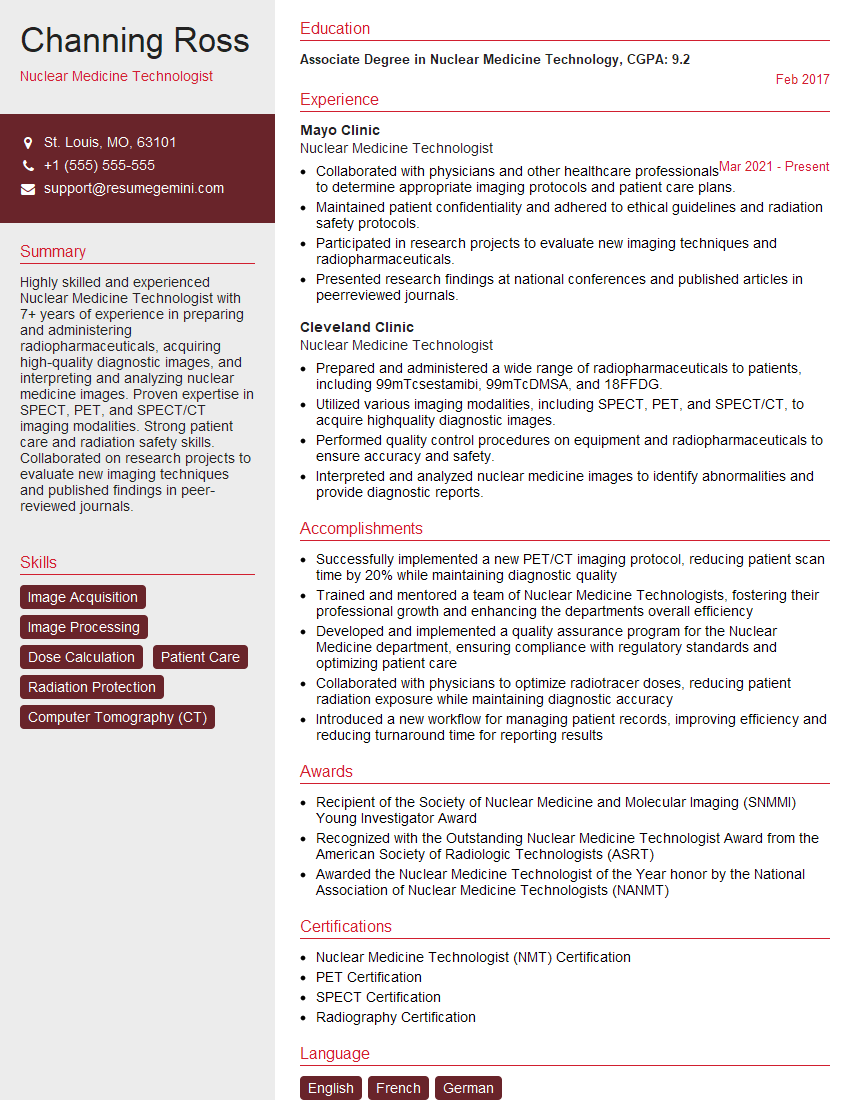
Mastering External Dosimetry opens doors to exciting career opportunities in radiation protection, nuclear engineering, and medical physics. A strong understanding of these principles is highly valued by employers. To significantly enhance your job prospects, it’s crucial to create a compelling and ATS-friendly resume that showcases your skills and experience effectively. ResumeGemini is a trusted resource that can help you build a professional resume tailored to the specific requirements of External Dosimetry positions. Examples of resumes tailored to this field are available on ResumeGemini to guide you through the process. Invest time in crafting a powerful resume; it’s your first impression on potential employers.





Explore more articles
Users Rating of Our Blogs
Share Your Experience
We value your feedback! Please rate our content and share your thoughts (optional).
What Readers Say About Our Blog
To the interviewgemini.com Webmaster.
Very helpful and content specific questions to help prepare me for my interview!
Thank you
To the interviewgemini.com Webmaster.
This was kind of a unique content I found around the specialized skills. Very helpful questions and good detailed answers.
Very Helpful blog, thank you Interviewgemini team.