Are you ready to stand out in your next interview? Understanding and preparing for Fiber Optic Cable Installation and Maintenance interview questions is a game-changer. In this blog, we’ve compiled key questions and expert advice to help you showcase your skills with confidence and precision. Let’s get started on your journey to acing the interview.
Questions Asked in Fiber Optic Cable Installation and Maintenance Interview
Q 1. Explain the difference between single-mode and multi-mode fiber optic cables.
The core difference between single-mode and multi-mode fiber optic cables lies in their core size and the number of light paths they support. Think of it like this: a single-mode fiber is like a single-lane highway, allowing only one light signal to travel efficiently over long distances. A multi-mode fiber is like a multi-lane highway, allowing multiple light signals to travel simultaneously, but with greater signal degradation over longer distances.
- Single-mode fiber: Has a smaller core diameter (around 8-10 microns), allowing only one mode of light to propagate. This results in lower attenuation and higher bandwidth, making it ideal for long-haul telecommunications and high-speed data transmission. The laser light source used for single mode is monochromatic, meaning it has only a single wavelength of light, which is what enables the long distance transmission with minimal loss.
- Multi-mode fiber: Has a larger core diameter (50 or 62.5 microns), allowing multiple modes of light to propagate. This leads to higher attenuation and lower bandwidth compared to single-mode, making it suitable for shorter distances and lower bandwidth applications like local area networks (LANs) or connecting equipment within a building. Multi-mode fibers can usually use LED light sources, which are less expensive and produce less intense light than lasers required for single mode.
In essence, choosing between single-mode and multi-mode depends on the distance of the transmission and the required bandwidth. Long distances and high bandwidth necessitate single-mode, while shorter distances and lower bandwidth needs can be met by multi-mode fibers, which are often more cost-effective.
Q 2. Describe the process of fusion splicing fiber optic cables.
Fusion splicing is a precise method of permanently joining two fiber optic cables by melting their ends together. It’s like welding, but on a microscopic scale. The process ensures minimal signal loss and a strong, reliable connection. Here’s a step-by-step overview:
- Fiber Preparation: The cable ends are carefully cleaved to create a perfectly perpendicular and smooth surface. This is crucial for a strong splice. Imperfect cleaves lead to increased signal loss.
- Clamping: The cleaved fiber ends are precisely aligned within the fusion splicer’s clamps. The alignment must be extremely accurate to ensure minimal signal loss.
- Fusion: An electric arc is generated to melt the fiber ends, fusing them together. The splicer precisely controls the arc’s intensity and duration to ensure a perfect weld.
- Inspection: The splicer’s optical power meter measures the signal loss at the splice. A good splice should have minimal loss (typically less than 0.1dB).
- Coating: A protective coating is applied to protect the fused joint from environmental factors.
Fusion splicing requires specialized equipment and training. It’s a critical skill for fiber optic technicians, and a poorly executed splice can significantly degrade the performance of the entire fiber optic link. Think of it like welding two metal pipes – a poorly executed weld will cause leaks, similarly a poor fusion splice will lead to signal loss.
Q 3. What are the common causes of fiber optic cable attenuation?
Attenuation in fiber optic cables refers to the loss of optical power as the light signal travels along the fiber. Several factors can contribute to this:
- Absorption: The fiber material itself absorbs some of the light energy. This is dependent on the wavelength of light and the fiber type.
- Scattering: Imperfections within the fiber cause the light to scatter in different directions, reducing the amount of light reaching the destination. This is more prevalent in multi-mode fibers.
- Bending Losses: Excessive bending of the fiber causes light to leak out of the core, increasing attenuation. Sharp bends cause more losses than gradual bends.
- Connectors and Splices: Imperfect connectors or splices introduce additional signal loss due to misalignment and reflections.
- Environmental Factors: Factors like temperature variations can affect the fiber’s refractive index and lead to higher attenuation.
Understanding these causes helps in identifying and addressing attenuation issues. For instance, proper cable handling, choosing the right fiber type for the application and employing high-quality connectors and splicing techniques can minimize attenuation losses.
Q 4. How do you test for fiber optic cable continuity?
Testing for fiber optic cable continuity involves verifying the physical and optical path is unbroken. This involves two key steps:
- Visual Inspection: A thorough visual inspection of the fiber cable is the first step. Check for any physical damage such as cuts, kinks, or breaks.
- Optical Power Meter (OPM) and Light Source: An OPM is used to measure the optical power at the receiving end when a known power level is injected at the sending end using a light source. A successful test confirms that the signal can travel through the entire cable length without significant attenuation.
- Optical Time-Domain Reflectometer (OTDR): An OTDR is a more sophisticated tool that can pinpoint the location and severity of faults or breaks along the fiber. It sends a light pulse down the fiber and analyzes the reflections to identify events like splices, connectors, and faults.
The choice of testing method depends on the complexity of the system and the level of detail required. A simple OPM and light source is sufficient for basic continuity checks. An OTDR is necessary for more detailed analysis, especially when troubleshooting signal loss problems.
Q 5. What safety precautions should be taken when working with fiber optic cables?
Working with fiber optic cables requires strict adherence to safety precautions to avoid eye injuries and other hazards:
- Eye Protection: Always wear appropriate eye protection designed to filter out laser light. This is especially important during testing and splicing where intense light sources are used. Regular eyeglasses won’t suffice.
- Protective Clothing: Wear gloves and protective clothing to avoid cuts and contamination.
- Proper Handling: Avoid excessive bending, twisting or kinking of the cables that can damage the fibers.
- Laser Safety Awareness: Understand the potential hazards of laser light and follow safety procedures. Never look directly into the light source.
- Grounding: Proper grounding should be implemented when working in situations with potential static discharge, which can damage sensitive fiber optic components.
- Caution with Splicing Equipment: Be extremely careful while handling fusion splicing equipment to avoid burns and electrical shock.
Ignoring these safety precautions can lead to serious injuries. It’s essential to receive proper training and adhere strictly to safety protocols at all times.
Q 6. Explain the different types of fiber optic connectors and their applications.
Several types of fiber optic connectors are used, each with its own application:
- SC (Subscriber Connector): A popular connector known for its push-pull mechanism, offering a reliable and simple connection. Commonly used in telecommunications and data centers.
- LC (Lucent Connector): A smaller, high-density connector, suitable for applications where space is limited, like high-density patch panels in data centers.
- FC (Ferrule Connector): A bayonet-style connector known for its robust and high-precision connection; often preferred for applications requiring high stability and durability.
- ST (Straight Tip): A simple push-pull connector, used in older applications. Its popularity has declined due to the rise of better, more reliable connectors.
- MT-RJ (Mechanical Transfer-Registered Jack): A duplex connector (containing two fibers) designed for high density applications.
The choice of connector depends on the specific application requirements, including density needs, required performance, and environmental factors. For example, LC connectors are favored in data centers due to their space-saving design, while FC connectors might be chosen in harsh environments where durability is crucial.
Q 7. How do you identify different types of fiber optic cable damage?
Identifying fiber optic cable damage requires a multi-faceted approach:
- Visual Inspection: This is the first and most important step. Look for physical signs of damage, such as cuts, cracks, kinks, or crushed areas along the cable’s length. Also carefully inspect connector ends for damage or contamination.
- OTDR Testing: An OTDR can detect subtle forms of damage that are not visible to the naked eye. It can locate breaks, macrobends (large radius bends) and microbends (small radius bends) within the cable.
- Optical Loss Testing: By measuring the optical power at various points along the fiber, significant attenuation can indicate the presence of unseen damage or faults.
- Testing for Return Loss and Reflections: An OTDR can measure return loss, which indicates the amount of light reflected back at connectors and splices. High return loss indicates poor connector quality or other problems causing signal loss.
By combining visual inspection with advanced testing methods, you can accurately identify and locate the source of fiber optic cable damage, which is essential for prompt repair and restoration of network connectivity.
Q 8. Describe the process of terminating fiber optic cables.
Terminating fiber optic cables involves preparing the fiber end for connection to a connector. Think of it like meticulously preparing the end of a rope to attach a strong hook – precision is key. The process generally follows these steps:
- Cutting the fiber: Use a fiber optic cleaver to create a perfectly perpendicular and smooth end face. A poorly cleaved end will significantly impact signal quality.
- Stripping the coating and buffer layers: Carefully remove the outer jacket, strength members, and buffer coating using specialized stripping tools, exposing the fiber core without damaging it. Think of this like carefully peeling an onion, layer by layer.
- Cleaning the fiber end: Use a lint-free wipe and isopropyl alcohol to ensure a clean, dust-free surface. Even microscopic particles can severely degrade signal transmission.
- Preparing the connector: This involves inserting the prepared fiber into the chosen connector (e.g., SC, LC, ST) and ensuring proper alignment.
- Curing (if applicable): Some connectors require curing with UV light or heat to set the adhesive that secures the fiber.
- Testing: Always test the termination using an OTDR (Optical Time Domain Reflectometer) to verify proper connection and identify any signal loss or reflections.
Failing to follow these steps precisely can lead to poor signal quality, high attenuation (signal loss), and connection failures. A well-terminated fiber connection ensures reliable high-speed data transmission.
Q 9. What tools and equipment are essential for fiber optic cable installation and maintenance?
Fiber optic cable installation and maintenance requires specialized tools to handle the delicate nature of the fiber. Essential equipment includes:
- Fiber Optic Cleaver: For creating a precise and perpendicular cleave on the fiber end.
- Fiber Stripping Tools: For removing the outer jacket and buffer coating without damaging the fiber.
- Fusion Splicer: For permanently joining two fiber ends using heat and pressure, creating a near-invisible splice.
- Optical Power Meter (OPM): Measures the optical power level in a fiber optic link.
- OTDR (Optical Time Domain Reflectometer): Locates faults and measures signal loss in fiber optic cables.
- Fiber Optic Connectors and Adapters: Provide connection points between fiber optic cables and equipment.
- Cleaning Supplies: Lint-free wipes, isopropyl alcohol, and fiber optic cleaning pens are crucial for maintaining cleanliness and preventing signal loss.
- Cable Management Tools: Includes cable ties, rings, and trays for organization and strain relief.
- Safety Glasses: Essential to protect your eyes from flying debris during cable preparation and cutting.
The specific tools will depend on the job, whether it’s a simple termination or a complex network installation. Remember, safety is paramount when handling fiber optic equipment.
Q 10. What are the different types of fiber optic cable testing equipment?
Several types of fiber optic testing equipment are used to ensure network performance and identify faults. Key examples include:
- Optical Power Meter (OPM): Measures the absolute power level of an optical signal at a specific wavelength. It’s like a voltmeter for light, measuring the strength of the signal. Think of it as checking the ‘volume’ of your light signal.
- OTDR (Optical Time Domain Reflectometer): This is the workhorse for troubleshooting fiber optic networks. It measures signal reflections along the fiber’s length, allowing for the location and identification of faults (discussed further below).
- Optical Light Source (OLS): Generates a stable light signal at a specific wavelength for testing fiber optic links. This provides the ‘light’ for the OPM and OTDR to measure.
- Fiber Inspection Scope: Allows visual inspection of fiber connectors for cleanliness and damage. It’s crucial for ensuring clean connectors that minimize signal loss.
- Visual Fault Locator (VFL): Uses a visible light source to trace fiber optic cables. It’s incredibly helpful in identifying the physical path of the cable, particularly useful in large or complex installations.
Each tool plays a vital role in ensuring a reliable fiber optic infrastructure.
Q 11. Explain the concept of Optical Time Domain Reflectometry (OTDR) and its use in troubleshooting.
Optical Time Domain Reflectometry (OTDR) is a powerful technique used to test and troubleshoot fiber optic cables. Imagine it as a sophisticated sonar for light. It sends short pulses of light down the fiber and measures the amount of light reflected back at different points. These reflections are caused by imperfections in the fiber, connectors, or splices.
The OTDR can pinpoint the location and type of fault: a bad connector, a broken fiber, or excessive attenuation (signal loss) along the cable’s length. This enables technicians to quickly identify problems, saving significant time and effort during troubleshooting. It’s particularly useful in long-haul fiber optic networks where pinpointing faults can be extremely challenging without this technology.
Q 12. How do you interpret OTDR results?
Interpreting OTDR results requires understanding the graphical representation of the trace. The horizontal axis represents distance along the fiber, while the vertical axis usually represents the power level of the back reflections in decibels (dB). Key features to look for include:
- Events: Sharp dips or peaks in the trace represent connectors, splices, or breaks. Their location along the distance axis indicates the physical position of these events along the fiber.
- Attenuation: A gradual downward slope in the trace indicates signal loss. Excessive attenuation suggests problems like fiber degradation or bending losses.
- Reflections: High peaks indicate significant reflections, often due to poor connector quality or damage to the fiber end faces.
OTDR software often provides detailed information about these events, such as the exact location, attenuation, and reflection values. Experienced technicians can easily identify the problem area and its cause based on the OTDR trace. A thorough understanding of OTDR results is vital for efficient fiber optic network maintenance.
Q 13. Describe the process of cleaning fiber optic connectors.
Cleaning fiber optic connectors is crucial for ensuring signal quality and preventing connection problems. Even microscopic dust particles or debris can drastically degrade the signal. The process is surprisingly simple but requires care and precision:
- Visual Inspection: First, inspect the connector end face using a fiber inspection scope. This helps identify any contamination.
- Connector Cleaning: Use a specialized fiber optic cleaning pen or a lint-free wipe with isopropyl alcohol to carefully clean the connector ferrule. Always clean in a single, consistent direction to avoid scratching the delicate end face. For connectors with protective caps, remove and clean them as well.
- Re-inspection: After cleaning, inspect the connector again to confirm its cleanliness.
Using appropriate cleaning techniques prevents damaging the delicate fiber end face and ensures optimal performance. Always use high-quality cleaning supplies to avoid introducing contaminants.
Q 14. What are the different types of fiber optic cable routing methods?
Fiber optic cable routing methods depend on the environment and application. The goal is to protect the cables from damage and ensure efficient signal transmission.
- Aerial routing: Cables are suspended above ground using various methods such as aerial cable trays, lashed to existing lines, or supported by poles. This is common in long-haul applications.
- Underground routing: Cables are buried underground in conduits or trenches. This is typically used in areas where cables are exposed to harsh environmental conditions or vandalism.
- Indoor routing: Cables are run within buildings through pathways, ducts, and cable trays. Careful planning is necessary to prevent cable damage and maintain easy accessibility.
- Microducting: Small-diameter tubes are installed underground or within buildings, through which fiber optic cables can be blown or pulled. This is a cost-effective method for adding future capacity.
Each method requires different tools, techniques, and considerations to ensure the cables are properly protected and maintained throughout their service life. Careful planning and the selection of the correct routing method is crucial for a successful fiber optic network deployment.
Q 15. How do you manage slack in fiber optic cables?
Managing slack in fiber optic cables is crucial for preventing stress on the fibers, which can lead to signal degradation or breakage. Think of it like giving a phone cord extra length – it prevents it from getting yanked and breaking. We use several methods:
Slack loops: Creating loops of slack at regular intervals, particularly at cable entry points and splice closures. The size of the loop depends on the cable length and potential for movement. Too little slack and the cable is stressed; too much and you have a management nightmare.
Slack storage: Utilizing designated areas within cable trays or racks to store excess cable. This keeps the slack organized and readily accessible for future maintenance.
Cable grips and strain relief: Employing specialized clamps or grips to secure the cable and prevent pulling or tension. These are especially vital near termination points.
Proper cable routing: Avoiding sharp bends or kinks in the cable during installation. Using cable guides and management systems helps prevent stress and keeps the routing neat.
For example, in a building installation, we’d create slack loops at each floor level and in the equipment room. Improper slack management can lead to costly repairs down the line.
Career Expert Tips:
- Ace those interviews! Prepare effectively by reviewing the Top 50 Most Common Interview Questions on ResumeGemini.
- Navigate your job search with confidence! Explore a wide range of Career Tips on ResumeGemini. Learn about common challenges and recommendations to overcome them.
- Craft the perfect resume! Master the Art of Resume Writing with ResumeGemini’s guide. Showcase your unique qualifications and achievements effectively.
- Don’t miss out on holiday savings! Build your dream resume with ResumeGemini’s ATS optimized templates.
Q 16. What are the common problems encountered during fiber optic cable installation?
Fiber optic cable installation presents several challenges. These can range from simple errors to significant environmental issues. Common problems include:
Microbends: Tiny bends in the fiber, often caused by excessive tension or improper handling, which significantly attenuate the signal.
Macrobends: Large bends that are easily visible and cause significant signal loss or complete failure. These can be caused by improper cable routing.
Incorrect splicing: Improper fusion splicing or mechanical splicing leads to signal loss and potential fiber damage.
- Environmental factors: Rodents chewing through cables, water ingress into cable closures, or extreme temperature fluctuations can all cause significant problems.
Difficult terrain: Installing cables in confined spaces, aerial installations, or underground conduits can present logistical challenges.
Improper grounding: Lack of proper grounding can lead to electromagnetic interference (EMI), impacting signal quality and network stability.
For instance, we once encountered a situation where rodents had chewed through a section of buried fiber, causing a major outage. That highlighted the need for rodent-resistant cable jackets in certain environments.
Q 17. How do you troubleshoot a fiber optic network outage?
Troubleshooting a fiber optic network outage requires a systematic approach. It’s like solving a detective mystery!
Identify the scope of the outage: Determine which parts of the network are affected. Is it a single user, a segment, or the entire network?
Check for obvious physical problems: Inspect the cables for any visible damage, loose connections, or signs of rodent activity. Look at the connectors at both ends – are they properly seated?
Use an Optical Time-Domain Reflectometer (OTDR): This powerful tool helps pinpoint breaks, splices, and other anomalies along the fiber. It’s essential for identifying the exact location of a fault.
Test the power supply and equipment: Ensure that all equipment is properly powered and functioning. A simple power problem can mimic a fiber failure.
Inspect the optical connectors: Check for dirt, scratches, or damage to the end-faces. Clean connectors using appropriate cleaning tools.
Check the light levels at various points: Use an optical power meter to measure the light levels at different points in the network, helping isolate the section with the problem.
Consult network maps and documentation: Use diagrams and records of the fiber network layout to guide your troubleshooting efforts.
Remember, patience is key. A methodical approach is more likely to lead to a quick resolution than frantic guesswork.
Q 18. Explain the importance of proper grounding and shielding in fiber optic systems.
Proper grounding and shielding in fiber optic systems is essential to prevent electromagnetic interference (EMI) and protect the system from electrical surges. While fiber itself is not directly susceptible to electrical current, the surrounding equipment (like repeaters, terminations, etc.) is definitely vulnerable.
Grounding provides a path for stray electrical currents to safely dissipate into the earth, preventing them from causing noise or damage. Think of it like a lightning rod, diverting the charge away from delicate components. Improper grounding can lead to signal noise, data corruption, or equipment failure.
Shielding involves using conductive materials (like metallic layers within the cable or around equipment) to block external electromagnetic fields. This prevents EMI from interfering with the optical signal. Without shielding, external sources of electromagnetic radiation (like radio waves or power lines) could introduce noise into the system.
An example of why this is crucial is in a data center where many electrical devices operate close to fiber optic cables. Proper grounding and shielding will help ensure the integrity of the data transmitted, preventing costly downtime.
Q 19. What are the different types of fiber optic cable closures?
Fiber optic cable closures are protective housings that seal and protect fiber optic splices or connections. Different types cater to various environmental conditions and installation needs.
Wall-mount closures: These are smaller closures typically used for splicing cables in buildings or less harsh environments.
Splice trays: Used for organizing and protecting multiple splices within larger enclosures.
Direct-buried closures: Designed for direct burial in the ground, often featuring robust seals and protection against water ingress.
Aerial closures: Attached to aerial cables, typically designed to withstand harsh weather conditions.
Pedestal closures: Larger enclosures, often used in underground or aerial applications where access is needed for splicing or maintenance.
The choice of closure depends on the specific application and environmental factors. For example, a direct-buried closure would be inappropriate for an aerial installation because it wouldn’t handle the stresses caused by wind and temperature changes.
Q 20. Describe the process of installing a fiber optic cable in a conduit.
Installing fiber optic cable in a conduit is a common practice for protecting the cable from environmental damage and mechanical stress. It’s like using a protective sleeve for a delicate wire.
Preparation: Ensure the conduit is clean, dry, and free from obstructions. Check the conduit’s diameter to confirm it’s suitable for the cable size.
Lubrication: Apply a suitable lubricant (like pulling lubricant) to the cable to reduce friction during installation.
Pulling the cable: Use a cable pulling grip or winch to carefully pull the cable through the conduit. Avoid excessive tension to prevent damage to the cable.
Cable management: Once the cable is installed, use appropriate cable organizers or ties within the conduit to prevent kinking or tangling.
Inspection: After installation, inspect the cable for any signs of damage. This is usually done using an OTDR, to ensure there is no significant attenuation added by the pulling.
Closure installation: Install appropriate cable closures at both ends of the conduit section to seal and protect the cable.
In a real-world scenario, we would use a fish tape to guide the pulling rope through a long conduit run, before attaching the cable to it and carefully pulling the entire length. Always follow safety procedures to prevent injury or damage.
Q 21. How do you handle fiber optic cable breaks in the field?
Handling fiber optic cable breaks in the field requires quick action and careful repair to minimize downtime. It’s a bit like fixing a broken telephone wire, but with much finer components.
Identify the break location: Use an OTDR to pinpoint the exact location of the break. This is critical for efficient repair.
Access the broken cable: Excavate the area around the break if the cable is underground or access the relevant area if aerial.
Prepare the fiber ends: Carefully clean and prepare the broken fiber ends for splicing using a fiber cleaver and appropriate cleaning supplies.
Splice the fibers: Use either fusion splicing or mechanical splicing techniques to join the broken fiber ends. Fusion splicing is more commonly used as it achieves higher quality and longevity.
Test the splice: Use an OTDR to test the quality of the splice and ensure the loss is within acceptable limits.
Protect the splice: Seal the splice using appropriate materials and cable closures to protect it from environmental damage.
Document the repair: Record the location, date, and details of the repair for future reference.
A crucial aspect is using the right tools and working meticulously to ensure the quality of the splice. A poorly done repair could lead to ongoing signal problems. Always follow safety guidelines when working with fiber optic cables.
Q 22. What is the importance of proper documentation during fiber optic cable installation and maintenance?
Proper documentation is the backbone of any successful fiber optic installation and maintenance project. Think of it as the project’s memory – it ensures continuity, prevents costly errors, and facilitates efficient troubleshooting. Without detailed records, you’re essentially navigating in the dark.
- Installation Documentation: This includes cable routes, splice locations (with precise coordinates), equipment specifications (manufacturer, model, serial number), test results (optical power levels, attenuation), and connection diagrams. Imagine trying to trace a fault in a complex network without knowing where the cables are routed! This detailed information prevents costly rework.
- Maintenance Documentation: This focuses on routine checks, repairs, and upgrades. Detailed logs of maintenance activities, including dates, times, technicians involved, and actions taken, are crucial. This helps track the history of the fiber optic system, predict potential failures and improve future maintenance practices.
- As-Built Drawings: These are updated drawings reflecting the actual installed infrastructure. These serve as a critical reference during future maintenance, upgrades, or troubleshooting. Discrepancies between ‘as-designed’ and ‘as-built’ can lead to significant problems.
In essence, thorough documentation minimizes downtime, reduces costs associated with errors, and ensures the long-term reliability of the fiber optic network. I always emphasize to my team the importance of meticulous record-keeping, and I use a standardized digital documentation system that allows for easy access and sharing of information.
Q 23. Explain the concept of chromatic dispersion in fiber optics.
Chromatic dispersion is a phenomenon that affects the speed of light traveling through an optical fiber. It happens because different wavelengths of light (colors) travel at slightly different speeds within the fiber. Imagine a group of runners in a race; some are naturally faster than others. Similarly, different wavelengths of light arrive at the receiver at slightly different times, causing signal distortion.
This distortion can lead to a loss of signal integrity, particularly over longer distances. There are two main types of chromatic dispersion:
- Material Dispersion: This occurs because the refractive index (how much the light bends) of the fiber material varies slightly with wavelength.
- Waveguide Dispersion: This is caused by the difference in propagation speeds of different wavelengths within the fiber’s core.
To mitigate chromatic dispersion, single-mode fibers with optimized designs are used, along with advanced signal processing techniques such as dispersion compensation modules which essentially ‘equalize’ the arrival times of the different wavelengths.
Q 24. What is modal dispersion, and how does it affect fiber optic transmission?
Modal dispersion is a type of signal distortion that occurs primarily in multimode fibers. Multimode fibers allow multiple light paths (modes) to travel through the core simultaneously. These light rays travel at slightly different speeds and arrive at the receiver at different times. Think of it like several cars taking different routes to the same destination – some routes will be shorter than others.
The difference in arrival times causes signal broadening and ultimately reduces the transmission bandwidth and distance. This is a significant concern in multimode fiber systems, as it limits the data rate and the range over which high-speed signals can be reliably transmitted. Single-mode fibers, with their smaller core diameter, largely eliminate modal dispersion because only one mode can propagate.
To reduce the impact of modal dispersion in multimode systems, graded-index fibers are used. These fibers have a refractive index that gradually decreases from the center of the core to its edge, helping to equalize the travel time of different modes.
Q 25. How do you calculate fiber optic cable length?
There are several ways to calculate fiber optic cable length. The most common methods are:
- Optical Time-Domain Reflectometer (OTDR): This is the most accurate method. An OTDR sends light pulses down the fiber and measures the time it takes for the reflections to return. Knowing the speed of light, the distance can be calculated precisely. This is invaluable for troubleshooting and maintenance as it pinpoints breaks and other faults in the cable.
- Physical Measurement (for shorter lengths): For shorter runs, you can measure the cable length using a tape measure. This method is less accurate, especially for complex routes with bends and twists.
- Manufacturer’s Specifications and Drawings: If you know the exact type of cable and the specific reel it came from, you can refer to the manufacturer’s documentation for the stated length. This is useful during the planning stage, but it’s less reliable once the cable has been installed.
The choice of method depends on the application. For long-haul networks, an OTDR is essential. For smaller installations, physical measurement might be sufficient, but always cross-check with other methods for higher accuracy.
Q 26. What are the advantages and disadvantages of different types of fiber optic connectors?
Several types of fiber optic connectors exist, each with its own advantages and disadvantages. The most common are SC, LC, ST, and FC.
- SC (Subscriber Connector): A relatively large connector with a push-pull mechanism. It’s robust and reliable but its size can make it less suitable for high-density applications.
- LC (Lucent Connector): A smaller, more compact connector with a push-pull mechanism. It is very popular for its size, allowing higher density in equipment. It’s also relatively easy to handle and more resistant to dust.
- ST (Straight Tip): An older connector with a bayonet-style coupling. While durable, it is less common now due to its larger size and less secure connection compared to push-pull designs.
- FC (Ferrule Connector): A very robust connector with a screw-on coupling, providing superior durability and reliability. However, it’s bulkier and slower to connect than push-pull types.
The choice of connector depends on factors like application, density requirements, budget, and desired level of robustness. For instance, LC connectors are ideal for high-density data centers, while SC connectors might be preferred in environments where durability is paramount. It’s crucial to ensure the connectors are well-polished and properly terminated to maintain the highest signal quality.
Q 27. Describe your experience with different types of fiber optic splicing machines.
My experience encompasses various fiber optic splicing machines, ranging from simple fusion splicers to advanced models with automated functions. I’ve worked with:
- Manual Fusion Splicers: These require precise manual alignment of the fiber ends before splicing. They are cost-effective but require a high level of skill and precision. Any misalignment can result in a poor splice loss.
- Semi-Automatic Fusion Splicers: These automate the alignment process, reducing human error and increasing speed and consistency. This reduces training time and improves splice quality.
- Fully Automatic Fusion Splicers: These automate almost the entire splicing process, from fiber cleaving to splicing and heating. They offer the highest levels of precision and efficiency, ideal for large-scale projects.
Each machine has its own strengths and weaknesses. I’ve found that choosing the right machine depends on the project’s size, budget, and the required level of precision. I’ve also had the opportunity to work with different manufacturers, and I find that understanding the specific features and capabilities of each machine is key to optimizing the splicing process.
For example, in a recent project involving a large underground fiber optic network, the use of a fully automated fusion splicer was critical for achieving the high throughput and consistency required. This reduced the time and labor compared to using manual splicers.
Q 28. What are the latest advancements and trends in fiber optic technology?
The fiber optic technology landscape is constantly evolving. Some significant advancements and trends include:
- Increased Bandwidth: The relentless demand for higher data rates is driving innovation in fiber design and signal processing techniques. We’re seeing the emergence of technologies supporting multi-terabit transmission speeds.
- Software-Defined Networking (SDN) for Fiber Optics: SDN is improving network management and control in fiber optic networks, allowing for greater flexibility and automation.
- Space-Division Multiplexing (SDM): This technology allows for the transmission of multiple signals within a single fiber by using multiple cores or spatial modes, significantly increasing capacity.
- Fiber-to-the-Home (FTTH) Expansion: The rapid expansion of FTTH networks is transforming the way we access internet services, driving the need for more efficient and cost-effective fiber installation and maintenance techniques.
- Advanced Optical Amplifiers: These enhance the transmission distance and capacity of fiber optic links, reducing the need for repeaters and improving signal quality.
These advancements are transforming the way we design, deploy, and manage fiber optic networks. Staying abreast of these trends and understanding their practical implications is crucial for anyone working in this field.
Key Topics to Learn for Fiber Optic Cable Installation and Maintenance Interview
- Fiber Optic Cable Types and Properties: Understanding single-mode vs. multi-mode fiber, different cable constructions (loose tube, tight buffer), and their respective applications in various network environments.
- Fiber Optic Cable Installation Techniques: Mastering splicing techniques (fusion splicing, mechanical splicing), cable termination, and the use of specialized tools and equipment. Practical experience with different installation methods in various terrains (aerial, underground, indoor) is highly valuable.
- Optical Transceivers and Connectors: Knowledge of different types of connectors (SC, ST, LC, FC), their functionalities, and proper cleaning and maintenance procedures. Understanding the principles of optical transceivers and their role in network communication.
- Testing and Troubleshooting: Familiarity with OTDR (Optical Time-Domain Reflectometer) use for fault location and performance testing. Experience troubleshooting common fiber optic issues like attenuation, signal loss, and connector problems.
- Safety Procedures and Regulations: Understanding and adhering to safety regulations when working with fiber optic cables, including laser safety precautions and proper handling techniques.
- Network Infrastructure and Design: Basic understanding of network topologies and how fiber optic cables integrate into larger network systems. This includes concepts like passive optical networks (PONs).
- Fiber Optic Cable Maintenance and Repair: Understanding preventative maintenance strategies, proactive troubleshooting, and repair procedures for damaged or degraded fiber optic cables. Knowledge of different repair techniques is critical.
Next Steps
Mastering Fiber Optic Cable Installation and Maintenance opens doors to exciting career opportunities in the rapidly expanding telecommunications and networking industries. To maximize your chances of landing your dream job, creating a strong, ATS-friendly resume is crucial. ResumeGemini is a trusted resource to help you build a professional resume that highlights your skills and experience effectively. We provide examples of resumes tailored specifically to Fiber Optic Cable Installation and Maintenance professionals, giving you a head start in showcasing your qualifications to potential employers.

Telecommunications Engineer Resume Sample
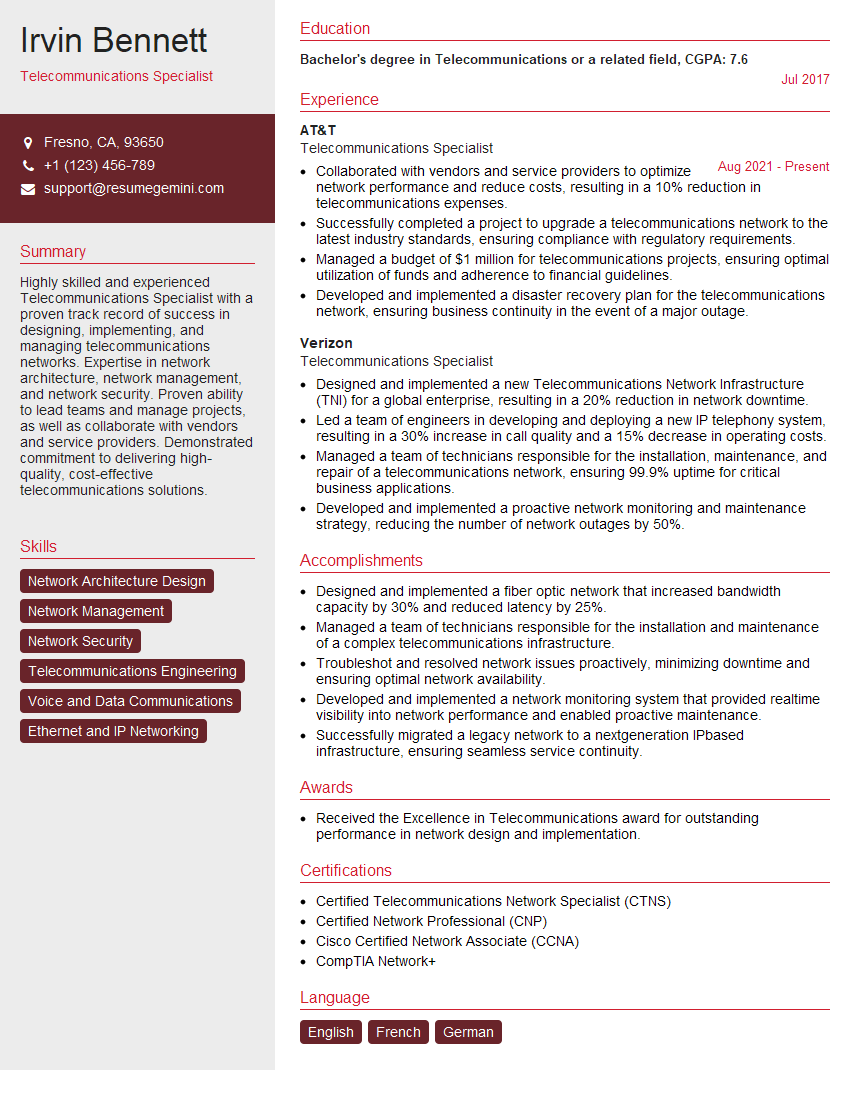
Telecommunications Specialist Resume Sample

Outside Plant Engineer Resume Sample

Fiber Optic Technician Resume Sample

Line Technician Resume Sample

Network Cable Installer Resume Sample

Outside Plant Technician Resume Sample

Cable Splicer Resume Sample

Fiber Optic Splicer Resume Sample
Explore more articles
Users Rating of Our Blogs
Share Your Experience
We value your feedback! Please rate our content and share your thoughts (optional).
What Readers Say About Our Blog
To the interviewgemini.com Webmaster.
Very helpful and content specific questions to help prepare me for my interview!
Thank you
To the interviewgemini.com Webmaster.
This was kind of a unique content I found around the specialized skills. Very helpful questions and good detailed answers.
Very Helpful blog, thank you Interviewgemini team.