The right preparation can turn an interview into an opportunity to showcase your expertise. This guide to Fiber Optic Cable Pulling interview questions is your ultimate resource, providing key insights and tips to help you ace your responses and stand out as a top candidate.
Questions Asked in Fiber Optic Cable Pulling Interview
Q 1. Explain the process of fiber optic cable pulling.
Fiber optic cable pulling is the process of carefully guiding a fiber optic cable through a conduit, duct, or other pathway connecting two or more points. It’s a crucial step in deploying fiber optic networks, ensuring reliable high-speed data transmission. The process involves several key stages, from preparation and planning to the actual pull and final termination.
- Preparation: This includes thoroughly inspecting the pathway for obstructions, bends, or damage. We’ll also measure the length and check for correct cable specifications.
- Lubrication: Applying a suitable lubricant significantly reduces friction and prevents cable damage during pulling.
- Pulling: Using specialized equipment, such as a cable pulling machine or winch, we gradually and carefully pull the cable through the conduit, ensuring controlled tension to avoid over-stretching or damaging the delicate fibers.
- Termination: Once the cable reaches the destination, it’s carefully terminated, connecting it to the network equipment.
Imagine threading a very thin, yet strong, string through a long, winding tube – that’s essentially what we do, but with much more precision and care to avoid damage.
Q 2. What safety precautions are essential during fiber optic cable pulling?
Safety is paramount during fiber optic cable pulling. We always prioritize the well-being of the crew and the integrity of the cable. Here are some essential precautions:
- Personal Protective Equipment (PPE): Safety glasses, gloves, and sturdy work boots are mandatory. Depending on the environment, hard hats and other specialized PPE may also be required.
- Proper Training and Certification: Only trained and certified personnel should handle fiber optic cable pulling. This ensures they understand the risks and proper procedures.
- Tension Monitoring: Using tension meters is critical to prevent over-tensioning, which could damage the cable fibers. Regular monitoring is key.
- Clear Communication: Maintaining clear communication between the pulling team and any personnel involved, especially those working in confined spaces, ensures coordination and safety.
- Emergency Procedures: A well-defined emergency plan should be in place to handle any unexpected events, such as cable snags or equipment malfunctions.
- Lockout/Tagout Procedures: If working near energized equipment, lockout/tagout procedures are strictly followed to prevent accidental electrical shock.
Ignoring these precautions can lead to serious injuries, cable damage, and costly delays. Safety is not just a guideline; it’s an absolute necessity.
Q 3. Describe different methods used for pulling fiber optic cables.
Several methods are used for pulling fiber optic cables, each suited to different conditions and cable types. The choice depends on factors such as cable length, conduit size, and environment.
- Hand Pulling: For short distances and smaller cables, hand pulling might be sufficient. However, this is limited and less efficient for longer runs.
- Mechanical Pulling: This involves using a motorized winch or cable pulling machine. This is more efficient for long distances and larger cable counts, providing precise control over tension.
- Vacuum Pulling: A vacuum system pulls the cable through the conduit, making it ideal for longer, more complex pathways. It’s particularly useful when obstructions are present or when minimizing friction is crucial.
- Compressed Air Pulling: Compressed air can assist in pulling cables, especially in difficult locations, reducing the overall pulling force needed.
The selection of the most appropriate pulling method involves careful consideration of the project’s specifics and always involves an evaluation of potential risk and the capability of the selected equipment.
Q 4. How do you determine the appropriate pulling tension for fiber optic cables?
Determining the appropriate pulling tension is crucial to prevent cable damage. It’s a balance between applying sufficient force to pull the cable and avoiding excessive tension that could stretch or break the fibers. This is generally determined by:
- Cable Specifications: The manufacturer’s specifications provide the maximum allowable pulling tension for the specific cable type and its diameter.
- Conduit Conditions: Bends, obstructions, and the overall length of the conduit significantly impact the required pulling tension. A longer or more complex conduit will typically need lower tension.
- Lubrication: Proper lubrication significantly reduces friction and the required pulling tension.
- Pulling Equipment: The capacity and capabilities of the pulling equipment also influence the tension.
- Tension Meters: These devices are used for continuous monitoring of pulling tension during the entire process.
We always adhere to the manufacturer’s recommendations and use tension meters to ensure that the tension remains within safe limits throughout the pull. Exceeding the recommended tension can result in cable damage and potential service interruptions.
Q 5. What are the common challenges encountered during fiber optic cable pulling?
Several challenges can be encountered during fiber optic cable pulling. Experience helps mitigate these issues, but preparedness is key.
- Cable Snags: The cable might snag on obstructions within the conduit, requiring careful troubleshooting and sometimes even pulling from the other end.
- Sharp Bends: Sharp bends in the conduit can damage the cable. We often need to employ bend radius mitigation techniques.
- Conduit Restrictions: The conduit might be too narrow or have other restrictions, making pulling difficult. This highlights the importance of thorough pre-installation checks.
- Incorrect Lubrication: Insufficient or improper lubricant can increase friction and damage the cable. Using the right lubricant for the right environment is critical.
- Excessive Tension: Over-tensioning is a significant risk that can lead to fiber breakage. Constant monitoring is key.
- Environmental Factors: Extreme temperatures, moisture, or other environmental conditions can affect the pulling process.
Careful planning, proper equipment, and experienced personnel are essential to effectively navigate these challenges.
Q 6. How do you handle cable damage during the pulling process?
Handling cable damage during pulling requires immediate attention. The process depends on the extent and location of the damage.
- Minor Damage: If the damage is minor (e.g., minor abrasions), and does not affect the integrity of the fibers, it might be acceptable to continue after carefully assessing the situation.
- Significant Damage: If significant damage has occurred (e.g., fiber breakage), the cable section needs to be repaired or replaced. This often requires splicing techniques or pulling a completely new cable.
- Assessment: Thorough cable testing using OTDR (Optical Time Domain Reflectometer) is essential to determine the extent of the damage and ensure no further issues exist.
- Documentation: All damage and repair procedures are meticulously documented for tracking and future reference.
The approach always prioritizes maintaining the integrity of the fiber optic system and ensuring its reliability.
Q 7. Explain the use of lubricants in fiber optic cable pulling.
Lubricants play a vital role in fiber optic cable pulling, significantly reducing friction between the cable and the conduit. This minimizes the risk of cable damage and reduces the pulling tension required. The choice of lubricant depends on the specific environment and cable type.
- Types of Lubricants: Water-based, oil-based, and silicone-based lubricants are commonly used. Water-based lubricants are often preferred for their environmentally friendly nature and ease of cleanup.
- Application: Lubricant should be applied liberally and evenly to the cable before pulling, ensuring full coverage to reduce friction. Specialized lubricant application methods like gel applicators are used for uniform coverage.
- Importance: Proper lubrication prevents abrasions, reduces the risk of cable snags, and enables smoother pulling, reducing the overall strain on the cable.
- Compatibility: It’s essential to choose a lubricant compatible with the cable jacket material to avoid any adverse reactions or degradation.
Imagine trying to pull a rope through a tight tube without lubrication – it would be incredibly difficult and likely cause damage. Lubricants are crucial for a smooth and successful fiber optic cable pull.
Q 8. Describe different types of fiber optic cable.
Fiber optic cables are categorized primarily by their core size and the type of light they transmit. This impacts their bandwidth and distance capabilities. Let’s explore some common types:
- Single-Mode Fiber: Uses a small core diameter (around 8-10 microns) allowing only one light path to travel through, resulting in minimal signal dispersion and enabling long-distance transmission with high bandwidth.
- Multi-Mode Fiber: Employs a larger core diameter (around 50/125 or 62.5/125 microns), allowing multiple light paths to propagate. This leads to higher signal dispersion, limiting transmission distance but often being more cost-effective for shorter runs.
- Tight-Buffered Fiber: Individual fibers are coated with a tight buffer material for enhanced protection. This is often used in aerial applications where protection from harsh weather is paramount.
- Loose-Tube Fiber: Fibers are housed in loose tubes within a cable, which allows for easier movement and reduces stress during installation. This design provides good protection against bending and is quite common.
- Ribbon Fiber: Multiple fibers are bundled together in a ribbon structure, which increases the fiber density within the cable, lowering cost and simplifying the termination process. This is great for high-fiber-count applications.
The choice of fiber optic cable depends on factors like distance requirements, bandwidth needs, and budget constraints. For example, a long-haul telecommunication network would utilize single-mode fiber for its low signal loss and high bandwidth capacity, while a local area network might use multi-mode fiber for its lower cost.
Q 9. What are the differences between single-mode and multi-mode fiber optic cables?
The key differences between single-mode and multi-mode fiber lie in their core size and the resulting signal propagation characteristics:
- Core Size: Single-mode fiber has a much smaller core (8-10 microns) compared to multi-mode fiber (50/125 or 62.5/125 microns).
- Light Propagation: Single-mode fiber allows only one light path, leading to minimal signal dispersion and making it suitable for long-distance transmissions. Multi-mode fiber allows multiple light paths, resulting in significant signal dispersion, limiting its range. Imagine a straight highway (single-mode) vs. a sprawling city with multiple intersecting roads (multi-mode). The highway allows for faster, more direct travel.
- Bandwidth and Distance: Single-mode fiber offers higher bandwidth and supports longer transmission distances, while multi-mode fiber has lower bandwidth and is suitable for shorter distances.
- Cost: Multi-mode fiber and its associated equipment are typically less expensive than single-mode solutions.
In summary, while multi-mode is cost-effective for shorter distances, single-mode reigns supreme for high bandwidth, long-haul applications.
Q 10. How do you identify and troubleshoot fiber optic cable faults?
Troubleshooting fiber optic cable faults involves a systematic approach, starting with visual inspection and progressing to specialized tools.
- Visual Inspection: Check for obvious physical damage such as cuts, bends, or crushed sections of the cable. Look for any signs of water ingress or contamination.
- Optical Power Meter (OPM): Measures the optical power level at various points in the fiber optic link. A significant drop in power level indicates a fault.
- Optical Time-Domain Reflectometer (OTDR): This sophisticated instrument sends light pulses down the fiber and analyzes the reflected signals to pinpoint the location and nature of faults. This is an invaluable tool for precise location of breaks, splices, and connector issues.
- Fiber Optic Visual Fault Locator (VFL): A VFL uses a visible red laser light to illuminate the fiber path. This is useful to identify bending or broken sections visually.
For instance, a sudden drop in power detected by the OPM could indicate a connector problem or a microscopic break in the fiber. The OTDR would help to locate and further classify the issue precisely.
A systematic approach combining visual inspection and specialized equipment like OTDRs and OPMs provides a comprehensive solution to identifying and troubleshooting fiber optic cable faults effectively. It is crucial to always follow safety precautions when dealing with optical equipment to prevent eye damage.
Q 11. What tools and equipment are used in fiber optic cable pulling?
Fiber optic cable pulling requires specialized tools and equipment to ensure efficient and safe installation. Here are some key pieces of equipment:
- Pulling Ropes/Cables: Strong and durable ropes, often with different materials and coatings suitable for various environments.
- Pulling Sockets/Eyes: Attach to the cable ends for secure connection to the pulling equipment.
- Cable Lubricants: Reduce friction during pulling and protect the fiber optic cable. Different types of lubricants are used depending on the conditions and cable type.
- Winches: Powerful machines for pulling cables through long distances, particularly in difficult conduits or aerial applications.
- Capstans: Similar to winches but provide controlled pulling and are useful in managing cable tension during long pulls.
- Tension Meters: Monitor the tension on the cable during pulling to prevent damage.
- Cable Reels: Store and manage the fiber optic cable during the installation process.
- Fiber Optic Cleavers and Connectors: Used for preparing fiber optic cable for termination.
- Fusion Splicers: Create highly reliable splices between fiber optic cables.
The specific tools required will vary depending on the project’s complexity and environment. For instance, a large-scale installation may necessitate larger winches and more sophisticated cable management systems, while a smaller project might only require hand-pulling tools.
Q 12. Explain the importance of proper cable management.
Proper cable management is crucial in fiber optic installations for several reasons:
- Reduced Downtime: Organized cables make troubleshooting and maintenance much easier. Finding a specific cable is quick and straightforward.
- Improved Network Performance: Neat cabling reduces signal loss and interference, leading to better network performance.
- Enhanced Safety: Proper cable management minimizes the risk of tripping hazards and prevents accidental damage to cables.
- Future Scalability: Well-planned cable management facilitates future expansion and upgrades by providing ample space for additional cables.
- Better Aesthetics: Neat and organized cabling enhances the overall look of the installation.
Think of it like a well-organized closet versus a cluttered mess. Finding what you need is quick and easy in an organized closet; the same applies to a neatly managed cable installation.
Q 13. How do you ensure the integrity of the fiber optic cable during installation?
Maintaining fiber optic cable integrity during installation is paramount. Several strategies contribute to this:
- Proper Bend Radius Compliance: Never bend the fiber beyond its minimum bend radius. Excessive bending can cause micro-fractures in the fiber, leading to signal loss or complete failure. Using proper cable management techniques ensures that bend radii are respected.
- Appropriate Lubrication: Using suitable lubricants during pulling reduces friction and prevents damage to the cable. It’s crucial to select the appropriate lubricant for the cable and environment.
- Tension Control: Continuously monitor cable tension during pulling using tension meters to prevent over-tensioning, which can cause breakage or damage.
- Environmental Protection: Protect the fiber optic cable from harsh environmental conditions like moisture, extreme temperatures, or UV radiation using protective conduits, sleeves or jackets.
- Careful Handling: Avoid dropping, dragging, or abrading the cables during installation.
- Regular Inspection: Regularly inspect the cable during the pulling and installation process for any signs of damage.
The success of a project hinges on carefully following these best practices to ensure fiber integrity.
Q 14. Describe your experience with different types of cable pulling equipment (e.g., winches, capstans).
My experience with cable pulling equipment encompasses a wide range of tools and technologies. I’ve worked extensively with:
- Hydraulic Winches: These are powerful and efficient for pulling cables over long distances, especially in challenging environments. I’ve used them on several large-scale projects, including underground installations where manual methods would be impractical.
- Electric Winches: These are a good alternative to hydraulic winches where power sources are readily available. They’re versatile and commonly used in various projects due to their ease of use and portability.
- Hand-Powered Capstans: In smaller projects or sections of a larger installation where a winch isn’t necessary, I’ve used hand-powered capstans to control cable tension and provide a consistent pulling force. They are invaluable for precision and safety in more delicate situations.
- Pneumatic Winches: On occasion, pneumatic winches are used when compressed air is the primary power source. These are particularly useful where portability and high-speed cable pulling are essential.
My experience allows me to select and operate the appropriate equipment based on the project’s specific requirements and challenges, ensuring optimal efficiency and safety. I’m also proficient in the maintenance and troubleshooting of this equipment, which is critical for minimizing downtime and project delays.
Q 15. How do you calculate the required pulling force for a specific cable and duct?
Calculating the required pulling force for fiber optic cable installation is crucial to prevent damage. It’s not a simple calculation, but rather a consideration of several factors. We use a formula that takes into account the cable’s weight, the coefficient of friction between the cable and the duct, the length of the pull, and the angle of the pull. The weight of the cable is straightforward; you need the cable’s linear density (weight per unit length). The coefficient of friction depends heavily on the duct material (e.g., HDPE, PVC), its internal smoothness, and the presence of lubricants. A smoother duct and the application of a suitable lubricant will reduce the coefficient of friction. The length of the pull is simply the distance the cable needs to travel. The angle of the pull is important because pulling uphill requires more force than pulling downhill; we typically break down the pull into its horizontal and vertical components for accurate calculations. This often involves the use of specialized software that can run several simulations using different inputs to find an optimal solution.
Example: Let’s say we have a 1000m long fiber optic cable weighing 50 N/m, a coefficient of friction of 0.2, and a relatively straight duct. We’ll assume a horizontal pull for simplicity. The total weight of the cable is 50,000 N. The frictional force is calculated as the coefficient of friction multiplied by the normal force (the weight of the cable in this case), which is 0.2 * 50,000 N = 10,000 N. The total pulling force required would be approximately 60,000 N to account for friction and any other unexpected resistances. However, this is a simplified example; realistic scenarios usually involve more complex calculations that take into account bends, changes in elevation, and other factors.
Career Expert Tips:
- Ace those interviews! Prepare effectively by reviewing the Top 50 Most Common Interview Questions on ResumeGemini.
- Navigate your job search with confidence! Explore a wide range of Career Tips on ResumeGemini. Learn about common challenges and recommendations to overcome them.
- Craft the perfect resume! Master the Art of Resume Writing with ResumeGemini’s guide. Showcase your unique qualifications and achievements effectively.
- Don’t miss out on holiday savings! Build your dream resume with ResumeGemini’s ATS optimized templates.
Q 16. What is the role of a pulling eye or lubricant in reducing friction?
Pulling eyes and lubricants play a vital role in minimizing friction during cable installation, thus preventing damage to the delicate fibers. The pulling eye, attached to the cable’s end, provides a strong, secure point for the pulling equipment to grip. This prevents damage to the cable itself. The smooth, rounded shape of the eye also minimizes friction as it moves through the duct. Lubricants, such as cable pulling gels or pastes, are applied to the cable’s outer jacket to reduce the coefficient of friction between the cable and the inside of the duct. This lubrication significantly reduces the pulling tension required and lessens the risk of damage.
Real-world example: Imagine trying to pull a rope through a narrow pipe. Without lubrication, the rope would snag and likely require considerable force, potentially breaking. However, applying a lubricant like soap or oil would significantly reduce the friction, allowing you to pull the rope through with much less effort. This is analogous to how lubricants function in fiber optic cable pulling.
Q 17. Describe the procedure for terminating fiber optic cables.
Terminating fiber optic cables is a precise process requiring specialized tools and meticulous care. The goal is to create a clean, reliable connection that maintains the optical signal integrity. The process generally involves these steps:
- Prepare the cable: Carefully strip the outer jacket and any buffer layers, exposing the optical fibers without damaging them. This step requires precise control, as any nick or scratch to the fiber can severely impair signal transmission.
- Clean the fibers: Use a fiber optic cleaning kit, typically consisting of lint-free wipes and isopropyl alcohol, to remove any dirt or debris from the fiber ends. A clean fiber end is critical for a successful termination.
- Cleaving the fiber: Use a precision cleaver to create a perfectly perpendicular and smooth fiber end face. Any imperfections can cause significant signal loss. A good cleave is crucial for optimal transmission.
- Connect to the connector: Insert the fiber into the chosen connector (typically SC, LC, or ST) while ensuring its properly aligned and securely fixed. This often requires specialized tools and alignment procedures.
- Cure the connector: For many connector types, especially fusion splices, a curing process is required to harden the glue or cement that bonds the fiber to the connector body. Improper curing may result in a faulty termination.
- Test the connection: Use an optical power meter and light source to verify that the connection is good and doesn’t produce excessive signal loss. This checks for successful termination and quality of the connection.
Throughout the entire process, it’s critical to avoid touching the fiber’s exposed ends. Even fingerprints can degrade the connection and lead to signal loss.
Q 18. Explain the concept of microbending and how it affects fiber optic cable performance.
Microbending refers to the small-scale bending or deformation of a fiber optic cable. This is usually caused by external pressure or stress on the cable. These tiny bends, often invisible to the naked eye, disrupt the total internal reflection of light within the fiber, leading to signal attenuation (signal loss) and increased signal dispersion. The result can be significant signal degradation which, if severe enough, can lead to complete signal failure.
How it affects performance: Microbending introduces additional scattering and absorption of the light signal. The light rays, instead of traveling along the fiber’s core smoothly, get scattered by the micro-bends, resulting in less light arriving at the destination. Severe microbending may lead to modal noise and signal distortion, impacting system performance. High signal attenuation from microbending would necessitate the use of amplifiers to compensate for the loss, and this adds complexity and cost to the system.
Preventing microbending: Careful cable handling, proper routing, and using appropriate cable supports are essential to minimize microbending during installation and operation. Excessive tension during pulling, sharp bends, and improper cable management all contribute to microbending.
Q 19. How do you handle sharp bends and curves during cable pulling?
Sharp bends and curves are a major concern during cable pulling because they can damage the fiber optic cable and significantly increase pulling tension. To mitigate these risks, we use several strategies:
- Proper Duct Design: The design of the duct route should minimize sharp bends wherever possible. Long, gradual curves are preferable to tight angles.
- Bending Radius: We always adhere to the minimum bending radius specified by the cable manufacturer. This radius varies depending on the cable’s type and construction.
- Pulling Lubricants: Liberal application of cable lubricant helps reduce friction and allows the cable to negotiate bends more easily.
- Pulling Equipment: We use specialized pulling equipment that provides controlled and consistent tension during the pull to prevent the cable from being subjected to extreme forces.
- Cable Guides and Rollers: Using cable guides and rollers at bend locations helps to manage the cable and prevent it from being crushed or kinked.
- Intermediate Access Points: In cases of extremely long or complex routes, we may use intermediate access points to break up the pull into smaller segments, thus reducing tension and risk at any single point.
Example: If a 90-degree bend is unavoidable, we will utilize cable guides and rollers to smoothly guide the cable around the bend, ensuring that the cable doesn’t experience a sudden change of direction that might cause damage. Furthermore, extra care is taken to ensure the pulling tension doesn’t exceed the recommended limits during this transition.
Q 20. What are the different types of duct systems used for fiber optic cable installation?
Various duct systems are used for fiber optic cable installation, each with its advantages and disadvantages:
- High-Density Polyethylene (HDPE) Ducts: These are commonly used due to their strength, durability, and resistance to chemicals. They are relatively lightweight, easy to install, and offer good protection to the cables.
- Polyvinyl Chloride (PVC) Ducts: PVC ducts are also widely used, offering good resistance to chemicals and moisture, though they tend to be less flexible and more prone to cracking than HDPE ducts.
- Micro-Ducts: These are small-diameter ducts, often bundled within larger conduits, used for pulling individual fibers or small fiber bundles. They are ideal for high-fiber-density applications and can significantly reduce installation costs compared to using larger conduits.
- Concrete Ducts: These are durable and offer excellent protection, though they are heavier, more expensive, and more challenging to install than plastic ducts. Often used in situations requiring greater protection from external forces.
- Metal Ducts: Typically steel or aluminum, offering strong protection and great durability. More expensive and heavier than plastic options and susceptible to corrosion.
The choice of duct system depends on factors like budget, environmental conditions, required capacity, and the overall installation environment. For example, a high-fiber-count network in a busy urban area might use a system of micro-ducts within larger HDPE conduits for efficiency and ease of future expansion. In contrast, a less populated area might use simpler and less expensive PVC ducts.
Q 21. How do you deal with obstacles encountered during cable pulling (e.g., bends, obstructions)?
Obstacles during cable pulling are common, and handling them requires a combination of planning, experience, and the right tools. Here’s a breakdown of common strategies:
- Bends: As discussed earlier, we address bends by employing cable guides and rollers, lubricants, and controlling pulling tension to avoid exceeding the cable’s bending radius.
- Obstructions: If a complete blockage is encountered, we need to identify the cause and determine the best way to remove or bypass the obstruction. This might involve using a camera to inspect the duct, employing specialized tools to remove minor blockages, or even rerouting the cable if a complete solution isn’t feasible.
- Sharp Turns: These are addressed in a similar way to sharp bends, using lubrication, careful tension control, and suitable guides to help the cable navigate the turn without damage.
- Changes in Elevation: Pulling uphill requires significantly more force, so we plan for this by selecting the appropriate pulling equipment and using lubricants to reduce friction. We might also use multiple pulling points to reduce the strain at any single location.
- Unexpected obstructions: Unexpected obstacles are often overcome using a combination of techniques such as jetting (using high-pressure water to clear debris), specialized fishing tools to retrieve the cable, and if all else fails, rerouting the cable.
Important note: Safety is paramount. If any situation appears too dangerous or beyond the team’s capabilities, we always halt the operation and consult with experienced colleagues or specialists to develop a safe and effective solution.
Q 22. Describe your experience with different types of cable routing techniques.
Cable routing techniques are crucial for efficient and reliable fiber optic network deployment. My experience encompasses various methods, each chosen based on the specific project constraints. These include:
- Direct Burial: This involves burying the cable directly in the ground, often within a protective conduit. This is common for long-distance terrestrial links and requires careful consideration of soil conditions and potential hazards. For example, I’ve worked on projects where we used directional drills to minimize ground disruption and accurately place the conduit.
- Aerial Installation: Cables are suspended above ground, typically attached to poles or existing infrastructure. This method is cost-effective for shorter spans but is susceptible to environmental factors like wind and ice. I’ve overseen numerous aerial installations, carefully planning cable slack and utilizing appropriate hardware for secure attachment.
- Indoor/Building Cabling: This involves routing cables through walls, ceilings, and floor spaces within buildings. This often necessitates the use of cable trays, conduits, and careful planning to avoid interference with other systems. In one project, I coordinated with other trades to ensure safe and unobtrusive cable placement within a busy office building.
- Microduct Installation: Smaller diameter conduits are installed, often blown in, allowing for future cable deployment without extensive excavation. This is particularly beneficial for scenarios where future expansion is anticipated and minimizes initial disruption.
Choosing the right technique involves a thorough site survey, considering factors such as cost, accessibility, environmental conditions, and the long-term maintenance requirements of the network.
Q 23. What are the environmental factors that can affect fiber optic cable installation?
Environmental factors significantly impact fiber optic cable installation and can affect both the installation process and the long-term performance of the network. Key factors include:
- Temperature Extremes: Extreme heat can damage the cable jacket and affect signal transmission. Cold temperatures can make the cable brittle and prone to breakage. We account for this by using cables rated for the specific climate and employing appropriate techniques during installation.
- Moisture and Water: Water ingress can cause significant damage to fiber optic cables, leading to signal attenuation and failures. We use waterproof conduits, seals, and proper trenching techniques to prevent water intrusion. In one instance, we had to re-route a section of cable due to unexpected groundwater levels.
- Soil Conditions: Rocky or unstable soil can damage cables during burial. We use appropriate trenching techniques and protective conduits to ensure cable integrity. Detailed ground surveys are critical in such cases.
- Rodents and Pests: Rodents can chew through cables, causing significant disruption. We utilize rodent-resistant conduits and cable jackets to minimize this risk.
- UV Radiation: Prolonged exposure to sunlight can degrade the cable jacket. In outdoor installations, UV-resistant cable jackets are crucial. We also consider shade and cable protection strategies.
Proper planning and mitigation strategies are essential to address these challenges and ensure the longevity and reliability of the fiber optic network.
Q 24. How do you document the cable pulling process?
Comprehensive documentation is paramount for maintaining the integrity and traceability of the fiber optic cable network. My documentation process includes:
- As-Built Drawings: Detailed drawings that show the actual cable route, including splice points, termination points, and any deviations from the original design. These are crucial for future maintenance and repairs.
- Cable Splice Records: A detailed log of every cable splice, including splice location, date, time, and the individuals involved. This ensures traceability and simplifies troubleshooting.
- Testing Records: Documentation of all testing performed after installation, including optical power measurements, attenuation, and optical time-domain reflectometry (OTDR) traces. These records verify network performance and identify any potential problems.
- Material Inventory: A complete list of all materials used, including cable type, length, connectors, and other components. This ensures future procurement efforts are efficient and accurate.
- Photographs: Visual records of key aspects of the installation process, such as cable routing, splicing, and termination. These provide a visual reference point for future work.
This meticulous documentation is not only vital for ongoing maintenance but also serves as legal proof of proper installation and compliance with industry standards.
Q 25. Describe your experience working with different types of connectors.
My experience encompasses a wide range of fiber optic connectors, each with its own advantages and disadvantages. The most common types I’ve worked with include:
- SC Connectors: These are reliable and widely used connectors with a push-pull mechanism. They’re simple and cost-effective.
- FC Connectors: Known for their high precision and durability, often used in demanding environments.
- LC Connectors: Smaller and more compact than SC connectors, popular in high-density applications.
- ST Connectors: A less commonly used bayonet-type connector, primarily found in older installations.
- MT-RJ Connectors: These connectors have two fibers in a single housing and provide high density.
Connector selection depends on the application. For example, in high-density data centers, LC connectors are preferred for their space-saving design. In harsh environments, FC connectors are a better choice due to their ruggedness. Proper connector installation is crucial to ensure the integrity of the network. Any misalignment or damage can significantly affect signal transmission.
Q 26. Explain the importance of testing fiber optic cables after installation.
Testing fiber optic cables after installation is critical to ensure the network is functioning correctly and meets performance requirements. It allows for the identification and remediation of any issues before they impact the network’s operational capabilities. Testing involves several key steps:
- Optical Power Measurements: Measuring the optical power at various points along the cable to identify signal loss and potential problems.
- Attenuation Measurement: Determining the signal loss over a specified distance. This helps assess the cable’s quality and identify potential attenuation issues.
- Optical Time-Domain Reflectometry (OTDR): This technique utilizes reflected light pulses to identify faults, breaks, or splices along the fiber. It provides precise location and characterization of any issues.
- Return Loss Measurement: This measures the amount of light reflected back towards the source, which can be indicative of connector issues or other imperfections in the fiber.
Thorough testing helps prevent costly downtime, ensures network reliability, and provides valuable data for future maintenance and upgrades. A documented testing process is essential for tracking and verifying network performance over time.
Q 27. What safety regulations do you follow during fiber optic cable pulling?
Safety is paramount during fiber optic cable pulling. My adherence to safety regulations includes:
- Personal Protective Equipment (PPE): Consistent use of safety glasses, gloves, and appropriate clothing to protect against potential hazards such as cuts, abrasions, and electrical shock.
- Proper Lifting Techniques: Using appropriate lifting equipment and techniques to prevent injuries related to manual handling of heavy cables and equipment.
- Awareness of Underground Utilities: Employing the services of utility locators to identify underground utilities before commencing excavation or trenching to prevent accidental damage.
- Fall Protection: Using appropriate fall protection equipment when working at heights, such as during aerial installations.
- Lockout/Tagout Procedures: Following strict lockout/tagout procedures when working near energized equipment to prevent electrical shocks.
- Emergency Response Plan: Being familiar with and prepared to execute the emergency response plan in case of an accident or injury.
Safety is not merely a set of rules but an ingrained culture. I prioritize safety in all aspects of my work and encourage a safety-conscious environment among my team members. Regular safety training and toolbox talks are crucial to reinforce these principles.
Key Topics to Learn for Fiber Optic Cable Pulling Interview
- Cable Preparation and Handling: Understanding different fiber optic cable types, proper storage, and techniques for preventing damage during handling and pulling.
- Pulling Equipment and Techniques: Familiarity with various pulling equipment (e.g., winches, capstans, lubricants), their capabilities, and safe operating procedures. Mastering different pulling techniques for various cable types and environments.
- Microduct and Conduit Systems: Knowledge of different conduit types, their installation, and how to effectively pull fiber optic cables through them, including considerations for bends and obstacles.
- Tension and Friction Management: Understanding the factors affecting cable tension during pulling (e.g., cable length, friction, bends), and how to manage tension to avoid damage. Knowledge of lubrication techniques and the selection of appropriate lubricants.
- Troubleshooting and Problem Solving: Identifying and resolving common issues encountered during cable pulling, such as cable snags, breaks, or excessive tension. Experience with diagnostic tools and techniques.
- Safety Procedures and Regulations: Thorough understanding of safety regulations and best practices for fiber optic cable pulling, including personal protective equipment (PPE) requirements and emergency procedures.
- Splicing and Termination Techniques (Basic Understanding): While not directly cable pulling, a basic understanding of splicing and termination is beneficial for a complete understanding of the process and potential troubleshooting.
Next Steps
Mastering fiber optic cable pulling opens doors to rewarding careers in telecommunications, data centers, and network infrastructure. This in-demand skillset positions you for rapid career growth and competitive salaries. To maximize your job prospects, creating a strong, ATS-friendly resume is crucial. ResumeGemini can help you build a professional and impactful resume that highlights your skills and experience effectively. ResumeGemini offers examples of resumes tailored to the Fiber Optic Cable Pulling field, ensuring your application stands out from the competition. Take the next step in your career journey – build your best resume with ResumeGemini today.

Fiber Optic Technician Resume Sample

Line Technician Resume Sample
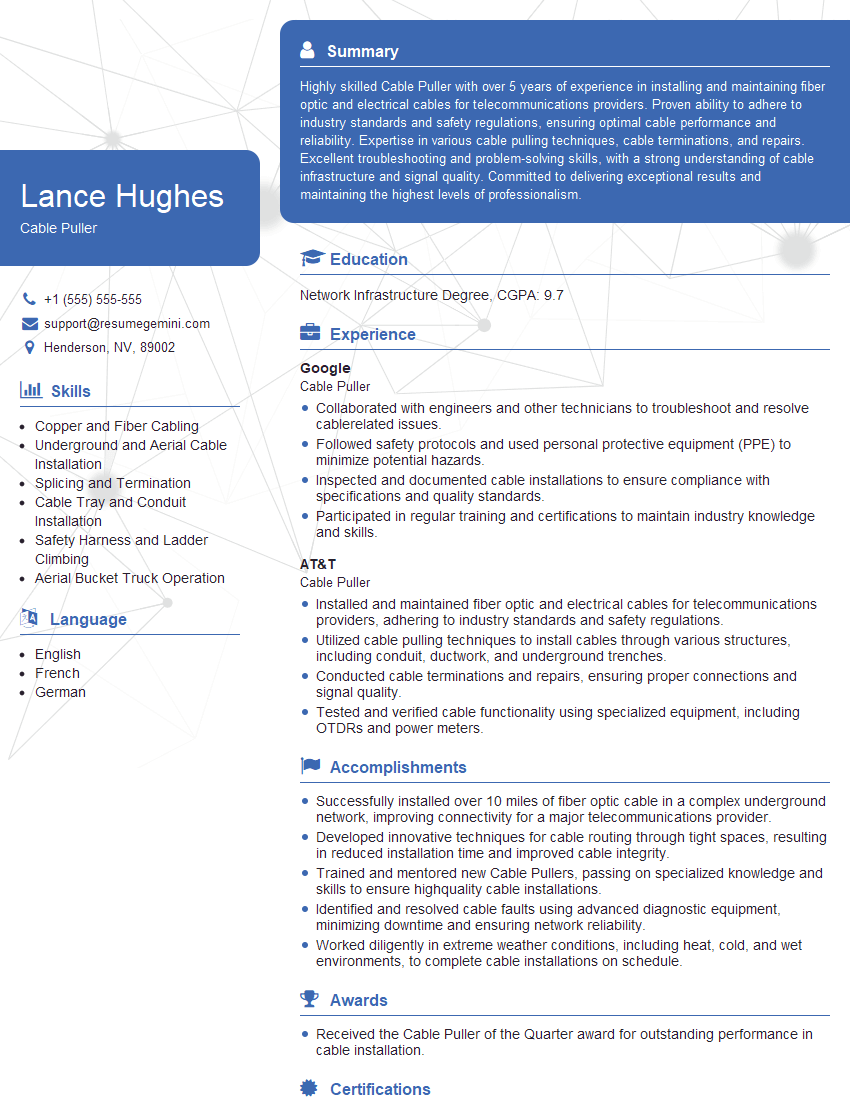
Cable Puller Resume Sample

Construction Technician Resume Sample

Infrastructure Technician Resume Sample
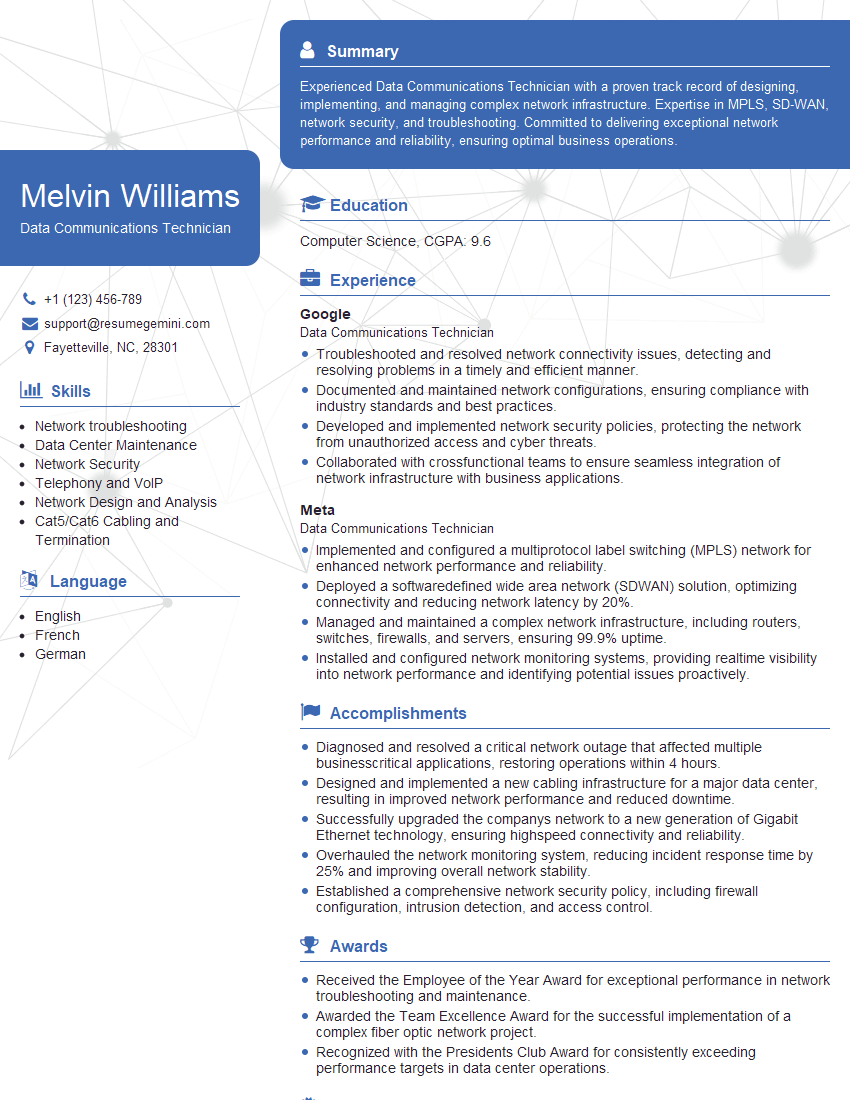
Data Communications Technician Resume Sample

Network Cable Installer Resume Sample

Outside Plant Technician Resume Sample

Telecommunications Technician Resume Sample

Cable Splicer Resume Sample

Fiber Optic Splicer Resume Sample
Explore more articles
Users Rating of Our Blogs
Share Your Experience
We value your feedback! Please rate our content and share your thoughts (optional).
What Readers Say About Our Blog
To the interviewgemini.com Webmaster.
Very helpful and content specific questions to help prepare me for my interview!
Thank you
To the interviewgemini.com Webmaster.
This was kind of a unique content I found around the specialized skills. Very helpful questions and good detailed answers.
Very Helpful blog, thank you Interviewgemini team.