Preparation is the key to success in any interview. In this post, we’ll explore crucial Fiberglass and resin work interview questions and equip you with strategies to craft impactful answers. Whether you’re a beginner or a pro, these tips will elevate your preparation.
Questions Asked in Fiberglass and resin work Interview
Q 1. Explain the different types of fiberglass cloth and their applications.
Fiberglass cloth comes in various types, each suited for different applications. The choice depends on factors like strength requirements, flexibility needs, and the final finish desired.
- Woven Roving: This is a heavy-duty cloth, ideal for structural components where high strength is paramount. Think of the hull of a boat or a large storage tank. It’s strong but can be less flexible.
- Satin Cloth: This offers a good balance of strength and flexibility. It’s often used for automotive parts or smaller, more intricate fiberglass projects because it’s easier to work with and conforms to curves well.
- Plain Cloth: A simpler weave that’s less expensive, making it suitable for applications where extreme strength isn’t critical. It’s often used for filler layers in a laminate.
- Chopped Strand Mat (CSM): This isn’t a cloth in the traditional sense; it’s a mat of randomly oriented short fiberglass strands. It’s inexpensive and easy to work with, but it’s less strong than woven cloths. Great for filling gaps or adding bulk to a laminate.
- Unidirectional (UD) Tape: This consists of fibers running in a single direction, providing maximum strength along that axis. This is often incorporated into a laminate strategically for added reinforcement in specific areas.
Choosing the right cloth is crucial for the success of your project. For instance, using woven roving for a small, curved part would be unnecessarily difficult and wasteful, whereas using CSM for a structural component would compromise its strength.
Q 2. Describe the process of creating a fiberglass mold.
Creating a fiberglass mold is a multi-step process requiring precision and attention to detail. The method depends on the complexity of the part being molded. Here’s a common approach for creating a positive mold (the mold from which you create the final fiberglass part):
- Create a Master Pattern: This is the original form, often made from wood, clay, or foam, which perfectly represents the final shape you want to reproduce.
- Mold Release Application: Apply a mold release agent to the master pattern. This prevents the fiberglass from sticking to the master and allows for easy removal of the final product. The type of release agent depends on the material of your master pattern.
- Layering the Mold Material: Typically, you’d use a layer of fiberglass cloth and resin on top of the master pattern. Multiple layers may be necessary for sufficient thickness and strength, depending on the complexity and anticipated stress on the final part. The exact number of layers and type of cloth will vary depending on your project.
- Curing the Mold: Allow the resin to fully cure according to the manufacturer’s instructions. This usually involves letting it sit at room temperature or in a controlled environment (oven curing for faster curing).
- Removal from Master Pattern: Once cured, carefully separate the mold from the master pattern. The release agent makes this process easier.
Remember, a well-made mold is the foundation for a quality fiberglass product. Imperfections in the mold will directly translate to imperfections in the final part.
Q 3. What are the common types of resins used in fiberglass work?
Several types of resins are used in fiberglass work, each with its own properties and applications:
- Polyester Resin: This is the most common and economical choice. It’s relatively easy to work with, cures relatively quickly, and offers good strength. It’s used extensively in boat building, automotive parts, and many other applications.
- Epoxy Resin: Epoxy resins are known for their superior strength, chemical resistance, and durability. They are more expensive than polyester resins but are preferred for high-performance applications and where chemical resistance is crucial, such as in marine environments or aerospace components.
- Vinyl Ester Resin: Vinyl ester resins offer a good compromise between the cost-effectiveness of polyester and the high performance of epoxy. They have better chemical resistance than polyester but are less expensive than epoxy, making them a popular choice for various applications.
The choice of resin depends heavily on the intended use of the fiberglass part. For a simple decorative item, polyester resin might suffice. But for a structural component that needs to withstand harsh conditions, epoxy or vinyl ester would be a better choice.
Q 4. How do you ensure proper curing of fiberglass parts?
Proper curing is essential for the strength and durability of fiberglass parts. Several factors influence curing:
- Temperature: Higher temperatures generally accelerate the curing process, but excessive heat can lead to imperfections or weaken the final product. Follow the resin manufacturer’s recommendations for curing temperatures.
- Humidity: High humidity can inhibit proper curing. A controlled environment with low humidity is ideal.
- Resin-to-Hardener Ratio: Mixing the resin and hardener precisely according to the manufacturer’s instructions is crucial. Incorrect ratios can lead to incomplete curing, resulting in a weak or sticky part.
- Pot Life: Resins have a limited pot life (the time after mixing before it begins to thicken and become unusable). Work quickly and efficiently within this timeframe.
- Post-Cure: Some resins benefit from a post-cure process, often involving elevated temperature for a specific duration to ensure complete curing and maximum strength. This is often specified by the resin manufacturer.
Always use a properly calibrated mixing scale to ensure accuracy when determining the correct resin to hardener ratio. Insufficient curing can dramatically affect the final part’s strength and durability.
Q 5. What safety precautions are necessary when working with fiberglass and resin?
Working with fiberglass and resin requires strict adherence to safety precautions. These materials can be hazardous if mishandled:
- Respiratory Protection: Always use a respirator with appropriate cartridges to prevent inhalation of resin fumes and fiberglass dust. These particles can irritate the lungs and cause long-term health problems.
- Eye Protection: Wear safety glasses or a full-face shield to protect your eyes from resin splashes and fiberglass particles.
- Skin Protection: Wear gloves made of nitrile or similar material to protect your skin from contact with resin, which can cause skin irritation or allergic reactions. Long sleeves and pants are also recommended.
- Ventilation: Work in a well-ventilated area or use exhaust fans to remove resin fumes. Inhaling these fumes can cause headaches, dizziness, and other health issues.
- Fire Safety: Fiberglass resin is flammable, so keep it away from open flames or sources of ignition. Have a fire extinguisher readily available.
- Proper Disposal: Dispose of leftover resin, hardener, and other waste materials according to local regulations.
Safety should never be compromised. Always prioritize your health and safety when working with fiberglass and resin.
Q 6. Describe the process of laminating fiberglass.
Laminating fiberglass involves applying layers of fiberglass cloth and resin to a mold or substrate to create a composite structure. It’s a systematic process:
- Mold Preparation: Ensure the mold is clean, smooth, and properly prepared with a mold release agent.
- Resin Mixing: Mix the resin and hardener accurately according to the manufacturer’s instructions. Thorough mixing is crucial for proper curing.
- Cloth Application: Apply the first layer of fiberglass cloth to the mold, using a brush or roller to saturate the cloth with resin. Avoid air bubbles; work them out by rolling or brushing the material carefully.
- Layer Build-up: Add subsequent layers of cloth and resin, allowing each layer to cure slightly before adding the next. This ensures proper adhesion and strength. The number of layers determines the final thickness and strength.
- Curing: Allow the laminate to cure completely according to the manufacturer’s instructions. This typically involves allowing the part to sit undisturbed at room temperature or using a controlled curing environment (oven curing).
- Demolding: Carefully remove the cured fiberglass part from the mold. The release agent will assist with this.
The key to successful lamination is ensuring proper saturation of each layer with resin while minimizing air bubbles. It’s a technique that improves with practice.
Q 7. What are the different types of surface finishes used on fiberglass parts?
Various surface finishes can be applied to fiberglass parts, depending on the desired aesthetic and functional properties:
- Gel Coat: A pigmented resin applied to the mold before laminating. It provides a smooth, colored surface and acts as a barrier against UV degradation and moisture.
- Painting: Fiberglass parts can be easily painted using automotive or marine paints, offering a wide range of colors and finishes. Proper surface preparation, including sanding and priming, is essential for good adhesion.
- Sanding and Polishing: Sanding and polishing can produce a high-gloss finish on fiberglass parts, especially when combined with a gel coat. Various grades of sandpaper are used to achieve a smooth surface.
- Vinyl Wrap: Applying vinyl wraps provides a decorative finish and protects the underlying fiberglass. It’s a relatively easy and inexpensive option.
- Powder Coating: This durable finish offers excellent protection against scratches, UV rays and chemicals.
The choice of surface finish depends on factors like the intended use of the part, the desired aesthetic, and the budget. For example, a gel coat is essential for exterior applications that require UV resistance, while painting might be sufficient for interior components.
Q 8. How do you repair damage to a fiberglass part?
Repairing fiberglass damage depends heavily on the extent and type of damage. Small chips or cracks can often be addressed with a simple repair, while larger holes or structural damage may require more extensive work. The process generally involves these steps:
- Preparation: Clean the damaged area thoroughly, removing any loose fibers, dirt, or contaminants. This is crucial for proper adhesion. You might use sandpaper, a wire brush, and a solvent cleaner like acetone.
- Repair Material: Choose the appropriate resin and reinforcing material (fiberglass mat or cloth) based on the severity of the damage. For small repairs, a small amount of micro-balloons mixed into the resin can create a good filler. For larger areas you may need more extensive layering of mat and cloth.
- Application: Mix the resin and hardener according to the manufacturer’s instructions (more on this in a later question). Apply the resin to the damaged area, saturating the fiberglass cloth or mat. Ensure proper saturation to avoid dry spots which weaken the repair. Work in thin layers, allowing each to cure before adding another to avoid excessive heat build-up and potential cracking.
- Curing: Allow the repaired area sufficient time to cure completely. The curing time will depend on the type of resin used, temperature, and humidity. Once cured, carefully sand the repair area smooth, paying attention to feather the edges for a seamless finish.
- Finishing (Optional): Depending on the application, you might apply a gel coat or paint to finish the repair and match the surrounding area.
Example: Imagine a small ding in a kayak hull. You’d clean the area, apply a small amount of resin mixed with micro-balloons to fill the ding, then carefully sand it smooth and finish with gel coat.
Q 9. What are the common problems encountered in fiberglass work, and how do you solve them?
Common problems in fiberglass work often stem from improper preparation, mixing, or curing. Here are some examples and solutions:
- Poor Adhesion: This usually results from a dirty or improperly prepared surface. Solution: Thoroughly clean and roughen the surface before applying resin.
- Air Bubbles: Trapped air weakens the laminate. Solution: Use a roller or brush to work out air bubbles during resin application. Avoid using excessive amounts of resin in one go and work from the center outward to help the bubbles escape.
- Incomplete Curing: This leads to a weak and sticky part. Solution: Ensure the correct resin-to-hardener ratio is used, and provide adequate curing time at the right temperature.
- Resin Yellowing: This is common with polyester resins and can be due to UV exposure or poor quality resin. Solution: Use UV resistant gel coats or top coats or opt for vinyl ester or epoxy resins which are more UV resistant.
- Warping/Distortion: This usually happens due to uneven curing or inconsistent resin application. Solution: Use appropriate supports during the curing process to prevent distortion.
Solving these issues involves meticulous attention to detail at every step of the process. Experience helps develop a keen eye for identifying potential problems early.
Q 10. Explain the concept of fiber orientation and its effect on the strength of a composite part.
Fiber orientation is crucial in fiberglass work because it dictates the strength and stiffness of the final composite part. Fibers aligned in the direction of the expected stress provide maximum strength; think of it like reinforcing concrete with rebar.
Unidirectional Fiber: Fibers all running in one direction, provides maximum strength in that direction but is weak perpendicular to it.
Bidirectional Fiber: Fibers in two directions, usually at 90 degrees to each other, offering strength in two directions.
Random Mat: Fibers in a random orientation, leading to more isotropic properties (similar strength in all directions), but typically less strong than unidirectional or bidirectional arrangements in any single direction.
Example: In a boat hull, the bottom layers of fiberglass would typically be oriented longitudinally (along the length of the boat) to withstand the stress from waves and impacts while some cross-layers add strength and prevent cracking.
Q 11. How do you determine the correct resin-to-hardener ratio?
The resin-to-hardener ratio is always specified by the manufacturer and is crucial for proper curing. It’s usually expressed as a weight ratio (e.g., 100:2). This means you’d mix 100 parts of resin with 2 parts of hardener by weight. Using a different ratio can lead to incomplete curing, excessive heat build-up, or poor mechanical properties.
Accurate Measurement: Use a precision scale to measure both the resin and the hardener. Never guess! Measuring cups can be inaccurate and lead to inconsistent results.
Thorough Mixing: After measuring, mix the resin and hardener thoroughly for at least two to three minutes to ensure a homogeneous mixture. A stirrer is recommended to fully combine the two components. Failing to do this properly could cause areas of the final product to remain uncured.
Example: If the instructions state a 100:3 ratio, you would weigh 100 grams of resin and 3 grams of hardener.
Q 12. What are the signs of a poorly cured fiberglass part?
A poorly cured fiberglass part often exhibits several telltale signs:
- Soft or Sticky Surface: The surface remains tacky to the touch, indicating incomplete curing.
- Chalky Appearance: A powdery or whitish residue on the surface could mean the resin did not properly cure.
- Brittleness: The part is more fragile than it should be, indicating either incorrect mixing or insufficient curing time.
- Discoloration: Some resins can exhibit discoloration if not cured properly, particularly noticeable as yellowing with polyester resins.
- Fish-Eyeing: This shows as clear spots in the cured resin, indicative of poor mixing and/or contamination.
These signs indicate that the chemical reaction between the resin and hardener didn’t proceed as expected due to various factors such as incorrect ratio, insufficient mixing, or inappropriate temperature.
Q 13. Describe different methods of applying resin to fiberglass.
Several methods are employed to apply resin to fiberglass, each with its own advantages and disadvantages:
- Brush Application: Suitable for smaller parts and areas requiring precise control. It’s a more labor-intensive method and can introduce more air bubbles.
- Roller Application: Efficient for larger surfaces, and reduces the risk of air bubbles compared to brushing. It’s faster, but less precise than brushing.
- Spray Application: Ideal for large-scale production and complex shapes. Requires specialized equipment and expertise, but offers the highest degree of uniformity.
- Vacuum Infusion: A more advanced method which uses vacuum pressure to draw resin into the fiberglass, eliminating air bubbles and leading to a high-quality, consistent laminate.
The choice of application method is dictated by the size and complexity of the part, the desired quality, and the available resources. Each method has nuances to master for optimal results.
Q 14. How do you measure the thickness of a fiberglass laminate?
Measuring the thickness of a fiberglass laminate can be done in several ways:
- Micrometer: A highly accurate method for precise measurements, often used in quality control. It directly measures the thickness at a specific point.
- Thickness Gauge: A simpler, less precise instrument, commonly used for quick assessments in the field. Again, this is a point measurement.
- Ultrasonic Thickness Gauge: A non-destructive method that utilizes sound waves to measure the thickness of the laminate. This is extremely useful for laminated parts that can’t be easily sectioned.
For large parts, you’d take multiple measurements at various locations to get a representative average thickness. The required accuracy depends on the specific application. For instance, aerospace components need far more precise thickness control than a simple hobby project.
Q 15. What are the advantages and disadvantages of using fiberglass compared to other materials?
Fiberglass, a composite material of glass fibers bound together by resin, offers several advantages over other materials. Its lightweight yet strong nature makes it ideal for applications where weight is a concern, such as boats, cars, and aircraft. It also boasts excellent corrosion resistance, making it suitable for marine and chemical environments. Fiberglass is incredibly versatile, capable of being molded into complex shapes. However, it also has limitations. It’s less strong in compression than some other materials like steel, and its strength can be affected by UV degradation over time. Compared to wood, fiberglass offers superior water resistance and durability, but it’s more challenging to repair. Compared to metals, fiberglass offers lighter weight and greater corrosion resistance but is less rigid and can be more brittle under impact.
- Advantages: Lightweight, strong, corrosion-resistant, versatile, relatively inexpensive.
- Disadvantages: Less strong in compression than steel, susceptible to UV degradation, more difficult to repair than some materials.
Career Expert Tips:
- Ace those interviews! Prepare effectively by reviewing the Top 50 Most Common Interview Questions on ResumeGemini.
- Navigate your job search with confidence! Explore a wide range of Career Tips on ResumeGemini. Learn about common challenges and recommendations to overcome them.
- Craft the perfect resume! Master the Art of Resume Writing with ResumeGemini’s guide. Showcase your unique qualifications and achievements effectively.
- Don’t miss out on holiday savings! Build your dream resume with ResumeGemini’s ATS optimized templates.
Q 16. Explain the importance of proper ventilation when working with resins.
Proper ventilation is paramount when working with resins because most release volatile organic compounds (VOCs) during curing. These VOCs can be harmful, causing respiratory irritation, headaches, dizziness, and even long-term health problems. Imagine working in a closed room with paint fumes; the effect of resin fumes is similar, but often more intense and potentially dangerous. Adequate ventilation removes these harmful vapors, protecting your health and ensuring a safe working environment. This involves working outdoors whenever possible, or using a well-ventilated workspace with appropriate respiratory protection such as a respirator with organic vapor cartridges. Even with ventilation, using gloves, eye protection, and proper clothing is vital.
Q 17. Describe the process of sanding and finishing a fiberglass part.
Sanding and finishing a fiberglass part is a crucial step to achieve a smooth, aesthetically pleasing, and durable surface. The process typically begins with coarser grit sandpaper (e.g., 80-120 grit) to remove imperfections and excess resin. Progressively finer grits (e.g., 180, 220, 320, and higher) are used to achieve a smoother finish. Between each grit change, you should thoroughly clean the surface to remove sanding dust. After sanding, any imperfections or scratches might require filling with a suitable filler before further sanding. Once the desired smoothness is achieved, a primer is applied to ensure the topcoat adheres properly. Finally, a topcoat—paint, varnish, or gelcoat—is applied, providing protection and the desired finish. For a truly professional finish, multiple coats of topcoat may be necessary with appropriate sanding between coats. For example, in boat building, achieving a glass-smooth finish requires meticulous sanding and multiple layers of gelcoat and varnish.
Q 18. What is gel coat and its function in fiberglass products?
Gel coat is a pigmented, highly-reactive polyester resin applied to the surface of a fiberglass part before the fiberglass layers are added. Think of it as the ‘skin’ of the fiberglass product. Its primary function is to provide a smooth, colored, and UV-resistant surface. It improves the aesthetic appeal and protects the underlying fiberglass from weathering and degradation. The gel coat acts as a barrier against moisture, chemicals, and UV radiation, enhancing the overall durability and lifespan of the product. Without a gelcoat, the fiberglass would be porous and prone to discoloration and deterioration. Its smooth surface also makes it easier to clean and maintain the final product.
Q 19. How do you select the appropriate resin for a specific application?
Resin selection depends heavily on the specific application and its demands. For example, a boat hull needs a resin that is strong, flexible, and resistant to water damage. Epoxy resins are often chosen for their strength, durability, and chemical resistance, making them suitable for high-performance applications or those exposed to harsh environments. Polyester resins are more common in less demanding applications due to their lower cost and easier handling. Vinyl ester resins offer a compromise, combining some of the best qualities of both epoxy and polyester resins. Consider factors such as required strength, chemical resistance, temperature tolerance, curing time, and cost when making your choice. Consulting resin manufacturers’ datasheets is essential for informed decision making. For instance, a marine application might call for a resin with high UV resistance and water impermeability, while an automotive part might prioritize a resin with good impact resistance and paintability.
Q 20. Explain the different types of fiberglass reinforcements.
Fiberglass reinforcements come in various forms, each with its own properties and applications. The most common is chopped strand mat (CSM), consisting of randomly oriented short fibers, offering good drapability and cost-effectiveness. Woven roving, made of continuous strands woven into a fabric, provides greater strength and dimensional stability. Other types include unidirectional (UD) fabrics with fibers aligned in a single direction for maximum strength along that axis, and stitched mat, combining the benefits of CSM and woven roving. The choice of reinforcement depends on the desired strength, stiffness, and cost. A boat hull, for instance, may use a combination of CSM for bulk and woven roving for added strength in critical areas. A more complex shape might benefit from UD fabrics to control the direction of strength.
Q 21. What is voiding, and how can it be prevented in fiberglass work?
Voiding in fiberglass work refers to the presence of air pockets or voids within the finished part. These voids weaken the structure, reducing its strength and durability, and can lead to premature failure. Imagine a sponge; it’s weak because of the air pockets within. Similarly, voids weaken the fiberglass structure. Voiding can be caused by improper mixing of resin and hardener, insufficient pressure during lamination, or trapped air bubbles during the application process. Prevention involves thorough mixing of the resin and hardener, proper layup techniques to eliminate trapped air, using a vacuum bagging or pressure laminating system to remove air, and ensuring adequate resin saturation of the reinforcement material. Careful attention to detail at each stage of the process is vital to minimize voiding and achieve a high-quality, strong, and durable fiberglass part.
Q 22. Describe your experience with different types of fiberglass tooling.
My experience with fiberglass tooling spans a wide range, from simple hand tools to sophisticated machinery. I’ve worked extensively with various types, including:
- Open molds: These are typically made from wood, metal, or even polyurethane foam and are used for creating one-off parts or small production runs. I’ve used these extensively for custom boat repairs and small component manufacturing. The key is precise preparation to ensure a smooth, defect-free surface for the fiberglass layup.
- Closed molds (female molds): These are used for high-volume production and provide superior surface finish. I’ve worked with both hand-laid and spray-up techniques in closed molds, specifically in the manufacturing of automotive components. Controlling resin flow and pressure is crucial here.
- Plug molds (positive molds): These are used to create female molds. I have experience sculpting and finishing plugs to ensure accurate mold reproduction. Accurate dimensions are paramount to prevent defects in the final product.
- CNC-machined molds: These offer unparalleled precision and repeatability, ideal for complex shapes and high-precision parts. My experience includes working with molds created using this technique for aerospace applications, where tolerances are extremely tight.
Choosing the right tooling depends on the complexity of the part, desired production volume, and budget constraints. Each type requires a different skillset and level of precision.
Q 23. Explain the importance of quality control in fiberglass manufacturing.
Quality control in fiberglass manufacturing is paramount; it directly impacts the structural integrity, durability, and aesthetic appeal of the final product. My approach incorporates several key elements:
- Raw Material Inspection: This involves verifying the quality of fiberglass cloth, resin, and other additives before they are used. Checking for proper cure time, viscosity, and the absence of contaminants ensures consistent performance.
- Process Monitoring: During the layup and curing process, I closely monitor parameters such as resin-to-fiber ratio, curing temperature and pressure (where applicable), and the overall consistency of the laminate. Deviations are immediately addressed.
- Dimensional Inspection: Regular checks using measuring tools such as calipers, rulers, and sometimes specialized 3D scanners ensure the finished part meets the specified dimensions and tolerances. Any discrepancies are investigated, and corrective actions are implemented.
- Non-Destructive Testing (NDT): Techniques like ultrasonic testing and visual inspection help detect internal flaws such as voids or delaminations that might compromise the integrity of the part, without damaging the finished product. I have extensive experience with these techniques.
- Documentation: Maintaining detailed records of each step of the manufacturing process allows traceability, helping us understand the root cause of defects if they arise and enabling continuous improvement.
A rigorous quality control program is not just about detecting defects; it is about preventing them in the first place. A proactive approach ensures consistent high-quality products.
Q 24. Describe your experience with different resin systems (e.g., polyester, epoxy, vinylester).
I’m experienced with a variety of resin systems, each with its own properties and applications:
- Polyester Resin: This is the most common and cost-effective resin. It’s relatively easy to work with but offers lower strength and chemical resistance compared to other systems. I’ve used it extensively for applications like boat hulls and less demanding structural components.
- Epoxy Resin: Epoxy resins are known for their superior strength, chemical resistance, and adhesion. They are more expensive than polyester but are ideal for high-performance applications such as aerospace components and marine applications requiring high durability and resistance to chemicals.
- Vinylester Resin: Vinylester resins offer a good balance between the properties of polyester and epoxy resins. They have better chemical resistance than polyester and are stronger than polyester, but they are less expensive than epoxy resins. This makes them a popular choice for marine applications and other demanding environments.
The choice of resin system depends heavily on the specific requirements of the project. Factors like strength, chemical resistance, cost, and cure time all play a critical role in selecting the optimal resin.
Q 25. How do you handle waste materials generated during fiberglass work?
Proper waste management is a critical aspect of responsible fiberglass work. My approach includes:
- Segregation: Separating different types of waste, such as resin-soaked cloths, cured fiberglass scraps, and packaging materials, simplifies recycling and disposal.
- Recycling: Many cured fiberglass scraps can be ground and reused as fillers in other materials. I actively seek opportunities to recycle usable materials.
- Hazardous Waste Disposal: Resin and hardener are hazardous materials. I strictly follow all local and national regulations for proper disposal through licensed hazardous waste handlers.
- Minimizing Waste: Careful planning and precise cutting techniques help to reduce material waste during the fabrication process. Accurate estimations are a key component of this.
- Solvent Management: Proper storage, handling, and disposal of solvents used for cleaning tools and equipment are essential to environmental protection.
Environmental responsibility is a top priority. Following best practices ensures both worker safety and environmental sustainability.
Q 26. What are the different methods for bonding fiberglass to other materials?
Bonding fiberglass to other materials requires careful selection of the adhesive and preparation of the surfaces. Common methods include:
- Mechanical Fasteners: Bolts, screws, and rivets can be used to bond fiberglass to metal or wood, especially for stronger joints. This method requires precise drilling to avoid damaging the fiberglass.
- Adhesives: Epoxy adhesives are often preferred for their strong bond strength and chemical resistance. Surface preparation, including cleaning and roughening, is critical for good adhesion. I have extensive experience with various epoxy formulations for different materials.
- Structural Bonding: Using structural adhesives in conjunction with mechanical fasteners, often seen in aerospace and high-performance applications, ensures a durable and high-strength bond.
The selection of the bonding method depends on the type of materials being joined, the required strength of the bond, and the environmental conditions the final product will be exposed to.
Q 27. Describe your experience with using various hand tools and machinery in fiberglass fabrication.
My experience with hand tools and machinery in fiberglass fabrication encompasses a broad spectrum:
- Hand Tools: Scissors, knives, rollers, brushes, and sanding tools are essential for precise layup and finishing. I’m proficient in using these to create intricate shapes and achieve a high-quality finish. Proper technique with each tool is vital for optimal results.
- Power Tools: Grinders, routers, and drills are used for more demanding tasks such as trimming, shaping, and creating complex features. Safety is always paramount when operating power tools.
- Spray Equipment: Spray guns are used for applying resin and gel coat, allowing for even coating and efficient production, particularly in large-scale projects. Proper adjustment of the spray gun is crucial for optimal results.
- CNC Machining (for molds): As mentioned previously, experience with CNC machines for mold creation is a valuable asset, especially in high-precision work.
The appropriate selection of tools and machinery is crucial for efficiency and quality. My experience ensures I can select and operate the tools effectively and safely for any given project.
Q 28. Explain your troubleshooting skills in identifying and resolving fiberglass-related issues.
Troubleshooting in fiberglass work requires a systematic approach. My process typically involves:
- Visual Inspection: Carefully examining the problem area to identify visible defects such as voids, delaminations, or surface imperfections is the first step. This often reveals the root cause.
- Investigating the Process: Reviewing the steps involved in the fabrication process helps identify potential areas where errors might have occurred. Was the resin mixed correctly? Were the curing conditions appropriate?
- Material Testing: If necessary, testing the raw materials (resin, fiber) to determine whether they meet the specified properties is essential to rule out material defects.
- Non-Destructive Testing (NDT): Utilizing techniques such as ultrasonic testing can help identify internal defects without causing damage to the product.
- Systematic Repair: Once the cause is identified, I implement the appropriate repair method. This might involve removing and replacing the damaged area, filling voids, or applying additional reinforcement.
Experience is key to effective troubleshooting. The ability to quickly identify the root cause and implement an appropriate solution minimizes downtime and maximizes efficiency.
Key Topics to Learn for Fiberglass and Resin Work Interviews
- Materials Science: Understanding the properties of various fiberglass types (e.g., E-glass, S-glass), resin systems (e.g., polyester, epoxy, vinylester), and their respective strengths, weaknesses, and applications.
- Layup Techniques: Mastering different hand layup methods, including wet layup, spray-up, and filament winding. Understanding the importance of proper fiber orientation and resin distribution for optimal strength and durability.
- Mold Making and Preparation: Knowledge of mold construction techniques, including the use of various materials (e.g., wood, metal, polyurethane) and release agents. Understanding mold surface preparation for optimal resin adhesion.
- Curing Processes: Understanding the chemical reactions involved in resin curing, the influence of temperature and pressure on curing time and quality, and troubleshooting common curing problems.
- Finishing and Post-Curing: Knowledge of surface finishing techniques (e.g., sanding, grinding, painting) and post-curing processes to optimize part properties and durability.
- Safety Procedures and Regulations: Familiarity with relevant safety regulations and best practices for handling fiberglass and resin materials, including personal protective equipment (PPE) and waste disposal.
- Troubleshooting and Quality Control: Ability to identify and troubleshoot common problems in fiberglass and resin work, such as voids, delamination, and resin bleed. Understanding quality control methods to ensure consistent part quality.
- Practical Applications: Demonstrate understanding of how fiberglass and resin work is applied in various industries, such as marine, automotive, aerospace, and construction.
Next Steps
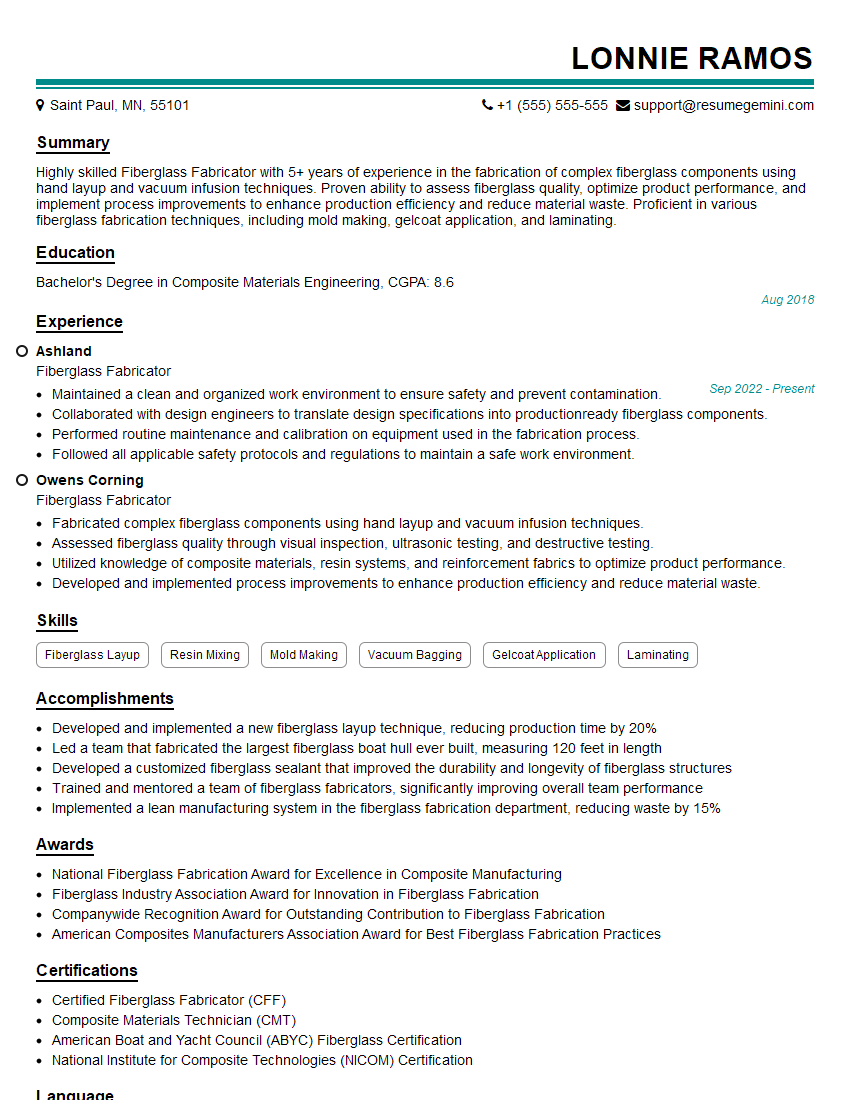
Mastering fiberglass and resin work opens doors to a rewarding career with diverse opportunities and strong earning potential. To stand out from other candidates, create a compelling and ATS-friendly resume that showcases your skills and experience effectively. ResumeGemini is a trusted resource to help you build a professional resume that gets noticed. Use their tools and resources to craft a standout document highlighting your expertise in fiberglass and resin work. Examples of resumes tailored to this field are available to guide you.




Explore more articles
Users Rating of Our Blogs
Share Your Experience
We value your feedback! Please rate our content and share your thoughts (optional).
What Readers Say About Our Blog
To the interviewgemini.com Webmaster.
Very helpful and content specific questions to help prepare me for my interview!
Thank you
To the interviewgemini.com Webmaster.
This was kind of a unique content I found around the specialized skills. Very helpful questions and good detailed answers.
Very Helpful blog, thank you Interviewgemini team.