Interviews are opportunities to demonstrate your expertise, and this guide is here to help you shine. Explore the essential Finishing and curing concrete interview questions that employers frequently ask, paired with strategies for crafting responses that set you apart from the competition.
Questions Asked in Finishing and curing concrete Interview
Q 1. Explain the different types of concrete finishing tools and their applications.
Concrete finishing involves a variety of tools, each designed for a specific purpose in achieving a smooth, level, and aesthetically pleasing surface. The choice of tool depends on the desired finish (e.g., broom finish, smooth finish, exposed aggregate) and the scale of the project.
- Hand Floats: These are smaller, hand-held tools used for finishing smaller areas or hard-to-reach spots. They’re essential for smoothing out irregularities and creating a level surface.
- Power Floats: Larger, motorized versions of hand floats, ideal for efficiently finishing large areas. They significantly speed up the process and provide a more consistent finish.
- Bull Floats: Long-handled tools used to level larger areas of freshly placed concrete. They’re crucial for achieving a relatively flat surface before finer finishing techniques are applied.
- Trowels: Used for creating various finishes, from a smooth, polished look to a textured surface like a broom finish. Steel trowels are common for achieving a smooth, dense finish; magnesium trowels are known for their lightweight nature.
- Edgers: Used to create a crisp, clean edge along the perimeter of the concrete slab, preventing chipping and creating a professional appearance.
- Groovers: Used to create control joints in concrete slabs to manage shrinkage and cracking, promoting long-term durability.
- Brooms: Create a textured finish by dragging a stiff-bristled broom across the surface of the concrete. This is a common and cost-effective method to improve slip resistance.
- Texturing Tools: These include a wide variety of tools depending on the desired effect, from textured stamps creating patterns to specialized tools for achieving exposed aggregate finishes.
For example, on a large warehouse floor, you’d likely use a power float for initial leveling, followed by a steel trowel for a smooth finish, and finally a groover to create control joints. On a smaller patio, hand floats and a trowel might suffice.
Q 2. Describe the process of bull-floating concrete.
Bull-floating is a crucial step in concrete finishing, primarily used to level and consolidate freshly placed concrete. It’s performed after the initial screeding (leveling) process but before final finishing with a trowel. This stage ensures a smooth and even surface, reducing the need for extensive work later.
The process involves using a long-handled bull float to gently glide across the surface of the concrete, working the surface to remove high points and fill in low spots. This distributes the aggregate evenly and eliminates any significant inconsistencies in the surface. It’s important to avoid excessive pressure, as this could create more irregularities. The operator moves the float in overlapping strokes, ensuring complete coverage. The bull float creates a slightly roughened surface, which is then refined by subsequent finishing steps such as power floating or hand floating.
Imagine bull-floating like smoothing out a large patch of freshly tilled soil before sowing seeds – you want a relatively even surface to ensure even growth, but not so much that you compact the soil and impede root development.
Q 3. What are the key factors influencing the selection of a concrete curing method?
The selection of a concrete curing method depends on several key factors: the type of concrete mix, the ambient temperature and humidity, the intended application (e.g., pavement, structural element), the project schedule, and cost considerations. Proper curing is paramount for achieving the desired strength and durability of the concrete.
- Temperature and Humidity: Hot, dry conditions require more intensive curing to prevent rapid moisture loss. High humidity can slow down curing, and sometimes supplemental heat might be required.
- Concrete Mix Design: High-performance concrete often requires more stringent curing regimes to achieve its potential strength.
- Project Schedule and Budget: Methods like water curing are cost-effective but require consistent monitoring, while membrane curing is faster but adds cost.
- Desired Finish and Properties: The selected method will influence the final texture and properties of the finished concrete surface.
For instance, in a hot, arid climate, a combination of water curing and membrane curing might be necessary to prevent rapid evaporation and cracking. In a colder climate, curing blankets may be used to retain heat and accelerate the hydration process.
Q 4. How do you ensure proper consolidation of concrete during placement?
Proper consolidation of concrete is crucial to ensure that the concrete mix is free of air voids and has adequate strength and durability. It’s achieved through a combination of techniques during the placement process.
- Vibration: Using internal vibrators (needle vibrators or poker vibrators) to compact the concrete, removing entrapped air and ensuring the concrete flows properly into the formwork. Over-vibration can cause segregation (separation of aggregate and cement), while under-vibration leaves air voids.
- Proper Placement and Handling: Concrete should be placed in layers and consolidated carefully to avoid segregation and uneven distribution of materials. Avoiding dropping the concrete from a significant height is crucial.
- Formwork Design: Properly designed and braced formwork prevents concrete leakage and ensures that the concrete is placed within the desired shape.
- Consolidation Methods: Depending on the type and volume of concrete, you might use methods like hand rodding or even special equipment for difficult placements.
Imagine making a cake – you need to carefully mix and pour the batter to ensure it’s evenly distributed in the pan and free of air bubbles. Similarly, with concrete, proper consolidation eliminates the air voids and creates a more homogeneous, strong, and dense concrete structure.
Q 5. What are the common defects in concrete finishing, and how can they be prevented?
Several defects can arise during concrete finishing, impacting both aesthetics and structural integrity. Prevention focuses on careful planning, execution, and quality control.
- Cracking: Caused by rapid drying, insufficient curing, or inadequate control joints. Prevention involves proper curing, using appropriate admixtures, and implementing a suitable control joint plan.
- Scaling: Surface deterioration caused by freeze-thaw cycles or chemical attack. Using air-entraining admixtures and careful selection of aggregates helps to mitigate scaling.
- Dusting: A powdery surface caused by poor finishing or insufficient curing. Proper compaction and curing are key to preventing dusting.
- Surface discoloration: This can stem from the use of contaminated water or other environmental factors. Using clean water and taking preventative measures during placement is paramount.
- Plastic shrinkage cracking: Occurs during the early stages of setting, primarily due to rapid moisture loss. Shading the surface to reduce evaporation is a common solution.
- Honeycombing: Pores or voids in the concrete. Proper consolidation by vibration prevents it.
For instance, scaling is often observed in pavements subjected to de-icing salts; proper curing is key to preventing dusting; and, control joints reduce the risk of cracking.
Q 6. Explain the importance of proper concrete curing for long-term durability.
Proper concrete curing is absolutely critical for achieving the desired strength, durability, and long-term performance of concrete structures. The hydration process, the chemical reaction between cement and water that causes concrete to harden, continues for weeks or even months after placement. Proper curing helps this process to proceed efficiently.
Insufficient curing leads to reduced strength, increased permeability (allowing water and other substances to penetrate), increased susceptibility to cracking, and reduced resistance to abrasion and freeze-thaw cycles. This can result in premature deterioration and significant repair costs. Think of it as providing the concrete with the optimal conditions to fully develop its potential, like providing a seedling with the right amount of water and sunlight.
A well-cured concrete structure will exhibit increased resistance to weathering, chemical attack, and structural degradation, significantly extending its service life. Therefore, investment in proper curing procedures is essential for long-term cost-effectiveness.
Q 7. Describe the different types of concrete curing compounds.
Concrete curing compounds are liquid membrane-forming materials applied to the surface of freshly placed concrete to retard moisture loss and maintain adequate moisture content during the crucial hydration process. They are designed to simplify the curing process compared to traditional methods like water curing.
- Membrane-forming curing compounds: These form a continuous film over the concrete surface, preventing excessive evaporation. They are available in various formulations, including acrylics, resins, and waxes, each with different properties and performance characteristics. They often contain pigments for color and to indicate application coverage.
- Water-based curing compounds:These are typically less expensive than solvent-based options but can leave a slightly sticky residue.
- Solvent-based curing compounds: Usually provide a faster-drying, more durable film.
The choice depends on factors like environmental conditions, project requirements, and cost considerations. For instance, in hot and windy conditions, a high-performance, solvent-based curing compound is often preferred to minimize moisture loss. In less demanding conditions, a water-based compound may be suitable.
Q 8. How do you determine the appropriate curing time for a concrete structure?
Determining the appropriate curing time for concrete isn’t a simple matter of counting days; it’s a nuanced process dependent on several factors. The primary goal is to allow the concrete to achieve sufficient strength and durability before exposure to typical stresses. This is achieved by allowing the hydration process – the chemical reaction between cement and water – to progress optimally. We generally consider factors like the type of cement used (higher-strength cements might hydrate faster), the concrete mix design (higher water-cement ratios generally require longer curing), the ambient temperature (hotter temperatures accelerate hydration, colder temperatures slow it down), and the intended use of the structure (high-stress applications demand longer curing).
A common approach involves consulting established standards and guidelines like ACI 301 (American Concrete Institute), which provides recommendations based on various parameters. For instance, a typical minimum curing time might be 7 days for standard applications, but this could extend to several weeks for larger structures or those subject to harsh environmental conditions. In practice, I often use a combination of techniques like checking compressive strength at specified intervals using core samples, and visual inspection for signs of proper hydration and surface hardness. Only when both strength requirements and visual assessment are satisfactory do we deem the curing complete.
Q 9. What are the environmental factors that affect concrete curing?
Environmental factors significantly impact concrete curing, potentially accelerating or hindering the hydration process and ultimately affecting the final strength and quality of the concrete. Temperature is arguably the most crucial factor. High temperatures can lead to rapid evaporation of water, resulting in surface cracking and reduced strength. Conversely, low temperatures slow down the hydration reaction, prolonging curing time and potentially leading to weaker concrete. Humidity also plays a key role. Low humidity accelerates evaporation, while high humidity helps maintain the moisture content necessary for proper hydration. Wind can also be a significant factor, as it increases the rate of evaporation, especially in hot, dry conditions. Finally, exposure to direct sunlight can cause rapid drying and temperature fluctuations, leading to cracking and uneven curing. Therefore, controlling the environment during curing is crucial, employing techniques such as water curing, membrane curing, or using insulated enclosures, depending on the climate and project requirements. I’ve personally experienced projects delayed due to unexpectedly cold snaps, requiring us to implement additional insulation and extend the curing time.
Q 10. Explain the role of admixtures in concrete finishing and curing.
Admixtures are chemical additives introduced to the concrete mix to modify its properties. They play a vital role in both finishing and curing, impacting workability, strength development, and durability. For finishing, we often use plasticizers or superplasticizers to improve the workability of the mix, allowing for easier placement and consolidation, leading to smoother surfaces and a reduction in finishing effort. Retarders can extend the setting time, giving the crew more time to finish the surface before the concrete hardens. For curing, specific admixtures can enhance the hydration process, leading to faster strength gain or improved resistance to cracking. Air-entraining admixtures, for example, create microscopic air bubbles that improve freeze-thaw resistance, enhancing durability, especially in colder climates. I’ve seen firsthand how using the right admixture can dramatically improve the finishing process, resulting in a higher-quality final product and reduced labor costs. Choosing the right admixture always requires a careful assessment of the project’s specific requirements and environmental conditions.
Q 11. How do you assess the effectiveness of a concrete curing method?
Assessing the effectiveness of a concrete curing method involves a combination of techniques aimed at verifying that the hydration process has progressed satisfactorily and that the concrete has achieved the required strength and durability. Visual inspection is a fundamental aspect, where we check for cracking, discoloration, or other surface defects. These could indicate insufficient curing or improper handling. We also perform compressive strength testing using core samples taken from the cured concrete. This allows us to quantitatively determine if the concrete has reached the design strength. Furthermore, we may use techniques such as rebound hammer testing, which measures the surface hardness and indirectly indicates the concrete’s strength. Finally, we can analyze the moisture content of the cured concrete to check for adequate hydration. The combination of visual assessment, compressive strength testing, and other relevant tests provides a comprehensive evaluation of the curing effectiveness. In a recent project, we had to adjust our curing plan due to unexpectedly high temperatures. By closely monitoring compressive strength through periodic testing, we were able to ensure that the final product met the required specifications despite the challenges.
Q 12. What are the safety precautions to be followed during concrete finishing and curing?
Safety is paramount during concrete finishing and curing. Personal Protective Equipment (PPE) is essential, including safety glasses, gloves, and sturdy work boots to protect against falling debris, chemical splashes, and slips. Appropriate respiratory protection is necessary when working with cement dust, which can irritate the lungs. When working with admixtures or curing compounds, it’s crucial to review their Safety Data Sheets (SDS) and follow all recommended precautions. Working around freshly placed concrete requires caution to avoid tripping hazards. Proper signage and barriers should be used to prevent unauthorized access to curing concrete. Additionally, adequate hydration for workers is vital, especially in hot weather conditions. I always emphasize the importance of regular safety briefings and training for the crew, highlighting potential hazards and proper safety procedures. We also regularly inspect our equipment and ensure it is properly maintained to prevent accidents.
Q 13. Describe your experience with different types of concrete mixes and their finishing requirements.
My experience encompasses a wide range of concrete mixes, each with unique finishing requirements. High-performance concrete, used for structural elements demanding high strength and durability, requires meticulous finishing to achieve a smooth, dense surface to prevent potential cracking. This often involves specialized techniques like power troweling and careful control of vibration. On the other hand, exposed aggregate concrete, where the aggregate is intentionally exposed, demands a different approach, focusing on carefully removing the surface cement paste to reveal the desired aggregate pattern. I’ve also worked with fiber-reinforced concrete, which improves crack resistance and can be finished using standard techniques, but requires attention to ensure proper distribution of fibers during placement. Each mix type necessitates a tailored approach, considering factors such as workability, setting time, and desired final finish. For example, a project using a self-consolidating concrete (SCC) would focus on ensuring proper consolidation and minimal surface imperfections, whereas a project using a normal strength concrete would likely involve vibration and surface finishing techniques. The knowledge of different mix types and their corresponding finishing requirements is crucial for achieving the desired result.
Q 14. How do you handle unexpected problems during concrete finishing?
Unexpected problems during concrete finishing are inevitable. My approach involves a systematic problem-solving strategy. First, I assess the nature of the problem – is it a surface defect, a strength issue, or a time constraint? Then, I investigate the potential causes. Could it be an issue with the mix design, improper placement, unfavorable weather conditions, or equipment malfunction? Once the root cause is identified, I develop a solution. This may involve adjusting the finishing techniques, using specialized equipment, applying corrective treatments, or modifying the curing plan. For instance, if surface cracking occurs, we might employ crack repair techniques and adjust the curing regime. If the concrete is setting too quickly, we might incorporate admixtures to extend the setting time. Documentation is crucial – I always maintain detailed records of the materials used, the processes followed, and any corrective actions taken. Communication with the project team and stakeholders is also key, ensuring everyone is informed about the problem, the proposed solution, and the potential impact on the project schedule and budget. My experience has taught me that proactive monitoring, thorough planning, and rapid response are crucial for handling unexpected issues effectively.
Q 15. What is the importance of achieving the desired surface finish for concrete?
Achieving the desired surface finish in concrete is paramount because it directly impacts the project’s aesthetics, durability, and functionality. A well-finished concrete surface is not just visually appealing; it’s also more resistant to cracking, staining, and damage. The type of finish also dictates its intended use. For instance, a smooth, polished finish might be ideal for a showroom floor, while a textured finish is better suited for an exterior walkway to prevent slips.
Consider a high-end residential project. A flawlessly polished concrete floor elevates the overall look and feel, contributing significantly to the home’s value. Conversely, a poorly finished concrete surface on a commercial building’s loading dock would be prone to damage, impacting functionality and safety.
- Aesthetics: The visual appeal of the finished product significantly influences the overall impression.
- Durability: A properly finished surface provides better protection against wear and tear.
- Functionality: The chosen finish dictates the surface’s suitability for its intended use (e.g., slip resistance for ramps).
Career Expert Tips:
- Ace those interviews! Prepare effectively by reviewing the Top 50 Most Common Interview Questions on ResumeGemini.
- Navigate your job search with confidence! Explore a wide range of Career Tips on ResumeGemini. Learn about common challenges and recommendations to overcome them.
- Craft the perfect resume! Master the Art of Resume Writing with ResumeGemini’s guide. Showcase your unique qualifications and achievements effectively.
- Don’t miss out on holiday savings! Build your dream resume with ResumeGemini’s ATS optimized templates.
Q 16. Explain your understanding of concrete strength and its relation to curing.
Concrete strength is intrinsically linked to the curing process. Curing is the process of maintaining adequate moisture and temperature conditions for a sufficient period to allow the cement to fully hydrate. This hydration reaction is what gives concrete its strength. Without proper curing, the hydration process is incomplete, resulting in weaker, more porous concrete that is susceptible to cracking and damage.
Think of it like baking a cake. The recipe (concrete mix) is crucial, but the baking process (curing) is equally important to achieve the desired texture and strength. Insufficient baking results in a crumbly cake, much like insufficient curing results in weak concrete.
The relationship is directly proportional: longer, properly controlled curing leads to increased compressive strength and overall durability. Factors such as temperature, humidity, and the type of cement used influence the optimal curing time and methods.
Q 17. How do you ensure proper surface texture in concrete finishing?
Ensuring proper surface texture involves a combination of techniques, starting with the concrete mix design itself. The aggregate size and type influence the final texture. Then, the finishing process itself plays a critical role. Different tools achieve different textures.
- Choosing the right aggregate: Larger aggregates create a coarser texture, while finer aggregates create a smoother finish.
- Using appropriate tools: Hand floats create a smooth finish; broomed finishes create a textured surface for slip resistance; and steel trowels provide a very smooth, polished surface.
- Controlling water content: Excessive water can lead to a weaker, more porous, and uneven surface.
- Timing of finishing operations: Each finishing step should be performed at the optimal time to achieve the desired outcome.
For example, to create a broom-finished surface, a stiff broom is used to sweep the concrete while it’s still workable, creating linear grooves that enhance traction.
Q 18. What is your experience with different types of concrete saws and cutting equipment?
My experience with concrete saws and cutting equipment encompasses a wide range of tools, from hand-held saws for smaller cuts to large, specialized equipment for large-scale projects. I’m proficient with various types including:
- Hand-held saws: These are versatile for smaller cuts and intricate work, allowing for precise cuts in various concrete types.
- Wall saws: Used for cutting through walls and other vertical surfaces, often employing diamond blades for clean cuts.
- Floor saws: These powerful saws are specifically designed for cutting through thick concrete slabs, frequently employed in demolition and renovation projects.
- Wire saws: Ideal for intricate cuts and curved lines in concrete.
- Ring saws: Used for making circular cuts, particularly useful for creating openings for pipes or other installations.
Safety is always paramount. I ensure that all equipment is properly maintained, operators are trained, and appropriate safety precautions, including PPE (Personal Protective Equipment), are implemented before any cutting operation begins.
Q 19. How do you manage a team during a large-scale concrete finishing project?
Managing a team on a large-scale concrete finishing project requires strong leadership, clear communication, and meticulous planning. I emphasize teamwork and open communication, fostering a collaborative environment where every team member feels valued and understood.
- Clear roles and responsibilities: Each team member understands their specific tasks and how they contribute to the overall project goal.
- Regular progress updates: Frequent meetings and progress checks ensure everyone stays informed and on track.
- Problem-solving: Addressing challenges promptly and effectively through open discussions and collaborative problem-solving minimizes delays.
- Safety protocols: Implementing rigorous safety protocols is non-negotiable, ensuring a safe working environment.
- Motivational leadership: Creating a positive and supportive atmosphere keeps the team motivated and engaged throughout the project.
On a recent large-scale project, I implemented a daily huddle system where the team met briefly each morning to address any immediate concerns, ensuring daily productivity and proactive problem-solving.
Q 20. Describe your experience with different types of concrete formwork and their impact on finishing.
My experience with concrete formwork includes various types, each impacting the final finish differently. The formwork’s quality and construction directly influence the concrete’s surface. Imperfections in the formwork translate to imperfections in the finished concrete.
- Wooden forms: These are cost-effective but require careful construction to avoid leaving imperfections in the concrete.
- Metal forms: More durable and reusable, but can be more expensive. They generally produce a smoother finish.
- Insulating concrete forms (ICFs): These forms create an insulated wall while simultaneously forming the concrete. They usually produce a consistently smooth surface and improve energy efficiency.
- Slipforming: A specialized method using continuously moving forms for large projects like roads or retaining walls.
For instance, using improperly sealed wooden forms can result in unsightly gaps or bleed marks on the concrete surface. Conversely, using well-maintained metal forms can contribute to a seamless, professional finish.
Q 21. How do you calculate the amount of curing compound needed for a given area?
Calculating the amount of curing compound needed involves several steps. First, accurately determine the area that requires curing. Then, consider the recommended coverage rate provided by the curing compound manufacturer (usually expressed in square feet per gallon). Finally, account for any potential loss or waste.
Step-by-step calculation:
- Measure the area: Calculate the total surface area (length x width) in square feet.
- Check manufacturer’s specifications: Find the coverage rate per gallon on the curing compound’s label. It might vary depending on the application method.
- Calculate the required gallons: Divide the total surface area by the coverage rate to get the number of gallons needed.
- Add for waste: Add an extra 10-15% to account for spills, uneven application, or any other potential loss.
Example: If you have 1000 square feet to cure, and the curing compound has a coverage rate of 300 square feet per gallon, you will need (1000 sq ft / 300 sq ft/gallon) = 3.33 gallons. Adding 15% for waste, the total needed would be approximately 3.83 gallons. Always round up to the nearest whole gallon to ensure sufficient material.
Q 22. Explain the importance of joint spacing and sealing in concrete finishing.
Joint spacing and sealing are critical in concrete finishing for managing shrinkage and thermal expansion. Concrete, like most materials, expands and contracts with temperature fluctuations. Without controlled expansion joints, these stresses can lead to unsightly and structurally damaging cracks. Properly spaced joints allow the concrete to move independently in sections, preventing these cracks.
The spacing depends on several factors, including the concrete mix design, the thickness of the slab, and the anticipated temperature variations. Typical spacing might range from 10 to 20 feet for large slabs, but this is just a guideline. A structural engineer’s calculations are always essential for critical applications.
Sealing these joints is equally crucial. A high-quality sealant prevents water ingress, which causes deterioration and freeze-thaw damage. The sealant needs to be compatible with the concrete and the environmental conditions. We use a variety of sealants, choosing the best option for specific applications considering factors like weather exposure and traffic load. For example, a highly trafficked area might require a polyurethane sealant with excellent abrasion resistance, while a less-stressed area might suffice with a silicone-based sealant.
Q 23. What are your experience with different types of concrete sealers and coatings?
My experience encompasses a wide range of concrete sealers and coatings. I’ve worked extensively with acrylic sealers, which are popular for their ease of application and good durability. They offer good UV protection and resistance to staining, ideal for residential driveways or patios. For heavier-duty applications, such as industrial floors, I’ve utilized epoxy coatings, offering superior chemical resistance and mechanical strength. These can withstand heavy equipment and harsh chemicals.
Furthermore, I have experience with penetrating sealers, which soak into the concrete, enhancing its durability from within. These are particularly useful for older or porous concrete. Finally, I’ve worked with decorative coatings, offering a range of colors and finishes to enhance the aesthetic appeal. These are often used to create stamped concrete or other decorative effects. The choice of sealer or coating depends heavily on the intended use of the concrete surface and the specific conditions it will encounter. I always consider factors like permeability, abrasion resistance, and chemical resistance when making a selection.
Q 24. How do you handle different weather conditions during concrete finishing and curing?
Weather is a significant factor in concrete finishing and curing. Extreme temperatures, both hot and cold, can impact the setting and curing process, potentially leading to cracking, discoloration, or reduced strength. High temperatures can cause rapid evaporation, leading to surface cracking, while low temperatures can slow down the hydration process, delaying strength development. We mitigate these risks with several strategies.
During hot weather, we often use techniques like curing compounds to reduce evaporation, and we might schedule our pours for cooler parts of the day or employ shading techniques. In cold weather, we might use insulated forms, heated curing blankets, or incorporate anti-freeze admixtures into the concrete mix to prevent freezing before proper setting.
Rain is another challenge. Heavy rain can wash away surface cement, weakening the concrete. To prevent this, we’ll often use protective coverings like plastic sheeting until the concrete has achieved sufficient strength. Careful planning and monitoring are essential to ensure the concrete cures properly regardless of the weather conditions.
Q 25. Describe your understanding of different types of concrete pavements and their finishing techniques.
I’m familiar with various concrete pavements, including plain concrete pavements, reinforced concrete pavements, and jointed reinforced concrete pavements (JRCP). The finishing techniques vary based on the type of pavement. Plain concrete pavements generally receive a simple finishing process, ensuring a smooth, level surface. This might involve floating, screeding, and troweling.
Reinforced concrete pavements require more attention to detail because of the embedded reinforcement. Proper consolidation is vital to ensure the reinforcement is fully encased and protected from corrosion. Techniques like vibration are often used to achieve this. JRCP incorporate joints at specific intervals for stress relief. These joints require precise cutting and sealing to ensure they function properly.
Beyond these types, I’ve worked with specialized pavements such as those using fiber reinforcement, which modifies finishing to account for the inclusion of fibers, and colored or textured pavements, which require additional steps during finishing, potentially including specialized dyes or stamps.
Q 26. How do you troubleshoot problems related to concrete cracking or discoloration?
Troubleshooting concrete cracking or discoloration requires careful investigation. Cracking can result from various factors, including insufficient curing, shrinkage stresses, poor mix design, or inadequate joint spacing. Discoloration might be due to staining, efflorescence (salt deposits), or the use of contaminated materials.
To diagnose cracking, I would examine the pattern and location of the cracks. For example, random cracking often points to shrinkage issues, while consistently spaced cracks may indicate problems with joint spacing. We might employ techniques like core drilling to assess the depth and extent of damage. Solutions range from simple cosmetic repairs to more extensive structural repairs, depending on the severity.
Discoloration is addressed based on its cause. Stains might be cleaned with specialized cleaners. Efflorescence usually requires washing and sealing to prevent further issues. In some cases, resurfacing or replacement might be necessary if the discoloration is too severe or the cause cannot be easily remedied. Always document any repair process meticulously, recording material used, methods employed, and relevant observations.
Q 27. Explain the importance of maintaining accurate records during concrete finishing and curing projects.
Maintaining accurate records is paramount for several reasons. Firstly, it ensures compliance with relevant standards and specifications. Secondly, it provides a valuable reference point for future maintenance or repairs. Thirdly, it helps manage costs and track the project’s progress. Finally, comprehensive records can be vital in resolving disputes or addressing potential warranty issues.
Our record-keeping system includes daily logs detailing weather conditions, materials used, quantities, and the progress of work. We also maintain detailed documentation for mix designs, test results (e.g., slump, air content), and photographs at various stages of the project. As-built drawings that reflect the final configuration are also produced. This level of record-keeping protects all parties involved and provides a robust history of the project. It is essential to organize this documentation efficiently for easy retrieval when needed.
Q 28. Describe your experience with using different types of concrete testing equipment.
My experience with concrete testing equipment is extensive. I regularly use equipment like slump cones to measure the consistency of the concrete mix. This gives us critical information about workability. We also use air content meters to determine the amount of entrained air, which affects durability and workability. Testing cylinders are made and tested to ensure the concrete achieves the required compressive strength at various ages, such as 7 and 28 days.
Other equipment I use includes rebound hammers, which measure the concrete’s surface hardness, and maturity meters, which estimate the concrete’s strength based on its temperature and age. In certain cases, we might even use more advanced equipment like ultrasonic pulse velocity meters to assess the internal condition of hardened concrete. This is particularly helpful in detecting internal defects that are not readily apparent on the surface. Proficiency with this equipment is critical for producing high-quality, durable concrete. The proper operation and interpretation of the results from this equipment are essential for quality control.
Key Topics to Learn for Finishing and Curing Concrete Interview
- Concrete Finishing Techniques: Understanding various finishing methods like hand finishing, power troweling, and brooming; their applications in different projects, and the factors influencing choice of method.
- Curing Methods and their Significance: Exploring different curing techniques (water curing, membrane curing, chemical curing); knowing how each impacts concrete strength, durability, and longevity; identifying ideal curing methods for specific concrete mixes and environmental conditions.
- Understanding Concrete Properties: Grasping concepts like workability, slump, setting time, and strength development; knowing how these properties are affected by the mix design and curing process.
- Quality Control and Testing: Familiarizing yourself with standard testing procedures for concrete strength, surface quality, and curing effectiveness; understanding the importance of maintaining accurate records and complying with industry standards.
- Troubleshooting Common Issues: Identifying and addressing problems like cracking, scaling, dusting, and surface imperfections; understanding the root causes and implementing preventative measures.
- Safety Procedures and Regulations: Demonstrating knowledge of relevant safety protocols and regulations pertaining to concrete finishing and curing; understanding the use of personal protective equipment (PPE) and safe handling of materials.
- Sustainable Practices in Concrete Finishing and Curing: Understanding environmentally friendly methods, waste reduction techniques, and the impact of concrete production on the environment.
- Practical Application and Case Studies: Being able to discuss real-world examples of how finishing and curing techniques have been successfully applied in different projects, highlighting challenges and solutions.
Next Steps
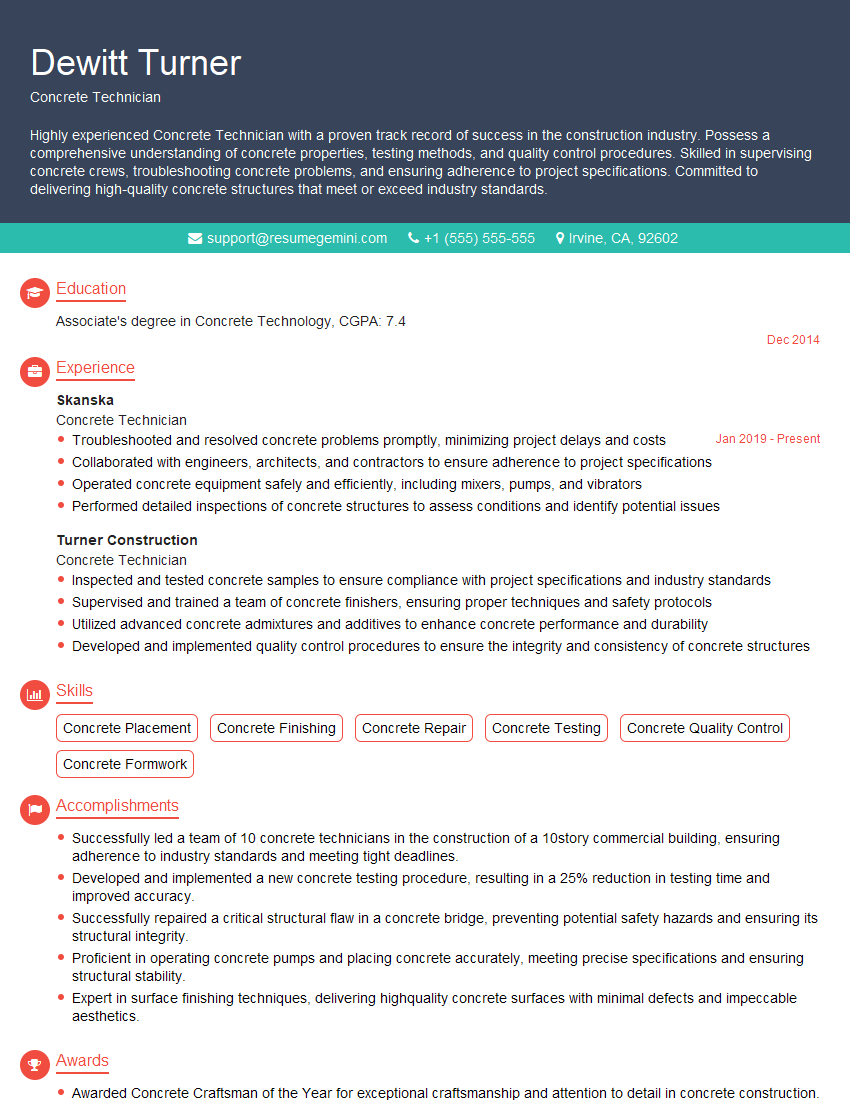
Mastering the art of finishing and curing concrete is vital for career advancement in the construction industry. A strong understanding of these processes positions you for higher-level roles with increased responsibility and earning potential. To significantly boost your job prospects, crafting a compelling and ATS-friendly resume is essential. ResumeGemini is a trusted resource to help you build a professional and impactful resume that highlights your skills and experience effectively. Examples of resumes tailored to Finishing and Curing Concrete are available to guide your creation process within ResumeGemini.

Explore more articles
Users Rating of Our Blogs
Share Your Experience
We value your feedback! Please rate our content and share your thoughts (optional).
What Readers Say About Our Blog
To the interviewgemini.com Webmaster.
Very helpful and content specific questions to help prepare me for my interview!
Thank you
To the interviewgemini.com Webmaster.
This was kind of a unique content I found around the specialized skills. Very helpful questions and good detailed answers.
Very Helpful blog, thank you Interviewgemini team.