Feeling uncertain about what to expect in your upcoming interview? We’ve got you covered! This blog highlights the most important Fluorescent Lighting Installation interview questions and provides actionable advice to help you stand out as the ideal candidate. Let’s pave the way for your success.
Questions Asked in Fluorescent Lighting Installation Interview
Q 1. What are the different types of fluorescent lamps?
Fluorescent lamps come in a variety of types, categorized primarily by shape, size, and wattage. The most common are:
- T8 and T12 Tubes: These are the classic, long, linear tubes. T8 lamps are more energy-efficient and commonly used today, having replaced the older, larger T12s. The number refers to the diameter of the tube in eighths of an inch.
- T5 and T5 HO (High Output) Tubes: These are smaller diameter tubes than T8, offering even greater efficiency and brightness in a more compact form. The HO versions are particularly powerful.
- Compact Fluorescent Lamps (CFLs): These are designed to replace incandescent bulbs in smaller fixtures. They come in various shapes, like spirals or U-shapes, and offer significant energy savings over incandescent.
- U-shaped and Circular Tubes: These lamps are used in specific fixtures and applications, offering different light distribution patterns.
Choosing the right type depends heavily on the fixture, the space’s size and lighting needs, and the desired energy efficiency.
Q 2. Explain the principles of operation of a fluorescent lamp.
Fluorescent lamps work by exciting mercury vapor inside the tube. Here’s a breakdown:
- Electric Current: The lamp is energized by an electric current flowing through electrodes at each end.
- Mercury Vapor Excitation: This current excites mercury atoms within the tube, causing them to emit ultraviolet (UV) light, invisible to the human eye.
- Phosphor Coating: The inside of the tube is coated with a phosphor substance. This phosphor absorbs the UV light emitted by the mercury and converts it into visible light.
- Visible Light Emission: The type of phosphor used determines the color temperature of the emitted light – cool white, warm white, or daylight.
Think of it like this: the mercury is the energy source, the UV light is the intermediary, and the phosphor is the transformer that converts the invisible into visible light.
Q 3. Describe the various ballast types used in fluorescent lighting systems.
Several ballast types exist, each influencing the lamp’s operation and efficiency:
- Magnetic Ballast: The older, more common type. They are relatively inexpensive but less energy efficient and generate more heat and flicker compared to electronic ballasts.
- Electronic Ballast: More efficient, quieter, and produce less heat than magnetic ballasts. They typically offer features like rapid start and dimming capabilities. They can be further classified into different types based on their starting mechanism (instant start, rapid start, programmed start).
- Programmable Ballast: Offer advanced control and dimming features. These are commonly used in commercial settings to control light levels and energy consumption.
The choice of ballast depends on several factors, including budget, energy efficiency requirements, and the desired level of control.
Q 4. How do you troubleshoot a flickering fluorescent light?
A flickering fluorescent light indicates a problem within the system. Troubleshooting involves a systematic approach:
- Check the Lamp: Start by replacing the fluorescent tube. Often, a faulty tube is the simplest explanation for flickering.
- Inspect the Ballast: If replacing the lamp doesn’t resolve the issue, inspect the ballast for any signs of damage, such as burns or discoloration. A faulty ballast is a frequent culprit.
- Examine the Wiring Connections: Loose or corroded wiring can interrupt the circuit, causing flickering. Check all connections for tightness and corrosion.
- Test the Starter (if applicable): Older magnetic ballast systems use starters. A faulty starter can cause flickering, and should be replaced if needed.
- Check the Voltage: Insufficient voltage can also cause flickering. Measure the voltage at the fixture to ensure it’s within the acceptable range.
If you’re not comfortable working with electricity, call a qualified electrician.
Q 5. What are the common causes of premature fluorescent lamp failure?
Premature fluorescent lamp failure is often caused by several factors:
- Overheating: Poor ventilation around the fixture can lead to overheating and reduced lamp lifespan.
- Frequent Switching: Repeated on/off cycling stresses the lamp, shortening its life.
- High Ambient Temperatures: Operating fluorescent lamps in excessively hot environments significantly reduces their lifespan.
- Incorrect Ballast Operation: A faulty or mismatched ballast can stress the lamp.
- Power Surges: Voltage spikes can damage the lamp’s internal components.
- Poor Quality Lamps: Using low-quality lamps can lead to shorter lifespan.
Remember that even with proper care, fluorescent lamps have a finite lifespan, typically ranging from 10,000 to 20,000 hours.
Q 6. Explain the process of installing a fluorescent light fixture.
Installing a fluorescent light fixture involves several steps, including safety precautions:
- Turn Off Power: Always switch off the power at the breaker box before starting any electrical work. This is crucial for your safety.
- Prepare the Fixture: Mount the fixture’s mounting bracket to the electrical box and ensure it’s securely fastened.
- Wire the Fixture: Connect the fixture’s wires to the electrical box wires according to the wiring diagram. Use wire connectors to secure the connections.
- Install the Lamps and Ballast: Carefully install the fluorescent lamps and the ballast into the fixture.
- Mount the Fixture Cover: Attach the fixture cover to the mounting bracket. Securely fasten it to prevent accidental detachment.
- Test the Fixture: After everything is securely installed, turn the power back on at the breaker box and test the light.
Always refer to the manufacturer’s instructions for specific details and safety guidelines for your particular fixture. If you are unsure, consult a qualified electrician.
Q 7. How do you wire a fluorescent light fixture?
Wiring a fluorescent light fixture requires understanding the different wires and ensuring proper connections:
- Identify Wires: Typically, you’ll have a black (hot), white (neutral), and ground (green or bare copper) wire from the building’s wiring and corresponding wires from the fixture. The ballast will have its own set of wires, usually labeled clearly.
- Connect Wires: Connect the black (hot) wires together, the white (neutral) wires together, and the ground wires together. Use wire connectors to make secure connections.
- Connect to Ballast: Connect the ballast wires to the fixture wires according to the ballast’s wiring diagram. This diagram is crucial and will be specific to your ballast model.
- Secure Connections: Ensure all wire connections are tightly secured. Loose connections can lead to malfunctions and fire hazards.
- Ground Wire: The ground wire is crucial for safety. Make sure it is securely connected to the ground wire in the electrical box and to the fixture’s ground.
If you are not comfortable with electrical work, consult a licensed electrician. Improper wiring can be dangerous.
Q 8. Describe the safety precautions you take when installing fluorescent lights.
Safety is paramount when installing fluorescent lights. Before starting any work, always ensure the power is completely switched off at the breaker box and double-checked with a non-contact voltage tester. This prevents potentially fatal electric shocks. Wear appropriate personal protective equipment (PPE), including safety glasses to protect your eyes from flying debris, insulated gloves to prevent electrical shocks, and sturdy work boots to protect your feet. Fluorescent tubes contain mercury, a hazardous material, so if a tube breaks, you must immediately ventilate the area and follow proper cleanup procedures using a specialized kit. Never touch a broken tube with bare hands. Always follow the manufacturer’s instructions provided with the fixtures and lamps. If you’re unsure about any aspect of the installation, consult a qualified electrician.
For example, imagine you’re replacing a fluorescent fixture in a high ceiling area. Before climbing a ladder, you’d want to ensure the power is OFF, and you have a colleague to act as a spotter. Additionally, you would use insulated tools and avoid any unnecessary contact with metal parts of the fixture. Proper safety procedures are a crucial part of responsible electrical work, preventing accidents and ensuring a safe working environment.
Q 9. What are the different types of fluorescent light fixtures?
Fluorescent light fixtures come in various types, each suited for different applications and aesthetics. Some common types include:
- Recessed fixtures: These are mounted into the ceiling, offering a clean, integrated look.
- Surface-mounted fixtures: These are attached directly to the ceiling or wall, simpler to install than recessed fixtures.
- Pendant fixtures: These hang from the ceiling, providing adjustable height and often a more decorative aesthetic.
- Troffer fixtures: These are long, rectangular fixtures often used in commercial settings, offering even illumination across large areas.
- Linear fixtures: These feature long fluorescent tubes and are versatile, suitable for various indoor spaces, including offices, warehouses, and workshops.
- Wrap-around fixtures: Often used in shop lighting applications; these fixtures are long and designed to provide illumination around a periphery.
The choice depends on factors like the space’s design, the required light level, and the budget. For instance, a sleek modern office might opt for recessed LED-integrated fluorescent fixtures, while a warehouse might use longer linear fixtures for maximum coverage.
Q 10. How do you determine the appropriate wattage for a fluorescent lamp?
Determining the appropriate wattage for a fluorescent lamp involves considering several factors. The most important is the desired light output (lumens), the area to be illuminated, and the fixture’s efficiency. You’ll also need to factor in the type of lamp (T8, T5, T12, etc.), as their efficiency varies. Higher wattage generally equals more lumens but also higher energy consumption. Therefore it’s crucial to find the balance.
For example, let’s say you need to illuminate a 100 sq. ft. office. You might consult a lighting guide or use online calculators to determine the required lumens. Once you have the target lumens, you can look at lamp specifications to find lamps with appropriate lumen output within a desired wattage range. Selecting higher-efficiency lamps (such as T5 or T8) helps you achieve the needed light output with a lower wattage, ultimately saving energy. Consider also using energy-efficient ballasts to further enhance efficiency.
Q 11. Explain the concept of lumen maintenance in fluorescent lighting.
Lumen maintenance refers to the ability of a fluorescent lamp to retain its initial light output over its lifespan. All fluorescent lamps experience lumen depreciation – a gradual decrease in light output over time. Lumen maintenance is expressed as a percentage of initial lumens remaining after a specific time (e.g., 40,000 hours). A higher lumen maintenance percentage indicates a longer-lasting and more consistent light source.
Imagine two lamps with the same initial lumens. One has 80% lumen maintenance after 40,000 hours, while the other has only 60%. After 40,000 hours of use, the first lamp will still be providing 80% of its initial brightness, whereas the second will only be producing 60%. This is a significant difference, impacting both the visual comfort and energy efficiency of the lighting system. Choosing lamps with higher lumen maintenance helps minimize the frequency of lamp replacement and maintain consistent illumination.
Q 12. What is the role of a starter in a fluorescent lighting system?
In a traditional fluorescent lighting system, the starter is a small, usually neon-glow, device that initiates the lamp’s operation. When the light switch is turned on, the starter heats a bimetallic strip, briefly completing a circuit and allowing current to flow through the fluorescent tube’s filaments. This heats the filaments and creates a low-pressure environment within the tube, allowing the gas to conduct electricity. Once the gas begins to conduct, the starter’s circuit is broken by the bimetallic strip cooling down and opening the circuit. The current is then switched to the ballast, which regulates the current and maintains the lamp’s operation.
Without a functioning starter, the fluorescent lamp won’t light or will flicker incessantly. Think of the starter as a key to ignite the lamp; without it, you can’t start the engine. Modern electronic ballasts often incorporate their own starting mechanisms and don’t need a separate starter component, which simplifies the system design and installation.
Q 13. How do you test the integrity of a fluorescent lamp?
Testing the integrity of a fluorescent lamp involves visual inspection and a functional test. A visual inspection checks for any physical damage to the tube, such as cracks, pinholes, or discoloration. A functional test simply involves installing the lamp into the fixture and turning the power on. If the lamp lights up evenly and without flickering, it’s usually functioning correctly. If the lamp flickers excessively, fails to ignite, or has dark patches, it’s likely defective and needs to be replaced.
For example, if you notice a dark spot or a crack in the tube, it is already evident the lamp is faulty and should be discarded properly. If the lamp flickers, a defective starter or ballast could also be a contributing factor, warranting further investigation.
Q 14. Describe the procedure for replacing a fluorescent lamp.
Replacing a fluorescent lamp is a relatively straightforward process, but safety is always crucial. First, turn off the power at the breaker. Then, carefully remove the fixture cover, usually by loosening screws or clips. Next, gently remove the old lamp by sliding it out or unscrewing it depending on the fixture design. Remember, handle the lamp with care to avoid breaking it (as they contain mercury). Install the new lamp in the same orientation as the old one. Finally, replace the fixture cover and turn the power back on. Check the lamp to ensure it lights up properly.
For instance, if you’re replacing a lamp in a drop ceiling fixture, you’d start by removing the access panel, then carefully remove the lamp, ensuring you don’t drop it. Remember to refer to the manufacturer’s instructions for specific procedures related to the fixture model.
Q 15. What are the environmental considerations related to fluorescent lamp disposal?
Fluorescent lamps contain mercury, a hazardous substance. Improper disposal can lead to environmental contamination. Therefore, responsible disposal is crucial.
- Recycling: The most environmentally friendly option. Many municipalities have recycling programs specifically for fluorescent lamps. These programs ensure the mercury is safely extracted and the remaining materials are recycled.
- Designated Collection Centers: Hardware stores, lighting suppliers, and waste management facilities often have designated drop-off points for fluorescent lamps, making disposal convenient and safe.
- Never Throw in Regular Trash: Breaking a fluorescent lamp releases mercury vapor, which is toxic to humans and the environment. This is a significant hazard and should always be avoided.
For large-scale projects or businesses, it’s recommended to contract a specialized waste disposal company experienced in handling hazardous materials like mercury. This ensures compliance with all environmental regulations and safe disposal.
Career Expert Tips:
- Ace those interviews! Prepare effectively by reviewing the Top 50 Most Common Interview Questions on ResumeGemini.
- Navigate your job search with confidence! Explore a wide range of Career Tips on ResumeGemini. Learn about common challenges and recommendations to overcome them.
- Craft the perfect resume! Master the Art of Resume Writing with ResumeGemini’s guide. Showcase your unique qualifications and achievements effectively.
- Don’t miss out on holiday savings! Build your dream resume with ResumeGemini’s ATS optimized templates.
Q 16. Explain the difference between rapid-start and instant-start fluorescent ballasts.
Both rapid-start and instant-start ballasts are used to start and operate fluorescent lamps, but they differ in their starting mechanisms and efficiency.
- Instant-start ballasts: These apply a high voltage across the lamp electrodes, instantly ionizing the gas within and causing the lamp to light. They are simpler and less expensive but tend to shorten lamp life due to the high starting voltage stress on the filaments.
- Rapid-start ballasts: These apply a lower voltage continuously to preheat the filaments before applying high voltage. This gentler approach extends lamp life and improves efficiency. They are more energy efficient and produce less flicker.
Think of it like starting a car: instant-start is like cranking the engine hard, while rapid-start is like letting the engine warm up a bit before driving. Rapid-start offers better performance and longevity but comes at a slightly higher initial cost.
Q 17. How do you troubleshoot a fluorescent light fixture that doesn’t turn on?
Troubleshooting a non-functioning fluorescent fixture is a systematic process. Here’s a step-by-step approach:
- Check the power supply: Ensure the circuit breaker is not tripped and the power to the fixture is on. Use a voltage tester to confirm power at the fixture.
- Inspect the lamp: Examine the fluorescent tube for any signs of damage, such as blackening at the ends or cracks. Try replacing it with a known good lamp.
- Check the ballast: Listen for a humming sound from the ballast. If it’s silent, there’s a high chance the ballast has failed. A buzzing or high-pitched sound could indicate a problem with the ballast as well. Testing the ballast directly with a multimeter can confirm if it’s faulty.
- Inspect wiring connections: Verify all wiring connections are secure and free from corrosion or damage. Loose connections are a frequent cause of failure.
- Examine the starter (if applicable): Older fixtures use starters. A clicking sound from the starter might suggest it needs replacing.
- Consider the fixture itself: In rare cases, the fixture itself might be faulty. If all other components are in good working order, the fixture could require replacement.
If you’re uncomfortable working with electricity, call a qualified electrician.
Q 18. What are the common problems associated with fluorescent lighting systems?
Common problems with fluorescent lighting systems include:
- Ballast failure: This is a very common issue, often leading to a non-functional fixture or flickering lights. Ballast failure is usually indicated by flickering, humming, or no light output.
- Lamp failure: Fluorescent lamps have a limited lifespan, and eventually need replacement. Dark spots or complete failure are common signs of lamp failure.
- Flickering lights: Flickering can be caused by faulty ballasts, loose wiring, failing lamps, or even voltage issues in the electrical supply.
- Dim lighting: This could be due to nearing the end of the lamp’s life, a failing ballast, or incorrect voltage.
- Premature lamp failure: This can be a sign of electrical surge issues or using the wrong type of lamp for the ballast.
Regular maintenance, including lamp and ballast inspections, can help mitigate many of these problems.
Q 19. Describe your experience working with different types of fluorescent light fixtures (e.g., T5, T8, T12).
My experience encompasses a broad range of fluorescent lighting fixtures, including T5, T8, and T12 types.
- T12 fixtures: These were very common but are now largely being phased out due to their lower energy efficiency. I’ve worked extensively on retrofitting these older systems with more efficient T8 or T5 equivalents.
- T8 fixtures: These represent a significant improvement in energy efficiency over T12s, and I have significant experience in their installation, maintenance, and troubleshooting. I’ve worked on numerous commercial and residential projects involving T8 systems.
- T5 fixtures: These are the most energy-efficient of the three, and offer superior light output. I’ve been involved in new construction projects utilizing T5 systems, focusing on optimal fixture placement for efficient lighting design.
My experience extends beyond simply installation; I’m also adept at designing lighting layouts for optimal illumination and energy efficiency, considering factors such as room size, ceiling height, and intended use.
Q 20. How do you calculate the number of fluorescent fixtures needed for a given space?
Calculating the number of fluorescent fixtures needed involves several steps:
- Determine the area: Calculate the square footage of the space to be lit.
- Determine the required light level: This depends on the type of space and its intended use. Codes and guidelines often specify required illuminance levels (measured in lumens per square foot or lux). A task-based area will need much higher levels than a hallway.
- Determine the lumen output per fixture: Check the specifications of the chosen fixture to find its lumen output. This value is often printed on the fixture or its packaging.
- Calculate the total lumens required: Multiply the area by the required light level to determine the total lumens needed for the space.
- Calculate the number of fixtures: Divide the total lumens required by the lumen output per fixture. This will give you the minimum number of fixtures needed.
- Adjust for spacing and layout: Consider the spacing guidelines for fixtures, which depend on their lumen output and the type of reflector used. Ensure uniform illumination across the space by adjusting fixture placement.
It’s always best to consult industry standards and lighting design guides for best practices. Software tools can also help in calculating the optimal number and placement of fixtures for a given space.
Q 21. Explain the concept of energy efficiency in fluorescent lighting.
Energy efficiency in fluorescent lighting centers around minimizing energy consumption while maximizing light output. This is achieved through several factors:
- Lamp efficiency: Modern fluorescent lamps, particularly T5s, produce significantly more lumens per watt compared to older T12 lamps. A higher lumens-per-watt ratio translates to more light for less energy.
- Ballast efficiency: Electronic ballasts are far more energy-efficient than older magnetic ballasts. They are essential for achieving the best energy performance from fluorescent lamps.
- Lighting controls: Implementing occupancy sensors, daylight harvesting, and timers can significantly reduce energy consumption by only lighting spaces when and where needed.
- Fixture design: Well-designed fixtures maximize light output by effectively directing the light where it’s needed, minimizing wasted light and energy.
Comparing the energy usage of a fluorescent lamp to an incandescent lamp clearly illustrates the energy efficiency advantage. For example, a typical fluorescent lamp can produce significantly more light than an incandescent bulb using a fraction of the electricity.
Q 22. What are the benefits and drawbacks of using fluorescent lighting?
Fluorescent lighting offers several advantages, but also has some drawbacks. Let’s start with the benefits:
- Energy Efficiency: Fluorescent lights are significantly more energy-efficient than incandescent bulbs, consuming less power to produce the same amount of light. This translates to lower electricity bills and a smaller carbon footprint.
- Longer Lifespan: They last much longer than incandescent bulbs, reducing replacement costs and minimizing maintenance downtime.
- Versatile Design: Fluorescent lights come in various shapes, sizes, and color temperatures, allowing for flexibility in design and application, from compact tubes to long linear fixtures.
- Even Light Distribution: They typically provide more even light distribution compared to incandescent bulbs, minimizing shadows and creating a more comfortable environment.
However, there are downsides to consider:
- Mercury Content: Fluorescent tubes contain mercury, a hazardous substance requiring careful disposal at designated recycling centers. Improper disposal can harm the environment.
- Flickering and Humming: Some older or poorly installed fluorescent fixtures can produce a noticeable flickering or humming sound, which can be distracting and annoying.
- Ballast Issues: The ballast, a component that regulates the current to the tube, can fail, leading to premature bulb failure or complete fixture malfunction. These ballasts can also generate some heat.
- Disposal Costs: The need for special disposal adds a small cost compared to incandescent bulb disposal.
Ultimately, the decision of whether to use fluorescent lighting depends on a careful weighing of these pros and cons in relation to the specific application.
Q 23. How do you ensure compliance with electrical codes during fluorescent light installation?
Ensuring compliance with electrical codes during fluorescent light installation is paramount for safety and legal reasons. My approach involves several key steps:
- Proper Wiring: I always adhere to the National Electrical Code (NEC) and local regulations regarding wire gauge, circuit protection (breakers), grounding, and bonding. Using the correct wire size for the amperage and ensuring a proper ground connection are critical to prevent electrical shock or fire hazards.
- Fixture Mounting: Fixtures must be securely mounted to appropriate structural members, capable of supporting their weight, and installed according to the manufacturer’s instructions. This prevents falls and potential injury.
- Ballast Selection and Installation: Choosing the correct ballast for the fluorescent tube is essential. The ballast must be compatible with the tube type and voltage. The ballast should be installed according to the manufacturer’s specifications, ensuring proper ventilation to prevent overheating.
- Junction Box Requirements: All wiring connections must be made within approved junction boxes, adequately sized to accommodate the wires and easily accessible for inspection and maintenance. Boxes must be properly grounded.
- Safety Inspections: Before energizing the circuit, I always conduct a thorough visual inspection of all wiring connections, grounding, and fixture mounting to ensure everything is correctly installed and meets code requirements.
Ignoring these codes can lead to serious consequences, including electrical fires, shock hazards, and potential legal liabilities. Prioritizing safety and code compliance is always my top priority.
Q 24. Describe your experience with troubleshooting and repairing fluorescent lighting systems.
Troubleshooting and repairing fluorescent lighting systems is a significant part of my work. I’ve encountered a wide range of issues, from simple bulb replacements to complex ballast problems. My approach is systematic and involves:
- Visual Inspection: First, I carefully inspect the fixture for any visible damage, loose connections, or burned components. This often reveals the source of the problem.
- Testing with a Multimeter: I use a multimeter to check the voltage at the fixture, the continuity of the wiring, and the function of the ballast. This helps pinpoint whether the issue lies with the wiring, ballast, or the tube itself.
- Ballast Diagnosis: If the problem appears to be with the ballast, I’ll check for common faults such as burned-out components, loose connections, or overheating. Sometimes, replacing the ballast resolves the issue entirely.
- Tube Testing: If the ballast is functioning correctly, I’ll test the fluorescent tube itself. A faulty tube will typically show no signs of illumination, even with a working ballast.
- Wiring Checks: I carefully trace the wiring from the fixture back to the breaker panel, checking for any loose connections, breaks, or shorts in the circuit.
For example, I once had a case where a flickering fluorescent light was due to a loose ground wire causing voltage fluctuation. Another time, a complete lighting outage in an office was traced to a faulty ballast that had overheated and failed, causing a circuit breaker trip. In each instance, a systematic approach led to the prompt and effective resolution of the issue.
Q 25. What are the different types of emergency lighting systems commonly used with fluorescent lights?
Emergency lighting systems are crucial in ensuring safety during power outages. With fluorescent lighting, several types are commonly used:
- Battery-Backed Fluorescent Fixtures: These fixtures contain internal batteries that automatically illuminate the fluorescent tube(s) when the main power fails. They often include a test switch to verify battery functionality.
- Centralized Emergency Lighting Systems: Larger buildings often utilize centralized systems with a dedicated battery backup powering multiple fluorescent fixtures through a separate wiring system. These often include monitoring capabilities.
- Exit Sign Systems: These are specifically designed to illuminate exit signs and pathways during emergencies, usually employing fluorescent or LED tubes powered by batteries.
The choice of emergency lighting system depends on factors like building size, occupancy, and local fire codes. Regular testing and maintenance of these systems are vital to guarantee their proper function during an actual emergency. I always ensure that any emergency lighting installed complies with all applicable standards and regulations.
Q 26. How do you maintain fluorescent lighting systems to ensure optimal performance?
Maintaining fluorescent lighting systems is essential to ensure optimal performance, extending their lifespan, and preventing premature failures. My maintenance program includes:
- Regular Cleaning: Dust and dirt accumulation on the fluorescent tubes and fixtures significantly reduces light output. Regular cleaning, using appropriate methods, improves light efficiency and extends the life of the tubes.
- Ballast Inspection: Periodically inspecting ballasts for signs of overheating, loose connections, or damage is critical. Addressing issues promptly can prevent complete ballast failure.
- Tube Replacement: Fluorescent tubes have a finite lifespan. Replacing tubes as they reach the end of their life extends system lifespan and maintains consistent light output.
- Emergency Lighting Testing: Emergency lighting systems need regular testing, usually monthly, to verify battery function and ensure they activate correctly during a power failure.
- Preventative Maintenance: Proactive maintenance, such as checking for loose connections or worn components can save time and money in the long run by preventing larger issues.
A well-maintained system will not only provide consistent lighting, but also reduce maintenance costs and extend the overall system life.
Q 27. What are your preferred methods for documenting fluorescent light installations and maintenance?
Accurate documentation is crucial for efficient maintenance and future reference. My preferred methods include:
- Detailed Installation Reports: I create comprehensive reports detailing the installation process, including fixture locations, wiring diagrams, component specifications, and any modifications made from the original plan. These reports include photographs and diagrams.
- Maintenance Logs: I maintain detailed logs recording all maintenance activities, including dates, tasks performed, components replaced, and any observations made. This history aids in identifying recurring issues and optimizing maintenance schedules.
- Digital Asset Management: I utilize digital tools, including cloud-based storage and software, to organize and store installation and maintenance documentation for easy access and sharing.
- As-Built Drawings: If modifications are made during installation or maintenance, I update the as-built drawings to reflect the current system configuration. This is crucial for future work.
This systematic approach to documentation ensures that all information related to the fluorescent lighting system is readily available, facilitating efficient maintenance and troubleshooting in the future.
Q 28. Describe a challenging fluorescent lighting installation project and how you overcame the challenges.
One challenging project involved installing a fluorescent lighting system in a historic building with intricate architectural details. The building’s old wiring posed significant limitations, and some areas had extremely limited access. The challenge was to install a modern, energy-efficient system without compromising the building’s historical integrity.
To overcome these hurdles, I implemented several strategies:
- Careful Planning and Design: We collaborated closely with architects and preservationists to design a system that minimized disruption to the historical features. This involved selecting compact fluorescent fixtures and running wiring through existing conduits where possible.
- Innovative Wiring Techniques: In areas with limited access, we used flexible conduit and small-diameter wiring to navigate tight spaces. We utilized surface-mounted raceways in some cases to maintain the aesthetic appeal.
- Specialized Tools and Expertise: We employed specialized tools, such as fish tapes and borescopes, to snake wires through concealed spaces. The project demanded a high level of expertise and experience in navigating old building structures.
- Rigorous Testing and Inspection: Given the complexities of the installation, we conducted thorough testing and inspections at each stage to ensure the system’s safety and functionality. This included regular voltage and continuity tests.
The project’s successful completion demonstrated our ability to adapt to challenging environments, integrate modern technology into historical structures, and deliver a system that met both functional and aesthetic requirements. It was a testament to meticulous planning, innovative problem-solving, and skilled execution.
Key Topics to Learn for Fluorescent Lighting Installation Interview
- Understanding Fluorescent Tube Types: Learn the differences between T5, T8, and T12 tubes, their wattage, and lumen output. Consider the impact of different tube types on energy efficiency and lighting quality.
- Ballast Selection and Installation: Master the selection of appropriate ballasts (magnetic vs. electronic) based on tube type and power requirements. Understand the wiring diagrams and safety procedures for ballast installation.
- Wiring and Circuitry: Familiarize yourself with common wiring configurations for fluorescent lighting fixtures, including single and multiple tube circuits. Practice identifying and troubleshooting common wiring issues.
- Fixture Installation Techniques: Develop proficiency in safely installing various types of fluorescent fixtures, including surface mount, recessed, and pendant fixtures. Understand the importance of proper grounding and securing.
- Troubleshooting and Maintenance: Learn how to diagnose and repair common problems such as flickering lights, ballast failures, and faulty wiring. Understand preventative maintenance procedures to extend the lifespan of fluorescent lighting systems.
- Safety Regulations and Codes: Familiarize yourself with relevant electrical safety codes and regulations related to fluorescent lighting installation. Understand the importance of working safely and using appropriate personal protective equipment (PPE).
- Energy Efficiency Considerations: Understand the energy efficiency implications of different fluorescent lighting systems and the role of lighting controls in reducing energy consumption. Be prepared to discuss energy-saving strategies.
Next Steps
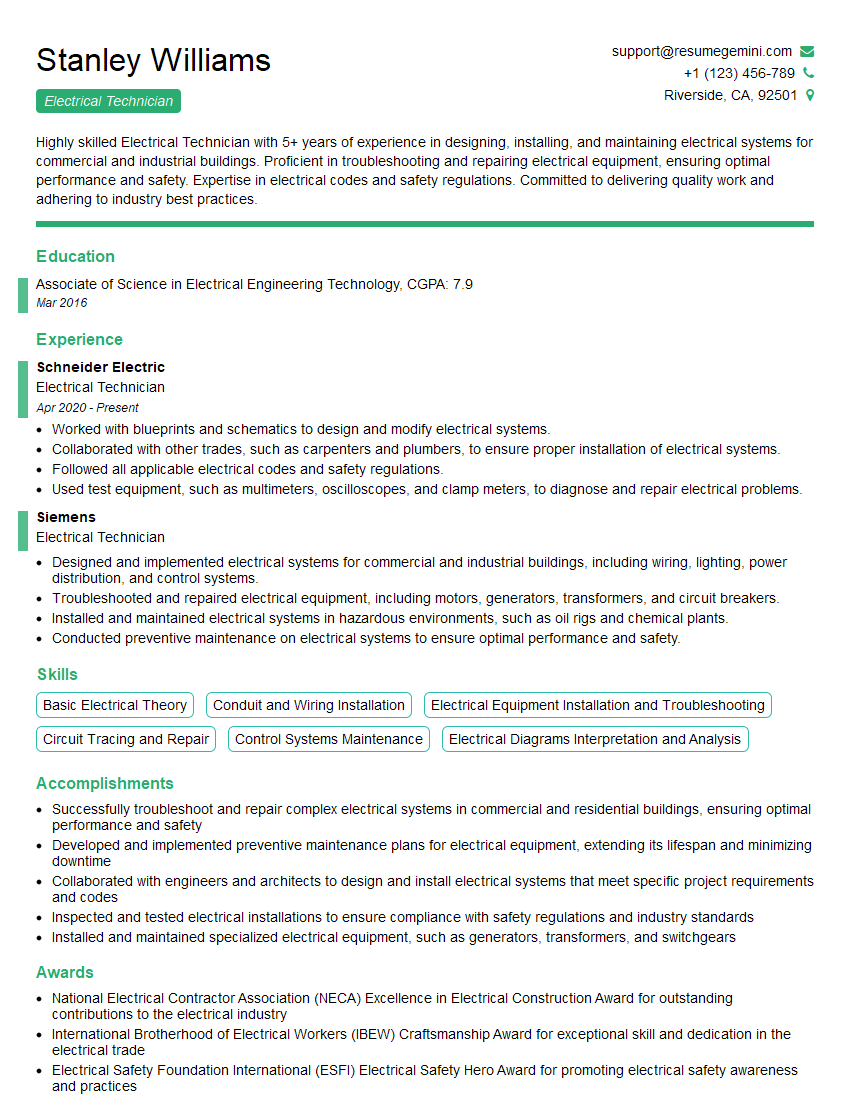
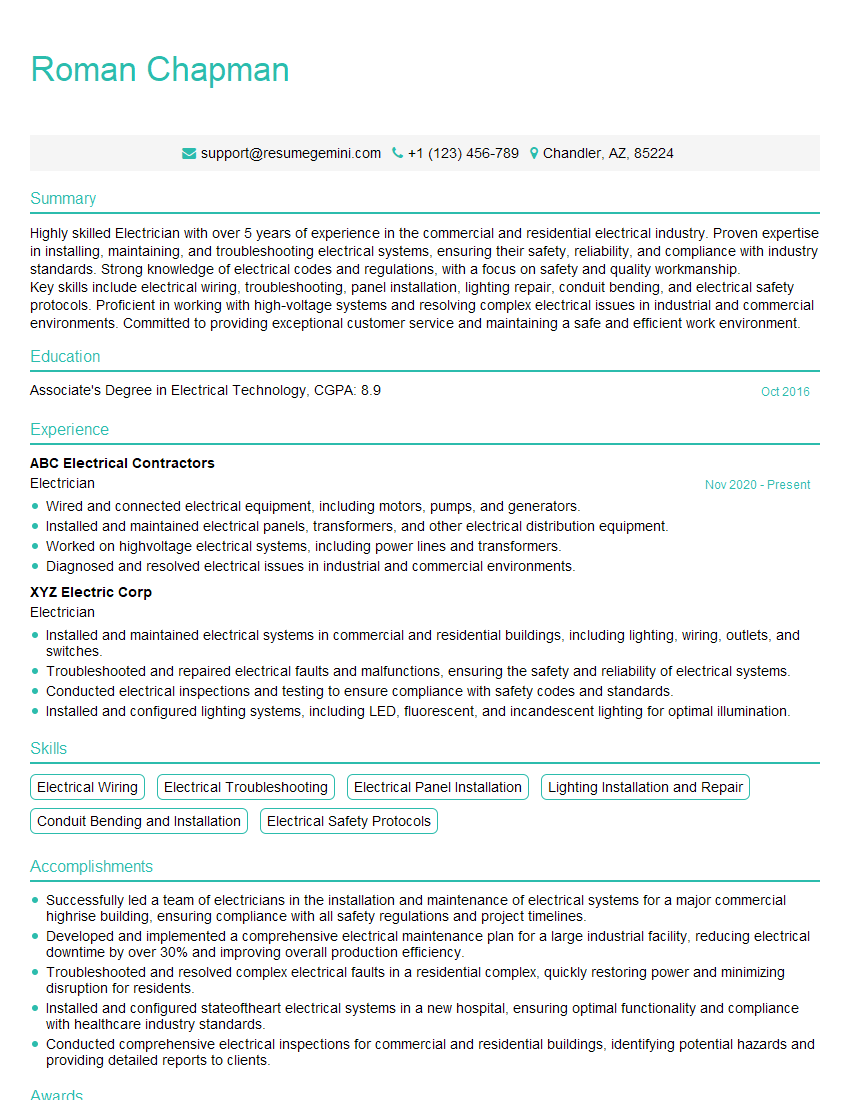
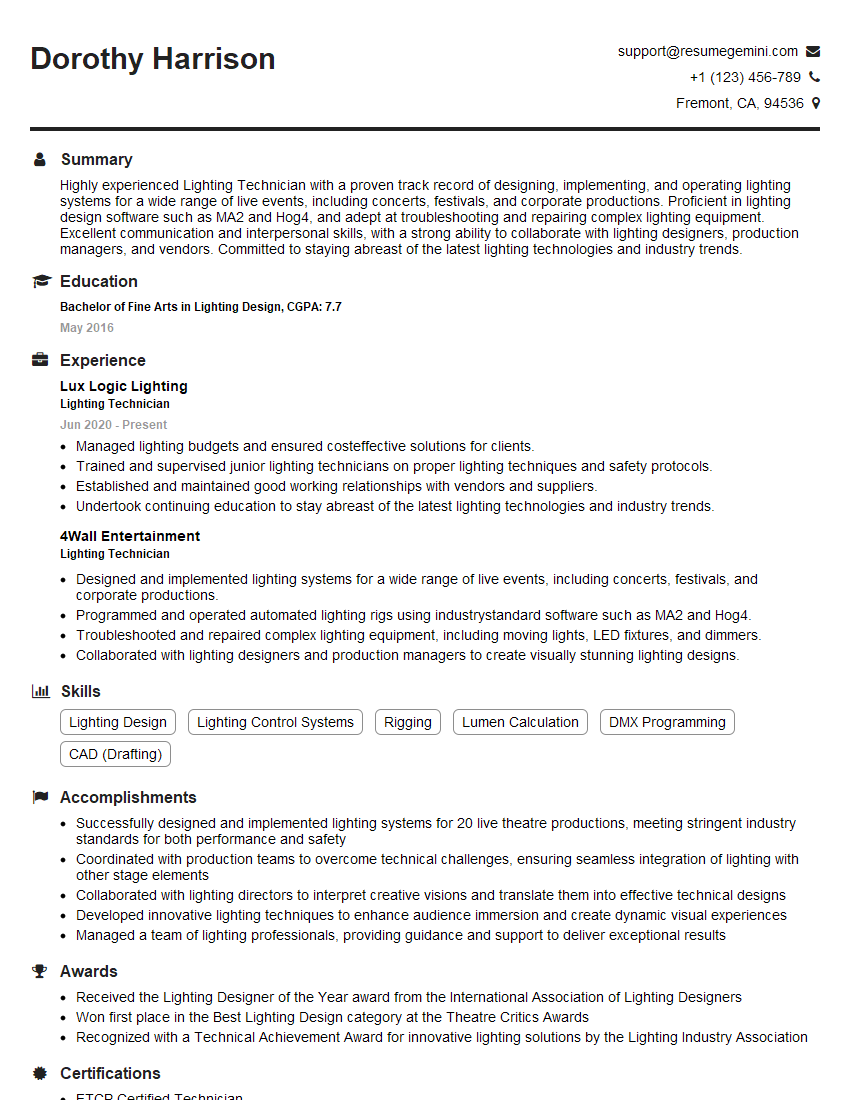
Mastering Fluorescent Lighting Installation opens doors to rewarding careers in the electrical and construction industries. A strong foundation in these skills is highly sought after by employers, leading to increased job opportunities and higher earning potential. To maximize your chances of landing your dream job, it’s crucial to present your skills effectively. Creating an ATS-friendly resume is key to getting your application noticed. We strongly recommend using ResumeGemini to build a professional, impactful resume that showcases your expertise. ResumeGemini provides examples of resumes tailored to Fluorescent Lighting Installation to guide you through the process. Invest the time to craft a compelling resume – it’s your first impression with potential employers.
Explore more articles
Users Rating of Our Blogs
Share Your Experience
We value your feedback! Please rate our content and share your thoughts (optional).
What Readers Say About Our Blog
To the interviewgemini.com Webmaster.
Very helpful and content specific questions to help prepare me for my interview!
Thank you
To the interviewgemini.com Webmaster.
This was kind of a unique content I found around the specialized skills. Very helpful questions and good detailed answers.
Very Helpful blog, thank you Interviewgemini team.