Cracking a skill-specific interview, like one for Generator Control and Protection, requires understanding the nuances of the role. In this blog, we present the questions you’re most likely to encounter, along with insights into how to answer them effectively. Let’s ensure you’re ready to make a strong impression.
Questions Asked in Generator Control and Protection Interview
Q 1. Explain the principle of operation of a generator AVR (Automatic Voltage Regulator).
The Automatic Voltage Regulator (AVR) is the heart of maintaining stable voltage output from a generator. Imagine a water faucet – you want a consistent flow of water, not a fluctuating stream. The AVR does the same for voltage. It continuously monitors the generator’s output voltage and compares it to a setpoint (desired voltage). If the voltage drops, the AVR increases the generator’s field current, strengthening the magnetic field and boosting the voltage. Conversely, if the voltage rises too high, it reduces the field current.
This regulation is achieved through a feedback loop. A sensor measures the output voltage, and this signal is fed to a control circuit within the AVR. This circuit compares the measured voltage to the reference voltage. The difference (error) is then used to adjust the excitation current supplied to the generator’s rotor field windings. Different types of AVRs use various control techniques, such as proportional-integral-derivative (PID) control, to achieve precise and rapid voltage regulation. For example, a simple AVR might use a thyristor to control the field current, while more sophisticated AVRs employ more complex power electronic components for smoother and faster control.
Q 2. Describe different types of generator protection relays and their functions.
Generator protection relays are like security guards, ensuring the generator’s safety and preventing damage. Several types exist, each with a specific function:
- Overcurrent Relay: This is the most basic protection. If the current flowing through the generator exceeds a preset limit (due to a short circuit or overload), this relay trips the circuit breaker, disconnecting the generator from the load.
- Differential Protection Relay: This compares the current entering and leaving the generator. Any significant difference indicates an internal fault (e.g., winding fault), triggering the breaker to trip.
- Over/Under Frequency Relay: This protects against frequency deviations. If the generator’s frequency goes outside acceptable limits, this relay will shut down the generator to prevent damage or grid instability.
- Loss of Excitation Relay: This detects a loss of field excitation, which causes the generator’s voltage to drop significantly. Without excitation, the generator can become unstable and potentially damage itself or the grid.
- Over Speed Relay: This relay detects if the generator’s rotor speed exceeds the safe operating limit, preventing mechanical damage.
- Reverse Power Relay: This relay protects against situations where power flows back into the generator, potentially damaging it.
These relays often work together, providing comprehensive protection. The specific relays used depend on the size and application of the generator.
Q 3. How does a generator’s governor control system maintain frequency?
The governor is the brains behind maintaining the generator’s frequency. It’s like the cruise control in a car, ensuring a consistent speed. The governor senses the generator’s rotational speed (and hence frequency) and compares it to a setpoint (usually 50Hz or 60Hz). If the frequency drops, indicating an increased load, the governor increases the fuel supply to the engine, speeding it up and restoring the frequency. Conversely, if the frequency is too high, it reduces the fuel supply.
This control loop involves a speed sensor (often a tachometer), a control unit, and an actuator (like a fuel valve). The sophistication of the governor system can vary from simple mechanical governors in smaller generators to advanced electronic governors with sophisticated control algorithms in larger power plants. These algorithms, often based on PID control, optimize the response of the governor to transient changes in the load.
Q 4. What are the common causes of generator overspeed and how are they prevented?
Overspeed is a dangerous condition, potentially causing catastrophic damage to the generator. Common causes include:
- Loss of Load: A sudden drop in load can cause the generator to accelerate rapidly if the governor doesn’t respond quickly enough.
- Governor Malfunction: A faulty governor may fail to regulate the speed, leading to overspeed.
- Engine Problems: Mechanical problems within the engine, such as runaway fuel injection, can cause overspeed.
- Protection System Failure: If the overspeed protection relay fails, the generator will not shut down even when it overspeeds.
Prevention involves regular maintenance of the governor and protection system, ensuring timely response to load changes and using robust mechanical components in the engine. Redundant overspeed protection is vital in critical applications.
Q 5. Explain the importance of synchronization before connecting a generator to the grid.
Synchronization is crucial before connecting a generator to the grid, preventing damage to the generator and grid instability. It involves matching three key parameters:
- Voltage Magnitude: The generator’s voltage must match the grid voltage.
- Frequency: The generator’s frequency must match the grid frequency.
- Phase Angle: The generator’s voltage waveform must be in phase with the grid voltage waveform. Connecting out of phase can lead to a massive short circuit.
Think of it like trying to seamlessly join two moving conveyor belts. If the speeds or directions don’t match, things will get chaotic. Synchronization is usually achieved using a synchroscope that visually indicates the phase difference. Once all three parameters are matched, the generator can be safely connected to the grid using a synchronizing switch.
Q 6. Describe the steps involved in troubleshooting a generator’s failure to start.
Troubleshooting a generator’s failure to start is a systematic process:
- Check the obvious: Is the fuel tank full? Is there power to the control circuit? Is the emergency stop button disengaged?
- Engine-related issues: Verify the engine’s oil level, check for fuel supply and prime the system if necessary, investigate the battery voltage (for starting), inspect the starter motor, and consider if the engine needs maintenance (e.g., air filter).
- Control System Checks: Test the control circuit for proper operation, examine the auto-start logic, inspect relay contactors and wiring. Check the governor setting.
- Generator-related issues: Ensure the generator’s circuit breaker is closed and that no safety interlocks are preventing start-up. Investigate issues with the excitation system.
- Check the load: An excessively high load can prevent the generator from starting.
By methodically checking each aspect, one can typically isolate the root cause of the failure. Using diagnostic tools like multimeters and an understanding of the generator’s system schematics are crucial. Remember to always follow safety procedures when working on any electrical or mechanical equipment.
Q 7. What are the safety precautions to be taken while working on a generator?
Safety is paramount when working on a generator. Always follow these precautions:
- Lockout/Tagout: Before performing any maintenance, completely disconnect the generator from the power source using lockout/tagout procedures. This prevents accidental energization.
- Personal Protective Equipment (PPE): Use appropriate PPE, including safety glasses, gloves, and hearing protection.
- Grounding: Ensure the generator is properly grounded to prevent electric shock.
- Ventilation: Generators produce carbon monoxide, so ensure adequate ventilation to prevent poisoning.
- Hot Surfaces: Be aware of hot surfaces, particularly around the engine and exhaust system.
- Moving Parts: Never reach into moving parts while the generator is operating.
- Qualified Personnel: Work should only be carried out by qualified and trained personnel.
Failure to observe these safety precautions can lead to serious injury or death. Safety training is essential for anyone working with generators.
Q 8. Explain the concept of parallel operation of generators.
Parallel operation of generators refers to connecting two or more generators to a common busbar, allowing them to supply power to the same electrical load. This is crucial for increasing power capacity, enhancing system reliability (as one generator can compensate for another’s failure), and improving efficiency by allowing generators to operate at their optimal load points.
Successful parallel operation requires careful synchronization. This involves matching the generators’ voltage, frequency, and phase angles. Think of it like merging lanes on a highway – you can’t just jump in; you need to match speed and position before safely merging. Mismatch can lead to circulating currents, damaging the generators. Sophisticated control systems monitor these parameters, automatically adjusting generator output to maintain synchronization.
For instance, a large data center might use several generators in parallel to ensure continuous operation. If one generator fails, the others seamlessly take over the load, minimizing downtime. Proper load sharing is achieved through sophisticated control algorithms within each generator’s governor and Automatic Voltage Regulator (AVR).
Q 9. How do you ensure proper grounding of a generator?
Proper grounding of a generator is paramount for safety and performance. It provides a low-impedance path for fault currents to flow to the earth, preventing dangerous voltage buildup and protecting personnel and equipment. This is achieved through a grounding system that connects the generator’s frame and neutral point (if applicable) to a grounding electrode, typically a driven rod or a ground grid.
The grounding electrode should have low resistance to earth, typically less than 5 ohms. Resistance measurements are critical and should be regularly tested. A high resistance can compromise the effectiveness of the ground, increasing the risk of electrical shock and equipment damage. Furthermore, the grounding system needs to be robust, able to handle the high fault currents expected. Improper grounding can lead to stray voltages, creating a shock hazard. For example, in a hospital, proper grounding prevents potential life-threatening hazards to patients and staff during a generator operation.
Q 10. What are the different types of generator excitation systems?
Generator excitation systems provide the DC current needed to create the magnetic field in the generator’s rotor, which is essential for generating AC power. There are several types:
- Static Excitation: Uses solid-state devices like thyristors or IGBTs to control the DC excitation. It’s widely used due to its fast response, precise control, and lack of moving parts. It’s the most common system for larger generators.
- Rotating Excitation: Employs a separate smaller generator (exciter) to provide DC excitation to the main generator’s rotor. Simpler and more robust, but slower and less efficient compared to static excitation.
- Brushless Excitation: A variation of rotating excitation where the exciter’s output is rectified using diodes mounted on the rotor, eliminating the need for brushes and slip rings. It’s more reliable and maintenance-friendly than traditional rotating systems.
The choice of excitation system depends on the generator’s size, application, and required performance characteristics. For instance, high-speed generators often use brushless systems for enhanced reliability.
Q 11. Explain the role of a generator’s breaker in protection.
The generator breaker is a crucial component in the protection system, acting as the main on/off switch and a critical safety device. Its role is to quickly isolate the generator from the system in case of a fault. This prevents damage to the generator, the electrical system, and protects personnel.
The breaker is equipped with various protective relays that monitor generator parameters like current, voltage, frequency, and power. If a fault condition, such as an overcurrent, ground fault, or loss of synchronism, is detected, the relay trips the breaker, instantly disconnecting the generator. For example, a sudden short circuit will cause a significant increase in current, triggering the overcurrent relay to trip the breaker.
Choosing an appropriate breaker with suitable protective relays is vital for ensuring the safety and reliability of the generator system. The breaker’s rating must exceed the generator’s maximum output current to ensure proper protection.
Q 12. Describe different types of generator fuel systems and their control.
Generator fuel systems vary depending on the type of fuel used – diesel, natural gas, or others. The control systems aim to deliver the correct amount of fuel to maintain the desired generator speed and power output.
- Diesel Fuel Systems: Typically employ an injection pump that delivers precisely metered fuel to the engine cylinders. The control system adjusts the fuel injection rate based on the load demand, using a governor that regulates the engine speed.
- Natural Gas Fuel Systems: Use pressure regulators and gas valves to control the gas flow to the engine. The control system manages the gas pressure and flow rate to maintain the desired engine speed and power.
These systems often incorporate safety features like fuel level monitoring, pressure sensors, and automated shut-down mechanisms to prevent malfunction and ensure safe operation. Modern systems often include electronic control units (ECUs) for precise fuel management and monitoring.
Q 13. How do you perform load sharing between multiple generators?
Load sharing between multiple generators requires precise control to prevent overloading individual generators and ensure efficient operation. It’s achieved through governor control systems.
Each generator’s governor regulates its speed and power output. The governors are designed to share the load proportionally, based on their ratings. This is typically accomplished using droop control – each generator’s governor is set to slightly reduce its speed as the load increases. This inherent droop characteristic ensures that generators share the load based on their capacity. More sophisticated systems utilize electronic controls and communication networks to fine-tune load sharing, optimizing the efficiency of each generator.
Imagine a team of weightlifters lifting a heavy barbell. Each lifter should contribute based on their strength. Load sharing ensures a similar balance among generators, preventing some from working too hard and others from being underutilized.
Q 14. What are the common causes of generator overheating and how are they addressed?
Generator overheating is a serious issue that can lead to engine damage and even fires. Common causes include:
- Insufficient Cooling: Blocked air intakes, clogged radiators, or low coolant levels restrict heat dissipation, leading to overheating. Regular maintenance, ensuring adequate airflow, and monitoring coolant levels are essential.
- Overloading: Running the generator at a higher power output than its rated capacity generates excessive heat. This requires operating the generator within its specified power limits.
- Lubrication Problems: Insufficient or contaminated lubricating oil reduces its ability to absorb heat, leading to overheating of engine components. Regular oil changes and maintenance are crucial.
- Fuel System Issues: Problems like incorrect fuel-air mixture or fuel injector malfunction can result in incomplete combustion, generating excess heat. Proper fuel system maintenance can prevent this.
Addressing these issues involves regular inspection and maintenance, including checking coolant levels, cleaning the air filters and radiators, ensuring proper lubrication, and verifying the fuel system’s operation. Modern generators often have temperature sensors and alarms that provide early warnings of overheating conditions. Proper maintenance, preventative measures, and timely action can avoid costly and dangerous outcomes.
Q 15. Explain the importance of regular maintenance for generator control and protection systems.
Regular maintenance of generator control and protection systems is paramount for ensuring reliable power generation, preventing costly downtime, and safeguarding personnel and equipment. Think of it like a car – regular servicing prevents major breakdowns. Neglecting maintenance can lead to premature component failure, inaccurate readings, delayed responses to faults, and ultimately, complete system failure.
Maintenance activities include:
- Visual inspections: Checking for loose connections, corrosion, damaged wiring, and proper ventilation.
- Functional testing: Verifying the proper operation of all control and protection components, including relays, circuit breakers, and sensors.
- Calibration: Ensuring accurate readings from instruments like voltage and current transformers.
- Cleaning: Removing dust and debris that can impede performance and create fire hazards.
- Lubrication: Maintaining moving parts to ensure smooth operation and prevent wear.
A well-maintained system ensures rapid response times to faults, protecting the generator and the connected load. For example, a timely response to a generator overload will prevent damage to the engine or other components. Regular maintenance translates to fewer unplanned outages and improved operational efficiency, which in turn minimizes financial losses and enhances safety.
Career Expert Tips:
- Ace those interviews! Prepare effectively by reviewing the Top 50 Most Common Interview Questions on ResumeGemini.
- Navigate your job search with confidence! Explore a wide range of Career Tips on ResumeGemini. Learn about common challenges and recommendations to overcome them.
- Craft the perfect resume! Master the Art of Resume Writing with ResumeGemini’s guide. Showcase your unique qualifications and achievements effectively.
- Don’t miss out on holiday savings! Build your dream resume with ResumeGemini’s ATS optimized templates.
Q 16. What are the different types of generator control panels and their features?
Generator control panels come in various types, each with unique features catering to specific applications and generator sizes. The complexity scales with the size and importance of the generator.
- Basic Control Panels: These are simpler panels, typically found in smaller generators. They provide basic functionalities such as starting, stopping, and monitoring essential parameters like voltage and frequency. They often lack sophisticated protection and control features.
- Advanced Control Panels: These panels are used in larger, more critical applications. They incorporate advanced features including automatic voltage regulation (AVR), power factor correction (PFC), and sophisticated protection schemes. They also offer more extensive monitoring capabilities, typically with digital displays and data logging.
- Programmable Logic Controller (PLC)-Based Panels: These panels utilize PLCs for advanced control and automation. They allow for custom programming to meet specific application requirements and can integrate with supervisory control and data acquisition (SCADA) systems for remote monitoring and control.
Features can include:
- Meters: Displaying voltage, current, frequency, power factor, etc.
- Alarms: Indicating abnormal operating conditions, such as overspeed, low voltage, or overcurrent.
- Circuit Breakers: Providing protection against overcurrents and short circuits.
- Automatic Voltage Regulators (AVRs): Maintaining stable output voltage.
- Synchronization Equipment: Enabling seamless parallel operation of multiple generators.
The choice of control panel depends greatly on the generator’s size, application, and the level of automation required. For example, a standby generator for a hospital will require a more robust and sophisticated panel than a small generator for a construction site.
Q 17. Describe the function of a generator’s protective relaying system.
The generator’s protective relaying system is its crucial defense mechanism, acting as a first responder in case of any anomalies. It constantly monitors the generator’s operating parameters and instantly trips the circuit breakers to isolate the fault, protecting the generator, connected loads, and personnel. Think of it as a highly trained security guard.
Key functions include:
- Overcurrent Protection: Protecting against excessive currents due to short circuits or overloads.
- Differential Protection: Detecting internal faults within the generator by comparing the currents entering and leaving.
- Ground Fault Protection: Identifying faults to ground.
- Over/Under Voltage Protection: Maintaining voltage within acceptable limits.
- Over/Under Frequency Protection: Maintaining stable frequency.
- Loss of Excitation Protection: Detecting the loss of field current, crucial for generator stability.
- Overspeed Protection: Preventing damage to the generator from excessive speed.
These protections work in concert to ensure the generator’s safe and stable operation. For instance, if a short circuit occurs, the overcurrent relay will detect the fault and trip the circuit breaker, preventing further damage and potential fires.
Q 18. How do you interpret generator control panel alarms and indicators?
Interpreting generator control panel alarms and indicators requires careful attention and understanding. Each alarm and indicator corresponds to a specific operating parameter or fault condition. The panel typically uses a combination of visual indicators (lights) and audible alarms.
For example:
- A red light indicating ‘Overload’: Signals that the generator is drawing more current than its rated capacity, potentially damaging the equipment. Immediate action is needed – reduce the load.
- An audible alarm coupled with a ‘Low Oil Pressure’ indicator: Suggests a critical problem with the engine lubrication system. Shut down the generator immediately to avoid catastrophic engine failure.
- A ‘High Temperature’ alarm: Points to overheating of the generator or its components. Investigate potential causes like insufficient cooling or a blocked cooling system.
The specific meaning of each alarm and indicator will be detailed in the generator’s operating manual. It’s crucial to understand these meanings and to take appropriate action based on the specific alarm or indicator triggered. Ignoring alarms can lead to severe consequences.
Q 19. Explain the concept of power factor correction in generators.
Power factor correction (PFC) in generators aims to improve the efficiency of power delivery by minimizing the reactive power component. A low power factor means that a significant portion of the current is used for creating magnetic fields rather than doing actual work. This wastes energy and can overload the generator.
PFC is achieved by adding devices called power factor correction capacitors to the system. These capacitors supply the reactive power needed by inductive loads, such as motors, reducing the reactive component of the current drawn from the generator. This results in:
- Increased Efficiency: Less current is drawn from the generator for the same amount of real power.
- Reduced Losses: Lower currents mean less heat loss in cables and other equipment.
- Improved Voltage Regulation: A higher power factor improves the stability of the voltage output.
- Higher Generator Capacity: The generator can supply more real power for the same apparent power rating.
Imagine a water pipe – the real power is like the useful water flow, and reactive power is like water sloshing around uselessly. PFC is like adding a valve to reduce the sloshing, allowing more useful water to flow through.
Q 20. What are the different types of generator monitoring systems?
Generator monitoring systems provide a comprehensive overview of the generator’s performance and operational status. They range from simple analog meters to sophisticated computer-based systems.
- Basic Analog Monitoring: This involves using simple analog meters to monitor parameters like voltage, current, frequency, and temperature. This provides a basic level of monitoring but lacks the data logging and analysis capabilities of more advanced systems.
- Digital Monitoring Panels: These panels use digital displays and often incorporate data logging capabilities. They provide more precise measurements and may include additional parameters such as power factor and load sharing.
- Computer-Based Monitoring Systems: These systems use computers and software to monitor and analyze data from various sensors and instruments. They allow for remote monitoring, data logging, and sophisticated alarm management. These often integrate with SCADA systems for centralized monitoring of multiple generators.
- Remote Monitoring Systems: Enable monitoring and control of generators from a remote location, often through internet connectivity, allowing for proactive maintenance and fault response.
The choice of monitoring system depends on the complexity of the installation, the required level of automation, and the budget available. A larger power plant will require a highly sophisticated monitoring system, while a small standby generator may only need a basic digital panel.
Q 21. How do you troubleshoot a generator’s low voltage issue?
Troubleshooting a generator’s low voltage issue requires a systematic approach. Low voltage can be caused by various factors, and pinpointing the root cause is crucial.
Here’s a step-by-step troubleshooting guide:
- Check the load: Is the load too high for the generator’s capacity? Reducing the load may resolve the issue.
- Examine the AVR (Automatic Voltage Regulator): Is it functioning correctly? A malfunctioning AVR can cause low voltage. Test the AVR’s output and make sure it’s within the acceptable range.
- Inspect the excitation system: Is the excitation current sufficient? Low excitation current will result in low voltage. Check for any issues in the excitation circuitry.
- Verify the fuel supply: Is there sufficient fuel and is it of the correct quality? Insufficient fuel can lead to reduced engine speed and consequently, low voltage.
- Check engine speed: Is the engine running at its rated speed? Low engine speed will lead to reduced voltage. Check the governor and engine for any issues affecting speed.
- Inspect the wiring and connections: Are there any loose connections, damaged wiring, or high resistance in the circuits? These can significantly affect voltage.
- Inspect voltage regulators (if any): These are used in some generators and their failure may cause low voltage.
- Check the terminal voltage: Measure the voltage directly at the generator terminals to eliminate the effects of voltage drop in the wiring.
Systematic troubleshooting using a multimeter and understanding the generator’s schematic diagram will help identify the root cause. Don’t forget safety precautions – always disconnect the power before undertaking any maintenance or repair work.
Q 22. Explain the impact of harmonics on generator performance.
Harmonics are non-sinusoidal currents and voltages at multiples of the fundamental frequency (typically 50 or 60 Hz). Their presence significantly impacts generator performance. Imagine a perfectly smooth wave representing the ideal power supply; harmonics introduce distortions, like ripples, into this wave. These distortions can lead to several negative consequences:
- Increased heating: Harmonic currents generate extra heat in generator windings, reducing their lifespan and potentially causing insulation failure. This is particularly true for higher-order harmonics.
- Increased losses: Harmonics increase core and winding losses within the generator, leading to reduced efficiency and higher fuel consumption.
- Overcurrent and overheating in neutral: Three-phase systems with unbalanced loads can experience significant neutral current due to triplen harmonics (3rd, 9th, 15th, etc.), potentially overheating the neutral conductor.
- Torque pulsations and vibrations: The interaction between harmonic currents and the magnetic field creates torque pulsations, leading to increased vibrations and potential mechanical stress on the generator.
- Malfunction of control systems and protection relays: Harmonic distortions can mislead protection systems and control circuits, causing them to malfunction or trip unnecessarily.
For example, a large industrial facility with many non-linear loads like rectifiers and variable speed drives might experience significant harmonic distortion, requiring the installation of harmonic filters to protect the generator and power system.
Q 23. Describe the role of a generator’s transfer switch.
A generator’s transfer switch is a crucial safety and operational component that acts as a mechanical or electronic switch, allowing seamless transition between the main power supply (utility grid) and the backup generator power. It prevents backfeeding from the generator to the grid during utility power outages, safeguarding utility workers and equipment. Think of it as a sophisticated gatekeeper for your power supply.
Here’s how it works: Under normal conditions, the switch connects the facility to the main power supply. When a power failure occurs, the transfer switch automatically (or manually, depending on the design) disconnects from the main supply and connects to the generator. Once utility power is restored, the switch reverts back to the main supply, ensuring a safe and uninterrupted power supply to the critical loads.
There are several types of transfer switches including:
- Manual Transfer Switches: Requires manual operation to switch between power sources.
- Automatic Transfer Switches (ATS): Automatically switches between the main and generator power based on power failure detection.
- Static Transfer Switches: Uses electronic switching technology for faster and more reliable transitions.
The selection of a particular transfer switch depends on the size and criticality of the load being supplied.
Q 24. What are the common types of generator faults and their effects?
Generators, like any complex machinery, are susceptible to various faults. These faults can range from minor issues causing reduced performance to catastrophic events causing complete shutdown. Understanding these faults is crucial for effective maintenance and protection.
- Over-speed: The generator rotates beyond its designed speed limit, potentially causing severe damage to the rotor and stator. This is usually due to a loss of governor control or a malfunction in the speed sensing system.
- Over-current: Excessive current flow through the generator windings can cause overheating and potentially damage the insulation. This can result from overloading, short circuits, or system faults.
- Over-voltage/Under-voltage: These can damage the generator’s insulation and other components, leading to premature failure. Causes include voltage regulator malfunction or system imbalances.
- Stator ground fault: A fault causing a ground connection in the stator windings, leading to excessive current flow and potentially fire. Detection and isolation is critical.
- Rotor ground fault: A difficult-to-detect fault leading to potential damage to the rotor and windings. Specialized protection is often needed.
- Loss of excitation: The generator loses its magnetic field, resulting in loss of output voltage and potential damage to the generator.
The effects of these faults can range from minor efficiency reductions to complete generator failure, leading to significant economic losses and potential safety hazards. Proper protection schemes are essential to mitigate these risks.
Q 25. How do you perform load shedding during a power system emergency?
Load shedding is a crucial strategy to prevent a complete system collapse during power system emergencies like generator failures or high demand situations. It involves selectively disconnecting less critical loads to reduce the overall demand on the remaining generation capacity. Imagine a ship that’s overloaded; load shedding is like strategically removing cargo to maintain stability and prevent capsizing.
Effective load shedding requires a well-defined load shedding scheme, often implemented using a programmable logic controller (PLC) or a dedicated load shedding relay. The scheme prioritizes critical loads (e.g., hospitals, emergency services) which remain connected while less critical loads are shed in a predetermined sequence. This sequence is usually defined based on the importance of each load and its impact on the overall system.
Step-by-step approach to load shedding:
- Identify critical and non-critical loads: This requires a thorough understanding of the power system and its loads.
- Develop a load shedding sequence: Define the order in which loads will be shed based on their criticality.
- Implement the scheme using appropriate control devices: PLCs or load shedding relays are commonly used.
- Test and validate the scheme: Regular testing is essential to ensure the system functions correctly during an emergency.
Properly implemented load shedding can prevent cascading failures and ensure the continued operation of critical systems during power system emergencies.
Q 26. Explain the importance of generator testing and commissioning.
Generator testing and commissioning are vital stages in ensuring safe and reliable operation. They are not just compliance requirements; they are insurance policies against operational failures and significant economic losses. Think of it like a thorough pre-flight check for an aircraft – crucial for safety and optimal performance.
Testing includes:
- Acceptance tests: Verification that the generator meets the specified performance parameters as defined by manufacturer specifications.
- Performance tests: Measurement of key parameters such as voltage, current, power factor, and efficiency under various operating conditions.
- Protection system tests: Verification of the proper functioning of all protective relays and devices to ensure they correctly respond to faults.
- Insulation tests: Assessment of the insulation integrity of generator windings to prevent electrical failures.
- Synchronization tests (if applicable): Checking the ability of the generator to synchronize with the grid or other generators.
Commissioning involves:
- Installation verification: Ensuring correct installation and alignment of all components.
- Wiring verification: Checking for correct connections and grounding.
- Functional testing: Testing all components and systems to ensure they operate as designed.
- Operator training: Providing training to personnel on the safe and efficient operation of the generator.
Thorough testing and commissioning ensure the generator’s reliability and prevent costly downtime and safety incidents.
Q 27. What are the regulatory requirements for generator operation and safety?
Regulatory requirements for generator operation and safety vary depending on location and the size/type of the generator. However, several common themes exist globally.
- Safety standards: Generators must comply with relevant safety standards (e.g., NFPA, IEC) addressing aspects like electrical safety, mechanical integrity, emissions control, and fire protection.
- Emission regulations: Generators often fall under environmental regulations concerning air emissions (NOx, CO, particulate matter). Compliance with these regulations often necessitates specific emission control systems.
- Licensing and permitting: Depending on the size and location of the generator, permits and licenses might be required for installation and operation.
- Periodic inspections and maintenance: Regular inspections and maintenance are typically mandated to ensure ongoing compliance with safety and operational requirements. These inspections often include testing of safety and protection systems.
- Emergency response plans: Facilities with generators are often required to have plans in place to handle emergencies, including generator failures and fuel spills.
Failure to comply with these regulations can result in significant penalties, operational disruptions, and safety hazards.
Q 28. Describe your experience with different generator control and protection systems (e.g., Woodward, GE, etc.)
Throughout my career, I’ve worked extensively with various generator control and protection systems, including prominent manufacturers like Woodward and GE. My experience encompasses both the design and implementation aspects, as well as troubleshooting and maintenance.
With Woodward systems, I’ve had experience with their governor systems, including electronic and mechanical governors used in various generator applications, from small standby generators to large industrial power plants. I am familiar with their control algorithms, their integration with generator protection systems, and the intricacies of their configuration software. I’ve worked on projects involving commissioning and troubleshooting, resolving issues like governor instability and improper load sharing.
My work with GE systems has involved their advanced control and protection systems used in larger power plants and grid-connected generators. This includes experience with their digital excitation systems and their sophisticated protection schemes, including sophisticated fault detection and system stability functions. I’ve been involved in projects addressing protection scheme upgrades and enhancements to improve overall system reliability and security.
Beyond Woodward and GE, I have also worked with other manufacturers and have a good understanding of the common principles behind the different systems. Regardless of the brand, the core focus remains ensuring the generator operates safely, reliably, and efficiently while seamlessly integrating with the broader power system.
Key Topics to Learn for Generator Control and Protection Interview
- Generator Excitation Systems: Understanding different types (static, rotating, etc.), their control principles, and troubleshooting common issues. Practical application: Analyzing system response to load changes and voltage regulation.
- Protective Relaying: Mastering the principles of various protection schemes (overcurrent, differential, distance) for generators and associated equipment. Practical application: Interpreting relay settings and fault analysis.
- Governor Systems: Deep dive into the mechanics and control strategies of speed governors, including isochronous and droop control modes. Practical application: Analyzing generator response to frequency deviations and load sharing in parallel operation.
- Generator Synchronization: Understanding the process of synchronizing generators to the grid, including voltage, frequency, and phase matching. Practical application: Troubleshooting synchronization issues and ensuring safe parallel operation.
- Power System Stability: Exploring the factors affecting generator stability, including transient and steady-state stability. Practical application: Analyzing the impact of various disturbances on generator operation.
- Generator Control Systems (GCS): Familiarize yourself with the architecture and functionality of modern GCS, including human-machine interfaces (HMI) and communication protocols. Practical application: Understanding the role of GCS in optimizing generator performance and safety.
- Troubleshooting and Maintenance: Develop problem-solving skills related to common generator malfunctions and maintenance procedures. Practical application: Analyzing fault logs and developing effective repair strategies.
Next Steps
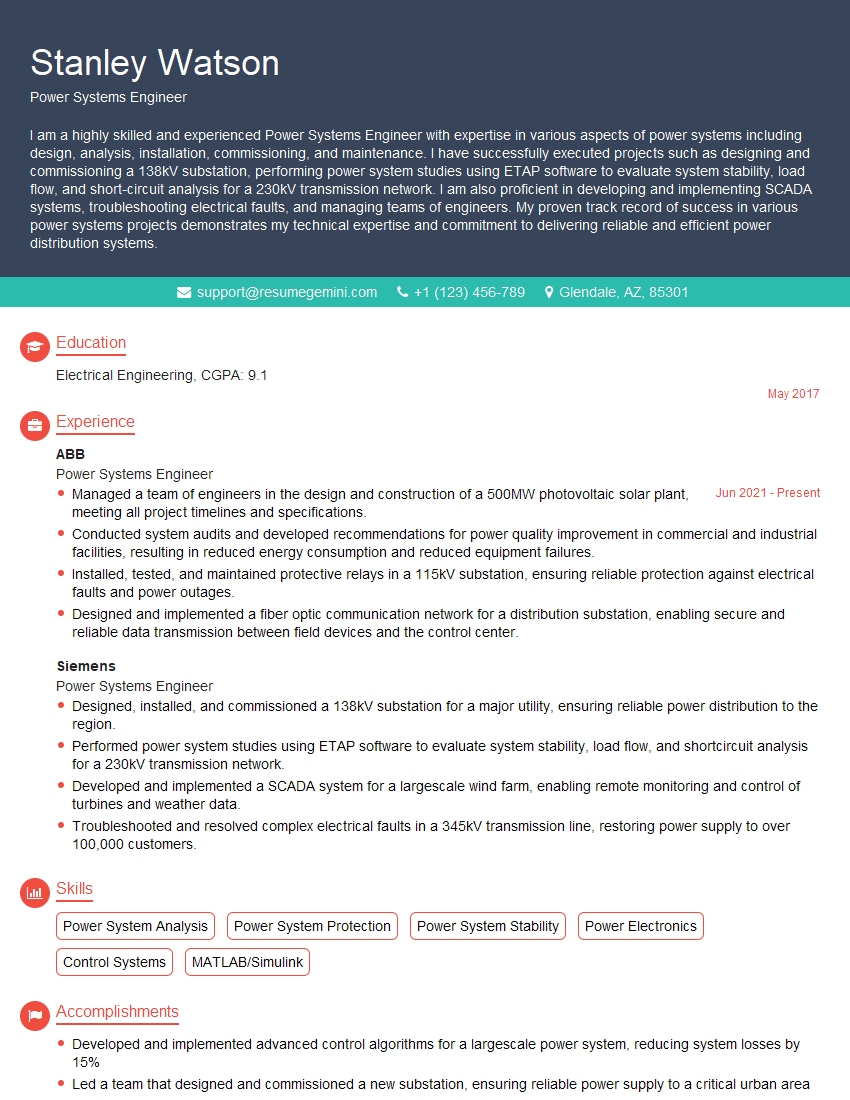
Mastering Generator Control and Protection opens doors to exciting career opportunities in power generation, transmission, and distribution. A strong understanding of these principles significantly enhances your value to prospective employers. To maximize your job prospects, crafting an ATS-friendly resume is crucial. This is where ResumeGemini can be invaluable. ResumeGemini provides a trusted platform for building professional, impactful resumes. We offer examples of resumes tailored to Generator Control and Protection to help you showcase your skills effectively. Take the next step in advancing your career—build your best resume with ResumeGemini.
Explore more articles
Users Rating of Our Blogs
Share Your Experience
We value your feedback! Please rate our content and share your thoughts (optional).
What Readers Say About Our Blog
To the interviewgemini.com Webmaster.
Very helpful and content specific questions to help prepare me for my interview!
Thank you
To the interviewgemini.com Webmaster.
This was kind of a unique content I found around the specialized skills. Very helpful questions and good detailed answers.
Very Helpful blog, thank you Interviewgemini team.