Unlock your full potential by mastering the most common Grounding and Bonding Systems interview questions. This blog offers a deep dive into the critical topics, ensuring you’re not only prepared to answer but to excel. With these insights, you’ll approach your interview with clarity and confidence.
Questions Asked in Grounding and Bonding Systems Interview
Q 1. Explain the difference between grounding and bonding.
Grounding and bonding are closely related but distinct concepts in electrical safety. Grounding is the connection of a conductive object to the earth, providing a low-impedance path for fault currents to flow to the ground, preventing dangerous voltage buildup. Think of it as creating a safe escape route for electricity. Bonding, on the other hand, is the connection of two or more conductive objects together to ensure they are at the same electrical potential. This prevents voltage differences between metallic parts that could lead to electric shock. Imagine bonding as creating a level playing field electrically. The key difference is that grounding connects to the earth, while bonding connects multiple metallic parts to each other.
For example, grounding a metal electrical enclosure ensures that if a fault occurs, the current will flow safely to the earth through the grounding wire. Bonding metallic plumbing pipes to the electrical service panel ensures that they are all at the same electrical potential, eliminating the risk of a voltage difference causing a shock if you touch both.
Q 2. Describe the purpose of a grounding electrode system.
The purpose of a grounding electrode system is to provide a low-resistance path to the earth for fault currents. This is crucial for safety. If a fault occurs – like a live wire touching a metal enclosure – the fault current needs to flow rapidly to ground to trip the circuit breaker or fuse, preventing electric shock or fire. A properly designed grounding electrode system minimizes the voltage to ground, ensuring personnel and equipment safety. The system’s effectiveness depends on factors like soil resistivity, the type and number of grounding electrodes used, and the quality of the connections.
Think of it like a safety valve for an electrical system – it allows excess current to escape safely.
Q 3. What are the different types of grounding electrodes?
Several types of grounding electrodes can be used, depending on the soil conditions and specific application. Common types include:
- Rod electrodes: Driven into the ground, these are effective in many soil types, but their effectiveness depends on soil resistivity.
- Plate electrodes: Usually buried horizontally, they offer a larger contact area with the soil, making them suitable for high-resistivity soils.
- Pipe electrodes: Metal pipes driven into the ground, often used in conjunction with other electrodes.
- Grounding rings: These are effective for large installations and provide a more extensive ground path than single electrodes.
- Water pipes (in specific cases): Metallic water pipes can be used as grounding electrodes if they meet specific criteria regarding size, material, and continuity.
The choice depends on local soil conditions and the size of the installation.
Q 4. How do you select the appropriate grounding electrode for a specific application?
Selecting the appropriate grounding electrode requires careful consideration of several factors. First, the soil resistivity must be measured using specialized equipment. High-resistivity soil requires a more extensive grounding system, perhaps involving multiple electrodes or chemical soil treatment. Second, the size and type of installation will dictate the required grounding electrode’s current-carrying capacity. A large industrial facility will need a more robust system than a small residential building. Third, local electrical codes and standards must be followed meticulously. They specify minimum grounding requirements, acceptable types of electrodes, and installation methods. Lastly, the availability of suitable locations for electrode placement must be considered while minimizing interference with other underground services.
For example, in a location with highly resistive soil, a combination of multiple rod electrodes and a ground ring might be necessary to achieve the required low ground impedance. Always consult relevant codes and standards and conduct a thorough site assessment.
Q 5. Explain the concept of earth impedance and its significance.
Earth impedance (or ground impedance) is the total opposition to the flow of current between a grounding electrode and a remote earth point. It’s a crucial parameter in grounding system design. A lower earth impedance signifies a better path for fault currents to flow to the earth, improving safety. Factors contributing to earth impedance include soil resistivity, electrode type, electrode size, and electrode depth. A high earth impedance will impede the flow of fault current leading to slower fault clearing time and increased risk of equipment damage and potential fire hazards.
Imagine earth impedance as the resistance to water flowing through a pipe: a smaller, narrower pipe (high impedance) restricts flow, while a wider pipe (low impedance) allows it to flow easily.
Q 6. What are the common methods for measuring earth resistance?
Earth resistance is typically measured using a ground resistance tester, which utilizes the fall-of-potential method or the three-point method. These methods involve applying a known current to the grounding electrode and measuring the resulting voltage drop. The earth resistance is then calculated using Ohm’s law (Resistance = Voltage/Current).
- Fall-of-potential method: This method uses three probes (current, potential, and reference) to measure the voltage drop and calculate earth resistance. The distance between probes is crucial for accurate measurements.
- Three-point method (Wenner method): This method uses three probes placed at equal intervals, simplifying the measurement process, but may be less accurate than the fall-of-potential method.
Accurate measurement is crucial for ensuring the grounding system’s effectiveness and compliance with safety standards.
Q 7. Describe the different types of bonding methods.
Different bonding methods exist, each suited to different applications. The choice depends on the specific requirements of the installation and the materials involved.
- Exothermic welding: Creates a permanent, high-conductivity bond, ideal for critical applications where reliable connection is paramount.
- Mechanical connectors: Such as clamps or bolted connections, are simpler to install but require regular inspection and maintenance to ensure reliable contact. They are less robust than exothermic welds.
- Soldering: Offers a good connection, but may not be suitable for high-current applications or environments with extreme temperatures.
- Brazing: Creates a strong and durable bond but requires specialized equipment and skill.
The key is to select a method that ensures a low-resistance connection, maintaining electrical continuity and preventing the development of dangerous voltage differences between bonded equipment. The reliability of the bond is crucial for safety.
Q 8. What are the safety considerations for working with grounding and bonding systems?
Working with grounding and bonding systems requires meticulous safety precautions because you’re dealing with potentially lethal electrical currents. Think of it like this: you’re handling a tamed lion – respect is paramount.
- Always de-energize circuits: Before working on any grounding or bonding system component, ensure the power is completely switched off and locked out/tagged out. Never trust a visual inspection alone.
- Use appropriate PPE: Personal Protective Equipment (PPE) is crucial. This includes insulated gloves, safety glasses, and arc flash protective clothing depending on the voltage level.
- Use insulated tools: Employ tools with insulated handles to prevent accidental shocks. Regular tools are a recipe for disaster in this context.
- Test for voltage: Before touching any conductor or equipment, always verify that it is de-energized using a voltage tester. A double check is always worthwhile.
- Understand the system: Thoroughly understand the grounding and bonding system’s layout and functionality before beginning any work. A proper understanding minimizes the risk of error.
- Follow safety procedures: Adhere strictly to all relevant safety procedures and regulations. This might include working with a partner or having someone nearby as a spotter.
- Be aware of surroundings: Be mindful of potential hazards in your work environment, such as wet conditions, which can increase the risk of electrical shock.
Ignoring these precautions can lead to severe injury or even death. Safety should never be compromised.
Q 9. Explain the importance of grounding and bonding in lightning protection.
Grounding and bonding are absolutely essential for lightning protection systems. Imagine a lightning strike hitting a building – without these systems, the massive surge of electrical energy could cause catastrophic damage and fire. Grounding and bonding act as a controlled path for that energy to safely dissipate into the earth.
Grounding provides a low-impedance path for lightning current to travel from the air terminal (the lightning rod) to the earth. This prevents voltage build-up within the structure.
Bonding connects all metallic parts of the structure together, ensuring that they are at the same electrical potential. This prevents voltage differences that could lead to dangerous arcing and sparking if the lightning current was to seek alternative paths.
For example, a building’s metal framework, plumbing, and electrical conduits should all be effectively bonded together and then connected to the grounding electrode system (GES). This creates a unified system that diverts the lightning current harmlessly away from sensitive equipment and occupants.
Q 10. How do grounding and bonding systems protect against electrical shocks?
Grounding and bonding systems protect against electrical shocks by ensuring that any stray electrical currents are directed safely to the earth, preventing them from flowing through people or equipment.
Grounding provides a path for fault currents to flow directly to the earth in case of a short circuit or equipment failure. This prevents voltage build-up on metal enclosures or conductive surfaces.
Bonding connects metallic parts of a system together to equalize their potential, preventing a difference in voltage that might cause a shock. Imagine two metal pipes – if one is grounded and the other isn’t, touching both simultaneously could result in a shock. Bonding ensures they are at the same potential, eliminating this risk.
For example, a grounded metal enclosure around electrical equipment prevents a person from receiving a shock if they accidentally touch the enclosure during a fault condition. The current flows safely to earth through the grounding wire.
Q 11. What are the relevant codes and standards for grounding and bonding systems (e.g., NEC, IEEE)?
Several codes and standards govern the design, installation, and testing of grounding and bonding systems. These standards ensure consistency and safety.
- National Electrical Code (NEC): In the United States, the NEC provides comprehensive guidelines for grounding and bonding in electrical installations. It covers everything from grounding electrodes to bonding conductors.
- IEEE Standards: The Institute of Electrical and Electronics Engineers (IEEE) publishes numerous standards related to grounding and bonding, covering specific applications and industries. These often provide more detailed technical information.
- Other National and International Standards: Many other countries have their own national electrical codes with similar requirements. International standards organizations like IEC also provide globally relevant guidance.
Adherence to these standards is crucial for ensuring safety and compliance. Failure to meet the requirements can lead to substantial legal and safety consequences.
Q 12. Explain the concept of equipotential bonding.
Equipotential bonding is the practice of connecting all metallic components within a specific area to the same electrical potential. Think of it as creating a ‘common ground’ to eliminate voltage differences.
This is vital for safety, particularly in areas with potential electrical hazards like bathrooms or near pools. By bonding all exposed metal parts (pipes, fixtures, etc.) together and to the grounding system, the risk of receiving a shock from a stray current is significantly reduced. If a fault occurs, all bonded surfaces will be at the same potential, preventing dangerous voltage gradients.
A practical example would be a bathroom where metallic pipes, electrical conduits, and the metal framing of a shower stall are all bonded together and then connected to the main grounding electrode. This ensures that even if there’s a fault in the electrical system, there will be no potential difference between these surfaces, preventing a user from getting a shock.
Q 13. Describe the role of surge arresters in grounding systems.
Surge arresters, also known as surge protectors, play a crucial role in grounding systems by providing protection against transient overvoltages caused by lightning strikes or switching surges.
They act as a safety valve, diverting excess current to ground before it can damage equipment or cause hazards. Imagine a dam with a spillway – the arrester is the spillway, safely redirecting excess water (current) to prevent the dam (equipment) from being overwhelmed.
Surge arresters typically consist of metal-oxide varistors (MOVs) or other non-linear devices that have a very high resistance at normal voltages but a very low resistance when subjected to high transient voltages. This allows the surge current to safely bypass the protected equipment and go to ground.
They’re often integrated into grounding systems to protect sensitive electronic equipment, power systems, and telecommunication lines from damaging voltage spikes.
Q 14. How do you troubleshoot grounding system faults?
Troubleshooting grounding system faults requires systematic investigation using specialized testing equipment. It’s like detective work – you need to find the culprit in the electrical system.
- Visual Inspection: Begin with a thorough visual inspection of all grounding conductors, electrodes, and connections. Look for corrosion, loose connections, or damaged components.
- Ground Resistance Testing: Use a ground resistance tester to measure the resistance between the grounding electrode and the earth. High resistance indicates a problem in the earth connection or grounding electrode.
- Ground Continuity Testing: Verify the continuity of the grounding system by measuring the resistance between various points in the system. Open circuits or high resistance indicate poor bonding.
- Voltage Measurements: Check for stray voltages on metal enclosures or equipment, indicating a grounding fault. This can reveal areas with insufficient or faulty grounding.
- Infrared Thermography: Employ infrared cameras to detect hot spots, which could be caused by loose connections or high resistance in the grounding system.
Depending on the findings, remediation might involve repairing loose connections, replacing corroded components, upgrading grounding electrodes, or addressing issues in the earth grounding path. Detailed documentation of each step, findings, and corrective actions is crucial.
Q 15. What are the common causes of grounding system failures?
Grounding system failures stem from a variety of causes, often interconnected. Think of it like a chain – if one link is weak, the entire system is compromised. Common culprits include:
- Corrosion: Over time, especially in harsh environments, grounding conductors and electrodes can corrode, increasing resistance and reducing effectiveness. Imagine a rusty pipe – it doesn’t conduct electricity as well as a clean one.
- Loose Connections: Poorly tightened bolts or connections create high-resistance points, hindering the flow of fault current. This is like a kink in a garden hose – it restricts water flow.
- Mechanical Damage: Physical damage to conductors or electrodes from digging, impacts, or wear can compromise the system’s integrity. It’s like breaking a crucial wire in your home’s electrical system.
- Soil Conditions: High soil resistivity can impede the dissipation of fault current. Dry, rocky soil is a poor conductor compared to moist, clay-rich soil.
- Improper Design or Installation: Incorrect sizing of conductors, inadequate electrode depth, or flawed grounding grid design are significant causes of failure. This is like building a house on a weak foundation.
- Aging Infrastructure: Over time, materials degrade, leading to increased resistance and potential failure points. It’s like an old car – parts wear out and need replacing.
Regular inspection and maintenance are crucial to mitigate these issues and ensure the grounding system’s longevity and effectiveness.
Career Expert Tips:
- Ace those interviews! Prepare effectively by reviewing the Top 50 Most Common Interview Questions on ResumeGemini.
- Navigate your job search with confidence! Explore a wide range of Career Tips on ResumeGemini. Learn about common challenges and recommendations to overcome them.
- Craft the perfect resume! Master the Art of Resume Writing with ResumeGemini’s guide. Showcase your unique qualifications and achievements effectively.
- Don’t miss out on holiday savings! Build your dream resume with ResumeGemini’s ATS optimized templates.
Q 16. Explain the importance of proper grounding in industrial environments.
In industrial settings, proper grounding is paramount for safety and equipment protection. It’s the cornerstone of a safe and reliable operation. Imagine a large factory – without proper grounding, a simple electrical fault could have catastrophic consequences.
- Personnel Safety: Grounding prevents dangerous voltage buildup on equipment casings, protecting workers from electric shock. It’s like a safety net, preventing a fall.
- Equipment Protection: It provides a low-impedance path for fault currents, preventing damage to sensitive equipment and preventing fires. This is like a pressure relief valve, protecting your system from overpressure.
- Data Integrity: In facilities with sensitive electronic equipment, grounding minimizes noise and interference, ensuring data accuracy and reliability. Think of it as noise cancellation in your headphones for clear audio.
- Compliance: Industrial environments are subject to stringent safety regulations, and proper grounding is often a mandatory requirement for operation. It’s like having the necessary permits to operate your business.
Failure to properly ground equipment in an industrial environment can lead to significant financial losses due to equipment damage, production downtime, and potential legal liabilities.
Q 17. Describe the grounding requirements for different types of equipment (e.g., transformers, motors, switchgear).
Grounding requirements vary based on equipment type and its voltage rating. Specific standards, such as IEEE and NEC, dictate these requirements.
- Transformers: Transformer tanks and frames are typically grounded to provide a path for fault currents and prevent dangerous voltage buildup. Multiple grounding points are often used for redundancy.
- Motors: Motor frames are grounded to protect personnel from electric shock and to provide a return path for fault currents. The method depends on the motor’s size and application.
- Switchgear: Switchgear enclosures are rigorously grounded to protect personnel and ensure safe operation. This includes the cabinet itself, as well as internal components.
The specific grounding methods employed will include the use of grounding conductors, grounding electrodes, and bonding techniques to ensure low impedance paths to earth. Always consult relevant codes and standards for detailed requirements for your specific equipment.
Q 18. What are the considerations for grounding in hazardous locations?
Grounding in hazardous locations, such as those with flammable or explosive materials, requires special consideration. The goal is to minimize the risk of ignition due to electrical faults. It’s about preventing a spark that could ignite a fire or explosion.
- Specialized Fittings and Materials: Explosion-proof fittings and intrinsically safe grounding systems are often required. These are designed to prevent the formation of arcs or sparks.
- Increased Inspection and Maintenance: More frequent inspection and testing are vital to ensure the integrity of the grounding system. Regular checks are crucial to minimize risk.
- Equipment Bonding: Bonding conductive parts of equipment together ensures that there’s no potential difference between them, preventing sparks. It’s like connecting all the metal parts to prevent a build-up of static electricity.
- Proper Earth Electrode Selection: The type of grounding electrode used needs to be appropriate for the soil conditions and the hazardous environment. The electrode’s effectiveness is vital to ground fault currents safely.
Compliance with relevant standards such as those from NFPA and IEC is critical in hazardous locations. Failure to comply can have severe consequences.
Q 19. Explain the concept of grounding grids and their design.
A grounding grid is a network of interconnected conductors buried in the earth, providing a low-impedance path for fault currents. Think of it as a large, buried metal web providing a safe path to ground.
Design Considerations:
- Grid Size and Geometry: The size and shape of the grid depend on the facility’s size and the expected fault current. Larger facilities require larger grids.
- Conductor Size and Material: Copper or galvanized steel conductors are commonly used, with the size determined by the expected fault current and soil resistivity.
- Electrode Depth and Spacing: The depth and spacing of the conductors influence the grid’s effectiveness. Deeper and closer spacing is generally better, but practical limitations exist.
- Soil Resistivity: The soil’s resistivity significantly affects the grid’s performance. Low-resistivity soil is ideal. Measurements are crucial to ensure effectiveness.
Proper design and installation of a grounding grid are crucial for the safety and reliability of any electrical system. It’s a critical infrastructure component that needs to be given the necessary attention and care.
Q 20. How do you test the effectiveness of a grounding system?
Testing the effectiveness of a grounding system is crucial for ensuring safety and compliance. Several methods are employed:
- Earth Resistance Testing: This measures the resistance between the grounding electrode and the earth. Low resistance indicates a good connection.
- Fall-of-Potential Test: A more sophisticated method that provides a more accurate measurement of earth resistance, accounting for soil variations.
- Grounding Continuity Testing: This checks for continuity between different grounding points to ensure that they are properly interconnected.
- Step and Touch Voltage Testing: This tests the voltage levels at various points around the grounding system to assess potential shock hazards.
- Ground Impedance Testing: This involves injecting a current into the ground and measuring the resulting voltage to determine the overall impedance of the grounding system.
Regular testing, preferably annually, is vital for early detection and mitigation of problems. It’s like getting a regular checkup for your electrical system.
Q 21. What is the difference between a grounding rod and a grounding plate?
Both grounding rods and grounding plates are used to provide a connection to the earth, but they differ in their characteristics and applications:
- Grounding Rod (Ground Rod): A long, typically copper-clad steel rod driven vertically into the ground. It’s effective in areas with low soil resistivity and is relatively easy to install. Think of it as a single, deep stake in the earth.
- Grounding Plate (Grounding Plate): A large, flat conductive plate buried horizontally in the ground. It’s more effective in areas with high soil resistivity because it provides a larger contact area with the earth. Think of it as a broad base spreading the connection.
The choice between a grounding rod and a grounding plate depends on the specific site conditions and the required grounding resistance. Sometimes, a combination of both is used to achieve optimal performance.
Q 22. Describe the role of grounding conductors in a grounding system.
Grounding conductors are the lifeline of any electrical system, providing a low-resistance path for fault currents to flow back to the earth. Think of them as the system’s emergency exit for electricity. Their primary role is to prevent dangerous voltage buildup on conductive surfaces, protecting both equipment and personnel from electrical shocks. This is achieved by connecting various parts of the system – such as metal enclosures, equipment frames, and conduits – to a grounding electrode, typically a rod driven deep into the earth.
For example, imagine a washing machine with a faulty wire touching its metal casing. Without a grounding conductor, the casing would become energized, potentially causing a severe shock. However, with a properly installed grounding conductor, the fault current will flow through that conductor to earth, tripping a circuit breaker and preventing the hazard.
- They provide a path for fault currents.
- They limit voltage rise during fault conditions.
- They equalize the potential between various conductive parts of the system.
- They prevent the buildup of static electricity.
Q 23. Explain the importance of using proper grounding materials.
Using the right grounding materials is critical for the system’s effectiveness and longevity. The materials must be durable, corrosion-resistant, and have low electrical resistance to ensure efficient current flow. Poor material choices lead to increased resistance, hindering the system’s ability to protect against electrical hazards, potentially causing equipment damage or even fires.
For instance, using galvanized steel is common for grounding rods and conductors. Galvanized steel offers good conductivity and corrosion resistance, especially in less aggressive soil conditions. However, in highly corrosive environments like coastal areas or those with acidic soil, copper-clad steel or even solid copper might be necessary to prevent premature degradation. Using inadequately sized conductors is another common issue; this creates a ‘bottleneck’ in the pathway for fault currents, hindering the effectiveness of the entire system.
Therefore, material selection depends greatly on the specific environment and application. Considering factors like soil resistivity, environmental conditions, and expected current levels ensures system performance and lifespan.
Q 24. How do you design a grounding system for a new building?
Designing a grounding system for a new building involves a systematic approach. It begins with a thorough site assessment, considering the soil resistivity, the building’s electrical load, and the presence of any nearby grounding systems. This helps determine the appropriate grounding electrode system – whether it be ground rods, a ground grid, or a combination of both. The design also accounts for the building’s structure, including the size and type of conductors needed to connect various grounding points.
- Site Assessment: Soil resistivity testing is crucial to determine the ground electrode’s required size and configuration. Highly resistive soil necessitates more extensive grounding systems.
- Ground Electrode Design: The design will specify the type, number, and placement of ground electrodes. A grid system is usually preferred for larger buildings, while individual rods might suffice for smaller structures.
- Conductor Sizing and Routing: The size of the grounding conductors (typically copper or galvanized steel) depends on the expected fault currents and their length. Conductors should be routed to minimize bends and sharp turns, and any joints should be carefully made with appropriate connectors.
- Bonding: All metal parts of the electrical system, including conduit, enclosures, and equipment frames, must be effectively bonded to the grounding electrode system. This ensures a continuous and low-impedance path for fault currents.
- Testing and Verification: Once installed, the grounding system must be tested to verify its impedance and effectiveness. This involves measuring the ground resistance using a ground resistance tester.
The entire design process should adhere to relevant codes and standards (e.g., NEC in the US) to ensure safety and compliance.
Q 25. Describe your experience with grounding system design software.
I’ve extensively utilized several grounding system design software packages, including CDEGS (Computer Design of Electrical Grounding Systems) and similar programs. These tools are invaluable for modeling complex grounding systems, simulating fault conditions, and calculating ground resistance. They allow for a precise evaluation of the system’s performance under various scenarios, helping optimize designs for maximum effectiveness and safety. For example, CDEGS allows me to input site-specific parameters like soil resistivity and electrode configurations, then it generates detailed reports including ground resistance values, potential distribution maps, and potential rise calculations. This assists in designing robust and efficient systems while ensuring compliance with safety regulations.
My experience with these software packages has significantly improved the accuracy and efficiency of my grounding system designs. It replaces tedious manual calculations with automated analysis, leading to faster turnaround times and more reliable results.
Q 26. What are the challenges you have faced in designing or maintaining grounding systems?
One of the biggest challenges is dealing with unforeseen site conditions. During a project, we encountered unexpectedly high soil resistivity, requiring extensive modifications to the original ground grid design to achieve acceptable grounding resistance. This involved deploying additional ground rods and employing chemical soil improvement techniques. Another significant challenge involves coordinating with other trades during construction. Ensuring proper grounding connections while other work is ongoing demands clear communication and meticulous coordination to prevent damage to the system.
Dealing with aging infrastructure poses additional challenges. Locating and repairing corroded grounding conductors in older buildings can be difficult and time-consuming. Often, non-destructive testing methods are employed to assess the condition of existing grounding systems before any intervention is undertaken.
Q 27. How do you ensure the safety of workers while working on grounding systems?
Worker safety is paramount. Before commencing any work on grounding systems, a thorough risk assessment must be conducted, identifying potential hazards like energized equipment and confined spaces. Lockout/Tagout procedures are strictly followed to de-energize equipment before any maintenance or repairs. Appropriate personal protective equipment (PPE), including insulated tools and rubber gloves, is mandatory. Regular training sessions reinforce safe work practices and ensure workers are aware of the potential dangers involved in working with electrical systems.
Clear communication is essential, especially during excavation near buried grounding conductors, to prevent accidental damage and worker injury. The use of ground fault circuit interrupters (GFCIs) provides an additional layer of protection, immediately shutting off power in case of a ground fault.
Q 28. Describe your experience with grounding system inspections and audits.
I have extensive experience conducting grounding system inspections and audits, both for new installations and existing systems. These inspections involve visual examination of all grounding components, including conductors, electrodes, and connections, for any signs of corrosion, damage, or loose connections. Testing procedures, such as measuring ground resistance and potential gradients, are conducted using calibrated instruments to verify the system’s effectiveness. Comprehensive reports detailing the findings, including any necessary remedial actions, are prepared and submitted to the client.
A recent audit involved an industrial facility where I discovered several corroded grounding connections and loose bonding wires. My report outlined the risks these posed and provided recommendations for repair and replacement, ensuring the facility’s electrical safety was maintained.
Key Topics to Learn for Grounding and Bonding Systems Interview
- Fundamentals of Grounding: Earth electrode systems, grounding resistance, soil resistivity measurements, and grounding grid design. Understand the theoretical basis and practical limitations.
- Bonding Principles: Equipment grounding, bonding conductors, and the purpose of bonding in safety and preventing electrical hazards. Consider different bonding methods and their applications.
- Lightning Protection Systems: Air terminals, down conductors, grounding electrodes, and surge protection devices. Analyze the design considerations and practical challenges.
- Grounding and Bonding in Specific Industries: Explore the unique grounding and bonding requirements for different sectors like power generation, transmission & distribution, industrial facilities, and telecommunications. Focus on relevant codes and standards.
- Fault Current Calculations and Analysis: Understand how grounding and bonding impact fault current flow and the implications for protective device coordination.
- Troubleshooting and Diagnostics: Learn practical techniques for identifying grounding and bonding faults, including testing methods and interpreting test results. Develop problem-solving skills to address real-world scenarios.
- Relevant Codes and Standards: Familiarize yourself with national and international standards (e.g., NEC, IEEE) related to grounding and bonding systems. Understand their implications in design and implementation.
- Safety Practices: Highlight the critical importance of safety precautions when working with grounding and bonding systems to prevent electrical shock and other hazards.
Next Steps
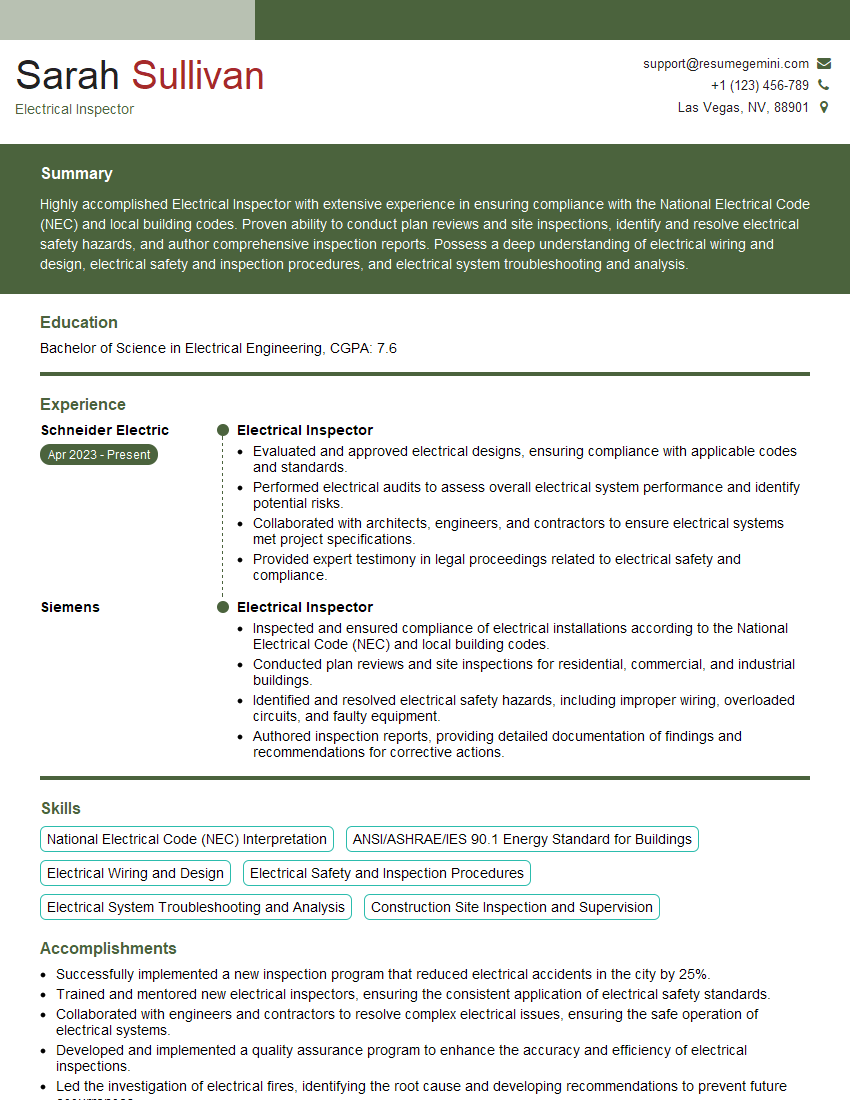
Mastering Grounding and Bonding Systems opens doors to exciting career opportunities in a vital field ensuring electrical safety. A strong understanding of these principles is highly valued by employers and sets you apart from the competition. To maximize your job prospects, invest time in creating an ATS-friendly resume that clearly highlights your skills and experience. ResumeGemini is a trusted resource for building professional resumes that get noticed. They offer examples of resumes tailored to Grounding and Bonding Systems, helping you showcase your expertise effectively. Take the next step towards your dream career – craft a compelling resume that reflects your capabilities in this critical area of expertise.
Explore more articles
Users Rating of Our Blogs
Share Your Experience
We value your feedback! Please rate our content and share your thoughts (optional).
What Readers Say About Our Blog
To the interviewgemini.com Webmaster.
Very helpful and content specific questions to help prepare me for my interview!
Thank you
To the interviewgemini.com Webmaster.
This was kind of a unique content I found around the specialized skills. Very helpful questions and good detailed answers.
Very Helpful blog, thank you Interviewgemini team.