Interviews are opportunities to demonstrate your expertise, and this guide is here to help you shine. Explore the essential Groundwater Modeling System (GMS) interview questions that employers frequently ask, paired with strategies for crafting responses that set you apart from the competition.
Questions Asked in Groundwater Modeling System (GMS) Interview
Q 1. Explain the different types of boundary conditions used in GMS.
Boundary conditions in GMS define the constraints and interactions at the edges of your groundwater model. Think of them as the rules governing how water enters or leaves your modeled area. Incorrectly defining these can significantly impact your results. GMS offers several types:
- Constant Head: This represents a location where the hydraulic head (water level) is known and remains constant over time. Imagine a large lake – its water level is relatively stable and acts as a constant head boundary. In GMS, you’d specify the exact head value.
- Specified Flux (or Recharge/Discharge): This defines the rate of water flowing into or out of the model area. This could represent rainfall infiltration (recharge) or pumping from a well (discharge). You’d input the flux value (e.g., in mm/day or m³/day).
- No-Flow: This is an impermeable boundary where no water can cross. A geological fault acting as an aquitard, or an impermeable bedrock layer, are good examples. In GMS, this boundary condition simply prevents water movement across it.
- River/Stream Boundary: A more complex boundary condition that simulates the interaction between the aquifer and a surface water body. It considers factors like river stage (water level), riverbed conductivity, and the exchange of water between the river and aquifer.
- Seepage Face: This boundary allows for groundwater discharge to the surface, changing depending on the water table elevation. This is often used for modeling springs or losing streams.
Choosing the correct boundary condition is crucial for accurate model representation. A poorly defined boundary can lead to unrealistic flow patterns and inaccurate predictions.
Q 2. Describe the process of model calibration in GMS.
Model calibration in GMS is an iterative process of adjusting model parameters to match observed data. Think of it as fine-tuning your model to fit reality. It involves several steps:
- Data Gathering: Collect historical groundwater level measurements from wells (observation wells), streamflow data, and any other relevant data within and around the modeled area.
- Initial Parameter Estimation: Begin with initial estimates for model parameters like hydraulic conductivity, transmissivity, and recharge rates. These are often based on existing studies, field measurements, and professional judgement.
- Model Run & Comparison: Run the model with the initial parameters and compare the simulated groundwater heads with the observed data. GMS offers tools to visually compare these using graphs and cross-sections.
- Parameter Adjustment: Based on the comparison, adjust model parameters to reduce the discrepancies between simulated and observed data. This is often done systematically, focusing on parameters with the greatest impact.
- Iteration: Repeat steps 3 and 4 until a satisfactory fit is achieved. This may involve numerous model runs and adjustments. GMS helps track these adjustments and their impacts.
- Evaluation of Goodness of Fit: Use statistical measures like the root mean squared error (RMSE) or the coefficient of determination (R²) to quantitatively evaluate the goodness of fit and decide if the calibration process is complete.
Calibration is not just about minimizing the error; it’s about achieving a balance between a good fit and a physically realistic model. Over-calibration can lead to a model that fits the historical data perfectly but poorly predicts future conditions. A skilled modeller needs experience and judgement to achieve that balance.
Q 3. How do you handle data uncertainty in GMS?
Data uncertainty is inherent in all groundwater modeling projects. In GMS, we address this using several approaches:
- Sensitivity Analysis: Identify parameters that significantly impact model outputs. This helps focus efforts on obtaining more accurate data for critical parameters.
- Geostatistical Methods: Utilize kriging or other geostatistical techniques to interpolate data and estimate values in areas with limited measurements. GMS incorporates several options for spatial data interpolation.
- Monte Carlo Simulations: Assign probability distributions to uncertain parameters. The model is run repeatedly with different parameter sets drawn randomly from those distributions. This provides a range of possible model outputs, reflecting the uncertainty in the input data.
- Ensemble Methods: Multiple models with slightly different parameter sets are run to capture different potential scenarios.
- Uncertainty Quantification: Quantify the uncertainty in model predictions. This can be done through measures like confidence intervals or prediction uncertainty maps.
Documenting and communicating uncertainty is a crucial part of groundwater modeling. Transparency about data limitations and their influence on results is essential for responsible decision-making.
Q 4. What are the strengths and weaknesses of using GMS for groundwater modeling?
GMS is a powerful and widely used software for groundwater modeling, but like any tool, it has strengths and weaknesses:
- Strengths:
- Comprehensive Capabilities: Handles diverse model types (e.g., MODFLOW, MT3DMS), boundary conditions, and solvers.
- User-Friendly Interface: Relatively intuitive GUI, making it easier to learn than some command-line based alternatives.
- Pre- and Post-Processing Tools: Offers a rich set of tools for data management, visualization, and analysis.
- Extensive Documentation and Support: Well-documented with a large community providing support and resources.
- Weaknesses:
- Computational Demands: Large and complex models can be computationally intensive, requiring significant processing power and time.
- Learning Curve: While relatively user-friendly, mastering advanced features still requires significant training and experience.
- Cost: The software itself is commercially licensed and can be expensive, especially for small organizations or individuals.
- Black Box Nature: While visually appealing, the underlying numerical methods can be complex and difficult to fully understand without a good grasp of numerical methods and groundwater hydrology.
Q 5. Explain the concept of model sensitivity analysis in GMS.
Model sensitivity analysis in GMS helps identify which model parameters have the greatest influence on the simulation results. Think of it like figuring out which knobs on a soundboard have the biggest impact on the overall sound. This is crucial because:
- Prioritization of Data Collection: Focus resources on collecting accurate data for the most sensitive parameters.
- Model Calibration Strategy: Guide the calibration process by focusing on sensitive parameters first.
- Uncertainty Assessment: Understand which parameters contribute most to the uncertainty in model predictions.
GMS facilitates sensitivity analysis through various techniques, including:
- One-at-a-time (OAT) method: Systematically varying each parameter individually while keeping others constant.
- Morris method: A more efficient approach that explores parameter space in a structured way, generating multiple samples to get a broader picture.
- Sobol’ method: A variance-based global sensitivity analysis approach that provides information on the relative importance of parameters.
The results are often presented visually, using plots showing the influence of each parameter on key model outputs. This information guides the modeler in making informed decisions.
Q 6. How do you validate a GMS model?
Validating a GMS model confirms whether it accurately represents the real-world system. It’s distinct from calibration (matching historical data). Validation involves comparing model predictions with independent data not used during calibration. This could include:
- Future data: Compare predictions with groundwater levels or other measurements from a period after the calibration period.
- Data from different locations: Use observations from wells or monitoring sites not used for calibration.
- Qualitative information: Compare the predicted flow directions and patterns with geological interpretations or other qualitative evidence.
If the model predictions match the independent data reasonably well, it increases confidence in the model’s ability to simulate the system accurately. However, perfect agreement is unlikely due to natural variability and model limitations. A key aspect of validation is to quantitatively assess the agreement (or disagreement) between model predictions and independent data.
Disagreements highlight areas needing further investigation – either in the model structure, parameterization, or the availability of reliable data. A good validation process provides insights into the model’s strengths and limitations, improving decision-making based on the model outputs.
Q 7. Describe your experience with different GMS solvers.
My experience encompasses several GMS solvers, each with its strengths and weaknesses. The choice of solver depends on the specific problem and model characteristics:
- MODFLOW: The workhorse of groundwater modeling. I’ve extensively used MODFLOW and its various packages (e.g., MF6) for a range of projects, from regional aquifer simulations to detailed local-scale studies. It’s robust and well-tested, but can be computationally demanding for large models.
- MT3DMS: For solute transport simulations, MT3DMS is my go-to solver. I’ve used it to model contaminant transport, including scenarios with advection, dispersion, and reactions. It integrates well with MODFLOW, allowing for coupled groundwater flow and transport modeling.
- SEAWAT: This solver is ideal when dealing with density-dependent flow, as it is frequently used for saltwater intrusion modeling in coastal aquifers. I have applied it in several projects where the density variations due to salinity gradients were significant.
I’m familiar with the nuances of each solver, understanding their underlying numerical methods and limitations. I strategically select the solver best suited to the specific problem at hand, considering factors like model complexity, computational resources, and desired accuracy.
For instance, when dealing with a complex three-dimensional model with heterogeneous hydraulic properties and intricate boundary conditions, I might opt for MODFLOW-6’s enhanced flexibility and capabilities. If the focus is on contaminant transport, MT3DMS is usually chosen.
Q 8. How do you create a conceptual model for a groundwater flow problem?
Creating a conceptual model in GMS is like drawing a blueprint before building a house. It involves understanding the groundwater system’s key features and representing them in a simplified way. This begins with gathering all available data: geological maps, well logs, hydrogeological surveys, and historical water level data. Then, we define the study area’s boundaries, identify key hydrogeological units (aquifers, aquitards), and delineate their spatial extent and properties (porosity, permeability). We also identify significant hydraulic features like streams, lakes, and wells, characterizing their interactions with the groundwater system. For example, if we’re modeling a coastal aquifer, we’d carefully define the freshwater-saltwater interface. The conceptual model is then represented graphically using GMS’s visualization tools, helping to communicate the understanding of the system to stakeholders and guides the creation of the numerical model.
The process typically includes:
- Defining the study area: Establishing clear geographical boundaries.
- Identifying hydrogeologic units: Classifying different layers based on their properties.
- Characterizing hydraulic properties: Estimating parameters like hydraulic conductivity and storativity.
- Defining boundary conditions: Identifying sources and sinks of water (e.g., recharge areas, wells, rivers).
- Identifying key processes: Considering factors like evapotranspiration, leakage, and pumping.
A well-defined conceptual model is crucial for a successful numerical model; inaccuracies here propagate to the final simulation results.
Q 9. Explain the process of parameter estimation in GMS.
Parameter estimation in GMS involves determining the values of the model’s input parameters (like hydraulic conductivity, specific yield, and recharge rates) that best match the observed data. This is an iterative process often using inverse modeling techniques. We begin by assigning initial values to these parameters, based on available data and professional judgment. GMS offers several methods for this, including:
- Calibration: Adjusting parameters to minimize the difference between simulated and observed heads (water levels). GMS provides tools to visualize this difference through residual plots.
- Optimization algorithms: These automated methods (like simplex, nonlinear least squares, or PEST) systematically adjust parameters to find the best fit to the data, often using objective functions (e.g., minimizing the sum of squared errors).
- Parameter sensitivity analysis: This helps identify which parameters have the most significant impact on the model’s results, guiding prioritization in the calibration effort.
The process usually involves comparing model predictions against measured data, refining parameter values iteratively, and assessing the goodness-of-fit. For example, if the model significantly overestimates water levels in a specific area, we might need to reduce the hydraulic conductivity of the aquifer in that zone. It’s critical to document all parameter estimations meticulously and to perform rigorous uncertainty analysis.
Q 10. What are some common issues encountered during GMS model development?
Developing GMS models often presents challenges. Some common issues include:
- Data scarcity or poor data quality: Lack of sufficient or reliable data can hinder accurate parameter estimation.
- Model complexity: Overly complex models can be computationally expensive and difficult to calibrate and interpret.
- Conceptual model uncertainty: Inaccuracies in the conceptual model (like misrepresentation of geological structures) will directly affect simulation results.
- Numerical instability: Problems with mesh design or parameter values may lead to convergence issues or unrealistic results.
- Software limitations: GMS has specific requirements that should be met to avoid software issues.
- Defining boundary conditions: Appropriately defining boundaries that represent realistic conditions can be challenging.
Addressing these issues often requires a combination of careful data collection and analysis, robust model design, iterative calibration, and effective communication among the project team. Experience and expertise are crucial for successful model development.
Q 11. How do you address numerical issues in GMS simulations?
Numerical issues in GMS simulations, like divergence or unrealistic oscillations, often stem from improper model setup or parameter choices. Addressing these involves a multi-pronged approach:
- Mesh refinement: Reducing the size of grid cells in areas of high gradients or complex geology can improve numerical stability.
- Parameter adjustments: Extreme or unrealistic parameter values can cause instability; careful calibration and sensitivity analysis are key. In extreme cases, consider regularization techniques to smooth parameter distributions.
- Time step adjustments: Using smaller time steps can improve the accuracy and stability of the simulation, particularly for transient problems.
- Numerical schemes: GMS offers several numerical solution schemes. Experimentation might be necessary to find the best approach for a given problem.
- Checking for errors: Carefully check for potential user errors in the setup, which can be a leading cause of numerical instability. A good strategy is to start with a simplified model and increase complexity progressively, checking for issues at each step.
For example, if the simulation diverges, reducing the time step or refining the mesh near the area of divergence can resolve the problem. Careful review of model input and output data is essential for effective troubleshooting.
Q 12. How do you incorporate spatial variability in model parameters in GMS?
Incorporating spatial variability in model parameters is crucial for representing real-world groundwater systems accurately. GMS allows for this in several ways:
- Layered models: Defining distinct layers with different parameter values, reflecting the heterogeneity of the subsurface.
- Zonal parameters: Assigning different parameter values to specific zones within the model domain, reflecting geological variations.
- Random fields: Using geostatistical methods (like kriging) to generate spatially correlated random fields of parameters, representing uncertainty and spatial variability.
- Using external data: Importing parameter values from GIS data layers or other sources.
For instance, if hydraulic conductivity varies significantly across the study area, we might use a geostatistical method to generate a spatially variable hydraulic conductivity field based on available measurements. This will produce a more realistic representation of groundwater flow compared to using a single average value.
Q 13. Explain your experience with different GMS visualization tools.
My experience with GMS visualization tools is extensive. I’m proficient in using its capabilities to create maps, cross-sections, and animations to visualize groundwater flow, contaminant transport, and other relevant parameters. I’ve used:
- Contour maps: To visualize water table elevations, hydraulic heads, or contaminant concentrations.
- Cross-sections: To visualize vertical variations in hydraulic parameters and flow patterns.
- 3D visualizations: To create immersive views of the groundwater system and its behavior.
- Animations: To demonstrate temporal changes in water levels or contaminant plumes.
- Data plots: To display time-series data, like well pumping rates or water quality parameters.
These tools are invaluable for interpreting model results, communicating findings to stakeholders, and identifying areas needing further investigation. For example, an animation showing the migration of a contaminant plume over time helps illustrate the risk posed to drinking water supplies.
Q 14. Describe your experience using GMS for specific applications like contaminant transport or well design.
I’ve utilized GMS for various applications. In contaminant transport modeling, I’ve used it to simulate the fate and transport of various contaminants (e.g., chlorinated solvents, nutrients) under different scenarios to assess remediation strategies. This involved defining appropriate transport parameters (dispersion, retardation) and boundary conditions. For example, I worked on a project simulating the plume migration from a leaking underground storage tank and evaluated the effectiveness of pump-and-treat remediation.
For well design, GMS has been instrumental in optimizing well placement and pumping rates to maximize water extraction while minimizing drawdown and ensuring sustainable water use. I’ve used the model to simulate drawdown in multiple wells in a complex aquifer system, helping determine optimal well spacing and pumping strategies to meet water demand without excessive drawdown in neighboring wells. In both applications, the use of GMS greatly improved the understanding of the system and allowed for the development of more effective solutions.
Q 15. What is your experience with MODFLOW and its integration with GMS?
MODFLOW, the Modular Three-Dimensional Finite-Difference Ground-Water Flow Model, is the industry standard for groundwater modeling. My experience encompasses building, calibrating, and post-processing numerous MODFLOW models, almost exclusively within the Groundwater Modeling System (GMS) environment. GMS provides a user-friendly interface for creating and managing the complex input files required by MODFLOW, significantly streamlining the workflow. For example, in a recent project modeling saltwater intrusion in a coastal aquifer, GMS allowed me to easily define the model grid, assign boundary conditions (like rivers and the ocean), and set up the various MODFLOW packages – all within a single, integrated environment. This eliminated the need for manual coding and significantly reduced the risk of errors.
Specifically, I’m proficient in using GMS to create and edit MODFLOW input files such as the discretization file (DIS), the basic package (BAS), the boundary condition packages (CHD, RCH, etc.), and the solver package (PCG). I can leverage GMS’s capabilities to manage complex model setups, including nested grids and variable grid spacing, adapting the model resolution to capture the heterogeneity of the subsurface environment. Finally, GMS makes it simple to visualize the model results directly alongside the geological data, providing valuable insight for interpretation and calibration.
Career Expert Tips:
- Ace those interviews! Prepare effectively by reviewing the Top 50 Most Common Interview Questions on ResumeGemini.
- Navigate your job search with confidence! Explore a wide range of Career Tips on ResumeGemini. Learn about common challenges and recommendations to overcome them.
- Craft the perfect resume! Master the Art of Resume Writing with ResumeGemini’s guide. Showcase your unique qualifications and achievements effectively.
- Don’t miss out on holiday savings! Build your dream resume with ResumeGemini’s ATS optimized templates.
Q 16. How do you manage large datasets within GMS?
Managing large datasets in GMS requires a strategic approach. I typically employ several techniques. First, I utilize GMS’s capabilities to import data from various sources, including shapefiles, raster data (like DEMs and geological maps), and tabulated data (like well logs and piezometric measurements). GMS allows for efficient data preprocessing and transformation within the program itself. This minimizes external data manipulation. Secondly, I employ data compression techniques and optimize the model grid resolution to reduce the storage size of input data. Third, utilizing GMS’s capabilities to manage data through separate layers enables efficient organization and manipulation, preventing confusion and errors. For exceptionally large datasets, I may utilize specialized tools for data processing and extraction before importing the refined dataset into GMS. Imagine working on a regional groundwater model spanning thousands of square kilometers – efficient data handling is paramount to avoid model crashes and unreasonable processing times.
Q 17. What is the role of GIS in GMS modeling?
GIS plays a crucial role in GMS modeling. It provides the framework for spatial data management, visualization, and integration. GMS leverages GIS data to define the model domain, create the model grid, assign spatial parameters (like hydraulic conductivity and recharge), and visualize results spatially. Think of it as the foundation upon which the entire model is built. For example, I regularly use GIS data like elevation models (DEMs) to define the model’s topography, geological maps to delineate different hydrogeological units and assign corresponding parameters, and well location data to specify observation points. This tight integration between GMS and GIS ensures accurate representation of the real-world subsurface conditions, leading to more robust and reliable model results. In essence, GIS provides the contextual backdrop for the quantitative analysis performed by the MODFLOW engine.
Q 18. Explain your process for generating input files for GMS.
My process for generating input files for GMS involves several key steps: First, I carefully gather and organize all necessary data, including topography, geology, hydrogeology, and boundary conditions. Then, I use GMS to create the model grid, incorporating the spatial data to ensure that the model accurately reflects the subsurface geometry. This involves selecting an appropriate grid type and defining the cell size and dimensions. After the grid is established, I import and assign the parameters based on available data. For instance, I’ll import a raster of hydraulic conductivity values and assign them to the corresponding grid cells. Next, I define the boundary conditions using GMS’s tools—specifying constant head boundaries, recharge rates, or river interactions—reflecting the observed or anticipated hydrological interactions. Finally, I review and verify all input files using GMS’s built-in checks and validation tools. This thorough review is crucial for error prevention. The entire process is meticulously documented, including data sources, assumptions, and any modifications made.
Q 19. How do you interpret GMS model results?
Interpreting GMS model results requires a multi-faceted approach. It goes beyond simply looking at numbers; it involves understanding the hydrological processes captured by the model. I begin by visually inspecting the results using GMS’s visualization tools, looking at head distributions, flow patterns, and travel times. I pay close attention to areas of high variability and potential discrepancies between modeled and observed data. Then, I compare the model results with observed data—like water levels from wells or streamflow measurements—to assess the model’s accuracy and identify areas needing improvement. This often leads to model calibration, involving iterative adjustments to parameters until the simulated and observed data align. Statistical measures, such as the root mean squared error (RMSE), are calculated to quantify the model fit. Finally, I analyze the sensitivity of the model to different parameters to identify the key factors driving the simulated groundwater flow. This understanding is crucial for making informed decisions based on the model outputs.
Q 20. How do you present model results to non-technical audiences?
Presenting model results to non-technical audiences requires simplifying complex information without sacrificing accuracy. I use clear and concise language, avoiding jargon wherever possible. I rely heavily on visual aids, such as maps, charts, and animations generated from GMS output. For example, instead of discussing numerical head values, I might show a map with different color gradients representing groundwater levels, instantly conveying the spatial variation. I focus on conveying the key findings and their implications in a relatable manner. For example, I might discuss how changes in groundwater levels affect well yields or how future development might impact water resources. Storytelling techniques can help make the information engaging and memorable. In essence, the objective is to transform complex data into a narrative that’s easily grasped and understood by a broad audience.
Q 21. Discuss your experience with GMS post-processing and visualization.
GMS offers robust post-processing and visualization capabilities, significantly enhancing my workflow. I routinely use GMS to create contour maps of hydraulic heads, velocity vectors illustrating groundwater flow patterns, and particle tracking animations showcasing the movement of groundwater. These visualizations provide an intuitive understanding of the model results. I also utilize GMS to extract key parameters from the model output, such as travel times or water budgets, for further analysis and report generation. Additionally, GMS allows me to export results in various formats compatible with other software, such as GIS packages or spreadsheet programs, allowing for integration with other analyses. For example, I can export cross-sections showing groundwater levels along specific transects or time-series data for specific observation wells. This flexibility makes GMS an invaluable tool for both detailed analysis and efficient communication of results.
Q 22. What are your preferred methods for model verification?
Model verification in GMS, like in any groundwater modeling, is crucial for ensuring the model accurately represents the real-world system. My preferred methods involve a multi-step approach, combining quantitative and qualitative checks.
- Data Comparison: I rigorously compare model outputs (e.g., heads, fluxes) with observed field data. This often involves statistical analyses like comparing model-predicted water levels to measured water levels at multiple wells over time. Discrepancies are investigated thoroughly.
- Sensitivity Analysis: I conduct sensitivity analyses to identify parameters that significantly influence model results. This helps prioritize calibration efforts and understand uncertainties.
- Parameter Estimation/Calibration: I use automated calibration tools within GMS (like PEST or MODFLOW-USG) to adjust model parameters to best match observed data. I focus on achieving a balance between fitting the data and maintaining physically realistic parameter values. Goodness-of-fit statistics like RMSE (Root Mean Square Error) and R² are carefully evaluated.
- Conceptual Model Review: A critical aspect is reviewing the conceptual model itself. Does the model structure adequately represent the hydrogeology? Are the boundary conditions realistic? Addressing inconsistencies in the conceptual model can resolve significant model discrepancies.
- Mass Balance Checks: For transient models, I meticulously perform mass balance checks to ensure that the model conserves mass over time. Significant imbalances could point to errors in the model setup or data.
For example, in a recent project modeling saltwater intrusion, I used a combination of water level data from monitoring wells, chloride concentration data, and a sensitivity analysis to calibrate the model parameters and ensure the model effectively captured the dynamic interaction between fresh and saltwater.
Q 23. How do you approach debugging a GMS model?
Debugging a GMS model can be challenging, but a systematic approach is key. My strategy involves:
- Visual Inspection: I start with visual inspection of the model using GMS’s visualization tools. Are there any unrealistic patterns in the model results (e.g., sudden jumps in head)? Does the flow direction make sense given the hydraulic gradients?
- Log Files: GMS generates comprehensive log files that are invaluable for debugging. Examining these files can often pinpoint the source of errors (e.g., incorrect input data, convergence issues).
- Modular Approach: I break down the complex model into smaller, more manageable components and test each one separately. This isolates problem areas and makes debugging easier. For example, I might verify the boundary condition setup independently before running a full model simulation.
- Simplified Model Runs: Sometimes, simplifying the model (e.g., using a coarser grid, simpler boundary conditions) can help identify the source of the problem. Once the problem is found in the simplified model, it’s easier to address it in the more complex model.
- Error Messages: I carefully read and understand any error messages generated by GMS. These messages often provide clues about the nature and location of errors.
For instance, I once encountered an error in a GMS model due to an incompatible version of a module. The log file pointed to this issue, which I resolved by updating the module.
Q 24. Describe your experience with different types of GMS simulations (steady-state vs. transient).
I have extensive experience with both steady-state and transient simulations in GMS. Steady-state simulations are suitable when the system is assumed to be at equilibrium, with no significant changes in groundwater levels or fluxes over time. Transient simulations, on the other hand, are necessary when temporal variations are significant, like in cases of pumping, recharge changes, or climate change impacts.
- Steady-State Simulations: These are computationally less intensive and useful for preliminary assessments or for parts of a larger model that are relatively unchanging. For instance, a steady-state model might be used to estimate regional groundwater flow patterns under constant recharge conditions.
- Transient Simulations: These are more complex, requiring specification of time-varying parameters and boundary conditions. They are essential for understanding the temporal dynamics of groundwater systems, such as the response to pumping or changes in rainfall patterns. A transient model is necessary to assess the long-term effects of groundwater extraction on water levels.
I often use a combination of both. A steady-state model may be used to create an initial condition for a transient model, or a transient simulation may be run for specific periods to investigate events with short-term impacts, within a larger steady-state conceptualization.
Q 25. How do you incorporate climate change scenarios into your GMS models?
Incorporating climate change scenarios into GMS models involves modifying the model input parameters to reflect predicted climate changes. This typically involves:
- Altered Recharge: Changes in precipitation patterns (e.g., increased intensity, altered seasonality) are incorporated by adjusting the recharge boundary conditions using time series data from climate models.
- Modified Evapotranspiration: Changes in temperature and humidity affect evapotranspiration rates. This can be incorporated by using climate model outputs to adjust evapotranspiration parameters in the GMS model.
- Sea-Level Rise: For coastal aquifers, the effects of sea-level rise on saltwater intrusion are modeled by adjusting the sea-level boundary condition.
- Changes in Temperature: Changes in groundwater temperature can affect various parameters, including viscosity, and density. This should be accounted for when the model is sensitive to these effects.
I typically use climate projections from downscaled General Circulation Models (GCMs) or regional climate models (RCMs). The specific method depends on the available data and the complexity of the model. Uncertainty analysis is crucial to assess the range of possible impacts under different climate scenarios. For example, I recently used climate projections from a regional climate model to assess the vulnerability of an aquifer to future sea-level rise and increased evapotranspiration.
Q 26. What are your experiences using GMS for regulatory compliance?
I have significant experience using GMS for regulatory compliance purposes, particularly in groundwater resource management. This often involves:
- Developing models to assess the impact of pumping permits on groundwater resources: GMS allows us to simulate the drawdown effects of pumping wells and ensure compliance with minimum water level regulations. This frequently involves the use of wellhead protection area analysis.
- Modeling contaminant transport: GMS, with appropriate modules, can simulate the movement of contaminants in the subsurface, allowing assessment of compliance with drinking water standards and risk assessments.
- Evaluating the effectiveness of remediation strategies: GMS can be used to model and evaluate the impact of remediation efforts (e.g., pump and treat systems) to ensure they meet regulatory requirements.
- Preparing reports for regulatory agencies: I’m experienced in documenting the model development, calibration, and validation process in a clear and comprehensive manner, meeting regulatory reporting standards.
In one project, I used GMS to demonstrate compliance with minimum water level requirements for a large-scale groundwater pumping project. The model results were submitted to the relevant regulatory agency and successfully supported the permit application.
Q 27. How familiar are you with using GMS for coupled processes (e.g., groundwater-surface water interaction)?
I am proficient in using GMS for coupled processes, particularly groundwater-surface water interaction. This often involves utilizing modules or coupling GMS with other software. The key is understanding the complexities of these interactions and accurately representing them in the model.
- MODFLOW-SURFACT: This module within GMS allows for the simulation of surface water-groundwater interaction using a variety of approaches. It allows for simulating complex interactions such as seepage faces, stream depletion, and bank storage.
- External Coupling: GMS can be coupled with other software packages (e.g., HEC-RAS for river flow simulation) to create more sophisticated, integrated models. This is vital for accurately representing the interactions between the groundwater system and surface water bodies.
- Calibration Considerations: Calibrating coupled models is more challenging than calibrating single-process models, requiring more data and iterative adjustments to accurately capture the interaction between the different processes. This may involve using various observational data such as surface water levels, discharge measurements, and water quality data.
For example, in a recent project, I used MODFLOW-SURFACT within GMS to model the impact of a proposed dam on groundwater levels in an adjacent aquifer. The model showed a significant decrease in the groundwater levels near the dam, which helped inform the design of mitigation strategies.
Key Topics to Learn for Groundwater Modeling System (GMS) Interview
- Model Setup and Conceptualization: Understanding how to define the study area, boundary conditions (constant head, no-flow, etc.), and initial conditions. Practical application: Developing a conceptual model from site data and geological information.
- Discretization and Mesh Generation: Choosing appropriate grid types (structured, unstructured) and refining mesh resolution in areas of interest. Practical application: Optimizing mesh density to balance accuracy and computational efficiency.
- Hydraulic Parameters Estimation: Methods for estimating hydraulic conductivity, transmissivity, and storage coefficients from field data. Practical application: Calibration of a model using observed groundwater levels and pumping test data.
- Model Calibration and Validation: Techniques for adjusting model parameters to match observed data and verifying model reliability. Practical application: Using optimization methods (e.g., PEST) to improve model fit and assess uncertainty.
- Scenario Analysis and Prediction: Using the calibrated model to simulate different scenarios (e.g., pumping changes, climate change impacts). Practical application: Predicting future groundwater levels and assessing the impact of various management strategies.
- Data Management and Visualization: Importing and exporting data in various formats, creating effective visualizations of model results. Practical application: Communicating model results clearly and concisely through maps, graphs, and reports.
- Understanding GMS specific features: Familiarize yourself with unique aspects of the GMS software such as its pre and post-processing capabilities and its solver options. Practical application: Leveraging GMS features to improve modeling efficiency and accuracy.
Next Steps
Mastering Groundwater Modeling System (GMS) is crucial for career advancement in hydrogeology, environmental consulting, and related fields. Proficiency in GMS demonstrates valuable technical skills and problem-solving abilities highly sought after by employers. To maximize your job prospects, creating a strong, ATS-friendly resume is essential. ResumeGemini is a trusted resource to help you build a professional and effective resume that highlights your GMS skills and experience. Examples of resumes tailored to Groundwater Modeling System (GMS) are available to guide you. Take the next step towards your dream career – invest in your resume today!
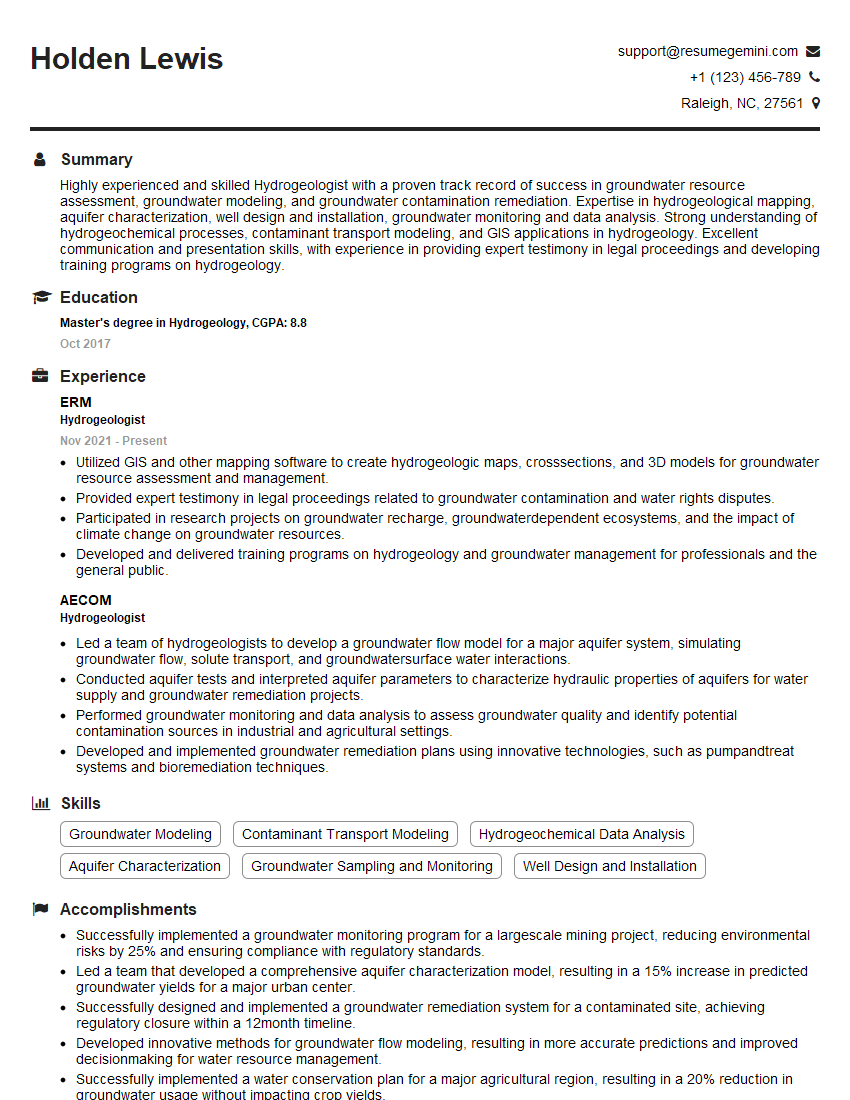
Hydrogeologist Resume Sample

Senior Hydrogeologist Resume Sample

Environmental Remediation Specialist Resume Sample
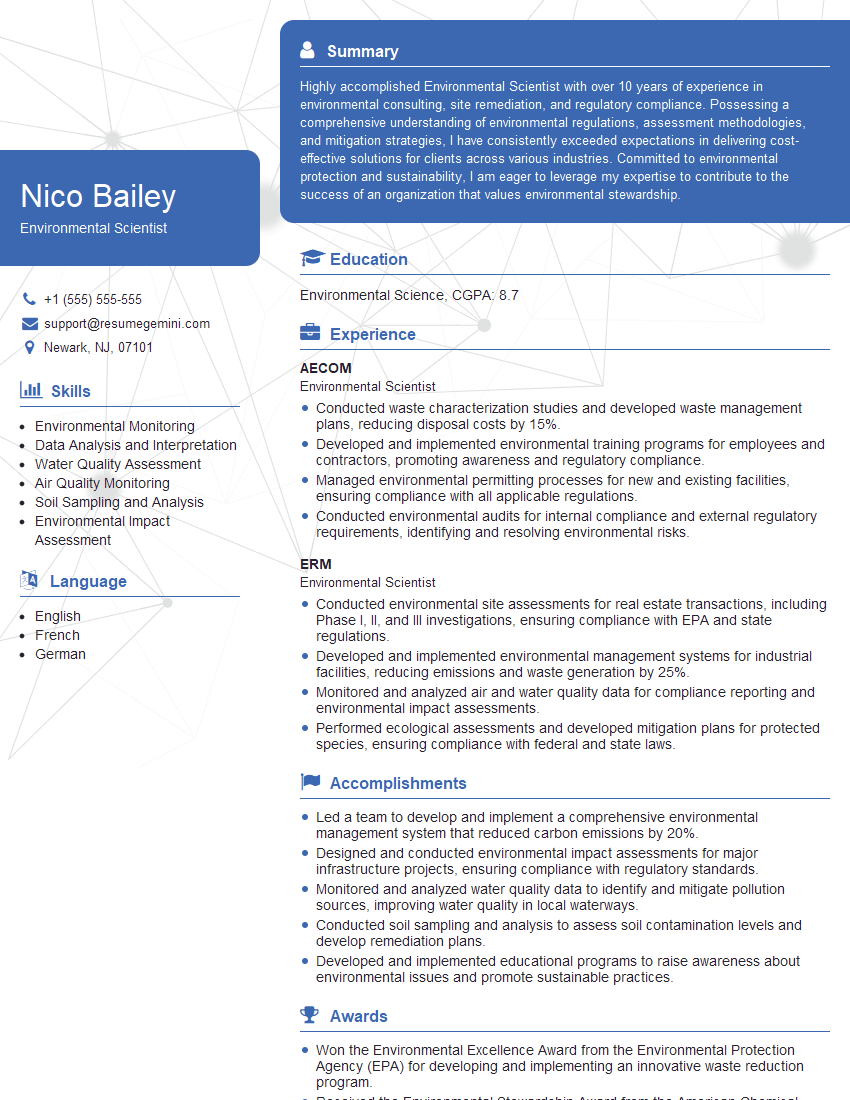
Environmental Scientist Resume Sample
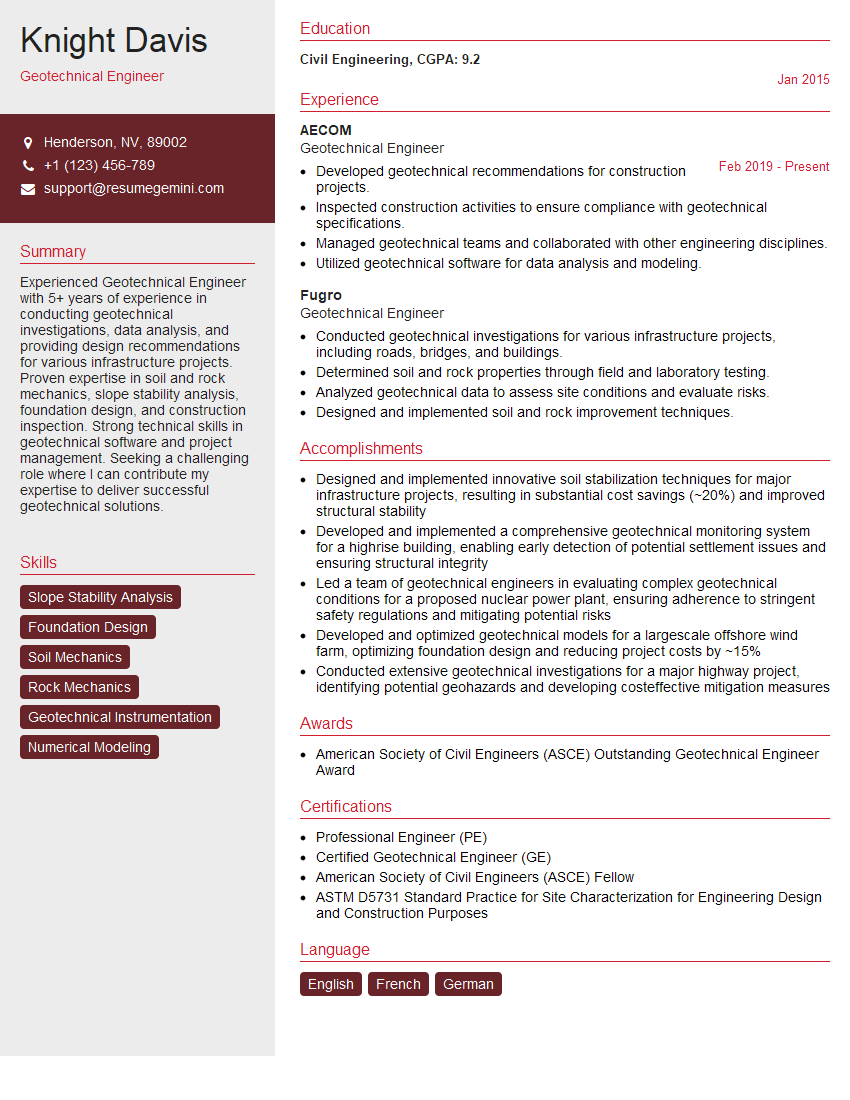
Geotechnical Engineer Resume Sample
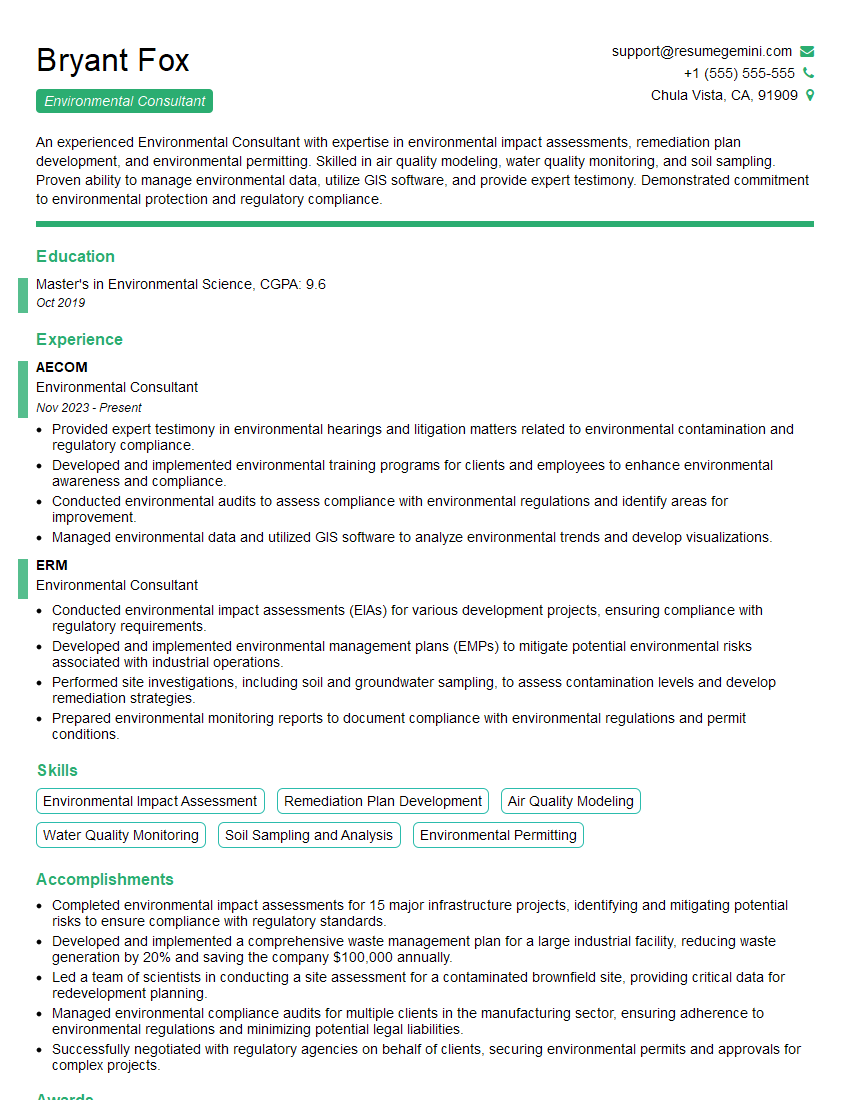
Environmental Consultant Resume Sample

Environmental Project Manager Resume Sample
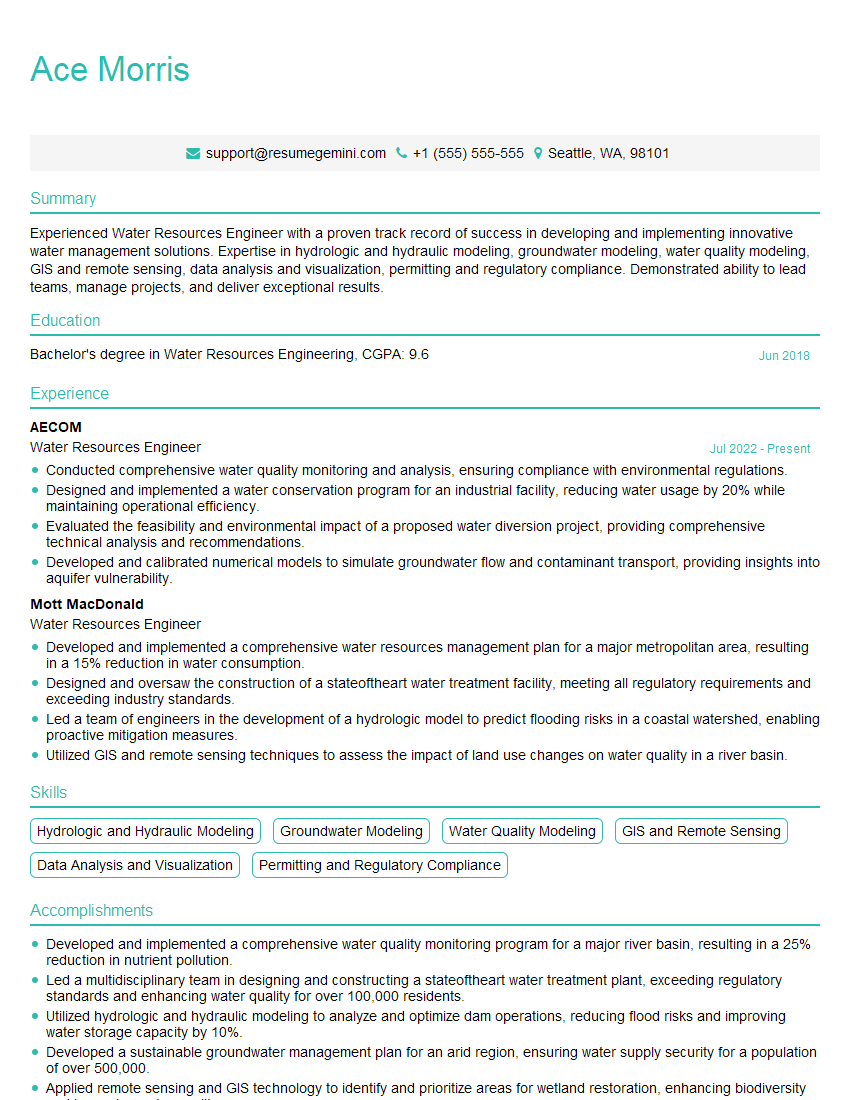
Water Resources Engineer Resume Sample
Explore more articles
Users Rating of Our Blogs
Share Your Experience
We value your feedback! Please rate our content and share your thoughts (optional).
What Readers Say About Our Blog
To the interviewgemini.com Webmaster.
Very helpful and content specific questions to help prepare me for my interview!
Thank you
To the interviewgemini.com Webmaster.
This was kind of a unique content I found around the specialized skills. Very helpful questions and good detailed answers.
Very Helpful blog, thank you Interviewgemini team.