Interviews are opportunities to demonstrate your expertise, and this guide is here to help you shine. Explore the essential Hydraulic Modeling (SWMM, HEC-RAS) interview questions that employers frequently ask, paired with strategies for crafting responses that set you apart from the competition.
Questions Asked in Hydraulic Modeling (SWMM, HEC-RAS) Interview
Q 1. Explain the difference between steady and unsteady flow in hydraulic modeling.
In hydraulic modeling, the distinction between steady and unsteady flow is fundamental. Steady flow implies that the water’s depth and velocity at any given point in the system remain constant over time. Think of a calm river with a consistent discharge – the flow characteristics don’t change significantly. Unsteady flow, on the other hand, involves changes in water depth and velocity over time. This is common in scenarios like flash floods or during the operation of a dam, where the flow conditions are dynamic and evolving.
SWMM is particularly well-suited for modeling unsteady flow in urban drainage systems, where rainfall events cause rapid fluctuations in water levels. HEC-RAS, while capable of handling unsteady flow, is often used for larger-scale river systems where steady-flow conditions might be acceptable for certain analyses, such as designing a bridge based on average annual discharge.
Q 2. Describe the Manning’s equation and its application in SWMM and HEC-RAS.
Manning’s equation is an empirical formula used to calculate the flow velocity in open channels. It’s expressed as:
V = (1/n) * R^(2/3) * S^(1/2)Where:
Vis the flow velocity (m/s or ft/s)nis the Manning’s roughness coefficient (dimensionless)Ris the hydraulic radius (area/wetted perimeter) (m or ft)Sis the energy slope (approximately equal to the bed slope for mild slopes) (dimensionless)
Both SWMM and HEC-RAS utilize Manning’s equation to estimate flow velocities within their respective models. In SWMM, it’s integral to calculating flow through conduits and open channels representing the drainage network. In HEC-RAS, it plays a crucial role in determining the flow characteristics within river channels and determining water surface profiles.
The roughness coefficient, n, is a critical parameter that reflects the surface texture and the channel’s resistance to flow. Selecting the appropriate n value is crucial for model accuracy and often involves literature review, field surveys, or calibration against observed data.
Q 3. How do you calibrate and validate a hydraulic model (SWMM or HEC-RAS)?
Calibrating and validating a hydraulic model is a critical step to ensure its accuracy and reliability. Calibration involves adjusting model parameters (like Manning’s n, infiltration parameters, or rainfall intensity) to match the model’s simulated results with observed field data. This process often involves iterative adjustments based on comparisons between simulated and observed water levels, flow rates, or other relevant data.
Validation, on the other hand, uses a separate dataset (independent of the calibration dataset) to assess the model’s performance in predicting conditions not explicitly used in calibration. A successful validation demonstrates the model’s ability to generalize and accurately predict hydraulic behavior under different conditions.
For example, in calibrating a SWMM model for a storm drainage system, you might compare simulated water levels at various manholes with observed water levels during a past storm event. If discrepancies exist, you would adjust parameters (e.g., inlet capacity, pipe roughness) until a satisfactory match is achieved. Validation would then involve comparing the model’s predictions for a different storm event against observed data to confirm its accuracy.
Q 4. What are the limitations of using the kinematic wave approximation?
The kinematic wave approximation simplifies the St. Venant equations by neglecting the pressure terms and assuming that the flow is primarily controlled by the channel’s geometry and the friction slope. This simplification reduces computational complexity, making it useful for large-scale or computationally intensive models.
However, the kinematic wave approximation has limitations. It’s most accurate for steep slopes and relatively uniform channels where the influence of backwater effects is minimal. It struggles to represent situations involving:
- Subcritical flow: where the Froude number is less than 1. Backwater effects significantly impact the flow profile which the kinematic wave approximation ignores.
- Significant lateral inflows: The approximation performs poorly when substantial inflows or outflows alter the flow regime along the channel.
- Rapidly varying flow conditions: Events like dam breaks generate complex flow patterns that exceed the assumptions of the kinematic wave approximation.
Therefore, while computationally efficient, the kinematic wave approach should be applied judiciously, and its limitations must be carefully considered.
Q 5. Explain the concept of backwater curves and how they’re calculated.
Backwater curves represent the water surface profile in an open channel when the flow is controlled by downstream conditions. They occur when the downstream water level is higher than the normal depth, causing the water surface to rise upstream. This is like placing your thumb over the end of a garden hose—the water backs up.
Backwater curves are calculated by solving the energy equation (or momentum equation for more accurate results), considering the channel geometry, flow discharge, and downstream boundary conditions. The process often involves numerical methods (e.g., finite difference or finite element methods) to determine the water surface elevation at various points along the channel. HEC-RAS is a powerful tool specifically designed for this type of calculation.
Consider a bridge crossing a river. The bridge piers can restrict the flow and create backwater effects upstream. Accurate modeling using HEC-RAS and calculation of the backwater curve will ensure adequate design to avoid flooding upstream of the structure.
Q 6. How do you handle boundary conditions in a hydraulic model?
Boundary conditions are crucial in hydraulic modeling, defining the flow and water level conditions at the model’s edges. These conditions dictate how the flow enters and exits the modeled system and significantly influence the simulation results.
Common types include:
- Upstream boundary: Defines the inflow hydrograph (flow rate over time) or water level at the model’s upstream end.
- Downstream boundary: Specifies the water level (e.g., at a river confluence or outflow to the ocean), or a rating curve relating flow and water level.
- Lateral inflow boundary: Models the addition of water to the channel from tributaries or other sources.
- Normal depth boundary: Used in some circumstances to specify a normal depth based on flow at a specific cross section.
The correct selection and implementation of boundary conditions are paramount for accurate model predictions. Improper boundary conditions can lead to significant errors in the results, so carefully checking and understanding the relevant hydraulics for your model is essential.
Q 7. What are different types of rainfall data used in hydraulic modeling?
Several types of rainfall data are used in hydraulic modeling, each with its strengths and weaknesses:
- Point rainfall data: Represents rainfall at a single location, typically obtained from rain gauges. Simple to obtain but has spatial limitations.
- Rainfall intensity-duration-frequency (IDF) curves: Provide the relationship between rainfall intensity, duration, and return period, which is useful for design purposes. Useful for design storms but does not represent the actual rainfall event.
- Radar rainfall data: Uses radar to estimate rainfall over a larger area, providing better spatial coverage than point data. Can have some uncertainties in measurement.
- Rainfall time series data: A continuous record of rainfall intensity over time, typically at a higher resolution than point data. Ideal for simulating the effects of actual rainfall events.
The choice of rainfall data depends on the model’s scale, data availability, and the objectives of the study. For example, a small-scale drainage model might use point rainfall data, whereas a regional flood model might rely on radar rainfall data or more spatially distributed rainfall.
Q 8. Describe different types of losses considered in pipe flow calculations.
Pipe flow calculations consider several types of energy losses that resist the flow of water. These losses can be broadly categorized into major losses and minor losses.
- Major Losses: These are frictional losses that occur along the length of the pipe due to the interaction between the water and the pipe wall. They are typically calculated using the Darcy-Weisbach equation or other empirical formulas like Hazen-Williams or Manning equations. The Darcy-Weisbach equation, considered the most accurate, uses a friction factor (f) which is dependent on the pipe roughness, diameter, and flow velocity (Reynolds number). A higher friction factor indicates greater energy loss.
- Minor Losses: These losses occur due to changes in pipe geometry, such as bends, valves, fittings, and entrances/exits. They are often expressed as a head loss coefficient (K) multiplied by the velocity head (v²/2g). Each fitting or change in geometry has its own associated K-value, which can be found in engineering handbooks or manufacturer’s specifications. For example, a sharp bend will have a significantly higher K-value than a gradual bend.
Imagine water flowing through a garden hose. The major loss is like the friction of the water against the hose’s inner walls, slowing it down along its entire length. Minor losses are like the bumps and kinks in the hose, causing additional slowing down.
Accurate accounting for both major and minor losses is crucial for proper pipe sizing and pressure calculations in hydraulic systems. Underestimating losses can lead to insufficient pressure at the end of the pipe network, while overestimating them can lead to unnecessarily oversized and expensive pipes.
Q 9. Explain the significance of critical depth in open channel flow.
Critical depth in open channel flow is the depth of flow at which the specific energy is minimum for a given discharge. It’s a crucial concept because it represents a transition point in flow behavior.
At depths less than critical depth, the flow is considered subcritical, characterized by a relatively slow velocity and a downstream control. This means the flow is largely influenced by downstream conditions. Think of a gently flowing river – its depth is primarily determined by the river’s downstream characteristics.
At depths greater than critical depth, the flow is supercritical, having a high velocity and an upstream control. This means the flow is largely influenced by upstream conditions. Imagine a rapid in a mountain stream; the depth is mainly determined by what’s happening upstream.
The critical depth is important because it’s often used in hydraulic structures design. For example, we need to ensure that the water flowing over a spillway doesn’t exceed its critical depth, otherwise the flow may become supercritical, leading to unstable and potentially dangerous conditions. It’s also important in determining the type of hydraulic jump that might occur downstream. Determining the critical depth aids in the design of hydraulic structures like weirs and spillways by helping ensure safe and efficient operation.
Q 10. How do you model infiltration in SWMM?
SWMM (Storm Water Management Model) models infiltration using several methods, primarily based on the Horton, Green-Ampt, or Curve Number methods. Each approach has its own parameters to define the infiltration rate.
- Horton’s Equation: This method assumes an initial infiltration rate that decays exponentially to a constant final infiltration rate. It’s characterized by two parameters: the initial infiltration rate (f0) and a decay constant (k).
- Green-Ampt Method: This method considers the effect of soil moisture content. It’s based on the principle of water entering the soil until it reaches saturation, at which point infiltration stops. The parameters include the saturated hydraulic conductivity (Ks) and a suction head (ψ). This is more physically based and thus more accurate in many cases.
- Curve Number Method: A simpler, empirical method based on the curve number (CN), which reflects the soil type and land cover. It is commonly used for watershed-scale modeling. Higher CN values indicate lower infiltration rates.
In SWMM, you specify the infiltration method and corresponding parameters for each subcatchment. This information, along with rainfall data and other relevant parameters, is used to simulate the infiltration process. The model then calculates the runoff that occurs after infiltration. The choice of infiltration model depends on the accuracy needed and the available data. For example, for detailed simulation of infiltration in a specific area, the Green-Ampt method might be preferred. The Curve Number method is often used for quick estimations and large-scale applications.
Q 11. How does HEC-RAS handle bridge modeling?
HEC-RAS (Hydrologic Engineering Center’s River Analysis System) handles bridge modeling by considering the bridge as a control structure that influences the water surface profile. The model calculates the flow contraction and expansion effects of the bridge piers and abutments on the water level upstream and downstream of the bridge.
HEC-RAS uses a variety of methods to model bridge hydraulics, including:
- Energy equation: Using the energy equation to estimate the head loss through the bridge and determine the water surface profiles.
- Simplified bridge methods: These methods employ simplified calculations, and are useful for quick estimations but may lack accuracy in complex situations.
- Full bridge modeling: Includes detailed geometry including pier shapes, which requires more data input but provides a more accurate estimation of hydraulic behaviour.
- Computational fluid dynamics (CFD) integration: For complex situations, HEC-RAS can be integrated with specialized CFD software for a more detailed analysis.
The model considers factors such as bridge geometry (number of piers, pier shape, opening width), flow conditions (discharge, water surface elevation), and channel characteristics (roughness, cross-section geometry). Improper bridge design could lead to scour or flooding and requires a thorough analysis. In practice, this often involves a range of modeling techniques to ensure results are accurate and reliable.
Q 12. What are the different flow routing methods in HEC-RAS?
HEC-RAS offers several flow routing methods for simulating water movement through a river system. The choice of method depends on the complexity of the problem and the required accuracy:
- Kinematic Wave Routing: This is a simplified method suitable for relatively steep channels where the flow is dominated by gravity. It’s computationally efficient but less accurate for complex flow conditions.
- Diffusion Wave Routing: This method accounts for both the advective and diffusive aspects of flow, providing greater accuracy than kinematic wave routing, particularly in milder slopes. It’s considered an improvement over the kinematic approach and handles backwater effects better.
- Dynamic Wave Routing: This is the most comprehensive method, explicitly solving the Saint-Venant equations (continuity and momentum equations). It can handle complex flow conditions, including backwater effects, unsteady flow, and hydraulic jumps, but it’s computationally more intensive.
The selection of the routing method is often an iterative process that balances computational efficiency and modeling accuracy. A simpler method might suffice for a preliminary analysis or for situations where data is limited. For more detailed and accurate results, or where complex phenomena like hydraulic jumps and backwater curves are important, the dynamic wave routing method is typically employed.
Q 13. Explain the concept of water surface profiles in open channel flow.
Water surface profiles describe the shape of the water surface in an open channel flow as a function of distance along the channel. They are crucial for understanding flow behavior and designing hydraulic structures.
Different types of water surface profiles exist, depending on the relationship between the channel slope, energy slope and the critical depth:
- M1, M2, M3 profiles: These are subcritical profiles where the flow depth is greater than the critical depth. The energy line slopes down relatively gently.
- S1, S2, S3 profiles: These are supercritical profiles where the flow depth is less than the critical depth. The water moves quickly and the energy line slopes sharply.
- C1, C2, C3 profiles: These profiles include both subcritical and supercritical flow regions, often with a hydraulic jump transitioning between the two.
Understanding water surface profiles is essential for designing safe and effective hydraulic structures. For example, the design of a spillway requires careful consideration of the water surface profile to avoid the formation of a hydraulic jump near the downstream end, which could damage the structure. Similarly, the design of a culvert requires an understanding of how the water surface profile changes as the water flows through the structure to prevent backup and flooding upstream.
Q 14. How do you model culverts in HEC-RAS?
HEC-RAS models culverts by considering them as control structures that restrict flow in an open channel. The model calculates the flow through the culvert using energy and momentum equations, accounting for the head loss through the culvert barrel.
HEC-RAS offers several culvert modeling options:
- Full flow (or barrel) modeling: It accounts for the entire geometry of the culvert. This approach provides a detailed representation of the flow conditions and is important when the culvert flow is near full capacity.
- Simplified culvert methods: These approaches utilize empirically derived equations to estimate flow without the need for detailed geometric data. They are suitable for initial design or when detailed data is unavailable but provide less accuracy than full modeling.
- Specific energy calculations: These methods use energy principles to estimate flow and are useful to approximate flow across the culvert structure.
Accurate culvert modeling is crucial for flood plain management. Underestimating the capacity of a culvert can lead to flooding upstream of the structure, while overestimating the capacity could lead to unnecessary and expensive construction. The selection of an appropriate modeling method depends on the available data, desired accuracy, and the complexity of the culvert and surrounding geometry.
Q 15. What are the different types of weirs and how are they modeled?
Weirs are structures used to control or measure water flow in open channels. Different types are characterized by their geometry and flow characteristics. Modeling them accurately is crucial for accurate hydraulic simulations.
- Rectangular Weir: The simplest type, with a vertical rectangular opening. In SWMM and HEC-RAS, it’s often modeled using a discharge equation based on the weir’s height and the upstream water level, like the simplified formula: Q = CLH3/2, where Q is the discharge, C is a discharge coefficient (affected by weir geometry and flow conditions), L is the weir length, and H is the head (upstream water level above the weir crest).
- Triangular Weir (V-notch): This has a V-shaped opening, offering more precise measurements at lower flow rates. The discharge equation is different, usually incorporating the V-notch angle. Both SWMM and HEC-RAS can model these using similar principles, often relying on pre-defined weir equations or user-defined functions.
- Trapezoidal Weir: Combining aspects of rectangular and triangular weirs, offering a flexible design. Modeling involves more complex equations, often requiring iterative solutions to determine the flow. Software packages usually provide built-in options or allow for custom equation input.
- Broad-crested Weir: Has a broad, flat crest, leading to different flow behavior and a different discharge equation. Accurate modeling requires accounting for the specific crest shape and the approach flow conditions.
In both SWMM and HEC-RAS, weirs are typically defined by their geometry (type, length, height, etc.) and location within the model. The software then utilizes appropriate discharge equations to estimate flow over the weir based on the calculated water surface elevations.
Career Expert Tips:
- Ace those interviews! Prepare effectively by reviewing the Top 50 Most Common Interview Questions on ResumeGemini.
- Navigate your job search with confidence! Explore a wide range of Career Tips on ResumeGemini. Learn about common challenges and recommendations to overcome them.
- Craft the perfect resume! Master the Art of Resume Writing with ResumeGemini’s guide. Showcase your unique qualifications and achievements effectively.
- Don’t miss out on holiday savings! Build your dream resume with ResumeGemini’s ATS optimized templates.
Q 16. How do you account for unsteady rainfall in your modeling?
Accurately representing unsteady rainfall in hydraulic modeling is critical for realistic simulations, especially during intense storm events. Instead of using a constant rainfall intensity, we incorporate time-varying rainfall data.
This data can come from various sources:
- Rainfall gauges: Provides point measurements of rainfall intensity over time.
- Radar data: Offers spatially distributed rainfall estimates, enabling more sophisticated models.
- Rainfall hyetographs: These are pre-defined curves showing rainfall intensity over time, often derived from historical data or design storms. These are often used in design scenarios for simplified models.
In SWMM, unsteady rainfall is input as a time series of rainfall intensities. HEC-RAS handles this by either incorporating rainfall intensities directly into its inflow boundary conditions or coupling with external hydrologic models that produce unsteady flow hydrographs as input. The model then uses this time-varying rainfall to update the inflow hydrographs and the water levels within the system at each time step. This leads to a more accurate representation of the dynamic behavior of the system, especially in situations of rapid runoff response.
For example, a sudden intense rainfall event will cause a rapid increase in runoff and thus a peak in the flow hydrographs.
Q 17. Describe your experience with GIS integration in hydraulic modeling.
GIS integration is indispensable in modern hydraulic modeling. It streamlines data input, visualization, and analysis significantly.
My experience includes using GIS software (ArcGIS, QGIS) to:
- Create model geometry: Digitizing rivers, channels, and other drainage features directly from high-resolution imagery and elevation data. This is far more efficient than manual data entry.
- Import/export data: Seamlessly transferring spatial data like land use, soil type, and elevation data into the hydraulic model (SWMM, HEC-RAS). This information is crucial to calibrate the model accurately.
- Define model boundaries: Precisely defining the catchment area and model extents using GIS tools ensures accurate representation of the study area.
- Post-processing results: Visualizing model outputs such as water surface elevations, velocities, and flood extents on a map, making the results easily understandable for stakeholders. This helps identify potential problem areas.
- Conduct sensitivity analysis: Utilizing GIS to systematically modify model parameters, visualize the impacts, and identify the most influential variables in the model.
For instance, in a recent project involving flood risk assessment, I used ArcGIS to import LiDAR data, creating a high-resolution digital elevation model (DEM) which was then used to define the model’s topography in HEC-RAS. This resulted in a much more accurate representation of the floodplains and improved model performance.
Q 18. Explain how you would assess the impact of a proposed development on drainage.
Assessing the impact of a proposed development on drainage involves a systematic approach using hydraulic modeling.
Here’s a step-by-step process:
- Develop a baseline model: Create a hydraulic model of the existing drainage system before the development, using surveyed data, GIS data, and other relevant information. Calibrate and validate this model against historical data.
- Incorporate the development: Add the proposed development features to the model. This might include changes to impervious surfaces, new pipes, or alterations to existing channels. The accuracy of this step is crucial for reliable results.
- Run the model: Simulate the drainage system with and without the development under various rainfall scenarios. This will highlight differences in flow patterns and water levels.
- Compare results: Analyze the differences between the baseline and developed scenarios. Key metrics might include peak flows, water depths, flood extents, and flow velocities.
- Assess potential impacts: Evaluate the potential impacts of the development on downstream areas, infrastructure, and other vulnerable elements. This may involve considering various return periods to evaluate the risk under different storm magnitudes.
- Mitigation measures: Based on the assessment, recommend appropriate mitigation measures, such as increased drainage capacity or improved water management strategies, to reduce any adverse impacts.
For example, a new housing development might increase impervious areas, leading to higher runoff volumes. The model will show the increase in peak flows downstream and identify potential flooding hotspots. This information guides the design of appropriate drainage improvements.
Q 19. How do you handle uncertainty in hydraulic modeling?
Uncertainty is inherent in hydraulic modeling, stemming from limitations in data, model simplifications, and parameter estimations.
We address uncertainty using various techniques:
- Sensitivity analysis: Identifying model parameters most sensitive to changes in output. This helps focus efforts on improving data quality and reducing uncertainty in key areas.
- Calibration and validation: Using observed data to fine-tune model parameters and confirm the model’s accuracy. A robust calibration process leads to a more reliable model.
- Monte Carlo Simulation: Assigning probability distributions to uncertain parameters, then running the model multiple times with randomly sampled parameter values. This generates a range of possible outcomes, providing a measure of uncertainty in the results. This helps to define confidence intervals for results.
- Ensemble modeling: Using multiple models with different assumptions and parameterizations to compare results and identify areas of agreement and disagreement.
For example, in a flood modeling project, uncertainty might exist in the roughness coefficients of the channels. Monte Carlo simulations could be used to determine how this uncertainty propagates to the predicted water levels and flood extents.
Q 20. What are the different methods for determining rainfall intensity?
Determining rainfall intensity is crucial for designing hydraulic infrastructure. Several methods exist:
- Intensity-Duration-Frequency (IDF) curves: These are empirical relationships derived from historical rainfall data, showing the relationship between rainfall intensity, duration, and return period (frequency). These are commonly used in design and are readily available from meteorological agencies.
- Statistical analysis of rainfall records: Analyzing historical rainfall data using statistical methods (e.g., Gumbel, Log-Pearson Type III distributions) to estimate rainfall intensities for various return periods. This is a more data-intensive approach and requires longer rainfall records for accurate results.
- Rainfall simulation models: Using stochastic rainfall generators to simulate synthetic rainfall data that match the statistical properties of observed data. This is useful when historical data is limited or when design storms need to be generated.
- Radar data: Utilizing rainfall data from weather radar systems. However, radar data often requires adjustment to account for spatial variability and measurement errors.
The choice of method depends on the data availability and project requirements. In many cases, IDF curves are readily available and sufficient for preliminary design, while more sophisticated statistical methods or rainfall simulation may be needed for detailed design or risk assessment.
Q 21. Explain the concept of hydraulic jump.
A hydraulic jump is a rapid transition from supercritical flow to subcritical flow in an open channel. Imagine a fast-moving stream suddenly slowing down and becoming much deeper and calmer.
In supercritical flow, the Froude number (Fr) – a dimensionless number representing the ratio of inertial forces to gravitational forces – is greater than 1. The flow is characterized by high velocity and low depth. In subcritical flow, Fr < 1, and the flow is slower and deeper.
The jump occurs when energy is rapidly dissipated, often due to turbulent mixing. This dissipation can be modeled using energy balance equations. The jump is characterized by a sudden increase in water depth and a corresponding decrease in velocity. The location and characteristics of the jump are influenced by the upstream flow conditions and the channel geometry.
In hydraulic modeling (SWMM, HEC-RAS), hydraulic jumps are often modeled implicitly through the solution of the Saint-Venant equations. These equations govern the flow in open channels, and their solution implicitly captures the energy dissipation associated with the hydraulic jump. However, more specific modelling may be required in scenarios involving significant energy dissipation to improve the accuracy of the results. Accurate representation of the jump is crucial for accurate prediction of downstream water levels and forces on structures.
Q 22. How do you use SWMM to model different types of drainage systems (e.g., combined, separate)?
SWMM (Storm Water Management Model) is incredibly versatile in handling various drainage systems. The key lies in how you define the network’s components within the model. For separate sewer systems, you’ll define separate conduits and nodes for sanitary and stormwater flows, ensuring no direct connection between the two. Think of it like having two completely independent plumbing systems in a building – one for wastewater and the other for rainwater. In SWMM, this is achieved by creating different subcatchments and linking them to the appropriate conduit systems. You will specify the inflow to each system independently, representing the separation in reality.
Combined sewer systems, however, are modeled by connecting both sanitary and stormwater flows into the same conduits and nodes. This represents the reality of the system where both flows travel together. In SWMM, this is accomplished by connecting the sanitary and stormwater subcatchments to the same conduits. Careful calibration and input data are critical to accurately reflect the flow dynamics.
Example: Imagine modeling a city. In a separate system, you’d model rainwater flowing through one set of pipes, ending up in a stormwater treatment facility, while wastewater flows through completely different pipes to a wastewater treatment plant. In a combined system, both flows would mix in a single set of pipes, potentially leading to combined sewer overflows during intense rainfall events. SWMM allows you to accurately replicate both scenarios.
Q 23. How do you interpret HEC-RAS output and identify potential flood risks?
Interpreting HEC-RAS (Hydrologic Engineering Center’s River Analysis System) output requires a systematic approach. The software provides a wealth of data, but you need to focus on key parameters to assess flood risks. First, I examine the water surface profiles. These profiles show the water elevation at different locations along the river or channel for a given flow scenario. Comparing these elevations to the ground elevations, particularly critical infrastructure, reveals areas prone to inundation.
Next, I analyze the velocity profiles. High velocities can cause erosion and damage to structures. By identifying areas of high velocity, I can pinpoint potential risk points. Finally, I look at the hydrographs which show the temporal variation of the flow at specific locations, allowing the assessment of the peak discharge and the duration of the flood event.
Identifying flood risks is done by comparing the modeled water surface elevations to various floodplains and critical elevations, often using GIS integration. Areas where the modeled water surface exceeds these critical elevations are identified as high-risk flood zones.
Example: Let’s say the model shows a water surface elevation of 10 meters during a 100-year flood event. If a bridge has a deck elevation of 9 meters, it indicates a potential for significant damage or even failure. This information is crucial for effective flood mitigation planning.
Q 24. What software and tools are you proficient with for hydraulic modeling?
My proficiency extends to several key software and tools integral to hydraulic modeling. Naturally, I am very experienced with SWMM and HEC-RAS. My experience also includes working with GIS software (ArcGIS, QGIS) for data preprocessing, visualization, and integration with the modeling results. I’m also adept at using Microsoft Excel for data analysis and manipulation. Furthermore, I have experience with programming languages like Python, primarily for automating tasks, data processing, and customizing model inputs and outputs.
Beyond the core modeling packages, I am familiar with various other tools for water quality modeling, such as QUAL2K. I utilize statistical software like R for data analysis and calibration optimization.
Q 25. Describe a challenging hydraulic modeling project you’ve worked on and how you overcame the challenges.
One particularly challenging project involved modeling a large, complex urban watershed with significant combined sewer overflows (CSOs). The challenge stemmed from the limited availability of high-quality input data, particularly for the sanitary sewer network. Furthermore, the watershed included several highly irregular channels and numerous hydraulic structures, making accurate model calibration very complex.
To overcome these challenges, I employed a multi-step approach. First, I spent considerable time gathering and verifying the available data, supplementing it with field surveys and data from other sources. Then, I adopted a phased calibration strategy, starting with the main channels and then refining the calibration of the tributary streams and subcatchments. Finally, I utilized a combination of manual calibration techniques and automated calibration tools within SWMM to optimize model parameters.
The successful completion of this project was not only a result of the technical solutions but was significantly facilitated by effective communication and close collaboration with stakeholders throughout the process.
Q 26. How do you ensure the accuracy and reliability of your hydraulic models?
Ensuring the accuracy and reliability of hydraulic models is paramount. This involves a rigorous process that begins with careful data collection and quality control. Data from various sources needs to be thoroughly checked for consistency and accuracy. Following that, model calibration is crucial. This involves adjusting model parameters to match observed data (e.g., water levels, flows). I typically use a combination of manual calibration and automated optimization techniques to achieve the best fit.
Model validation is equally important; this involves comparing the model’s performance against independent datasets. A properly validated model shows reasonable agreement with observed data. Finally, sensitivity analysis helps understand the influence of individual parameters on model outcomes, revealing areas where data uncertainty is most critical. This analysis helps quantify the uncertainty associated with the model’s predictions.
Example: In calibrating a SWMM model, I might adjust Manning’s roughness coefficients for different conduits to match observed flow depths during a past rainfall event. Subsequently, I would validate the model against another independent rainfall event to confirm its reliability.
Q 27. What are your experiences using different modeling techniques (e.g., 1D, 2D)?
I have experience with both 1D and 2D modeling techniques. 1D modeling (like in HEC-RAS) simplifies the flow as occurring in a single direction, often suitable for rivers and channels where the lateral variations in flow are relatively small. It’s computationally efficient but less accurate in areas with complex flow patterns.
2D modeling (e.g., using MIKE FLOOD, LISFLOOD-FP), on the other hand, considers flow in two dimensions (plan view), which is significantly beneficial for modeling flow over floodplains, urban areas with complex topography, and areas where flow separation and lateral flow are significant. It provides a more realistic representation of the flow but requires significantly more computational resources and data.
The choice between 1D and 2D modeling depends on the specific project requirements. For large river systems with relatively simple geometry, 1D modeling is often sufficient. However, for areas with complex topography, significant lateral flows, or when detailed inundation mapping is required, 2D modeling is often preferred. In some complex projects, I have even employed a coupled 1D-2D approach, leveraging the strengths of both modeling techniques.
Key Topics to Learn for Hydraulic Modeling (SWMM, HEC-RAS) Interview
- Hydrological Processes: Understanding rainfall-runoff modeling, infiltration, evapotranspiration, and their influence on hydraulic simulations in both SWMM and HEC-RAS.
- Hydraulic Principles: Mastering fundamental concepts like Manning’s equation, energy equation, and gradually varied flow for accurate model setup and interpretation.
- SWMM Model Setup: Gain proficiency in creating and calibrating SWMM models, including defining subcatchments, nodes, links, and incorporating rainfall data and boundary conditions. Practice simulating various scenarios like rainfall events and infrastructure changes.
- HEC-RAS Model Setup: Develop expertise in building and calibrating HEC-RAS models, focusing on defining cross-sections, setting boundary conditions (water surface elevations or flows), and simulating unsteady flow conditions for rivers and channels.
- Data Management and Analysis: Learn how to effectively manage and analyze large datasets, including rainfall, topography, and observed flow data, to validate model results and improve accuracy.
- Calibration and Validation Techniques: Understand the process of model calibration and validation using observed data. Practice applying different calibration methods and evaluating model performance metrics.
- Uncertainty Analysis: Explore techniques to assess and quantify uncertainties in model inputs and outputs, contributing to more robust and reliable results.
- Practical Applications: Familiarize yourself with real-world applications of hydraulic modeling, such as urban drainage design, flood risk assessment, and river restoration projects. Be prepared to discuss your experience with these applications, even if it’s through coursework or personal projects.
- Problem-Solving Approaches: Develop your troubleshooting skills. Be prepared to discuss how you’d approach common challenges such as model convergence issues, data inconsistencies, or unexpected simulation results.
- Software Specifics: Demonstrate a strong understanding of the specific features and capabilities of both SWMM and HEC-RAS software packages. Highlight your experience with their graphical user interfaces and any scripting or programming skills you possess.
Next Steps
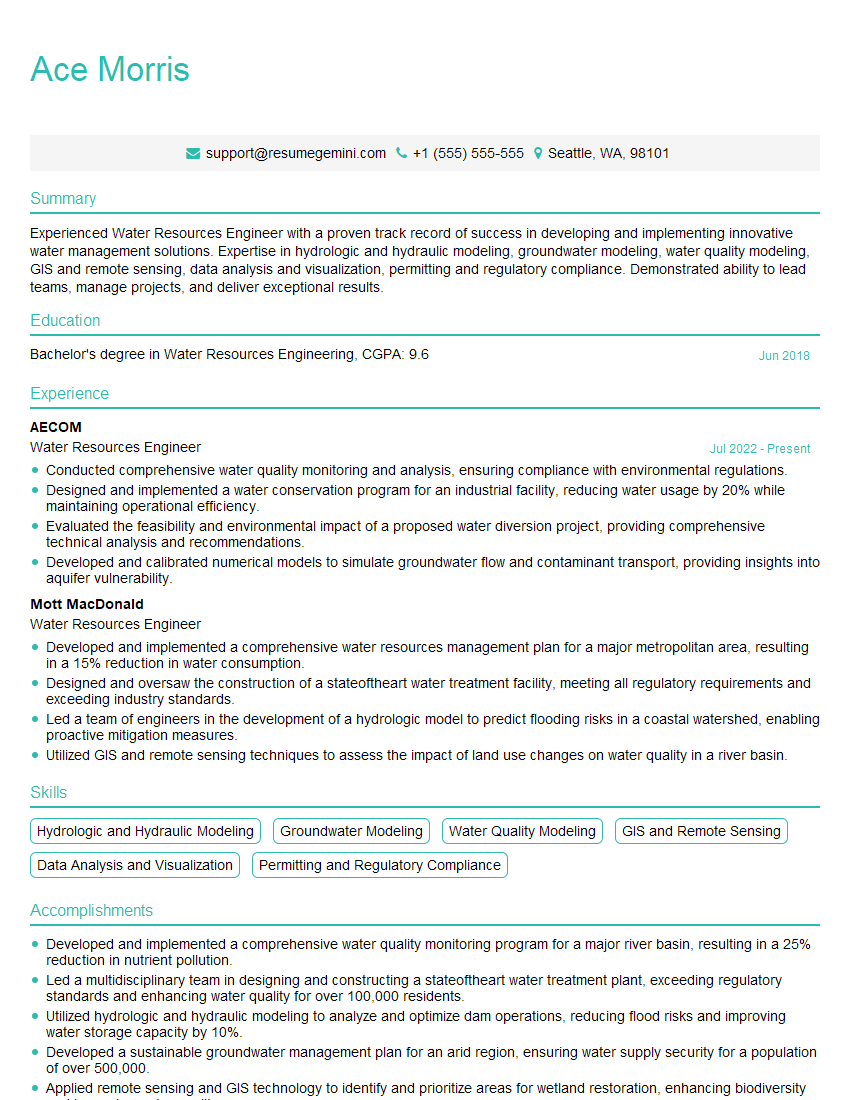
Mastering hydraulic modeling with SWMM and HEC-RAS significantly enhances your career prospects in water resources engineering, opening doors to exciting roles in design, analysis, and management. To maximize your job search success, invest in creating a compelling and ATS-friendly resume that highlights your skills and experience. ResumeGemini is a trusted resource that can help you build a professional resume that stands out. They offer examples of resumes tailored to hydraulic modeling (SWMM, HEC-RAS) positions to guide you. Make your skills shine, and land your dream job!





Explore more articles
Users Rating of Our Blogs
Share Your Experience
We value your feedback! Please rate our content and share your thoughts (optional).
What Readers Say About Our Blog
To the interviewgemini.com Webmaster.
Very helpful and content specific questions to help prepare me for my interview!
Thank you
To the interviewgemini.com Webmaster.
This was kind of a unique content I found around the specialized skills. Very helpful questions and good detailed answers.
Very Helpful blog, thank you Interviewgemini team.