Interviews are more than just a Q&A session—they’re a chance to prove your worth. This blog dives into essential Hydrogeologic Investigations interview questions and expert tips to help you align your answers with what hiring managers are looking for. Start preparing to shine!
Questions Asked in Hydrogeologic Investigations Interview
Q 1. Explain the concept of Darcy’s Law and its limitations.
Darcy’s Law is the foundational principle governing groundwater flow. It states that the rate of groundwater flow through a porous medium is proportional to the hydraulic gradient and the hydraulic conductivity of the medium. Think of it like water flowing through a sponge: the steeper the slope (hydraulic gradient), the faster the water flows, and the more porous the sponge (higher hydraulic conductivity), the easier it is for water to move.
Mathematically, it’s expressed as:
Q = -KA(dh/dl)Where:
Qis the discharge rate (volume of water per unit time)Kis the hydraulic conductivity (a measure of how easily water moves through the medium)Ais the cross-sectional area of flowdh/dlis the hydraulic gradient (change in hydraulic head over a given distance)
Limitations: Darcy’s Law is an empirical law, meaning it’s based on observation, and it has limitations. It’s most accurate for laminar flow (smooth, slow flow) in homogeneous and isotropic aquifers (uniform in all directions). It doesn’t hold true for turbulent flow (fast, chaotic flow), which can occur in highly permeable formations or near wells with high pumping rates. Furthermore, it doesn’t directly account for factors like temperature variations, chemical reactions, or biological processes that can influence groundwater flow.
For instance, in fractured rock aquifers, groundwater flow might be dominated by flow through fractures, rather than the entire rock matrix, making Darcy’s Law less applicable in its simplest form. Modifications and extensions of Darcy’s Law exist to address these limitations, such as the Forchheimer equation for turbulent flow.
Q 2. Describe different types of aquifers and their characteristics.
Aquifers are underground geological formations that store and transmit significant quantities of groundwater. They are classified based on their geological characteristics and hydraulic properties.
- Confined Aquifers: These are bounded above and below by impermeable layers (aquitards or aquicludes). The water is under pressure, and when a well penetrates the aquifer, the water rises to a level above the top of the aquifer, forming an artesian well. Examples include aquifers sandwiched between layers of clay or shale.
- Unconfined Aquifers: These are not bounded by impermeable layers at the top. The upper boundary is the water table, which fluctuates with recharge and discharge. Water in an unconfined aquifer is typically under atmospheric pressure. Think of a water table in a sandy soil profile.
- Perched Aquifers: These are small, localized unconfined aquifers that occur above the main water table, usually due to an impermeable layer within the soil profile. They often form on hillsides or slopes.
- Fractured Rock Aquifers: These aquifers are found in bedrock formations, where groundwater primarily flows through interconnected fractures and fissures. Hydraulic conductivity is highly variable and often depends on the density and aperture of the fractures. This is different from the pore-based flow in sand and gravel.
Each aquifer type has unique characteristics affecting its productivity, vulnerability to contamination, and management needs. For example, confined aquifers are generally less susceptible to surface contamination, while unconfined aquifers are more vulnerable because contaminants can readily reach the water table. Fractured rock aquifers pose unique challenges for well design and groundwater modeling because of their heterogeneity.
Q 3. How do you determine the hydraulic conductivity of an aquifer?
Determining the hydraulic conductivity (K) of an aquifer is crucial for groundwater modeling and resource management. Several methods exist, each with its advantages and limitations:
- Pumping Tests: This is a common method involving pumping a well at a constant rate and measuring the drawdown (decrease in water level) in the pumped well and nearby observation wells. The data are then analyzed using various theoretical models (e.g., Theis, Cooper-Jacob) to estimate K. This provides an in situ measurement, but can be expensive and time-consuming.
- Slug Tests: A simpler and faster method involving rapidly changing the water level in a well (e.g., by inserting or removing a volume of water) and monitoring the recovery or decline of the water level. Analysis uses specific equations to determine K. This is less expensive but provides a localized K value.
- Laboratory Tests: Soil or rock samples are collected from the aquifer and tested in a laboratory using permeameters to measure the hydraulic conductivity under controlled conditions. This method provides K values for specific samples but may not represent the entire aquifer’s heterogeneity.
- Tracer Tests: A tracer (a non-reactive substance) is injected into the aquifer, and its movement is tracked over time to determine the flow velocity and ultimately estimate K. This method is particularly useful for heterogeneous aquifers.
The choice of method depends on factors such as the aquifer’s characteristics, available resources, and the level of accuracy required. Often, a combination of methods is employed to obtain a more comprehensive understanding of the aquifer’s hydraulic properties.
Q 4. Explain the principles of groundwater flow modeling.
Groundwater flow modeling uses mathematical equations to simulate groundwater flow and transport processes within an aquifer system. The principles rely on solving governing equations, typically based on Darcy’s law and the mass conservation principle. These models help understand aquifer behavior under various conditions (e.g., pumping, recharge, contamination).
Key principles:
- Governing Equations: These equations describe the flow of groundwater based on hydraulic head, hydraulic conductivity, aquifer properties (porosity, storage coefficient), and boundary conditions (recharge, discharge, well pumping). Numerical techniques (finite difference, finite element) are used to solve these equations.
- Model Calibration and Validation: This is a crucial step to ensure the model accurately represents the real-world system. This involves adjusting model parameters (e.g., hydraulic conductivity) to match observed data (e.g., water levels, pumping rates) and comparing model outputs to independent datasets.
- Boundary Conditions: These define the limits of the model domain and specify the flow conditions at those boundaries (e.g., constant head, no-flow). Accurate representation of boundary conditions is vital for reliable results.
- Model Inputs: Accurate input data is essential. This includes parameters such as hydraulic conductivity, aquifer thickness, porosity, storage coefficient, well locations, pumping rates, recharge rates, and boundary conditions. Data are gathered from fieldwork, laboratory analysis, and literature.
Groundwater models are used for various purposes, including predicting the impact of groundwater pumping on water levels, assessing the fate and transport of contaminants, designing groundwater remediation strategies, and managing groundwater resources sustainably. Different types of models are suited for different scales and purposes.
Q 5. What are the different methods used for groundwater remediation?
Groundwater remediation involves cleaning up contaminated groundwater. The choice of method depends on several factors, including the type and extent of contamination, the aquifer’s characteristics, and cost considerations. Methods include:
- Pump and Treat: This involves pumping contaminated groundwater to the surface, treating it (e.g., using activated carbon filtration, air stripping), and then re-injecting the treated water or disposing of it properly. This is a common method but can be expensive and time-consuming for large plumes.
- Bioremediation: This method uses microorganisms (bacteria, fungi) to break down the contaminants. This is a cost-effective and environmentally friendly approach but requires careful monitoring and site-specific conditions. It’s particularly effective for certain organic contaminants.
- Permeable Reactive Barriers (PRBs): These are underground barriers constructed of reactive materials (e.g., zero-valent iron) that intercept and treat contaminants as groundwater flows through them. This is a relatively passive and permanent solution but requires careful design and site characterization.
- In-situ Chemical Oxidation (ISCO): Oxidizing agents (e.g., hydrogen peroxide, permanganate) are injected into the subsurface to break down contaminants. This is effective for many organic contaminants but requires careful control and monitoring to avoid adverse effects.
- In-situ Chemical Reduction (ISCR): Reducing agents are used to transform contaminants to less harmful forms. This technique is effective for specific contaminants like chlorinated solvents.
Often, a combination of methods is used to achieve optimal results. The selection of the appropriate remediation technique requires a thorough understanding of the hydrogeology of the site and the nature of the contamination.
Q 6. Describe your experience with groundwater monitoring well installation and sampling.
I have extensive experience in groundwater monitoring well installation and sampling, having participated in numerous projects involving site characterization, remediation monitoring, and long-term groundwater quality assessments. My experience encompasses all phases, from site selection and well design to construction, development, and sampling.
Well Installation: This involves careful consideration of well screen placement to target specific aquifer zones, the use of appropriate drilling techniques to minimize well damage, and installation of proper well casing and grouting to prevent cross-contamination. I’ve used various drilling methods (e.g., direct push, rotary drilling), depending on site conditions and project requirements. I ensure strict adherence to quality assurance/quality control protocols throughout the process, meticulously documenting all procedures.
Sampling: My experience includes various sampling techniques, including low-flow pumping, bailing, and the use of peristaltic pumps. I understand the importance of minimizing well disturbance and ensuring representative samples are collected. Proper sample preservation and chain-of-custody procedures are critically important and followed strictly to maintain data integrity and validity for laboratory analyses. I’m familiar with various water quality parameters and their implications for interpreting groundwater quality.
For example, on a recent project involving a suspected industrial spill, precise well placement and low-flow sampling techniques were crucial to delineate the extent of the contaminant plume accurately and effectively. This allowed for the development of a targeted and cost-effective remediation plan.
Q 7. How do you interpret hydrogeological data (e.g., water levels, chemical analyses)?
Interpreting hydrogeological data requires a holistic approach that integrates various types of data and considers the hydrogeological context. It’s not just about looking at individual numbers; it’s about understanding the story they tell.
Water Levels: Analyzing water level data helps determine groundwater flow directions, gradients, and the response of the aquifer to stresses like pumping or recharge. Changes in water levels over time can indicate seasonal fluctuations, changes in recharge, or the impacts of groundwater withdrawal. Contouring water level data creates potentiometric surfaces that visually illustrate groundwater flow patterns.
Chemical Analyses: Interpreting chemical data requires considering various factors, such as the presence of specific contaminants, their concentrations, spatial distribution, and temporal trends. This helps identify pollution sources, evaluate the extent of contamination, and assess the effectiveness of remediation measures. Statistical methods and geochemical modeling are often used to identify sources and pathways of contaminants.
Integration and Interpretation: I often use various tools to integrate these datasets effectively. This includes creating cross-sections, maps, and three-dimensional visualizations to depict the spatial distribution of water levels, contaminants, and other relevant parameters. Statistical analysis and numerical modeling help quantify relationships between data sets and provide insights into complex hydrogeological processes. For instance, comparing water level data with chemical data can help correlate contaminant movement with groundwater flow patterns.
A crucial aspect is considering the geological setting and site-specific factors. Understanding the geology, aquifer properties, and other environmental factors is essential to provide meaningful interpretations and avoid misinterpretations. It’s a process of iterative analysis, refinement, and hypothesis testing.
Q 8. Explain the concept of aquifer testing and its applications.
Aquifer testing is crucial for determining the hydraulic properties of aquifers – underground layers of rock and soil that hold groundwater. These properties, like transmissivity (how easily water moves through the aquifer) and storativity (how much water the aquifer releases under stress), are essential for managing groundwater resources and predicting the behavior of contaminants.
We use various methods, depending on the aquifer’s characteristics and the project’s objectives. For instance, a pumping test involves pumping water out of a well at a constant rate and monitoring the water level decline in the well and surrounding observation wells. Analyzing this drawdown data allows us to calculate the aquifer’s transmissivity and storativity. A simpler method, a slug test, involves rapidly changing the water level in a well (e.g., by inserting or removing a volume of water) and observing the recovery rate. This is useful for quicker assessments, especially in smaller aquifers or for preliminary investigations.
Applications of aquifer testing are diverse, including:
- Groundwater resource management: Determining sustainable yield for water supply.
- Contaminant transport modeling: Input parameters for simulating contaminant spread.
- Well design and optimization: Determining well spacing and pumping rates.
- Environmental impact assessment: Evaluating the impact of development projects on groundwater resources.
For example, I once worked on a project where we conducted pumping tests to determine the sustainable yield of an aquifer supplying drinking water to a growing community. The results guided the development of a water management plan that ensured the long-term availability of this crucial resource.
Q 9. What are the common types of groundwater contaminants and their sources?
Groundwater contamination is a serious issue, with various sources introducing a range of harmful substances into our aquifers. Common contaminants include:
- Pathogens: Bacteria, viruses, and parasites from sewage, livestock waste, or failing septic systems. Think of E. coli as a prime example.
- Inorganic contaminants: Metals (like arsenic, lead, and chromium) and salts (from fertilizers, industrial discharge, or road de-icing). These can cause serious health issues even at low concentrations.
- Organic contaminants: Petroleum hydrocarbons (from fuel spills or leaking underground storage tanks), pesticides (from agricultural runoff), and volatile organic compounds (VOCs, like solvents and dry cleaning fluids) which are often associated with industrial activities.
- Radionuclides: Radioactive materials from natural sources or nuclear waste, causing long-term health risks.
Sources of these contaminants are equally diverse and can be broadly classified as:
- Point sources: Specific locations where contaminants enter, like a leaking fuel tank or industrial discharge pipe.
- Non-point sources: Diffuse sources across a larger area, such as agricultural runoff or atmospheric deposition.
Understanding both the types of contaminants and their sources is fundamental to designing effective remediation strategies.
Q 10. Describe the process of conducting a hydrogeologic site assessment.
A hydrogeologic site assessment is a systematic investigation to understand the subsurface geology, hydrology, and potential for groundwater contamination at a specific location. It’s like taking a detailed ‘x-ray’ of the subsurface.
The process typically involves these steps:
- Phase I: Preliminary Assessment: Reviewing existing data (maps, reports, aerial photographs) to identify potential sources and pathways of contamination.
- Phase II: Site Investigation: Conducting field work, including drilling boreholes, installing monitoring wells, collecting soil and groundwater samples, and performing geophysical surveys (e.g., ground-penetrating radar) to define the subsurface conditions.
- Phase III: Detailed Investigation (if needed): More extensive investigation if Phase II reveals contamination, to delineate the extent and concentration of contaminants. This may involve more intensive sampling and laboratory analysis.
- Data Analysis and Interpretation: Analyzing the collected data to develop a conceptual hydrogeologic model – a representation of how groundwater flows and contaminants might move through the subsurface.
- Report Preparation: Documenting the findings and conclusions in a comprehensive report, which may include recommendations for remediation or further investigation.
For example, I once conducted a hydrogeologic site assessment for a proposed industrial facility. The Phase I review showed the site had historical uses that raised concerns about potential soil and groundwater contamination. Subsequent Phases II and III revealed contamination from past industrial activities, informing the remediation plan designed for the site.
Q 11. How do you assess the potential for groundwater contamination?
Assessing the potential for groundwater contamination involves evaluating several key factors. Think of it as a risk assessment for the groundwater.
We consider:
- Presence of potential sources of contamination: Identifying nearby industrial facilities, landfills, septic systems, or other sources that could release contaminants.
- Hydrogeologic setting: Analyzing the aquifer’s properties (permeability, porosity, hydraulic gradient) to understand how groundwater flows and how quickly contaminants might migrate.
- Pathway analysis: Determining how contaminants could travel from sources to the groundwater, considering factors such as soil type, depth to groundwater, and presence of preferential flow paths (e.g., fractures in bedrock).
- Receptor analysis: Identifying potential receptors – people or ecosystems – that could be impacted by groundwater contamination. This involves assessing the proximity of wells, water bodies, or ecologically sensitive areas.
A key tool is the development of a conceptual site model – a simplified representation of the site’s geology, hydrology, and contaminant pathways. This model guides further investigations and helps prioritize remediation efforts.
For instance, during a site assessment for a proposed gas station, we identified a high potential for contamination due to the proximity of the proposed underground storage tanks to a shallow, highly permeable aquifer and a nearby residential well.
Q 12. Explain the principles of contaminant transport in groundwater.
Contaminant transport in groundwater is a complex process governed by several factors. Imagine it like a dye spreading in water.
Key principles include:
- Advection: The movement of contaminants with the groundwater flow. This is the dominant transport mechanism in many cases. The rate of advection depends on the groundwater velocity.
- Dispersion: The spreading of contaminants due to variations in groundwater velocity within the aquifer. Think of it as the dye spreading out as it moves.
- Diffusion: The movement of contaminants from areas of high concentration to areas of low concentration. This process is generally slower than advection and dispersion.
- Retardation: The slowing down of contaminant movement due to interactions with the aquifer material (e.g., adsorption onto soil particles). This is why some contaminants travel much slower than the groundwater itself.
- Chemical reactions: Chemical reactions between contaminants and the aquifer materials can alter the contaminant’s mobility and concentration.
- Biodegradation: The breakdown of contaminants by microorganisms. This is a natural attenuation process, but its effectiveness depends on the type of contaminant and the environmental conditions.
Understanding these principles is crucial for predicting the extent and duration of groundwater contamination and designing effective remediation strategies. Mathematical models, such as those using numerical solvers in software packages like MODFLOW, are frequently used to simulate contaminant transport.
Q 13. What are the different methods for estimating groundwater recharge?
Estimating groundwater recharge – the amount of water replenishing the aquifer – is vital for sustainable groundwater management. There are several methods, each with its own strengths and limitations:
- Water balance method: This method uses a simple mass balance approach, comparing the total water inflow (precipitation, surface water inflow) to the total outflow (evaporation, transpiration, groundwater discharge). It requires accurate measurements of precipitation and other water fluxes. This is a relatively simple method, but it can be quite inaccurate if the water balance isn’t well-constrained.
- Hydrochemical methods: Using stable isotopes (like deuterium and oxygen-18) or chloride concentrations to trace the source of recharge water and estimate the recharge rate. This is useful for identifying the dominant recharge sources but less useful in quantifying total recharge.
- Environmental isotope methods: Using radioactive isotopes (like tritium and carbon-14) to date groundwater and estimate the recharge rate. These isotopes help determine the age of groundwater, giving insights into recharge rates. But the interpretation can be quite complex.
- Hydrogeologic modeling: Using numerical models (like MODFLOW) to simulate groundwater flow and estimate recharge based on measured hydraulic parameters and boundary conditions. This is a powerful method but requires detailed data and sophisticated model calibration.
- Tracer tests: Injecting a tracer (a non-toxic substance) into the soil and monitoring its movement to estimate the infiltration rate and recharge. This method can provide more direct estimates of infiltration.
The best method depends on the specific hydrogeologic setting, the available data, and the desired level of accuracy.
Q 14. Describe your experience with using hydrogeologic software (e.g., MODFLOW, FEFLOW).
I have extensive experience using hydrogeologic software, primarily MODFLOW and FEFLOW. MODFLOW (Modular Three-Dimensional Finite-Difference Ground-Water Flow Model) is a widely used code for simulating groundwater flow. I’ve utilized it extensively in various projects to simulate aquifer response to pumping, assess contaminant transport, and evaluate the impact of land-use changes on groundwater resources.
For example, I used MODFLOW to simulate the impact of a proposed wastewater treatment plant on the groundwater level in a nearby aquifer. The model helped assess the potential impact on nearby wells and inform the design of the plant's discharge system.
FEFLOW (Finite Element subsurface FLOW system) is another powerful tool I’ve employed, particularly for modeling complex hydrogeologic settings with heterogeneous materials and intricate boundary conditions. Its finite-element approach allows for more detailed modeling of geometries and subsurface heterogeneity compared to the finite-difference scheme used by MODFLOW.
In one project, FEFLOW was invaluable in simulating groundwater flow and contaminant transport in a fractured rock aquifer, where its flexibility in handling complex geometries proved critical for achieving accurate results.
My proficiency includes model development, calibration, and interpretation of results. I’m also skilled in using pre- and post-processing tools to prepare input data and visualize the model outputs. This expertise allows me to accurately model and predict the behavior of groundwater systems in various settings and provides valuable insights for decision-making in groundwater management and remediation projects.
Q 15. How do you manage hydrogeologic data and ensure data quality?
Managing hydrogeologic data effectively hinges on a robust system encompassing data acquisition, processing, analysis, and archiving. Data quality is paramount and is ensured through meticulous attention to detail at every stage.
- Data Acquisition: We use calibrated and regularly maintained instruments to collect data (e.g., water level loggers, flow meters). Field notes are detailed and include instrument readings, location details, and any relevant observations. Chain of custody is meticulously documented.
- Data Processing: Raw data undergoes rigorous quality control checks. This involves outlier detection, applying corrections for instrument drift, and comparing data against known standards. Software such as AQTESOLV or MODFLOW are employed to handle the datasets.
- Data Analysis: Statistical methods are employed to identify trends and relationships within the data. For example, we might use regression analysis to relate groundwater levels to pumping rates. We also use visualization techniques (e.g., cross-sections, contour maps) to aid in interpretation.
- Data Archiving: A secure, accessible, and well-organized database system is crucial. We use relational databases and geodatabases, and backups are regularly performed. Metadata are carefully documented to ensure data provenance.
For example, during a recent investigation of saltwater intrusion, I discovered inconsistencies in the salinity readings of several wells. Through careful review of the field logs and sensor calibration records, I identified a faulty sensor, corrected the data, and prevented the incorrect data from affecting the final report.
Career Expert Tips:
- Ace those interviews! Prepare effectively by reviewing the Top 50 Most Common Interview Questions on ResumeGemini.
- Navigate your job search with confidence! Explore a wide range of Career Tips on ResumeGemini. Learn about common challenges and recommendations to overcome them.
- Craft the perfect resume! Master the Art of Resume Writing with ResumeGemini’s guide. Showcase your unique qualifications and achievements effectively.
- Don’t miss out on holiday savings! Build your dream resume with ResumeGemini’s ATS optimized templates.
Q 16. Explain the concept of sustainable groundwater management.
Sustainable groundwater management involves balancing the extraction of groundwater resources with the needs of the environment and future generations. It’s about ensuring that the rate of groundwater recharge equals or exceeds the rate of extraction.
Key principles include:
- Aquifer Characterization: Thorough understanding of the aquifer’s properties (e.g., hydraulic conductivity, storage coefficient) is essential to predict the impacts of pumping.
- Water Budgeting: Quantifying the inflow and outflow of water to the aquifer helps determine the sustainable yield, i.e., the maximum amount of water that can be extracted without depleting the resource.
- Adaptive Management: Monitoring the aquifer’s response to pumping and adjusting extraction strategies as needed is crucial. This might involve implementing artificial recharge techniques or restricting groundwater withdrawals.
- Stakeholder Engagement: Collaboration with all affected parties (e.g., farmers, industry, municipalities) is vital to develop and implement effective management strategies.
- Regulatory Frameworks: Establishing clear regulations to govern groundwater use and prevent over-extraction is essential.
Think of it like managing your bank account: You can’t spend more than you earn without eventually running out of money. Similarly, excessive groundwater extraction can lead to aquifer depletion, saltwater intrusion, or land subsidence.
Q 17. How do you address uncertainty in hydrogeologic investigations?
Uncertainty is inherent in hydrogeologic investigations due to the complexities of subsurface systems. We address this through a combination of techniques:
- Probabilistic Modeling: Instead of using single point estimates for parameters (like hydraulic conductivity), we use probability distributions to represent the range of possible values. Monte Carlo simulations are often employed to assess the impact of this uncertainty on model predictions.
- Sensitivity Analysis: This helps identify which parameters have the greatest influence on model results. It allows us to focus our efforts on characterizing those parameters more precisely.
- Data Integration: Combining various sources of information (e.g., geophysical data, well logs, field measurements) can reduce uncertainty by providing a more comprehensive understanding of the system.
- Multiple Working Hypotheses: Exploring different conceptual models of the groundwater system is vital to account for alternative explanations.
- Transparency and Reporting: Clearly communicating the uncertainties associated with the investigation and the limitations of the conclusions are crucial to responsible interpretation.
In a recent project involving a contaminated site, we used Bayesian methods to update our understanding of contaminant plume extent as new data became available. This allowed us to refine our remediation strategy and allocate resources more efficiently.
Q 18. Describe your experience with regulatory compliance related to groundwater.
My experience with regulatory compliance related to groundwater spans several years, focusing on adherence to state and federal regulations. This includes:
- Environmental Protection Agency (EPA) regulations: I have extensive knowledge of the Safe Drinking Water Act (SDWA), the Resource Conservation and Recovery Act (RCRA), and the Comprehensive Environmental Response, Compensation, and Liability Act (CERCLA), focusing on aspects pertaining to groundwater.
- State-specific regulations: I am familiar with the specific groundwater protection regulations in various states, tailoring our investigations to meet those requirements.
- Permitting: I have assisted with the preparation of permits for groundwater extraction, injection, and remediation activities. This includes preparing detailed reports and supporting data.
- Reporting: I am experienced in preparing regulatory reports, including groundwater monitoring reports, remediation reports, and compliance summaries. I am familiar with reporting formats and requirements.
- Environmental Site Assessments (ESAs): I have been involved in conducting ESAs, which include evaluating the potential for groundwater contamination and recommending appropriate actions. This experience included compliance with the All Appropriate Inquiries (AAI) standards.
For instance, I successfully guided a client through the permitting process for a new groundwater well, ensuring that the proposed well design and operation were compliant with all relevant regulations. This involved extensive site characterization, modeling of groundwater flow, and preparation of detailed documentation.
Q 19. What are the ethical considerations in hydrogeologic investigations?
Ethical considerations are paramount in hydrogeologic investigations. They encompass objectivity, integrity, and client confidentiality.
- Objectivity: Maintaining scientific rigor and avoiding conflicts of interest are crucial. We must report findings accurately, even if they are unfavorable to the client.
- Integrity: Data must be handled with honesty and transparency. This includes proper data collection, processing, and analysis, as well as avoiding manipulation or misrepresentation of results.
- Client Confidentiality: Protecting the client’s proprietary information is essential. We adhere to strict data security protocols and confidentiality agreements.
- Public Health and Safety: Our investigations must prioritize public health and safety, including informing clients and regulatory agencies about potential risks associated with groundwater contamination.
- Environmental Stewardship: We are mindful of the environmental impact of our work, striving to minimize disturbance and promoting sustainable groundwater management practices.
A key example involves a situation where data suggested a contamination level was lower than expected by the client. While there was pressure to interpret the data more favorably, maintaining our ethical commitment to accuracy was paramount. We clearly articulated the findings and implications, suggesting further investigations to confirm the initial results.
Q 20. How do you communicate complex hydrogeologic information to non-technical audiences?
Communicating complex hydrogeologic information to non-technical audiences requires clear, concise, and relatable language. We avoid jargon as much as possible, and use analogies and visual aids.
- Analogies and metaphors: We can explain groundwater flow as similar to water flowing through a sponge, or relate aquifer depletion to overdrawing a bank account.
- Visual aids: Simple diagrams, maps, and charts effectively convey information. For example, a cross-section showing the location of an aquifer and the movement of groundwater is much clearer than a complex technical description.
- Storytelling: Framing information within a narrative can make it more engaging and memorable. For instance, we could start by discussing the importance of groundwater for drinking water and then explain the threats to its sustainability.
- Interactive presentations: Using interactive tools can make the information more accessible and encourage audience participation.
- Plain language summaries: We write concise summaries that highlight the key findings and recommendations in plain language, avoiding technical terms.
When explaining aquifer depletion to a town council, I used a simple analogy of a water bottle. I showed how emptying the bottle too quickly will lead to it being empty, and then explained how over-extraction of groundwater would have similar effects on the local aquifer.
Q 21. Explain the difference between confined and unconfined aquifers.
The difference between confined and unconfined aquifers lies in the presence or absence of a confining layer above the aquifer.
- Unconfined Aquifer: An unconfined aquifer is an aquifer whose upper boundary is the water table. The water table is the surface where the water pressure is equal to the atmospheric pressure. Water can easily recharge into an unconfined aquifer through infiltration.
- Confined Aquifer: A confined aquifer is overlain by a layer of impermeable material (e.g., clay, shale) called an aquitard or confining layer. Water in a confined aquifer is under pressure, and the water level in a well penetrating a confined aquifer will rise above the top of the aquifer. Recharge for a confined aquifer may be limited to areas where the aquifer outcrops.
Imagine a sponge sitting in a bowl of water (unconfined). The water level in the sponge represents the water table. Now imagine the sponge is covered by a plastic sheet (confined). The water in the sponge is still there, but it’s under pressure, and it might not readily accept new water.
Q 22. Describe the various types of well screens and their applications.
Well screens are crucial components of groundwater wells, designed to allow water to enter while preventing the ingress of sediment and other undesirable materials. The choice of screen type depends heavily on the specific geological conditions at the site.
- Slotted Screens: These are the most common type, featuring precisely cut slots along the length of the screen. Slot size is carefully selected to balance water intake with sediment exclusion. For example, a finer slot size might be used in fine-grained aquifers to prevent clogging, whereas coarser slots might be used in coarser-grained aquifers to maximize yield.
- Wire-Wrapped Screens: These screens consist of a perforated pipe wrapped with a helical wire, offering good strength and durability. They’re often preferred in areas with abrasive sediments or challenging geological conditions. I recall a project where we used wire-wrapped screens in a fractured bedrock aquifer due to their ability to withstand the stresses of the rock.
- Louvered Screens: These screens have a series of angled openings (louvers), designed to allow water to flow in while directing sediment away. They are particularly useful in applications where sediment is a major concern.
- Johnson Screens: These screens utilize a system of V-shaped wires creating a self-cleaning mechanism and allowing for higher flow rates. They are often the preferred choice in applications where high yield is critical.
The selection of a specific screen type involves a detailed analysis of aquifer characteristics such as grain size distribution, sediment composition, and anticipated flow rates. It’s a crucial decision, as an improperly selected screen can lead to well failure.
Q 23. How do you interpret pumping test data?
Interpreting pumping test data is a critical step in characterizing aquifers. The process involves analyzing drawdown (the decline in water level in an observation well during pumping) and recovery data to determine key aquifer parameters such as transmissivity (T), storativity (S), and hydraulic conductivity (K). We typically use different methods depending on the well configuration and field conditions.
A common approach is the Theis method, which uses a type curve matching technique to estimate T and S. Other methods, like Cooper-Jacob, provide simplified solutions for specific conditions. The interpretation also often involves the use of specialized software, which allows for more sophisticated analysis including considering wellbore storage effects and boundary conditions.
The data analysis requires careful consideration of factors such as well construction, pumping rate, and the location and number of observation wells. For example, an improperly constructed well could influence the drawdown data. A critical step is to ensure the quality of the data itself; outliers should be investigated and potential sources of error identified. A comprehensive interpretation often includes a sensitivity analysis to assess the uncertainty in the estimated parameters.
Finally, it’s important to integrate pumping test results with other hydrogeological data, such as geological logs and aquifer testing data, to develop a robust conceptual model of the aquifer.
Q 24. Explain the concept of groundwater vulnerability assessment.
Groundwater vulnerability assessment is the process of identifying areas where groundwater is susceptible to contamination from surface sources. This assessment helps prioritize areas for protection and management. We utilize different methods and approaches, with the choice depending on the data availability, resources and the specific objectives of the assessment.
Several methods exist, including the DRASTIC method (Depth to water, Recharge, Aquifer media, Soil media, Topography, Impact of the vadose zone, and Hydraulic conductivity) which considers various hydrogeological parameters to assign a vulnerability index to a specific area. Other methods, like GOD (Groundwater Overlay method) provide more simplified approaches. Each method has strengths and limitations, so choosing the appropriate method is crucial.
For example, in an area with highly permeable soils and shallow groundwater, the vulnerability assessment might indicate a high risk of contamination from agricultural runoff, requiring proactive measures like buffer zones around wells. In contrast, an area with deep groundwater and low permeability soils would be considered to be less vulnerable.
The outcome of the assessment informs the development of management strategies, such as land-use planning, wellhead protection programs, and regulatory frameworks. It’s a crucial component of protecting our valuable groundwater resources.
Q 25. What are the different types of groundwater models and their applications?
Groundwater models are mathematical representations of groundwater flow and transport processes. They are powerful tools for understanding and predicting groundwater behavior under various conditions. There are two main categories:
- Analytical Models: These models use simplified assumptions and mathematical equations to solve groundwater flow problems. They are relatively simple to build and run, but their applicability is limited to idealized scenarios. An example is the Theis model, used to interpret pumping test data.
- Numerical Models: These models use numerical techniques, like finite difference or finite element methods, to solve complex flow and transport equations. They can simulate a wider range of scenarios, including heterogeneous aquifers, complex boundary conditions, and multiple stresses. Popular software packages include MODFLOW and MT3DMS.
The application of a specific model depends on the complexity of the hydrogeological system and the objectives of the study. For instance, a simple analytical model might suffice for a preliminary assessment of a relatively homogenous aquifer, while a complex numerical model is often needed to investigate the long-term impacts of groundwater pumping or contaminant transport in a heterogeneous aquifer.
Numerical models are particularly useful for simulating scenarios like groundwater remediation, predicting the impacts of climate change on groundwater resources, or evaluating the sustainability of groundwater extraction.
Q 26. Describe your experience with geophysical methods used in hydrogeologic investigations.
Geophysical methods provide valuable information about subsurface geology and hydrogeology, complementing traditional borehole data. I have extensive experience using several geophysical techniques including:
- Electrical Resistivity Tomography (ERT): This method measures the electrical resistivity of the subsurface, which is closely related to geological formations and groundwater salinity. It’s very useful in mapping aquifer boundaries, identifying contaminant plumes, and detecting fractures in bedrock aquifers. I used ERT in a recent project to delineate the extent of a saline intrusion into a coastal aquifer.
- Seismic Refraction/Reflection: These methods use seismic waves to image the subsurface. Refraction surveys help map the depth to bedrock and identify different geological layers. Reflection surveys provide higher-resolution images, useful for detailed geological mapping. We utilized seismic reflection in a project to identify potential locations for drilling new wells in a complex geological setting.
- Ground Penetrating Radar (GPR): GPR uses high-frequency electromagnetic waves to image shallow subsurface features. It’s extremely helpful in locating buried utilities, mapping shallow geological layers, and identifying potential sources of contamination near the surface.
The interpretation of geophysical data often involves integrating the results with other data sources such as borehole logs and pumping tests to produce a comprehensive hydrogeological model. Geophysical surveys are an integral part of many of my projects, enhancing our understanding of the subsurface and improving the efficiency and accuracy of hydrogeological investigations.
Q 27. How do you develop a conceptual hydrogeologic model for a site?
Developing a conceptual hydrogeologic model is a crucial first step in any hydrogeologic investigation. It’s a simplified representation of the system, based on all available information, that guides the design of further investigations and the development of numerical models.
The process typically involves:
- Data Compilation and Review: This includes gathering all relevant information, such as geologic maps, well logs, geophysical data, previous hydrogeologic studies, and water quality data.
- Hydrogeologic Setting Characterization: Defining the key hydrogeologic units, their spatial extent, and their hydraulic properties. Identifying potential sources and pathways of groundwater recharge and discharge.
- Boundary Condition Identification: Determining the type and location of boundaries influencing groundwater flow, such as rivers, lakes, and regional groundwater divides.
- Conceptual Model Visualization: Creating a visual representation of the conceptual model, typically as a cross-section or three-dimensional representation. This aids in understanding and communicating the conceptual model.
- Model Refinement: Iteratively refining the conceptual model based on new data and information obtained during the investigation. This often involves feedback loops and revisions as we gather more information.
For example, when investigating a site for a new water supply well, the conceptual model might include identification of potential aquifers, delineation of their boundaries, and assessment of their hydraulic properties and groundwater flow directions. This model will inform the location and design of the well, and inform future management strategies.
Q 28. Explain your understanding of the principles of isotope hydrology.
Isotope hydrology utilizes the naturally occurring stable and radioactive isotopes in water to understand various hydrogeological processes. The isotopic composition of water provides valuable insights into its origin, age, and movement patterns.
For example, the ratio of deuterium (2H) to hydrogen (1H) and oxygen-18 (18O) to oxygen-16 (16O) can reveal the source of groundwater recharge (e.g., precipitation, surface water). Radioactive isotopes like tritium (3H) and carbon-14 (14C) can be used to determine the age of groundwater, providing crucial information about groundwater residence times and flow paths.
By analyzing the isotopic signatures in various water samples, we can differentiate between different sources of recharge, trace groundwater flow paths, identify areas of mixing between different water bodies, and estimate the age of groundwater. For instance, a high tritium concentration in groundwater might indicate recent recharge, whereas a low or absent tritium concentration would suggest older groundwater.
Isotope hydrology provides invaluable information for a range of applications, including groundwater resource management, contaminant transport studies, and understanding the impacts of climate change on groundwater systems. This technique is particularly useful when dealing with complex systems where traditional methods might provide limited information.
Key Topics to Learn for Hydrogeologic Investigations Interview
- Groundwater Flow and Transport: Understand Darcy’s Law, aquifer properties (transmissivity, storativity), and the principles governing groundwater movement. Consider both steady-state and transient flow scenarios.
- Aquifer Testing: Familiarize yourself with various aquifer testing methods (e.g., pumping tests, slug tests) and their applications in determining aquifer parameters. Practice interpreting test data and drawing conclusions.
- Hydrogeological Modeling: Gain experience with numerical modeling techniques used to simulate groundwater flow and contaminant transport. Understand the strengths and limitations of different modeling approaches.
- Well Design and Construction: Learn the principles of well design, construction, and development, including well completion methods and wellhead protection.
- Contaminant Hydrology: Understand the fate and transport of contaminants in groundwater systems. This includes understanding remediation techniques and strategies.
- Site Characterization Techniques: Become proficient in interpreting data from various site investigation methods, such as drilling logs, geophysical surveys, and laboratory analyses.
- Regulatory Framework and Compliance: Familiarize yourself with relevant environmental regulations and permitting requirements related to groundwater investigations.
- Data Analysis and Interpretation: Develop strong skills in data analysis and interpretation, including statistical methods and data visualization techniques. Practice presenting complex data clearly and concisely.
- Problem Solving and Critical Thinking: Practice applying your knowledge to solve real-world hydrogeological problems. Focus on developing your analytical and problem-solving skills.
Next Steps
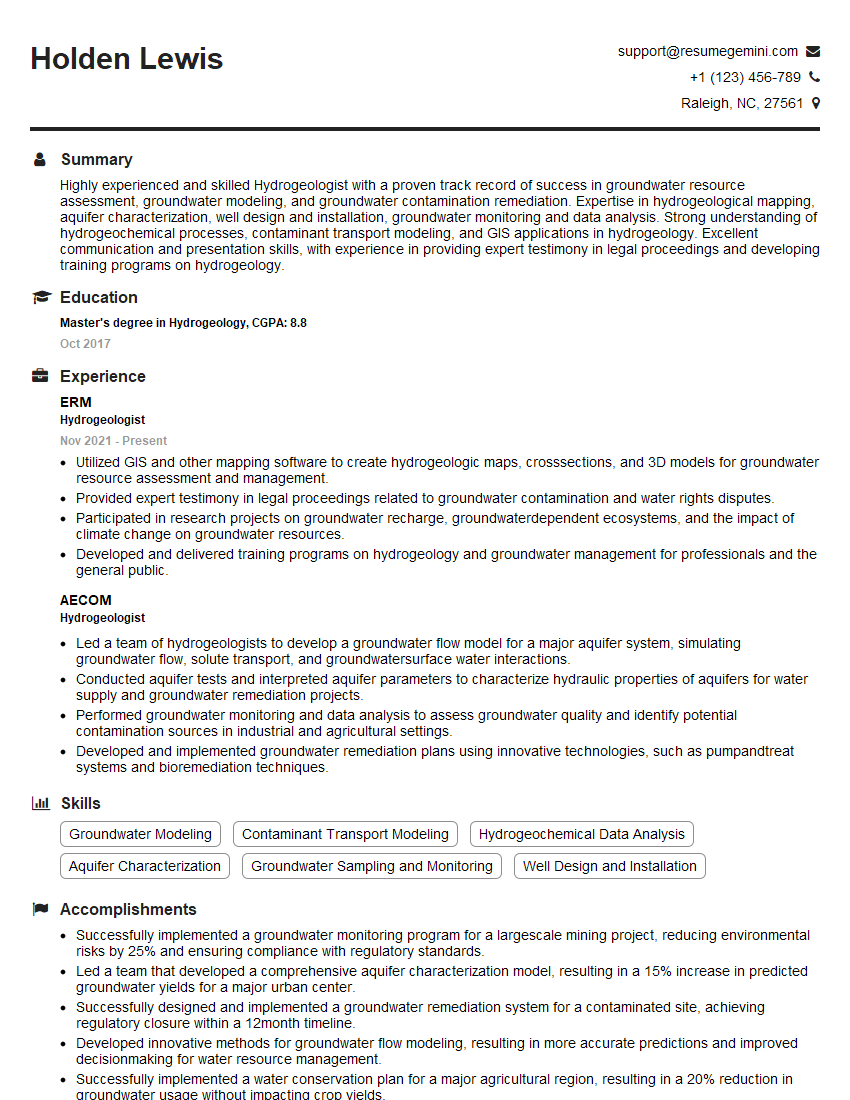
Mastering hydrogeologic investigations is crucial for career advancement in this dynamic field. A strong understanding of these principles opens doors to diverse and impactful roles. To maximize your job prospects, creating a compelling and ATS-friendly resume is essential. ResumeGemini can significantly enhance your resume-building experience, helping you present your skills and experience effectively. ResumeGemini provides examples of resumes tailored specifically to Hydrogeologic Investigations, helping you craft a document that highlights your expertise and catches the eye of potential employers.

Explore more articles
Users Rating of Our Blogs
Share Your Experience
We value your feedback! Please rate our content and share your thoughts (optional).
What Readers Say About Our Blog
To the interviewgemini.com Webmaster.
Very helpful and content specific questions to help prepare me for my interview!
Thank you
To the interviewgemini.com Webmaster.
This was kind of a unique content I found around the specialized skills. Very helpful questions and good detailed answers.
Very Helpful blog, thank you Interviewgemini team.