Unlock your full potential by mastering the most common Industrial Statistics interview questions. This blog offers a deep dive into the critical topics, ensuring you’re not only prepared to answer but to excel. With these insights, you’ll approach your interview with clarity and confidence.
Questions Asked in Industrial Statistics Interview
Q 1. Explain the concept of Statistical Process Control (SPC).
Statistical Process Control (SPC) is a collection of statistical techniques used to monitor and control a process to ensure it operates within predefined limits and produces consistent, high-quality outputs. Think of it as a proactive quality management system, preventing defects rather than just detecting them after they occur. It involves collecting data, analyzing it, and taking corrective actions when necessary to keep the process stable and predictable.
Imagine a factory producing car parts. SPC helps ensure the dimensions of these parts remain consistent, preventing issues like engine malfunctions down the line. Without SPC, variations in the manufacturing process could lead to a high proportion of defective parts, resulting in costly rework, recalls, and damage to the company’s reputation.
Q 2. Describe different types of control charts and their applications.
Several types of control charts exist, each designed for specific data types and purposes:
- X-bar and R charts: Used for monitoring the average (X-bar) and range (R) of variables data (continuous data like measurements). They are excellent for monitoring the central tendency and variability of a process. For example, monitoring the average weight of a product and the range of weights within a sample.
- X-bar and s charts: Similar to X-bar and R charts, but use the standard deviation (s) instead of the range. Standard deviation provides more statistical information and is preferred when sample sizes are larger (n>10).
- p-charts: Used for monitoring the proportion of nonconforming units in a sample (attribute data). Imagine tracking the percentage of defective items in a batch of manufactured goods.
- np-charts: Similar to p-charts, but tracks the actual number of nonconforming units rather than the proportion. Useful when the sample size is constant.
- c-charts: Used for monitoring the number of defects per unit (attribute data). For example, counting the number of scratches on a painted car.
- u-charts: Used for monitoring the number of defects per unit when the sample size varies. For instance, tracking the number of flaws in fabric rolls of varying lengths.
Q 3. How do you interpret control charts to identify process shifts?
Interpreting control charts involves looking for patterns that indicate process shifts. A stable process will show points randomly distributed within the control limits. However, certain patterns signal problems:
- Points outside the control limits: This strongly suggests a special cause variation (a significant shift or problem).
- Trends: A consistent upward or downward trend indicates a gradual shift in the process average.
- Stratification: Data points clustering in distinct areas suggests hidden factors influencing the process.
- Cycles or patterns: Recurring patterns suggest periodic issues.
When you observe such patterns, you need to investigate the assignable cause (the root cause of the variation) and take corrective action. This might involve adjusting machinery, retraining personnel, or changing raw materials.
Q 4. Explain the difference between common and assignable causes of variation.
Common causes of variation are inherent in the process and are considered random, unavoidable variations. They are the small, normal fluctuations that occur due to many small, unpredictable factors. Think of it as the natural background noise in a system. Reducing common cause variation requires fundamental process improvements.
Assignable causes are specific, identifiable factors that cause significant deviations from the norm. These are not inherent to the process; they are unusual events or factors that need to be identified and corrected. Examples include a malfunctioning machine, a change in raw materials, or human error. Addressing assignable causes involves fixing the specific problem causing the deviation.
Q 5. What is the purpose of capability analysis?
Capability analysis assesses whether a process is capable of consistently producing outputs that meet customer specifications. In simpler terms, it answers the question: ‘Can this process reliably meet the requirements?’ It compares the process’s natural variability to the tolerance limits specified by the customer or product design. This helps determine if improvements are needed to ensure consistent product quality.
Imagine a manufacturer producing bolts with a specified diameter. Capability analysis determines if the process consistently produces bolts within the acceptable diameter range, minimizing defects and scrap.
Q 6. How do you calculate process capability indices (Cp, Cpk)?
Process capability indices, Cp and Cpk, quantify the process capability. They relate the process’s variability to the specification limits (USL – Upper Specification Limit, LSL – Lower Specification Limit).
- Cp = (USL – LSL) / (6σ): This index measures the potential capability of the process, assuming the process is centered on the target value. It represents the ratio of the specification width to the process spread (6σ represents the process spread for a normally distributed data, where σ is the standard deviation).
- Cpk = min[(USL – μ) / (3σ), (μ – LSL) / (3σ)]: This index considers both the process variability and its centering. μ is the process mean. Cpk is a more realistic measure of process capability because it accounts for the process’s potential offset from the target.
A Cp or Cpk value greater than 1 indicates the process is capable of meeting the specifications, while a value less than 1 signals the need for improvements.
Q 7. Explain the principles of Design of Experiments (DOE).
Design of Experiments (DOE) is a powerful statistical methodology used to efficiently design experiments, analyze data, and draw conclusions. Instead of changing factors one at a time, DOE systematically varies multiple factors simultaneously to understand their individual and combined effects on a response variable. This allows for a more comprehensive and efficient understanding of the process.
Imagine trying to optimize the yield of a chemical reaction. Instead of changing temperature, pressure, and concentration one by one, DOE allows you to test different combinations simultaneously. This approach significantly reduces the number of experiments needed to find the optimal combination of factors for maximizing the yield.
DOE utilizes various experimental designs, such as factorial designs, fractional factorial designs, and response surface methodologies, depending on the complexity of the problem and the number of factors involved.
Q 8. What are the different types of DOE designs?
Design of Experiments (DOE) is a powerful statistical tool used to efficiently investigate the effects of multiple factors on a response variable. There are numerous DOE designs, each chosen based on the experimental goals and constraints. Some of the most common types include:
- Factorial Designs: These designs systematically investigate all possible combinations of factor levels. Full factorial designs examine every combination, while fractional factorial designs efficiently explore a subset, especially useful with many factors. They are excellent for identifying main effects and interactions between factors.
- Response Surface Methodology (RSM): Used to optimize a process by exploring the relationship between multiple continuous input variables (factors) and a continuous response. Techniques like central composite designs are commonly employed.
- Taguchi Methods: Focuses on robust design, aiming to minimize the impact of uncontrollable factors on the response. Orthogonal arrays are used to efficiently select experimental runs.
- Screening Designs: Used to quickly identify the most significant factors influencing a response from a large number of potential factors. They’re often used in early stages of experimentation to narrow down the field.
- Plackett-Burman Designs: A specific type of screening design efficient for identifying main effects with a minimal number of runs.
The choice of design depends on the number of factors, the nature of the factors (continuous or discrete), the resources available, and the desired level of detail in the analysis.
Q 9. Describe how you would design an experiment to optimize a manufacturing process.
Optimizing a manufacturing process using DOE involves a structured approach:
- Define the objective: Clearly state what needs to be optimized (e.g., reduce defect rate, increase yield, improve throughput).
- Identify key factors: Determine the process parameters that might affect the objective (e.g., temperature, pressure, feed rate).
- Choose a suitable DOE design: Select an appropriate design based on the number of factors and the nature of the factors (e.g., full factorial, fractional factorial, RSM). Consider the number of runs and available resources. For example, if we have three factors each at two levels, a 2³ full factorial design would be appropriate.
- Conduct the experiment: Run the experiment according to the chosen design, carefully controlling and measuring all variables. It’s crucial to maintain consistent operating conditions except for the factors under investigation.
- Analyze the data: Use statistical software (like Minitab or JMP) to analyze the results. This involves assessing the significance of each factor and their interactions, potentially fitting models to predict the response variable.
- Optimize: Based on the analysis, determine the optimal settings of the factors that lead to the desired improvement in the objective. This might involve techniques like response surface plots or numerical optimization.
- Verification: Conduct confirmatory runs at the identified optimal settings to validate the findings and ensure the improvements are reproducible.
For example, in optimizing the yield of a chemical reaction, factors like temperature, pressure, and reactant concentration could be investigated using a central composite design (RSM). The analysis will determine the optimal combination of these parameters maximizing yield.
Q 10. Explain the concept of hypothesis testing in the context of industrial applications.
Hypothesis testing, in an industrial context, is a formal procedure used to make decisions about a population based on sample data. It allows us to assess whether observed differences are statistically significant or due to random chance. Imagine you’re comparing the strength of two different materials. Your hypothesis would be that there’s a difference in their strength (alternative hypothesis) against the assumption there’s no difference (null hypothesis). You gather data on the strength from samples of each material. The test determines if the observed difference is large enough to reject the null hypothesis with a specified level of confidence.
Steps generally involve:
- State the hypotheses: Formulate the null and alternative hypotheses.
- Choose a significance level (α): This is the probability of rejecting the null hypothesis when it is actually true (Type I error). A common value is 0.05.
- Select a test statistic: This depends on the type of data and the hypotheses (e.g., t-test, z-test, ANOVA).
- Calculate the p-value: The probability of observing the data (or more extreme data) if the null hypothesis is true.
- Make a decision: If the p-value is less than α, reject the null hypothesis; otherwise, fail to reject the null hypothesis.
In industrial applications, hypothesis testing helps determine if a new process is truly better than the old one, if two machines produce parts with similar quality, or if a specific factor significantly impacts product performance.
Q 11. What are Type I and Type II errors? How can they be minimized?
Type I and Type II errors are potential mistakes in hypothesis testing:
- Type I Error (False Positive): Rejecting the null hypothesis when it is actually true. In our material strength example, this would mean concluding the materials have different strengths when they actually don’t. The probability of making a Type I error is the significance level (α).
- Type II Error (False Negative): Failing to reject the null hypothesis when it is actually false. In our example, this would mean concluding the materials have the same strength when they actually have different strengths. The probability of making a Type II error is denoted by β.
Minimizing these errors involves:
- Increasing sample size: Larger samples provide more reliable estimates and reduce both Type I and Type II errors.
- Choosing an appropriate significance level (α): A lower α reduces the chance of a Type I error but increases the chance of a Type II error. The choice depends on the context – a stricter α might be chosen when the consequences of a false positive are severe.
- Increasing the power of the test (1-β): Power represents the probability of correctly rejecting the null hypothesis when it is false. Power can be increased by increasing the sample size or by using a more sensitive test.
The balance between Type I and Type II error rates is crucial. Often, it’s a trade-off; reducing one may increase the other.
Q 12. Explain different statistical distributions (normal, exponential, binomial) and their applications in industrial settings.
Several statistical distributions are commonly used in industrial settings:
- Normal Distribution: A bell-shaped, symmetric distribution. It’s used extensively in quality control, modeling continuous variables like dimensions, weights, or temperatures. The central limit theorem ensures that many sample means will approximate a normal distribution even if the underlying population isn’t normally distributed.
- Exponential Distribution: Models the time until an event occurs in a Poisson process (events occur randomly and independently at a constant average rate). Applications include modeling time to failure of equipment, downtime in a production line, or the time between defects in a manufactured product.
- Binomial Distribution: Models the probability of getting a certain number of successes in a fixed number of independent Bernoulli trials (each trial has two outcomes: success or failure). Example applications include determining the proportion of defective items in a batch, the number of customers who make a purchase, or the number of successful welds in a sample.
Understanding the characteristics and assumptions of these distributions is essential for correctly applying statistical methods in industrial settings. For instance, control charts frequently rely on the assumption of normally distributed data.
Q 13. How do you perform regression analysis and interpret the results?
Regression analysis is a statistical technique used to model the relationship between a dependent variable and one or more independent variables. In industrial settings, this might involve modeling the relationship between process parameters (independent variables) and product quality (dependent variable).
Steps involved:
- Data collection: Gather data on the dependent and independent variables.
- Model selection: Choose an appropriate regression model (e.g., linear, polynomial). Linear regression assumes a linear relationship, while polynomial regression allows for curved relationships.
- Model fitting: Use statistical software to estimate the model parameters (coefficients) that best fit the data. Methods like least squares are employed.
- Model diagnostics: Assess the goodness of fit of the model using metrics such as R-squared (measures the proportion of variance explained by the model), residual plots (check for model assumptions), and statistical significance tests.
- Interpretation: Interpret the estimated coefficients. They represent the change in the dependent variable for a unit change in the corresponding independent variable, holding other variables constant.
For example, a linear regression might model the relationship between the cutting speed (independent variable) and the surface roughness (dependent variable) of a machined part. The coefficient of the cutting speed would indicate how much surface roughness changes for each unit increase in cutting speed.
Example R code (Linear Regression): model <- lm(surface_roughness ~ cutting_speed, data = mydata) summary(model)Q 14. What is ANOVA and when is it used?
Analysis of Variance (ANOVA) is a statistical test used to compare the means of two or more groups. It's particularly useful when evaluating the effect of multiple factors on a response variable, especially when there are interactions between factors.
ANOVA partitions the total variability in the data into different sources of variation, allowing us to determine if the differences between group means are statistically significant. The F-statistic compares the variance between groups to the variance within groups. A large F-statistic suggests significant differences between group means.
ANOVA is used in numerous industrial applications, such as:
- Comparing the performance of different machines: Determining if there are significant differences in the output quality from multiple machines.
- Evaluating the effect of different treatments: Assessing whether different treatments (e.g., different heat treatments) have a significant impact on the properties of a material.
- Analyzing experimental results: Determining the significance of factors and their interactions in a DOE.
When the assumptions of ANOVA (normality and homogeneity of variances) are not met, transformations or non-parametric alternatives (e.g., Kruskal-Wallis test) may be considered.
Q 15. Explain time series analysis and its relevance to industrial processes.
Time series analysis is a statistical technique used to analyze data points collected over time. It's crucial in industrial processes because many variables, like production output, machine efficiency, or energy consumption, are naturally measured sequentially. By understanding the patterns and trends in this time-ordered data, we can make better predictions, detect anomalies, and improve process control.
For example, consider a manufacturing plant tracking the daily output of a specific product. A time series analysis could reveal seasonal trends (higher output during peak demand periods), cyclical patterns (due to machine maintenance cycles), and any abrupt changes (indicating potential equipment malfunctions). This information is invaluable for optimizing production schedules, anticipating supply chain needs, and proactively addressing potential issues.
Common methods in time series analysis include:
- Decomposition: Separating the time series into its components (trend, seasonality, and residuals).
- ARIMA modeling: Autoregressive Integrated Moving Average models for forecasting.
- Exponential smoothing: Forecasting techniques that give more weight to recent observations.
The choice of method depends on the characteristics of the data and the specific objectives of the analysis.
Career Expert Tips:
- Ace those interviews! Prepare effectively by reviewing the Top 50 Most Common Interview Questions on ResumeGemini.
- Navigate your job search with confidence! Explore a wide range of Career Tips on ResumeGemini. Learn about common challenges and recommendations to overcome them.
- Craft the perfect resume! Master the Art of Resume Writing with ResumeGemini's guide. Showcase your unique qualifications and achievements effectively.
- Don't miss out on holiday savings! Build your dream resume with ResumeGemini's ATS optimized templates.
Q 16. How do you handle missing data in a dataset?
Handling missing data is critical for the reliability of statistical analyses. Ignoring missing data can lead to biased results. Several methods exist, and the best approach depends on the nature and extent of the missingness.
- Deletion: The simplest approach is to remove rows or columns with missing values. This is suitable only if the amount of missing data is small and the data is missing completely at random (MCAR). Otherwise, it can lead to a significant loss of information and bias.
- Imputation: This involves replacing missing values with estimated values. Common techniques include:
- Mean/Median/Mode Imputation: Replacing missing values with the mean, median, or mode of the observed values. Simple but can distort the variance and relationships between variables.
- Regression Imputation: Predicting missing values using a regression model based on other variables.
- K-Nearest Neighbors Imputation: Replacing missing values with the average of the values from the 'k' nearest neighbors in the data based on a distance metric.
- Multiple Imputation: Creates multiple plausible imputed datasets and then combines the results. This accounts for the uncertainty introduced by imputation.
The choice of imputation method requires careful consideration. For example, in a manufacturing context, if we have missing values for temperature readings, regression imputation using other process parameters might be suitable. However, if the data is not MCAR, multiple imputation should be preferred for its robustness.
Q 17. Describe various methods for outlier detection.
Outlier detection is crucial in industrial settings to identify unusual observations that may indicate errors in data collection, equipment malfunctions, or significant process changes. Several methods can be employed:
- Boxplots: Visually identify outliers as points lying outside the whiskers (typically 1.5 times the interquartile range from the quartiles).
- Z-scores: Calculate the number of standard deviations each data point is from the mean. Points with absolute Z-scores above a threshold (e.g., 3) are often considered outliers.
- Scatter plots: Visually identify outliers as points deviating significantly from the overall pattern.
- DBSCAN (Density-Based Spatial Clustering of Applications with Noise): A clustering algorithm that groups data points based on density. Points not belonging to any cluster are considered outliers.
- Isolation Forest: An anomaly detection algorithm that isolates outliers by randomly partitioning the data. Outliers are isolated quickly because they are easier to separate.
It's important to note that simply identifying outliers doesn't mean they should be automatically removed. Investigate the cause of the outlier. Was there a measurement error? Did an unusual event occur? The decision to remove or retain an outlier should be based on a thorough investigation and understanding of the context.
Q 18. What are the key differences between descriptive, inferential, and predictive statistics?
The three branches of statistics—descriptive, inferential, and predictive—serve distinct purposes:
- Descriptive Statistics: Summarizes and describes the main features of a dataset. Think of it as telling a story about the data. This includes measures like mean, median, mode, standard deviation, and visualizations like histograms and scatter plots. In a manufacturing context, descriptive statistics might summarize the average defect rate of a production line over a month.
- Inferential Statistics: Makes inferences and draws conclusions about a population based on a sample of data. It uses probability theory to quantify uncertainty and test hypotheses. For example, an A/B test in a website design might use inferential statistics to determine if one design leads to significantly higher conversion rates than another.
- Predictive Statistics: Uses statistical models to predict future outcomes based on historical data. This is often used for forecasting and decision-making under uncertainty. In an industrial context, predictive modeling could predict future equipment failures based on sensor data and maintenance logs.
The three types of statistics are often interconnected. Descriptive statistics provides insights that inform the design of inferential and predictive analyses. Inferential statistics helps to validate the assumptions and conclusions of predictive models.
Q 19. Explain your experience with statistical software packages (e.g., Minitab, JMP, R, SAS).
I have extensive experience with several statistical software packages, including R, Minitab, and JMP. R is my preferred tool for its flexibility, extensive libraries, and open-source nature. I've used it extensively for time series analysis (using packages like forecast and tseries), statistical modeling (glm, lme4), and data visualization (ggplot2). Minitab and JMP have also been valuable for their user-friendly interfaces and capabilities for Design of Experiments (DOE) and process capability analysis. I've utilized Minitab in quality control projects, and JMP for more exploratory data analysis. My choice of software depends on the specific task and the needs of the project.
Q 20. How do you ensure data integrity and quality?
Data integrity and quality are paramount. I follow a multi-step approach to ensure data reliability:
- Data Validation: Implementing checks at the data entry stage, such as range checks, consistency checks, and plausibility checks, to prevent errors from entering the dataset.
- Data Cleaning: Handling missing values, outliers, and inconsistencies in the dataset using appropriate techniques as discussed previously.
- Data Transformation: Applying transformations to improve data normality, reduce skewness, and improve model performance.
- Documentation: Maintaining meticulous documentation of the data sources, cleaning procedures, and any transformations performed.
- Version Control: Using version control systems (like Git) to track changes and allow for easy rollback to previous versions if needed.
For instance, in a process monitoring scenario, we might implement checks to ensure that sensor readings are within physically plausible ranges. Regular audits of data quality procedures are also essential.
Q 21. Describe a situation where you had to troubleshoot a statistical problem.
In a previous project involving the analysis of semiconductor manufacturing data, I encountered a significant issue with the unexpectedly high variability in the thickness of a crucial layer. Initial analysis using standard control charts indicated the process was out of control, suggesting a systemic problem. However, further investigation, involving a deeper dive into the data and discussions with engineers, revealed a previously undocumented maintenance procedure change that was implemented midway through the data collection period. This change was the true underlying source of the increased variability, not a process fault. By carefully reviewing the data collection log and interacting with the process engineers, I identified this root cause. This highlights the importance of considering the contextual factors and not relying solely on statistical measures when troubleshooting process issues. Subsequently, we incorporated this information into a revised statistical model providing more accurate predictions and control.
Q 22. How would you present statistical findings to a non-technical audience?
Presenting statistical findings to a non-technical audience requires translating complex data into clear, concise, and relatable information. Instead of using jargon like 'p-value' or 'confidence interval,' I focus on using visual aids like charts and graphs to show the main points. For instance, instead of saying 'The A/B test showed a statistically significant difference with a p-value of 0.03,' I'd say something like, 'We tested two approaches, and the results clearly show that option A performed significantly better than option B, leading to a [quantifiable benefit, e.g., 15%] improvement.' I use analogies and real-world comparisons to illustrate the impact of the findings, making them easily understandable and memorable.
For example, if I'm presenting data on defect rates, I might compare the reduction to the percentage of defective products in a grocery store – something the audience can readily grasp. I also focus on the 'so what?' – emphasizing the practical implications and business value of the findings, rather than dwelling on the statistical methods themselves. The goal is to empower the audience to understand the key insights and make informed decisions based on the data.
Q 23. How do you apply statistical methods to improve efficiency and reduce waste in manufacturing?
Statistical methods are crucial for improving efficiency and reducing waste in manufacturing. Control charts are fundamental for monitoring process stability and identifying sources of variation. For instance, a Shewhart chart can detect shifts in the mean or standard deviation of a critical quality characteristic, allowing for timely intervention to prevent defects. Similarly, process capability analysis (using Cp and Cpk indices) helps assess whether a process is capable of meeting specifications, identifying areas needing improvement.
Design of Experiments (DOE) is another powerful technique. It allows us to systematically investigate the influence of different factors on the output variable. By intelligently varying factors like temperature, pressure, or raw material composition, we can identify optimal settings that minimize waste and maximize efficiency. Regression analysis can model the relationship between various factors and the output, allowing us to predict outcomes and optimize the process based on these predictions. For example, we can build a regression model to predict the yield of a chemical process based on temperature and pressure, enabling us to identify the optimal operating conditions.
Finally, statistical process control (SPC) helps maintain consistent quality and prevent defects by continually monitoring the manufacturing process. This proactive approach helps reduce scrap, rework, and other forms of waste.
Q 24. Explain your understanding of Lean Six Sigma methodologies.
Lean Six Sigma is a data-driven methodology aimed at improving business processes by reducing variation and defects. Lean focuses on eliminating waste ('muda') in all forms – overproduction, waiting, transportation, unnecessary inventory, motion, over-processing, and defects. Six Sigma focuses on reducing process variation to achieve near-zero defects (3.4 defects per million opportunities).
The two methodologies complement each other. Lean provides the framework for identifying and eliminating waste, while Six Sigma provides the statistical tools to measure, analyze, and improve process performance. The DMAIC (Define, Measure, Analyze, Improve, Control) cycle is a core structure within Six Sigma, providing a systematic approach to problem-solving. Each phase involves various statistical techniques. For example, during the 'Measure' phase, we might use Gage R&R studies to assess measurement system variability, while in the 'Analyze' phase we might use hypothesis testing or regression analysis to understand root causes.
Q 25. What are your strengths and weaknesses in applying statistical methods?
My strengths lie in my ability to apply a wide range of statistical methods to solve real-world problems in manufacturing settings. I'm proficient in using statistical software packages like Minitab and JMP, and I possess a strong understanding of experimental design and data analysis techniques. I am comfortable communicating complex statistical concepts to both technical and non-technical audiences. I'm also adept at collaborating with cross-functional teams to identify and solve problems.
However, my weakness lies in keeping up with the rapid advancements in certain areas of statistical modeling, such as advanced machine learning algorithms. While I am familiar with the fundamentals, dedicated time needs to be set aside for deeper learning in these areas. I actively address this by participating in relevant training courses and continuously reading industry publications to stay current on best practices and new techniques.
Q 26. Describe a situation where you used statistical analysis to make a business decision.
In a previous role, we were experiencing high variability in the yield of a critical manufacturing process. We used a fractional factorial design (a type of DOE) to investigate the impact of five factors (temperature, pressure, reactant concentration, etc.) on the yield. We used statistical software to analyze the results and determined that two factors – temperature and reactant concentration – had the most significant effects on the yield. By optimizing these two factors, we were able to increase the average yield by 12% and significantly reduce the variability, resulting in substantial cost savings and improved product quality. The entire project improved customer satisfaction and overall production throughput. This clearly demonstrates the practical value of statistical analysis in decision-making.
Q 27. How do you stay updated on advancements in industrial statistics?
To stay updated on advancements in industrial statistics, I employ several strategies. I regularly read peer-reviewed journals like Technometrics and Journal of Quality Technology. I also actively participate in professional organizations such as the American Statistical Association (ASA) and the American Society for Quality (ASQ), attending conferences and workshops to learn about the latest techniques and applications. I leverage online resources, such as webinars and online courses offered by reputable institutions, to stay abreast of new developments in statistical modeling and data analysis. Furthermore, I actively engage with online communities and forums dedicated to industrial statistics to exchange knowledge and learn from the experiences of other professionals in the field.
Key Topics to Learn for Industrial Statistics Interview
- Descriptive Statistics: Understanding and summarizing data using measures of central tendency, dispersion, and visualization techniques. Practical application: Analyzing manufacturing process data to identify trends and potential defects.
- Inferential Statistics: Drawing conclusions about populations based on sample data using hypothesis testing and confidence intervals. Practical application: Determining if a new production method significantly improves product quality.
- Regression Analysis: Modeling relationships between variables to make predictions and understand causal effects. Practical application: Predicting customer demand based on historical sales data and marketing campaigns.
- Design of Experiments (DOE): Planning and conducting experiments to efficiently collect data and draw valid conclusions. Practical application: Optimizing a chemical process by systematically varying input parameters.
- Quality Control and Process Capability Analysis: Monitoring and improving manufacturing processes to meet quality standards. Practical application: Implementing control charts to detect and address variations in product dimensions.
- Time Series Analysis: Analyzing data collected over time to identify trends, seasonality, and forecast future values. Practical application: Forecasting energy consumption based on historical data and weather patterns.
- Statistical Software Proficiency (e.g., R, Python, Minitab): Demonstrating practical skills in data manipulation, analysis, and visualization using statistical software. Practical Application: Effectively communicating statistical findings through clear and concise data visualizations and reports.
Next Steps
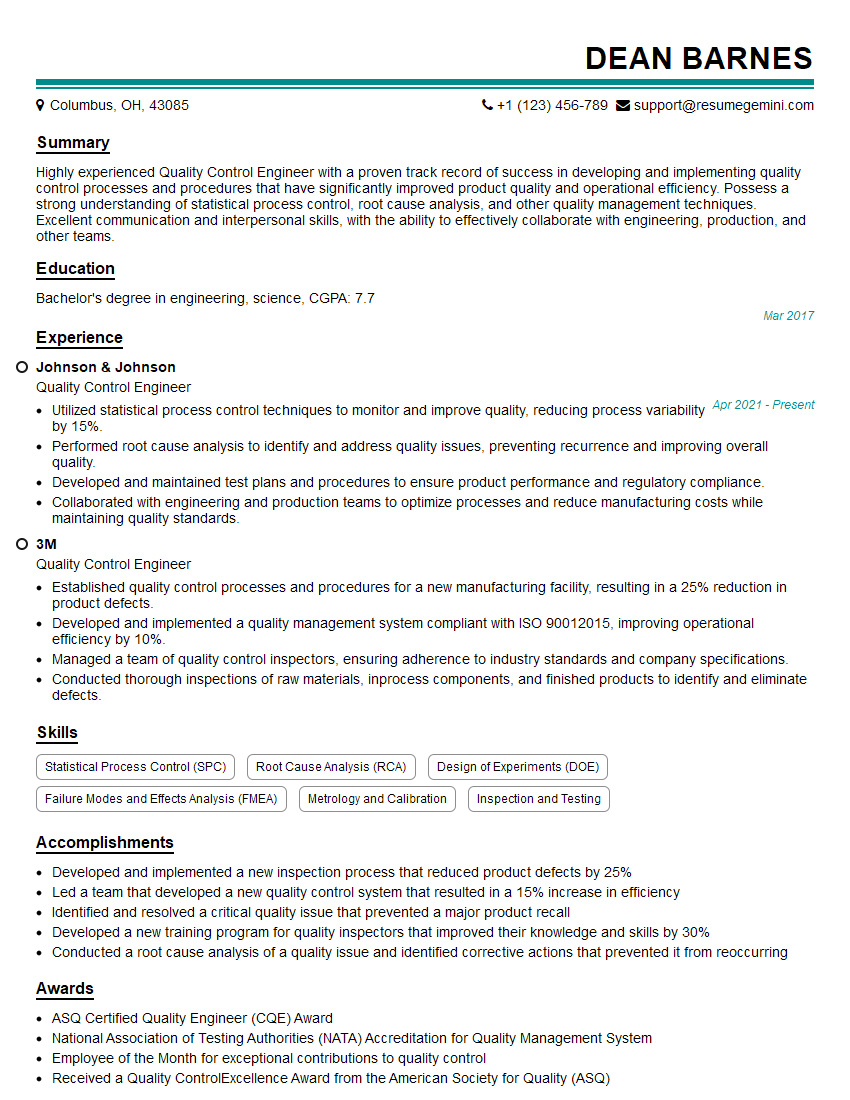
Mastering Industrial Statistics is crucial for a successful career in various sectors, opening doors to exciting opportunities in quality control, data analysis, and process improvement. A strong resume is your first impression; make it count! Create an ATS-friendly resume that showcases your skills and experience effectively. ResumeGemini is a trusted resource to help you build a professional and impactful resume, ensuring your qualifications shine. Examples of resumes tailored to Industrial Statistics professionals are available to help you get started.




Explore more articles
Users Rating of Our Blogs
Share Your Experience
We value your feedback! Please rate our content and share your thoughts (optional).
What Readers Say About Our Blog
To the interviewgemini.com Webmaster.
Very helpful and content specific questions to help prepare me for my interview!
Thank you
To the interviewgemini.com Webmaster.
This was kind of a unique content I found around the specialized skills. Very helpful questions and good detailed answers.
Very Helpful blog, thank you Interviewgemini team.