Feeling uncertain about what to expect in your upcoming interview? We’ve got you covered! This blog highlights the most important Installation of Satellite Antennas interview questions and provides actionable advice to help you stand out as the ideal candidate. Let’s pave the way for your success.
Questions Asked in Installation of Satellite Antennas Interview
Q 1. Describe the different types of satellite dishes and their applications.
Satellite dishes come in various sizes and designs, each suited for different applications. The most common types are:
- Offset Feed Dishes: These are the most prevalent type, featuring a dish offset from the center. This design allows for a more compact design and better low-noise block (LNB) protection from the elements. They’re used for most residential satellite TV installations.
- Prime Focus Dishes: These have the LNB positioned at the focal point directly in the center of the dish. They’re generally larger than offset dishes for the same gain, and are less common in residential settings. They might be found in specialized applications or older installations.
- Grid Dishes: Made of perforated metal, they are lighter and more wind-resistant than solid dishes. While less efficient, they are sometimes preferred in windy locations.
- Cassegrain Dishes: These use a subreflector to focus the signal onto the LNB, resulting in a more compact design for high-gain applications. They are less common in residential applications but often found in professional or large-scale satellite systems.
The choice of dish depends on factors such as signal strength needed, location (wind conditions), available space, and budget. For instance, a larger dish is necessary for receiving weaker signals from a geostationary satellite, while a smaller, offset dish might suffice for strong signals.
Q 2. Explain the process of aligning a satellite dish.
Aligning a satellite dish involves precisely pointing it at the target satellite. This usually requires adjusting the dish’s azimuth (horizontal angle), elevation (vertical angle), and sometimes skew (rotation about the feedhorn axis). Here’s a step-by-step process:
- Find Satellite Coordinates: Determine the precise azimuth and elevation angles for your location and the desired satellite. Many online satellite calculators are available for this purpose. You’ll input your coordinates (latitude and longitude).
- Initial Positioning: Manually adjust the dish’s azimuth and elevation to the calculated values. This is an approximate setting.
- Use a Satellite Meter: A satellite finder (meter) is crucial. It measures the signal strength from the satellite. Connect it to the LNB.
- Fine Tuning: Make small adjustments to the azimuth and elevation, constantly monitoring the signal strength on the satellite meter. The goal is to achieve the maximum signal strength.
- Skew Adjustment (if necessary): Some satellites require skew adjustment to optimize the signal. This is usually a smaller adjustment after achieving a strong signal with azimuth and elevation.
- Tighten the Mounts: Once you’ve achieved maximum signal, secure all adjustments to prevent movement.
Think of it like aiming a telescope. You need precise adjustments to focus on a distant object. With a satellite dish, your ‘object’ is a satellite hundreds of miles above the earth.
Q 3. What tools and equipment are essential for satellite antenna installation?
Essential tools and equipment for satellite antenna installation include:
- Satellite Dish: The antenna itself, sized appropriately for the desired signal strength.
- LNB (Low-Noise Block): Receives and amplifies the satellite signal.
- Satellite Meter: Essential for finding and optimizing the signal.
- Mounting Hardware: This includes brackets, bolts, and other fasteners needed to mount the dish securely.
- Cable and Connectors: Coaxial cable to connect the LNB to the receiver, along with F-type connectors for a secure connection.
- Ladder or Scaffolding: For safe access to the mounting location.
- Level: To ensure the dish is mounted horizontally.
- Wrench/Screwdrivers: For tightening bolts and connectors.
- Drill (sometimes): May be needed for mounting into certain surfaces.
- Cable Ties: To neatly secure cables.
Having all the necessary equipment beforehand saves time and ensures a smooth installation. Improper tools can lead to delays and possibly damage.
Q 4. How do you troubleshoot signal strength issues?
Troubleshooting weak signals involves a systematic approach. Start with the basics:
- Check Cable Connections: Ensure all connections are tight and free from damage. A loose connection can significantly reduce signal strength.
- Inspect the LNB: Make sure the LNB is securely attached to the dish and free from any obstructions.
- Verify Satellite Alignment: Even a slight misalignment can severely impact the signal. Use the satellite meter to recheck azimuth, elevation, and skew.
- Check for Obstructions: Trees, buildings, or even weather can block the signal path. Remove any obstacles if possible.
- Test with another Receiver: Use a known-good receiver to rule out receiver problems.
- Check the LNB’s Power Supply: Ensure the LNB is receiving the correct voltage from the receiver.
- Inspect the Cable for Damage: Look for kinks, cuts, or water damage along the cable’s length. Replace damaged cables.
If the problem persists, it might involve more complex issues like interference or faulty equipment, requiring further investigation. The step-by-step approach helps isolate the source of the issue.
Q 5. What safety precautions do you take during installation?
Safety is paramount during satellite dish installation. Always:
- Use appropriate safety equipment: Wear safety glasses, gloves, and sturdy footwear. If working at height, use a harness and follow fall protection procedures.
- Work with a partner: Having a second person helps with stability, especially when working on ladders or roofs.
- Be mindful of power lines: Never work near power lines. Maintain a safe distance and call your local power company if necessary.
- Secure the work area: Clear the area around the mounting location of any obstacles to prevent trips and falls.
- Be aware of weather conditions: Avoid working in strong winds, rain, or lightning storms.
- Follow local regulations: Check for any building permits or regulations that may apply to the installation.
A minor injury can easily derail a project. Following these safety guidelines ensures a safe and efficient installation process.
Q 6. Explain the concept of azimuth, elevation, and skew in satellite alignment.
Azimuth, elevation, and skew are crucial parameters for accurate satellite dish alignment. Imagine a globe:
- Azimuth: This is the horizontal angle, measured in degrees east or west of north. It’s the compass direction you need to point the dish.
- Elevation: This is the vertical angle, measured in degrees above the horizon. It indicates how high the satellite is in the sky.
- Skew: This is the rotation of the LNB about its axis. It’s required because satellites aren’t always perfectly aligned with the earth’s equator. It’s necessary to compensate for the satellite’s orbital position.
Incorrect settings for any of these will result in a weak or nonexistent signal. Precise measurements and adjustments are critical for optimal reception. Think of it like targeting a specific point on a globe – you need the right latitude (elevation), longitude (azimuth), and potentially a slight rotational adjustment (skew) to hit your target.
Q 7. How do you identify and resolve signal interference?
Signal interference can come from various sources, impacting satellite reception. Identifying and resolving it requires a methodical approach:
- Check for Obstructions: Trees, buildings, or even other antennas can interfere with the signal.
- Look for Multipath Interference: Signals reflecting off surfaces can cause interference. Identify and try to minimize these reflections.
- Check for Electrical Interference: Electrical devices, power lines, or faulty wiring can introduce noise into the signal.
- Identify Co-channel Interference: Interference from other satellites operating on the same frequency band.
- Use a Spectrum Analyzer (advanced): This tool can pinpoint the frequency of the interference, aiding in identification and remediation.
- Use a High-Quality Cable: Poor quality cables can introduce noise into the system.
- Shielding: Consider using shielded cables and connectors to minimize interference.
Addressing interference can involve repositioning the dish, using a different frequency, or applying shielding. A systematic approach is essential for resolving the issue effectively.
Q 8. What are the common causes of poor satellite reception?
Poor satellite reception can stem from several sources, often interconnected. Think of it like trying to hear a whisper across a noisy room – the signal needs a clear path and amplification to reach you. The most common culprits are:
- Obstructions: Trees, buildings, or even hills can block the satellite signal. Imagine a straight line from your dish to the satellite; anything in that line will cause problems. I’ve had cases where a seemingly insignificant branch caused significant signal loss.
- Incorrect Dish Alignment: This is crucial! Even a slight misalignment can drastically reduce signal strength. It’s like aiming a flashlight – a small shift changes the entire focus. Accurate alignment requires precision tools and a clear understanding of satellite coordinates.
- Weather Conditions: Heavy rain, snow, or fog can weaken or completely block the signal. This is especially true for higher frequencies like Ku-band. It’s like trying to see through a thick fog – the visibility is drastically reduced.
- Faulty LNB: The LNB (Low-Noise Block) is the heart of the receiving system, converting the satellite signal into a usable format. A damaged or malfunctioning LNB can greatly diminish the signal, requiring replacement.
- Cable Issues: Damaged, poorly connected, or improperly shielded coaxial cables can lead to significant signal loss or interference. Think of it as a leaky hose – the water (signal) is lost before it reaches its destination.
- Receiver Problems: Finally, the receiver itself might be malfunctioning. A simple software update or even a power reset could fix the problem. This is a less common cause but is often overlooked.
Troubleshooting usually involves systematically eliminating these possibilities, starting with the simplest solutions (checking cables) and moving towards more complex ones (dish alignment, LNB replacement).
Q 9. Describe your experience with different types of LNBs (Low-Noise Blocks).
My experience encompasses a wide range of LNBs, from single-output to multi-output, universal, and single-frequency. I’ve worked with LNBs across various frequency bands, including Ku-band and C-band. For example, I have extensive experience with single LNBs for standard installations and the complexities of multi-LNB setups for receiving multiple satellites simultaneously, which often requires specialized switches. I prefer universal LNBs for their flexibility, allowing them to operate across a wider frequency range, reducing the need for specific LNBs for different satellites.
I regularly assess LNB performance using signal strength meters, looking for factors like noise figures and gain to ensure optimum signal quality. A lower noise figure indicates better performance. I also understand the importance of matching the LNB to the specific satellite and frequency band for optimal reception. I’ve had to troubleshoot several instances of LNB failure, ranging from simple connection problems to internal component defects, highlighting the critical role proper installation and maintenance play in the longevity and efficiency of these components. I always ensure that the LNB is correctly mounted and aligned within the dish assembly.
Q 10. How do you handle challenging installation environments (e.g., high winds, difficult access)?
Challenging installations demand adaptability and specialized equipment. High winds, for instance, require extra precautions: robust mounting hardware, possibly guy wires for added support, and careful consideration of the dish’s wind resistance. I’ve used specialized clamps and brackets designed to withstand high winds. I once had to install a satellite dish on a very tall building with limited access. This needed safety harnesses and specialized scaffolding. Difficult access often means employing specialized tools like pole extenders or even employing drone technology for precise alignment and verification.
Safety is paramount. In these situations, I always adhere to strict safety protocols, including wearing appropriate safety gear (harnesses, helmets, etc.), and where necessary, employing a second person for assistance and safety backup. Proper planning and risk assessment are crucial before starting any challenging installation. For example, before installing on a steep roof, I’d assess the roof’s structural integrity and ensure safe access points.
Q 11. Explain the differences between Ku-band and C-band satellite systems.
Ku-band and C-band are both frequency bands used for satellite communication, but they have key differences. Think of it like different radio stations – they operate on different frequencies. Ku-band (10.7GHz to 12.75GHz) uses smaller dishes compared to C-band (3.7GHz to 4.2GHz), making them more suitable for residential installations and easier to install. The trade-off is that Ku-band is more susceptible to atmospheric interference such as rain fade.
C-band, on the other hand, requires larger dishes but offers better signal stability during adverse weather conditions. This makes it a better choice for applications where consistent reception is vital, such as professional broadcasting or remote locations with challenging weather patterns. The larger dish acts like a bigger bucket catching the signal, making it less affected by weather interference. The choice between Ku-band and C-band depends on various factors including budget, location, and required signal stability.
Q 12. Describe your experience with multi-satellite setups.
Multi-satellite setups involve receiving signals from multiple satellites, requiring careful planning and specialized equipment. It’s like tuning a radio to multiple stations simultaneously. This usually involves using a multi-LNB setup, often with a diSEqC (Digital Satellite Equipment Control) switch to route signals from different satellites to a single receiver. This switch is like a signal selector, allowing the receiver to choose which satellite signal to receive. The dish itself might be a single dish with multiple LNBs pointing at different satellites, or it might be an array of individual dishes each aiming at a specific satellite.
My experience includes configuring and troubleshooting various multi-satellite setups. Precise alignment of each LNB and proper configuration of the DiSEqC switch are crucial, requiring a deep understanding of satellite positions and signal paths. I once worked on a setup receiving signals from three different satellites, requiring a careful balance between dish size, LNB placement and switch configuration to ensure optimal performance from each satellite. Proper planning and calculations are key to preventing signal interference between the various satellites.
Q 13. How do you test the integrity of a satellite cable connection?
Testing the integrity of a satellite cable connection is critical for ensuring reliable signal transmission. The process usually involves a combination of visual inspection and signal measurement. First, I visually inspect the cable for any signs of damage, kinks, or exposed wires, similar to checking a garden hose for leaks. Then, I use a satellite signal meter to check the signal strength and quality at different points along the cable, starting from the LNB and going to the receiver.
A significant drop in signal strength or an increase in error rate indicates a problem somewhere along the cable run. If the signal is weak or degraded, I’ll systematically check the connections at each point (LNB, cable connectors, receiver), looking for corrosion or loose connections, then try replacing individual sections of cable to isolate the fault. Modern signal meters can provide detailed information, revealing the presence of impedance mismatches or other cable-related problems. A continuity test can also help confirm the physical integrity of the cable.
Q 14. What are your preferred methods for grounding satellite equipment?
Proper grounding of satellite equipment is crucial for safety and preventing damage from lightning strikes. The goal is to provide a low-resistance path to earth, diverting any surge currents to ground. I always connect the satellite dish mast and the receiver chassis to a suitable earth ground using a dedicated ground wire, similar to the grounding of electrical appliances. This wire must be heavy-gauge and properly connected to a ground rod or grounding system that’s independently tested.
I ensure all connections are clean and tight to avoid high-resistance connections that could negate the grounding effect. In some cases, a separate ground rod needs to be installed specifically for the satellite system, especially in areas prone to lightning strikes or where the building’s grounding system is inadequate. Never rely solely on the building’s electrical grounding, as it may not be sufficient for the high surge currents associated with lightning strikes. Proper grounding is a critical safety measure and often overlooked aspect of satellite installations.
Q 15. What are the legal and regulatory requirements for satellite antenna installation?
Legal and regulatory requirements for satellite antenna installations vary significantly depending on your location. Generally, you need to check with your local government and any relevant telecommunications authorities. These regulations often cover aspects like:
- Building permits: Many areas require permits before installing any external structure, including satellite dishes. The process usually involves submitting plans and receiving approval before starting the installation.
- Height restrictions: There might be limits on how high you can mount your antenna, particularly in residential areas or near airports. These restrictions are designed to ensure safety and avoid interference with air traffic.
- Homeowners association (HOA) rules: If you live in a community with an HOA, you’ll need to review their guidelines. They often have specific rules about the size, location, and appearance of satellite dishes.
- Frequency regulations: Satellite signals operate on specific frequencies, and you must ensure your equipment complies with local regulations to avoid interference with other services.
- Environmental considerations: In some cases, environmental regulations might impact where you can place an antenna, particularly in protected areas.
Failing to comply with these regulations can lead to fines or even removal of the antenna. Always check local ordinances and obtain necessary permits before commencing any installation.
Career Expert Tips:
- Ace those interviews! Prepare effectively by reviewing the Top 50 Most Common Interview Questions on ResumeGemini.
- Navigate your job search with confidence! Explore a wide range of Career Tips on ResumeGemini. Learn about common challenges and recommendations to overcome them.
- Craft the perfect resume! Master the Art of Resume Writing with ResumeGemini’s guide. Showcase your unique qualifications and achievements effectively.
- Don’t miss out on holiday savings! Build your dream resume with ResumeGemini’s ATS optimized templates.
Q 16. Describe your experience with different types of satellite receivers.
My experience encompasses a wide range of satellite receivers, from basic SD models to advanced HD and 4K receivers. I’ve worked with both single-tuner and multi-tuner receivers, enabling simultaneous viewing of multiple channels. I’m also familiar with integrated receivers built into TVs, and standalone external receivers. Some examples include:
- SD Receivers: These older models offer standard-definition picture quality and are generally simpler to operate. They’re still relevant in areas with limited bandwidth or where cost is a primary concern.
- HD Receivers: These are much more common now, offering high-definition picture quality and often supporting a wide array of features like recording capabilities and on-demand content.
- 4K UHD Receivers: These deliver the highest resolution available and are increasingly popular as 4K content becomes more readily accessible. These often have advanced features like HDR support for improved contrast and color.
- IPTV Receivers: These receivers allow access to internet-based television services, often delivering a large selection of channels over a broadband connection, which might complement or even replace a traditional satellite setup.
My experience extends to troubleshooting issues with each type, ranging from simple signal problems to complex software glitches, and I’m adept at identifying the source of the problem and providing the necessary solution. I always prioritize finding cost-effective solutions that meet the client’s needs.
Q 17. How do you manage customer expectations during installation?
Managing customer expectations is crucial for a smooth installation process. I begin by having a clear and open conversation with the client, discussing their needs, budget, and expectations. This involves:
- Realistic Timelines: I always provide a realistic estimate for the installation time, considering factors like weather conditions and potential unforeseen difficulties.
- Cost Transparency: I clearly outline all costs upfront, including any potential additional charges for extra cabling or unexpected issues. I never spring unexpected expenses on customers.
- Technical Explanation: I explain the technical aspects in simple terms, avoiding jargon whenever possible, ensuring they understand the process and potential challenges.
- Regular Updates: During the installation, I keep them informed of progress, highlighting any delays and their reasons. A quick call or text message can go a long way.
- Post-Installation Support: I emphasize that I’m available for any questions or issues after the installation is complete, reassuring them of ongoing support.
By setting clear expectations and maintaining transparent communication, I aim to build trust and ensure a positive experience for every customer.
Q 18. How do you handle difficult or demanding customers?
Dealing with demanding customers requires patience, empathy, and strong communication skills. My approach is to listen carefully to their concerns, acknowledge their frustrations, and then work towards a solution. I’ll try the following steps:
- Active Listening: I let them fully express their concerns without interruption, demonstrating respect and understanding.
- Empathy: I attempt to understand their perspective and validate their feelings, even if I don’t necessarily agree with their approach.
- Problem-Solving Focus: I shift the conversation toward finding practical solutions, outlining the steps involved and explaining the rationale behind my recommendations.
- Professional Demeanor: I maintain a calm and professional demeanor, avoiding arguments or getting defensive.
- Escalation Protocol: If the situation remains unresolved, I have an established escalation protocol in place to involve a supervisor or other team members for support.
For instance, if a customer is upset about signal strength, I systematically troubleshoot the issue—checking cable connections, aiming the dish, and using signal meters to pinpoint the problem. If all else fails, I’ll explore options like changing the dish size or calling the satellite provider for account-specific issues. The key is patience and persistence in finding a satisfactory resolution.
Q 19. What is your experience with troubleshooting satellite receivers?
Troubleshooting satellite receivers requires a systematic approach, starting with the most obvious problems and gradually moving to more complex issues. My process involves:
- Visual Inspection: I begin by visually inspecting all connections, checking for loose cables, damaged wires, or other physical problems.
- Signal Strength Check: I use a satellite signal meter to measure the signal strength and quality, identifying any weak signals or signal dropouts. This is the first sign of a problem.
- Receiver Diagnostics: Most modern receivers have built-in diagnostic tools that can provide information about signal levels, error rates, and other relevant parameters.
- Software Issues: Sometimes, software glitches can cause problems, and a factory reset or software update can solve the issue. I assess whether it’s a hardware problem or software.
- Cable Issues: Faulty cabling is a common problem, and I’ll systematically check each section of the cable, often replacing damaged or old cables.
- Dish Alignment: Misalignment of the dish is a frequent cause of signal loss. I carefully re-align the dish using a compass and signal meter for optimal performance.
Throughout this process, I document every step, helping me trace the source of the problem and avoid repeating past mistakes. I strive to provide efficient solutions that minimizes client downtime and restores satellite service quickly.
Q 20. Explain the importance of proper grounding and lightning protection.
Proper grounding and lightning protection are essential for the safety of the equipment and the occupants of the building. A lightning strike can cause significant damage to electronic equipment, including satellite receivers and dishes. Grounding provides a path for electrical currents to safely dissipate into the earth, preventing damage.
- Grounding: The satellite dish and receiver should be properly grounded using a dedicated grounding rod and a low-impedance ground wire. This provides a path to ground for any stray electrical current, preventing voltage surges from damaging sensitive components. Ideally, this should be part of the overall building grounding system.
- Lightning Protection: A lightning arrester or surge protector should be installed near the antenna input to further protect the receiver from lightning strikes. This device diverts excess electrical current safely to ground, protecting the equipment from voltage spikes.
Failure to implement proper grounding and lightning protection can result in costly repairs or complete equipment failure. Always prioritize safety when installing satellite equipment, and ensure all connections are properly grounded and protected from lightning.
Q 21. Describe your experience with using signal meters and other testing equipment.
I regularly utilize signal meters and other testing equipment to ensure optimal satellite reception. These tools are crucial for accurate dish alignment and troubleshooting signal problems.
- Satellite Signal Meters: These meters measure the signal strength and quality from the satellite, providing crucial information about the signal’s quality. They typically display numerical readings and often also show signal quality.
- Multimeters: These are used to test the continuity and voltage levels in cables and other components to identify shorts or breaks. Useful for checking if there are any cabling issues.
- Cable Testers: These help test cable continuity, resistance, and other factors, to aid in isolating cable faults. I use these to efficiently test cable runs before connecting them to the receiver.
- Spectrum Analyzers: For more complex troubleshooting, spectrum analyzers are used to identify interference sources and determine the frequency spectrum being used by the satellite signal.
My proficiency with these tools allows me to diagnose and resolve signal issues efficiently. I use them not only during the initial installation but also during troubleshooting calls, enabling me to accurately identify and solve problems, delivering reliable satellite service to my clients.
Q 22. How do you maintain accurate records of installations and repairs?
Maintaining accurate records is crucial for efficient service and client satisfaction. I utilize a digital system, typically a CRM (Customer Relationship Management) software, to meticulously document every installation and repair job. This includes detailed customer information, the date and time of service, the address, the type of equipment installed (dish size, brand, receiver model), a description of the work performed, any parts used (with serial numbers if applicable), and photographs of the completed installation. For repairs, I record the nature of the problem, troubleshooting steps taken, parts replaced, and the final resolution. This system allows for easy retrieval of information for future reference, warranty claims, and overall business management. For instance, if a customer calls with a problem six months later, I can instantly access the installation details, saving time and improving service.
Q 23. What is your experience with different types of satellite mounting hardware?
My experience encompasses a wide range of satellite mounting hardware, from simple mast-mounted brackets to more complex pole mounts and roof-mounted systems. I’m proficient with various materials including galvanized steel, aluminum, and even specialized mounts for extreme weather conditions. I’ve worked with both fixed and adjustable mounts, understanding the need for precise alignment and stability. For example, I’ve used J-mounts for wall installations, offering flexibility in aiming the dish. For larger dishes or challenging locations, I often utilize stronger, heavier-duty pole mounts anchored securely to the ground or a building structure. Knowledge of different mounting hardware is critical in ensuring a secure and long-lasting installation that can withstand various environmental factors like wind and snow.
Q 24. How do you determine the optimal location for a satellite dish?
Determining the optimal location involves a combination of factors. First, I need a clear line of sight to the satellite. Obstructions like trees, buildings, or even hills can significantly weaken or block the signal. I use a satellite finder tool, often a combination of a satellite signal meter and a compass, to identify the satellite’s azimuth (horizontal angle) and elevation (vertical angle). Furthermore, the location needs to provide structural integrity for mounting the dish; this means a sturdy wall, post, or roof section capable of supporting the weight and withstanding wind loads. I also consider factors like cable routing, minimizing the length of cabling to reduce signal loss, and accessibility for future maintenance. For example, if installing a dish on a roof, I’ll ensure easy access for future adjustments or repairs without unnecessary risks.
Q 25. What are some common problems encountered during satellite dish installation?
Common problems include poor signal strength due to obstructions or incorrect alignment, faulty cabling or connectors resulting in signal loss or interference, improper grounding leading to electrical issues, and mounting hardware failures due to inadequate installation or weathering. Another challenge is dealing with difficult terrain or weather conditions. For instance, strong winds can make precise alignment difficult, requiring patience and extra caution. Sometimes, I encounter pre-existing wiring issues that need to be addressed before the satellite installation can be completed effectively. Successfully navigating these challenges requires experience and problem-solving skills.
Q 26. How do you ensure the structural integrity of the satellite dish mount?
Ensuring structural integrity is paramount. This begins with a thorough assessment of the mounting location. I evaluate the load-bearing capacity of the structure, factoring in the weight of the dish, the mount, and potential wind loads. I use appropriate hardware, including high-quality bolts, anchors, and brackets, specifically chosen for the material and load requirements. For instance, using concrete anchors for brick or concrete walls ensures a strong and reliable mount. I always follow manufacturer’s recommendations for torque specifications when tightening bolts, preventing damage to the mount or the structure. In high-wind areas, I may employ additional bracing or reinforcement to enhance stability and prevent the dish from being dislodged.
Q 27. Describe your troubleshooting process for a no-signal situation.
My troubleshooting process for a no-signal situation is systematic. First, I verify the receiver is powered on and correctly connected to the satellite dish and television. Then, I check the cabling for any visible damage or loose connections. Next, I use a signal meter to check the signal strength from the dish itself. A weak signal indicates a problem with alignment, obstructions, or cabling. I’ll then re-check the azimuth and elevation angles, carefully removing any obstructions. If the signal is still weak, I’ll systematically check each section of the cable, including connectors, looking for breaks, corrosion, or poor connections. In some cases, it could point to a fault within the receiver itself or an issue with the satellite signal itself. If the problem persists, I’ll then use a professional satellite signal meter for more detailed diagnostics.
Q 28. What is your experience with different types of satellite cabling?
I have experience with various types of satellite cabling, including coaxial cables like RG-6 and RG-11. The choice of cable depends on the distance between the dish and the receiver and the frequency range being used. RG-6 is commonly used for shorter runs, while RG-11 is preferred for longer distances to minimize signal loss. I also work with different connector types, such as F-type connectors, ensuring secure and weatherproof connections. Poor quality cables or improperly installed connectors can significantly degrade signal quality. Therefore, using high-quality cables and connectors is crucial for optimal signal reception. I always prioritize weatherproof connectors and cable sealing to prevent water damage and ensure a long-lasting, reliable connection.
Key Topics to Learn for Installation of Satellite Antennas Interview
- Satellite Signal Fundamentals: Understanding signal strength, frequency bands (Ku-band, C-band), polarization, and signal degradation factors. Practical application: Troubleshooting weak signals and optimizing antenna alignment.
- Antenna Types and Specifications: Familiarize yourself with different antenna types (dish size, offset vs. prime focus), LNBs (Low-Noise Block downconverters), and their specifications. Practical application: Selecting the appropriate antenna for a specific location and signal requirements.
- Installation Techniques: Mastering proper grounding techniques, cable routing and management, and secure antenna mounting procedures. Practical application: Ensuring signal integrity and longevity of the installation.
- Alignment and Pointing Procedures: Understanding compass use, satellite finder tools, and different alignment methods (e.g., using satellite finder meters, compass, and signal strength meters). Practical application: Achieving optimal signal reception and minimizing signal loss.
- Troubleshooting Common Issues: Diagnosing problems like signal interference, cable faults, LNB malfunctions, and atmospheric effects. Practical application: Efficiently resolving installation problems and providing customer satisfaction.
- Safety Regulations and Best Practices: Adhering to safety protocols related to working at heights, electrical safety, and weather conditions. Practical application: Ensuring a safe working environment and avoiding accidents.
- Multi-switch and Multi-TV setups: Understanding the principles of signal distribution using multi-switches and the implications for cabling and configuration. Practical application: Designing and implementing installations for multiple receivers.
- Local Regulations and Permits: Awareness of any local regulations or permits required for satellite antenna installations. Practical application: Ensuring compliance and avoiding legal issues.
Next Steps
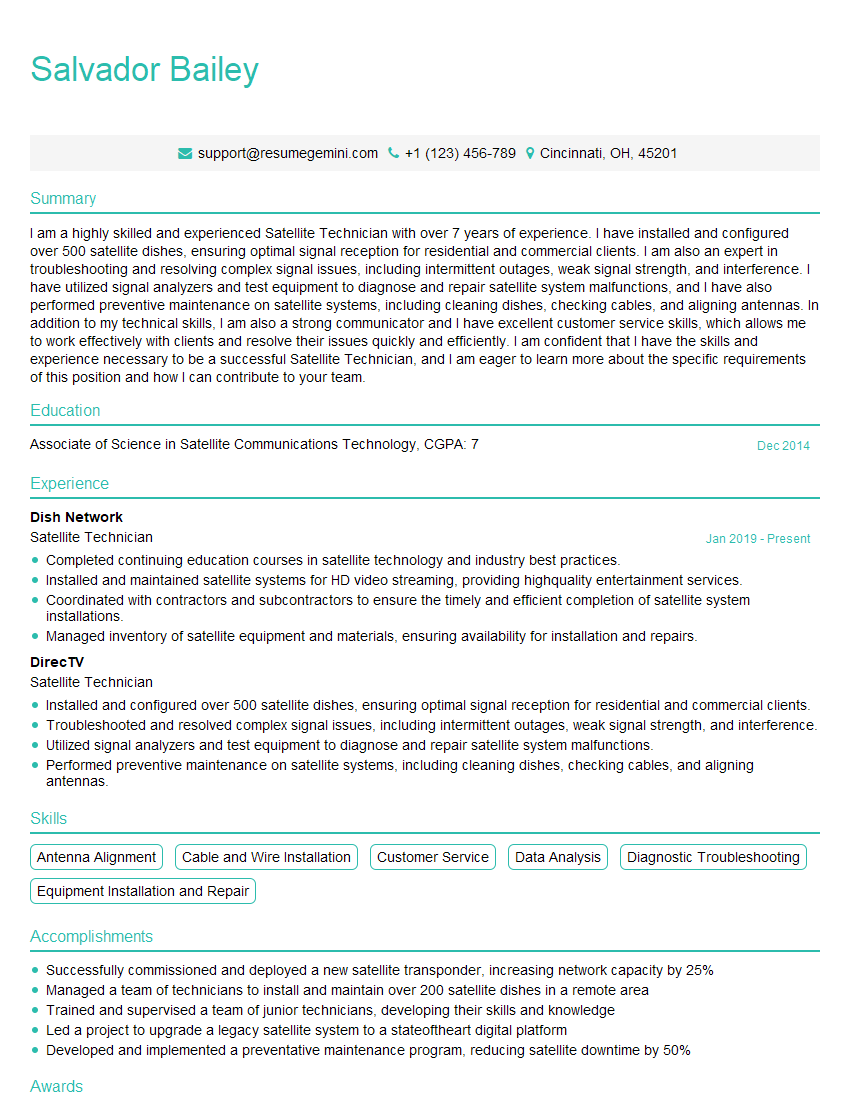
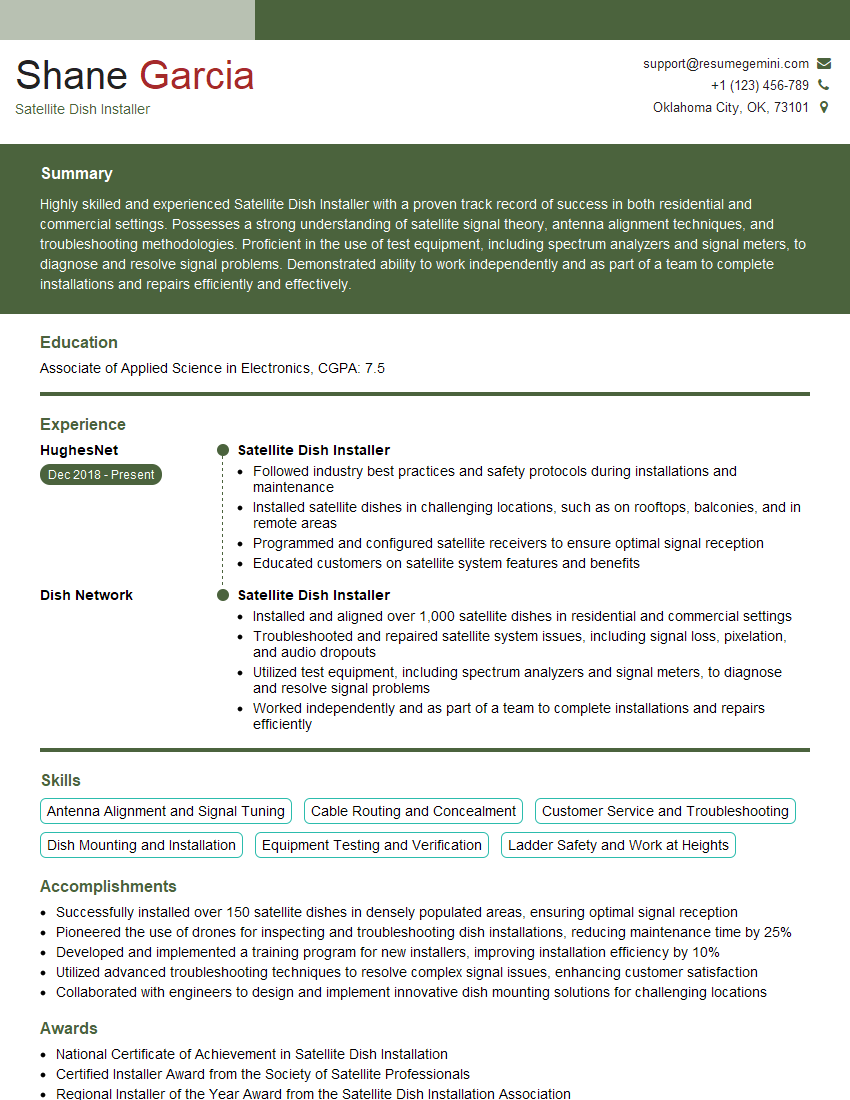
Mastering the installation of satellite antennas opens doors to a rewarding career with excellent growth potential. This field demands strong technical skills, problem-solving abilities, and a commitment to customer satisfaction. To maximize your job prospects, create a compelling and ATS-friendly resume that highlights your relevant skills and experience. ResumeGemini is a trusted resource for building professional resumes that get noticed by recruiters. They provide examples of resumes tailored to the Installation of Satellite Antennas field, helping you showcase your qualifications effectively and land your dream job.
Explore more articles
Users Rating of Our Blogs
Share Your Experience
We value your feedback! Please rate our content and share your thoughts (optional).
What Readers Say About Our Blog
To the interviewgemini.com Webmaster.
Very helpful and content specific questions to help prepare me for my interview!
Thank you
To the interviewgemini.com Webmaster.
This was kind of a unique content I found around the specialized skills. Very helpful questions and good detailed answers.
Very Helpful blog, thank you Interviewgemini team.