Interviews are opportunities to demonstrate your expertise, and this guide is here to help you shine. Explore the essential Interpreting aerial photography and topographic maps interview questions that employers frequently ask, paired with strategies for crafting responses that set you apart from the competition.
Questions Asked in Interpreting aerial photography and topographic maps Interview
Q 1. Explain the difference between orthophotos and aerial photographs.
While both orthophotos and aerial photographs are derived from aerial imagery, they differ significantly in their geometric properties. An aerial photograph is a simple image taken from an aircraft or drone, preserving the perspective of the camera. Think of it like a regular picture – objects closer to the camera appear larger, and those farther away appear smaller. This introduces geometric distortions, particularly near the edges of the image.
An orthophoto, on the other hand, is a georeferenced image that has been orthorectified. This means all geometric distortions – caused by camera tilt, terrain relief, and earth curvature – have been removed. It’s essentially a corrected aerial photograph, where all features appear at their true map coordinates, making measurements directly from the image accurate. Imagine a perfectly flattened map view from the air; that’s an orthophoto.
In essence, aerial photos are raw images, while orthophotos are processed images suitable for accurate measurements and mapping.
Q 2. Describe the various types of topographic map scales and their applications.
Topographic map scales represent the ratio between a distance on the map and the corresponding distance on the ground. Different scales are used depending on the application and the level of detail required.
- Large-scale maps (e.g., 1:1000, 1:2000): Show a small area with high detail, often used for engineering projects, urban planning, or detailed site surveys. Imagine planning a building; you’d need a large-scale map to see individual trees and buildings accurately.
- Medium-scale maps (e.g., 1:10,000, 1:25,000): Provide a balance between detail and coverage, useful for regional planning, hiking, or route planning. These are perfect for navigating a national park, showing trails and key landmarks.
- Small-scale maps (e.g., 1:50,000, 1:100,000): Show large areas with less detail, ideal for national-level planning, broad-scale environmental studies, or strategic military planning. Think of planning a long-distance road trip – you would use a small-scale map to understand the route across different states.
The choice of scale is crucial. A large-scale map might be too cluttered for national-level planning, while a small-scale map would lack the detail needed for a building site survey.
Q 3. How do you interpret contour lines on a topographic map?
Contour lines on a topographic map connect points of equal elevation. They are the key to understanding the terrain’s shape and slope.
- Spacing: Closely spaced contour lines indicate a steep slope; widely spaced lines show a gentle slope. Think of it like walking uphill – closely packed contour lines are like a steep climb, while wide spacing means a gradual incline.
- Elevation: The elevation value is often printed on selected contour lines. This value represents the height above a chosen datum, usually sea level.
- Contour Intervals: The vertical distance between adjacent contour lines is the contour interval. This interval is usually consistent throughout the map.
- Index Contours: These are often bolder or thicker than the regular contour lines and usually have their elevation printed. They highlight key elevations for easier reading.
- Depression Contours: These are similar to regular contour lines but usually have short, inward-pointing lines called hachures to indicate a depression or closed basin.
By analyzing the pattern, spacing, and elevation of contour lines, we can determine the slope, elevation, and overall topography of the area represented on the map. This information is essential for various applications, including land development, hydrological studies, and route planning.
Q 4. What are the limitations of using aerial photography for mapping?
While aerial photography is a powerful tool for mapping, it has several limitations:
- Atmospheric Conditions: Cloud cover, haze, and atmospheric distortion can severely affect image quality and make accurate interpretation difficult. A perfectly clear day is essential for high-quality data.
- Shadows: Shadows cast by trees, buildings, and other objects can obscure features or create misleading interpretations. This is particularly problematic in areas with significant relief.
- Geometric Distortions: As mentioned earlier, aerial photographs are subject to geometric distortions unless they are orthorectified. These distortions can make accurate measurements challenging.
- Scale and Resolution: The resolution and scale of the imagery might not always be sufficient for the required level of detail, particularly for very small features. High-resolution imagery can be expensive.
- Cost and Time: Acquiring aerial photography can be a costly and time-consuming process, especially for large areas.
Understanding these limitations is crucial for selecting appropriate mapping techniques and managing expectations.
Q 5. Explain the concept of ground control points (GCPs) in photogrammetry.
Ground Control Points (GCPs) are points on the ground whose coordinates are precisely known in a defined coordinate system (e.g., UTM, State Plane). In photogrammetry, GCPs are used to georeference aerial images and orthorectify them. Think of them as reference points that link the aerial images to the real world.
The process involves identifying the same GCPs in both the aerial imagery and a reference dataset (e.g., a topographic map, GPS measurements). The software then uses the known coordinates of the GCPs to mathematically transform and correct the aerial images, aligning them precisely with the ground.
Accurate GCPs are critical for achieving high-accuracy georeferencing. The number and distribution of GCPs are essential factors that affect the accuracy of the final product. More GCPs, strategically distributed, generally improve accuracy.
Q 6. How do you identify and correct geometric distortions in aerial imagery?
Geometric distortions in aerial imagery stem from several factors including camera tilt, terrain relief, and earth curvature. The process of correcting these distortions is called orthorectification.
The process typically involves these steps:
- Image Orientation: Determining the camera’s position and orientation (interior and exterior orientation) during image capture. This can be achieved using GCPs or by using the data from the camera itself.
- Digital Elevation Model (DEM) Integration: A DEM is used to correct for terrain-induced distortions. The DEM provides elevation information, allowing the software to adjust the image geometry based on the terrain’s slope and relief.
- Orthorectification Software: Specialized software packages employ mathematical models to perform the transformation. They use the GCPs’ coordinates and the DEM to transform the image into an orthophoto.
- Quality Control: Checking the accuracy of the orthorectified image using additional GCPs or by visual inspection for any remaining geometric inconsistencies.
Accurate orthorectification is essential for creating accurate maps and conducting reliable spatial analyses. Without correction, measurements made directly from the imagery would be inaccurate.
Q 7. What software packages are you familiar with for processing aerial photography and topographic data?
I am proficient in several software packages for processing aerial photography and topographic data. These include:
- ArcGIS Pro: A comprehensive Geographic Information System (GIS) software with extensive capabilities for image processing, georeferencing, orthorectification, and analysis.
- ERDAS IMAGINE: A powerful remote sensing software with tools for image processing, orthorectification, and various image analysis techniques.
- QGIS: A free and open-source GIS software that offers similar functionalities as ArcGIS Pro, suitable for many image processing tasks.
- Agisoft Metashape: A photogrammetry software that excels at generating 3D models and orthomosaics from aerial imagery using Structure from Motion (SfM) techniques.
- Pix4Dmapper: Another popular photogrammetry software similar in function to Agisoft Metashape.
My experience with these packages allows me to handle various aspects of aerial photo processing and topographic data analysis effectively. The choice of software often depends on project specifics, budget, and the level of detail required.
Q 8. Describe your experience with different digital elevation models (DEMs).
Digital Elevation Models (DEMs) are digital representations of the terrain’s surface. My experience encompasses working with various DEM types, each offering unique strengths and weaknesses. For instance, I’ve extensively used:
- Raster DEMs: These represent elevation as a grid of regularly spaced cells, each containing an elevation value. I’ve worked with DEMs derived from LiDAR data, offering high accuracy and resolution, perfect for detailed hydrological modeling or precise volume calculations for construction projects. I’ve also used DEMs derived from stereo aerial photography, a cost-effective option when high resolution isn’t absolutely critical. The resolution trade-off is usually manageable for applications such as broad-scale land-use planning.
- TIN DEMs (Triangulated Irregular Networks): These use a network of interconnected triangles to represent the terrain. TIN DEMs are particularly useful for areas with complex topography, as they adapt their resolution to the terrain complexity. I’ve used them in projects involving slope analysis in mountainous regions, where a constant grid resolution would be inefficient and potentially inaccurate.
- Contour DEMs: While not strictly a DEM format itself, contour lines derived from DEMs are crucial. I’ve used these extensively for visualizing terrain and integrating them with other GIS data for comprehensive analysis and map production. For instance, in a recent project concerning flood risk assessment, contour lines were essential in identifying potential flood zones based on elevation.
Choosing the right DEM depends heavily on the project requirements, budget, and desired level of detail. The trade-off often lies between high accuracy/resolution (often more expensive) and cost-effectiveness, which might involve lower resolution but sufficient detail for the application.
Q 9. How do you determine the accuracy of a topographic map?
Determining the accuracy of a topographic map involves a multi-faceted approach. It’s not just about a single number but a holistic assessment. I usually consider these aspects:
- Vertical Accuracy: This refers to how accurately elevations are represented. It’s often expressed as a root mean square error (RMSE) or a contour interval. For instance, a map with a 1-meter contour interval suggests elevations are accurate within ±0.5 meters. I verify this by comparing the map’s elevation data against known ground control points (GCPs) or other high-accuracy elevation datasets like LiDAR.
- Horizontal Accuracy: This focuses on the positional accuracy of features. Similar to vertical accuracy, RMSE or similar metrics are used. I’d assess this by comparing the map’s feature locations with GPS measurements or high-resolution imagery.
- Completeness and Consistency: A high-accuracy map should comprehensively cover all terrain features within its area. I check for any missing or misrepresented details, such as inconsistencies in contour lines or abrupt changes in elevation that might indicate errors.
- Metadata Examination: The map’s metadata is critical. It should clearly specify the source data, accuracy standards, projection, and date of creation. Missing or incomplete metadata raises concerns about the map’s reliability.
In practice, I often use statistical analysis and comparison with other datasets to quantify the accuracy and validate the reliability of a given topographic map. Understanding the source data and mapping methods is crucial for interpreting the accuracy statements provided in the metadata.
Q 10. Explain the process of creating a topographic map from aerial photography.
Creating a topographic map from aerial photography is a multi-step process involving photogrammetry, which uses overlapping photographs to create 3D models of the terrain. Here’s a breakdown:
- Aerial Photography Acquisition: High-resolution aerial images are captured using specialized cameras from aircraft or drones, ensuring sufficient overlap for stereoscopic viewing.
- Image Orientation: The images undergo orientation to determine their relative positions and orientations. This involves identifying and measuring ground control points (GCPs) in both the images and the real world to establish a coordinate system.
- Stereoscopic Viewing and Point Cloud Generation: Specialized software uses overlapping images to create a 3D point cloud. This point cloud represents the terrain’s surface as a collection of individual 3D points.
- DEM Creation: The 3D point cloud is processed to create a DEM (Digital Elevation Model). This might involve interpolation techniques to fill in gaps or smooth out irregularities.
- Contour Line Generation: Contour lines representing elevation are automatically generated from the DEM.
- Map Compilation: Other features like roads, buildings, and water bodies are digitized onto the map using the aerial imagery as a base, with the contour lines superimposed.
- Map Production: The final topographic map is produced, often incorporating a legend, scale, and other relevant information.
Software packages such as ArcGIS, ERDAS IMAGINE, and Pix4D are commonly used for this process. The accuracy of the final map depends heavily on the quality of the aerial photography, the accuracy of GCP measurements, and the processing techniques employed.
Q 11. What are the various types of aerial platforms used for data acquisition?
Data acquisition for creating topographic maps and DEMs relies on a variety of aerial platforms, each with its own advantages and limitations:
- Fixed-wing Aircraft: These are traditional platforms offering extensive coverage capabilities and high altitude flights for broad area mapping. They’re ideal for large-scale projects but can be expensive.
- Helicopters: Helicopters offer greater maneuverability, allowing for detailed mapping of smaller areas or challenging terrain like mountainous regions where fixed-wing aircraft might struggle.
- Unmanned Aerial Vehicles (UAVs or Drones): Drones have become increasingly popular due to their cost-effectiveness, flexibility, and ability to capture very high-resolution imagery. However, their flight time and coverage area are limited compared to aircraft.
- Satellites: Satellites provide very large-scale coverage but often with lower spatial resolution than aircraft or drones. They are useful for very broad regional or global analysis but less suitable for detailed topographic mapping.
The selection of the aerial platform is a critical decision based on the project’s specific needs, budget, and required level of detail. For example, a large national park mapping project would likely use fixed-wing aircraft or satellites, while a detailed survey of a construction site could be best done with a drone.
Q 12. How do you interpret drainage patterns on a topographic map?
Interpreting drainage patterns on a topographic map is crucial for understanding the hydrology and geomorphology of an area. The key is to recognize how water flows downhill based on the contours and elevation changes.
- Stream Ordering: Streams are ordered based on their size and branching pattern. Smaller streams merge to form larger ones. Understanding this hierarchy helps in analyzing the flow direction and volume.
- Drainage Density: The density of streams indicates the drainage basin’s characteristics. High drainage density usually suggests a steep terrain and highly permeable soil.
- Drainage Patterns: Various patterns exist, each with geological implications:
- Dendritic: Resembles tree branches, indicative of uniform geology.
- Radial: Streams radiate outwards from a central point like a volcano.
- Rectangular: Streams follow fault lines or joint systems, creating right-angle bends.
- Trellis: Streams follow parallel valleys, often found in folded mountain regions.
- Divides and Watersheds: High points (divides) separate drainage basins (watersheds). Identifying these boundaries is crucial for understanding water flow and management.
For example, a dendritic pattern suggests a uniform underlying geology, while a radial pattern points towards a volcanic origin. Analyzing drainage patterns allows us to infer subsurface structures, soil types, and potential flood risks.
Q 13. Describe your experience with LiDAR data processing.
My experience with LiDAR (Light Detection and Ranging) data processing involves several key stages:
- Data Acquisition: This involves understanding the LiDAR system used, point density, and pulse frequency to manage expectations about accuracy and resolution. Higher point density leads to a more detailed representation of the terrain.
- Data Preprocessing: This is crucial and includes filtering to remove noise and outliers, correcting for atmospheric effects, and georeferencing the data to a known coordinate system.
- Point Cloud Classification: This step categorizes points into ground points, vegetation, buildings, etc. This classification is essential for creating accurate DEMs and other geospatial products. Algorithms and manual editing are often used to achieve accurate classifications.
- DEM Generation: Using the classified point cloud, a DEM is generated through interpolation techniques. The choice of interpolation method affects the DEM’s smoothness and accuracy, I consider factors like terrain complexity when making this selection.
- Data Analysis and Visualization: The DEM and other derived products are used for various analysis like slope analysis, hydrological modeling, and 3D visualization. Software like ArcGIS Pro, QGIS, and CloudCompare are used for this purpose.
A recent project involved using LiDAR data to create a highly accurate DEM for a flood plain analysis. The high point density provided by LiDAR allowed for detailed modeling of the terrain, which was critical for accurate flood risk assessment. The preprocessing steps were vital for ensuring data quality and producing reliable results.
Q 14. Explain the difference between planimetric and topographic maps.
The core difference lies in what each map type represents:
- Planimetric Maps: These show the horizontal positions of features on the Earth’s surface, focusing on the x and y coordinates. Think of it like a bird’s-eye view that ignores elevation. They represent features like roads, buildings, and land boundaries, but they don’t depict elevation or terrain relief.
- Topographic Maps: These maps represent both horizontal position and elevation, giving a three-dimensional representation of the terrain. Contour lines, spot heights, and other elevation-related information are key components of a topographic map. They’re essential for tasks that require understanding the terrain’s shape, such as route planning or hydrological analysis.
An analogy: A planimetric map is like a floor plan of a house, showing the layout of rooms and walls but not the height of ceilings. A topographic map is like a 3D model of the house, showing not only the layout but also the roof’s shape and overall elevation.
Q 15. How do you identify different land cover types using aerial photography?
Identifying land cover types from aerial photography relies on interpreting variations in tone, texture, pattern, shape, and size of features. Think of it like reading a visual code. Different land covers have distinct visual signatures.
- Tone: Darker tones might represent dense forests, while lighter tones could indicate sandy areas or built-up environments. For example, a dark, homogenous tone might signify a coniferous forest, whereas a lighter, more variegated tone could indicate deciduous forest with varied canopy density.
- Texture: This refers to the visual ‘feel’ of the area. Smooth textures could indicate water bodies or paved surfaces, while rough textures might suggest agricultural fields or scrubland. Imagine the difference between the smooth texture of a lake and the rough texture of a field.
- Pattern: Regular patterns often indicate human intervention, such as agricultural fields arranged in rows or urban grids. Irregular patterns, on the other hand, usually represent natural landscapes.
- Shape: The shape of features can be highly indicative. Linear shapes suggest roads or rivers, while irregular shapes might represent forests or wetlands. For instance, the meandering shape of a river contrasts sharply with the straight lines of a highway.
- Size: The scale of features gives important context. Large, contiguous areas might represent extensive forests or large bodies of water, while smaller, fragmented areas may represent smaller fields or individual buildings.
Combining these visual cues allows for accurate classification. Often, we use image processing software with spectral indices to enhance these visual differences, allowing for more precise land cover mapping. For example, the Normalized Difference Vegetation Index (NDVI) highlights areas with healthy vegetation.
Career Expert Tips:
- Ace those interviews! Prepare effectively by reviewing the Top 50 Most Common Interview Questions on ResumeGemini.
- Navigate your job search with confidence! Explore a wide range of Career Tips on ResumeGemini. Learn about common challenges and recommendations to overcome them.
- Craft the perfect resume! Master the Art of Resume Writing with ResumeGemini’s guide. Showcase your unique qualifications and achievements effectively.
- Don’t miss out on holiday savings! Build your dream resume with ResumeGemini’s ATS optimized templates.
Q 16. What are the key considerations when selecting appropriate aerial photography for a specific project?
Choosing the right aerial photography depends heavily on project requirements. Several key considerations are crucial:
- Spatial Resolution: This dictates the level of detail. High resolution is necessary for projects demanding fine-scale mapping, like individual tree identification or building assessment, while lower resolution suffices for broader-scale studies such as habitat mapping.
- Spectral Resolution: The number of spectral bands determines the information captured. Multispectral imagery provides more information about the reflectance properties of the land cover, enabling better classification. For example, near-infrared bands are useful for vegetation analysis.
- Temporal Resolution: The frequency of image acquisition. This is critical for monitoring change over time. Frequent acquisitions (e.g., for flood monitoring) are more expensive but provide invaluable dynamic data.
- Image Geometry and Corrections: The accuracy of geometric corrections is vital. Orthophotos are georeferenced images corrected for distortions, ensuring accurate measurements and integration with GIS.
- Project Budget and Timeline: High-resolution imagery, multispectral data, and frequent acquisitions increase project cost.
For example, a project assessing deforestation would require high temporal resolution to track changes, while a project mapping urban infrastructure might prioritize high spatial resolution for detailed building identification.
Q 17. How do you use topographic maps for site analysis and planning?
Topographic maps, showing elevation data, are invaluable tools for site analysis and planning. They provide crucial information for understanding terrain characteristics and making informed decisions.
- Site Selection: Maps highlight areas with suitable slopes, elevations, and proximity to infrastructure. For instance, finding a suitable location for a building avoiding steep slopes or floodplains is made easy by contour lines.
- Drainage Analysis: Contour lines and hydrological features help determine drainage patterns and potential flood risks. Understanding water flow is crucial for designing drainage systems and mitigating flood hazards.
- Infrastructure Planning: Topographic maps guide road, pipeline, or utility line placement, minimizing environmental impact and construction costs. The steepness of slopes influences the design of road cuts and fills.
- Environmental Impact Assessment: Maps help identify sensitive areas like wetlands or steep slopes that need protection during project development.
- Volume Calculations: Contour lines allow calculation of earthwork volumes for construction projects. This is crucial for accurate cost estimation.
In essence, topographic maps provide a three-dimensional understanding of the land, enabling accurate site assessment and better planning decisions.
Q 18. Describe your experience with GPS and its integration with GIS.
My experience with GPS (Global Positioning System) is extensive. I’ve used it extensively for georeferencing aerial photography and collecting ground control points (GCPs) for accurate map creation. GPS data, when integrated with GIS (Geographic Information System), adds a crucial spatial dimension to geographic data.
Specifically, I’ve used handheld GPS receivers to collect coordinates for GCPs, which are points whose location is known precisely. These points are then used to rectify and georeference aerial photos, correcting distortions and ensuring accurate positioning within a GIS environment. This precise georeferencing is essential for overlaying different datasets, accurate measurements, and spatial analysis.
Furthermore, I’m proficient in importing GPS tracklogs into GIS software to visualize movement patterns, such as animal migration or vehicle routes. This allows for the creation of dynamic maps showing location and time information, offering valuable insights in various applications.
Q 19. Explain the concept of spatial resolution in remote sensing.
Spatial resolution in remote sensing refers to the size of the smallest discernible detail on an image. Think of it like the pixel size: smaller pixels mean higher resolution and greater detail. High spatial resolution provides more information, allowing for fine-scale analysis.
For example, a high-resolution image might show individual trees in a forest, whereas a low-resolution image would only show a general area of forest cover. The spatial resolution is typically expressed in meters, for instance, a 0.5-meter resolution image shows details down to 0.5 meters.
The choice of spatial resolution depends entirely on the project’s objectives. High-resolution imagery is more expensive and requires more processing power but is crucial for detailed analyses. Low-resolution imagery is suitable for broad-scale studies where fine details aren’t necessary. It’s always a balance between detail and cost.
Q 20. What are the challenges in interpreting aerial photography in urban areas?
Interpreting aerial photography in urban areas presents unique challenges due to the high density and complexity of structures and features.
- High Density: The sheer number of buildings, roads, and other structures makes distinguishing individual features difficult, often leading to spectral confusion.
- Spectral Similarity: Many urban materials have similar spectral signatures, making it difficult to differentiate between different building materials, for example, concrete and asphalt.
- Shadows: Tall buildings cast significant shadows, obscuring features and complicating analysis. Shadows can change throughout the day, adding further complexity.
- Three-Dimensional Structures: The vertical nature of urban environments makes it challenging to accurately represent the features in a two-dimensional image.
- Artifacts: Urban areas often contain various man-made artifacts that might be misidentified as natural features. For example, reflections of sunlight can cause confusion.
Strategies for handling these challenges include utilizing high-resolution imagery, employing advanced image processing techniques like shadow removal and object-based image analysis (OBIA), and incorporating other data sources like LiDAR data to gain a 3D understanding of the urban environment.
Q 21. How do you handle large datasets of aerial imagery and topographic data?
Handling large datasets of aerial imagery and topographic data requires efficient strategies for storage, processing, and analysis. This often involves specialized software and hardware.
- Cloud-Based Storage: Cloud platforms offer scalable storage solutions for massive datasets. Services like Amazon S3 or Google Cloud Storage are well-suited for this.
- Geospatial Databases: PostgreSQL/PostGIS or other geospatial databases provide efficient storage and retrieval of georeferenced data.
- Parallel Processing: Processing large datasets requires parallelization techniques to speed up analysis. This often utilizes high-performance computing clusters or cloud-based computing resources.
- Geoprocessing Tools: Software like ArcGIS or QGIS offers tools for automating geoprocessing tasks, such as mosaicking images, creating orthorectified images, and performing classifications.
- Data Compression: Utilizing appropriate compression techniques for imagery (e.g., GeoTIFF) minimizes storage space and improves data transfer speeds.
It’s crucial to have a well-defined workflow and utilize appropriate software and hardware to manage these large datasets effectively. Without a robust system, analysis will be slow and inefficient.
Q 22. Describe your experience with data visualization and presentation techniques.
My experience in data visualization and presentation spans over a decade, encompassing various techniques tailored to different audiences and project needs. I’m proficient in using Geographic Information Systems (GIS) software like ArcGIS and QGIS to create maps, charts, and interactive dashboards. For instance, I’ve used ArcGIS Pro to generate 3D visualizations of terrain models derived from LiDAR data, highlighting areas prone to flooding for a local government. For broader audiences, I prefer simpler presentations leveraging tools like Power BI or Tableau to communicate complex spatial data effectively using clear, concise visuals like choropleth maps and cartograms. I understand the importance of choosing the right visualization technique to convey the information clearly and accurately, adapting my approach based on the data’s characteristics and the recipient’s technical background. I regularly incorporate legends, scale bars, and north arrows to ensure maps are readily interpretable.
Q 23. Explain the concept of coordinate systems and projections.
Coordinate systems and projections are fundamental to representing the three-dimensional Earth on a two-dimensional map. A coordinate system defines a location on the Earth’s surface using numerical values. The most common is the geographic coordinate system, using latitude and longitude. However, these spherical coordinates aren’t suitable for direct use in many applications. This is where map projections come in. A map projection is a systematic transformation of the Earth’s spherical surface onto a flat plane. Because this transformation is impossible without distortion, different projections minimize different types of distortion. For instance, the Mercator projection preserves direction, making it useful for navigation but significantly distorting areas at higher latitudes. Conversely, equal-area projections like Albers preserve area but distort shapes. Choosing the right projection depends entirely on the application; a navigation map needs a different projection than one used for land area calculations.
Q 24. How do you ensure data quality and accuracy in your work?
Data quality and accuracy are paramount. My approach involves a multi-stage process. First, I meticulously examine metadata associated with aerial imagery and topographic data, verifying sensor specifications, acquisition dates, and processing methods. This step helps to identify potential biases or errors early on. Then, I perform visual inspection of the imagery and data for obvious errors like artifacts or inconsistencies. For quantitative assessment, I use ground control points (GCPs) – points with known coordinates – to georeference the data, ensuring accurate alignment with real-world locations. Root Mean Square Error (RMSE) calculations quantify the accuracy of the georeferencing. Furthermore, I employ techniques like image rectification and orthorectification to correct geometric distortions. Finally, data validation and consistency checks are performed comparing data from multiple sources to identify discrepancies. Throughout the process, detailed documentation is crucial for maintaining a transparent and auditable workflow.
Q 25. Describe your experience with different map projections.
My experience encompasses various map projections, each chosen based on the specific project needs and the type of distortion that can be tolerated. I am familiar with the Mercator, Transverse Mercator, Lambert Conformal Conic, Albers Equal-Area Conic, and UTM (Universal Transverse Mercator) projections. For instance, the UTM projection is commonly used for large-scale mapping because it divides the Earth into zones, minimizing distortion within each zone. The choice often depends on the project’s geographic extent and the type of analysis being conducted. Working on a project involving global land cover changes might necessitate using a projection that minimizes area distortion, whereas a navigation chart would likely employ a conformal projection preserving angles and shapes.
Q 26. What is your experience with using aerial imagery for environmental monitoring?
I have extensive experience utilizing aerial imagery for environmental monitoring, applying various techniques to analyze land cover changes, deforestation, and pollution patterns. For example, I used multispectral imagery to monitor the spread of invasive species in a national park, identifying areas requiring immediate intervention. In another project, I analyzed time-series satellite imagery to track changes in glacier extent over several decades. I routinely employ techniques like image classification, change detection, and object-based image analysis (OBIA) to extract meaningful information from aerial imagery. These methods allow for accurate quantification of environmental changes and support evidence-based decision-making for conservation efforts and resource management.
Q 27. Explain the process of creating a 3D model from aerial photography and LiDAR data.
Creating a 3D model from aerial photography and LiDAR data is a multi-step process. First, the aerial photographs undergo orthorectification to remove geometric distortions, resulting in an orthomosaic – a georeferenced image mosaic. Simultaneously, LiDAR data, which provides highly accurate elevation information, is processed to create a Digital Elevation Model (DEM). Then, using specialized software like Pix4D or Agisoft Metashape, these data sources are integrated. The software uses photogrammetry techniques, automatically identifying and matching common features between overlapping images to create a point cloud. The DEM is incorporated to improve the accuracy and detail of the 3D model. Finally, the point cloud is processed to generate a textured 3D mesh, providing a realistic representation of the terrain. The result is a highly accurate 3D model suitable for various applications, from urban planning to environmental impact assessments.
Q 28. Describe a situation where you had to troubleshoot a problem related to aerial imagery or topographic data.
During a project involving the assessment of coastal erosion, we encountered significant discrepancies between the elevation data derived from LiDAR and the information shown on existing topographic maps. Initial analysis pointed towards potential errors in the LiDAR data. However, thorough investigation revealed that the topographic maps were outdated, reflecting the coastal line from a much earlier period. To resolve the issue, we cross-referenced the LiDAR data with high-resolution satellite imagery and ground-truthing measurements. This allowed us to accurately delineate the current coastline and quantify the extent of erosion. The updated data revealed significantly greater erosion than initially anticipated, prompting a revised assessment of coastal protection strategies. This experience underscored the importance of rigorous data validation and the need to consider the age and accuracy of all data sources.
Key Topics to Learn for Interpreting Aerial Photography and Topographic Maps Interview
- Scale and Resolution: Understanding how scale affects interpretation and the limitations of different resolutions in aerial photography and topographic maps. Practical application: Determining accurate distances and areas from imagery.
- Photogrammetry Principles: Grasping the fundamentals of creating 3D models and measurements from overlapping aerial photos. Practical application: Analyzing terrain features and elevation changes.
- Map Symbols and Conventions: Mastering the interpretation of contour lines, spot elevations, and other symbols used on topographic maps. Practical application: Identifying landforms, slopes, and drainage patterns.
- Image Analysis Techniques: Developing skills in identifying land cover types, infrastructure, and other features using visual interpretation techniques. Practical application: Classifying vegetation, detecting changes over time, and assessing environmental impact.
- Digital Elevation Models (DEMs): Understanding the creation and use of DEMs derived from aerial photography and topographic data. Practical application: Analyzing terrain for planning purposes (e.g., infrastructure development, environmental management).
- GIS Integration: Familiarizing yourself with how aerial photography and topographic maps integrate with Geographic Information Systems (GIS) for spatial analysis. Practical application: Overlaying different datasets to analyze relationships between features.
- Error Analysis and Uncertainty: Understanding the sources of error in aerial photography and topographic maps and how to assess their impact on interpretations. Practical application: Evaluating the reliability of interpretations and making informed decisions based on data quality.
Next Steps
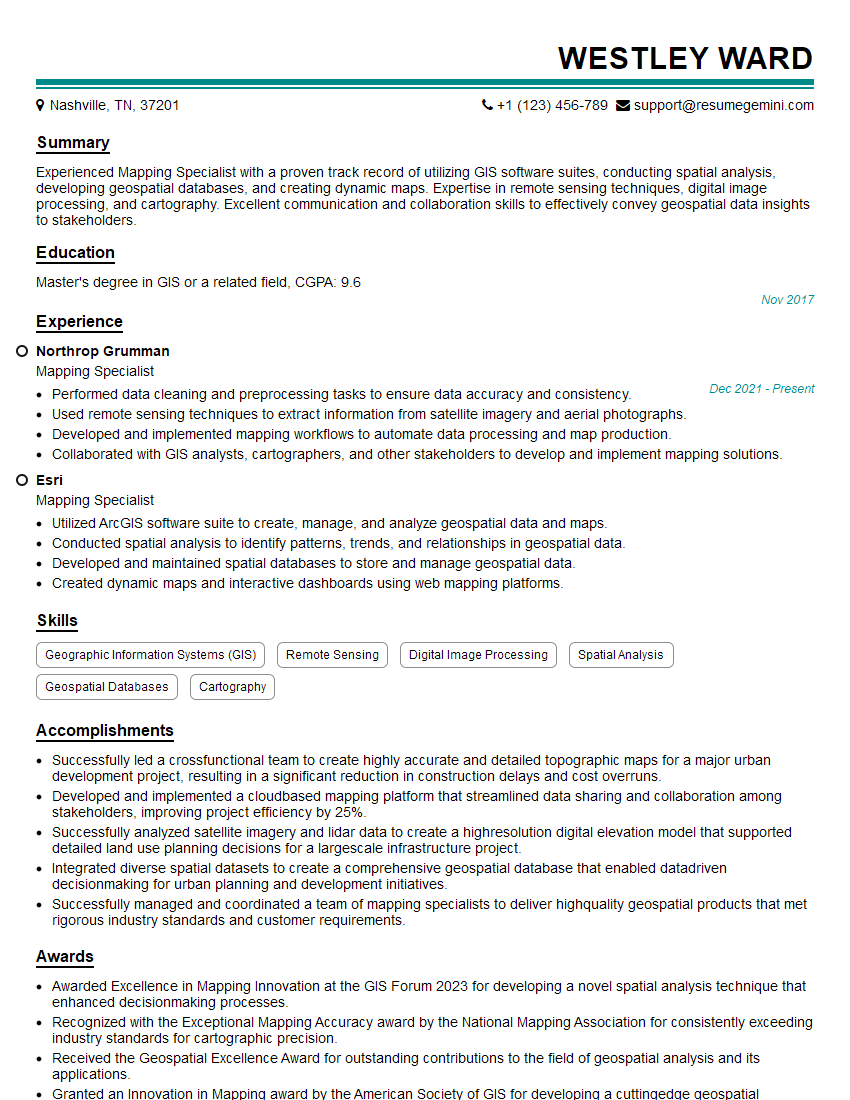
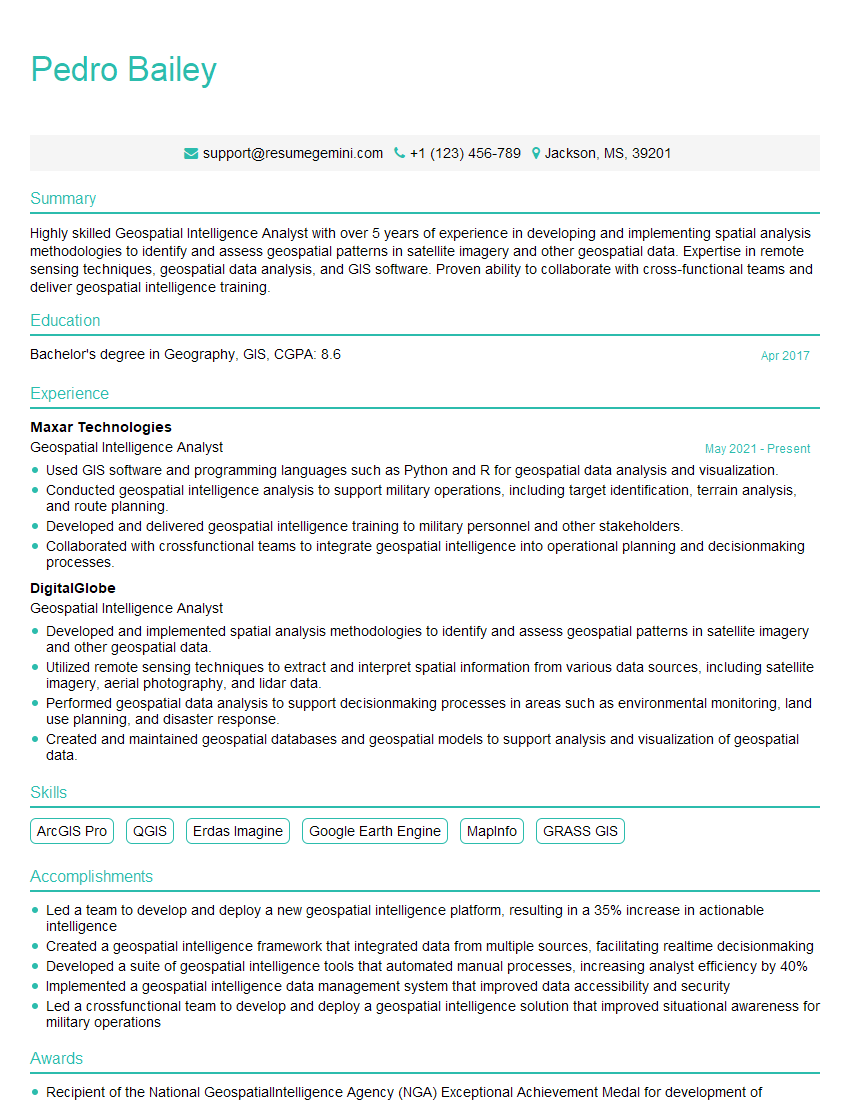
Mastering the interpretation of aerial photography and topographic maps is crucial for career advancement in fields like surveying, GIS, environmental science, and urban planning. A strong understanding of these skills demonstrates valuable analytical and problem-solving abilities highly sought after by employers. To increase your job prospects, it’s essential to present your skills effectively. Creating an ATS-friendly resume is key to getting your application noticed. ResumeGemini is a trusted resource to help you build a professional and impactful resume that highlights your expertise. Examples of resumes tailored to interpreting aerial photography and topographic maps are available to help guide you.





Explore more articles
Users Rating of Our Blogs
Share Your Experience
We value your feedback! Please rate our content and share your thoughts (optional).
What Readers Say About Our Blog
To the interviewgemini.com Webmaster.
Very helpful and content specific questions to help prepare me for my interview!
Thank you
To the interviewgemini.com Webmaster.
This was kind of a unique content I found around the specialized skills. Very helpful questions and good detailed answers.
Very Helpful blog, thank you Interviewgemini team.