Are you ready to stand out in your next interview? Understanding and preparing for Intrusion Detection and Prevention Systems interview questions is a game-changer. In this blog, we’ve compiled key questions and expert advice to help you showcase your skills with confidence and precision. Let’s get started on your journey to acing the interview.
Questions Asked in Intrusion Detection and Prevention Systems Interview
Q 1. Explain the difference between an Intrusion Detection System (IDS) and an Intrusion Prevention System (IPS).
The core difference between an Intrusion Detection System (IDS) and an Intrusion Prevention System (IPS) lies in their response to detected threats. Think of an IDS as a security guard who observes suspicious activity and alerts you; an IPS is like a security guard with the authority to actively stop the threat.
An IDS passively monitors network traffic or system activity for malicious patterns. When a threat is detected, it generates an alert, typically logging the event and potentially notifying an administrator. It doesn’t interfere with the network traffic itself.
An IPS, on the other hand, actively intervenes. Upon detecting a threat, it can take actions like blocking the malicious traffic, resetting the connection, or even isolating the infected system. This proactive approach helps prevent damage before it occurs.
Example: Imagine a hacker attempting a SQL injection attack. An IDS would detect the malicious SQL query and log it as an alert. An IPS would, in addition to logging, actively block the query, preventing the attack from succeeding.
Q 2. Describe the various types of IDS/IPS signatures and their effectiveness.
IDS/IPS signatures are essentially rules that define malicious activity. They come in various types:
- Signature-based: These signatures match specific patterns of malicious code or network traffic (e.g., specific strings in HTTP requests, known malware hashes). Think of these like fingerprints for known threats.
- Protocol anomaly-based: These signatures detect deviations from expected network protocol behavior. For example, if a TCP session shows unexpected flags or sequences, it might trigger an alert.
- Statistical anomaly-based: These use statistical models of normal network behavior to identify outliers. If traffic patterns deviate significantly from the established baseline, an alert is generated.
- Heuristic-based: These signatures rely on rules-of-thumb and expert knowledge to identify potentially malicious behavior. They might look for suspicious patterns not explicitly defined in other signature types.
- Fuzzy matching: These account for slight variations in malicious code or network traffic, enabling detection even when attackers attempt obfuscation techniques.
Effectiveness varies depending on the sophistication of the attack and the quality of the signatures. Signature-based detection is highly effective against known threats, but less so against new or zero-day attacks. Anomaly-based detection is better at catching novel attacks but often suffers from a higher rate of false positives.
Q 3. How do signature-based IDS/IPS systems work, and what are their limitations?
Signature-based IDS/IPS systems work by comparing incoming network traffic or system events against a database of known malicious signatures (patterns). If a match is found, the system triggers an alert (IDS) or takes preventative action (IPS).
How it works:
- Data Acquisition: The system captures network traffic or system logs.
- Signature Matching: It compares the captured data against its signature database using pattern matching algorithms.
- Alerting/Prevention: If a signature match is found, an alert is generated (IDS) or the traffic is blocked/modified (IPS).
Limitations:
- Effectiveness against zero-day exploits: Signature-based systems are ineffective against new attacks that haven’t been identified and added to the signature database.
- High false positive rate: Signatures can sometimes match benign traffic, leading to unnecessary alerts and administrative overhead.
- Signature updates are crucial: Regular updates of the signature database are vital to maintain effectiveness. Out-of-date signatures render the system vulnerable.
- Bypass techniques: Attackers may employ techniques to evade detection, such as polymorphism or code obfuscation.
Q 4. Explain anomaly-based intrusion detection.
Anomaly-based intrusion detection focuses on identifying deviations from established normal behavior. Instead of relying on known attack signatures, it builds a model of typical system or network activity and flags any significant deviations from this baseline as potentially malicious.
How it works:
- Profiling: The system learns the normal behavior by analyzing network traffic or system activity over a period. This involves identifying statistical patterns like average bandwidth usage, frequency of specific events, and typical user activity.
- Threshold setting: Thresholds are set to define how much deviation from the normal profile triggers an alert. This is crucial for minimizing false positives.
- Anomaly detection: Incoming traffic or events are compared against the established profile. If the activity falls outside the defined thresholds, it’s considered an anomaly and flagged as potentially malicious.
Example: A sudden spike in login attempts from an unusual geographical location or an unexpected increase in data transfer rate could be flagged as anomalies.
Advantages: More effective against zero-day exploits and polymorphic malware. Disadvantages: Higher risk of false positives if the normal profile isn’t accurately established. Requires a longer learning period before it becomes effective.
Q 5. What are the key components of a SIEM system and how does it integrate with IDS/IPS?
A Security Information and Event Management (SIEM) system is a centralized security monitoring solution that collects and analyzes security logs from various sources across an organization’s IT infrastructure. It’s essentially a central hub for security information.
Key components:
- Log collection: Gathers security logs from multiple sources, including IDS/IPS, firewalls, servers, databases, and endpoint devices.
- Log normalization: Standardizes log formats to enable efficient analysis.
- Correlation engine: Analyzes logs to identify correlations between events, revealing potential security incidents.
- Alerting and reporting: Generates alerts on suspicious activities and provides reports on security posture.
- Security analytics: Uses advanced analytics to detect subtle threats and patterns.
SIEM integration with IDS/IPS: The SIEM system integrates with IDS/IPS by receiving alerts and log data. This allows the SIEM to correlate IDS/IPS alerts with other security events, providing a broader context for security analysis. This improved context helps to reduce false positives by verifying alerts against other security information and identify potential attacks that might be missed by IDS/IPS alone. It also enables more comprehensive security monitoring and incident response.
Q 6. Discuss the challenges in deploying and managing IDS/IPS in a large network.
Deploying and managing IDS/IPS in large networks present several challenges:
- Performance impact: IDS/IPS systems can consume significant network bandwidth and processing power, especially with high traffic volumes. Poorly implemented systems can lead to network slowdowns.
- Scalability: Scaling IDS/IPS to accommodate growing network sizes and traffic volumes requires careful planning and infrastructure.
- Complexity of configuration: Configuring and maintaining IDS/IPS systems can be complex, requiring specialized skills and expertise.
- Alert fatigue: High volumes of alerts (especially false positives) can lead to alert fatigue, making it difficult for security teams to identify and respond to actual threats.
- Integration with existing infrastructure: Integrating IDS/IPS with existing security systems and network infrastructure can be a significant undertaking.
- Cost: Deploying and maintaining enterprise-grade IDS/IPS systems can be expensive.
Strategies for addressing these challenges:
- Proper network segmentation: Divide the network into smaller, more manageable segments.
- Load balancing: Distribute traffic across multiple IDS/IPS devices.
- Automated response mechanisms: Implement automated actions to reduce manual intervention and alert fatigue.
- Centralized management: Employ central management platforms to simplify configuration and maintenance across multiple devices.
- Regular tuning and maintenance: Ongoing fine-tuning and regular maintenance are essential to optimize performance and minimize false positives.
Q 7. How do you tune an IDS/IPS to minimize false positives?
Tuning an IDS/IPS to minimize false positives requires a multi-faceted approach:
- Refine Signatures: Carefully review and adjust the IDS/IPS signatures. Overly broad signatures can lead to many false positives. Consider using more specific signatures or reducing the sensitivity of existing rules.
- Adjust Thresholds: Tweak the thresholds for anomaly-based detection. Lowering the threshold increases sensitivity but also increases the likelihood of false positives. Finding the optimal balance requires careful monitoring and analysis.
- Whitelist Trusted Traffic: Identify and whitelist trusted sources of traffic (e.g., internal servers, known vendors) to reduce the number of alerts generated for legitimate traffic.
- Regular Monitoring and Analysis: Continuously monitor the IDS/IPS alerts, investigate the causes of false positives, and adjust configurations accordingly. Use security analytics to identify patterns in false positives and refine rules accordingly.
- Utilize more than one detection technology: Combining signature-based with anomaly-based detection can help to reduce false positives while increasing detection capabilities.
The key is to continuously monitor, analyze, and refine the system’s configuration based on observed behavior. Think of it like fine-tuning a musical instrument; it’s an iterative process requiring attention and expertise.
Q 8. What are the common attack vectors that IDS/IPS systems are designed to detect?
Intrusion Detection and Prevention Systems (IDS/IPS) are designed to detect a wide range of attack vectors. Think of them as security guards constantly monitoring your network for suspicious activity. These vectors can be broadly categorized as network-based or host-based attacks.
- Network-based attacks: These target the network infrastructure itself. Examples include:
SQL Injection: Attempts to inject malicious SQL code into database queries.DoS/DDoS attacks: Flooding a system with traffic to make it unavailable.Port Scans: Probing for open ports to identify vulnerabilities.Man-in-the-middle attacks: Intercepting communication between two parties.Exploits targeting known vulnerabilities: Leveraging known weaknesses in software or hardware.- Host-based attacks: These target individual computers or servers. Examples include:
Malware infections: Viruses, worms, trojans attempting to compromise a system.Unauthorized access attempts: Brute-force password guessing or using stolen credentials.Privilege escalation: Gaining higher-level access than authorized.Data exfiltration: Stealing sensitive data from a compromised system.
Understanding these attack vectors is crucial for effective IDS/IPS configuration and tuning. You need to know what to look for to effectively protect your systems.
Q 9. Explain the concept of false positives and false negatives in IDS/IPS.
False positives and false negatives are inherent challenges in any security system, including IDS/IPS. Think of it like a smoke detector: sometimes it goes off for harmless reasons (false positive), and sometimes there’s a real fire, but it doesn’t detect it (false negative).
- False positive: An alert triggered by an IDS/IPS that indicates a potential security incident, but is actually benign activity. For example, a legitimate network scan by a system administrator might be flagged as a potential intrusion attempt.
- False negative: A situation where an actual malicious activity occurs, but the IDS/IPS fails to detect it. This is obviously much more serious as it leaves your systems vulnerable.
Balancing these two is a constant challenge. Too many false positives lead to alert fatigue and ignored genuine threats. Too many false negatives leave your systems exposed. Fine-tuning the IDS/IPS rules and signatures is essential to minimize both.
Q 10. How do you prioritize alerts generated by an IDS/IPS system?
Prioritizing alerts is crucial to efficiently manage the volume of events generated by an IDS/IPS. A simple triage system is often employed.
- Severity Level: Assign severity levels (critical, high, medium, low) based on the potential impact of the event. Critical alerts, like a successful rootkit installation, require immediate attention.
- Source and Destination: Prioritize alerts based on critical systems or sensitive data involved. Attacks against database servers are higher priority than attacks targeting a less critical web server.
- Frequency and Pattern: Repeated alerts from the same source or related events often indicate a more serious attack.
- Correlation: Analyze events in context to determine if they are part of a larger attack pattern. Multiple events pointing towards the same compromised system warrant a higher priority.
- Rule Confidence: Some IDS/IPS rules are more reliable than others. A high-confidence alert deserves more immediate action.
Using a SIEM (Security Information and Event Management) system can greatly aid in alert correlation and prioritization.
Q 11. Describe different deployment models for IDS/IPS (e.g., inline, out-of-band).
IDS/IPS systems can be deployed in different ways, impacting their functionality and overall effectiveness.
- Inline deployment: The IDS/IPS is placed directly in the network path. All traffic passes through it. This allows for real-time threat detection and prevention. Think of it like a security checkpoint where all traffic must pass through for inspection.
- Out-of-band deployment: The IDS/IPS monitors network traffic passively, without directly interfering with the flow. It observes traffic but does not block or prevent malicious activity. It’s like having a security camera watching, but it can’t stop the thief. This approach reduces performance impact on the network, but lacks the ability to actively block attacks.
- Hybrid deployment: A combination of both inline and out-of-band deployments, leveraging the advantages of both approaches. For example, a high-performance IPS inline on critical segments and a more comprehensive IDS out-of-band for wider network monitoring.
Q 12. What are the advantages and disadvantages of inline versus out-of-band IDS/IPS deployment?
The choice between inline and out-of-band deployment depends on specific needs and trade-offs.
- Inline Deployment:
- Advantages: Real-time prevention, immediate threat mitigation.
- Disadvantages: Performance impact on network, single point of failure (if the IPS fails, the network segment is unavailable).
- Out-of-band Deployment:
- Advantages: Low performance impact, detailed monitoring of traffic patterns.
- Disadvantages: Can’t actively block attacks, requires additional analysis to take action.
In practice, many organizations opt for hybrid approaches. Inline deployment for critical resources and out-of-band monitoring for the broader network.
Q 13. How does an IDS/IPS interact with firewalls?
Firewalls and IDS/IPS work together to enhance network security. The firewall acts as the first line of defense, blocking unauthorized access based on pre-defined rules. The IDS/IPS adds another layer by monitoring traffic that gets past the firewall or internal network traffic.
Imagine a castle with a strong gate (firewall) and guards inside (IDS/IPS). The gate prevents most invaders, but the guards detect and respond to any who manage to get through.
They can integrate through various methods. For example, the IDS/IPS can receive logs from the firewall to enhance its analysis of suspicious activity, or the firewall can be configured to take actions based on IDS/IPS alerts (e.g., blocking traffic identified as malicious).
Q 14. Explain the role of log analysis in security incident response related to IDS/IPS.
Log analysis plays a vital role in security incident response involving IDS/IPS. The logs provide a detailed record of network activity, allowing security teams to reconstruct events, identify root causes, and respond effectively.
When an incident occurs, security analysts will review IDS/IPS logs to understand:
- The timeline of the attack: When did it start? How long did it last?
- The source and destination of the attack: Where did the attack originate? Which systems were targeted?
- The methods used by the attacker: What techniques did the attacker use? What vulnerabilities were exploited?
- The impact of the attack: What data was compromised? What systems were affected?
By carefully analyzing these logs, security teams can identify patterns, improve their security posture, and develop better defenses against future attacks. Log analysis tools often facilitate this process.
Q 15. Describe different types of network traffic that might trigger IDS/IPS alerts.
Intrusion Detection and Prevention Systems (IDS/IPS) constantly monitor network traffic for malicious activity. Various types of network traffic can trigger alerts, broadly categorized into:
- Port Scans: Attempts to identify open ports on a system, often a precursor to an attack. For instance, an Nmap scan attempting to find vulnerable services like SSH on port 22 or HTTP on port 80 would raise an alert.
nmap -sS 192.168.1.100 - Malicious Traffic Patterns: Unusual traffic volumes, frequent connection attempts from unexpected sources, or communication with known malicious IP addresses will trigger alerts. Imagine a sudden surge of connections from a single IP address attempting to connect to your database server – a clear red flag.
- Exploit Attempts: These are attempts to use known vulnerabilities in software or operating systems. For example, an attempt to exploit a buffer overflow vulnerability in a web server would generate an alert, often involving specific malicious payloads.
- Data Exfiltration: IDS/IPS monitors for large amounts of data leaving the network unusually quickly or to unauthorized destinations. Imagine a large amount of sensitive data being transferred to a known command-and-control server – a classic data breach attempt.
- Malware Communication: Systems infected with malware often communicate with external servers to receive commands or send stolen data. IDS/IPS can detect this suspicious communication pattern.
- Denial-of-Service (DoS) Attempts: A flood of requests targeted at a single server or service attempting to exhaust its resources and make it unavailable would trigger an alert.
Each alert contains details like source/destination IPs, ports, protocols, and potentially the malicious payload, helping security professionals investigate further.
Career Expert Tips:
- Ace those interviews! Prepare effectively by reviewing the Top 50 Most Common Interview Questions on ResumeGemini.
- Navigate your job search with confidence! Explore a wide range of Career Tips on ResumeGemini. Learn about common challenges and recommendations to overcome them.
- Craft the perfect resume! Master the Art of Resume Writing with ResumeGemini’s guide. Showcase your unique qualifications and achievements effectively.
- Don’t miss out on holiday savings! Build your dream resume with ResumeGemini’s ATS optimized templates.
Q 16. How do you handle a large number of IDS/IPS alerts?
Handling a large number of IDS/IPS alerts, a common issue called ‘alert fatigue,’ requires a multi-pronged approach. The key is to prioritize and reduce the noise.
- Fine-tune your rules: Carefully review and refine your IDS/IPS ruleset to minimize false positives. This might involve adjusting thresholds (e.g., reducing the sensitivity of certain rules) or disabling unnecessary rules.
- Implement an alert correlation system: Instead of treating each alert in isolation, a correlation engine aggregates similar alerts into single, higher-level events, reducing the overall number of alerts to review.
- Use a Security Information and Event Management (SIEM) system: SIEM systems collect, analyze, and correlate security logs from various sources, including IDS/IPS. They can help prioritize alerts based on severity and potential impact.
- Regularly review and update your rulesets: Attack techniques evolve constantly; outdated rules might generate false negatives or fail to detect new threats.
- Employ machine learning and AI: Advanced IDS/IPS solutions use machine learning to identify patterns and anomalies in network traffic, helping to reduce false positives and improve threat detection.
- Focus on high-priority alerts: Triaging alerts by severity is essential. Prioritize alerts related to critical assets or known critical vulnerabilities.
Think of it like sifting through sand to find gold. You need the right tools and techniques to focus on what truly matters.
Q 17. What are the security implications of misconfigured IDS/IPS systems?
Misconfigured IDS/IPS systems pose serious security risks, potentially leading to:
- False Positives: Overly sensitive rules can trigger countless false alerts, overwhelming security personnel and leading to alert fatigue. This ultimately reduces the effectiveness of the system, allowing real threats to go undetected.
- False Negatives: Poorly configured rules can fail to detect actual attacks, leaving your systems vulnerable. Imagine a crucial rule is disabled or incorrectly configured, missing an actual exploitation attempt.
- Denial of Service (DoS) from within: An incorrectly configured IPS can block legitimate internal traffic, causing a denial-of-service condition for your internal users. For example, unintentionally blocking access to internal web servers.
- Increased attack surface: If the IDS/IPS exposes management interfaces or vulnerabilities, it becomes an additional point of attack for intruders. An attacker can exploit a weakness in the IDS/IPS to bypass the security it’s designed to provide.
Regular audits, testing, and proper configuration are essential to minimize these risks. Think of it like a poorly installed alarm system – it could be easily bypassed or might even create a false sense of security.
Q 18. Discuss the importance of regular updates and maintenance for IDS/IPS systems.
Regular updates and maintenance for IDS/IPS are critical for maintaining their effectiveness. Outdated systems are vulnerable to known exploits and are unable to detect the latest attack techniques. Think of it like having a security guard with an outdated list of criminals; they’d miss many potential threats.
- Signature updates: Regularly updating the signature database ensures the system can identify newly discovered threats. New malware and attack techniques emerge constantly, necessitating frequent updates.
- Software updates: Patching vulnerabilities in the IDS/IPS software itself is crucial. Otherwise, it becomes susceptible to attack, potentially compromising its functionality and undermining its security.
- Performance monitoring: Regularly monitor the performance of the IDS/IPS to ensure it’s operating efficiently and is not causing network bottlenecks or performance degradation. Overloaded systems can miss alerts or even crash.
- Rule optimization: Periodically review and optimize the ruleset to improve detection accuracy and reduce false positives. This process is crucial for maintaining high efficacy.
- Regular testing: Conduct regular penetration tests to assess the effectiveness of the IDS/IPS in detecting and responding to various attacks. This testing helps identify weaknesses and areas for improvement.
Think of it like a car – regular servicing prevents breakdowns and ensures it performs at its best. Neglecting maintenance will leave your IDS/IPS vulnerable and inefficient.
Q 19. How do you evaluate the effectiveness of an IDS/IPS system?
Evaluating the effectiveness of an IDS/IPS system is crucial to ensure it provides adequate protection. There are several ways to do this:
- False Positive Rate: Measure the percentage of alerts that are not actual threats. A high rate indicates a need for ruleset optimization.
- False Negative Rate: Measure the percentage of actual attacks missed by the system. This is the most critical metric – a high rate indicates significant vulnerabilities.
- Detection Rate: This metric measures the percentage of actual attacks successfully detected. A high detection rate is obviously desirable.
- Mean Time To Detect (MTTD): This metric assesses how quickly the system detects an attack. A shorter MTTD indicates better responsiveness and protection.
- Mean Time To Respond (MTTR): This measures the time taken to investigate and respond to a detected threat. Faster responses minimize the potential damage.
- Penetration Testing: Simulating attacks to assess the IDS/IPS’s ability to detect and prevent them. This provides a realistic measure of its effectiveness.
Regularly tracking these metrics and analyzing them provides valuable insights into the system’s performance and effectiveness, helping you identify areas needing improvement.
Q 20. What are some common IDS/IPS evasion techniques?
Attackers employ various evasion techniques to bypass IDS/IPS systems. These techniques aim to either avoid detection entirely or to appear as benign traffic. Examples include:
- Spoofing: Masquerading the source IP address to hide the attacker’s identity. This makes tracing the attack back to the source more challenging.
- Fragmentation: Breaking down network packets into smaller fragments to evade signature-based detection. This makes it more difficult for the IDS/IPS to identify the malicious payload.
- Encryption: Encrypting malicious traffic to prevent the IDS/IPS from analyzing its content. The encryption itself might not be malicious, but the context can be suspicious.
- Payload Encoding: Encoding the malicious payload to avoid keyword-based detection. This obscures the true nature of the traffic.
- Polymorphic Malware: Malware that changes its code constantly, making it difficult to detect using signature-based techniques. Each infection could have a slightly different ‘signature’.
- Stealthy Ports and Protocols: Using uncommon ports and protocols to avoid detection by rules that focus on standard ports.
A layered security approach and use of advanced detection techniques, such as anomaly detection and machine learning, is necessary to mitigate these evasion attempts.
Q 21. Explain the concept of a honeypot and its relationship to IDS/IPS.
A honeypot is a decoy system designed to attract and trap attackers. It mimics a valuable system, luring them to interact with it while being closely monitored. Honeypots complement IDS/IPS by providing valuable intelligence on attacker tactics, techniques, and procedures (TTPs).
The relationship between honeypots and IDS/IPS is synergistic. Honeypots can provide valuable data about attackers’ activities and techniques, which can be used to improve the accuracy and effectiveness of IDS/IPS rules. The IDS/IPS, in turn, can monitor the honeypot’s network activity for suspicious behavior, providing an early warning of attacks.
For example, a honeypot acting as a vulnerable web server might attract attackers attempting to exploit known vulnerabilities. The IDS/IPS would monitor the honeypot’s network traffic and alert on any suspicious activity. The detailed logs from the honeypot would then help in updating the IDS/IPS rules to better detect such attacks in the future. This combined approach significantly enhances overall security posture.
Q 22. What are the ethical considerations related to deploying and using IDS/IPS?
Deploying and using IDS/IPS systems brings several ethical considerations. Primarily, there’s the balance between security and privacy. An IDS/IPS can monitor network traffic, potentially capturing sensitive data like user communications or personally identifiable information (PII). This necessitates robust data handling policies, including data minimization, encryption, and access controls to prevent unauthorized access or misuse.
Another key concern is the potential for false positives. An improperly configured or poorly tuned system can generate numerous alerts for benign activity, leading to alert fatigue and a diminished response to actual threats. This highlights the need for careful system tuning and regular review of alert rules. Furthermore, the use of IDS/IPS data for purposes beyond security, such as employee monitoring, requires explicit consent and transparency. A company must be transparent about what data is collected and how it’s used. Finally, ensuring the IDS/IPS itself isn’t vulnerable to attacks is crucial; a compromised IDS/IPS could be used to exfiltrate data or disrupt operations. Regular patching and updates are vital.
Q 23. How do cloud-based IDS/IPS solutions differ from on-premises solutions?
Cloud-based and on-premises IDS/IPS solutions differ significantly in deployment, management, and scalability. On-premises solutions involve installing and maintaining the IDS/IPS hardware and software directly within an organization’s network. This provides greater control over the system but demands significant upfront investment in hardware, software licenses, and dedicated IT staff for maintenance and updates. Think of it as owning your own security car – you have full control but bear all the maintenance costs.
Cloud-based solutions, conversely, are hosted by a third-party provider. This eliminates the need for on-site hardware and reduces the burden of maintenance, as the provider handles updates and system management. Scalability is often easier in the cloud; resources can be adjusted on demand as needed. The trade-off is a dependence on the cloud provider’s security and performance, as well as potential latency concerns depending on network connectivity. This is more like leasing a security car – less upfront cost and easier maintenance but less direct control.
Q 24. Describe your experience with specific IDS/IPS technologies (e.g., Snort, Suricata, Cisco IPS).
I have extensive experience with Snort, Suricata, and Cisco IPS. Snort, an open-source intrusion detection system, is known for its flexibility and extensive rule sets. I’ve used it to build custom rules tailored to specific threats and network environments, leveraging its powerful scripting capabilities. For example, I once developed a Snort rule to detect anomalous DNS traffic patterns indicative of a command-and-control server. Suricata, another open-source IDS, offers improved performance and scalability compared to Snort, and I’ve utilized its capabilities in high-throughput environments. Its efficient architecture allows it to handle large volumes of network traffic without compromising accuracy.
My experience with Cisco IPS involves deploying and managing their next-generation intrusion prevention system within a large enterprise network. This involved integrating the IPS with other security tools, configuring security policies, and analyzing alerts to improve detection and prevention capabilities. Cisco IPS’s integration with their other network devices, especially routers and switches, proved advantageous in streamlining the overall security infrastructure.
Q 25. How do you stay up-to-date on the latest threats and vulnerabilities relevant to IDS/IPS?
Staying current with the latest threats and vulnerabilities is paramount. My strategy involves a multi-pronged approach. First, I actively subscribe to threat intelligence feeds from reputable sources, such as security vendors, CERTs (Computer Emergency Response Teams), and government agencies. These feeds provide early warning of emerging threats and vulnerabilities. I also regularly review security advisories and vulnerability databases, like the National Vulnerability Database (NVD).
Secondly, I participate in online security communities and forums to exchange information with peers and learn from their experiences. Attending industry conferences and webinars allows me to stay abreast of the latest research and technological advancements. Finally, I regularly update my IDS/IPS signatures and rules to incorporate the latest threat intelligence, ensuring my systems remain effective against the evolving threat landscape. It’s a continuous learning process; staying complacent can lead to serious security gaps.
Q 26. Explain how machine learning is used in modern IDS/IPS systems.
Machine learning (ML) is revolutionizing modern IDS/IPS systems, enabling them to detect more sophisticated and evasive attacks. Traditional signature-based IDS/IPS rely on known attack patterns; ML algorithms, however, can learn from network traffic patterns and identify anomalies indicative of malicious activity even without pre-defined signatures. This allows for the detection of zero-day attacks and previously unseen threats.
For example, ML algorithms can analyze network flows, identify outliers in traffic patterns, and flag suspicious activity based on deviations from established baselines. This is particularly useful for detecting insider threats or advanced persistent threats (APTs) that often evade traditional signature-based detection. Another application is in anomaly detection – where ML models identify unusual activities like unusually large file transfers or connections to suspicious IP addresses. However, it’s important to note that ML-based IDS/IPS also require careful tuning and validation to minimize false positives and ensure accuracy.
Q 27. Describe a situation where an IDS/IPS prevented a security breach. What was the outcome?
In a previous role, we prevented a significant data breach using a properly configured Suricata IDS. Our organization experienced a surge in outbound network traffic targeting a specific server hosting sensitive customer data. The Suricata system, configured with custom rules designed to detect unusual data exfiltration patterns, immediately flagged the anomalous activity. The alerts triggered an automated response, isolating the affected server and initiating an investigation.
Further analysis revealed a sophisticated malware infection attempting to exfiltrate data through encrypted tunnels. Thanks to the early warning provided by Suricata, we were able to contain the breach before significant data loss occurred. The outcome was a successful prevention of a potential data breach, minimizing financial and reputational damage, and reinforcing the importance of a well-configured and monitored IDS system.
Q 28. How would you design an IDS/IPS solution for a specific network environment (e.g., a small business, a large enterprise)?
Designing an IDS/IPS solution depends heavily on the specific network environment. For a small business, a simpler, cost-effective solution might suffice. This could involve deploying a cloud-based IDS/IPS solution with basic features, focusing on essential protections against common threats like malware and phishing attacks. Regular security awareness training for employees is also critical in this scenario.
A large enterprise, however, requires a more robust and layered approach. This would likely involve a combination of on-premises and cloud-based IDS/IPS solutions, integrating them with other security tools like firewalls, SIEM (Security Information and Event Management) systems, and threat intelligence platforms. The system would need to be highly scalable to handle the larger network traffic and should incorporate advanced features like machine learning for anomaly detection. A comprehensive incident response plan is also essential for large organizations.
Regardless of the size, a key design consideration is the placement of IDS/IPS sensors for optimal coverage. Network segmentation can enhance effectiveness by focusing monitoring on critical assets. Finally, regular testing and updates are crucial to maintain effectiveness against evolving threats. The system should also have clear reporting and alert mechanisms to ensure timely response to security events.
Key Topics to Learn for Intrusion Detection and Prevention Systems Interview
Landing your dream job in cybersecurity requires a deep understanding of Intrusion Detection and Prevention Systems (IDPS). This section outlines key areas to focus on during your preparation.
- Network Security Fundamentals: Mastering concepts like TCP/IP, network protocols, and common network attacks forms the bedrock of IDPS understanding. Consider practical scenarios involving packet analysis and network traffic flow.
- IDPS Architectures: Explore different IDPS architectures, including network-based, host-based, and cloud-based systems. Understand their strengths, weaknesses, and appropriate deployment strategies.
- Signature-Based vs. Anomaly-Based Detection: Deeply understand the differences between these two approaches, their limitations, and when one is preferred over the other. Think about real-world examples of each method in action.
- Log Analysis and Security Information and Event Management (SIEM): Develop proficiency in analyzing security logs to identify and respond to security incidents. Familiarize yourself with SIEM tools and their role in IDPS management.
- False Positives and False Negatives: Understand the challenges of balancing sensitivity and specificity in IDPS. Discuss strategies for minimizing false positives and detecting real threats.
- Incident Response and Remediation: Prepare to discuss the steps involved in responding to security incidents detected by an IDPS, including containment, eradication, recovery, and post-incident activity.
- Common Vulnerabilities and Exploits (CVE): Familiarize yourself with common vulnerabilities and how they are exploited. Understand how IDPS can detect and prevent these attacks.
- Specific IDPS Technologies: Research and understand the functionality and capabilities of popular IDPS solutions (without needing to be an expert on all of them). This shows initiative and a willingness to learn.
Next Steps
Mastering IDPS is crucial for a successful cybersecurity career, opening doors to exciting roles with significant responsibility and growth potential. To maximize your job prospects, focus on crafting a compelling and ATS-friendly resume that highlights your skills and experience. ResumeGemini is a trusted resource to help you build a professional and impactful resume. They provide examples of resumes tailored specifically to Intrusion Detection and Prevention Systems roles, ensuring yours stands out from the competition. Invest time in crafting a strong resume; it’s your first impression on potential employers.
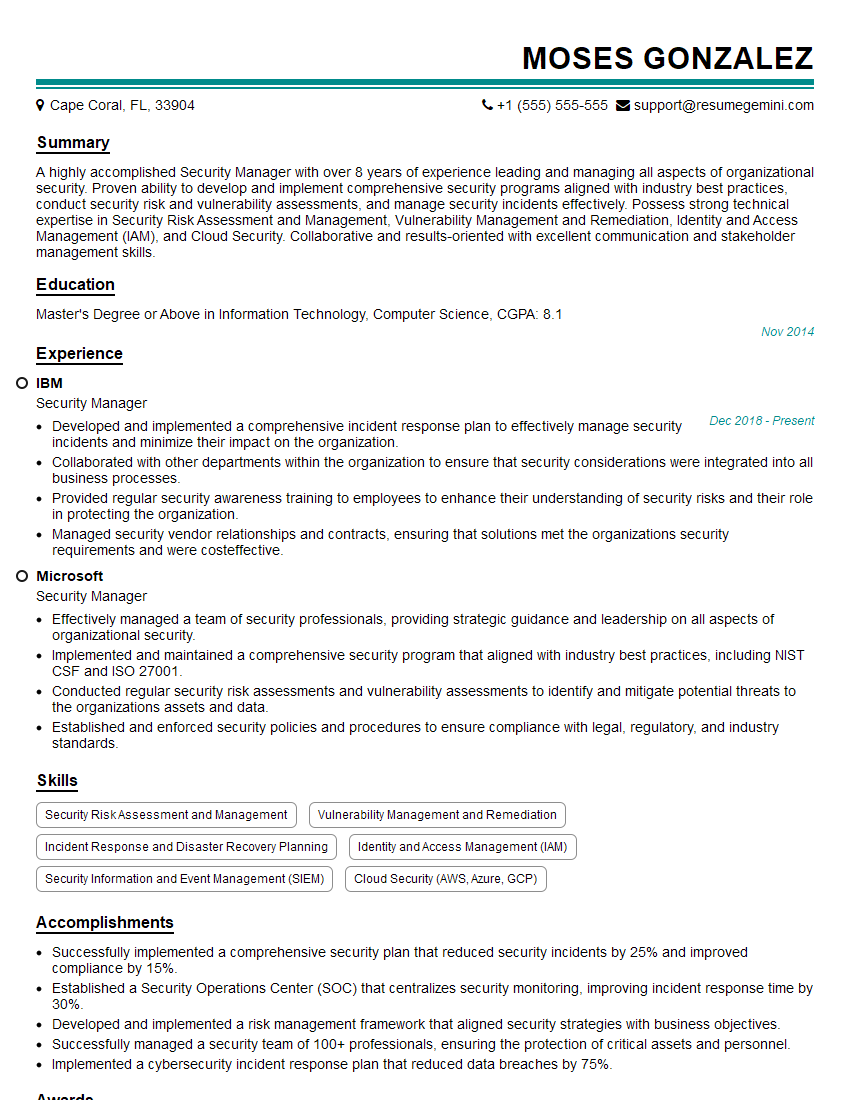
Security Manager Resume Sample

Security Analyst Resume Sample

Security Consultant Resume Sample

Security Engineer Resume Sample

Information Security Analyst Resume Sample

Network Security Engineer Resume Sample
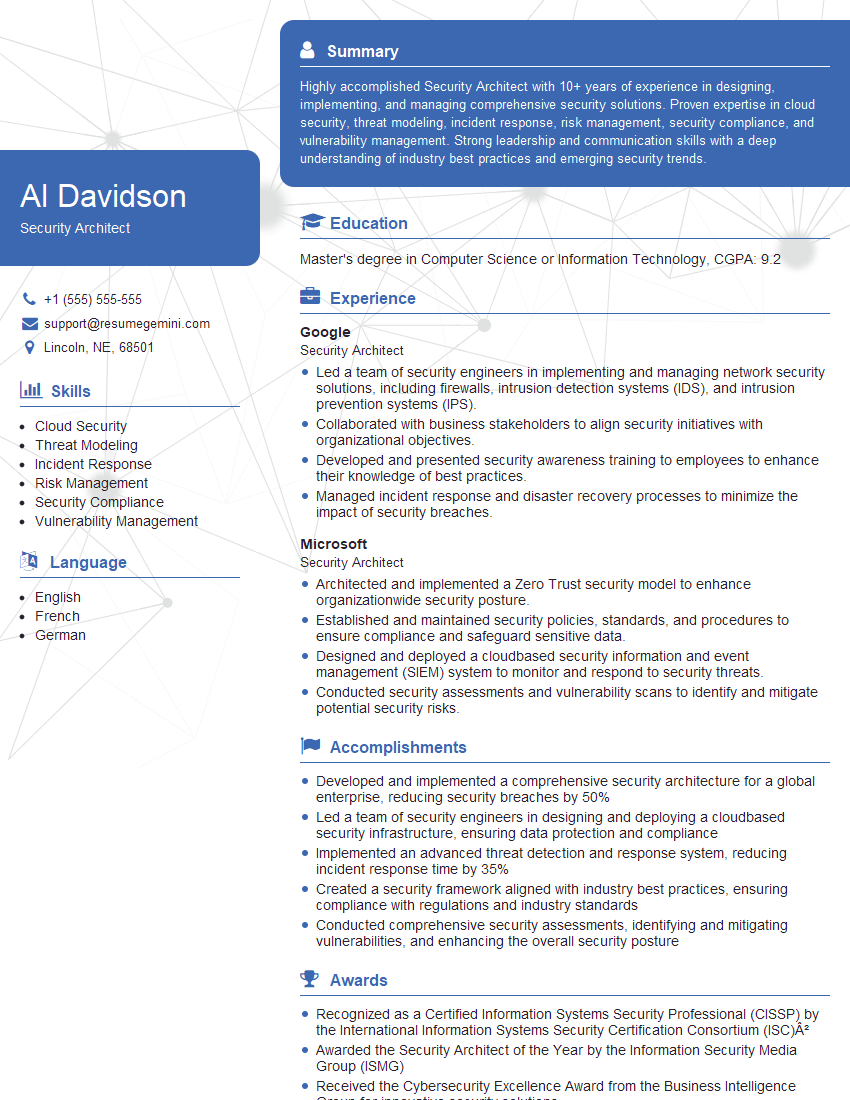
Security Architect Resume Sample

Cybersecurity Engineer Resume Sample

Cybersecurity Analyst Resume Sample
Explore more articles
Users Rating of Our Blogs
Share Your Experience
We value your feedback! Please rate our content and share your thoughts (optional).
What Readers Say About Our Blog
To the interviewgemini.com Webmaster.
Very helpful and content specific questions to help prepare me for my interview!
Thank you
To the interviewgemini.com Webmaster.
This was kind of a unique content I found around the specialized skills. Very helpful questions and good detailed answers.
Very Helpful blog, thank you Interviewgemini team.