The thought of an interview can be nerve-wracking, but the right preparation can make all the difference. Explore this comprehensive guide to Inverter and Charge Controller Installation interview questions and gain the confidence you need to showcase your abilities and secure the role.
Questions Asked in Inverter and Charge Controller Installation Interview
Q 1. Explain the difference between a pure sine wave and a modified sine wave inverter.
The key difference between pure sine wave and modified sine wave inverters lies in the quality of the AC power they produce. Think of it like this: a pure sine wave is a smooth, consistent wave, while a modified sine wave is a more jagged, stepped approximation.
A pure sine wave inverter produces an AC output that closely mimics the smooth sinusoidal waveform of power from the grid. This is crucial for sensitive electronics like computers, audio equipment, and some medical devices. These devices are designed to operate optimally with a clean sine wave and may malfunction or be damaged by the distortions present in modified sine wave outputs.
A modified sine wave inverter, on the other hand, generates a square wave or stepped approximation of a sine wave. While cheaper to manufacture, this ‘rougher’ power can cause issues with sensitive electronics. It may lead to humming noises from devices, reduced efficiency, overheating, and even premature failure. However, it’s perfectly adequate for powering less sensitive loads like lights, simple motors, and some power tools.
In short: Choose a pure sine wave inverter for sensitive electronics; a modified sine wave inverter is suitable for less demanding appliances where cost is a major factor.
Q 2. What are the safety precautions when working with inverters and charge controllers?
Safety is paramount when working with inverters and charge controllers, as we’re dealing with high voltages and currents that can be lethal. Always treat the system as if it’s live, even when it’s switched off.
- Disconnect from the source: Before any work, always disconnect the solar panels from the charge controller and disconnect the inverter from the battery bank. Use properly rated disconnects.
- Wear appropriate PPE: This includes safety glasses, insulated gloves, and closed-toe shoes.
- Work in a well-ventilated area: Inverters can generate heat, and poor ventilation can lead to overheating and potential fire hazards.
- Use proper tools: Only use tools appropriate for the task and voltage rating.
- Follow manufacturer instructions: Carefully read and understand the installation instructions and safety guidelines provided by the manufacturer for both the inverter and the charge controller. These are crucial.
- Never work alone: Always have a spotter or colleague present, especially when working at heights or with high-voltage systems.
- Check for grounding: Ensure that the system is properly grounded to prevent electrical shocks and protect against surges.
A simple mistake can have serious consequences. Prioritizing safety is not optional; it’s essential.
Q 3. How do you troubleshoot a faulty inverter?
Troubleshooting a faulty inverter involves a systematic approach. First, always prioritize safety! Disconnect the inverter from the power source before beginning any troubleshooting.
- Check the obvious: Start with the simple things. Is the inverter switched on? Are the circuit breakers tripped? Are all connections secure?
- Inspect the input voltage: Verify that the battery voltage is within the acceptable range for your inverter. A low battery voltage is a frequent cause of inverter failure.
- Check for overload: Is the inverter overloaded? It may have tripped its protection circuitry if the connected load exceeds its capacity.
- Examine the output voltage: Using a multimeter, check if the inverter is producing an output voltage. If not, there might be an internal problem.
- Look for error codes: Many inverters display error codes that indicate the problem. Consult the inverter’s manual to interpret these codes.
- Check the cooling system: Ensure proper ventilation around the inverter. Overheating is a common cause of failure.
- Test individual components: If the problem persists, you may need to test individual components of the inverter (such as transistors or capacitors) using specialized equipment. This usually requires more advanced knowledge and often necessitates contacting a qualified technician.
If you can’t identify the problem, don’t hesitate to contact a qualified technician. Attempting complex repairs without the necessary expertise can be dangerous and may further damage the inverter.
Q 4. Describe the function of a charge controller and its importance in a solar power system.
A charge controller is the vital traffic manager of your solar power system. It regulates the flow of electricity from the solar panels to the battery bank, preventing overcharging and protecting your batteries from damage.
Think of it like this: solar panels generate power based on sunlight; this power is inherently variable depending on cloud cover and time of day. Batteries, however, need a very specific charging profile to remain healthy and have a long lifespan. The charge controller acts as the intermediary, optimizing the charging process and extending battery life. Without a charge controller, your batteries could be overcharged (leading to damage, reduced lifespan, and potential fire hazards) or undercharged (resulting in poor performance).
The importance is clear: a charge controller protects your investment in solar panels and batteries by ensuring their safe and efficient operation.
Q 5. What are the different types of charge controllers available?
Several types of charge controllers exist, each with its own strengths and weaknesses:
- PWM (Pulse Width Modulation): This is the simplest and most affordable type. It regulates the charging voltage by turning the power on and off rapidly. It’s relatively inefficient, especially in low-light conditions.
- MPPT (Maximum Power Point Tracking): This is a more advanced and efficient type. It constantly adjusts the voltage and current to extract the maximum possible power from the solar panels, even under varying conditions. This results in significantly higher energy yields, particularly during cloudy weather or when the panel’s voltage doesn’t perfectly match the battery.
- Flooded lead-acid specific controllers: Designed to handle the specific needs of flooded lead acid batteries; they typically include equalization and boost charging stages.
- Lithium-ion specific controllers: Optimized for lithium-ion battery chemistries. They often feature advanced features like constant current and constant voltage charging profiles, balancing, and temperature monitoring.
The choice of charge controller type depends largely on budget, efficiency requirements, and the type of battery bank.
Q 6. How do you select the appropriate size inverter and charge controller for a given system?
Selecting the right size inverter and charge controller involves careful consideration of your system’s requirements. A common mistake is undersizing, which can lead to problems down the line.
For the inverter, calculate the total wattage of all the appliances you plan to power. Add a safety margin (typically 20-30%) to account for potential future additions or peak power demands. Select an inverter with a wattage rating that comfortably handles this total.
For the charge controller, consider the total wattage of your solar panels (this information is specified on the panels themselves). Select a charge controller with an amperage rating that is at least 25% higher than the short circuit current of your solar panels. You must also match the voltage of the charge controller to the voltage of your battery bank and solar panels (12V, 24V, 48V, etc.).
Example: If your total appliance wattage is 1500W, you’d choose at least a 2000W inverter (allowing for a 33% margin). If your solar panels have a total short circuit current of 10A, you’d select a charge controller with at least a 12.5A rating. Incorrect sizing can lead to issues like insufficient power or damage to components.
Q 7. Explain the concept of Maximum Power Point Tracking (MPPT) in charge controllers.
Maximum Power Point Tracking (MPPT) is an advanced algorithm used in charge controllers to optimize energy harvesting from solar panels. Solar panels don’t produce maximum power at a single voltage; their power output varies with changing light conditions.
An MPPT charge controller constantly monitors the voltage and current from the solar panels and adjusts the input voltage to extract the maximum possible power at any given moment. It acts like a smart power matchmaker, ensuring that the panels are always operating at their most efficient point. This results in increased energy yield compared to PWM controllers, particularly important during periods of low light or when there’s a mismatch between panel voltage and battery voltage.
Imagine a water pump. A PWM controller would be like turning the pump on and off; an MPPT controller would be like adjusting the pump’s speed to constantly extract the maximum amount of water (power), even as the water pressure (voltage) fluctuates.
Q 8. What are the common causes of overcharging and undercharging in a battery bank?
Overcharging and undercharging a battery bank are serious issues that can significantly shorten its lifespan. Overcharging occurs when the battery is subjected to a voltage higher than its recommended maximum, leading to excessive heat generation, electrolyte loss, and potential damage to internal components. Undercharging, on the other hand, leaves the battery perpetually partially discharged, leading to sulfation (a build-up of lead sulfate crystals that inhibits the battery’s ability to accept a charge) and ultimately reduced capacity and lifespan.
- Common causes of overcharging: Faulty charge controller (incorrectly set voltage limits, malfunctioning components), damaged battery voltage sensor, inverter issues feeding back voltage to the battery, and even prolonged exposure to high ambient temperatures. Think of it like overfilling a water glass – eventually, it spills over.
- Common causes of undercharging: Insufficient solar panel array capacity for the load demands, a charge controller that is not appropriately sized or configured, high system losses due to poor wiring or connections, consistent high loads that drain the batteries faster than they can recharge, and a partially shorted battery cell within the bank. It’s like trying to fill a leaky bucket – it never quite fills up.
Regularly monitoring battery voltage and ensuring the charge controller is correctly set up for the specific battery chemistry (lead-acid, lithium-ion, etc.) are crucial preventive measures.
Q 9. How do you test the output voltage and current of an inverter?
Testing the inverter’s output voltage and current requires a multimeter capable of measuring AC voltage and current for the inverter’s output. Safety first! Always disconnect the load before performing any measurements to prevent electric shock or damage to the equipment. For voltage, simply connect the multimeter’s probes (set to AC voltage) to the inverter’s output terminals. For current measurement, you’ll need to place the multimeter in series with the load using appropriate amperage settings. Make sure your multimeter can handle the expected current draw of the load. Never measure current without the appropriate amperage setting.
- Voltage Measurement: Set your multimeter to the appropriate AC voltage range (e.g., 120V or 240V depending on your inverter). Connect the probes to the inverter’s output terminals. The reading should match the inverter’s rated output voltage under load. If the voltage is significantly lower or higher, there might be a problem with the inverter itself or the connection.
- Current Measurement: Turn off the load. Break the circuit connecting the load to the inverter, carefully inserting the multimeter in series using the appropriately rated amperage setting. Turn the load back on. The reading indicates the current the load is drawing from the inverter. If the current is abnormally high, it might indicate a short circuit in the load or a problem with the inverter.
Compare your readings to the inverter’s specifications. A significant deviation usually points to a problem. For example, a low voltage could suggest a faulty inverter or insufficient battery charge, while a high current could indicate a short circuit.
Q 10. Explain the importance of grounding in an inverter and charge controller installation.
Grounding is critical for safety and performance in inverter and charge controller systems. It provides a low-impedance path for fault currents to flow back to the ground, preventing electrical shocks and protecting equipment. A properly grounded system minimizes the risk of electrical hazards and ensures that the system operates as intended.
- Safety: In the event of a fault, such as a short circuit, the ground provides a safe path for the current to flow, preventing dangerous voltages from appearing on exposed metal parts. Think of it like a lightning rod – it safely directs the energy away from vulnerable structures.
- Performance: Proper grounding minimizes electrical noise and interference, improving the performance and reliability of the inverter and charge controller. It aids in maintaining stable voltage levels and reduces the risk of data corruption.
All metal enclosures, the battery bank negative terminal, and the system’s grounding rod (driven into the earth) should be securely bonded using heavy-gauge copper wire. It’s essential to use a dedicated grounding rod instead of relying on household plumbing or other grounded structures for optimal safety and performance.
Q 11. How do you wire an inverter and charge controller to a battery bank and load?
Wiring an inverter and charge controller involves several steps. Always follow manufacturer instructions carefully and prioritize safety. Incorrect wiring can lead to damage, fires, and electric shock.
- Battery Bank Connections: The battery bank’s negative terminal is connected to the negative busbar and the system ground point. The positive terminal connects to the charge controller’s positive input. This is typically through thick, high-capacity cabling designed for the current carrying capacity of your system.
- Charge Controller Connections: The solar panels connect to the charge controller’s positive and negative input terminals. The charge controller’s output positive is connected to the positive busbar and the negative output to the negative busbar. Use appropriately sized wire gauges for both.
- Inverter Connections: The inverter’s positive and negative input terminals connect to the positive and negative busbars. The inverter’s output leads connect to the load, through an appropriate circuit breaker or fused switch for safety. It’s crucial to make sure these connections can handle the high current demands.
- Load Connections: The load (e.g., lights, appliances) is connected to the inverter’s output terminals through appropriate protection devices such as circuit breakers or fuses.
Use appropriately sized wiring throughout the system, based on the current carrying capacity of the wiring and the overall system current demands. Adequate bus bars are important to maintain reliable and efficient current distribution. Always double-check connections and consider using heat-shrink tubing for secure and watertight connections.
Q 12. Describe the process of commissioning a new inverter and charge controller system.
Commissioning a new inverter and charge controller system involves a systematic process to ensure that everything is correctly installed and operating optimally. This is where you test the system under various conditions.
- Visual Inspection: Thoroughly check all wiring connections for tightness and correct polarity. Inspect the inverter and charge controller for any physical damage.
- Voltage Measurements: Measure the battery voltage, the inverter’s input and output voltages, and the charge controller’s input and output voltages. These should all be within the rated specifications.
- Current Measurements: Measure the solar panel current and the load current to verify that they are operating correctly and meet expectations.
- Functional Testing: Apply a controlled load to the system and monitor the voltage and current under various operational scenarios. Note down power consumption, and verify efficiency.
- Charge/Discharge Cycles: Allow the system to undergo several charge and discharge cycles to evaluate its overall performance and battery behavior. Identify any anomalies.
- Documentation: Record all measurements and observations for future reference and maintenance. Maintain proper records.
This commissioning process ensures the system’s long-term reliability and optimizes its performance. Think of it like a car’s initial service after purchase – essential for ensuring it performs as intended.
Q 13. What are the common problems encountered during inverter and charge controller installation?
Common problems encountered during inverter and charge controller installations stem from several issues, such as improper planning, faulty components, and incorrect wiring.
- Wiring Issues: Incorrect wiring, loose connections, insufficient gauge wire, and improper grounding all lead to system failures. Poor wiring creates heat and resistance, potentially causing fires.
- Component Failure: Faulty inverters, charge controllers, or batteries can render the entire system useless. Check manufacturer warranty and replace defective components.
- Oversizing/Undersizing: Using components that are too small (undersized) or too large (oversized) can result in performance issues and safety hazards. Proper sizing is crucial for efficient operation.
- Environmental Factors: Excessive heat, cold, or moisture can negatively affect the performance of the system and reduce its lifespan. Ensure suitable installation locations.
- Incorrect Configuration: Incorrectly setting up the charge controller, such as wrong battery type or charge parameters, can lead to overcharging or undercharging.
Regular maintenance checks and adhering to manufacturer guidelines can significantly mitigate these problems.
Q 14. How do you troubleshoot a system with low voltage or low current?
Low voltage or low current are common symptoms of various underlying issues in an off-grid power system.
- Low Voltage: Low battery voltage is the most likely cause. Check the battery state of charge (SoC) using a multimeter. If the SoC is low, you need to determine why it isn’t charging properly. Is there sufficient sunlight for the solar array to generate enough power? Is there a fault in the charge controller or solar panels? Also, check for high loads that are depleting the battery faster than it’s being recharged. Look at the battery itself – it may be failing.
- Low Current: Low current can be due to problems with the solar panel array (shading, damage, or insufficient capacity), loose connections between the solar panels and the charge controller, or issues within the charge controller itself. Check each component thoroughly. Poor connections cause voltage drop and reduce the available current. A damaged cell in the battery can also cause low current.
Systematic troubleshooting using a multimeter is essential. Start by checking the simplest things – connections – and work your way toward more complex components. If the system is still malfunctioning after checking all the components, seek professional assistance.
Q 15. What are the different types of batteries used in renewable energy systems?
Renewable energy systems utilize various battery types, each with its strengths and weaknesses. The choice depends on factors like cost, lifespan, discharge rate requirements, and environmental impact.
- Lead-Acid Batteries: These are the most common and affordable, offering a good balance of performance and price. However, they have a shorter lifespan than other types and require more maintenance. Flooded lead-acid (FLA) and Absorbent Glass Mat (AGM) are two common subtypes, with AGM offering improved performance and less maintenance.
- Lithium-ion Batteries: These are becoming increasingly popular due to their higher energy density, longer lifespan, and faster charging capabilities. They are more expensive upfront but often result in lower long-term costs. Different chemistries exist within lithium-ion, such as LFP (Lithium Iron Phosphate), NMC (Nickel Manganese Cobalt), and NCA (Nickel Cobalt Aluminum), each with varying characteristics.
- Nickel-Cadmium (NiCd) Batteries: These offer good performance in cold temperatures but are less environmentally friendly due to the presence of cadmium. They’re less common in modern systems.
- Nickel-Metal Hydride (NiMH) Batteries: These provide a good alternative to NiCd, offering a better environmental profile and similar performance, though they still aren’t as popular as lead-acid or lithium-ion.
For example, a small residential system might use AGM lead-acid batteries for their cost-effectiveness, while a large-scale commercial system might opt for Lithium-ion for its superior performance and longer lifespan, despite the higher initial investment.
Career Expert Tips:
- Ace those interviews! Prepare effectively by reviewing the Top 50 Most Common Interview Questions on ResumeGemini.
- Navigate your job search with confidence! Explore a wide range of Career Tips on ResumeGemini. Learn about common challenges and recommendations to overcome them.
- Craft the perfect resume! Master the Art of Resume Writing with ResumeGemini’s guide. Showcase your unique qualifications and achievements effectively.
- Don’t miss out on holiday savings! Build your dream resume with ResumeGemini’s ATS optimized templates.
Q 16. Explain the difference between a grid-tied and off-grid system.
The key difference lies in their connection to the electrical grid.
- Grid-tied systems are connected to the utility grid. They operate only when the grid is active and feed excess power back to the grid. They generally require less battery storage since the grid acts as a backup power source. This simplifies system design and reduces initial costs.
- Off-grid systems operate independently of the utility grid. They rely solely on renewable energy sources (like solar or wind) and battery storage to provide power. This requires a more complex system design and higher initial investment due to the necessity of significant battery storage to ensure power availability during periods of low energy generation or at night.
Imagine a homeowner with solar panels. A grid-tied system allows them to use solar power when the sun shines, and draw power from the grid at night. An off-grid homeowner, on the other hand, needs sufficient batteries to store enough energy to power their house throughout the night, even on cloudy days.
Q 17. How do you calculate the total power consumption of a system?
Calculating total power consumption involves summing the power requirements of all the loads connected to the system. This is crucial for sizing the inverter, charge controller, and battery bank correctly.
Steps:
- Identify all loads: List every appliance, light, or device that will be powered by the system. Note their wattage (power rating) typically found on a label.
- Calculate individual load power: If an appliance’s rating is in amps (A) and volts (V), use the formula:
Power (Watts) = Voltage (Volts) x Current (Amps) - Sum individual loads: Add the wattage of all the loads to obtain the total power consumption.
- Consider safety margin: Add a safety factor (usually 20-30%) to account for future additions or unforeseen load increases.
Example: Let’s say you have a 100W refrigerator, 60W lighting, and a 50W TV. Total power consumption is 100W + 60W + 50W = 210W. Adding a 20% safety margin, the total system design should handle at least 252W (210W * 1.2).
Q 18. What are the environmental considerations for installing renewable energy systems?
Environmental considerations are paramount in renewable energy system installations. Minimizing environmental impact requires careful planning and execution throughout the project lifecycle.
- Material Selection: Prioritize using recyclable and environmentally friendly materials. This includes considering the environmental impact of battery manufacturing and disposal.
- Land Use: Solar panel arrays can require significant land area, impacting natural habitats. Careful site selection is essential to minimize ecological disruption.
- Waste Management: Proper disposal of old batteries and solar panels is crucial to prevent environmental contamination. Recycling options should be investigated and utilized.
- Habitat Preservation: Avoid disturbing wildlife during construction. Choose a location that minimizes impact on sensitive ecosystems.
- Carbon Footprint: While renewable energy systems reduce carbon emissions compared to fossil fuel-based systems, the manufacturing process and transportation of components contribute to their carbon footprint. Consider these factors and choose materials and systems with the lowest possible overall impact.
For instance, choosing a location for a solar array that avoids sensitive wetlands protects biodiversity. Similarly, selecting long-lasting lithium-ion batteries with responsible end-of-life recycling solutions reduces the environmental impact over the system’s lifetime.
Q 19. Explain the role of fuses and circuit breakers in a solar power system.
Fuses and circuit breakers are essential safety devices in solar power systems, protecting components and preventing fires or electrical shocks.
- Fuses: These are one-time devices that melt and break the circuit when excessive current flows, protecting downstream components. They are simpler and cheaper than circuit breakers but need replacement after they blow.
- Circuit Breakers: These are reusable devices that automatically interrupt the circuit when an overcurrent condition is detected. They can be reset manually after the fault is cleared, offering convenience and reduced maintenance costs compared to fuses.
Both are crucial for protection against short circuits, overloads, and other fault conditions. They are typically incorporated at various points in the system, such as the main panel, individual strings of solar panels, and the inverter. For example, a fuse might protect a specific string of solar panels, while a circuit breaker might protect the entire system’s main input.
Q 20. What are the different types of solar panels used?
Solar panels are broadly categorized into different types, primarily based on their cell technology.
- Monocrystalline Silicon: These panels are made from a single silicon crystal, resulting in high efficiency and a sleek black appearance. They are usually more expensive than polycrystalline panels but generate more power per unit area.
- Polycrystalline Silicon: These panels are made from multiple silicon crystals, resulting in slightly lower efficiency and a characteristic blue appearance. They are generally less expensive than monocrystalline panels, making them a popular choice for cost-conscious projects.
- Thin-Film Solar Panels: These use thin layers of photovoltaic material, such as cadmium telluride (CdTe) or copper indium gallium selenide (CIGS), deposited on a substrate. They are lightweight and flexible but usually have lower efficiency than crystalline silicon panels.
- Perovskite Solar Cells: These are a relatively new technology showing high efficiency potential and cost-effectiveness, but are still under development and not as widely available as other types.
For example, a homeowner prioritizing space optimization might choose monocrystalline panels for their higher efficiency. A larger commercial project with a budget constraint might opt for polycrystalline panels.
Q 21. How do you determine the appropriate wire gauge for a given system?
Choosing the correct wire gauge is crucial for safety and efficient power transmission. Incorrect wire sizing can lead to overheating, voltage drops, and potential fire hazards.
The appropriate wire gauge is determined by considering the:
- Current (Amperes): The higher the current, the larger (lower gauge number) the wire needs to be.
- Voltage: Higher voltage systems generally require smaller gauge wire for the same power transfer.
- Distance: Longer wire runs result in higher voltage drop, necessitating a larger gauge wire to compensate.
- Ambient temperature: Higher temperatures require a larger gauge wire to prevent overheating.
Consult the relevant electrical code and manufacturer’s specifications to determine the correct wire gauge for your system. Online wire sizing calculators can also assist in selecting appropriate wire gauges based on the system’s current, voltage, and distance. Always err on the side of caution and choose a larger gauge wire if unsure. Improper wire sizing is a significant safety concern that must be avoided.
Q 22. Explain the concept of parallel and series connections in solar panels.
Connecting solar panels in series or parallel significantly impacts the overall system voltage and current. Think of it like connecting batteries: series increases voltage, parallel increases current.
- Series Connection: Panels are connected end-to-end, + to -, adding their voltages. If you have three 12V panels in series, you get 36V. This is useful for higher voltage systems, reducing current and minimizing wire size.
- Parallel Connection: Panels are connected + to + and – to -, adding their currents. Three 12V panels in parallel still provide 12V but with triple the amperage. This is better for systems needing higher current at a lower voltage.
Practical Application: The choice depends on your inverter’s input voltage and current requirements. A high-voltage inverter needs a series connection, while a high-current inverter might need a parallel connection. Incorrect wiring can lead to system damage or malfunction, so careful planning and calculation are crucial.
Q 23. How do you troubleshoot communication errors between the inverter and charge controller?
Troubleshooting communication errors between an inverter and charge controller requires a systematic approach. First, always ensure the system is safely disconnected before beginning any troubleshooting.
- Check the Wiring: Look for loose connections, damaged cables, or incorrect wiring between the inverter and charge controller. Pay close attention to the communication protocol specified by the manufacturers (e.g., RS-485, CAN bus).
- Verify Communication Settings: Ensure the baud rate, parity, and other communication parameters in the inverter and charge controller are correctly matched. Consult the manuals for specific settings.
- Check for Interference: Electromagnetic interference (EMI) from other devices can disrupt communication. Try temporarily disconnecting any nearby devices to isolate the problem.
- Inspect the Communication Ports: Examine the physical communication ports on both the inverter and charge controller for any damage or debris.
- Firmware Updates: Outdated firmware can cause compatibility issues. Check for and install the latest firmware updates from the manufacturers’ websites.
- Factory Reset: As a last resort, perform a factory reset on both the inverter and charge controller to restore default settings. Remember to reconfigure the system afterwards.
Example: In one installation, I found a faulty communication cable causing intermittent communication errors. Replacing the cable immediately resolved the problem.
Q 24. What are the different methods of monitoring a solar power system?
Monitoring a solar power system is crucial for performance optimization and troubleshooting. Several methods exist:
- Inverter’s Built-in Monitoring: Most inverters have a display and sometimes web or app interfaces providing real-time data on power generation, voltage, current, and energy production.
- Dedicated Monitoring Systems: These systems use sensors to collect data from various points in the system and provide comprehensive monitoring and analysis. They can give alerts for potential problems.
- Data Loggers: Data loggers record system performance over time, allowing for historical analysis and trend identification.
- Remote Monitoring: Some inverters and monitoring systems offer remote access via internet connectivity allowing for convenient system monitoring from anywhere.
Practical Application: Continuous monitoring can help identify issues like shading on panels, faulty components, or inverter malfunctions, allowing for timely repairs or adjustments.
Q 25. Explain the importance of regular maintenance of inverters and charge controllers.
Regular maintenance is vital to ensure the longevity and optimal performance of inverters and charge controllers. Neglecting maintenance can lead to decreased efficiency, premature failure, and safety hazards.
- Cleaning: Keep the inverters and charge controllers clean, removing dust and debris to improve cooling and prevent overheating.
- Tightening Connections: Periodically inspect and tighten all terminal connections to prevent loose contacts that can lead to arcing and potential fire hazards.
- Visual Inspection: Regularly inspect for any signs of damage, corrosion, or overheating.
- Firmware Updates: Install firmware updates as they become available to improve performance and address potential bugs.
Example: Failing to clean dust from an inverter’s heatsink can lead to overheating and reduced efficiency. This could significantly impact the lifespan of the component.
Q 26. How do you ensure the safety of the system during maintenance?
Safety is paramount during maintenance. Always follow these steps:
- Disconnect the System: Completely disconnect the system from the solar panels, battery bank, and the grid before beginning any work. Use appropriate lockout/tagout procedures to prevent accidental re-energization.
- Use Appropriate PPE: Wear appropriate personal protective equipment (PPE), including safety glasses, gloves, and insulated tools.
- Grounding: Ensure the system is properly grounded to prevent electrical shocks.
- Check for Voltage: Use a non-contact voltage tester to verify that the system is completely de-energized before touching any components.
- Work with a Partner: Whenever possible, have another qualified technician present to assist with maintenance tasks.
Example: A simple oversight like forgetting to disconnect the system completely could lead to serious injury. Following a strict safety protocol is non-negotiable.
Q 27. What are the latest advancements in inverter and charge controller technology?
Recent advancements in inverter and charge controller technology are focused on improving efficiency, reliability, and intelligence:
- Higher Efficiency: New inverters boast higher conversion efficiencies, maximizing energy harvesting from the solar panels.
- Improved MPPT Algorithms: More sophisticated Maximum Power Point Tracking (MPPT) algorithms optimize energy extraction even under varying sunlight conditions.
- Smart Grid Integration: Many inverters offer smart grid features like power factor correction and grid support capabilities.
- Modular Designs: Modular inverters offer flexibility and easier maintenance. Replacing a single faulty module is easier than replacing the entire inverter.
- Advanced Communication Protocols: Improved communication protocols like Ethernet and Wi-Fi allow for better remote monitoring and control.
- Integrated Monitoring and Control: Some inverters and charge controllers include sophisticated integrated monitoring and control systems.
Example: The use of silicon carbide (SiC) power semiconductors is increasing efficiency and reducing energy losses in newer inverters.
Q 28. Describe a challenging installation you faced and how you overcame it.
I once faced a challenging installation in a remote location with limited access and extreme weather conditions. The site was on a steep hillside, making it difficult to transport equipment and wire the system.
The Challenge: The terrain made it challenging to safely and efficiently install the solar panels, inverters, and batteries. Furthermore, the unpredictable weather added to the complexity.
The Solution: We carefully planned the logistics, utilizing a small, specialized crane to lift the equipment to the installation site. We also implemented a robust grounding system to address the risk of lightning strikes. To mitigate the effects of the weather, we used weather-resistant equipment and implemented a contingency plan for weather delays.
Outcome: Despite the challenges, we successfully installed the system and it remains operational today. It highlighted the importance of detailed planning, careful execution, and adaptability in handling unexpected circumstances.
Key Topics to Learn for Inverter and Charge Controller Installation Interview
- Inverter Fundamentals: Understanding different inverter types (pure sine wave, modified sine wave), their specifications (power rating, efficiency, input/output voltage), and working principles.
- Charge Controller Functionality: Comprehending the role of charge controllers in regulating battery charging, preventing overcharging and maximizing battery lifespan. Familiarize yourself with MPPT (Maximum Power Point Tracking) technology and its advantages.
- Installation Procedures: Mastering safe and efficient installation practices, including wiring diagrams, grounding techniques, and safety precautions. Practice visualizing and explaining the process step-by-step.
- Troubleshooting and Diagnostics: Developing problem-solving skills to identify and resolve common issues like overcurrent, overvoltage, and faulty components. Practice explaining your diagnostic approach.
- System Design Considerations: Understanding how to size inverters and charge controllers appropriately for specific loads and battery banks, considering factors like power consumption and energy storage capacity.
- Safety Regulations and Codes: Familiarity with relevant electrical safety codes and regulations pertaining to inverter and charge controller installations, ensuring compliance and safe operation.
- Practical Application: Describe real-world scenarios where you’ve successfully installed or troubleshooted inverter/charge controller systems. Highlight your problem-solving skills and practical experience.
- Advanced Concepts (Optional): Explore topics like grid-tied inverters, off-grid systems, battery management systems (BMS), and communication protocols used in solar energy systems.
Next Steps
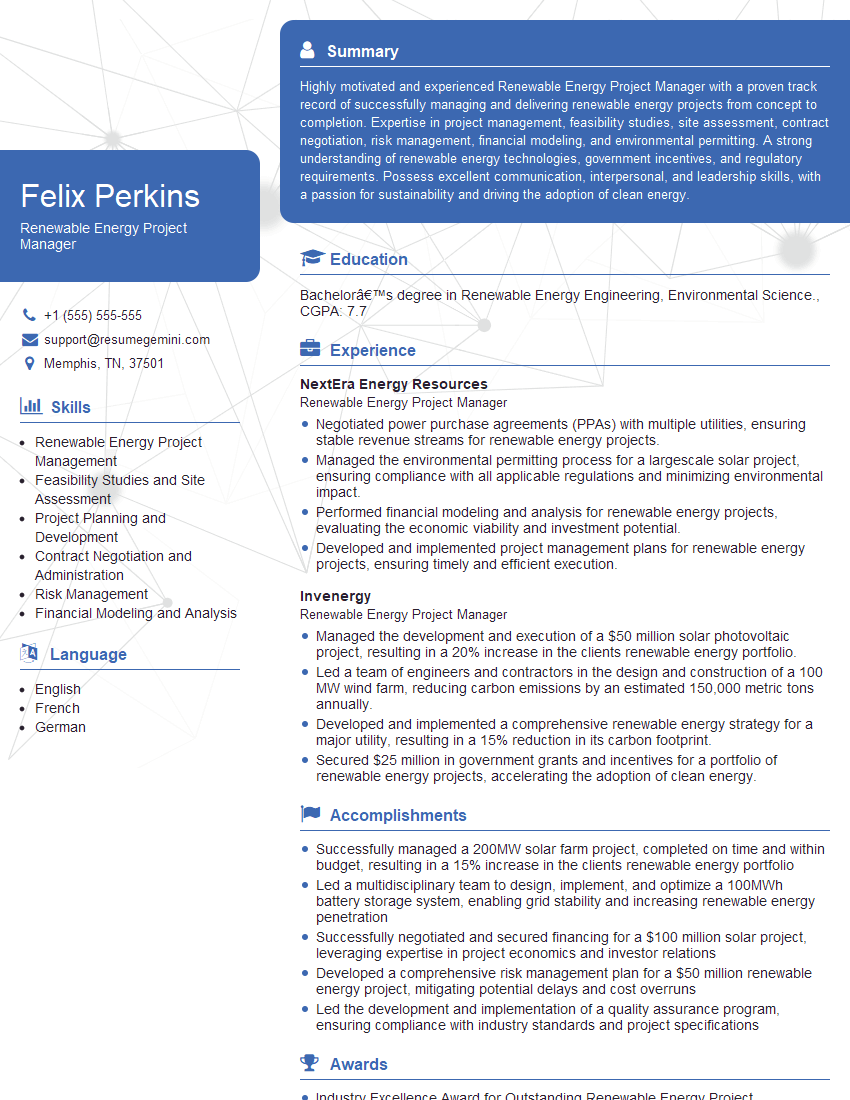
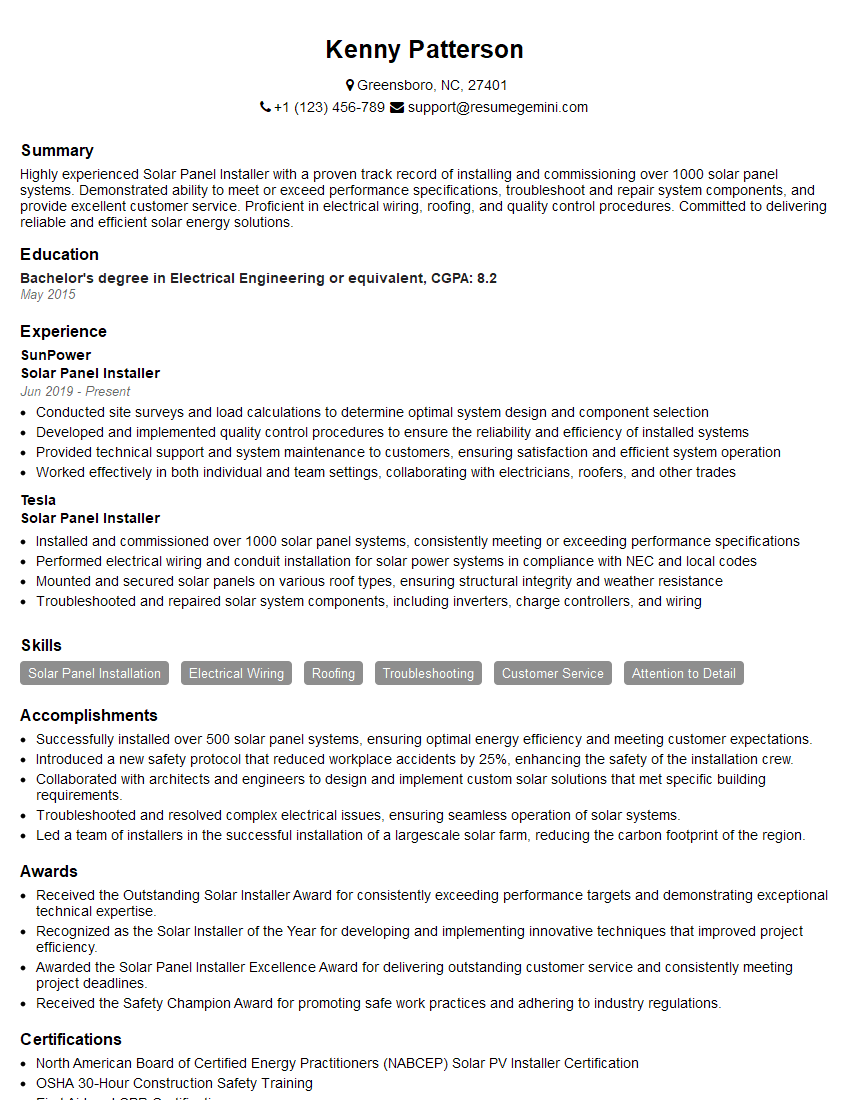
Mastering Inverter and Charge Controller Installation opens doors to exciting career opportunities in the rapidly growing renewable energy sector. A strong understanding of these systems is highly valued by employers, leading to increased job prospects and career advancement. To maximize your chances of landing your dream job, create an ATS-friendly resume that highlights your skills and experience effectively. ResumeGemini is a trusted resource that can help you build a professional and impactful resume. They offer examples of resumes tailored to Inverter and Charge Controller Installation, providing you with valuable templates and guidance to showcase your expertise convincingly. Invest time in crafting a compelling resume—it’s your first impression on potential employers.
Explore more articles
Users Rating of Our Blogs
Share Your Experience
We value your feedback! Please rate our content and share your thoughts (optional).
What Readers Say About Our Blog
To the interviewgemini.com Webmaster.
Very helpful and content specific questions to help prepare me for my interview!
Thank you
To the interviewgemini.com Webmaster.
This was kind of a unique content I found around the specialized skills. Very helpful questions and good detailed answers.
Very Helpful blog, thank you Interviewgemini team.