Are you ready to stand out in your next interview? Understanding and preparing for Inverter Installation and Commissioning interview questions is a game-changer. In this blog, we’ve compiled key questions and expert advice to help you showcase your skills with confidence and precision. Let’s get started on your journey to acing the interview.
Questions Asked in Inverter Installation and Commissioning Interview
Q 1. Explain the different types of inverters (grid-tied, off-grid, hybrid).
Inverters are the heart of any solar power system, converting DC electricity from solar panels into AC electricity usable by homes and businesses. There are three main types:
- Grid-tied inverters: These are the most common type, directly connecting to your home’s electrical grid. They only produce power when the grid is active and feed excess power back into the grid. Think of them as a one-way street for electricity. They are typically less expensive and simpler to install. For example, many residential solar installations utilize grid-tied inverters.
- Off-grid inverters: These operate independently of the electrical grid. They typically include battery storage, allowing you to use solar power even when the grid is down. They are ideal for remote locations or situations requiring backup power. Imagine a cabin in the woods – an off-grid inverter would be essential.
- Hybrid inverters: These offer the best of both worlds, combining grid-tied and off-grid functionality. They can utilize solar power to feed the grid, store energy in batteries for later use, and switch seamlessly to battery power if the grid goes down. This offers maximum flexibility and resilience.
The choice of inverter type depends heavily on your specific energy needs and location.
Q 2. Describe the process of connecting an inverter to a solar array.
Connecting an inverter to a solar array is a crucial step and requires meticulous attention to detail and safety. The process generally follows these steps:
- Safety First: Always disconnect the solar array and the inverter from the power source before starting any work. Lockout/Tagout procedures are mandatory.
- Verify Compatibility: Ensure the inverter’s specifications (voltage, current, power rating) are compatible with the solar array’s output.
- Connect DC Cables: Connect the positive (+) and negative (-) DC cables from the solar array to the corresponding terminals on the inverter, ensuring proper polarity and secure connections. Use appropriately sized and rated DC connectors and wire.
- Connect AC Cables: Connect the AC output cables from the inverter to the electrical panel, following all applicable electrical codes and regulations. This usually involves connecting to breakers specifically designated for the inverter output.
- Grounding and Earthing: Properly ground the inverter and the solar array to protect against electrical shocks and surges. Ensure proper grounding connections according to local and national electrical codes.
- Final Checks: Visually inspect all connections for tightness and proper insulation. Check the inverter’s manual for specific instructions.
Remember that proper cable sizing is crucial. Using undersized cables can lead to overheating and fire hazards. Incorrect polarity can severely damage the inverter and other components.
Q 3. How do you ensure the safety of personnel during inverter installation?
Safety is paramount during inverter installation. The following measures are essential:
- Lockout/Tagout (LOTO): Implement a robust LOTO procedure to isolate the power sources (both AC and DC) before working on the system. This is non-negotiable.
- Personal Protective Equipment (PPE): Always wear appropriate PPE, including insulated gloves, safety glasses, and sturdy work boots.
- Trained Personnel: Only qualified and trained electricians should perform inverter installation. Experience with high-voltage DC systems is a must.
- Work Permits: Obtain necessary work permits before commencing any installation work.
- Proper Tools: Use the correct tools for the job, ensuring they are well-maintained and properly insulated.
- Emergency Response Plan: Have a clearly defined emergency response plan in case of accidents or electrical shocks.
A thorough safety briefing at the start of any installation is crucial to ensure everyone understands the potential hazards and safety procedures. A safety-first mindset is not just a guideline, it’s the foundation of responsible and successful installation work.
Q 4. What are the key safety precautions when working with high-voltage DC systems?
Working with high-voltage DC systems presents significant risks. Here are crucial safety precautions:
- Always assume the system is energized until proven otherwise. Never touch any exposed conductors or terminals without first verifying they are de-energized.
- Use insulated tools and equipment. Any tools used must be rated for the voltage level of the DC system.
- Wear appropriate PPE, including insulated gloves, safety glasses, and arc flash protection. Arc flash hazards are very real with high-voltage systems.
- Never work alone. Always have a qualified colleague present as a spotter and to assist in emergencies.
- Understand the system’s grounding and earthing. Ensure proper grounding is in place to prevent electric shocks.
- Follow lockout/tagout procedures rigorously. This is the most effective way to prevent accidental energization.
- Regularly inspect equipment and wiring for any signs of damage.
High-voltage DC systems demand a level of caution and expertise that far surpasses working with low-voltage systems. Cutting corners is not an option.
Q 5. Explain the importance of grounding and earthing in inverter installations.
Grounding and earthing are vital for safety and proper operation of an inverter installation. They protect against electrical shocks, lightning strikes, and voltage surges.
- Grounding: Connecting the inverter’s metal chassis to the earth, providing a low-resistance path for fault currents to flow to the ground. This prevents the chassis from becoming energized in case of a fault.
- Earthing: Connecting the neutral point of the AC system to the earth. This helps stabilize voltage levels and provides a reference point for the electrical system.
Improper grounding can lead to serious consequences, including electrical shocks, equipment damage, and fires. Always follow local electrical codes and regulations regarding grounding and earthing. These codes specify the type and size of grounding conductors to use, and the proper connection methods. A properly grounded system is the first line of defense against electrical hazards.
Q 6. How do you troubleshoot common inverter faults?
Troubleshooting inverter faults requires a systematic approach. Here’s a process:
- Check for obvious signs: Examine the inverter for any visible damage, loose connections, or tripped circuit breakers.
- Consult the inverter’s display: Many inverters display error codes indicating the nature of the fault. Refer to the manufacturer’s manual to decipher these codes.
- Check DC input voltage and current: Ensure the solar array is producing sufficient power and that there are no problems with the wiring or connections to the solar panels.
- Check AC output voltage and current: Verify the inverter is producing AC power as expected.
- Inspect wiring and connections: Check for loose connections, damaged wires, or corrosion.
- Test grounding and earthing: Ensure proper grounding and earthing are established.
- Review the system’s logs: Modern inverters often keep detailed logs of events and errors. Analyze these logs to find patterns or clues.
- Contact the manufacturer or a qualified technician: If you can’t identify and resolve the fault, it’s best to contact a qualified professional.
Systematic troubleshooting, using the inverter’s built-in diagnostics and testing the system’s components one by one, is much more effective than guesswork. Always prioritize safety; never attempt repairs if you are not properly trained.
Q 7. Describe the process of commissioning an inverter.
Commissioning an inverter involves a thorough process to ensure it’s operating correctly and safely. Here’s a typical process:
- Visual Inspection: Thoroughly inspect all wiring, connections, and components for damage or loose connections.
- Safety Checks: Verify that all safety devices are functioning correctly, including circuit breakers and ground connections.
- Power-Up and Initialization: Turn on the inverter and allow it to initialize.
- Data Logging and Monitoring: Use monitoring software or the inverter’s display to monitor performance parameters such as voltage, current, frequency, and power output.
- Performance Testing: Under various operating conditions, test the inverter’s ability to produce and manage power. This may involve adjusting settings.
- Grid Synchronization (for grid-tied inverters): Verify that the inverter is properly synchronized with the grid and is feeding power back into the grid as expected. This is a critical step.
- Safety Testing: Perform insulation resistance tests and other safety checks to confirm the system’s electrical integrity.
- Documentation: Document all testing results, settings, and any anomalies encountered during the commissioning process.
Proper commissioning is not just a formality; it’s a critical step to ensure the longevity, efficiency and most importantly, the safety of the solar power system. A well-commissioned system will operate optimally and minimize potential problems.
Q 8. What are the key parameters you monitor during inverter commissioning?
Commissioning an inverter involves meticulously verifying its performance and safety. We monitor several key parameters to ensure optimal operation and adherence to specifications. These parameters fall into several categories:
- DC-Side Parameters: We check the input voltage and current from the solar array. This includes monitoring for any imbalances between strings and ensuring the voltage stays within the inverter’s acceptable range. We also look at the power produced by the array to ensure it aligns with expectations based on solar irradiance and array characteristics.
- AC-Side Parameters: This focuses on the output of the inverter. We check the output voltage, current, frequency, and power. These values must adhere to grid codes and the inverter’s specifications. We also monitor the power factor to ensure efficient energy delivery.
- Efficiency and Losses: We analyze the inverter’s efficiency, comparing the input DC power to the output AC power. Losses should be within the manufacturer’s specifications. High losses could indicate problems with components or wiring.
- Temperature Monitoring: Internal inverter temperature is crucial. Overheating can significantly impact lifespan and performance. We verify the temperature remains within safe operating limits.
- Protection Mechanisms: We test the inverter’s protection features, such as overcurrent, overvoltage, and ground fault protection. This ensures it responds appropriately to faults and safeguards the system.
For example, during a recent commissioning, we detected a slight imbalance in the DC input current between two strings. This was addressed by adjusting the wiring connections to ensure even distribution of the solar power, improving overall efficiency.
Q 9. How do you interpret inverter performance data?
Interpreting inverter performance data is crucial for identifying potential issues and optimizing the system’s output. We use a combination of techniques:
- Visual Inspection of Trends: We analyze graphs showing power production, voltage, current, and temperature over time. Consistent deviations from expected values can indicate underlying problems.
- Comparison to Baseline Data: We compare current performance data to baseline data collected during optimal operating conditions. Significant discrepancies can point to performance degradation.
- Performance Ratios: We calculate key performance indicators (KPIs) like PR (Performance Ratio) and CUF (Capacity Utilization Factor) to assess system efficiency. These ratios allow for easy comparisons between different systems and highlight areas for improvement. A low PR might suggest shading issues or suboptimal array orientation.
- Alarm and Error Logs: We scrutinize the inverter’s event logs for any error messages or alarms. These can provide valuable clues about the nature and cause of problems.
- Data Analysis Software: Sophisticated monitoring software can analyze large amounts of data, identify patterns, and alert us to potential problems before they escalate. This proactive approach is particularly helpful for large-scale solar installations.
Imagine a scenario where the PR is consistently low. Through analysis, we might discover that shading on part of the array is significantly reducing the output. This could be resolved by strategically trimming trees or installing more efficient panel placement.
Q 10. What are the common causes of inverter failure?
Inverter failures can stem from various causes, broadly categorized as:
- Environmental Factors: Extreme temperatures (both high and low), humidity, and dust accumulation can severely stress components, leading to malfunctions. For example, overheating can damage semiconductors and capacitors.
- Component Degradation: Capacitors, semiconductors, and other components have limited lifespans. Age-related degradation can lead to failures. This is why regular preventative maintenance is essential.
- Overloading and Overcurrent: Exceeding the inverter’s rated power or current can lead to immediate failure or gradual degradation. Proper sizing and protection are crucial.
- Electrical Faults: Short circuits, grounding issues, and other electrical faults can damage the inverter. Thorough installation and grounding practices are essential.
- Manufacturing Defects: While less common, manufacturing defects can result in premature failures. This highlights the importance of purchasing inverters from reputable manufacturers.
A practical example: I once dealt with an inverter failure caused by a ground fault. A thorough investigation traced the fault to corroded wiring within the junction box. Prompt identification and repair prevented further damage to the system.
Q 11. Explain the concept of Maximum Power Point Tracking (MPPT).
Maximum Power Point Tracking (MPPT) is a crucial function in solar inverters. It aims to extract the maximum possible power from the solar array at any given moment. Solar panels don’t produce power at a constant rate; it varies with sunlight intensity and temperature. The voltage and current at which maximum power is generated also change. MPPT algorithms continuously adjust the inverter’s input voltage to operate at the optimal voltage-current combination for maximum power extraction.
Think of it like this: imagine trying to squeeze the most juice from a lemon. You wouldn’t just squeeze it haphazardly. You’d apply pressure in a way that maximizes juice extraction. MPPT does the same for solar panels, dynamically adjusting the ‘pressure’ (voltage) to get the most ‘juice’ (power).
Different MPPT algorithms exist, such as Perturb and Observe (P&O), Incremental Conductance (IncCond), and others. Each has its own advantages and disadvantages in terms of efficiency and speed of tracking.
Q 12. How does an inverter handle grid faults?
Inverters incorporate various protection mechanisms to handle grid faults, ensuring both the safety of personnel and the integrity of the equipment. The response depends on the type of grid fault:
- Islanding Protection: If the grid goes down, the inverter must automatically disconnect from the grid to prevent it from feeding power back into the grid. This is a crucial safety measure for utility workers.
- Overvoltage and Undervoltage Protection: The inverter detects and responds to deviations in grid voltage. If the voltage is too high or too low, the inverter shuts down to prevent damage.
- Frequency Deviation Protection: Similar to voltage protection, the inverter monitors the grid frequency and disconnects if it deviates beyond acceptable limits. This often accompanies other protection measures.
- Ground Fault Protection: The inverter detects and reacts to ground faults, ensuring worker safety and equipment protection.
- Anti-Islanding Relay (if required): Certain grids require an anti-islanding relay to ensure a quick disconnection during a grid failure. This relay provides an added layer of safety.
The specific response may vary depending on the inverter’s design and the relevant grid codes. Often, detailed logs of the events will be saved, helping troubleshoot in case of outages.
Q 13. Describe the different communication protocols used with inverters.
Inverters employ various communication protocols for monitoring, control, and data exchange. The choice of protocol depends on factors like cost, distance, speed requirements, and network infrastructure.
- RS-232/RS-485: Serial communication protocols suitable for local communication with monitoring devices or a central control system. These are commonly used for point-to-point communication within short distances.
- Ethernet (TCP/IP): Provides network communication over a local area network (LAN) or the internet, allowing for remote monitoring and control. Ideal for larger installations with many inverters.
- Modbus TCP/RTU: Widely used industrial communication protocol. Offers both TCP/IP (for network communication) and RTU (for serial communication) versions. Suitable for integration with other industrial control systems.
- CAN bus: A high-speed communication protocol used for real-time control in applications where speed and reliability are crucial.
- Wireless Protocols (WiFi, Zigbee, etc.): Used for remote monitoring and control, especially useful in locations where wired communication is impractical.
For example, a large-scale solar farm would likely utilize Ethernet for data collection from multiple inverters and send it to a central monitoring system. Smaller residential systems might use RS-485 for communication with a local monitor.
Q 14. How do you ensure compliance with relevant safety standards?
Ensuring compliance with relevant safety standards is paramount during inverter installation and commissioning. This involves adhering to both international and local regulations, as well as the manufacturer’s instructions. This includes:
- Electrical Safety Codes: Adherence to national and international electrical safety codes (like IEC 62109, UL 1741 SA, etc.) is fundamental. This covers aspects like grounding, overcurrent protection, insulation, and safe working practices.
- Grid Codes: Inverters must meet grid connection requirements, which vary from region to region. These codes specify acceptable operating parameters and protection mechanisms to ensure grid stability.
- Proper Grounding: Effective grounding is vital for safety and minimizing risks of electrical shocks and system damage.
- Use of Certified Equipment: Using only certified components and equipment ensures quality and safety.
- Documentation: Meticulous documentation of the entire process, including tests, inspections, and any corrective actions, is essential for demonstrating compliance.
- Inspections and Testing: Thorough inspections and testing at various stages of the installation process are conducted to ensure the system’s safety and adherence to standards.
Failing to comply with safety standards can lead to dangerous situations, including electric shocks, fires, and system failures. Regular audits and inspections are essential to ensure long-term compliance.
Q 15. What experience do you have with different inverter manufacturers?
Throughout my career, I’ve worked extensively with a diverse range of inverter manufacturers, including industry giants like SMA, SolarEdge, Huawei, and smaller, specialized companies like Enphase. This broad experience has given me a deep understanding of the nuances of different inverter technologies, communication protocols, and monitoring systems. For instance, I’ve worked on large-scale projects using SMA’s central inverters, where precise coordination and efficient grid management were paramount, and smaller residential projects with SolarEdge optimizers and inverters, where individual panel performance monitoring was crucial. Each manufacturer has its own strengths and weaknesses; understanding these differences is key to designing and commissioning a robust and efficient solar system.
- SMA: Extensive experience with their Sunny Tripower and Sunny Boy series, including configuring their sophisticated monitoring software.
- SolarEdge: Proficient in using their power optimizers and inverters, troubleshooting issues at both the panel and inverter levels, and leveraging their advanced monitoring capabilities.
- Huawei: Familiar with their SUN2000 series and their robust communication protocols, focusing on their strong performance in challenging grid conditions.
- Enphase: Experienced with microinverter systems, emphasizing their inherent safety and individual panel monitoring capabilities.
Career Expert Tips:
- Ace those interviews! Prepare effectively by reviewing the Top 50 Most Common Interview Questions on ResumeGemini.
- Navigate your job search with confidence! Explore a wide range of Career Tips on ResumeGemini. Learn about common challenges and recommendations to overcome them.
- Craft the perfect resume! Master the Art of Resume Writing with ResumeGemini’s guide. Showcase your unique qualifications and achievements effectively.
- Don’t miss out on holiday savings! Build your dream resume with ResumeGemini’s ATS optimized templates.
Q 16. Explain your experience with inverter maintenance and repair.
Inverter maintenance and repair are critical aspects of ensuring long-term system performance and reliability. My experience encompasses preventative maintenance, such as regular inspections, cleaning, and thermal imaging, as well as diagnosing and resolving a wide variety of faults. This includes identifying issues with cooling fans, DC/AC voltage discrepancies, communication failures, and ground faults. I’m proficient in using various diagnostic tools, including multimeters, clamp meters, and specialized inverter communication interfaces. For example, I once resolved a system shutdown caused by a faulty cooling fan on a large string inverter, preventing a significant production loss for the client. Preventative maintenance is key; I often advise clients on scheduled maintenance to avoid major issues and extend the life of their inverters. I also maintain detailed records of all maintenance and repair activities, including date, actions performed, and any replacement parts used.
Q 17. Describe your experience with troubleshooting complex inverter issues.
Troubleshooting complex inverter issues often requires a systematic and methodical approach. I start by gathering data: reviewing error logs, checking communication protocols, and using diagnostic tools to assess system parameters. I then use my knowledge of electrical principles and inverter operations to isolate the problem. For instance, I once encountered a situation where an inverter was intermittently shutting down. After thorough investigation, including checking DC and AC wiring, grounding, and environmental factors, I discovered a faulty ground connection that was causing intermittent surges. Solving this required careful analysis and a deep understanding of the system’s electrical characteristics. My approach includes:
- Gather Data: Collect information from inverter error logs, communication interfaces, and physical inspections.
- System Analysis: Understand the interaction of all components within the system.
- Isolate the Problem: Use a combination of diagnostic tools and theoretical knowledge.
- Verify Solution: Confirm the issue is resolved and monitor for any recurrence.
Q 18. How do you handle a situation where an inverter malfunctions during operation?
Inverter malfunctions during operation are serious events that require immediate attention to minimize downtime and prevent further damage. My first step is to ensure safety—de-energizing the affected sections of the system if necessary and employing proper lockout/tagout procedures. I then systematically diagnose the issue using available tools and diagnostic software, identifying the root cause as quickly as possible. Next, depending on the severity and the availability of spare parts, I’ll either repair the inverter on-site or replace it, while simultaneously ensuring the minimal disruption to the client’s operations. After the repair or replacement, I rigorously test the system to verify its proper functioning. Finally, I document the entire process, including the cause of the malfunction, the corrective actions taken, and the lessons learned, for future reference and to prevent similar incidents. This approach balances prompt action with a systematic and thorough diagnostic process.
Q 19. What software or tools do you use for inverter configuration and monitoring?
I utilize a range of software and tools for inverter configuration and monitoring, varying depending on the specific manufacturer and system requirements. This includes both manufacturer-specific software, such as SMA Sunny Portal and SolarEdge Monitoring Portal, and third-party monitoring platforms. For example, I’m experienced with using SMA Sunny Design for system design and simulation, which aids in selecting the right inverters for optimal performance. Furthermore, I use various communication interfaces, such as Modbus and Ethernet, to connect to inverters and access their real-time data. I am also comfortable using advanced monitoring tools that integrate with SCADA systems for larger-scale installations. My proficiency in these tools allows for comprehensive system monitoring, proactive maintenance, and efficient troubleshooting.
Q 20. How do you ensure data integrity during commissioning?
Data integrity during commissioning is crucial for accurate performance assessment and long-term system management. My approach includes several key steps. First, I thoroughly verify all communication connections and configurations to ensure accurate data transmission. Second, I perform data validation checks, comparing readings from the inverters with expected values based on site conditions and system design. Third, I utilize checksums and other data integrity verification techniques where available. Fourth, I maintain meticulous records, documenting all commissioning procedures and data obtained. This comprehensive approach ensures that the collected data is reliable and trustworthy for future analysis and decision-making, crucial for ensuring the solar system meets its performance guarantees and for obtaining warranties.
Q 21. Describe your experience with different inverter technologies (e.g., string, micro, central).
My experience encompasses various inverter technologies, including string inverters, microinverters, and central inverters. Each technology presents unique advantages and disadvantages. String inverters are cost-effective and suitable for smaller installations, but a single fault can affect the entire string. Microinverters offer superior performance and individual panel monitoring, enhancing system reliability, but are typically more expensive. Central inverters are suited for large-scale projects, requiring careful planning for efficient power distribution and high-voltage handling. Understanding the strengths and weaknesses of each is crucial for proper system design and selection based on project specifications and client requirements. For example, I’ve successfully commissioned systems using all three types, tailoring the technology choices to optimize performance, cost, and reliability for diverse projects and clients.
Q 22. How do you handle discrepancies between design specifications and actual site conditions?
Discrepancies between design specifications and actual site conditions are a common challenge in inverter installations. My approach is systematic and prioritizes safety and system performance. First, I meticulously document all deviations, including photographic evidence. This forms the basis for a revised plan. For minor discrepancies, like slightly different cable lengths, I’ll adjust the installation accordingly, always ensuring compliance with safety regulations. For significant differences, such as inadequate grounding or insufficient structural support, I immediately engage the project stakeholders – the client, engineer, and potentially the permitting authority – to discuss solutions. We collaboratively determine the best course of action, which may involve redesigning elements of the system, sourcing alternative components, or even requesting a formal change order. The key is open communication and a documented record of all decisions and changes made.
For example, if the design specified a specific type of conduit that’s unavailable locally, I’d propose a suitable alternative that meets the same electrical and safety standards. I would then document this change, outlining the rationale and ensuring approval from the relevant parties. This detailed documentation protects all involved and guarantees the project’s successful completion and future maintainability.
Q 23. What is your experience with anti-islanding protection?
Anti-islanding protection is crucial for grid-tied inverters. It prevents the inverter from continuing to feed power into the grid after a power outage, a dangerous situation that could electrocute utility workers. My experience encompasses both passive and active anti-islanding methods. Passive methods rely on simple frequency and voltage detection; active methods use more sophisticated algorithms to rapidly detect grid faults. I’ve worked with inverters that employ various anti-islanding techniques, including frequency drift detection, phase-locked loop monitoring, and sophisticated impedance-based techniques. I understand the importance of adhering to local grid codes and regulations that mandate the specific anti-islanding techniques to be used and thoroughly test these features during the commissioning process. Failure to properly implement anti-islanding protection can lead to serious safety hazards and legal liabilities.
In one project, we encountered an older inverter that lacked robust anti-islanding protection. We had to supplement it with additional monitoring and safety devices to ensure compliance with local codes and meet the highest safety standards. This involved close collaboration with the utility company to ensure our solution met their requirements.
Q 24. Explain your understanding of reactive power control in inverters.
Reactive power control is vital for maintaining grid stability and improving the overall efficiency of the PV system. Inverters can be configured to inject or absorb reactive power to regulate the power factor. A high power factor (close to 1) indicates efficient use of electricity. Inverters with reactive power control capabilities help to optimize power factor, reducing power loss and improving voltage regulation. This is particularly important in weak grids where voltage fluctuations can be more significant. The control methods can be varied; some inverters offer simple power factor correction, while others allow for more sophisticated control strategies, such as voltage or current regulation using advanced algorithms. Understanding the specific capabilities of the inverter and the requirements of the grid is essential for properly configuring this functionality.
For instance, in an installation near a large industrial load, the grid could experience significant voltage dips. In such cases, we would configure the inverter to support the grid by providing reactive power, helping to stabilize the voltage and maintain system stability.
Q 25. How do you verify the proper functioning of the inverter’s protection mechanisms?
Verifying the proper functioning of an inverter’s protection mechanisms is a critical step in commissioning. This involves testing various scenarios to ensure that the inverter responds correctly to faults. This includes checking for ground faults, overcurrent protection, overvoltage and undervoltage protection, as well as anti-islanding protection. Each protection mechanism needs to be individually verified. This is typically done using specialized test equipment that simulates faults, and observing the inverter’s response. Detailed documentation of each test, including the results and any corrective actions, is essential for future reference and compliance.
For example, we’d simulate a ground fault by safely introducing a ground fault current, ensuring the inverter correctly trips within the specified timeframe. Failure to do so would necessitate investigation and potentially require inverter repair or replacement.
Q 26. What is your experience with different types of PV modules and their compatibility with inverters?
Experience with different PV modules and their compatibility with inverters is essential. I’m familiar with various module technologies, including monocrystalline, polycrystalline, and thin-film silicon modules, as well as their varying voltage and power output characteristics. It’s crucial to select an inverter compatible with the chosen module type and string configurations. Matching the inverter’s maximum input voltage and current ratings to the module characteristics is paramount. Incorrect matching can lead to reduced efficiency, system instability, or even damage to the equipment. Furthermore, understanding module manufacturers’ datasheets and ensuring the inverter’s compatibility with their specific specifications is vital for a seamless integration.
I’ve worked with systems utilizing various module configurations, including string-based and parallel-based systems, and have adapted the inverter configurations to optimize system performance in each scenario. Mismatch losses – performance losses due to differences in module performance within a string – are always considered, and mitigations like power optimizers or microinverters may be recommended to address them.
Q 27. How do you manage and document your work during the installation and commissioning process?
Managing and documenting my work is a crucial part of my process. I maintain a detailed installation log which includes all the relevant information about the project. This log documents the steps followed during the installation and commissioning, the equipment used, and any deviations from the design specifications. I take photographs throughout the entire process to provide visual documentation of the work and the site. Testing procedures and results are meticulously recorded, alongside any corrective actions taken. I use a combination of digital and physical records; digital records are backed up securely, and the physical documents are safely stored. This complete documentation package ensures transparency and aids in troubleshooting, future maintenance, and warranty claims.
Furthermore, I use a standardized checklist for each phase of the project, guaranteeing consistency and minimizing errors. Each completed task is marked off the checklist and the relevant documentation is cross-referenced. This methodical approach makes the entire process traceable and easily auditable.
Q 28. Describe your experience working with various safety standards (e.g., NEC, IEC).
My experience encompasses working with a variety of safety standards, including the National Electrical Code (NEC) in the US and the International Electrotechnical Commission (IEC) standards. I’m familiar with relevant safety regulations pertaining to inverter installations and grid interconnection, such as grounding requirements, overcurrent protection, isolation techniques, and lockout/tagout procedures. I understand the importance of adhering to all applicable safety regulations and codes to ensure the safety of personnel and the reliable operation of the system. I regularly update my knowledge of these standards to ensure compliance with the latest safety practices and regulations. In addition, I always conduct thorough risk assessments before starting any work and follow strict safety procedures during the entire process.
For example, I am well-versed in the NEC requirements for grounding PV systems and have ensured compliance with these regulations in numerous projects. My experience with IEC standards has given me a global perspective on best safety practices, allowing me to adapt to international project needs.
Key Topics to Learn for Inverter Installation and Commissioning Interview
- Understanding Inverter Types and Technologies: Explore different inverter topologies (e.g., string, central, microinverter), their applications, and performance characteristics. Be prepared to discuss advantages and disadvantages of each.
- Safety Procedures and Regulations: Demonstrate a thorough understanding of electrical safety regulations and best practices for working with high-voltage systems. This includes lockout/tagout procedures and proper use of personal protective equipment (PPE).
- Installation Procedures: Detail the steps involved in physically installing inverters, including mounting, wiring, grounding, and connection to other system components (solar panels, batteries, etc.). Be ready to discuss troubleshooting common installation challenges.
- Commissioning and Testing: Explain the process of verifying the proper operation of the inverter system after installation. This includes performing various tests to ensure efficiency, functionality, and compliance with safety standards.
- Troubleshooting and Diagnostics: Discuss common inverter faults and malfunctions. Show your ability to diagnose problems using diagnostic tools and implement effective solutions.
- Grid-Tie Systems and Compliance: Understand the requirements for connecting inverters to the electrical grid. This includes knowledge of anti-islanding protection and compliance with relevant grid codes.
- Data Acquisition and Monitoring: Explain the importance of data logging and performance monitoring in inverter systems. Describe different methods for collecting and analyzing data to optimize system performance and identify potential issues.
- System Design Considerations: Demonstrate an understanding of the factors that influence the design of inverter systems, such as sizing, location, and environmental conditions.
Next Steps
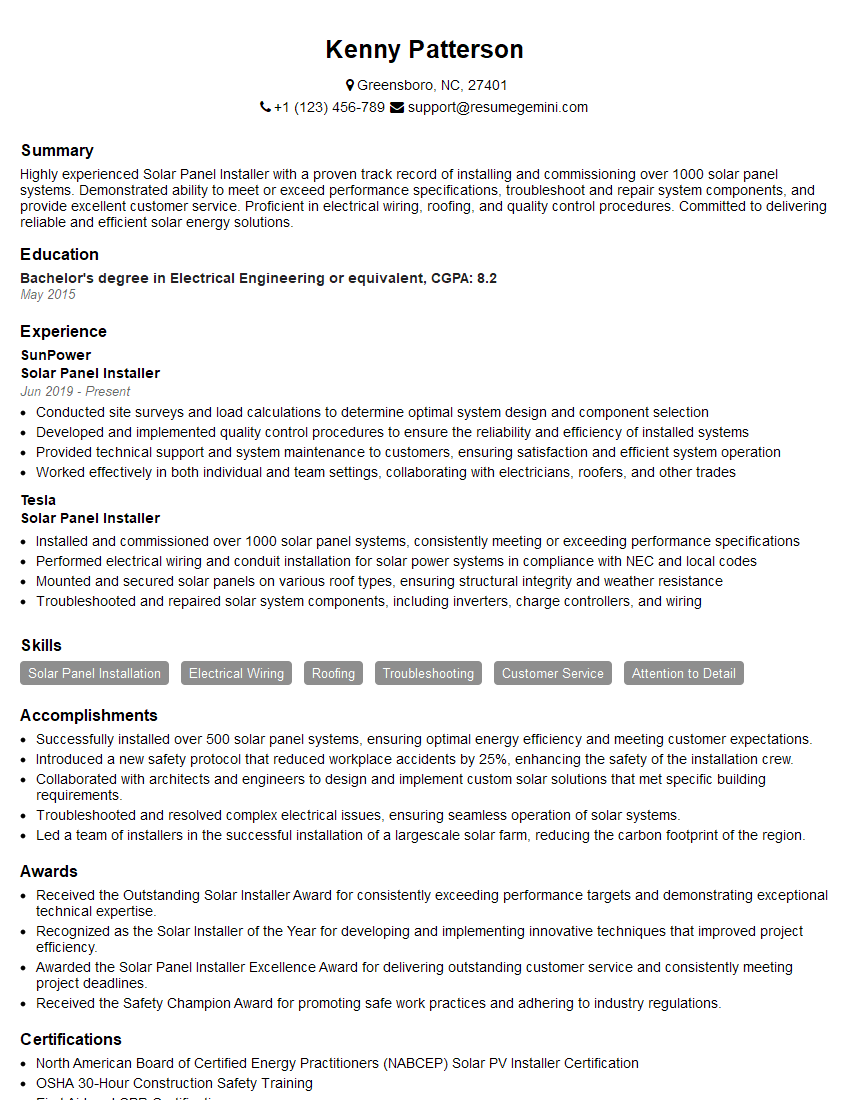
Mastering Inverter Installation and Commissioning is crucial for a successful and rewarding career in the renewable energy sector. This specialized skillset is highly sought after, opening doors to diverse roles and opportunities for professional growth. To significantly boost your job prospects, creating a strong, ATS-friendly resume is essential. ResumeGemini is a trusted resource that can help you build a compelling and effective resume tailored to the specific requirements of Inverter Installation and Commissioning roles. Examples of resumes tailored to this field are available to help you get started.
Explore more articles
Users Rating of Our Blogs
Share Your Experience
We value your feedback! Please rate our content and share your thoughts (optional).
What Readers Say About Our Blog
To the interviewgemini.com Webmaster.
Very helpful and content specific questions to help prepare me for my interview!
Thank you
To the interviewgemini.com Webmaster.
This was kind of a unique content I found around the specialized skills. Very helpful questions and good detailed answers.
Very Helpful blog, thank you Interviewgemini team.