Preparation is the key to success in any interview. In this post, we’ll explore crucial Knowledge of Pipe Support Systems interview questions and equip you with strategies to craft impactful answers. Whether you’re a beginner or a pro, these tips will elevate your preparation.
Questions Asked in Knowledge of Pipe Support Systems Interview
Q 1. Explain the different types of pipe supports and their applications.
Pipe supports are crucial for maintaining the integrity and functionality of piping systems. They prevent excessive stress, vibration, and movement, ensuring safe and reliable operation. Different support types cater to various needs and pipe characteristics. Here are some common types:
- Rigid Supports: These firmly restrain pipe movement in all directions. Think of them as anchors. They’re often used at critical points in the system or where movement is undesirable, such as near sensitive equipment. Examples include anchor clamps and welded supports.
- Flexible Supports: These allow for some degree of movement, accommodating thermal expansion and contraction. Imagine them as springs, providing restraint while allowing for flexibility. Common examples are spring supports and constant support hangers.
- Guides: These restrict pipe movement in one or two directions while allowing free movement in the others. Think of them as tracks guiding the pipe. They’re used to control sway and prevent lateral movement.
- Snubbers: These are safety devices that limit pipe movement during unusual events like seismic activity or pressure surges. They act as shock absorbers to prevent damage.
- Variable Spring Supports: These automatically adjust their support force to compensate for changing loads and pipe weight. They’re highly useful in systems with fluctuating contents.
The application of each type depends heavily on factors like pipe size, material, operating temperature and pressure, fluid content, and seismic considerations. For example, a high-pressure steam line would require rigid supports at critical points and flexible supports to accommodate thermal expansion, while a low-pressure water line might need simpler, less robust supports.
Q 2. Describe the factors considered when selecting pipe supports.
Selecting the appropriate pipe supports involves careful consideration of several factors:
- Pipe Properties: Size, material, operating temperature, pressure, and weight all significantly influence the support requirements. A larger, heavier pipe needs more robust supports.
- Fluid Properties: The type of fluid, its temperature, and pressure affect the loads and stresses on the pipe. For instance, high-pressure fluids demand supports capable of handling greater forces.
- Environmental Factors: Ambient temperature variations, seismic activity, and wind loads all impact the design. Seismic zones require more robust and resilient support systems.
- Operating Conditions: The frequency of operation and potential for unusual events (e.g., pressure surges) must be considered. Snubbers might be necessary in high-risk environments.
- Accessibility and Maintenance: Supports should be easily accessible for inspection, maintenance, and replacement. This influences the support type and location.
- Cost: The initial cost of the supports, as well as the long-term maintenance costs, should be balanced against the need for safety and reliability.
A thorough understanding of these factors ensures that the chosen supports are adequate for the specific application and meet all safety and regulatory requirements. For example, a refinery piping system will have significantly different support needs than a simple water supply line.
Q 3. How do you perform a pipe stress analysis?
Pipe stress analysis is a critical aspect of pipe support design. It involves using engineering principles and software to determine the stresses and displacements within a piping system under various operating conditions. This analysis helps prevent failures and ensures the system’s longevity.
The process typically involves these steps:
- Modeling: Creating a digital representation of the piping system, including pipe geometry, supports, and equipment connections.
- Loading: Defining the loads acting on the pipe, such as internal pressure, weight, thermal expansion, and external forces (wind, seismic).
- Analysis: Using specialized software to solve the equations of static equilibrium and determine the resulting stresses and displacements at various points in the pipe system. This might involve finite element analysis.
- Evaluation: Comparing the calculated stresses and displacements to allowable limits based on industry codes and standards (e.g., ASME B31).
- Iteration: If the calculated stresses exceed the allowable limits, adjustments to the pipe support system, including the addition or modification of supports, are made, and the analysis is repeated until acceptable results are obtained.
For example, a poorly designed support system might lead to excessive stresses during thermal expansion, causing pipe failure. Stress analysis helps identify these potential problems before they occur.
Q 4. What software are you proficient in for pipe stress analysis (e.g., Caesar II, AutoPIPE)?
I’m proficient in several industry-standard pipe stress analysis software packages, including Caesar II and AutoPIPE. Both programs allow for detailed modeling of complex piping systems and provide robust analysis capabilities. I have extensive experience utilizing these tools to perform static, dynamic, and thermal analyses, ensuring the design meets the required safety and performance criteria. My experience includes building models, defining loads, running simulations, interpreting results, and generating comprehensive reports documenting the analysis. This includes working with both simple and highly complex models containing numerous components and support configurations.
Q 5. Explain the importance of pipe support spacing.
Pipe support spacing is crucial for controlling stresses and deflections within the piping system. Inappropriate spacing can lead to excessive bending moments, vibrations, and even pipe failure. The optimal spacing depends on several factors, including:
- Pipe Diameter and Wall Thickness: Larger pipes require closer spacing due to their increased weight and flexibility.
- Material Properties: The stiffness of the pipe material influences the allowable spans between supports.
- Operating Conditions: High temperatures and pressures might necessitate closer spacing to prevent excessive stresses due to thermal expansion.
- Fluid Properties: Heavier fluids require more frequent supports.
In practice, engineers use industry guidelines and software tools to determine appropriate spacing. Too much spacing leads to sagging and potential stress failures, while too little is wasteful and unnecessary. Finding the right balance ensures structural integrity and cost-effectiveness.
For instance, a long, large-diameter pipeline carrying heavy crude oil would need closely spaced supports to prevent sagging and potential damage, unlike a smaller diameter water line.
Q 6. How do you account for thermal expansion and contraction in pipe support design?
Thermal expansion and contraction are significant factors influencing pipe support design. As temperature changes, pipes expand and contract, potentially causing excessive stresses if not properly accommodated. This is addressed through several strategies:
- Expansion Loops: Incorporating loops or bends in the piping system allows for thermal movement without imposing significant stresses on the pipe or supports.
- Expansion Joints: These specialized components are designed to absorb thermal movement. They often contain bellows or other flexible elements.
- Flexible Supports: Using supports that allow for some movement, such as spring hangers or constant support hangers, accommodates thermal expansion and contraction without excessive restraint.
- Guided Supports: Guides are used to constrain movement in specific directions to control the expansion and contraction within a predefined envelope.
Proper design accounts for the temperature range, material’s coefficient of thermal expansion, and pipe geometry to ensure that thermal movements are safely managed. Neglecting this aspect can lead to significant problems including pipe failure, component damage, and system malfunction.
For example, a long steam line will experience considerable thermal expansion; hence, the design must incorporate expansion loops or flexible supports to safely accommodate these changes.
Q 7. Describe your experience with pipe support design codes and standards (e.g., ASME B31.1, B31.3).
I have extensive experience working with various pipe support design codes and standards, primarily ASME B31.1 (Power Piping) and ASME B31.3 (Process Piping). My understanding of these standards extends to requirements for material selection, stress analysis, support design criteria, and documentation. I am familiar with the specific clauses and requirements relevant to different piping systems and operating conditions. I apply these codes to ensure that all designs meet the highest safety standards and comply with industry best practices. I routinely use these codes as a basis for the specifications developed in my stress analysis and support design work, ensuring all models and solutions fall within the accepted engineering bounds.
Furthermore, I’m also familiar with other relevant codes and standards that might apply depending on the project’s location and specific industry requirements. The application of these codes varies depending on the pressure rating, temperature range and operating environment of the system being designed, and it’s critically important to ensure that every relevant code requirement is met.
Q 8. What are the common failure modes of pipe supports?
Pipe support failure modes stem from a combination of factors, primarily inadequate design, material degradation, and operational stresses. Common failure modes include:
- Yielding or Fracture: Supports can fail due to excessive stress exceeding the material’s yield strength or causing brittle fracture. This often occurs due to incorrect load calculations or using inappropriate materials. Imagine a support designed for 1000 lbs bearing a 1500 lb load – failure is imminent!
- Corrosion: Exposure to corrosive environments, like chemicals or saltwater, weakens supports over time, leading to eventual failure. Regular inspection and the use of corrosion-resistant materials are crucial.
- Fatigue: Repeated cyclical loading, such as vibrations from machinery, can induce fatigue cracks, weakening the support and ultimately leading to failure. This is particularly relevant in industrial settings with heavy machinery.
- Creep: Under sustained high temperatures or stresses, some materials gradually deform, leading to support misalignment and potential failure. High-temperature applications require special consideration for creep resistance.
- Improper Installation: Errors during installation, like incorrect tightening of bolts or poor welding, can significantly reduce a support’s load-bearing capacity and lead to premature failure. Adhering strictly to installation guidelines is essential.
- Settlement: Uneven ground settlement can induce unforeseen loads on pipe supports, leading to misalignment and potential failure. Thorough geotechnical analysis and proper foundation design are crucial in such scenarios.
Understanding these failure modes allows for proactive preventative measures like regular inspections, appropriate material selection, and robust design practices.
Q 9. How do you handle complex pipe routing scenarios with numerous constraints?
Handling complex pipe routing scenarios involves a systematic approach combining engineering principles, software tools, and practical experience. The challenge lies in optimizing the support system while adhering to numerous constraints – space limitations, equipment interference, accessibility for maintenance, and code requirements.
My approach involves:
- 3D Modeling: Using specialized software (e.g., AutoCAD Plant 3D, AVEVA PDMS) to model the piping system in three dimensions allows for visualization of the entire routing, identifying potential conflicts early in the design process. This is essential to avoid costly rework later.
- Constraint Analysis: Carefully identifying and categorizing constraints is paramount. This includes structural limitations, equipment clearances, access requirements for maintenance, and any existing infrastructure. This helps prioritize solutions.
- Iterative Design: Complex routes often require an iterative design process. Initial layouts are refined through simulations and analysis to ensure support adequacy and compliance with codes. Software can help optimize support placement.
- Support Selection: Choosing the appropriate support type (rigid, flexible, spring) is crucial. For instance, spring supports are ideal for accommodating thermal expansion, while rigid supports provide stability in areas with minimal movement.
- Stress Analysis: Performing stress analysis (using software like Caesar II or AutoPIPE) is essential to verify the integrity of the piping system under different operating conditions and loads (pressure, weight, thermal expansion, seismic activity). It’s like checking the stress on each part of a bridge before building it.
- Code Compliance: Ensuring the design complies with relevant codes and standards (e.g., ASME B31.1, B31.3) is crucial for safety and regulatory compliance. This may involve specific requirements for seismic zones or hazardous materials.
The combination of careful planning, sophisticated software, and iterative refinement guarantees a robust and efficient pipe support system even in the most demanding scenarios.
Q 10. Explain your understanding of spring supports and their applications.
Spring supports, also known as constant support hangers, are designed to accommodate movement in the piping system, primarily thermal expansion and contraction. They provide a constant supporting force regardless of pipe displacement within a defined range. This is essential to mitigate stress and strain buildup in the pipes.
Applications of spring supports include:
- Piping Systems with Significant Temperature Fluctuations: Power plants, refineries, and chemical plants frequently use spring supports due to the large temperature variations influencing pipe length. The spring allows for elongation and contraction without stressing the pipe or its connections.
- Vibration Isolation: Spring supports can effectively isolate vibrations from pumps and other equipment, reducing noise and protecting sensitive equipment. The spring acts as a shock absorber.
- Seismic Zones: In areas prone to earthquakes, spring supports allow for some movement to better withstand seismic forces. The flexibility reduces the stresses exerted on the piping during ground motion.
Selecting the right spring support involves careful consideration of the required spring rate (force per unit of deflection), range of travel, and the material’s operating temperature. It’s like choosing a spring mattress – too soft, and you sink in; too stiff, and you’re uncomfortable. The perfect spring support provides the right amount of give for a comfortable and safe ride!
Q 11. Describe the use of rigid supports and their limitations.
Rigid supports, as the name suggests, provide fixed points of support, restricting movement in the piping system. They transfer loads directly to the supporting structure. They are commonly used where minimal movement is expected or desired.
Applications of rigid supports include:
- Anchors: Rigid supports are often used as anchors to fix the piping system to the structure, preventing excessive movement under stress. They provide stability and control.
- Guide Supports: These limit pipe movement in one direction while allowing for movement in others. Think of how a train follows the tracks – it can go forward and backward but stays on the defined path.
- Areas with Minimal Movement: In applications with minimal temperature variation or dynamic loading, rigid supports are simpler and less expensive than spring supports.
However, rigid supports have limitations. Their inability to accommodate thermal expansion or vibration can lead to significant stress concentrations in the pipe, potentially causing failure. They are not suitable for applications with significant thermal expansion or vibration and are often used in conjunction with other support types.
Q 12. How do you calculate the loads on pipe supports?
Calculating loads on pipe supports involves a combination of static and dynamic analysis, considering several factors such as:
- Pipe Weight: The self-weight of the pipe and its contents is a primary load. This depends on the pipe’s material, diameter, and length.
- Fluid Weight: The weight of the fluid flowing through the pipe adds to the overall load, depending on the fluid density and pipe fill level.
- Pressure Loads: Internal pressure within the pipe can induce bending moments and axial forces on the supports.
- Thermal Expansion: Changes in temperature cause the pipe to expand or contract, placing additional loads on the supports. This can be substantial in long pipelines with large temperature fluctuations.
- Dynamic Loads: External forces like wind, seismic activity, and vibration from nearby equipment induce dynamic loads on the supports.
The calculation itself usually involves:
- Stress Analysis Software: Specialized software (like Caesar II, AutoPIPE) is used to model the piping system and calculate stresses and reactions at each support point under various load conditions.
- Hand Calculations: Simpler cases can be analyzed using hand calculations based on fundamental mechanics principles. This is seldom used in complex systems due to the error-prone nature of these methods.
- Code Requirements: Calculations must comply with relevant industry codes and standards, which provide guidance on allowable stresses and safety factors. These codes often incorporate safety margins.
The result of these calculations dictates the size and type of supports needed to ensure the integrity of the piping system.
Q 13. What are the different types of pipe hangers?
Pipe hangers are a subset of pipe supports, specifically designed to suspend pipes from above. Various types exist, each optimized for different applications and load conditions:
- Rigid Hangers: Provide a fixed point of support and do not allow for pipe movement. Simple and cost-effective but unsuitable for applications with thermal expansion.
- Spring Hangers: Compensate for thermal expansion and contraction by providing a constant supporting force over a range of movements. These are very versatile.
- Variable Spring Hangers: Similar to spring hangers, but the spring rate can be adjusted to accommodate changing loads. Ideal for situations with fluctuating contents.
- Constant Support Hangers: Maintain a constant load on the supporting structure, regardless of pipe movement within a defined range.
- Snubbers: Limit pipe movement during emergencies such as seismic activity or pipe whip, preventing catastrophic failure.
- Hydraulic Hangers: Use hydraulic cylinders to adjust the supporting force. These allow for fine-tuning of support load and are useful in situations requiring precise control.
- Trapeze Hangers: A type of hanger that supports pipes at multiple points, offering greater stability.
The selection of an appropriate pipe hanger depends on factors like load capacity, desired movement allowance, and the environment in which the pipe is operating.
Q 14. Explain the design considerations for pipe supports in seismic zones.
Designing pipe supports for seismic zones demands a thorough understanding of seismic forces and their effects on piping systems. The goal is to prevent damage to the pipes and supports, as well as avoid potentially hazardous leaks during an earthquake.
Key design considerations include:
- Seismic Analysis: Performing dynamic analysis using specialized software to simulate the response of the piping system to seismic loads is critical. This analysis accounts for ground motion characteristics and piping system properties.
- Support Selection: Selecting appropriate support types and locations is vital. Flexible supports, such as spring hangers and snubbers, are often preferred to accommodate ground movement. They help reduce the stress transmitted to the pipes.
- Support Spacing: Careful spacing of supports is critical to minimize stress concentrations during seismic events. The spacing should be close enough to restrict excessive movement but not so close that it creates rigid zones prone to failure. This is like strengthening a bridge’s support pillars so that they can withstand a quake.
- Damping: Incorporating damping mechanisms into the support system can help dissipate seismic energy and reduce the response of the piping system. Think of this as shock absorbers for the pipe system.
- Material Selection: Using ductile materials with high yield strength is essential to resist seismic forces without failure. The material should be resistant to fatigue from repeated stresses.
- Code Compliance: Designs must comply with relevant building codes and seismic design standards (e.g., ASCE 7, IBC). These codes provide specific requirements for seismic design of piping systems.
Proper seismic design of pipe supports is paramount to the safe operation of facilities in earthquake-prone regions. Failure to do so could result in significant damage and potential hazards.
Q 15. How do you ensure the proper installation and alignment of pipe supports?
Ensuring proper installation and alignment of pipe supports is crucial for preventing stress, leaks, and premature failure of the piping system. It’s a multi-step process that begins even before installation.
- Pre-Installation Planning: This involves carefully reviewing the piping isometric drawings and support specifications. We verify the support locations, types, and dimensions match the design. We also check for any potential clashes with other systems.
- Accurate Marking and Positioning: Once the supports are received, we verify their quality and specifications before marking their precise locations on the structure. Laser levels and other precision tools are essential to ensure accurate alignment. This is akin to building a house – a slightly off-kilter foundation will lead to major issues later.
- Support Installation: The actual installation depends on the support type (e.g., clamps, hangers, cradles). Rigorous adherence to manufacturer’s instructions and proper use of fasteners are paramount. We might use shims to fine-tune alignment and ensure a firm, level seating for the pipe. Visual inspections and measurements at every stage are necessary.
- Post-Installation Verification: After installation, we conduct a final alignment check using precision measuring tools and levels. This is critical to confirm that the pipe is properly supported and aligned per the design specifications, minimizing stress points and preventing sagging.
For example, in a recent project involving high-pressure steam lines, meticulous alignment was vital to avoid thermal expansion issues. A single millimeter out of alignment could have led to significant problems. We used laser alignment tools and regular checks throughout the installation process to ensure perfect alignment.
Career Expert Tips:
- Ace those interviews! Prepare effectively by reviewing the Top 50 Most Common Interview Questions on ResumeGemini.
- Navigate your job search with confidence! Explore a wide range of Career Tips on ResumeGemini. Learn about common challenges and recommendations to overcome them.
- Craft the perfect resume! Master the Art of Resume Writing with ResumeGemini’s guide. Showcase your unique qualifications and achievements effectively.
- Don’t miss out on holiday savings! Build your dream resume with ResumeGemini’s ATS optimized templates.
Q 16. Describe your experience with pipe support inspections and maintenance.
Pipe support inspections and maintenance are vital for the long-term integrity and safety of a piping system. My experience involves a systematic approach, encompassing both routine and specialized inspections.
- Routine Inspections: These are visual checks performed regularly, looking for signs of corrosion, damage, loosening of fasteners, misalignment, or other defects. This is similar to a car inspection – regular checks prevent bigger problems down the line. We often use checklists and photographic documentation.
- Specialized Inspections: These might involve non-destructive testing methods (NDT) like ultrasonic testing to detect internal flaws in the supports or pipe itself, or vibration analysis to identify resonance issues that could damage the supports over time. We would conduct more thorough inspections following significant events like an earthquake or a period of extreme weather.
- Maintenance: Maintenance actions range from tightening loose bolts and replacing damaged components to applying corrosion protection coatings. For example, I once had to replace several corroded pipe hangers in a chemical plant. The timely replacement prevented a potential leak and ensured system safety.
Comprehensive documentation of each inspection and maintenance activity is crucial. This includes dates, findings, actions taken, and photographs. This documentation is essential for demonstrating compliance with safety standards and for tracking the system’s condition over time.
Q 17. Explain your understanding of vibration isolation for pipe systems.
Vibration isolation in pipe systems is designed to mitigate the transmission of vibrations from equipment like pumps, compressors, or turbines to the piping system and supporting structures. Uncontrolled vibrations can lead to fatigue failure, noise problems, and operational disruptions.
- Understanding Vibration Sources: The first step is identifying the sources and frequencies of vibrations. This often involves vibration analysis using specialized equipment.
- Selecting Isolation Devices: Once the vibration characteristics are understood, appropriate isolation devices can be selected. Common devices include spring hangers, elastomeric bearings, and hydraulic dampers. The selection depends on the frequency and amplitude of the vibrations, the weight of the pipe, and the required level of isolation.
- Proper Installation: Correct installation of the isolation devices is essential for their effectiveness. This includes ensuring proper alignment and avoiding any constraints that could hinder their ability to dampen vibrations.
Imagine a washing machine – if it’s not properly balanced, it vibrates intensely. Vibration isolators for pipes perform a similar function, reducing the transfer of vibrations to the surrounding environment and the piping system.
Q 18. How do you handle pipe support design in corrosive environments?
Designing pipe supports for corrosive environments requires careful material selection and consideration of corrosion protection strategies. The choice of materials is crucial here.
- Material Selection: Materials resistant to the specific corrosive agents present must be chosen. This might involve using stainless steel, high-alloy steels, or non-metallic materials like fiberglass-reinforced polymers (FRP). The selection is highly dependent on the chemical composition of the fluid and ambient conditions.
- Corrosion Protection: Even corrosion-resistant materials benefit from additional protection. Coatings like epoxy, zinc, or other specialized coatings can significantly extend the service life of the supports. Regular inspections and maintenance are also important in corrosive environments.
- Design Considerations: The design itself should minimize crevices and stagnant areas where corrosion can accumulate. Proper drainage and ventilation can help prevent corrosion. Careful consideration must also be given to the potential for galvanic corrosion if different metals are in contact.
For example, in offshore oil and gas platforms, pipe supports are often exposed to saltwater and harsh weather conditions. Therefore, selecting highly corrosion-resistant materials like duplex stainless steel and applying specialized coatings is critical to ensure long-term performance and safety.
Q 19. What are some common mistakes to avoid in pipe support design?
Several common mistakes can significantly impact the effectiveness and safety of pipe support systems. Avoiding these is crucial for long-term performance.
- Inadequate Support Spacing: Insufficient spacing between supports can lead to excessive sagging and stress concentrations in the pipe. This can cause leaks or even failure.
- Incorrect Support Type Selection: Choosing the wrong type of support for the load and environment can lead to premature failure. For example, using a rigid support where a flexible support is needed can result in stress concentrations.
- Neglecting Thermal Expansion: Failing to account for thermal expansion and contraction can induce significant stress in the pipe and supports, leading to leaks or component failure. Expansion loops or bellows are often necessary for this.
- Poor Alignment: Misalignment of supports introduces stress in the pipe, weakening it over time. This often leads to leakage points.
- Ignoring Corrosion: Failure to address corrosion in the design or maintenance can lead to premature failure of supports and pipes, resulting in costly repairs and potential safety hazards.
Many of these mistakes stem from insufficient planning and overlooking crucial design factors. A thorough understanding of the piping system, its contents, and the operating conditions is paramount for avoiding these issues.
Q 20. How do you coordinate pipe support design with other disciplines (e.g., structural, electrical)?
Coordination with other disciplines like structural, electrical, and instrumentation engineers is essential for successful pipe support design and installation. This collaborative approach avoids conflicts and ensures a safe and functional system.
- Early Collaboration: The best practice is to involve other disciplines early in the design process. This allows for the identification and resolution of potential clashes before construction begins.
- Model Coordination: Using 3D modeling software allows for the visualization and detection of clashes between the piping system and other systems. This provides a visual representation of potential conflicts.
- Clear Communication: Maintaining open and consistent communication between disciplines ensures that everyone is informed about design changes and potential issues. Regular meetings and collaborative reviews are very beneficial.
- Clear Documentation: Detailed drawings and specifications are essential for communicating the design and installation requirements to all involved parties. This documentation must be consistent and up-to-date.
For example, in a recent power plant project, collaboration with the structural engineers was vital to ensure that the pipe supports were correctly integrated into the supporting structure. We used 3D modeling to identify and resolve any clashes and create an efficient design.
Q 21. Explain the importance of proper documentation in pipe support design.
Proper documentation is critical for the success of any pipe support project. It ensures proper installation, maintenance, and future modifications, as well as providing a crucial record for legal and safety compliance.
- Design Drawings: Detailed drawings showing the pipe routing, support locations, types, and specifications are essential. These drawings act as the blueprint for the installation team.
- Material Specifications: Documentation detailing the materials used for each support, including material grades and specifications, is necessary for ensuring that appropriate materials are used and for future maintenance.
- Installation Records: Records of the actual installation, including dates, personnel involved, and any deviations from the design, are important for maintaining a history of the system.
- Inspection and Maintenance Reports: Detailed reports of all inspections and maintenance activities, including findings, actions taken, and any corrective measures, are essential for tracking the system’s condition over time.
- As-Built Drawings: These drawings reflect the final installed configuration of the pipe supports and can be used for future modifications or maintenance.
Thorough documentation is not just good practice; it is crucial for maintaining the integrity and safety of the piping system throughout its lifespan, helping to prevent costly errors and ensure compliance with regulatory standards. Imagine trying to repair a system without knowing its history – it’s near impossible.
Q 22. Describe your experience with pipe support design reviews.
Pipe support design reviews are crucial for ensuring the safety and longevity of piping systems. My experience encompasses a wide range of projects, from small industrial facilities to large-scale petrochemical plants. I’ve been involved in every stage, from initial plan review to final inspection. This includes verifying the design’s adherence to relevant codes and standards (like ASME B31.1, B31.3, etc.), checking for proper stress analysis and calculations, and ensuring the selected supports are appropriate for the pipe’s material, size, operating temperature, and pressure. I also look for potential conflicts with other systems, such as electrical conduits or HVAC equipment. For example, in one project, a design review uncovered an oversight where a critical support was missing, potentially leading to pipe failure. My intervention led to its timely addition, preventing a costly and potentially dangerous situation.
I typically use checklists and standardized forms to systematically review drawings and calculations, focusing on critical aspects like support spacing, anchor bolt design, and the overall structural integrity of the support system. I also employ advanced software for validating stress analysis results and ensuring the system’s compliance with industry best practices.
Q 23. How do you handle changes in pipe support design during construction?
Changes in pipe support design during construction are inevitable and require a systematic approach. My process starts with a thorough understanding of the reason for the change. This could range from unforeseen site conditions, to revised equipment layouts, or even material availability issues. Once the reason is clear, I assess the impact of the change on the overall system integrity and safety. This often requires updating the stress analysis and ensuring that the new design still meets all relevant codes and standards.
Documentation is key. Every change must be meticulously documented, including the reason for the change, the revised design details, updated calculations, and approvals from relevant stakeholders. This documentation helps to maintain a clear audit trail and aids in future maintenance and troubleshooting. Moreover, I always strive to communicate effectively with construction personnel to ensure that the changes are implemented accurately and safely. For instance, on a recent project, a change in the location of a large pump necessitated a redesign of the nearby pipe supports. Through careful planning and clear communication, we implemented the revised design without any delays or safety compromises.
Q 24. What is your experience with Finite Element Analysis (FEA) for pipe support systems?
Finite Element Analysis (FEA) is an indispensable tool in my pipe support design practice. It allows for a highly accurate and detailed analysis of stress and deflection in complex piping systems, going beyond the limitations of simpler hand calculations. I use FEA software to model the pipe system, including supports, loads (weight, pressure, thermal expansion), and boundary conditions. The software then solves for stresses, strains, and displacements throughout the system, allowing for a comprehensive understanding of its behavior under various operating conditions.
I’ve used FEA extensively to optimize support locations and designs, reduce stress concentrations, and verify the adequacy of existing supports. For example, on a project involving high-temperature piping, FEA helped to identify a potential stress concentration point that wasn’t evident in simpler calculations. By adjusting the support configuration based on the FEA results, we avoided a potential failure point.
Q 25. Explain the concept of flexibility analysis in pipe support design.
Flexibility analysis in pipe support design is crucial for determining the proper support spacing and configuration to accommodate thermal expansion and contraction. Pipes expand and contract significantly with temperature changes, and inadequate support systems can lead to high stresses and even failure. Flexibility analysis uses mathematical models to simulate these thermal movements and calculates the resulting stresses and deflections in the pipe.
The goal is to design a support system that allows for the free expansion and contraction of the pipe without imposing excessive stresses. This typically involves strategically placing supports and employing flexible elements like expansion joints or loops. Think of it like a chain – if it’s too tight, it will break. Similarly, if a pipe support system restricts thermal movement, high stresses develop. By considering flexibility, we avoid this and extend the pipe’s lifespan.
Q 26. How do you manage risks associated with pipe support system failures?
Managing risks associated with pipe support system failures involves a multifaceted approach. Firstly, thorough design reviews and FEA are essential to identify potential weaknesses early in the process. Secondly, regular inspections and maintenance play a crucial role in detecting any signs of deterioration or damage. This includes visual inspections, vibration monitoring, and potentially non-destructive testing methods. Finally, a robust emergency response plan should be in place to mitigate the consequences of a failure, including procedures for isolating the affected section of the piping system and minimizing environmental impact.
Implementing redundancy in the support system is also a key strategy. Having multiple supports can help prevent catastrophic failure if one support component fails. Furthermore, using high-quality materials and following proper installation practices are crucial for minimizing risk. For example, proper torqueing of anchor bolts is paramount to ensure the structural integrity of the entire support system.
Q 27. Describe your experience with pipe support design optimization techniques.
Pipe support design optimization aims to create systems that are both safe and cost-effective. This involves a range of techniques, from employing advanced analysis tools like FEA to utilizing standardized support components whenever feasible. I often use optimization algorithms to explore different support configurations and identify the most efficient solution. For instance, I might use an algorithm to minimize the number of supports while ensuring that stresses remain within acceptable limits.
Material selection plays a key role in optimization. Choosing appropriate materials can reduce weight and cost without compromising strength or durability. Moreover, value engineering is essential to identify areas where costs can be reduced without sacrificing safety or performance. For example, I once optimized a large piping system by using a combination of standardized supports and custom-designed components, resulting in significant cost savings without compromising safety.
Key Topics to Learn for Knowledge of Pipe Support Systems Interview
- Pipe Stress Analysis: Understanding fundamental principles of pipe stress, including thermal expansion, pressure forces, and weight effects. Be prepared to discuss different analysis methods and software applications.
- Support System Design: Familiarize yourself with various pipe support types (e.g., rigid supports, spring hangers, restraints) and their applications in different piping systems. Know how to select appropriate supports based on project requirements and industry codes.
- Material Selection: Understand the properties of materials commonly used in pipe support systems and their suitability for various operating conditions (temperature, pressure, corrosion).
- Code Compliance: Demonstrate knowledge of relevant industry codes and standards (e.g., ASME B31.1, B31.3) related to pipe support design and installation. Be ready to discuss code requirements and their practical implications.
- Practical Applications: Be prepared to discuss real-world examples of pipe support system design and installation, including challenges encountered and solutions implemented. Consider projects you’ve worked on or case studies you’ve reviewed.
- Troubleshooting & Problem Solving: Develop your ability to identify and troubleshoot common issues in pipe support systems, such as vibration, misalignment, and support failures. Practice explaining your problem-solving approach.
- Software Proficiency: If applicable, highlight your proficiency in relevant engineering software used for pipe stress analysis and support design (e.g., CAESAR II, AutoPIPE).
Next Steps
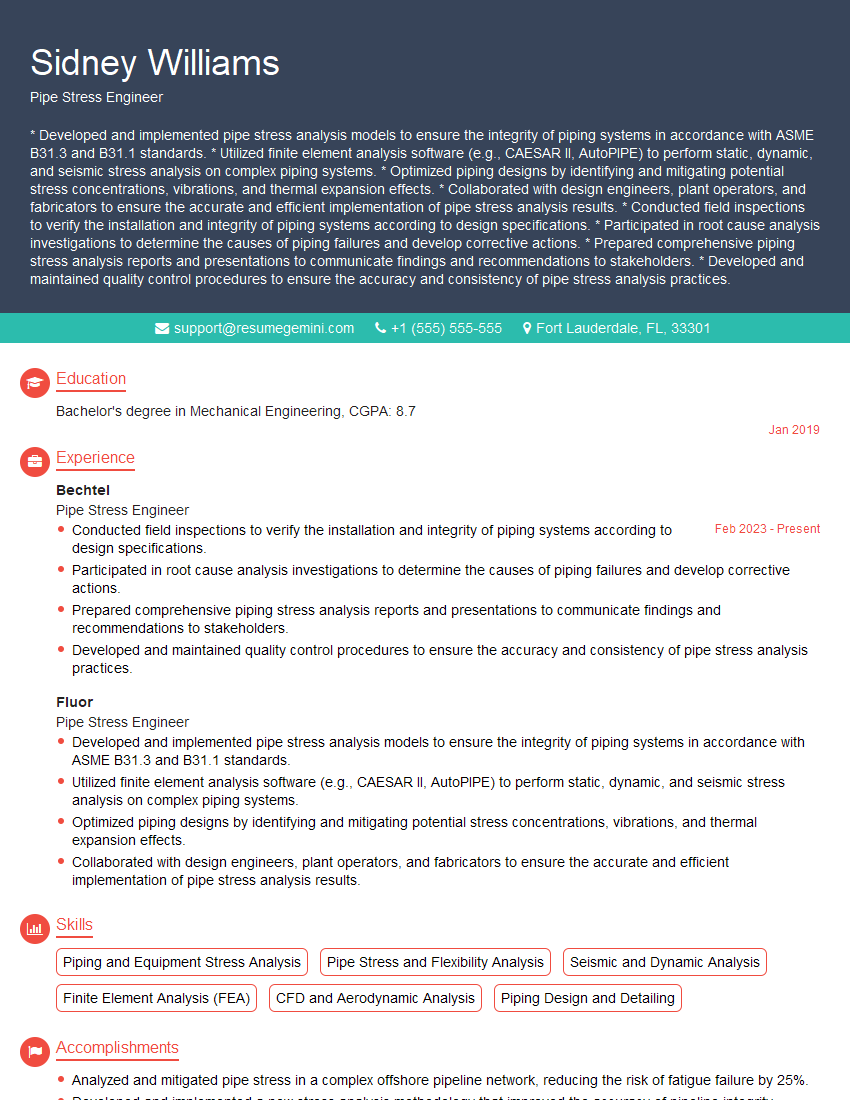
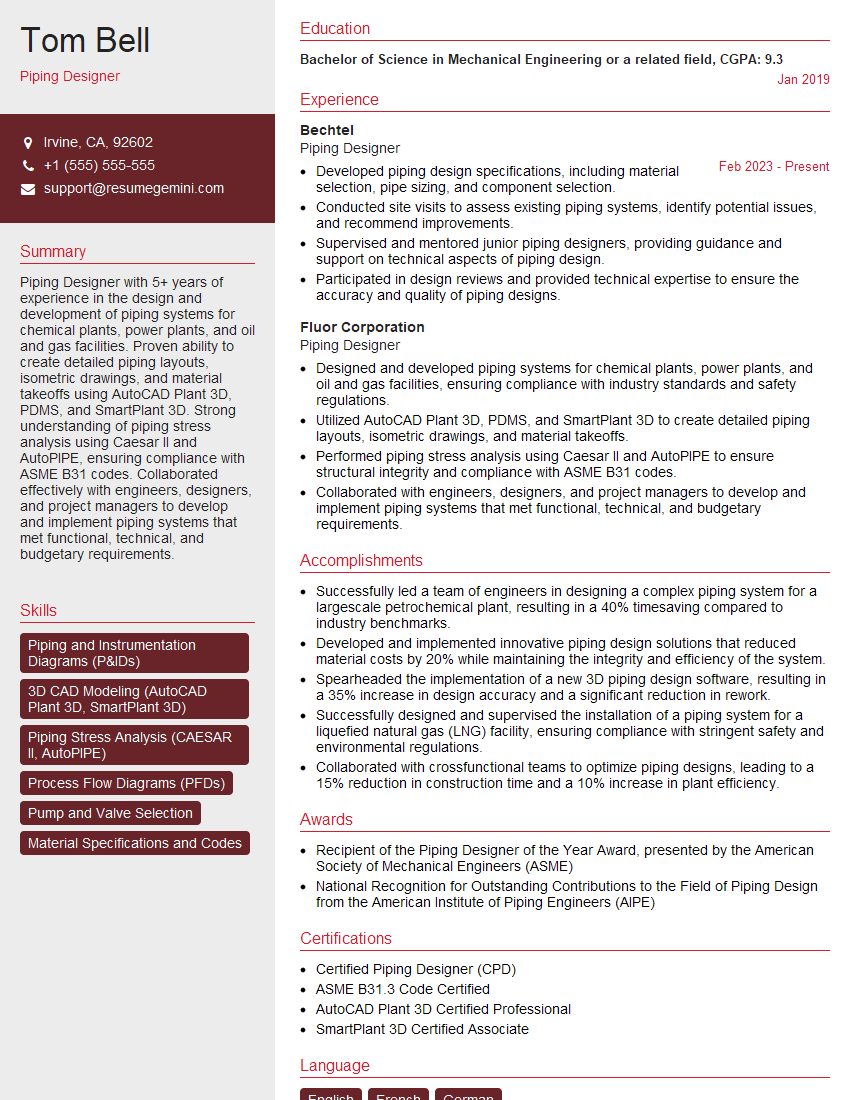
Mastering knowledge of pipe support systems is crucial for career advancement in the engineering and construction sectors. A strong understanding of these principles opens doors to exciting opportunities and demonstrates your expertise in a highly sought-after field. To maximize your job prospects, it’s essential to present your skills effectively. Creating an ATS-friendly resume is key to getting your application noticed by recruiters. ResumeGemini is a trusted resource to help you build a professional and impactful resume that highlights your unique qualifications. Examples of resumes tailored to Knowledge of Pipe Support Systems are available to further guide you.
Explore more articles
Users Rating of Our Blogs
Share Your Experience
We value your feedback! Please rate our content and share your thoughts (optional).
What Readers Say About Our Blog
To the interviewgemini.com Webmaster.
Very helpful and content specific questions to help prepare me for my interview!
Thank you
To the interviewgemini.com Webmaster.
This was kind of a unique content I found around the specialized skills. Very helpful questions and good detailed answers.
Very Helpful blog, thank you Interviewgemini team.