Feeling uncertain about what to expect in your upcoming interview? We’ve got you covered! This blog highlights the most important Knowledge of Thermodynamics interview questions and provides actionable advice to help you stand out as the ideal candidate. Let’s pave the way for your success.
Questions Asked in Knowledge of Thermodynamics Interview
Q 1. Explain the three laws of thermodynamics.
The three laws of thermodynamics govern the behavior of energy and its transformations. They are fundamental to understanding how systems exchange heat and work.
First Law (Conservation of Energy): Energy cannot be created or destroyed, only transformed from one form to another. Think of it like a bank account – the total amount remains constant, but you can transfer money between different accounts (kinetic, potential, thermal, etc.). For example, burning fuel converts chemical energy into heat and work to power a car. Mathematically, it’s represented as ΔU = Q – W, where ΔU is the change in internal energy, Q is heat added, and W is work done by the system.
Second Law (Entropy): The total entropy of an isolated system can only increase over time, or remain constant in ideal cases where the system is in a steady state or undergoing a reversible process. Entropy is a measure of disorder or randomness. Imagine a tidy room (low entropy) that inevitably becomes messy (high entropy) without constant effort. This law explains why heat flows spontaneously from hot to cold and why some processes are irreversible. It’s related to the concept of efficiency; no process is 100% efficient because some energy is always lost as unusable heat, increasing the entropy of the surroundings.
Third Law (Absolute Zero): The entropy of a perfect crystal at absolute zero temperature is zero. This means that at absolute zero, there’s perfect order – a theoretical state with no molecular motion. This law provides a reference point for measuring entropy and is crucial for calculating thermodynamic properties.
Q 2. Define enthalpy and entropy. How are they related?
Enthalpy (H) represents the total heat content of a system at constant pressure. It combines internal energy (U) and the product of pressure (P) and volume (V): H = U + PV. Think of it as the total energy a system possesses, considering both its internal energy and the energy associated with its volume. A positive change in enthalpy (ΔH > 0) indicates an endothermic process (heat is absorbed), while a negative change (ΔH < 0) indicates an exothermic process (heat is released). For example, melting ice is endothermic (absorbs heat), while burning wood is exothermic (releases heat).
Entropy (S) is a measure of the randomness or disorder within a system. A system with high entropy is disordered, while a system with low entropy is highly ordered. Imagine a deck of cards – a perfectly ordered deck has low entropy, while a shuffled deck has high entropy. The second law of thermodynamics states that the total entropy of an isolated system always increases over time.
Relationship: Enthalpy and entropy are related through the Gibbs free energy (G), which determines the spontaneity of a process at constant temperature and pressure: G = H – TS (where T is temperature). A negative change in Gibbs free energy (ΔG < 0) indicates a spontaneous process, while a positive change (ΔG > 0) indicates a non-spontaneous process.
Q 3. What is the difference between an isothermal and adiabatic process?
The key difference between isothermal and adiabatic processes lies in how heat is exchanged with the surroundings.
Isothermal Process: The temperature remains constant throughout the process. Heat is exchanged with the surroundings to maintain a constant temperature. Think of a system slowly expanding in a large temperature-controlled bath; heat flows in or out to compensate for work done. This often involves slow processes allowing for heat transfer to maintain thermal equilibrium.
Adiabatic Process: No heat exchange occurs between the system and its surroundings. This means the system is thermally isolated. Think of a rapidly expanding gas in a well-insulated container; the expansion cools the gas because the work done is not compensated by heat flow from the surroundings. This is often associated with rapid processes, where there’s insufficient time for heat transfer.
In an isothermal process, ΔT = 0, whereas in an adiabatic process, Q = 0.
Q 4. Describe the Carnot cycle and its efficiency.
The Carnot cycle is a theoretical thermodynamic cycle that describes the maximum possible efficiency for a heat engine operating between two temperatures. It’s a reversible cycle consisting of four stages: isothermal expansion, adiabatic expansion, isothermal compression, and adiabatic compression.
Efficiency: The efficiency (η) of a Carnot cycle is determined by the absolute temperatures of the hot reservoir (Th) and the cold reservoir (Tc):
η = 1 - (Tc/Th)
Where Th and Tc are the absolute temperatures (in Kelvin). The efficiency is always less than 1 (or 100%), indicating that some heat is always lost to the cold reservoir. The higher the temperature difference between the hot and cold reservoirs, the higher the efficiency of the Carnot cycle. No real-world heat engine can achieve the Carnot efficiency due to irreversibilities such as friction and heat loss.
For example, a Carnot engine operating between 500 K (Th) and 300 K (Tc) would have an efficiency of 1 - (300/500) = 0.4 or 40%. This means that only 40% of the heat energy is converted into useful work; the remaining 60% is lost as waste heat to the cold reservoir.
Q 5. Explain the concept of Gibbs free energy.
Gibbs free energy (G) is a thermodynamic potential that measures the maximum reversible work that may be performed by a thermodynamic system at a constant temperature and pressure. It combines enthalpy (H), entropy (S), and temperature (T):
G = H - TS
It predicts the spontaneity of a process. A negative change in Gibbs free energy (ΔG < 0) indicates a spontaneous process (occurs naturally), a positive change (ΔG > 0) indicates a non-spontaneous process (requires energy input), and a zero change (ΔG = 0) indicates a system at equilibrium.
For example, the combustion of methane (ΔG < 0) is spontaneous because it releases energy and increases entropy. Conversely, the decomposition of water into hydrogen and oxygen (ΔG > 0) is non-spontaneous under standard conditions because it requires energy input.
Q 6. What are the different types of thermodynamic systems?
Thermodynamic systems are classified based on how they interact with their surroundings regarding the exchange of mass and energy.
Open System: Exchanges both mass and energy with its surroundings. Think of a boiling pot of water on a stove – both heat (energy) and water vapor (mass) are exchanged with the environment.
Closed System: Exchanges energy but not mass with its surroundings. Imagine a sealed container of gas heated on a stove; heat energy is transferred, but no gas molecules enter or leave the container.
Isolated System: Exchanges neither mass nor energy with its surroundings. A perfectly insulated thermos containing coffee approximates an isolated system; ideally, no heat or mass is exchanged with the outside.
Q 7. How is the Clausius-Clapeyron equation used?
The Clausius-Clapeyron equation is used to describe the relationship between the vapor pressure of a substance and its temperature. It’s particularly useful for determining the vapor pressure at different temperatures or calculating the enthalpy of vaporization. The equation is:
ln(P2/P1) = (ΔHvap/R) * (1/T1 - 1/T2)
Where:
P1 and P2 are the vapor pressures at temperatures T1 and T2 (in Kelvin), respectively.
ΔHvap is the enthalpy of vaporization (the heat required to vaporize one mole of the substance).
R is the ideal gas constant.
This equation is commonly used in various applications, including:
Predicting boiling points: Knowing the vapor pressure at one temperature and the enthalpy of vaporization, we can calculate the vapor pressure at other temperatures, including the boiling point (where vapor pressure equals atmospheric pressure).
Determining enthalpy of vaporization: By measuring vapor pressures at different temperatures, we can determine the enthalpy of vaporization.
For example, in chemical engineering, it helps predict the behavior of refrigerants and solvents at various conditions. In meteorology, it aids in understanding atmospheric processes involving water vapor.
Q 8. Describe the concept of thermodynamic equilibrium.
Thermodynamic equilibrium describes a state where a system’s macroscopic properties, like temperature, pressure, and volume, remain constant over time and are uniform throughout the system. Imagine a perfectly insulated cup of coffee: initially, the coffee is hot in the center and cooler near the edges. Over time, the temperature equalizes throughout the cup, reaching equilibrium. No further net changes occur unless something external – like adding ice – interferes.
A system in thermodynamic equilibrium is characterized by three types of equilibrium:
- Thermal Equilibrium: Uniform temperature throughout the system. No net heat transfer occurs between parts of the system.
- Mechanical Equilibrium: Uniform pressure throughout the system. There are no unbalanced forces causing changes in volume or pressure.
- Chemical Equilibrium: No net change in the chemical composition of the system. This means the rate of forward reactions equals the rate of reverse reactions.
Reaching equilibrium is crucial in many applications, from designing efficient heat exchangers to understanding chemical reactions within industrial processes.
Q 9. Explain how the ideal gas law is used in thermodynamics.
The Ideal Gas Law, PV = nRT, is a foundational equation in thermodynamics. It relates pressure (P), volume (V), number of moles (n), the ideal gas constant (R), and temperature (T) for an ideal gas – a theoretical gas where intermolecular forces are negligible. While no real gas perfectly obeys this law, many behave ideally under certain conditions (low pressure and high temperature).
In thermodynamics, it helps us:
- Analyze processes: We can use it to track changes in a gas’s state during expansion, compression, heating, or cooling. For instance, in an isothermal expansion (constant temperature), we can calculate the work done by the gas.
- Calculate work and heat: The law allows for calculating the work involved in processes like isothermal or adiabatic expansion/compression. Combined with other thermodynamic laws, it helps find changes in internal energy and enthalpy.
- Model systems: Many real-world gases, especially at moderate temperatures and pressures, can be approximated as ideal gases, making calculations simpler.
For example, if we have 1 mole of an ideal gas at 273.15 K (0°C) and 1 atm pressure, we can calculate its volume using the ideal gas law: V = nRT/P ≈ (1 mol)(0.0821 L·atm/mol·K)(273.15 K)/(1 atm) ≈ 22.4 L. This volume represents the molar volume of an ideal gas under standard temperature and pressure.
Q 10. What is the difference between reversible and irreversible processes?
The key difference lies in the system’s ability to return to its initial state without leaving any trace on its surroundings. A reversible process is one where the system and surroundings can be restored to their original states by reversing the direction of the process. This is a theoretical idealization—it requires infinitely slow changes and no dissipative effects (like friction).
Imagine slowly compressing a gas in a perfectly insulated cylinder using a weight. If we carefully remove the weight, the gas expands back to its original state, leaving no change in the system or surroundings. This is a reversible process.
An irreversible process, in contrast, is any process that cannot be reversed without causing permanent changes to the system or surroundings. These typically involve energy losses due to friction, heat transfer across finite temperature differences, or spontaneous mixing.
Examples of irreversible processes include:
- Heat transfer from a hot object to a cold object.
- Friction between moving surfaces.
- The free expansion of a gas into a vacuum.
Understanding the reversibility of a process significantly impacts the calculations involving entropy changes, work done, and overall system efficiency.
Q 11. Describe the concept of heat capacity.
Heat capacity represents the amount of heat energy required to raise the temperature of a substance by one degree Celsius (or one Kelvin). It is a material property that depends on factors like the substance’s composition, phase (solid, liquid, or gas), and temperature.
There are two common types of heat capacity:
- Specific Heat Capacity (c): The heat capacity per unit mass of a substance. Units are typically J/g·K or J/kg·K.
- Molar Heat Capacity (C): The heat capacity per mole of a substance. Units are typically J/mol·K.
The relationship between heat (Q), mass (m), specific heat capacity (c), and temperature change (ΔT) is given by Q = mcΔT. Similarly, for molar heat capacity (C) and the number of moles (n), we have Q = nCΔT.
Understanding heat capacity is vital for many practical applications, such as designing efficient heating and cooling systems. It also helps predict how a material will react to temperature changes in various industrial processes.
Q 12. How do you calculate work done in a thermodynamic process?
The calculation of work done in a thermodynamic process depends on the nature of the process. The most common scenario involves a gas expanding or compressing against an external pressure.
In general, for a reversible process, the work (W) done by the system is given by the integral of pressure (P) with respect to volume (V):
W = ∫PdV
The sign convention is crucial: work done by the system is positive, while work done on the system is negative.
The specific calculation depends on the type of process:
- Isobaric (constant pressure):
W = PΔV - Isothermal (constant temperature):
W = nRT ln(Vf/Vi), where Vf and Vi are the final and initial volumes. - Adiabatic (no heat exchange): The calculation is more complex and involves the adiabatic index (γ).
For irreversible processes, the calculation of work can be more complex and depends on the specifics of the irreversible change. Consider, for instance, the free expansion of a gas into a vacuum; no work is done by the gas (W=0) even though the volume changes.
Q 13. Explain the concept of internal energy.
Internal energy (U) represents the total energy stored within a thermodynamic system. This includes all forms of energy associated with the system’s microscopic components, such as kinetic energy (from molecular motion) and potential energy (from intermolecular forces and chemical bonds).
It’s important to note that we cannot directly measure the absolute value of internal energy; instead, we focus on changes in internal energy (ΔU). The change in internal energy during a process is determined by the First Law of Thermodynamics, which states that the change in internal energy is equal to the heat (Q) added to the system minus the work (W) done by the system:
ΔU = Q - W
This fundamental law highlights the conservation of energy: energy cannot be created or destroyed, only transformed from one form to another. For example, when we heat a gas (add heat), its internal energy increases, often manifesting as higher temperature and faster molecular motion.
Q 14. What are the different types of heat transfer?
Heat transfer, the movement of thermal energy from one region to another, occurs through three primary mechanisms:
- Conduction: Heat transfer through direct contact. Energy is transferred through molecular vibrations and collisions within a material or between contacting materials. Think of touching a hot stove – heat conducts from the stove to your hand.
- Convection: Heat transfer through the movement of fluids (liquids or gases). Warmer, less dense fluid rises, while cooler, denser fluid sinks, creating a circulatory flow that distributes heat. Examples include boiling water or the warming of air near a radiator.
- Radiation: Heat transfer through electromagnetic waves. No medium is required for this type of heat transfer. The sun’s warmth reaching the Earth is a prime example of radiant heat transfer.
Understanding these mechanisms is vital in many engineering applications, such as designing insulation for buildings, improving heat exchangers in power plants, and optimizing cooling systems in electronic devices.
Q 15. How is entropy change calculated for a reversible process?
For a reversible process, the change in entropy (ΔS) is calculated using the integral of the heat transfer (δQrev) divided by the absolute temperature (T) along the reversible path. This is expressed mathematically as:
ΔS = ∫(δQrev/T)
This equation highlights a crucial point: entropy change depends not only on the initial and final states but also on the path taken. Because a reversible process is an idealized, infinitely slow process, it allows us to precisely track heat transfer and temperature at each point. In contrast, for irreversible processes, determining the exact path is often impossible, making entropy calculation more challenging.
Example: Consider a reversible isothermal expansion of an ideal gas. Since the temperature is constant, the equation simplifies to:
ΔS = Qrev/T = nRln(V2/V1)
where n is the number of moles, R is the ideal gas constant, V1 is the initial volume, and V2 is the final volume. This shows a clear relationship between the change in entropy, the amount of heat transferred (which is directly linked to work in this case), and the volume change.
Career Expert Tips:
- Ace those interviews! Prepare effectively by reviewing the Top 50 Most Common Interview Questions on ResumeGemini.
- Navigate your job search with confidence! Explore a wide range of Career Tips on ResumeGemini. Learn about common challenges and recommendations to overcome them.
- Craft the perfect resume! Master the Art of Resume Writing with ResumeGemini’s guide. Showcase your unique qualifications and achievements effectively.
- Don’t miss out on holiday savings! Build your dream resume with ResumeGemini’s ATS optimized templates.
Q 16. Explain the concept of fugacity.
Fugacity (f) is a thermodynamic concept that represents the effective partial pressure of a real gas. It’s particularly useful when dealing with non-ideal gases where the ideal gas law breaks down. Think of it as a ‘corrected’ pressure that accounts for the intermolecular forces and volume occupied by the gas molecules, which are ignored in the ideal gas model.
For an ideal gas, fugacity is equal to its partial pressure. However, for real gases, the fugacity coefficient (φ), defined as φ = f/P (where P is the partial pressure), deviates from unity. The closer φ is to 1, the more ideal the gas behaves.
Why is fugacity important? It allows us to use the simplicity of the ideal gas equations in the context of real gases, particularly when working with chemical equilibrium and phase equilibrium calculations. The equilibrium constant for a reaction involving real gases is expressed in terms of fugacities rather than partial pressures.
Example: In a high-pressure natural gas pipeline, the gas deviates significantly from ideality. Using fugacity accounts for these deviations to accurately predict the behavior and flow of the gas through the pipeline, allowing for efficient design and operation.
Q 17. Describe the use of thermodynamic property diagrams (e.g., T-s, P-v).
Thermodynamic property diagrams, such as T-s (temperature-entropy) and P-v (pressure-volume) diagrams, provide a visual representation of thermodynamic processes. They are invaluable tools for visualizing and analyzing the state changes of a system during various processes.
T-s diagrams: Useful for understanding the changes in temperature and entropy during processes like those in power cycles (Rankine cycle) and refrigeration cycles. The area under the curve on a T-s diagram represents the heat transfer during a process. Isentropic (constant entropy) processes are represented as vertical lines.
P-v diagrams: Useful for understanding piston-cylinder systems and processes involving volume changes, like those in internal combustion engines. The area under the curve represents the work done during a process. Isobaric (constant pressure) processes are represented as horizontal lines.
Applications: These diagrams are used extensively for:
- Analyzing engine performance
- Designing power generation systems
- Optimizing refrigeration cycles
- Understanding phase transitions
By visually representing processes, these diagrams facilitate a quick understanding of the relationships between properties and aid in problem-solving.
Q 18. How do you apply thermodynamics to solve engineering problems?
Thermodynamics provides a fundamental framework for solving a wide array of engineering problems. It’s crucial in areas such as power generation, refrigeration, air conditioning, chemical processing, and many more.
Problem-solving approach: Applying thermodynamics generally involves:
- Defining the system: Clearly identifying the boundaries of the system under consideration.
- Identifying the processes: Determining the type of processes involved (e.g., isothermal, adiabatic, isobaric).
- Applying conservation laws: Using the first and second laws of thermodynamics (conservation of energy and entropy) to establish relationships between properties.
- Using property relations: Employing equations of state and thermodynamic tables or software to relate properties.
- Analyzing results: Interpreting the results in the context of the problem, drawing conclusions, and making recommendations.
Example: In designing a power plant, thermodynamic principles are used to determine the optimal operating conditions, predict the efficiency of the plant, and assess the environmental impact. The Rankine cycle analysis, a thermodynamic analysis of power generation, provides a structured framework for making these calculations.
Q 19. Explain the concept of the Joule-Thomson effect.
The Joule-Thomson effect describes the temperature change of a real gas during an isenthalpic (constant enthalpy) expansion through a throttling valve or porous plug. It’s an irreversible process where the gas undergoes a significant pressure drop without any work being done.
In some cases, the gas cools down (positive Joule-Thomson coefficient), while in others it heats up (negative Joule-Thomson coefficient). The behavior depends on the gas’s initial temperature and pressure, as well as its intermolecular forces. The Joule-Thomson coefficient (μJT) quantifies this temperature change with respect to pressure change at constant enthalpy.
Practical application: The Joule-Thomson effect is crucial in liquefaction of gases like air or natural gas. By repeatedly throttling the gas, one can lower its temperature until it eventually liquefies. This is a crucial step in the industrial production of liquid nitrogen, oxygen, and natural gas.
Why it happens: At the molecular level, intermolecular forces play a vital role. As the gas expands, the average distance between molecules increases. If attractive forces dominate, the expansion causes a decrease in potential energy, which is converted to a decrease in kinetic energy, leading to a temperature drop.
Q 20. Describe the different types of compressors and their thermodynamic cycles.
Compressors are crucial components in various applications such as refrigeration, air conditioning, and gas processing. Several types exist, each with its own thermodynamic cycle.
- Reciprocating compressors: Use pistons to compress the gas in a cyclical manner. Their thermodynamic cycle is typically modeled as a series of isentropic compression and isobaric heat rejection.
- Centrifugal compressors: Employ rotating impellers to accelerate and compress the gas. The process is often approximated as an isentropic compression followed by a diffusion process, with some heat transfer to the surroundings.
- Rotary screw compressors: Use two intermeshing helical screws to compress the gas. The thermodynamic cycle is more complex, with significant irreversibilities due to friction and leakage.
- Axial compressors: Use multiple stages of rotating blades to gradually compress the gas along an axial direction. The cycle involves multiple isentropic compressions with inter-stage cooling.
The choice of compressor depends on the application’s requirements. Reciprocating compressors offer high compression ratios but can be less efficient at higher flow rates. Centrifugal and axial compressors are better suited for large flow rates, offering greater efficiency at the cost of potentially lower compression ratios.
Q 21. Explain the thermodynamic principles behind refrigeration cycles.
Refrigeration cycles are based on the second law of thermodynamics, harnessing the ability of a working fluid to absorb heat at a low temperature and reject it at a higher temperature. The most common refrigeration cycle is the vapor-compression cycle. It comprises four key processes:
- Evaporation: The refrigerant absorbs heat from the cold space, evaporating at a low pressure and temperature. This is an endothermic process.
- Compression: The low-pressure, low-temperature refrigerant vapor is compressed to a high-pressure, high-temperature state. This is an adiabatic process, typically modelled as isentropic.
- Condensation: The high-pressure, high-temperature refrigerant vapor rejects heat to the ambient environment, condensing into a high-pressure liquid. This is an exothermic process.
- Expansion: The high-pressure liquid is expanded through a throttling valve, causing a significant pressure and temperature drop. This is an isenthalpic process.
Thermodynamic principles: The cycle relies on the refrigerant’s phase change properties and the ability to absorb and reject heat at different temperatures. The net effect is the transfer of heat from a low-temperature region to a high-temperature region, which requires work input to the compressor.
Efficiency: The efficiency of a refrigeration cycle is often expressed by the coefficient of performance (COP), which is the ratio of the cooling effect to the work input. Higher COP values indicate more efficient refrigeration.
Q 22. What are some common applications of thermodynamics in the chemical industry?
Thermodynamics plays a crucial role in optimizing chemical processes. It helps us understand and predict energy changes during reactions, phase transitions, and separations. This knowledge is vital for designing efficient and cost-effective chemical plants.
- Reaction Equilibrium and Yield: Thermodynamics dictates the equilibrium constant for a reaction, directly influencing the achievable yield of a desired product. For example, understanding the Gibbs Free Energy change (ΔG) helps us determine the optimum temperature and pressure for maximizing product formation in ammonia synthesis (Haber-Bosch process).
- Reactor Design: Thermodynamic principles guide the design of reactors, ensuring safe and efficient operation. For example, calculating enthalpy changes helps engineers determine the cooling or heating requirements for exothermic or endothermic reactions to maintain the desired reaction temperature.
- Separation Processes: Thermodynamics is essential for designing efficient separation techniques such as distillation and extraction. Understanding phase equilibria (e.g., vapor-liquid equilibrium) allows us to optimize separation columns for maximum product purity and minimum energy consumption.
- Process Safety: Thermodynamic calculations are critical in assessing the potential hazards associated with chemical processes, such as runaway reactions and explosions. Analyzing the heat of reaction and potential energy releases is vital for preventing accidents.
Q 23. How is thermodynamics used in power generation?
Power generation heavily relies on thermodynamic principles, particularly the conversion of thermal energy into mechanical work. Most power plants, whether fossil fuel-based, nuclear, or solar thermal, utilize thermodynamic cycles to achieve this conversion.
- Rankine Cycle (Steam Power Plants): This cycle involves heating water to produce high-pressure steam, which then expands through a turbine to generate electricity. Thermodynamics dictates the efficiency of this cycle, relating parameters like pressure, temperature, and enthalpy changes.
- Brayton Cycle (Gas Turbines): Air is compressed, heated by combustion, expanded through a turbine, and then exhausted. Thermodynamic analysis optimizes the cycle’s efficiency by determining the optimal compression ratio and turbine inlet temperature.
- Combined Cycle Power Plants: These plants combine gas and steam turbines to improve overall efficiency by using the exhaust heat from the gas turbine to generate steam for a Rankine cycle. Thermodynamic analysis helps integrate these cycles effectively.
In essence, thermodynamics provides the framework for understanding and optimizing the energy conversion processes within these power generation systems, maximizing efficiency and minimizing environmental impact.
Q 24. Discuss the concept of exergy and its importance.
Exergy represents the maximum useful work that can be obtained from a system as it comes into equilibrium with its surroundings. It’s a measure of the potential of a system to do useful work, and its importance stems from its ability to quantify the quality of energy.
Unlike energy, which is conserved, exergy is destroyed during irreversible processes such as heat transfer across a finite temperature difference or friction. Analyzing exergy allows us to identify and quantify irreversibilities within a system, leading to process improvements.
- Process Optimization: Exergy analysis identifies areas where significant exergy destruction occurs, allowing engineers to pinpoint opportunities for process improvements and increased efficiency.
- Energy Efficiency Evaluation: Exergy helps assess the efficiency of energy conversion processes, going beyond the limitations of traditional energy efficiency measures. It provides a more accurate reflection of the actual useful work that can be extracted.
- Sustainable Design: Minimizing exergy destruction is crucial for sustainable process design. It leads to less energy consumption, reduced waste generation, and lower environmental impact.
Imagine a hot cup of coffee. It has high energy content but relatively low exergy if the surrounding environment is at room temperature. The exergy represents the potential to do work related to the temperature difference. As the coffee cools down to room temperature, its exergy is depleted.
Q 25. Explain the thermodynamic principles behind combustion processes.
Combustion processes involve the rapid oxidation of a fuel, releasing significant amounts of heat. Thermodynamics governs the energy released, the equilibrium composition of the products, and the efficiency of the process.
- First Law of Thermodynamics (Energy Conservation): The heat released during combustion is determined by the difference in enthalpy between the reactants (fuel and oxidant) and the products (gases like CO2, H2O, etc.). This enthalpy change can be calculated using tabulated enthalpy of formation data.
- Second Law of Thermodynamics (Entropy): Combustion processes are irreversible, leading to entropy generation. The second law limits the maximum amount of useful work that can be extracted from the combustion process. The actual work output will always be lower than the theoretical maximum due to this irreversibility.
- Chemical Equilibrium: The composition of the combustion products at equilibrium is determined by the equilibrium constant, which is a function of temperature and pressure. Thermodynamic calculations allow us to predict the amounts of various products (e.g., CO2, CO, NOx) based on the conditions.
Understanding these principles allows engineers to design efficient combustion systems, optimize fuel-air ratios, and minimize the formation of pollutants. For instance, adjusting air-fuel ratio affects the combustion temperature and the production of harmful nitrogen oxides (NOx).
Q 26. Describe the use of thermodynamic modeling and simulation software.
Thermodynamic modeling and simulation software packages (such as Aspen Plus, ChemCAD, etc.) are essential tools for process design and optimization in various industries.
- Process Simulation: These programs allow engineers to simulate the behavior of chemical processes under various conditions, predicting parameters such as temperature, pressure, flow rates, and compositions. This helps in designing and optimizing chemical plants virtually, reducing costs and risks associated with physical experimentation.
- Equilibrium Calculations: Software packages accurately calculate chemical and phase equilibria, enabling the prediction of reaction yields and separation efficiencies. This is especially important for complex systems involving multiple reactions and phases.
- Optimization Studies: Software allows engineers to perform optimization studies, identifying the operating conditions that maximize efficiency, minimize costs, and reduce environmental impact. This can involve varying process parameters to achieve the optimal outcome.
- Energy Integration: Thermodynamic modeling helps analyze energy integration opportunities within a process, leading to reduced energy consumption and improved sustainability.
For instance, using a simulator, engineers can model an entire refinery process, predicting the production of various fuels and chemicals under different operating conditions before constructing the actual plant.
Q 27. How do you handle thermodynamic calculations involving non-ideal gases?
Ideal gas laws provide a simplification, but real gases deviate from ideality, particularly at high pressures and low temperatures. To handle calculations with non-ideal gases, we utilize equations of state (EOS) that account for intermolecular forces and molecular volumes.
- Cubic Equations of State: These equations, like the Peng-Robinson and Soave-Redlich-Kwong equations, are widely used because of their relative simplicity and accuracy for many substances. These equations are complex but can easily be implemented in software packages.
- Virial Equations of State: These equations express the compressibility factor (Z) as a power series in pressure or density. They are more accurate at lower pressures than cubic EOS.
- Activity Coefficients: For mixtures of non-ideal gases, activity coefficients are used to correct for deviations from ideal behavior. Models like the Wilson, NRTL, and UNIQUAC models are used to estimate activity coefficients based on the composition and molecular properties of the components.
For example, using the Peng-Robinson equation: P = (RT/(V-b)) - (a/V(V+b)) Where P is pressure, R is the gas constant, T is temperature, V is molar volume, a and b are parameters dependent on the substance and temperature.
The choice of the EOS depends on the specific system and the accuracy required. Software packages typically incorporate multiple EOS options, allowing users to select the most appropriate one.
Q 28. Describe a time you had to solve a complex thermodynamic problem.
During my time at a petrochemical plant, we faced a challenge with the efficiency of our distillation column used for separating a mixture of hydrocarbons. The column consistently underperformed, resulting in lower product purity and increased energy consumption.
We first systematically analyzed the column’s operating data, identifying deviations from the expected performance. This involved examining pressure profiles, temperature gradients, and product compositions. We then developed a thermodynamic model of the column using Aspen Plus, incorporating a more sophisticated equation of state to account for the non-ideal behavior of the hydrocarbon mixture. This model allowed us to simulate the column’s operation under various conditions. By systematically adjusting operating parameters (reflux ratio, feed location, etc.) in the simulation, we identified an optimal operating point that significantly improved separation efficiency. Implementation of these changes led to a 15% increase in product purity and a 10% reduction in energy consumption.
This problem highlighted the crucial role of thermodynamic modeling and process simulation in troubleshooting and optimizing industrial processes. It demonstrated the practical application of thermodynamic principles to resolve a real-world problem and improved plant efficiency and profitability.
Key Topics to Learn for Your Thermodynamics Interview
Ace your next interview by mastering these key areas of thermodynamics. Remember, a strong understanding of both theory and application is crucial.
- Laws of Thermodynamics: Understand the Zeroth, First, Second, and Third Laws, including their implications and limitations. Be prepared to explain them clearly and concisely.
- Thermodynamic Properties: Develop a firm grasp of concepts like internal energy, enthalpy, entropy, and Gibbs free energy. Know how these properties relate to each other and how they change under different conditions.
- Thermodynamic Processes: Familiarize yourself with various processes such as isothermal, adiabatic, isobaric, and isochoric processes. Be able to analyze and solve problems involving these processes.
- Thermodynamic Cycles: Understand and be able to analyze common thermodynamic cycles, including Carnot, Rankine, and Brayton cycles. Know their applications and efficiencies.
- Phase Equilibria: Understand phase diagrams and phase transitions. Be able to analyze systems involving multiple phases.
- Practical Applications: Consider real-world applications of thermodynamics in areas such as power generation, refrigeration, chemical engineering, and materials science. Preparing examples will strengthen your responses.
- Problem-Solving Approach: Practice solving thermodynamic problems using relevant equations and diagrams. Focus on a systematic and logical approach to problem-solving.
- Advanced Topics (depending on the role): Depending on the specific role, you might want to explore topics such as statistical thermodynamics, chemical thermodynamics, or irreversible thermodynamics.
Next Steps: Unlock Your Career Potential
A strong understanding of thermodynamics is a highly sought-after skill, opening doors to exciting career opportunities in various engineering and scientific fields. To maximize your chances of landing your dream job, a well-crafted resume is essential. An ATS-friendly resume ensures your qualifications are noticed by recruiters and hiring managers.
We recommend using ResumeGemini to create a professional and impactful resume. ResumeGemini offers tools and resources to build an ATS-friendly resume that highlights your skills and experience effectively. They even provide examples of resumes tailored to roles requiring Knowledge of Thermodynamics, providing you with a great head start.

Engineering Manager Resume Sample

Project Engineer Resume Sample

Process Engineer Resume Sample

Research Scientist Resume Sample

Aerospace Engineer Resume Sample

Thermodynamics Engineer Resume Sample

Chemical Engineer Resume Sample

Environmental Engineer Resume Sample

Manufacturing Engineer Resume Sample
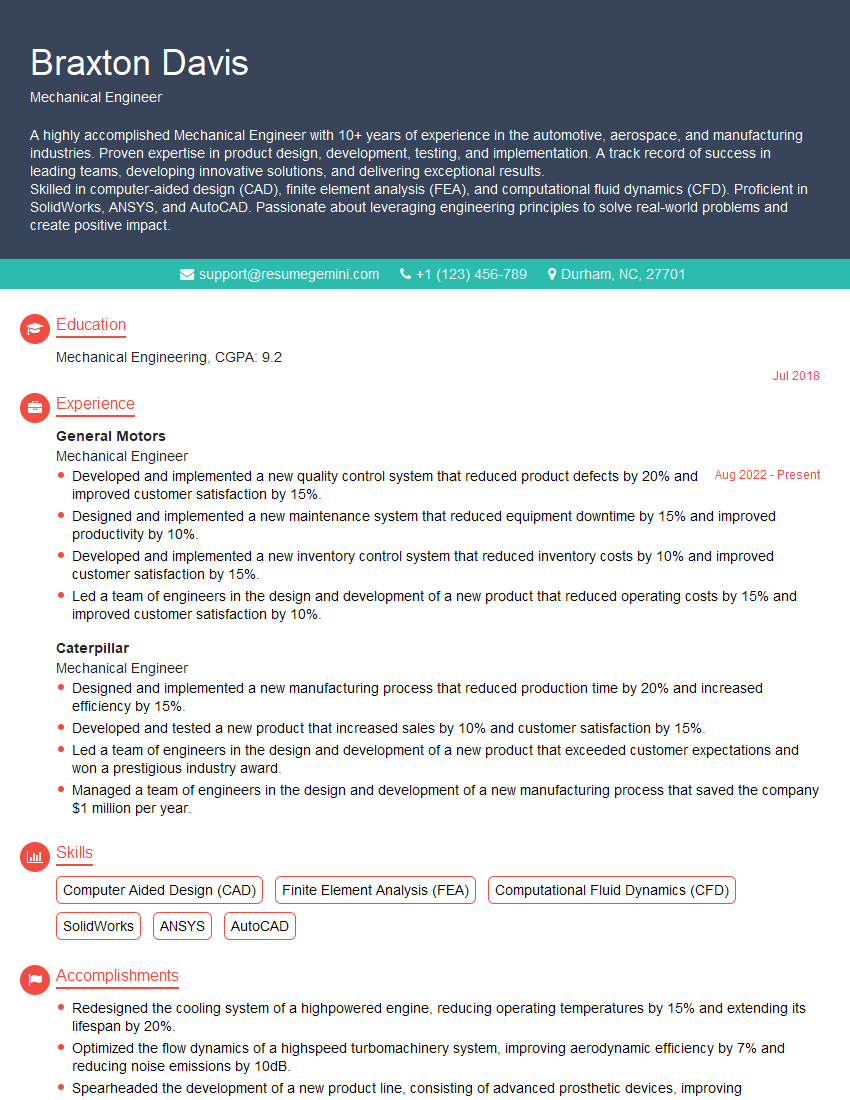
Mechanical Engineer Resume Sample

Refrigeration Engineer Resume Sample

Automotive Engineer Resume Sample

Nuclear Engineer Resume Sample

Petroleum Engineer Resume Sample

Energy Engineer Resume Sample

Renewable Energy Engineer Resume Sample

Control Systems Engineer Resume Sample

Materials Scientist Resume Sample
- Engineering Manager
- Project Engineer
- Process Engineer
- Research Scientist
- Aerospace Engineer
- Thermodynamics Engineer
- Chemical Engineer
- Environmental Engineer
- Manufacturing Engineer
- Mechanical Engineer
- Refrigeration Engineer
- Automotive Engineer
- Nuclear Engineer
- Petroleum Engineer
- Energy Engineer
- Renewable Energy Engineer
- Control Systems Engineer
- Materials Scientist
Explore more articles
Users Rating of Our Blogs
Share Your Experience
We value your feedback! Please rate our content and share your thoughts (optional).
What Readers Say About Our Blog
To the interviewgemini.com Webmaster.
Very helpful and content specific questions to help prepare me for my interview!
Thank you
To the interviewgemini.com Webmaster.
This was kind of a unique content I found around the specialized skills. Very helpful questions and good detailed answers.
Very Helpful blog, thank you Interviewgemini team.