Unlock your full potential by mastering the most common Lemmatization interview questions. This blog offers a deep dive into the critical topics, ensuring you’re not only prepared to answer but to excel. With these insights, you’ll approach your interview with clarity and confidence.
Questions Asked in Lemmatization Interview
Q 1. Define lemmatization and explain its difference from stemming.
Lemmatization is the process of reducing a word to its base or dictionary form, known as its lemma. Think of it like finding the root of a word, but taking into account its grammatical context. For example, the lemma of ‘running,’ ‘runs,’ and ‘ran’ is all ‘run’. Stemming, on the other hand, is a simpler process that chops off word endings without considering grammatical context. This often leads to inaccuracies, resulting in non-dictionary words (stems). For instance, stemming ‘running’ might produce ‘run’, but it could also incorrectly produce ‘runn’ which isn’t a valid word. Lemmatization is more sophisticated and produces actual words, improving the accuracy of NLP tasks.
In short: Lemmatization considers context and produces dictionary words; stemming is simpler, faster, but often less accurate.
Example:
- Lemmatization: ‘better’ -> ‘good’
- Stemming: ‘better’ -> ‘bett’
Q 2. Explain the role of lemmatization in Natural Language Processing (NLP).
Lemmatization plays a crucial role in NLP by significantly improving the accuracy and efficiency of various tasks. Imagine trying to analyze text where every variation of a verb is treated as a unique word; this would be very inefficient! Lemmatization addresses this by grouping different forms of the same word together. This simplifies tasks such as:
- Text Classification: Reduces the dimensionality of the feature space, leading to better classification results. Grouping ‘running,’ ‘runs,’ and ‘ran’ as ‘run’ prevents the model from considering them as separate and unrelated words.
- Information Retrieval: Improved search results by matching different forms of the same word. A search for ‘run’ will also return documents containing ‘running’ or ‘ran’.
- Topic Modeling: Accurate identification of themes and topics by representing words in their canonical forms.
- Machine Translation: Accurate translation by considering the underlying meaning and not just surface form of the word.
In essence, lemmatization enhances the meaning-based analysis of text, removing the ambiguity created by different word forms.
Q 3. What are some common algorithms used for lemmatization?
Several algorithms are employed for lemmatization, each with its strengths and weaknesses. These generally fall under rule-based, statistical, and hybrid approaches. Here are some prominent ones:
- WordNet Lemmatizer (NLTK): A widely used rule-based lemmatizer in Python’s NLTK library that utilizes the WordNet lexical database. It’s relatively simple to implement, but accuracy can be limited due to its reliance on predefined rules.
- Spacy’s Lemmatizer: A highly efficient statistical lemmatizer integrated within the Spacy NLP library. It leverages a combination of statistical models and word embeddings to achieve high accuracy, often outperforming rule-based methods.
- Stanford CoreNLP Lemmatizer: A powerful Java-based lemmatizer known for its high accuracy, especially on morphologically complex languages. It often incorporates a variety of linguistic features and machine learning techniques.
The choice of algorithm often depends on factors like the language being processed, the size of the corpus, and the desired level of accuracy.
Q 4. Discuss the advantages and disadvantages of rule-based vs. statistical lemmatization.
Rule-based lemmatization relies on handcrafted rules and dictionaries. Statistical methods, conversely, employ machine learning models trained on large corpora. Each has its advantages and disadvantages:
- Rule-based:
- Advantages: Simple to implement, computationally inexpensive, easily customized for specific domains.
- Disadvantages: Difficult to maintain, often inaccurate for languages with complex morphology, prone to errors for out-of-vocabulary words.
- Statistical:
- Advantages: Higher accuracy, especially for morphologically rich languages, better handling of out-of-vocabulary words.
- Disadvantages: Requires large annotated corpora for training, computationally more expensive, needs careful parameter tuning.
Hybrid approaches often combine the strengths of both, using rules to handle common cases and statistics for more complex or rare words, achieving a balance between accuracy and efficiency.
Q 5. How does part-of-speech (POS) tagging influence lemmatization accuracy?
Part-of-speech (POS) tagging significantly improves lemmatization accuracy. The lemma of a word can often differ depending on its grammatical role. For example, ‘run’ as a noun and ‘run’ as a verb have the same spelling but different meanings. POS tagging allows the lemmatizer to identify the correct part-of-speech for each word, which is crucial for selecting the appropriate lemma. Without POS tagging, a lemmatizer might be unable to distinguish between the noun and verb forms, potentially leading to errors.
Example: The word ‘bank’ can be either a noun (financial institution) or a verb (to rely on). POS tagging would identify the correct part-of-speech, allowing the lemmatizer to appropriately select the correct lemma: ‘bank’ (noun) or ‘bank’ (verb).
Q 6. Explain how WordNet or other lexical resources are used in lemmatization.
Lexical resources like WordNet play a vital role in lemmatization, especially in rule-based approaches. WordNet is a large lexical database of English that organizes words into synsets (sets of synonymous words). It provides information on word senses, hypernyms (more general words), hyponyms (more specific words), and other semantic relationships. Lemmatizers use this information to identify the lemma and disambiguate between different meanings of a word.
For example, a lemmatizer might use WordNet to determine that the lemma of ‘better’ is ‘good’ because WordNet indicates a semantic relationship between these two words. Other lexical resources perform similar functions, providing the linguistic knowledge required for accurate lemmatization.
Q 7. What are some challenges in lemmatization for morphologically rich languages?
Morphologically rich languages, like German or Russian, present unique challenges for lemmatization due to their complex inflectional systems. These languages have a high number of word forms derived from a single root word through the addition of prefixes, suffixes, and infixes. This morphological complexity makes it difficult for lemmatizers to accurately identify the root form. For example, a single lemma in German can have hundreds of different inflected forms. This necessitates the use of sophisticated algorithms that can handle complex morphological rules and often requires the use of larger training data sets to accurately capture the nuances of these languages.
Other challenges include:
- Handling of irregular words: Many words in morphologically rich languages don’t follow regular inflectional patterns, requiring special handling.
- Ambiguity in word segmentation: In some languages, it’s not always straightforward to separate words into individual morphemes (meaningful units).
- Limited availability of resources: Developing accurate lemmatizers for less-resourced languages can be challenging due to the lack of large, high-quality annotated corpora.
Q 8. How does handling ambiguity impact lemmatization results?
Ambiguity significantly impacts lemmatization results because words can have multiple meanings and grammatical forms. A lemmatization algorithm needs to resolve these ambiguities to accurately determine the lemma (dictionary form) of a word. For example, the word “bank” can refer to a financial institution or the side of a river. A robust lemmatization system must consider context to correctly identify the intended lemma. Failure to handle ambiguity leads to inaccurate lemmas, which can negatively affect downstream NLP tasks like information retrieval or sentiment analysis. Imagine a system analyzing customer reviews; mis-lemmatizing “banks” (to the river meaning instead of the financial one) will result in nonsensical conclusions about financial customer satisfaction.
The impact of ambiguity is particularly pronounced in languages with rich morphology, like Arabic or German, where a single word can have many inflectional forms. Advanced lemmatization approaches utilize Part-of-Speech (POS) tagging and context analysis to improve accuracy. However, even sophisticated algorithms will occasionally encounter ambiguous situations that require disambiguation based on probabilistic models or external knowledge bases.
Q 9. Describe a scenario where lemmatization is crucial for improving NLP task performance.
Lemmatization is crucial when building topic models. Imagine you’re analyzing a large corpus of text documents to identify recurring themes. Words like “running,” “ran,” and “runs” all convey the same underlying concept but will be treated as distinct words without lemmatization. This can lead to fragmented themes and diluted insights. By lemmatizing these words to their common lemma, “run,” we aggregate all instances of this concept and gain a much more accurate representation of its frequency and importance across the corpus.
Another great example is text summarization. If you are building a system to generate short summaries, applying lemmatization will prevent the summary from including many repetitive words that only differ slightly, such as “good”, “better”, and “best”. Instead, it can reduce these to their base form, “good”, offering a more concise and coherent output.
Q 10. Compare and contrast lemmatization with other normalization techniques.
Lemmatization and stemming are both text normalization techniques aiming to reduce words to their root forms, but they differ in their approach. Stemming is a simpler, rule-based process that chops off word endings without considering the word’s linguistic context. This can lead to inaccuracies and the creation of non-dictionary words (e.g., stemming “running” might produce “runn”).
Lemmatization, on the other hand, is a more sophisticated process that considers the word’s morphological analysis and its Part-of-Speech (POS) tag to return the dictionary form (lemma). It’s computationally more expensive but produces more linguistically correct results. Think of stemming as a rough cut, whereas lemmatization is a more refined process.
Other normalization techniques include lowercasing (converting text to lowercase), removing punctuation, and handling special characters. These pre-processing steps are usually performed *before* lemmatization and stemming. They are more rudimentary compared to stemming and lemmatization which aims at reducing words to a more meaningful canonical form.
Q 11. Explain the concept of a lemma and its significance in NLP.
A lemma is the dictionary form or base form of a word. It’s the canonical representation of a word that captures its core meaning, irrespective of its grammatical variations (e.g., tense, number, gender). For example, the words “run,” “running,” “ran,” and “runs” all share the same lemma: “run.”
In NLP, lemmas are incredibly significant because they allow us to reduce the vocabulary size and facilitate better analysis. They help in grouping related words together, enabling accurate information retrieval, more effective topic modeling, and improved performance in tasks sensitive to word variations. Imagine searching for information on “running”; by reducing the search term to its lemma “run”, you would match more documents that deal with the concept of running regardless of the grammatical form used.
Q 12. How would you evaluate the effectiveness of a lemmatization algorithm?
Evaluating a lemmatization algorithm requires a comprehensive approach. First, you need a gold standard: a manually lemmatized corpus of text annotated with correct lemmas. This can be a challenging task, and public datasets are available but might not perfectly fit your specific needs.
Once you have a gold standard, you can compare the output of your algorithm against it using various metrics (discussed in the next question). It is very important to test your lemmatizer on a held-out dataset that was not used for training. Besides accuracy metrics, you can also assess the algorithm’s computational efficiency (speed) and its performance on various text genres and languages. A thorough evaluation involves both quantitative measures and qualitative assessments to catch edge cases and unusual behavior.
Q 13. What are some common metrics used to assess lemmatization accuracy?
Common metrics for assessing lemmatization accuracy include:
- Precision: The proportion of correctly lemmatized words out of all words the algorithm *identified* as having a lemma (true positives / (true positives + false positives)).
- Recall: The proportion of correctly lemmatized words out of all words that *should have* been lemmatized (true positives / (true positives + false negatives)).
- F1-score: The harmonic mean of precision and recall, providing a balanced measure of accuracy.
- Accuracy: The overall percentage of correctly lemmatized words (true positives + true negatives) / (true positives + true negatives + false positives + false negatives). This metric can be misleading if the distribution of word types in your data is uneven.
These metrics provide a quantitative assessment; qualitative analysis involves manually examining incorrectly lemmatized words to identify systematic errors or areas for improvement in the algorithm.
Q 14. Discuss the trade-offs between speed and accuracy in lemmatization.
There’s a fundamental trade-off between speed and accuracy in lemmatization. Rule-based stemmers are fast but often less accurate, while sophisticated lemmatization algorithms using machine learning models or morphological analysis tend to be slower but more accurate. The choice of approach depends on the specific application.
In scenarios where speed is paramount, like real-time chatbots or large-scale data processing, a faster, less precise lemmatizer might be preferred. However, if accuracy is critical for the downstream task (e.g., medical text analysis), it’s better to opt for a slower, more accurate algorithm despite the increased computational cost. Consider carefully what level of accuracy is sufficient and acceptable given the time constraints of your project.
Optimization techniques can help mitigate the trade-off. For example, using parallel processing and efficient data structures can improve the speed of sophisticated algorithms. Selecting the right algorithm for the right application is equally important. Often, a smaller, curated dictionary can increase the speed of some algorithms while retaining relatively high accuracy. Experimenting with different approaches and evaluating them based on your specific needs is crucial for balancing speed and accuracy effectively.
Q 15. Describe how you would handle out-of-vocabulary words during lemmatization.
Handling out-of-vocabulary (OOV) words during lemmatization is crucial because lemmatizers rely on dictionaries or models trained on existing vocabulary. When an unknown word is encountered, several strategies can be employed. The simplest is to leave the word unchanged, treating it as its own lemma. However, this isn’t ideal for downstream tasks. A more sophisticated approach involves using techniques like phonetic or morphological analysis to guess the lemma based on its structure. For example, if the word resembles known words, we can infer its likely root. We might also use character n-grams to identify similar words in the dictionary. Machine learning models trained on known word-lemma pairs can also predict lemmas for OOV words, often outperforming rule-based methods. The choice depends on the size of the vocabulary, the nature of the text, and the acceptable error rate. A hybrid approach, combining rule-based and machine learning techniques, often yields the best results.
For example, imagine lemmatizing the sentence “The floccinaucinihilipilification of the project was complete.” Most standard lemmatizers wouldn’t know ‘floccinaucinihilipilification’. A rule-based system might fail completely. A machine learning-based system might try to relate it to known words based on its components or overall structure, perhaps suggesting ‘floccinaucinihilipilificate’ as the lemma, although the ideal is to identify the noun ‘floccinaucinihilipilification’.
Career Expert Tips:
- Ace those interviews! Prepare effectively by reviewing the Top 50 Most Common Interview Questions on ResumeGemini.
- Navigate your job search with confidence! Explore a wide range of Career Tips on ResumeGemini. Learn about common challenges and recommendations to overcome them.
- Craft the perfect resume! Master the Art of Resume Writing with ResumeGemini’s guide. Showcase your unique qualifications and achievements effectively.
- Don’t miss out on holiday savings! Build your dream resume with ResumeGemini’s ATS optimized templates.
Q 16. Explain how to handle named entities during the lemmatization process.
Named entities (NEs) – names of people, organizations, locations, etc. – present a unique challenge in lemmatization. Simply applying standard lemmatization rules can lead to incorrect results. For instance, lemmatizing “Barack Obama” to “Barack Obama” might seem trivial, but lemmatizing “President Obama” to “president” would lose crucial information. The best practice is to identify NEs beforehand using a named entity recognition (NER) system. Once identified, NEs should generally be left untouched during lemmatization, preserving their original form. This ensures that essential information contained within NEs isn’t lost, maintaining context and accuracy in downstream analyses. Consider scenarios where the analysis requires preserving the name for better accuracy and context, like in topic modeling or sentiment analysis concerning specific individuals.
Example: Original Sentence: "President Obama visited Apple Inc." Lemmatized Sentence (with NER): "President Obama visited Apple Inc." Lemmatized Sentence (without proper NER handling): "president Obama visited Apple Inc."Q 17. How would you choose an appropriate lemmatization tool or library for a given task?
Choosing the right lemmatization tool depends heavily on the specific task and the characteristics of the data. Factors to consider include: the language(s) being processed, the size of the vocabulary, the desired speed and accuracy, and the available resources. For English, popular libraries include NLTK’s WordNetLemmatizer, spaCy’s lemmatizer, and Stanford CoreNLP. NLTK is a great option for smaller projects and learning purposes due to its simplicity and accessibility. spaCy offers excellent speed and accuracy, making it suitable for large-scale projects. Stanford CoreNLP provides a comprehensive suite of NLP tools, including a robust lemmatizer, but demands more resources. For languages other than English, one would need to consider specialized lemmatizers designed for that language. If accuracy is paramount, more advanced techniques such as using a custom model trained on a domain-specific corpus should be considered, despite possibly being more resource-intensive.
Think of it like choosing a car: NLTK is like a reliable compact car – good for everyday use, but not ideal for large families or long journeys. spaCy is a powerful sports car, fast and efficient, but possibly more expensive. Stanford CoreNLP is a luxury SUV, able to handle anything, but needing considerable space and fuel.
Q 18. What are some common errors encountered during lemmatization and how can they be mitigated?
Common lemmatization errors stem from ambiguity and the limitations of the chosen method. One common issue is the handling of ambiguous words with multiple lemmas (e.g., “bank” as a financial institution or riverbank). The lemmatizer might choose the wrong lemma based on the available context, resulting in an incorrect analysis. This is where context becomes very important. Another challenge is dealing with irregular verbs and nouns, especially in morphologically rich languages. The lemmatizer may fail to correctly identify the root form or may produce inaccurate outputs. Finally, using a lemmatizer trained on one domain for data from another may lead to many errors, especially if the terminology varies significantly.
Mitigation strategies include: (1) Employing a more context-aware lemmatizer which incorporates part-of-speech tagging and other contextual clues. (2) Improving the lemmatizer’s knowledge base by adding domain-specific rules and data. (3) Post-processing the output to check for known errors or ambiguities, correcting them manually or using rule-based corrections. (4) Employing multiple lemmatizers and choosing the best output using a consensus approach.
Q 19. Describe the impact of lemmatization on downstream NLP tasks like text classification.
Lemmatization significantly impacts downstream NLP tasks, notably text classification. By reducing words to their base forms, lemmatization helps to improve the accuracy and efficiency of text classification models. It minimizes the impact of word variations that wouldn’t affect meaning, like stemming the words “running”, “runs”, “ran” to “run”. This reduces the dimensionality of the feature space, preventing overfitting and improving model generalizability. This reduction also makes it easier for classifiers to identify the true underlying semantic meaning. Furthermore, lemmatization helps resolve issues caused by morphological variations which could lead to the incorrect classification of documents.
For example, in sentiment analysis, ‘happy,’ ‘happier,’ and ‘happily’ all express positive sentiment. Lemmatization correctly groups them under the single lemma ‘happy’, enabling the classifier to better recognize and weigh the sentiment.
Q 20. How can lemmatization improve the performance of information retrieval systems?
Lemmatization enhances information retrieval (IR) systems by improving the matching of search queries with relevant documents. Traditional IR systems often rely on keyword matching; however, this can lead to missed matches if a query and a document use different forms of the same word. By lemmatizing both queries and documents, IR systems can identify and retrieve relevant documents even if the word forms differ. This leads to higher recall and precision. It essentially increases the efficiency of the system by reducing noise and improving the similarity assessment between documents and queries.
Imagine searching for documents on “running”. A lemmatized system would also return documents containing words like “runs” or “ran”, vastly improving the results.
Q 21. Explain the role of context in accurate lemmatization.
Context plays a crucial role in accurate lemmatization. Many words have multiple meanings or lemmas depending on their surrounding words. Consider the word “bank”. Without context, it’s impossible to determine whether it refers to a financial institution or the side of a river. A sophisticated lemmatizer incorporates part-of-speech (POS) tagging and other contextual information to disambiguate such words and select the correct lemma. Contextual information, provided by surrounding words and phrases, allows for better identification of the word’s intended meaning and, consequently, the selection of the correct lemma. This reduces ambiguity and enhances the overall accuracy of the lemmatization process. Advanced lemmatizers may use window-based approaches to consider the surrounding words or even broader context of the sentence or paragraph.
Think of it like understanding a sentence: the word alone provides limited information, but context provided by neighboring words clarifies the specific meaning.
Q 22. How does lemmatization contribute to better semantic analysis?
Lemmatization, the process of reducing words to their base or dictionary form (lemma), significantly improves semantic analysis by grouping together different word forms that share the same meaning. Think of it as reducing the noise of grammatical variations to focus on the core semantic meaning.
For example, consider the words “running,” “runs,” and “ran.” These are all different forms of the verb “to run,” but they might be treated as separate entities by a basic text processing system. Lemmatization reduces them all to the lemma “run,” allowing the system to understand they represent the same underlying concept. This dramatically improves the accuracy of tasks such as topic modeling, sentiment analysis, and information retrieval, where understanding the core meaning of words is crucial.
Without lemmatization, you’d have to account for every possible inflection of a word, exponentially increasing the complexity of your analysis. With lemmatization, you create a simplified representation that focuses on the core semantic units, making analysis more efficient and accurate.
Q 23. Discuss the computational complexity of different lemmatization algorithms.
The computational complexity of lemmatization algorithms varies significantly depending on the approach used. Rule-based methods, which rely on predefined dictionaries and morphological rules, generally have lower complexity, often O(n) where n is the number of words. This is because they simply look up words in dictionaries and apply rules. However, they are less adaptable to new words and variations.
Statistical methods, such as those using machine learning models (e.g., Hidden Markov Models or neural networks), are more complex. Training these models is computationally expensive, and inference can range from O(n) to O(n log n) or even higher depending on the model’s architecture. The benefit, however, is their ability to adapt to new words and handle ambiguous cases better than rule-based systems.
Finally, hybrid approaches combine rule-based and statistical methods, attempting to balance computational cost and accuracy. The complexity of a hybrid method is dependent on the specific design but usually lies between that of purely rule-based and purely statistical methods.
Q 24. How can lemmatization be optimized for large-scale text processing?
Optimizing lemmatization for large-scale text processing requires a multi-pronged approach. First, leverage efficient data structures and algorithms. Trie data structures, for instance, can significantly speed up dictionary lookups in rule-based systems. For statistical methods, consider optimized libraries and parallel processing techniques to handle the large datasets efficiently.
Second, pre-process the text to remove unnecessary elements like punctuation and irrelevant symbols. This reduces the computational burden on the lemmatization algorithm.
Third, utilize caching mechanisms to store frequently accessed lemmas and their corresponding word forms. This avoids redundant computation and dramatically speeds up the process for repeated words.
Fourth, consider using approximations or heuristics in cases where absolute precision isn’t critical. This allows for faster processing at the cost of potentially minor accuracy loss, which is often an acceptable tradeoff in high-volume processing.
Finally, explore distributed computing frameworks such as Apache Spark or Hadoop to distribute the lemmatization task across multiple machines, enabling scalable processing of massive text corpora.
Q 25. Explain the use of lemmatization in building a language model.
Lemmatization plays a crucial role in building robust language models. By reducing words to their lemmas, we create a more compact and generalized representation of the vocabulary, reducing the sparsity of the data. This leads to several benefits:
- Improved Vocabulary Coverage: The model doesn’t need to explicitly learn every inflection of a word. Instead, it learns the lemma, capturing the underlying semantic meaning effectively.
- Enhanced Generalization: The model can generalize better to unseen words or inflections because it already has learned the lemma’s representation.
- Reduced Model Size: By representing words with their lemmas, the vocabulary size is reduced, leading to a smaller and more efficient language model.
- Improved Contextual Understanding: By associating semantically related word forms with the same lemma, the model can better capture the contextual relationships between words in a sentence.
For example, in a language model trained on lemmatized text, the model will better understand the relationship between “running,” “runs,” and “ran” than a model trained on the raw forms, leading to more accurate predictions and improved overall performance.
Q 26. Describe how you would handle morphological variations in different languages during lemmatization.
Handling morphological variations across different languages during lemmatization requires language-specific resources and approaches. A one-size-fits-all approach won’t work due to the vast differences in morphology between languages.
For languages with rich morphology like German or Russian, you’ll need detailed morphological analyzers and dictionaries. These resources typically employ sophisticated rules or statistical models that account for complex inflectional patterns. For example, German nouns have grammatical genders and numerous case endings, all of which must be correctly handled during lemmatization. A rule-based approach or a well-trained machine learning model that has been trained on extensive corpora of the language is needed.
For languages with simpler morphology like English, simpler rule-based systems or even lookup tables might suffice, but even for English, handling irregular verbs correctly requires specialized knowledge.
For low-resource languages, where annotated data is scarce, techniques like transfer learning can be helpful. A model trained on a high-resource language can be adapted to a low-resource language, often yielding surprisingly good results. However, significant refinement and adaptation are often necessary.
Q 27. What are some emerging trends and future directions in lemmatization research?
Several emerging trends and future directions in lemmatization research focus on addressing the challenges associated with handling complex linguistic phenomena and improving scalability and efficiency.
- Unsupervised and Semi-Supervised Learning: Reducing reliance on large manually annotated datasets by leveraging unsupervised and semi-supervised learning techniques is crucial, especially for low-resource languages.
- Cross-Lingual Lemmatization: Developing models capable of lemmatizing text across multiple languages without requiring extensive language-specific training data.
- Context-Aware Lemmatization: Taking into account the surrounding context to disambiguate words with multiple possible lemmas. For example, the word “bank” could refer to a financial institution or the edge of a river; context is essential to determine the correct lemma.
- Neural Network Architectures: Exploring more advanced neural network architectures, such as transformer-based models, to capture complex morphological patterns and improve the accuracy and efficiency of lemmatization.
- Integration with other NLP tasks: Integrating lemmatization seamlessly into other NLP pipelines to improve the overall accuracy and efficiency of downstream tasks.
Q 28. How would you integrate lemmatization into a real-world NLP pipeline?
Integrating lemmatization into a real-world NLP pipeline is straightforward. It typically occurs early in the pipeline, after tokenization and before tasks like part-of-speech tagging, named entity recognition, or semantic analysis.
A typical workflow might look like this:
- Text Preprocessing: Clean the text, removing noise such as irrelevant characters and punctuation.
- Tokenization: Split the text into individual words or tokens.
- Lemmatization: Apply a chosen lemmatization algorithm (rule-based, statistical, or hybrid) to reduce each token to its lemma.
- Subsequent NLP Tasks: Pass the lemmatized text to subsequent NLP components, such as a part-of-speech tagger or a sentiment analysis module, to perform more advanced processing.
The choice of lemmatization algorithm depends on factors like the language, the size of the corpus, and the desired level of accuracy versus speed. For instance, a rule-based system might be sufficient for English and a smaller corpus, while a deep learning model might be necessary for a large multilingual corpus. Libraries like spaCy, NLTK, and Stanford CoreNLP offer convenient tools for lemmatization in various programming languages.
Key Topics to Learn for Lemmatization Interview
- What is Lemmatization? Understanding the core concept, its differences from stemming, and its importance in Natural Language Processing (NLP).
- Lemmatization Algorithms: Familiarize yourself with common algorithms like WordNet Lemmatizer and Stanford Lemmatizer. Understand their strengths and weaknesses.
- Part-of-Speech Tagging (POS Tagging): Grasp the crucial role of POS tagging in accurate lemmatization. Understand how different POS tags influence the lemmatization process.
- Practical Applications: Explore real-world applications of lemmatization in information retrieval, text summarization, sentiment analysis, and machine translation.
- Handling Ambiguity: Understand how to address challenges posed by ambiguous words and their multiple possible lemmas.
- Performance Evaluation Metrics: Learn how to evaluate the effectiveness of different lemmatization techniques using relevant metrics.
- Choosing the Right Lemmatizer: Understand the factors to consider when selecting a lemmatizer for a specific NLP task, considering factors like language support, accuracy, and speed.
- Advanced Techniques: Explore advanced topics like handling out-of-vocabulary words and incorporating context into the lemmatization process.
Next Steps
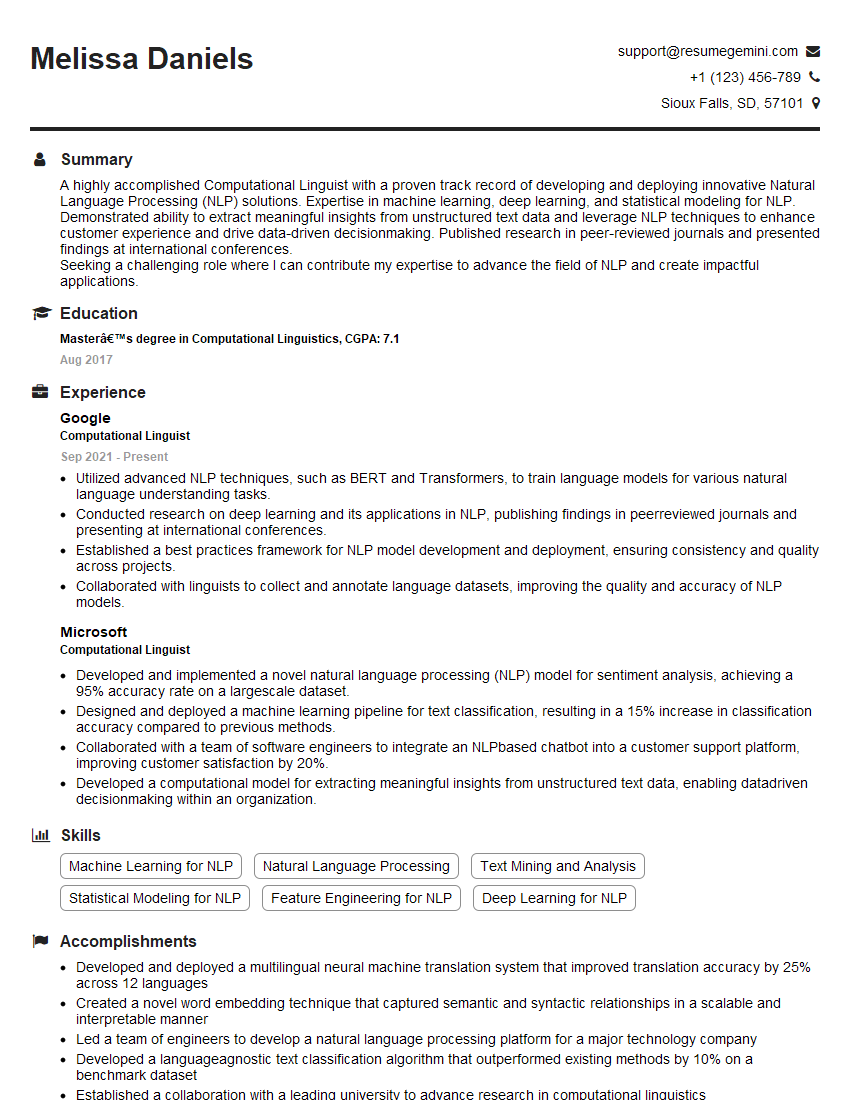
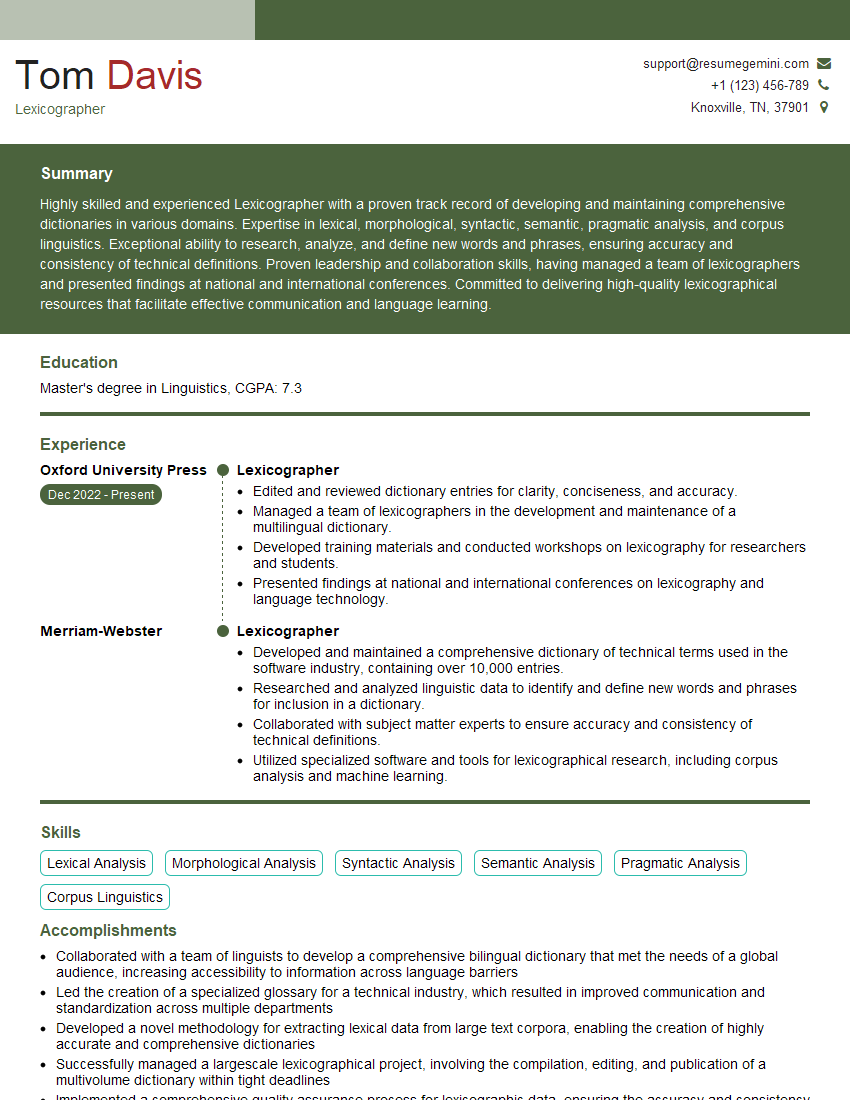
Mastering lemmatization significantly enhances your NLP skillset, opening doors to exciting career opportunities in data science, machine learning, and linguistic technology. A strong understanding of lemmatization demonstrates a deeper understanding of NLP fundamentals, making you a more competitive candidate. To further boost your job prospects, crafting an ATS-friendly resume is crucial. ResumeGemini is a trusted resource that can help you build a professional and impactful resume, highlighting your lemmatization expertise effectively. Examples of resumes tailored to Lemmatization are provided within ResumeGemini to help you get started.


Explore more articles
Users Rating of Our Blogs
Share Your Experience
We value your feedback! Please rate our content and share your thoughts (optional).
What Readers Say About Our Blog
To the interviewgemini.com Webmaster.
Very helpful and content specific questions to help prepare me for my interview!
Thank you
To the interviewgemini.com Webmaster.
This was kind of a unique content I found around the specialized skills. Very helpful questions and good detailed answers.
Very Helpful blog, thank you Interviewgemini team.