Feeling uncertain about what to expect in your upcoming interview? We’ve got you covered! This blog highlights the most important Maintenance of Satellite Antennas interview questions and provides actionable advice to help you stand out as the ideal candidate. Let’s pave the way for your success.
Questions Asked in Maintenance of Satellite Antennas Interview
Q 1. Explain the process of aligning a satellite antenna.
Aligning a satellite antenna is crucial for receiving a strong signal. It involves precisely pointing the dish towards the geostationary satellite transmitting the desired signal. This process, often called ‘pointing’ or ‘aiming’, requires a satellite finder meter, a compass, and knowledge of the satellite’s location (azimuth and elevation).
The process typically involves these steps:
- Locate the Satellite: Use a satellite finder app or website to determine the satellite’s azimuth (horizontal angle) and elevation (vertical angle) for your location. These vary depending on your geographic coordinates.
- Rough Alignment: Use the compass to set the azimuth angle, then adjust the antenna’s elevation angle. This is a coarse adjustment, getting you relatively close to the satellite.
- Fine Tuning: This is where the satellite finder meter comes into play. Connect the meter to the LNB (Low Noise Block) on your antenna. It will display a signal strength. Carefully adjust the azimuth and elevation until the signal strength reaches its maximum. Even slight adjustments can make a significant difference.
- Securing the Antenna: Once the optimum signal is achieved, securely tighten all bolts and clamps to prevent the antenna from shifting.
For example, I once helped a client who couldn’t receive HD channels. After carefully aligning their antenna using a satellite finder, we increased their signal strength by 20dB, which resolved their issue and allowed them to enjoy crystal-clear HD channels. It’s a rewarding feeling to troubleshoot such problems.
Q 2. Describe different types of satellite antenna feeds.
Satellite antenna feeds come in various types, each designed for specific frequency bands and signal polarization. The choice depends on the satellite signal and the receiver’s requirements.
- Single LNB: The most basic type, receiving signals from one polarization (either horizontal or vertical) of one frequency band. Common in older systems.
- Dual LNB: This receives signals from both horizontal and vertical polarizations of a single frequency band, allowing access to more channels.
- Quad LNB: Similar to a dual LNB but receives signals from both polarizations across two frequency bands (e.g., Ku-band and lower Ku-band).
- Multi-LNB feeds: These are more sophisticated systems that combine multiple LNBs to receive signals from multiple satellites or different frequency bands. This often requires a multi-switch to manage the signals.
- Offset Feed: These LNBs are positioned to the side of the dish, often used to minimize signal blockage from the antenna’s support structure.
The selection of the appropriate feed is critical to ensure optimal signal reception. Using the wrong type of feed can lead to significant signal loss or the inability to receive channels.
Q 3. What are the common causes of signal degradation in satellite communication?
Signal degradation in satellite communication can be caused by several factors, impacting the quality and availability of the received signal. These can be broadly classified into atmospheric, geographical, and equipment-related causes:
- Atmospheric Effects: Rain, snow, fog, and clouds can attenuate (weaken) the satellite signal. The higher the frequency, the more susceptible it is to this effect. This is particularly noticeable in Ka-band systems.
- Geographical Obstructions: Trees, buildings, and hills can block the signal path between the satellite and the antenna. Even slight obstructions can cause significant signal degradation.
- Equipment Issues: Problems with the LNB, coaxial cables, connectors, or the receiver itself can reduce signal strength. A damaged LNB, for example, can significantly weaken the signal. Poor quality coaxial cables can introduce significant signal loss due to high attenuation.
- Signal Interference: Interference from other sources, such as terrestrial transmitters or other satellite signals, can degrade the signal quality.
- Multipath Interference: Reflections of the satellite signal from nearby objects can interfere with the direct signal, leading to signal degradation and distortion.
Understanding these causes is crucial for effective troubleshooting and maintenance.
Q 4. How do you troubleshoot a low signal strength issue on a satellite antenna?
Troubleshooting low signal strength involves a systematic approach. It starts with the most obvious issues and moves towards more complex ones:
- Check the Antenna Alignment: Verify the antenna is accurately pointed at the satellite. Even a slight misalignment can cause significant signal loss. Re-aligning the antenna as described earlier may be necessary.
- Inspect the Cables and Connectors: Look for any damage to the coaxial cables or connectors. Loose, corroded, or damaged connectors are common causes of signal loss. Try replacing suspect components.
- Test the LNB: A faulty LNB can significantly weaken the signal. Try replacing the LNB with a known good one. If possible, use a satellite meter to test the signal strength at the LNB output.
- Check the Receiver: Ensure the receiver is properly configured and functioning correctly. Try connecting a different receiver to the antenna to rule out receiver problems.
- Check for Obstructions: Examine the line of sight between the antenna and the satellite. Any obstructions like trees or buildings should be removed or mitigated.
- Consider Atmospheric Conditions: Severe weather conditions (heavy rain, snow) can significantly attenuate the signal. Signal strength should improve when weather improves.
Remember to always use appropriate safety precautions, especially while working on the antenna itself.
Q 5. What safety precautions should be taken when working on a satellite antenna?
Safety is paramount when working with satellite antennas. These antennas are often mounted at heights that pose risks of falls, and the equipment itself can be electrically hazardous.
- Use appropriate safety equipment: This includes safety harnesses, fall protection systems, and insulated tools when working at heights. Always follow OSHA guidelines and local regulations regarding fall protection.
- Never work alone: Always have a spotter or partner present when working on the antenna, especially at heights.
- Use insulated tools: To avoid electrical shock, use insulated tools when working near the LNB and other electrical components.
- Be aware of weather conditions: Avoid working in inclement weather such as high winds, lightning storms, or heavy rain.
- Ground the antenna system: Grounding the antenna helps protect against lightning strikes and static electricity. Ensure the antenna is properly grounded according to safety standards.
- Follow manufacturer’s instructions: Carefully read and follow the manufacturer’s instructions for the specific antenna and equipment being used.
A fall or electrical shock can have severe consequences. Prioritizing safety is essential for a successful and hazard-free installation and maintenance.
Q 6. Explain the difference between Ku-band and Ka-band satellite frequencies.
Ku-band and Ka-band are both microwave frequency bands used for satellite communication, but they differ in their frequency ranges and characteristics:
- Ku-band: Typically operates in the range of 10.7 GHz to 12.75 GHz (downlink) and 13.75 GHz to 14.5 GHz (uplink). It’s a well-established band, with many existing satellites operating in this frequency range. It offers a good balance between signal attenuation and technology maturity.
- Ka-band: Operates at higher frequencies, typically 18 GHz to 30 GHz. This higher frequency allows for greater bandwidth, but signal attenuation due to atmospheric conditions (rain, clouds) is significantly higher than Ku-band. This requires more robust and expensive equipment.
Ka-band offers higher bandwidth capabilities compared to Ku-band, making it suitable for high-speed data applications like broadband internet. However, the increased atmospheric attenuation necessitates larger, more sophisticated antennas and advanced signal processing techniques. The choice between Ku-band and Ka-band depends on the specific application and the trade-off between bandwidth and signal reliability.
Q 7. Describe the function of a Low Noise Block (LNB).
A Low Noise Block (LNB) is a crucial component in satellite reception. It’s located at the focus point of the parabolic satellite dish and serves as the first stage of signal amplification and conversion.
Its primary functions are:
- Signal Reception: The LNB receives the weak microwave signals transmitted by the satellite.
- Signal Amplification: It amplifies the received signal to compensate for the attenuation that occurs during transmission through the atmosphere and over long distances.
- Frequency Conversion: The LNB converts the high-frequency satellite signals (e.g., Ku-band or Ka-band) into lower intermediate frequencies (IF) that are easier to process by the receiver.
- Polarization Selection: Some LNBs can select either horizontal or vertical polarization, or both, depending on the configuration of the LNB. This allows for reception of signals using different polarizations from the same satellite.
The LNB is critical for successful satellite reception. A faulty or mismatched LNB can lead to significant signal degradation or prevent reception altogether. Choosing the right LNB for the specific frequency band and polarization is essential for optimal performance.
Q 8. How do you test the integrity of a coaxial cable?
Testing the integrity of a coaxial cable, crucial for a strong satellite signal, involves several methods. The simplest is a visual inspection, checking for any kinks, cuts, or damage to the cable jacket or connectors. However, visual inspection alone isn’t sufficient. A more reliable method is using a Time Domain Reflectometer (TDR). This specialized tool sends a signal down the cable and measures the time it takes for the signal to return. Any reflections indicate a break, short, or other impedance mismatch within the cable. A signal level meter connected to the cable’s end can also indicate signal loss, suggesting a problem within the cable. Finally, a simple continuity test with a multimeter can verify a complete electrical path through the cable. For instance, if you’re troubleshooting a weak signal, a TDR can pinpoint the exact location of a break, allowing for targeted repair rather than replacing the entire cable.
Q 9. What are the common tools used for satellite antenna maintenance?
Satellite antenna maintenance requires a specialized toolkit. Essential tools include a signal meter (to measure signal strength and quality), various sized wrenches and screwdrivers (for adjusting the antenna and LNB), a cable tester (to check for faults in the coaxial cable), cable connectors and crimping tools (for repairing or replacing cables), a ladder (for safe access to the antenna), and possibly a torque wrench (to avoid over-tightening connections). For more advanced repairs, you might need specialized tools for aligning the dish accurately, depending on its design, including a compass and inclinometer. Safety equipment such as gloves and safety glasses are also crucial. Think of it like a mechanic’s toolbox, but specifically tailored for working at heights and with sensitive electronic equipment.
Q 10. Explain the concept of satellite antenna polarization.
Satellite antenna polarization refers to the direction of the electromagnetic wave’s electric field as it travels. Think of it like a radio wave vibrating either vertically or horizontally. Satellites transmit signals using either linear polarization (vertical or horizontal) or circular polarization (right-hand or left-hand). The LNB (Low Noise Block downconverter) on your antenna is designed to receive a specific polarization. If your LNB is set for vertical polarization, but the satellite transmits horizontally, you won’t receive a signal. Mismatched polarization is a common reason for weak or no signal. Imagine trying to catch rain in a bucket held sideways when the rain is falling vertically; you’ll only catch a small amount. The correct polarization ensures you ‘catch’ the maximum signal.
Q 11. How do you interpret a satellite signal meter reading?
A satellite signal meter displays several key parameters. The most important are signal strength (often measured in dBm, decibels relative to one milliwatt) and signal quality (often shown as a percentage or a quality indicator bar). High signal strength indicates a strong signal reaching the receiver, while high signal quality suggests minimal errors in the transmission. A low signal strength reading usually indicates problems with alignment, cable issues, or atmospheric conditions. Low signal quality might indicate interference or issues with the satellite itself or with the LNB. For example, a reading of -65 dBm with 95% quality is ideal, whereas -80 dBm with 50% quality signals significant issues requiring investigation. It’s important to understand the specific meter’s readings, as values and representations can vary slightly by manufacturer.
Q 12. Describe the process of replacing a faulty LNB.
Replacing a faulty LNB is a relatively straightforward procedure. First, ensure the power to the receiver is turned off for safety. Next, carefully detach the coaxial cable from the LNB, taking note of its orientation for reconnection. Then, unscrew the LNB from the antenna arm using the appropriate wrench. Before attaching the new LNB, it’s important to visually inspect the connector and antenna feedhorn for any obstructions or damage. Once the old LNB is removed, firmly attach the new LNB in its place, ensuring it is securely fastened and aligned correctly. Carefully reconnect the coaxial cable, making sure it’s tightly connected to avoid signal loss. Finally, turn on the receiver and use the signal meter to verify a strong and stable signal. If the signal is still weak, recheck the connections and alignment.
Q 13. What are the common causes of antenna reflector damage?
Antenna reflector damage can stem from several sources. The most common culprits are weather-related events, like strong winds, hailstorms, or heavy snow accumulation. Physical impact, such as tree branches falling on the antenna or accidental collisions, can also cause damage. Corrosion due to exposure to the elements, especially in coastal or humid environments, weakens the reflector’s material over time. Birds building nests on the antenna can also cause minor to significant damage. Proper maintenance, including regular inspections and protective measures (such as covers during severe weather), is crucial to minimize the risk of reflector damage. Regular cleaning to remove debris and corrosion can also extend its lifespan considerably.
Q 14. How do you identify and resolve issues related to signal interference?
Identifying and resolving signal interference requires a systematic approach. First, use a signal meter to pinpoint the exact nature and level of interference. Then, investigate possible sources: nearby Wi-Fi routers (2.4 GHz and 5 GHz bands can interfere with satellite signals), microwave ovens, cordless phones, and even faulty wiring within the building can disrupt satellite reception. A visual inspection of the antenna and its surroundings is crucial to identify any obstructions. If the interference is intermittent, it might indicate a nearby device switching on and off. If it’s constant, you might need to relocate the antenna, use a signal amplifier or use specialized filters on the coaxial cable to mitigate the specific interference frequency. Remember to try switching off suspected sources one by one to isolate the problematic device.
Q 15. Explain the importance of grounding in satellite antenna systems.
Grounding in satellite antenna systems is crucial for safety and optimal performance. It provides a low-resistance path for electrical discharges, preventing damage to equipment and protecting personnel from electrical shocks. Lightning strikes are a significant threat to satellite antennas, and a proper grounding system diverts the surge current safely into the earth. Without grounding, a lightning strike could fry the sensitive electronics within the Low Noise Block (LNB) and even the receiver itself. Think of it like a lightning rod for your satellite system – it channels the powerful energy safely away.
A typical grounding system consists of a ground rod driven deep into the earth, connected to the antenna mast and subsequently to the receiver and other equipment via a low-resistance grounding wire. Regular inspection and testing of the grounding system’s resistance are essential to ensure its effectiveness.
Career Expert Tips:
- Ace those interviews! Prepare effectively by reviewing the Top 50 Most Common Interview Questions on ResumeGemini.
- Navigate your job search with confidence! Explore a wide range of Career Tips on ResumeGemini. Learn about common challenges and recommendations to overcome them.
- Craft the perfect resume! Master the Art of Resume Writing with ResumeGemini’s guide. Showcase your unique qualifications and achievements effectively.
- Don’t miss out on holiday savings! Build your dream resume with ResumeGemini’s ATS optimized templates.
Q 16. How do you maintain the cleanliness of a satellite antenna?
Maintaining a clean satellite antenna is vital for optimal signal reception. Accumulated dirt, bird droppings, and other debris can significantly attenuate the signal, leading to poor picture quality or complete signal loss. The process involves a careful and methodical approach:
- Safety First: Always power down the system before cleaning. Never climb a ladder during a thunderstorm!
- Gentle Cleaning: Use a soft brush, such as a soft-bristled paintbrush, to remove loose dirt and debris. For stubborn grime, consider a slightly damp (not soaking wet!) soft cloth. Avoid abrasive materials that could scratch the antenna’s surface. For difficult-to-reach areas, use compressed air carefully.
- Frequency: The frequency of cleaning depends on the environment. In dusty or heavily polluted areas, more frequent cleaning is necessary, perhaps every few months. In cleaner environments, annual cleaning might suffice.
Regular cleaning ensures your investment in satellite technology delivers its maximum potential, extending its lifespan and preventing costly repairs.
Q 17. Describe the different types of satellite antenna mounts.
Satellite antenna mounts are designed to precisely position and maintain the antenna’s alignment with the satellite. The choice of mount depends on factors like the satellite’s position and the desired level of precision. Common types include:
- Azimuth-Elevation Mounts: These are the most common type, allowing adjustment in both azimuth (horizontal) and elevation (vertical) angles. They’re relatively simple to use and adjust, suitable for most applications.
- Polar Mounts: These mounts move along a single polar axis, simplifying the tracking mechanism for satellites at geostationary orbit. They require precise initial alignment and are less commonly used for home satellite installations.
- Motorized Mounts: These are automated mounts that use motors to adjust the antenna position, usually controlled via a receiver or computer. They are more expensive and complex than manual mounts but offer convenience and increased accuracy. These are quite common in professional environments.
The choice of mount will impact the ease of installation, accuracy of pointing, and the overall cost of the system.
Q 18. What are the environmental factors that affect satellite antenna performance?
Environmental factors significantly impact satellite antenna performance. These factors can reduce signal strength, introduce noise, and even cause physical damage to the antenna. Key factors include:
- Weather: Rain, snow, and ice can significantly attenuate the signal, while strong winds can displace the antenna, causing misalignment. Heavy rainfall can significantly impact signal strength; the level of attenuation depends on the frequency and the intensity and duration of the precipitation.
- Temperature: Extreme temperatures can affect the antenna’s structural integrity and the performance of electronic components. Expansion and contraction of the antenna structure may cause misalignment.
- Atmospheric Conditions: Atmospheric conditions such as humidity and atmospheric pressure can affect signal propagation. High humidity can increase signal attenuation.
- Obstructions: Trees, buildings, and even hilly terrain can block the line of sight between the antenna and the satellite.
Understanding these environmental factors allows for proactive measures such as choosing weather-resistant materials, implementing robust grounding, and selecting appropriate antenna locations.
Q 19. How do you perform a visual inspection of a satellite antenna?
A thorough visual inspection of a satellite antenna is a crucial step in preventative maintenance. It helps identify potential problems before they escalate into major issues. Here’s a step-by-step process:
- Check the Physical Condition: Inspect the antenna dish for any signs of damage such as dents, rust, or warping. Examine the feed horn, LNB, and cabling for any physical damage.
- Assess the Mount: Examine the mount for any signs of looseness, rust, or damage. Ensure all bolts and connections are secure and functioning correctly.
- Look for Obstructions: Carefully check for any obstructions, like trees or buildings, that may be blocking the antenna’s view of the satellite. Take measurements if necessary to determine the severity of the blockage.
- Check for Debris: Inspect the antenna dish for any accumulated debris such as bird droppings, leaves, or dust. Cleaning is often part of a visual inspection.
- Examine the Cables: Check the coaxial cables for any damage, kinks, or exposed wires. Replace damaged cables immediately.
Proper visual inspection is not just a quick glance but a systematic check for potential problems. Document your findings to create a maintenance history record. This approach minimizes downtime and maximizes the lifespan of your satellite system.
Q 20. Describe the process of troubleshooting a faulty satellite receiver.
Troubleshooting a faulty satellite receiver involves a systematic approach to pinpoint the source of the problem. Here’s a step-by-step process:
- Check the Obvious: Verify that the receiver is properly powered on and connected to the antenna. Make sure all cables are securely connected. This simple step often solves the issue.
- Signal Strength Check: Use the receiver’s built-in signal meter (usually in the settings menu) to check the signal strength and quality. Low signal strength suggests a problem with the antenna alignment or environmental factors. Poor signal quality might indicate cable issues or problems with the LNB.
- Check the LNB: Inspect the LNB for physical damage or corrosion. If possible, swap it with a known good LNB to see if that resolves the problem. This is a good intermediate step.
- Inspect Cabling: Check the coaxial cables for any damage or poor connections. Replace damaged cables. Improperly shielded cables can introduce noise and degrade the signal.
- Antenna Alignment: Verify that the antenna is correctly aligned with the satellite. Even a slight misalignment can significantly impact signal reception. Use a satellite finder tool to help with the alignment.
- Software and Receiver Issues: If all the hardware checks out, the issue may be a software problem. Try restarting the receiver or performing a factory reset (as a last resort). Consider a software update as well.
Troubleshooting involves a combination of logical deduction and methodical checking. Following these steps systematically generally identifies the root cause of a faulty satellite receiver.
Q 21. Explain the concept of satellite orbital parameters.
Satellite orbital parameters define the position and movement of a satellite in orbit. These parameters are crucial for accurate antenna pointing and tracking. Key orbital parameters include:
- Orbital Inclination: The angle between the orbital plane and the Earth’s equatorial plane. A zero-degree inclination means the satellite orbits directly above the equator.
- Orbital Longitude: The geographical longitude of the satellite’s sub-satellite point (the point on Earth directly beneath the satellite). This is crucial for antenna pointing.
- Orbital Altitude: The height of the satellite above the Earth’s surface. Geostationary satellites maintain a specific altitude to appear stationary in the sky from a given location.
- Orbital Eccentricity: A measure of how elliptical the orbit is. A perfectly circular orbit has an eccentricity of zero. Most communication satellites use near-circular orbits to simplify tracking.
- Orbital Period: The time it takes for the satellite to complete one orbit around the Earth. Geostationary satellites have an orbital period of 24 hours, matching Earth’s rotation.
Accurate knowledge of these parameters is crucial for setting up and maintaining a satellite antenna system. Incorrect parameter values will result in poor or nonexistent signal reception. These values can typically be obtained from the satellite operator or through publicly available databases.
Q 22. How do you handle severe weather conditions during antenna maintenance?
Safety is paramount during severe weather. Antenna maintenance in high winds, heavy rain, or lightning is postponed until conditions improve. This isn’t just about protecting equipment; it’s about protecting personnel. We have strict protocols in place, including weather monitoring systems and pre-defined cancellation thresholds. For example, wind speeds exceeding 30 mph usually halt any outdoor antenna work. If a storm hits unexpectedly while we are working, we immediately cease operations, retreat to a safe location, and secure the antenna as best we can before seeking shelter. Post-storm inspections are crucial to check for any damage, such as bent dishes, loose cabling, or water ingress.
Q 23. What are the regulatory compliance requirements for satellite antenna installations?
Regulatory compliance varies by location but generally includes adherence to local building codes, environmental regulations (especially regarding electromagnetic interference), and licensing requirements for operating satellite communication systems. For example, in many countries, you need a license to operate a high-power satellite earth station. Proper grounding and lightning protection are critical, often specified in detail by regional regulatory bodies like the FCC in the United States or Ofcom in the UK. Detailed documentation of the installation, including equipment specifications and compliance certifications, is mandatory for audits and for insurance purposes. Failing to adhere to these regulations can result in hefty fines and even legal action.
Q 24. Describe your experience with different types of satellite antenna technologies (e.g., parabolic, offset).
My experience encompasses various antenna types, including parabolic, offset, and even some phased arrays. Parabolic antennas, with their classic dish shape, are prevalent for their high gain and relatively simple design. Offset antennas offer advantages like reduced blockage of the feed horn by the dish structure, enhancing performance in some applications. I’ve worked on large C-band parabolic antennas used in broadcast applications, smaller Ku-band offset antennas for residential satellite internet services, and even smaller, more specialized antennas for satellite tracking systems. Each antenna type has its strengths and weaknesses in terms of gain, efficiency, and susceptibility to environmental factors, requiring different maintenance strategies.
Q 25. Explain the concept of antenna gain and its impact on signal strength.
Antenna gain is a measure of how effectively an antenna focuses transmitted or received power in a specific direction. Think of it like a magnifying glass focusing sunlight: a higher gain antenna concentrates the signal, resulting in a stronger signal strength. Gain is usually expressed in decibels (dB). A higher gain antenna means a stronger signal at the receiver, allowing for longer distances or weaker transmission power. However, a higher gain antenna typically has a narrower beamwidth, meaning it is more sensitive to precise aiming and can be more susceptible to signal loss from slight misalignment. For instance, a high-gain antenna might require more precise alignment than a low-gain antenna to maintain a stable connection.
Q 26. How do you manage and prioritize maintenance tasks for a large number of satellite antennas?
Managing maintenance for numerous antennas requires a structured approach. We utilize a computerized maintenance management system (CMMS) to track inspections, repairs, and scheduled maintenance. Tasks are prioritized based on factors like criticality of the antenna (e.g., emergency services rely on a certain antenna), predicted failure risk (based on historical data and environmental conditions), and contractual obligations. We employ a preventive maintenance schedule, conducting routine inspections and cleaning at defined intervals. Corrective maintenance is prioritized based on the severity of the issue. This CMMS provides detailed reporting, allowing us to optimize resource allocation and identify potential systemic issues before they lead to significant outages.
Q 27. Describe your experience with troubleshooting and resolving complex satellite antenna system failures.
Troubleshooting complex antenna failures requires a systematic approach. I begin by gathering information: signal strength readings, error logs from the receiver, and any environmental factors that could be contributing. I then visually inspect the antenna, cabling, and related equipment for obvious damage. If necessary, I’ll use specialized tools like a satellite signal meter to pinpoint the problem. One example involved a complete signal loss on a crucial antenna. After eliminating external factors, I discovered a loose connection inside a waveguide. The problem was isolated to the joint, which was repaired leading to the restoration of the service. Thorough documentation throughout the process is crucial for future reference and ongoing improvement.
Q 28. What are your strategies for maintaining accurate and up-to-date documentation of satellite antenna maintenance activities?
Accurate and up-to-date documentation is essential for maintaining the efficiency and reliability of satellite antenna systems. We use a combination of digital and physical documentation. Our CMMS serves as the central repository for all maintenance records, containing detailed logs of inspections, repairs, and parts replacements. Each maintenance activity includes date, time, technicians involved, actions taken, and any relevant photos or diagrams. Physical records, including blueprints and as-built drawings of the antenna installation, are stored securely and are cross-referenced with the digital database. Regular audits ensure data integrity and compliance with regulations. This comprehensive documentation is critical for effective maintenance planning, troubleshooting, and regulatory compliance.
Key Topics to Learn for Your Maintenance of Satellite Antennas Interview
- Antenna Alignment and Pointing: Understanding principles of azimuth, elevation, and polarization adjustments; troubleshooting signal loss due to misalignment; practical experience with alignment tools and techniques.
- RF Signal Measurement and Analysis: Interpreting signal strength, quality, and noise levels; using spectrum analyzers and other test equipment; diagnosing signal degradation and identifying sources of interference.
- Troubleshooting and Repair: Identifying common antenna malfunctions (e.g., faulty connectors, damaged cabling, LNB issues); practical experience with troubleshooting techniques and repair procedures; understanding safety protocols when working at heights.
- Maintenance Procedures and Schedules: Developing and implementing preventative maintenance plans; understanding the importance of regular inspections and cleaning; knowledge of relevant safety regulations and best practices.
- Satellite Communication Systems: Understanding the basics of satellite communication principles, including uplink and downlink frequencies, transponders, and orbital mechanics; familiarity with different types of satellite antennas and their applications.
- Low Noise Block (LNB) and Receiver Maintenance: Understanding the function of LNBs; troubleshooting LNB issues; experience with replacing and testing LNBs and receivers.
- Documentation and Reporting: Maintaining accurate records of maintenance activities; creating clear and concise reports; using specialized software for maintenance tracking (if applicable).
- Safety Procedures and Regulations: Adherence to safety protocols when working at heights or with electrical equipment; awareness of relevant industry safety standards and regulations.
Next Steps: Level Up Your Career
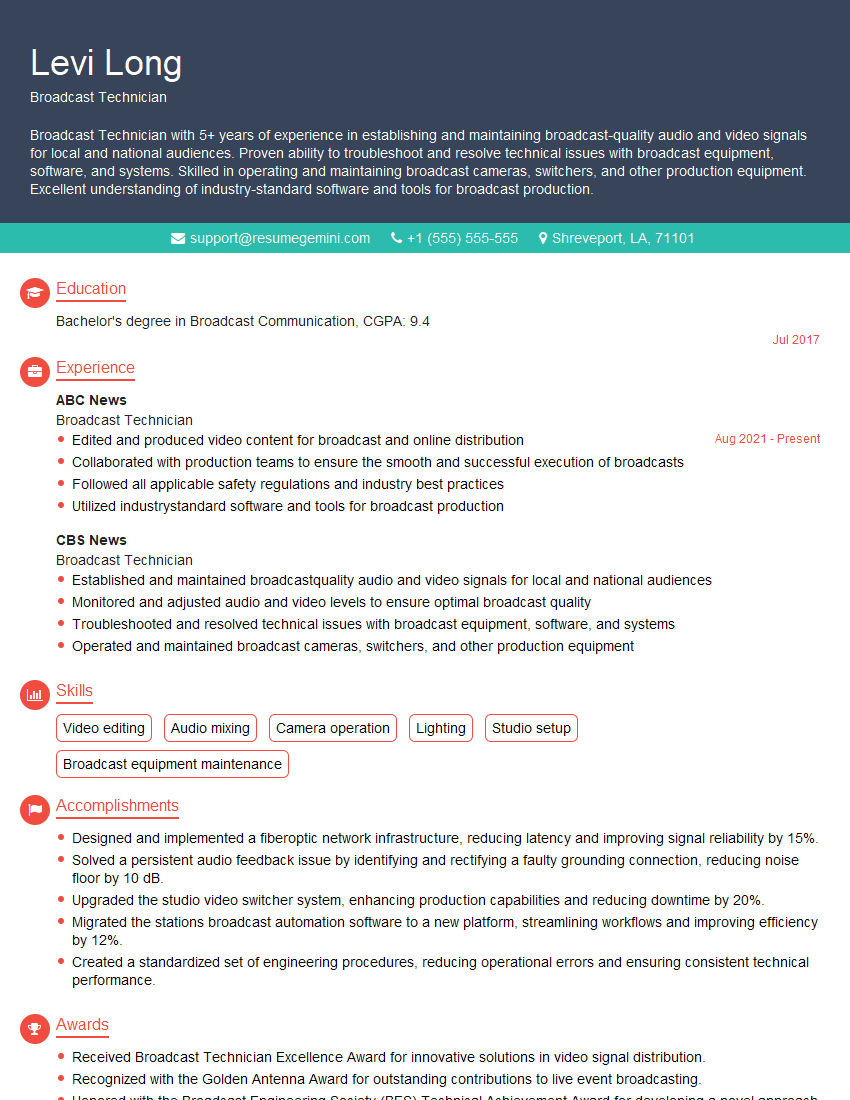
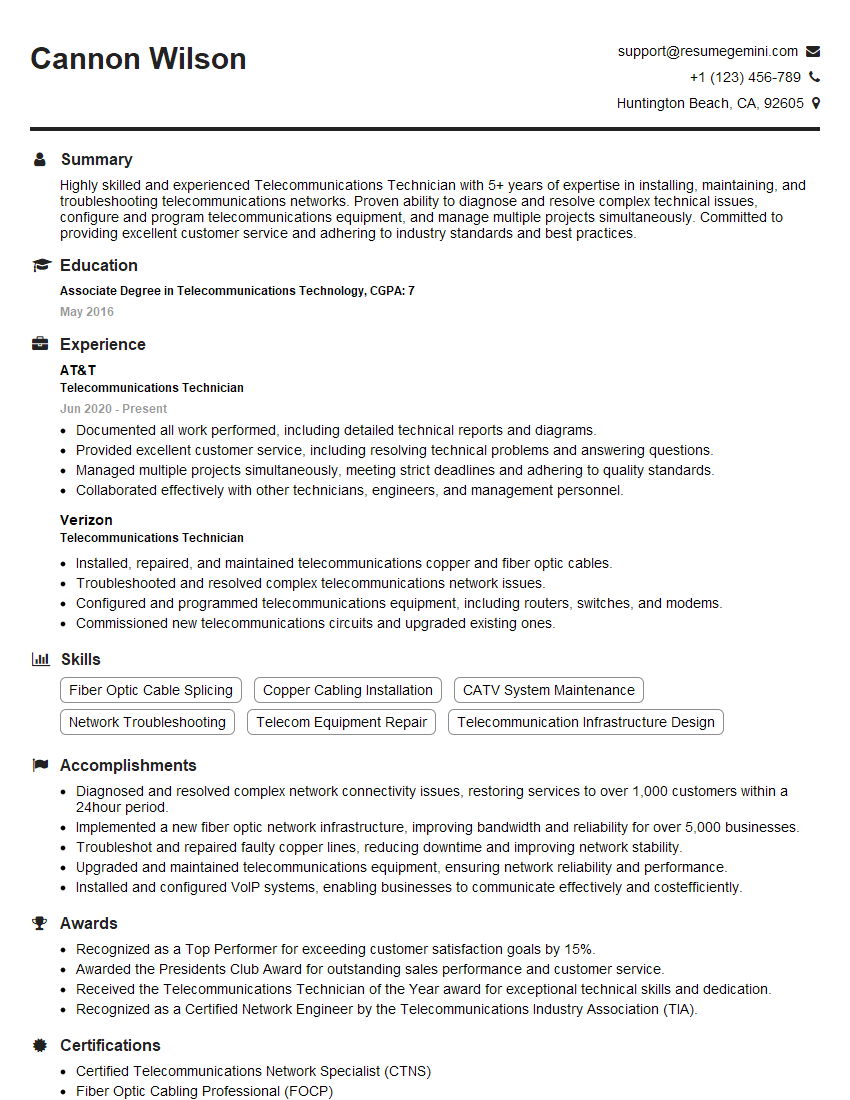
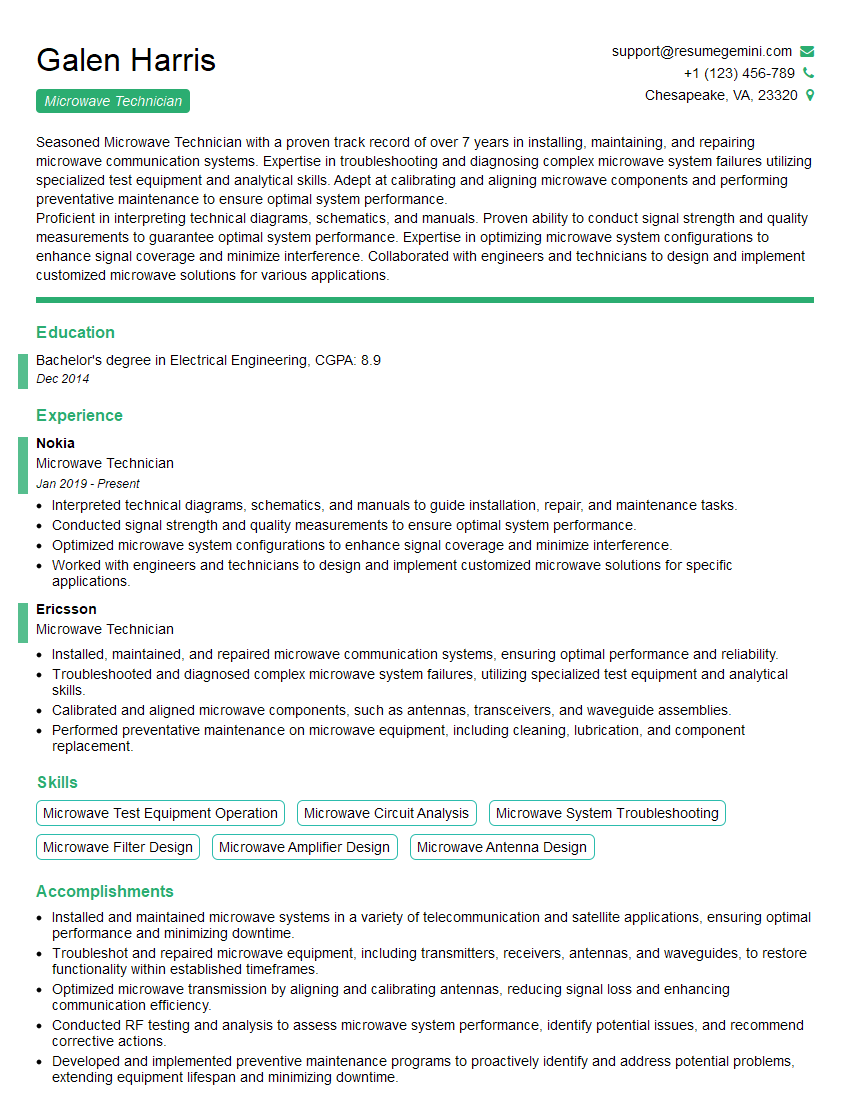
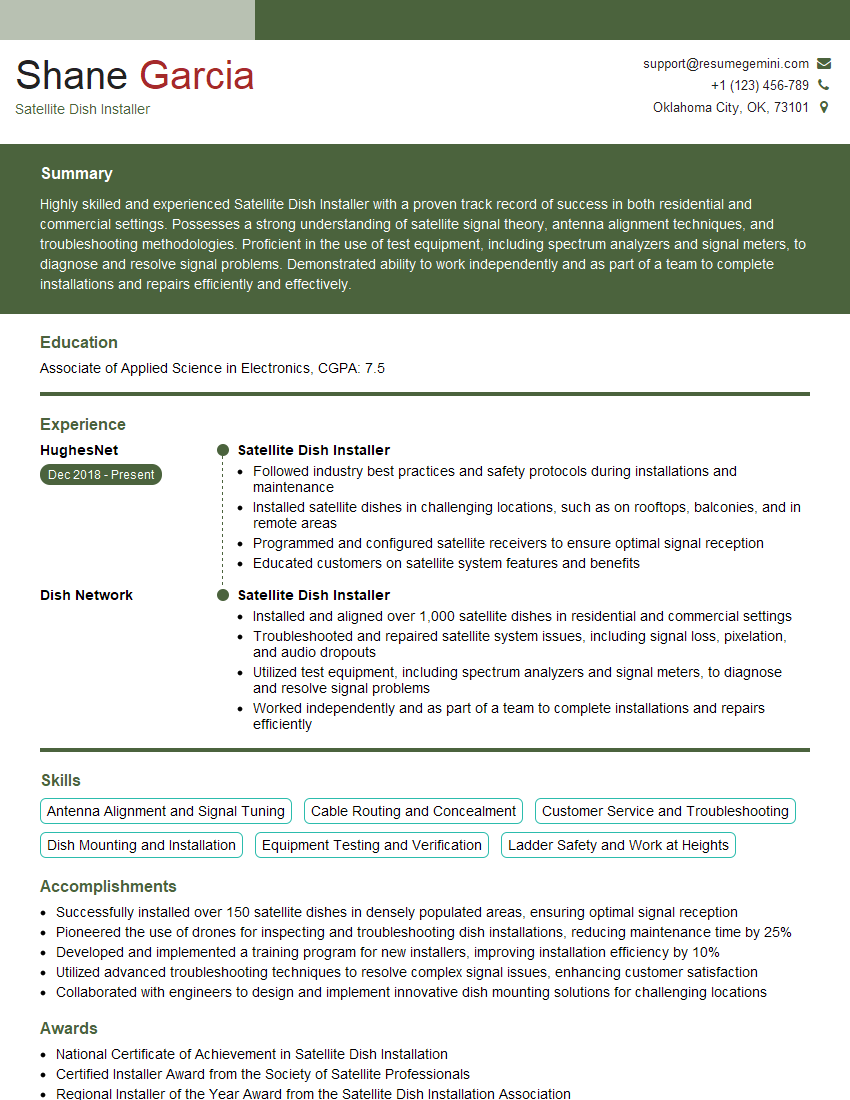
Mastering the maintenance of satellite antennas opens doors to exciting opportunities in the telecommunications and broadcasting industries. It showcases your technical expertise, problem-solving skills, and commitment to operational excellence. To maximize your job prospects, create an ATS-friendly resume that highlights your skills and experience effectively. ResumeGemini is a trusted resource that can help you build a professional and impactful resume. They offer examples of resumes specifically tailored to Maintenance of Satellite Antennas, helping you present your qualifications in the best possible light. Take the next step towards your dream career today!

Explore more articles
Users Rating of Our Blogs
Share Your Experience
We value your feedback! Please rate our content and share your thoughts (optional).
What Readers Say About Our Blog
To the interviewgemini.com Webmaster.
Very helpful and content specific questions to help prepare me for my interview!
Thank you
To the interviewgemini.com Webmaster.
This was kind of a unique content I found around the specialized skills. Very helpful questions and good detailed answers.
Very Helpful blog, thank you Interviewgemini team.