The right preparation can turn an interview into an opportunity to showcase your expertise. This guide to Masonry Carpentry interview questions is your ultimate resource, providing key insights and tips to help you ace your responses and stand out as a top candidate.
Questions Asked in Masonry Carpentry Interview
Q 1. Describe your experience with different types of mortar.
Mortar is the glue that holds masonry units together, and its type significantly impacts the project’s strength, durability, and aesthetic appeal. My experience encompasses a wide range, including:
- Type N Mortar: This is a general-purpose mortar, suitable for most applications. It offers a good balance of strength and workability. I’ve used it extensively in residential projects, like building chimneys and fireplaces.
- Type S Mortar: Stronger than Type N, Type S mortar is ideal for high-strength applications and areas subject to high stress, such as retaining walls or foundation work. I remember using this on a project where we were building a substantial retaining wall to prevent soil erosion on a hillside.
- Type M Mortar: This is the strongest type of mortar commonly used, offering exceptional compressive strength. It’s often used in high-load-bearing structures and areas prone to harsh weather conditions. I’ve employed Type M on projects requiring superior durability, such as commercial buildings in high-wind zones.
- Specialty Mortars: My experience also extends to specialty mortars such as those with added admixtures for increased flexibility, water resistance, or freeze-thaw resistance. These are vital for projects in specific climates or with unusual demands.
Choosing the right mortar type is crucial; using an inappropriate type can lead to structural failures and costly repairs. I always carefully consider the project’s specific requirements and local climate conditions when making my selection.
Q 2. Explain the process of laying brick in a running bond pattern.
Laying brick in a running bond pattern is a fundamental skill in masonry. It’s characterized by a simple, visually appealing arrangement where each course (horizontal row) of bricks is offset by half a brick length from the course below it. Think of it like a staggered arrangement.
The process involves:
- Establishing a level base: Ensuring a perfectly level foundation is paramount for the entire wall’s integrity. I typically use a level and string line to establish a consistent height.
- Laying the first course: The first course sets the tone for the whole wall. Accuracy here prevents compounding errors. I carefully space and level the bricks, ensuring even mortar joints.
- Applying mortar: I use a bricklayer’s trowel to apply mortar to the bed (base) and end joints of the bricks. The amount of mortar should be sufficient to create a consistent joint thickness.
- Setting the bricks: Each brick is carefully placed, ensuring it’s level and aligned with the adjacent bricks. I frequently check the alignment and level with a level and plumb bob to maintain precision.
- Tooling the joints: After the mortar has partially set, I tool the joints (the spaces between bricks) to create a neat and uniform finish. This improves the wall’s appearance and protects the mortar from erosion.
- Continuing the process: Courses are laid sequentially, meticulously maintaining the half-brick offset pattern throughout the wall.
Imagine building a staircase; each step relies on the previous one being correctly positioned and leveled. Similarly, in a running bond, each course depends on the accuracy of the one below it.
Q 3. How do you ensure proper leveling and alignment during bricklaying?
Precise leveling and alignment are vital for a structurally sound and aesthetically pleasing masonry project. My approach involves a combination of tools and techniques:
- Line levels and string lines: These help establish consistent vertical and horizontal planes. I use them to create reference points throughout the wall’s construction, ensuring everything stays aligned.
- Levels: I regularly use both a level and a plumb bob to check the horizontal and vertical alignment of each brick. The plumb bob is particularly crucial for checking the verticality, especially in tall structures.
- Mortar spacing: Consistent mortar joint thickness is crucial for achieving proper alignment and preventing uneven settlement. Using spacers helps maintain uniform joints.
- Checking and adjusting: Throughout the process, I frequently check the level and alignment of the bricks, making adjustments as needed. Early detection and correction of minor misalignments prevents major problems later on.
- Experienced eye: Years of experience allow me to quickly spot discrepancies in alignment, even subtle ones, preventing errors from compounding.
Think of it like building with LEGOs – each block needs to fit perfectly with the others to create a stable structure. Consistent checking ensures that the wall maintains its structural integrity and aesthetic appeal.
Q 4. What are the common causes of mortar cracking, and how can they be prevented?
Mortar cracking is a common issue, often stemming from:
- Shrinkage: As mortar dries and cures, it shrinks, which can lead to cracking if it’s not properly controlled. Using the appropriate type of mortar and adding plasticizers can help mitigate this.
- Movement: Differential movement between the masonry units and the foundation, or due to temperature changes, can create stress on the mortar, resulting in cracking. Utilizing expansion joints can accommodate this movement.
- Poor workmanship: Improper mixing of mortar, inadequate compaction, or inconsistent joint thickness can all contribute to cracking. Careful attention to detail during the laying process is crucial.
- Weathering: Exposure to freeze-thaw cycles can cause the mortar to crack, especially if it is not sufficiently frost-resistant. Using a suitable, frost-resistant mortar is essential in cold climates.
- Insufficient curing: The mortar needs sufficient time and moisture to cure properly. Protection from extreme weather conditions during curing is important.
Prevention involves using appropriate mortar, meticulous craftsmanship, and proper construction techniques. Regular inspections can also help identify and address minor cracks before they become major problems. Like preventing cracks in a dry lakebed, proper preparation and moisture control are crucial.
Q 5. Describe your experience with different types of brick and stone.
My experience encompasses a variety of brick and stone types:
- Bricks: I’ve worked with clay bricks (ranging from common to facing bricks), concrete bricks, and even reclaimed bricks. Each type has different properties, including strength, appearance, and durability. Clay bricks are popular for their aesthetic appeal and versatility, while concrete bricks offer greater strength and consistency.
- Stone: I’ve worked with various stones, including limestone, granite, sandstone, and fieldstone. Stone’s natural variation presents unique challenges and opportunities. Each type requires different cutting, laying, and finishing techniques. The weight and size of stone also demands consideration.
Understanding the characteristics of each material is crucial. For example, a project requiring high strength might use concrete bricks, while one prioritizing aesthetics might employ a specific type of clay brick or a particular stone. The choice is determined by the project requirements, budget, and aesthetic vision. It’s like choosing the right tools for the job.
Q 6. How do you calculate the amount of materials needed for a masonry project?
Accurately calculating materials is critical for cost-effectiveness and project success. My approach involves:
- Detailed drawings and specifications: These provide exact dimensions and quantities of materials needed. I always start with comprehensive plans and specifications.
- Calculating brick quantities: I determine the number of bricks required by calculating the area of the wall to be built, considering waste, and accounting for different brick sizes and layouts.
- Estimating mortar quantities: Mortar quantity is typically estimated as a percentage of the brick volume. This depends on the joint thickness and brick size.
- Accounting for waste: Always factor in additional materials to account for breakage, cutting waste, and potential errors. I usually add a 5-10% buffer to the total calculated quantities.
- Verifying calculations: After calculations, I always double-check the figures to avoid errors. I may use online calculators or software to ensure accuracy.
Accurate material calculation is vital. Underestimating leads to delays, while overestimating causes unnecessary costs. It’s a balance between precision and precaution.
Q 7. Explain your understanding of different types of masonry bonds (e.g., English bond, Flemish bond).
Masonry bonds refer to the pattern in which bricks or stones are arranged in a wall. Different bonds offer varying aesthetic appeal and structural characteristics. My understanding encompasses several common bonds:
- English Bond: This bond uses alternating courses of headers (bricks laid with their short ends showing) and stretchers (bricks laid with their long ends showing). It’s a very strong bond and visually striking.
- Flemish Bond: This bond uses alternating headers and stretchers in each course. It provides good strength and a pleasing, intricate appearance.
- Running Bond: As described previously, this uses stretchers in each course, offset by half a brick length. It’s simple and efficient.
- Stack Bond: This bond simply stacks bricks vertically, with no offset. It’s less structurally sound than other bonds but can be aesthetically appropriate in certain situations.
- Common Bond: This is a variation of English bond, using a course of stretchers for every six courses of headers.
Each bond has its advantages and disadvantages regarding structural performance and aesthetic effect. The selection depends on factors such as structural requirements, aesthetic preferences, and the type of masonry unit used. Choosing the correct bond is a crucial design decision that impacts the final outcome significantly.
Q 8. What safety precautions do you take when working at heights?
Working at heights in masonry is inherently risky. My approach prioritizes proactive safety measures above all else. This begins with a thorough risk assessment before any work commences. I always ensure I have the proper safety equipment, including a full-body harness, appropriately anchored safety lines, and robust scaffolding that meets or exceeds all safety regulations. I never work alone at heights; a spotter is always present. Furthermore, I regularly inspect my equipment for wear and tear and immediately report any issues. For example, on a recent project restoring a church steeple, we used a specialized scaffold system with outriggers for extra stability on uneven ground, and I personally checked the anchors multiple times per day. The principle is simple: prevention is better than cure when dealing with falls from height.
Q 9. How do you handle challenging weather conditions during masonry work?
Masonry work is significantly impacted by weather. Extreme heat can cause rapid mortar drying, leading to cracking and reduced strength. Conversely, rain or freezing temperatures can compromise the bond between bricks or blocks and the mortar. My approach involves carefully planning projects to avoid extreme weather whenever possible. This includes scheduling work around forecasts and potentially altering the construction sequence. If working in adverse conditions is unavoidable, we use appropriate protective measures. For example, in high winds, we may use temporary windbreaks to prevent materials from being blown away. In cold weather, we use frost-resistant mortars and may need to provide heat to the working area to prevent freezing. During heavy rain, we cover the work with tarpaulins to protect it from water damage. I always consult with engineers and adjust the schedule if there are safety or structural integrity concerns.
Q 10. Describe your experience with using various masonry tools and equipment.
My experience with masonry tools and equipment is extensive, encompassing both traditional and modern technologies. I’m proficient in using various types of trowels (brick trowels, pointing trowels, margin trowels), levels, plumb bobs, line levels, brick hammers, chisels, and power tools such as concrete mixers, grinders, and saws. I am comfortable with the use of scaffolding, hoists, and other lifting equipment, ensuring their safe and proper operation. I understand the nuances of different materials, selecting the right tools for each job, from precise bricklaying with a small trowel to large-scale block laying using a power mixer and hoist. For instance, when working on a large commercial building, the use of a power mixer was crucial for efficiency, whereas the restoration of an old brick fireplace required careful hand-laying using only a trowel and level.
Q 11. How do you ensure the structural integrity of a masonry wall?
Ensuring structural integrity in masonry is paramount. It starts with meticulous planning and adherence to building codes and specifications. This includes proper foundation preparation, using appropriate mortar mixes for the application (considering compressive strength and weather conditions), and implementing correct bonding patterns for the masonry units. Regular inspection during construction is crucial, including checking for plumbness, levelness, and the strength of the mortar joints. I always use the correct reinforcement where required, including steel reinforcement bars and mesh to improve resistance to lateral loads. For example, in a retaining wall project, we implemented a stepped foundation to distribute the load properly, and we incorporated steel reinforcement to prevent collapsing under pressure. Quality control is crucial from the initial design phase to the final inspection.
Q 12. What is your experience with repairing damaged masonry structures?
I have extensive experience in repairing damaged masonry structures. This involves identifying the cause of the damage – whether it’s freeze-thaw cycles, settlement issues, or impact damage – before selecting the appropriate repair method. Techniques I’ve used include pointing (re-mortaring joints), tuckpointing (re-creating damaged mortar joints with a contrasting color for aesthetic purposes), replacing damaged bricks or blocks, and applying specialist coatings to protect against future damage. A recent project involved repairing a damaged brick facade on a historical building. After carefully assessing the damage, which included cracks and missing bricks, we used traditional tuckpointing techniques to match the existing mortar and carefully replaced the damaged bricks, ensuring a seamless and historically accurate repair.
Q 13. Describe your experience with reading and interpreting blueprints.
Reading and interpreting blueprints is a fundamental skill for any mason. I’m proficient in understanding architectural drawings, structural details, and specifications, including elevations, sections, and details of masonry construction. This understanding helps me accurately determine material quantities, construction methods, and potential challenges before work begins. I pay close attention to dimensions, materials specified, and construction details, often verifying measurements on-site to ensure accuracy. Any ambiguities or discrepancies are immediately addressed with the project architect or engineer. This prevents costly errors and ensures that the final product aligns precisely with the design intent.
Q 14. How do you ensure the proper curing of mortar?
Proper mortar curing is essential for achieving optimal strength and durability. This involves maintaining the correct moisture content and temperature during the critical curing period, which typically lasts several days. Methods include keeping the mortar consistently moist by spraying or covering it with wet burlap or plastic sheeting to prevent premature drying and cracking. The temperature also plays a role; extreme heat or cold can hinder curing. On hot days, we might mist the masonry more frequently; conversely, in cold conditions, we might use insulated blankets or protect the work from frost. We follow manufacturer recommendations for specific mortar products and often conduct periodic inspections to assess the curing process. Neglecting proper curing can lead to weakened mortar joints, decreased structural integrity, and ultimately, premature failure of the masonry structure.
Q 15. What are the different methods for cleaning masonry after construction?
Cleaning masonry after construction is crucial for preserving its aesthetic appeal and structural integrity. The method depends heavily on the type of masonry (brick, stone, concrete block), the mortar used, and the type of soiling present. Generally, we employ a multi-step approach.
- Initial Cleaning: This involves removing loose debris like dust, mortar droppings, and wood scraps. We typically use soft-bristled brushes, low-pressure air compressors, and careful hand-scraping to avoid damaging the surface. Think of it like dusting your house before a deep clean.
- Washing: Once the loose debris is removed, we use a low-pressure water wash to remove remaining dirt and grime. High-pressure washing can be damaging, so we exercise caution. For stubborn stains, we might use a mild detergent solution, always testing it on an inconspicuous area first. This is similar to washing your car – you wouldn’t use a pressure washer on delicate paint.
- Acid Washing (with caution): For more severe staining, such as efflorescence (salt deposits), we might use a diluted acid solution like muriatic acid. This is a highly corrosive substance, and requires significant safety precautions, including proper personal protective equipment (PPE) and thorough rinsing. It’s a last resort, not a first step. Think of it like using a powerful cleaner – only when absolutely necessary.
- Sealing (optional): After cleaning, a sealant can protect the masonry from future staining and weathering. The type of sealant depends on the masonry type and the desired finish.
For example, on a recent project involving a brick facade, we first used soft brushes to remove loose mortar, then followed with a low-pressure water wash. A small area of efflorescence required diluted acid washing, followed by neutralization and thorough rinsing. Finally, we applied a breathable sealant to protect the brickwork.
Career Expert Tips:
- Ace those interviews! Prepare effectively by reviewing the Top 50 Most Common Interview Questions on ResumeGemini.
- Navigate your job search with confidence! Explore a wide range of Career Tips on ResumeGemini. Learn about common challenges and recommendations to overcome them.
- Craft the perfect resume! Master the Art of Resume Writing with ResumeGemini’s guide. Showcase your unique qualifications and achievements effectively.
- Don’t miss out on holiday savings! Build your dream resume with ResumeGemini’s ATS optimized templates.
Q 16. Explain your understanding of building codes and regulations related to masonry.
Building codes and regulations regarding masonry are critical for ensuring structural safety and public well-being. My understanding encompasses various aspects, including:
- Material Specifications: Codes stipulate acceptable brick, stone, concrete block types, their compressive strength, and freeze-thaw resistance. These specifications guarantee the masonry’s durability and longevity.
- Mortar Requirements: Codes define the appropriate mortar type and its compressive strength based on the masonry unit and the application. This ensures the proper bond between units and the overall structural integrity.
- Reinforcement: Codes mandate the use of reinforcement (steel) in certain applications, like high-rise buildings or structures subjected to seismic loads. This increases the masonry’s resistance to lateral forces.
- Construction Practices: Codes specify requirements for laying bricks or stones, including bond patterns, joint thickness, and tolerances. These guidelines ensure structural stability and a visually appealing finish.
- Inspections: Building codes mandate periodic inspections throughout the construction process to ensure compliance. These inspections help catch potential problems early.
Ignoring building codes can lead to severe consequences, including structural failure, liability issues, and project delays. I always prioritize adhering to and staying updated on the relevant codes for each project.
Q 17. Describe your experience with working as part of a team.
Throughout my career, I’ve consistently demonstrated strong teamwork skills. I believe effective collaboration is essential in masonry, where tasks are often interdependent. On several projects, I’ve worked as part of teams ranging in size from five to twenty people, including fellow masons, laborers, and supervisors.
For instance, on a recent large-scale restoration project, I coordinated with a team of masons to ensure efficient material handling and bricklaying, while maintaining quality control. I also assisted less experienced masons, providing guidance and support. Open communication, mutual respect, and a shared commitment to high-quality workmanship were key to our success. Each team member played a vital role, and I valued the opportunity to contribute my skills and experience to the team’s overall objectives.
Q 18. How do you handle conflicts or disagreements on a job site?
Conflicts on a job site are inevitable, but addressing them professionally is vital. My approach involves:
- Open Communication: I start by clearly understanding the source of the disagreement, listening carefully to all perspectives. It’s often a simple misunderstanding.
- Problem-Solving: Once everyone understands the problem, we work collaboratively to identify solutions. We might brainstorm options and evaluate their feasibility, considering safety, schedule, and cost.
- Compromise: Finding a solution acceptable to everyone often involves compromise. It’s about finding a workable solution, not winning an argument.
- Escalation (if necessary): If we can’t resolve the issue, we escalate it to the project supervisor or manager for mediation. This ensures a fair and impartial resolution.
On one project, a disagreement arose regarding the best method for laying a particular section of stonework. By openly discussing our concerns, considering the project’s constraints, and compromising on a hybrid approach, we successfully completed the task without delaying the project. Effective conflict resolution maintains productivity and team morale.
Q 19. What is your experience with different types of waterproofing techniques for masonry?
Waterproofing masonry is crucial for its longevity. I’ve experience with several techniques:
- Integral Waterproofing: This involves adding waterproofing admixtures to the mortar mix during construction. It’s effective against capillary water absorption, but less so against driving rain.
- Membrane Waterproofing: This uses a waterproof membrane applied to the exterior of the masonry. It provides excellent protection against rain and moisture penetration. It’s like a raincoat for the building.
- Coatings: Various coatings, such as silanes and silicones, can penetrate the masonry pores and reduce water absorption. They’re often used as a finishing treatment.
- Flashing and Sealants: Proper flashing (metal sheets) at critical points like window and door openings prevents water penetration. Sealants further enhance the waterproof seal.
The choice of technique depends on factors like the masonry type, climate, and budget. For a basement wall, I’d likely use a combination of membrane waterproofing and a sealant. On a brick façade in a rainy climate, a combination of integral waterproofing with a water-repellent coating might be appropriate.
Q 20. How do you identify and address problems with brickwork or stonework?
Identifying and addressing problems in brickwork or stonework requires a keen eye for detail and a thorough understanding of masonry principles. Common issues include:
- Cracking: Cracks can indicate foundation settlement, inadequate mortar strength, or freeze-thaw damage. Assessing the crack’s size, location, and cause is crucial for determining the repair method.
- Efflorescence: White salt deposits on the surface signify soluble salts migrating to the surface. This is usually treated by cleaning and possibly applying a sealant.
- Spalling: Chipping or flaking of masonry units can result from freeze-thaw cycles, improper curing, or chemical attack. Repair involves replacing damaged units.
- Mortar Defects: Uneven joints, insufficient mortar, or improper tooling can weaken the masonry. Repair might involve repointing (replacing damaged mortar).
For example, if I noticed horizontal cracks in a brick wall, I would investigate the foundation to rule out settlement issues. If the foundation appears sound, I would assess the mortar strength. The repair solution could range from simple crack filling to major structural intervention.
Q 21. Describe your experience with different types of foundations for masonry structures.
The foundation type for a masonry structure is critical for its stability and longevity. The choice depends on factors like soil conditions, building size, and local building codes.
- Spread Footings: Suitable for smaller structures on stable soil, they distribute the load over a larger area.
- Strip Footings: Often used for load-bearing walls, these continuous footings provide support along the length of the wall.
- Pier Footings: Used where soil conditions are poor or where the load is concentrated, these isolated footings support columns or piers.
- Caisson Footings: Used in challenging soil conditions, they are deep foundations that transfer loads to more stable strata.
- Slab-on-Grade: A common foundation type, particularly for smaller structures, the concrete slab is directly on the ground.
On one project, we used spread footings for a single-story building on stable soil. For a taller building on less stable soil, caisson footings would be necessary to ensure stability. Foundation design and construction are critical for long-term structural performance.
Q 22. What are your skills in using CAD software for masonry design?
My CAD skills are extensive, encompassing proficiency in programs like AutoCAD and Revit. I’m not just familiar with the software; I understand how to leverage its capabilities for efficient masonry design. This includes creating detailed 2D and 3D models, generating accurate material take-offs, and producing construction drawings that clearly communicate the design intent to the entire construction team. For instance, on a recent project involving a complex curved brick wall, I used Revit’s parametric modeling capabilities to design the wall precisely, ensuring optimal brick placement and minimizing waste. I can also create detailed shop drawings for custom masonry elements, like arches or decorative features, ensuring the masons have all the information they need for accurate construction.
Q 23. Describe your experience in estimating costs for masonry projects.
Accurate cost estimation is crucial in masonry. My approach involves a multi-step process. First, I meticulously review the project plans and specifications to identify all materials required – bricks, mortar, blocks, reinforcing steel etc. Then I calculate quantities using CAD software and my experience. Next, I source prices from multiple suppliers to secure the best deals. I factor in labor costs based on local rates and the complexity of the work. Finally, I incorporate contingency for unforeseen issues and profit margins. For example, on a recent project, my detailed estimation allowed us to avoid cost overruns by anticipating potential material shortages and securing bulk discounts early in the process. I also build in contingency for unexpected site conditions. This ensures the client is provided with a transparent and reliable cost estimate.
Q 24. How do you ensure the quality and durability of your masonry work?
Ensuring quality and durability is paramount. It begins with the selection of high-quality materials. I specify durable, weather-resistant bricks and mortar appropriate to the climate and the project’s aesthetic requirements. My focus is on proper construction techniques, including accurate laying patterns, appropriate mortar mixes, and careful attention to details like flashing and weep holes to manage water penetration. Regular quality checks throughout the construction process are essential, involving visual inspections and sampling. I adhere to all relevant building codes and best practices. For example, I always ensure proper curing of the mortar, which is critical for long-term durability. A project I’m proud of involved restoring a historical building; the meticulous attention to detail and use of traditional techniques ensured the structure’s long-term preservation.
Q 25. What are your methods for managing time and resources effectively on a project?
Effective time and resource management is vital. I utilize project management software like MS Project to create detailed schedules, breaking down the work into manageable tasks with assigned deadlines and responsibilities. Regular progress meetings keep the team informed and on track. Resource allocation is optimized by ordering materials in advance and coordinating deliveries to minimize delays. I proactively identify potential bottlenecks and implement solutions to mitigate risks. This includes things like having backup plans for materials deliveries and adjusting schedules based on weather conditions. In one project, using this approach allowed us to complete the project ahead of schedule and under budget.
Q 26. Describe your experience with working on restoration or renovation projects.
I have extensive experience in restoration and renovation projects, which often present unique challenges. These projects require careful analysis of the existing structure, understanding of historical building techniques, and the ability to integrate new work seamlessly with the old. This includes understanding the properties of older materials and adapting techniques to match historical styles while meeting modern building codes. On one restoration project, I was responsible for replicating original brickwork using salvaged materials, ensuring the repaired section was indistinguishable from the original. This required close collaboration with historical preservation specialists and careful selection of materials and techniques.
Q 27. What are your experience with different types of masonry finishes (e.g., pointing, tuckpointing)?
My experience encompasses various masonry finishes. Pointing refers to filling the joints between masonry units with mortar. Tuckpointing is a specialized technique where the old mortar is carefully raked out and replaced with a contrasting mortar, creating a clean, defined joint. I’m skilled in different pointing styles, including concave, weathered, and flush pointing, selecting the appropriate style based on the project’s aesthetic requirements and the type of masonry. On a recent project, we used tuckpointing to restore the historical appearance of a brick building, enhancing its aesthetic appeal and structural integrity. Understanding the nuances of different pointing styles is essential for both aesthetic appeal and the long-term durability of the masonry.
Q 28. How do you manage the disposal of waste materials from a masonry project?
Responsible waste disposal is a crucial aspect of any construction project. On my projects, we implement a comprehensive waste management plan, segregating materials such as bricks, mortar, wood, and metal. This is crucial for environmental reasons and often dictated by local regulations. We utilize licensed waste disposal contractors who handle the materials appropriately, ensuring recycling where possible and responsible disposal of non-recyclable materials. Detailed records are maintained to demonstrate compliance with environmental regulations. We aim to minimize waste generation through careful planning and precise material ordering. For example, on large projects, we often work with material suppliers to return unused materials, reducing overall waste and construction costs.
Key Topics to Learn for Masonry Carpentry Interview
- Building Codes and Regulations: Understanding local, regional, and national building codes related to masonry construction, including safety regulations and material specifications.
- Material Selection and Properties: Knowledge of various masonry materials (brick, block, stone), their properties (strength, durability, weather resistance), and appropriate selection based on project requirements. Practical application includes understanding the implications of choosing different mortar types.
- Mortar Mixing and Application: Understanding the proper ratios and techniques for mixing mortar to achieve desired consistency and strength. Practical application includes demonstrating knowledge of different application methods for various masonry units.
- Laying Techniques and Patterns: Proficiency in various laying techniques (running bond, common bond, stack bond, etc.) and understanding how to create aesthetically pleasing and structurally sound patterns. Consider the implications of different bond patterns on structural integrity and thermal performance.
- Tools and Equipment: Familiarity with common masonry tools (trowels, levels, plumb bobs, etc.) and equipment (mixers, scaffolding, cutting tools), including safety procedures for their use.
- Structural Principles: Understanding basic structural principles related to load-bearing walls, arches, and other masonry structures. Practical application involves explaining how to ensure proper support and prevent cracking or collapse.
- Troubleshooting and Problem-Solving: Ability to identify and address common problems encountered during masonry construction, such as cracking, efflorescence, and improper leveling. This includes understanding root causes and implementing effective solutions.
- Safety Procedures and Practices: Thorough understanding and adherence to all safety regulations and best practices related to working at heights, handling heavy materials, and using power tools.
- Blueprint Reading and Interpretation: Ability to accurately read and interpret construction blueprints and specifications related to masonry work.
- Estimating and Project Management: Understanding the basics of estimating material quantities, labor costs, and project timelines. This includes practical application in scenarios involving budget constraints and time limitations.
Next Steps
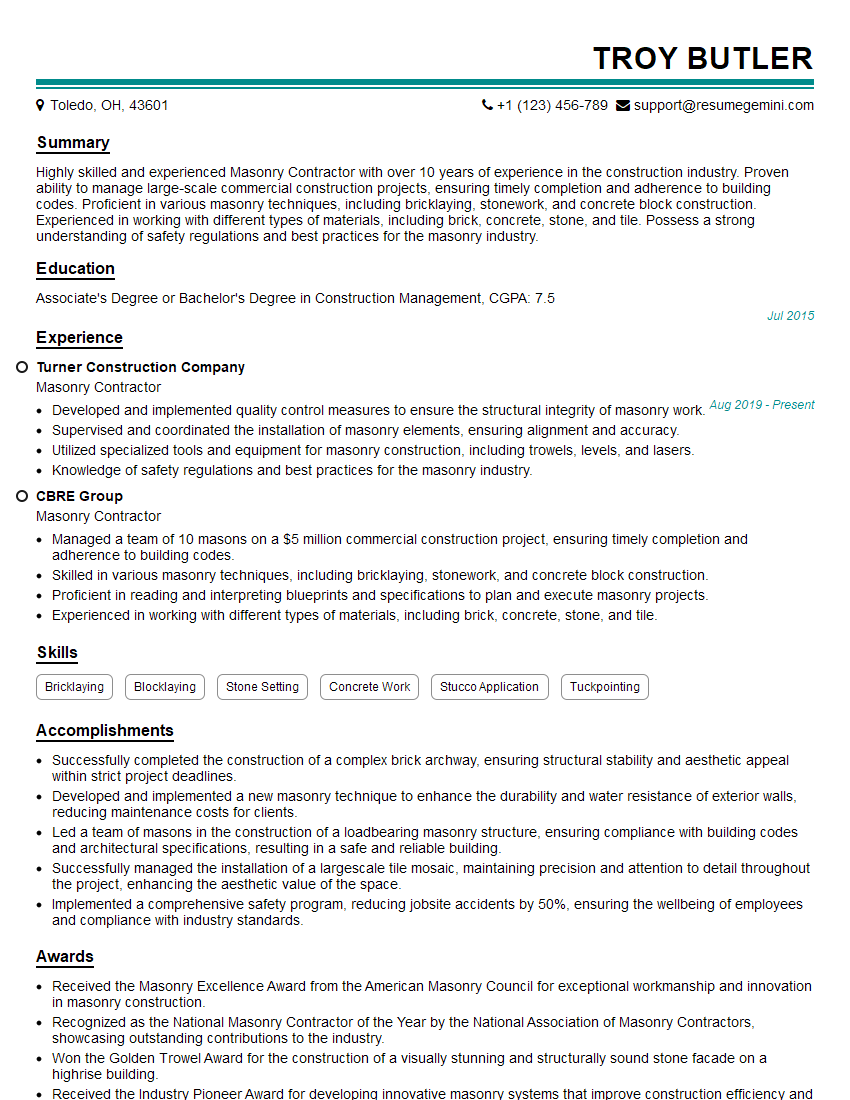
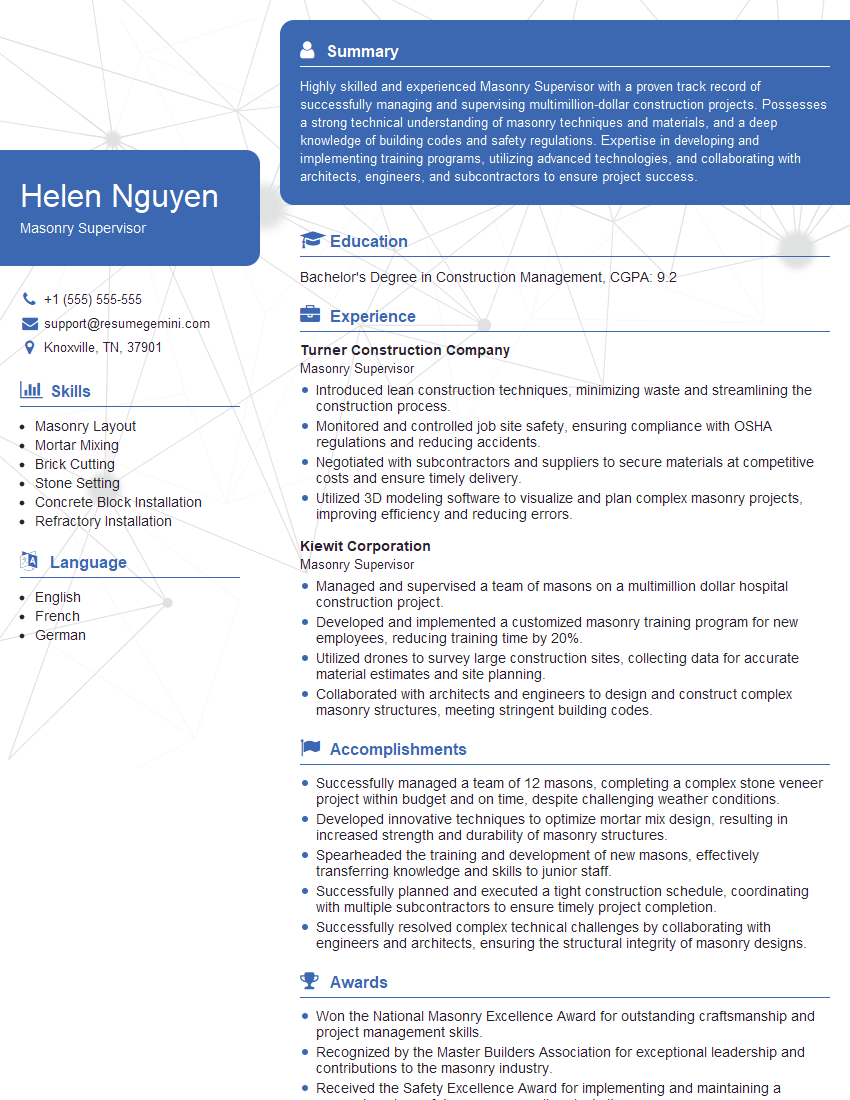
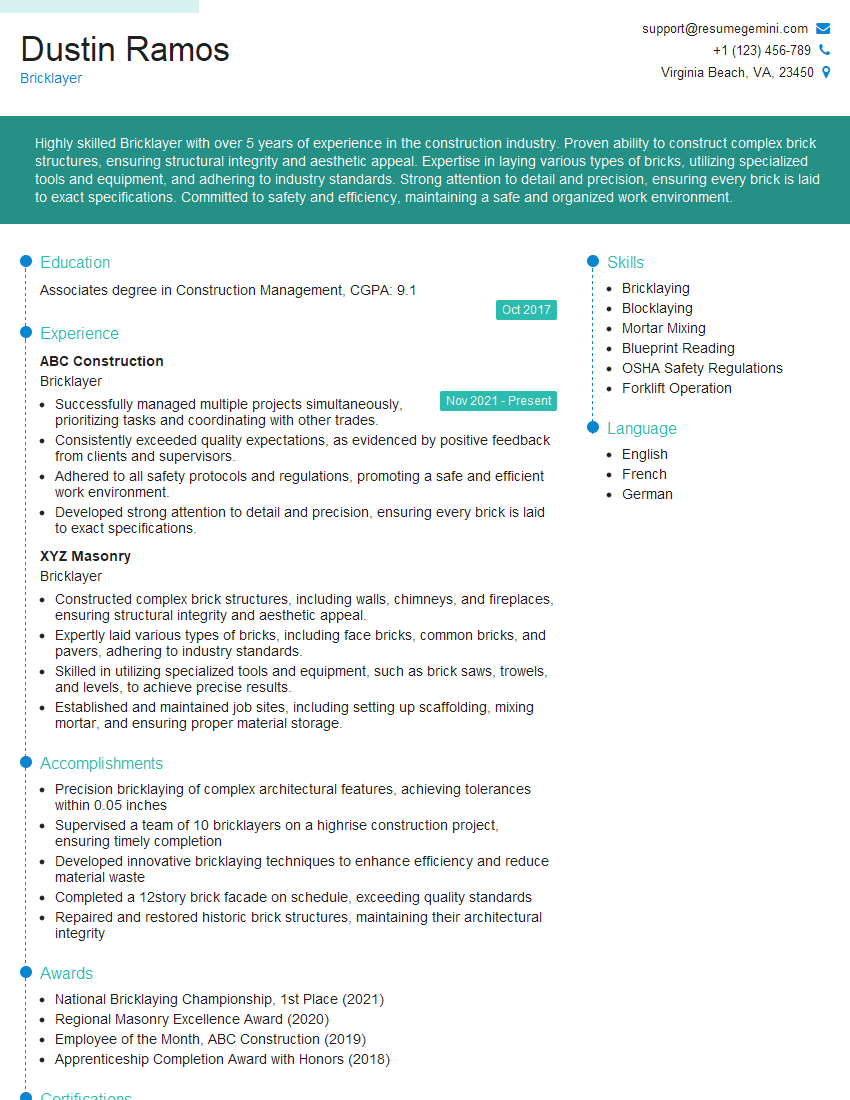
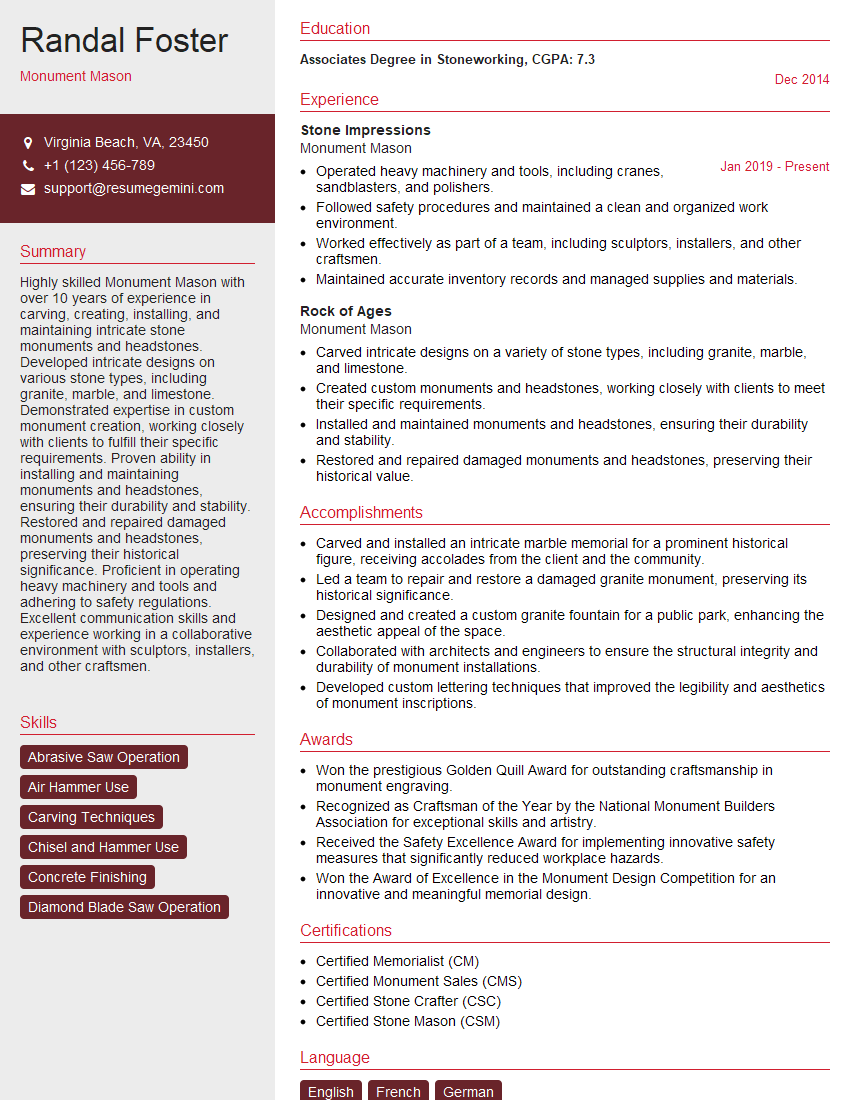
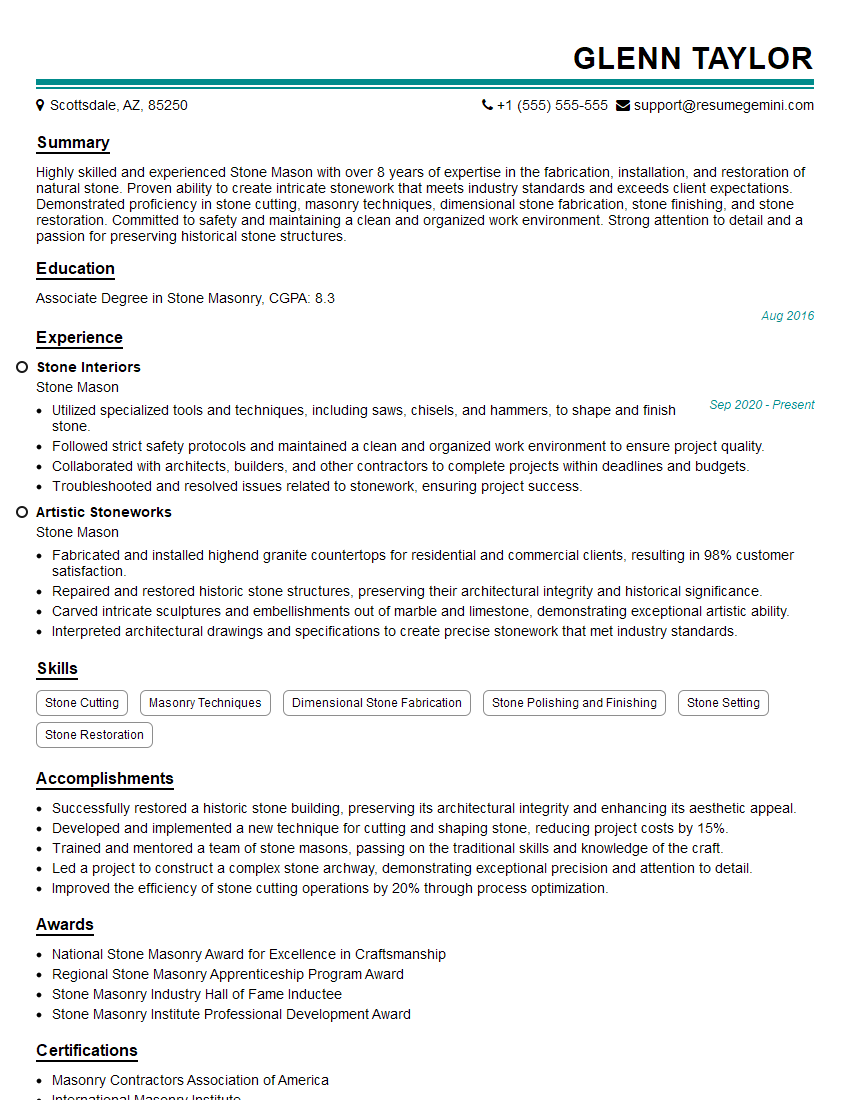
Mastering Masonry Carpentry opens doors to a rewarding career with excellent growth potential, offering opportunities for specialization and advancement. To maximize your job prospects, focus on creating an ATS-friendly resume that highlights your skills and experience effectively. ResumeGemini is a trusted resource for building professional resumes, and we provide examples of resumes tailored to the Masonry Carpentry field to help you get started. Invest time in crafting a compelling resume that showcases your expertise and makes you stand out from other candidates.
Explore more articles
Users Rating of Our Blogs
Share Your Experience
We value your feedback! Please rate our content and share your thoughts (optional).
What Readers Say About Our Blog
To the interviewgemini.com Webmaster.
Very helpful and content specific questions to help prepare me for my interview!
Thank you
To the interviewgemini.com Webmaster.
This was kind of a unique content I found around the specialized skills. Very helpful questions and good detailed answers.
Very Helpful blog, thank you Interviewgemini team.