Interviews are opportunities to demonstrate your expertise, and this guide is here to help you shine. Explore the essential Motor Control Technician Certification interview questions that employers frequently ask, paired with strategies for crafting responses that set you apart from the competition.
Questions Asked in Motor Control Technician Certification Interview
Q 1. Explain the difference between a VFD and a soft starter.
Both Variable Frequency Drives (VFDs) and soft starters control the starting and speed of AC motors, but they achieve this in fundamentally different ways. Think of it like controlling a car: a soft starter is like gently pressing the accelerator, while a VFD offers much finer control, like using cruise control.
A soft starter reduces the voltage applied to the motor during startup, gradually increasing it to full voltage. This reduces inrush current and mechanical stress on the motor and driven equipment. They’re simpler and generally cheaper than VFDs, but offer limited speed control, usually only capable of starting and stopping.
A VFD, on the other hand, uses power electronics to adjust the frequency and voltage supplied to the motor. This allows for precise speed control and offers many other features such as torque control, regenerative braking, and improved energy efficiency. They are more complex and expensive but provide a much wider range of capabilities. Imagine needing to precisely control the speed of a conveyor belt – a VFD is essential for that level of control.
In short: Soft starters are simpler and less expensive for basic start/stop applications, while VFDs provide sophisticated speed control and energy-saving capabilities for more complex applications.
Q 2. Describe the function of a motor starter.
A motor starter’s primary function is to safely control the starting and stopping of an electric motor. It’s like the ignition switch for a car – but much more sophisticated. It protects the motor from excessive current during startup (inrush current), and protects the circuit from short circuits and overloads. A motor starter usually incorporates these key components:
- Overload protection: This prevents the motor from overheating by tripping a circuit breaker if the current exceeds a safe level.
- Short-circuit protection: This immediately cuts power if a short circuit occurs in the motor or wiring.
- Starting mechanism: This can be a simple contactor, a soft starter, or a VFD, depending on the application.
Different types of motor starters exist, including magnetic starters, solid-state starters, and those integrated with VFDs. The choice depends on the motor’s size, voltage, and the application requirements.
Q 3. How do you troubleshoot a motor that won’t start?
Troubleshooting a motor that won’t start requires a systematic approach. Think of it like a detective solving a case – you need to gather evidence and eliminate possibilities.
- Check for power: Ensure power is available at the motor disconnect and that the disconnect is properly closed.
- Inspect fuses and circuit breakers: Check for blown fuses or tripped breakers. Replace blown fuses only with the correct amperage rating.
- Examine the motor starter: Check the motor starter for any visible damage or loose connections. Test the coils and contacts with a multimeter.
- Verify control circuit: Check the control circuit for wiring problems, using a multimeter to test for continuity and voltage. Look for any loose wires or damaged components.
- Check the motor itself: Inspect the motor for any signs of physical damage, such as loose windings or a damaged shaft. Test the motor’s insulation resistance using a megger.
- Test motor windings for continuity and shorts: Use a multimeter to check for continuity in the windings. A short circuit will indicate a problem within the motor.
- Check for mechanical obstructions: Ensure nothing is preventing the motor shaft from rotating.
Remember to always follow lockout/tagout procedures before working on any electrical equipment. If you’re unsure about any step, consult the motor’s manual or seek assistance from a qualified electrician.
Q 4. What are the different types of motor control circuits?
Motor control circuits vary widely depending on the application and complexity. Here are a few common types:
- Direct-on-line (DOL) starters: The simplest type, directly connecting the motor to the power source. Suitable for smaller motors with low inrush current.
- Star-delta starters: Reduces starting current by initially connecting the motor windings in a star configuration and then switching to a delta configuration after the motor reaches a certain speed.
- Autotransformer starters: Similar to star-delta, but uses an autotransformer to reduce the voltage during starting.
- Solid-state starters (soft starters): Use power electronics to gradually increase the voltage to the motor, reducing inrush current and mechanical stress.
- Variable frequency drives (VFDs): Provide precise control over motor speed and torque by varying the frequency and voltage supplied to the motor.
Each type has its advantages and disadvantages, and the choice depends on the specific needs of the application, considering factors like motor size, required starting torque, and budget constraints.
Q 5. Explain the principles of three-phase motor operation.
A three-phase motor operates using three alternating currents (AC) that are out of phase with each other by 120 degrees. This creates a rotating magnetic field within the motor. Imagine three magnets, each pulling and pushing in sequence, causing continuous rotation.
The three phases are labeled as L1, L2, and L3. Each phase provides a separate magnetic field. These fields interact to create a resultant magnetic field that rotates continuously. This rotating field interacts with the rotor’s magnetic field, inducing current in the rotor and causing it to turn. The speed of rotation is directly proportional to the frequency of the AC power supply.
The key to understanding is the rotating magnetic field – this is what drives the motor. This is achieved through the precise timing and phase differences between the three AC currents.
Q 6. How do you test a motor’s insulation resistance?
Testing a motor’s insulation resistance is crucial for safety and to determine the condition of the motor windings. We use a megohmmeter (megger) for this purpose. The megger applies a high DC voltage to the windings and measures the resistance between the windings and the motor frame (ground).
Procedure:
- Disconnect the motor from the power source and ensure it’s properly grounded. This is paramount for safety.
- Use a megger appropriate for the motor’s voltage rating. The megger should have a voltage rating higher than the motor’s operating voltage.
- Connect the megger leads: One lead to each winding and the other to the motor frame (ground).
- Perform the test: The megger will display the insulation resistance in megohms (MΩ).
- Compare the reading to the manufacturer’s specifications. A low insulation resistance indicates potential problems such as moisture, damage to the winding insulation, or contamination.
Low insulation resistance indicates a potential safety hazard and a need for repair or replacement of the motor. Always refer to the manufacturer’s specifications for acceptable insulation resistance values for the specific motor.
Q 7. What safety precautions are essential when working with high-voltage motors?
Safety is paramount when working with high-voltage motors. A single mistake can be catastrophic. Here’s a summary of essential precautions:
- Lockout/Tagout (LOTO): Always follow proper LOTO procedures to ensure the motor is completely de-energized before performing any work. This involves physically locking out the power source to prevent accidental energization.
- Personal Protective Equipment (PPE): Wear appropriate PPE, including insulated gloves, safety glasses, and arc flash protective clothing, especially for higher voltage systems. The level of PPE depends on the voltage.
- Use insulated tools: Use insulated tools specifically designed for high-voltage work. Never use tools with damaged insulation.
- Verify de-energization: Always double-check that the power is off using a non-contact voltage tester before touching any part of the motor or its associated circuitry.
- Grounding: Ensure the motor is properly grounded to prevent the buildup of static electricity or stray voltages.
- Training and qualifications: Only qualified and trained personnel should work with high-voltage motors. Proper training emphasizes safe work practices and the understanding of electrical hazards.
Remember, safety is not just a set of rules; it’s a mindset. Always prioritize safety when working with high-voltage equipment.
Q 8. Describe the different types of motor protection relays.
Motor protection relays are crucial safety devices that safeguard motors from various damaging conditions. They continuously monitor motor parameters and instantly trip the circuit if abnormal conditions arise, preventing costly repairs or hazardous situations. Different types cater to specific needs:
- Overcurrent Relays: These are the most common and protect against excessive current draw, often caused by short circuits, overloads, or stalled rotors. They can be thermal (responding to heat generated by excess current) or magnetic (responding to the magnetic field produced by high current).
- Thermal Overload Relays: These relays specifically protect against overheating due to prolonged overload. They use a bimetallic strip that bends and opens the circuit when a predetermined temperature is reached.
- Ground Fault Relays: These detect ground faults, which are dangerous electrical faults where current flows to ground. They are essential for safety, particularly in damp or hazardous environments.
- Phase Loss Relays: These detect the loss of one or more power supply phases. This condition can cause excessive currents in the remaining phases and potentially damage the motor.
- Negative Phase Sequence Relays: These relays detect an imbalance in the supply voltage phases, which can severely damage motors over time. This is common in three-phase systems.
- Motor Protection Relays (Comprehensive): More sophisticated relays combine multiple protection functions (overcurrent, ground fault, phase loss, etc.) into a single unit, providing comprehensive motor protection.
Imagine a factory conveyor belt motor. An overcurrent relay prevents damage from a jammed belt causing a stall, while a ground fault relay protects workers from electric shock in a wet environment. Choosing the correct relay depends on the specific application and potential hazards.
Q 9. Explain the operation of a Programmable Logic Controller (PLC).
A Programmable Logic Controller (PLC) is essentially a digital computer specifically designed for industrial automation. Think of it as the brain of an automated system. It receives input signals from sensors, processes that information according to a pre-programmed logic, and sends output signals to control actuators like motors, valves, and lights. It operates on a cyclical process:
- Input Scanning: The PLC reads the status of all input devices (sensors, switches).
- Program Execution: The PLC executes its program based on the input data. This program is written using ladder logic, function block diagrams, or other programming languages.
- Output Updating: The PLC updates the status of all output devices (motors, valves) based on the program execution.
- Communication: Many PLCs can communicate with other devices via networks, allowing for complex system control and data monitoring.
For example, a PLC might control a traffic light. Input sensors detect the presence of vehicles, the PLC’s program dictates the sequence of light changes, and the output controls the lights themselves.
Q 10. How do you program a PLC to control a motor?
Programming a PLC to control a motor involves defining the logic that governs when and how the motor operates. This typically involves using ladder logic, a graphical programming language widely used in industrial automation.
A simple example: Let’s say we want to start a motor when a push button is pressed and stop it when another button is pressed.
// Ladder Logic Example
---[Start Button]---[Motor]---
---[Stop Button]---|/---|
In this example:
Start Buttonrepresents the input from a start push button.Stop Buttonrepresents the input from a stop push button.Motorrepresents the output controlling the motor.
When the Start Button is pressed, the circuit closes, and the Motor output is energized, starting the motor. When the Stop Button is pressed, it opens the circuit, de-energizing the Motor and stopping it. More complex motor control programs might involve additional inputs (e.g., limit switches, sensors) and outputs (e.g., emergency stops, indicator lights) and incorporate timers, counters, and other logic elements.
Modern PLCs use software packages with advanced functionalities like simulation and debugging, making programming more efficient and error-free.
Q 11. What are the common causes of motor overheating?
Motor overheating is a serious issue that can lead to motor failure. Several factors contribute to this problem:
- Overload: The motor is asked to do more work than it’s designed for. This could be due to excessive load, mechanical binding, or incorrect load matching.
- Insufficient Ventilation: Poor airflow around the motor prevents heat dissipation, leading to a buildup of heat. This is common in enclosed spaces or when ventilation is obstructed.
- Bearing Problems: Worn or damaged bearings generate excessive friction, producing heat and contributing to motor overheating.
- Winding Faults: Short circuits, open circuits, or ground faults within the motor windings generate significant heat. This is often detected by high resistance readings.
- Incorrect Voltage: Operating a motor at a voltage significantly different from its rated voltage can lead to overheating and damage.
- High Ambient Temperature: Operating motors in hot environments increases the risk of overheating, as the motor struggles to dissipate heat effectively.
For instance, a motor driving a conveyor belt that is jammed will overheat due to overload. Proper maintenance, including regular inspections and temperature monitoring, can help prevent overheating and motor failures.
Q 12. How do you diagnose a faulty motor bearing?
Diagnosing a faulty motor bearing involves a combination of visual inspection, listening for sounds, and sometimes using specialized tools. Here’s a step-by-step approach:
- Visual Inspection: Check for obvious signs of damage, such as excessive grease leakage, scoring or pitting on the bearing surfaces, or signs of abnormal wear and tear.
- Listen for Sounds: A faulty bearing often produces distinctive sounds. Listen carefully for grinding, growling, squealing, or rumbling noises while the motor is running. These sounds provide clues about the type and severity of the bearing problem.
- Measure Temperature: Use a temperature gun to measure the bearing temperature. A significantly higher temperature than other bearings or the surrounding motor indicates a problem.
- Vibration Analysis: Specialized vibration analysis tools can provide more precise information about the bearing condition. This is often performed by a trained vibration analyst.
- Bearing Play Test: Gently try to move the shaft radially (side to side) and axially (end to end) to assess bearing play. Excessive play suggests significant bearing wear.
Imagine a motor in a pump application making a squealing noise. This immediately suggests a potential bearing problem and should be investigated promptly. Early detection prevents catastrophic motor failure.
Q 13. Explain the function of a limit switch in a motor control circuit.
A limit switch is a simple electromechanical device that acts as an on/off switch activated by a physical movement. In a motor control circuit, it’s used to detect when a machine part has reached a predetermined position or limit. This prevents damage and ensures safe operation.
For example:
- End-of-travel: A limit switch can stop a conveyor belt or robotic arm from moving beyond its designated range, preventing collisions or damage.
- Safety Interlocks: Limit switches are often used in safety systems. For instance, a machine might be prevented from operating if a safety guard is open (detected by a limit switch).
- Positioning: Limit switches can indicate when a process is complete. For example, in a packaging machine, a limit switch might signal when a box has been fully loaded.
In essence, a limit switch provides feedback to the control system, allowing it to make informed decisions based on the physical position of components in the machine. This ensures accurate and safe operation.
Q 14. What is the purpose of a thermal overload relay?
A thermal overload relay is a safety device that protects a motor from overheating due to prolonged overloads. It uses a bimetallic strip, a strip of two different metals with different thermal expansion coefficients. When excessive current flows through the motor, the bimetallic strip heats up and bends. This bending action opens the relay contacts, interrupting the power supply to the motor and preventing damage.
Think of it as a protective fuse but for heat overload instead of immediate high current. The relay has a time delay function, allowing for momentary overloads, but tripping when the overload persists for a longer duration. This prevents nuisance trips while still providing crucial protection. It’s a critical component in motor control circuits, safeguarding the motor from costly damage due to heat.
Q 15. How do you interpret a motor nameplate?
The motor nameplate is like a motor’s ID card – it provides crucial information about its specifications and operational characteristics. Think of it as a quick reference guide for anyone working with the motor. It usually includes:
- Voltage (V): The electrical potential required to operate the motor (e.g., 230V, 460V).
- Frequency (Hz): The rate at which the alternating current (AC) cycles (e.g., 50Hz, 60Hz). This is vital for AC motors.
- Power (kW or HP): The motor’s mechanical output power, indicating how much work it can perform (e.g., 10kW, 15HP).
- Full Load Current (FLA): The amount of current the motor draws when operating at its rated power. This helps determine the appropriate circuit breaker and wiring size.
- Speed (RPM): The rotational speed of the motor’s shaft at full load (e.g., 1750 RPM).
- Frame Size: A standardized code indicating the motor’s physical dimensions and mounting configuration.
- Insulation Class: Indicates the motor’s ability to withstand high temperatures (e.g., Class F, Class H). Higher classes denote greater heat resistance.
- Duty Cycle: Specifies the amount of time the motor can operate continuously at full load before overheating.
- Manufacturer and Model Number: Essential for finding replacement parts or technical documentation.
For instance, if a nameplate shows 460V, 60Hz, 10HP, and 1750 RPM, you immediately know the motor needs a 460V, 60Hz power supply, is capable of 10 horsepower, and runs at approximately 1750 revolutions per minute under full load. Misinterpreting the nameplate could lead to equipment damage or even safety hazards.
Career Expert Tips:
- Ace those interviews! Prepare effectively by reviewing the Top 50 Most Common Interview Questions on ResumeGemini.
- Navigate your job search with confidence! Explore a wide range of Career Tips on ResumeGemini. Learn about common challenges and recommendations to overcome them.
- Craft the perfect resume! Master the Art of Resume Writing with ResumeGemini’s guide. Showcase your unique qualifications and achievements effectively.
- Don’t miss out on holiday savings! Build your dream resume with ResumeGemini’s ATS optimized templates.
Q 16. Describe the different types of motor encoders.
Motor encoders provide feedback on the motor’s shaft position and speed. They’re crucial for precise control in closed-loop systems. There are several types:
- Incremental Encoders: These only provide relative position information – they indicate changes in position but not the absolute position. They typically consist of a slotted disc and light sensors that count pulses as the disc rotates. Think of it like an odometer in a car – it tells you how far you’ve traveled since the last reset but not your absolute location.
- Absolute Encoders: These give you the absolute position of the motor shaft at any time, regardless of power cycles. They usually use a coded disc with a unique pattern for each position. This is more reliable since the position is known even after power loss.
- Optical Encoders: These use light and photodetectors to detect the position, offering high accuracy and resolution. They can be incremental or absolute.
- Magnetic Encoders: These use magnetic fields and sensors for position sensing. They are often more robust and resistant to environmental conditions compared to optical encoders.
The choice of encoder depends on the application’s requirements. For instance, a robotic arm needing precise movements would usually employ an absolute encoder for accurate positioning. In simpler applications where precise absolute position is less critical, an incremental encoder might suffice.
Q 17. What is the difference between open-loop and closed-loop motor control?
The fundamental difference between open-loop and closed-loop motor control lies in the feedback mechanism.
- Open-loop control: In open-loop control, the motor receives a command signal, and it simply runs according to that command without any feedback on its actual speed or position. It’s like telling a car to go 60 mph without ever checking your speedometer – you’re assuming it’s going that speed but have no way of verifying.
- Closed-loop control: Closed-loop control involves a feedback mechanism that monitors the motor’s actual performance and compares it to the desired performance. Any discrepancies are used to adjust the command signal, ensuring the motor achieves the desired outcome. This is like using cruise control in a car – the car monitors its speed, and adjusts the throttle to maintain the set speed.
Closed-loop systems are more accurate and precise than open-loop systems, but they are also more complex and expensive due to the additional components required for feedback (like encoders).
Q 18. Explain the concept of PID control.
PID control is a widely used feedback control loop mechanism. PID stands for Proportional, Integral, and Derivative. It’s a way to adjust a control variable (like motor speed) to reach a desired setpoint by considering the error between the current state and the setpoint.
- Proportional (P): The proportional term is directly proportional to the error. A larger error results in a larger corrective action. Think of it as the immediate response.
- Integral (I): The integral term accumulates the error over time. This helps eliminate any persistent error (offset) that might occur due to factors like friction or load changes. It addresses long-term discrepancies.
- Derivative (D): The derivative term considers the rate of change of the error. It helps prevent overshoot by anticipating future error. It’s like predicting where you’re headed and adjusting accordingly.
By carefully tuning the P, I, and D gains, you can achieve optimal control performance – minimizing overshoot, settling time, and steady-state error. The exact tuning of these gains often involves trial and error or more advanced tuning methods.
Q 19. How do you troubleshoot a faulty proximity sensor?
Troubleshooting a faulty proximity sensor involves a systematic approach. Here’s a step-by-step procedure:
- Visual Inspection: Begin by visually inspecting the sensor for any physical damage, such as cracks, loose wires, or contamination.
- Check Wiring: Verify the wiring connections between the sensor, the control system, and the power supply. Look for loose connections, broken wires, or short circuits. A multimeter can be valuable here.
- Test the Power Supply: Ensure that the sensor is receiving the correct voltage and that the power supply is functioning correctly. Use a multimeter to measure the voltage at the sensor’s terminals.
- Check Sensor Output: Use a multimeter or oscilloscope to check the sensor’s output signal. If the sensor is functioning properly, you should see a change in the output signal when an object is near the sensing face.
- Test with a Known Object: If possible, test the sensor with a known object made of a material compatible with the sensor’s sensing range. This will help determine if the sensor is detecting the object correctly.
- Examine the Target: The object being sensed may be the problem; its surface properties (reflectivity, material) may interfere with detection. Is the target within the sensor’s detection range?
- Sensor Alignment: Verify that the sensor is correctly aligned with the target object. Even a slight misalignment can cause detection issues.
- Environmental Factors: Consider environmental factors that could interfere with the sensor’s operation such as ambient light, temperature, or electromagnetic interference.
If the problem persists after these steps, the sensor might need replacement.
Q 20. What are the different types of motor drives?
Motor drives are power electronic devices that control the speed and torque of electric motors. Several types exist:
- AC Drives (Variable Frequency Drives – VFDs): These drives are used for AC motors. They vary the frequency and voltage of the power supply to the motor, allowing for precise speed control. They are common in industrial automation and HVAC systems.
- DC Drives: These drives control DC motors by adjusting the voltage applied to the motor’s armature or field windings. Less common than AC drives now but still used in some applications.
- Servo Drives: These are high-precision drives used with servo motors, which provide precise control of position, speed, and torque. They are frequently found in robotics and automation systems.
- Stepper Motor Drives: These drives control stepper motors, which move in discrete steps. They are often used in applications requiring precise positioning, such as 3D printers.
The selection of motor drive depends heavily on the type of motor used and the application’s requirements for speed accuracy, torque control, and cost.
Q 21. Describe the principles of regenerative braking.
Regenerative braking is a method of slowing down a motor by using it as a generator. Instead of dissipating kinetic energy as heat (as with friction braking), the energy is fed back into the power system. Think of it like letting go of the gas pedal while going downhill in a car with regenerative braking; the car’s engine captures some of the kinetic energy, converting it into electrical energy, instead of completely losing the energy through friction.
Here’s how it works: when a motor is slowed, its rotational speed decreases. In a regenerative braking system, the motor’s action is reversed; the motor becomes a generator. As the motor slows, it generates electricity, which can then be fed back into the power supply. This electricity can be stored in a battery (like in hybrid or electric vehicles) or used to power other loads in the system.
The advantages of regenerative braking are:
- Energy Efficiency: Reduces energy waste by recovering kinetic energy.
- Reduced Wear and Tear: Less reliance on mechanical braking systems, leading to less wear and tear.
- Improved Control: Provides smooth and precise deceleration.
Regenerative braking is often used in applications requiring precise control and energy efficiency, such as electric vehicles, cranes, and elevators.
Q 22. How do you perform a lockout/tagout procedure on a motor control system?
Lockout/Tagout (LOTO) is a crucial safety procedure to prevent accidental energization of equipment during maintenance or repair. In a motor control system, this involves completely isolating the power source to the motor, ensuring nobody can inadvertently turn it on.
The steps typically involve:
- Energy Isolation: This is the most critical step. You must physically disconnect the power supply to the motor controller. This might involve switching off circuit breakers, disconnecting fuses, or locking out the power source at the main panel. Never rely solely on a switch being ‘off’ – physically lock it out to prevent accidental re-energization.
- Lockout: Attach a lock to the isolated power source, with your personal lockout device, ensuring that only you possess the key or combination. This prevents unauthorized access.
- Tagout: Attach a clearly visible tag to the lockout device indicating who has locked it out, the date, and the reason for the lockout. This serves as a visual warning to others.
- Verification: Before commencing work, verify the absence of power using a voltage tester. This critical step confirms the LOTO procedure has been effective.
- Tagout Removal: Only the person who initially applied the lockout can remove it, ensuring all work is completed and the area is safe.
Example: Imagine working on a conveyor belt motor. You’d first isolate the motor circuit breaker, then lock it out with your personal padlock and tag, clearly labeling it ‘DO NOT OPERATE – MAINTENANCE IN PROGRESS’. After testing for zero voltage, you can safely start your maintenance.
Q 23. Explain the importance of grounding in motor control systems.
Grounding in motor control systems is essential for safety and proper operation. It provides a low-resistance path for fault currents to flow to the earth, preventing dangerous voltage buildup on the motor casing or other exposed conductive parts.
Importance:
- Safety: Grounding prevents electric shock by diverting fault currents away from personnel. If a short circuit occurs within the motor, the current will flow through the ground wire instead of through a person who might touch the motor.
- Equipment Protection: Grounding protects the motor and control system from voltage surges and lightning strikes. It acts as a safety valve, preventing damage to sensitive components.
- Noise Reduction: Grounding can reduce electrical noise, improving the performance and reliability of the motor control system.
Improper grounding can lead to: Electric shock, equipment damage, inaccurate motor operation, and fire hazards.
Example: A poorly grounded motor might have a build-up of static charge, leading to unexpected sparks. Properly grounding the motor will ensure this charge dissipates safely, preventing the risk of fire.
Q 24. What are the common causes of motor vibration?
Motor vibration is a common issue that can indicate a variety of problems. It often points towards mechanical or electrical issues within the motor or its surrounding systems.
Common causes include:
- Mechanical Imbalance: An uneven distribution of mass within the rotor causes vibration. This can be due to damaged or worn bearings, bent shafts, or loose components.
- Bearing Problems: Worn, damaged, or improperly lubricated bearings are a significant source of vibration. This causes increased friction and noise.
- Misalignment: Misalignment between the motor shaft and the driven equipment (pump, conveyor, etc.) creates significant forces and vibrations.
- Loose Connections: Loose bolts, mounts, or connections can cause vibration.
- Electrical Issues: While less common, electrical problems like rotor imbalances, stator faults or winding problems, and even loose wiring, can cause noticeable vibration.
- Resonance: If the motor’s operating frequency coincides with a natural frequency of the system (motor mount, supporting structure), this can amplify vibrations significantly.
Diagnosing vibration: Often requires specialized tools like vibration analyzers to identify the frequency and amplitude of the vibration, helping pinpoint the root cause.
Q 25. How do you diagnose and repair a faulty motor winding?
Diagnosing and repairing a faulty motor winding requires careful testing and precision. It’s often best left to experienced technicians due to the complexity involved.
Diagnosis:
- Visual Inspection: Examine the winding for any signs of damage, such as burns, broken wires, or loose connections.
- Insulation Resistance Test (Megger Test): This measures the insulation resistance between the windings and the motor casing. Low resistance indicates insulation breakdown.
- Winding Resistance Test: Measures the resistance of each winding phase. Significant differences indicate a problem within the winding.
- Short Circuit Test: Checks for shorted turns within the windings.
- Turn-to-Turn Test: A more detailed test that specifically identifies shorted turns.
Repair:
- Minor Repairs: Minor damage like loose connections or broken wires can be repaired by soldering or replacing the damaged sections.
- Major Repairs or Rewinding: Severe damage necessitates rewinding the motor, a complex process best done by specialists.
Example: A motor exhibiting high resistance in one phase might be diagnosed with a shorted turn. This would require a rewinding of that specific phase.
Safety Note: Always disconnect power and perform LOTO before working on motor windings.
Q 26. Describe your experience with different types of motor controllers (e.g., AC, DC).
My experience encompasses a wide range of motor controllers for both AC and DC motors. This includes:
- AC Motor Controllers: I’ve worked extensively with Variable Frequency Drives (VFDs) for controlling the speed and torque of AC induction motors and synchronous motors. These controllers offer precise control, energy efficiency, and soft starting capabilities. I’m familiar with various types of VFDs, from basic single-phase drives to advanced multi-motor systems with sophisticated control algorithms.
- DC Motor Controllers: I have experience with various DC motor controllers, including those based on SCRs (Silicon Controlled Rectifiers) and transistors. I understand the principles of speed control in DC motors, including the use of PWM (Pulse Width Modulation) techniques. This also includes working with DC servo drives and their control systems.
- Other Controllers: This includes working with soft starters, magnetic starters, and other simpler motor control devices used in different applications.
Practical Application: I’ve used VFDs in applications ranging from pump control in water treatment plants to precise speed control in industrial machinery. My experience with DC controllers includes applications in robotics and specialized machinery where precise control is essential.
Q 27. How do you ensure the safety of a motor control system?
Ensuring the safety of a motor control system is paramount and involves a multi-faceted approach:
- Proper Grounding: A robust grounding system is fundamental for preventing electric shock and equipment damage.
- Lockout/Tagout Procedures: Rigorous LOTO procedures are essential for all maintenance and repair activities.
- Overload Protection: Implementing motor overload protection, such as fuses, circuit breakers, and thermal overload relays, prevents overheating and damage from excessive currents.
- Emergency Stop Systems: Ensuring readily accessible and functional emergency stop buttons and systems is critical for immediate shutdown in case of emergencies.
- Regular Inspections and Maintenance: Scheduled inspections and preventative maintenance, including checking connections, insulation, and motor bearings, can identify potential hazards before they escalate.
- Safety Training: Providing thorough safety training to all personnel involved with the motor control system is crucial. This includes proper LOTO procedures, emergency response, and electrical safety practices.
- Enclosure and Shielding: Utilizing appropriate enclosures and shielding to prevent accidental contact with live parts is vital, especially in hazardous environments.
- Compliance with Safety Standards: Adherence to relevant safety standards and regulations is essential to ensure compliance and minimize risks.
Example: In a factory setting, I ensure all motor control centers are properly grounded, regularly inspected, and that LOTO procedures are strictly followed. Workers are trained to immediately shut down equipment if they observe any safety hazards.
Key Topics to Learn for Motor Control Technician Certification Interview
Ace your Motor Control Technician Certification interview by mastering these key areas. Remember, understanding the “why” behind the “how” is crucial for demonstrating your expertise.
- Electrical Theory Fundamentals: Understand AC/DC circuits, Ohm’s Law, and Kirchhoff’s Laws. Be prepared to discuss their practical applications in motor control systems.
- Motor Types and Characteristics: Develop a strong grasp of different motor types (AC induction, DC, servo, stepper) and their operating principles. Know how to select the appropriate motor for a specific application.
- Motor Control Devices: Familiarize yourself with various control devices, including starters, contactors, relays, programmable logic controllers (PLCs), and variable frequency drives (VFDs). Practice troubleshooting common issues related to these devices.
- Safety Procedures and Regulations: Demonstrate a comprehensive understanding of relevant safety regulations and procedures for working with electrical equipment. Highlight your commitment to safe work practices.
- Troubleshooting and Diagnostics: Be prepared to discuss your approach to diagnosing and resolving motor control system malfunctions. Practice using diagnostic tools and techniques to identify and fix problems efficiently.
- Programmable Logic Controllers (PLCs): Showcase your proficiency in PLC programming, including ladder logic, and your experience in designing and implementing PLC-based control systems. Understand the role of PLCs in modern motor control applications.
- Power Distribution and Wiring: Understand the principles of safe and efficient power distribution within motor control systems. Be able to interpret wiring diagrams and explain your understanding of proper wiring techniques.
- Preventive Maintenance and Inspection: Explain your experience performing preventative maintenance and inspections on motor control systems. Highlight your ability to identify potential problems before they occur.
Next Steps
Earning your Motor Control Technician Certification significantly boosts your career prospects, opening doors to higher-paying roles and increased responsibilities. To maximize your chances of landing your dream job, invest time in creating a compelling, ATS-friendly resume that showcases your skills and experience effectively. ResumeGemini is a trusted resource to help you build a professional resume that stands out. We offer examples of resumes specifically tailored to the Motor Control Technician Certification, providing you with the best possible starting point for crafting your own successful application.
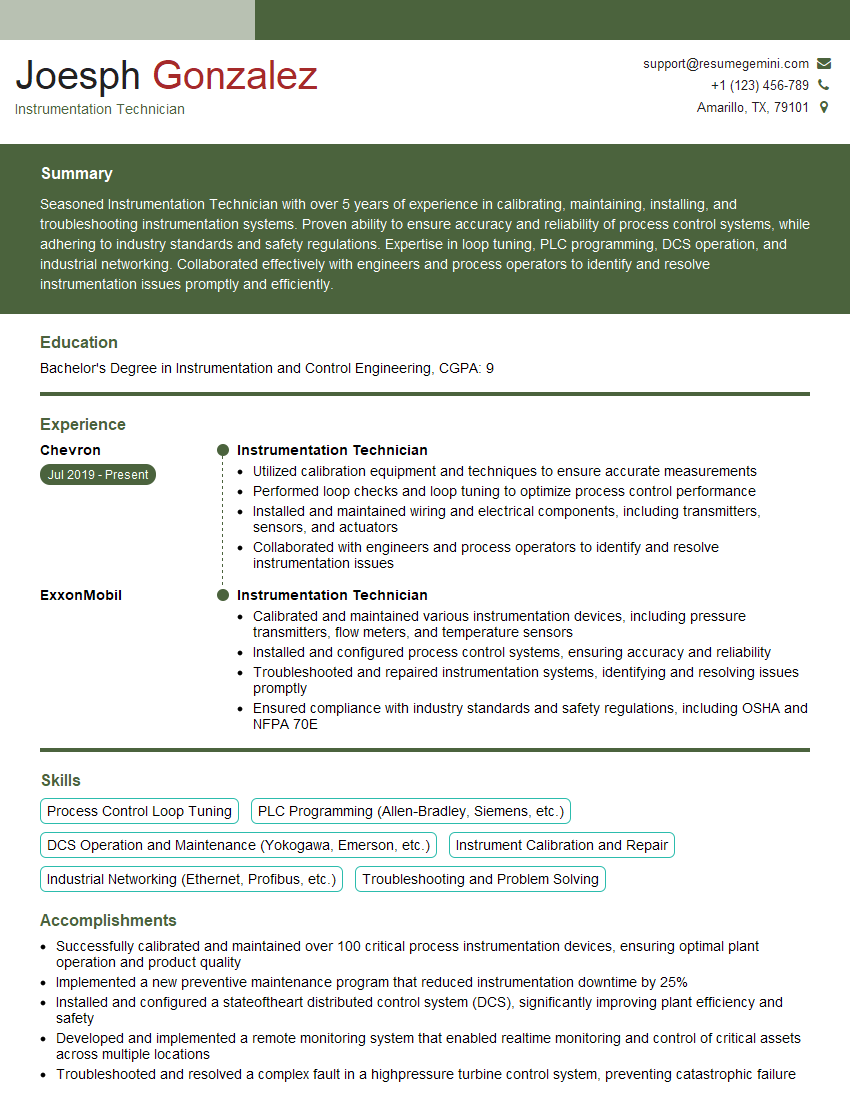
Instrumentation Technician Resume Sample

Automation Technician Resume Sample
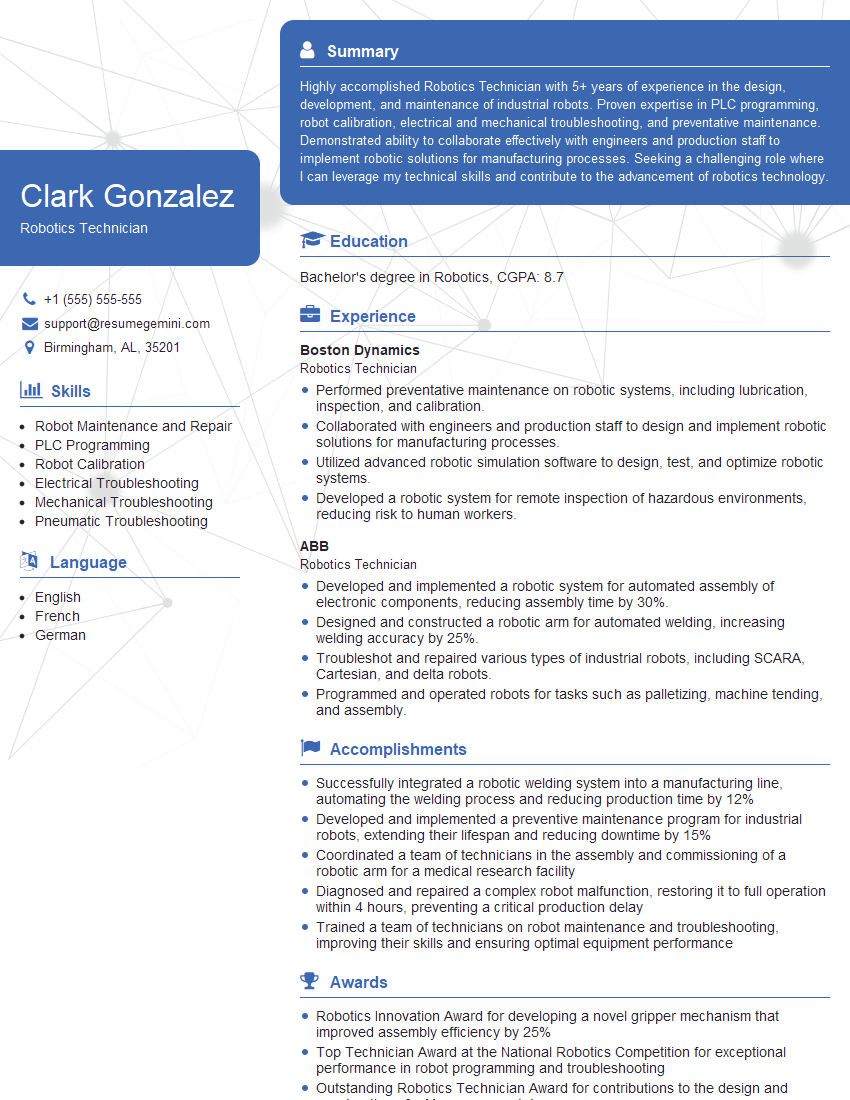
Robotics Technician Resume Sample
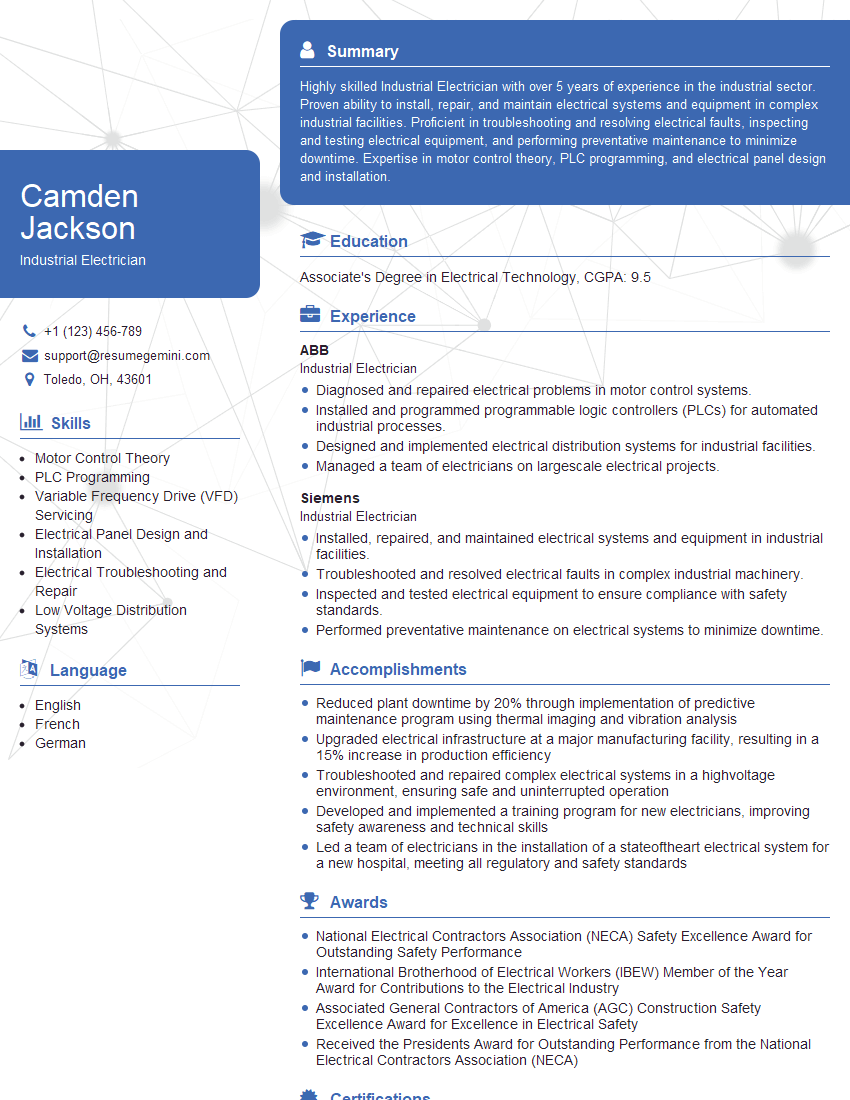
Industrial Electrician Resume Sample

Maintenance Electrician Resume Sample
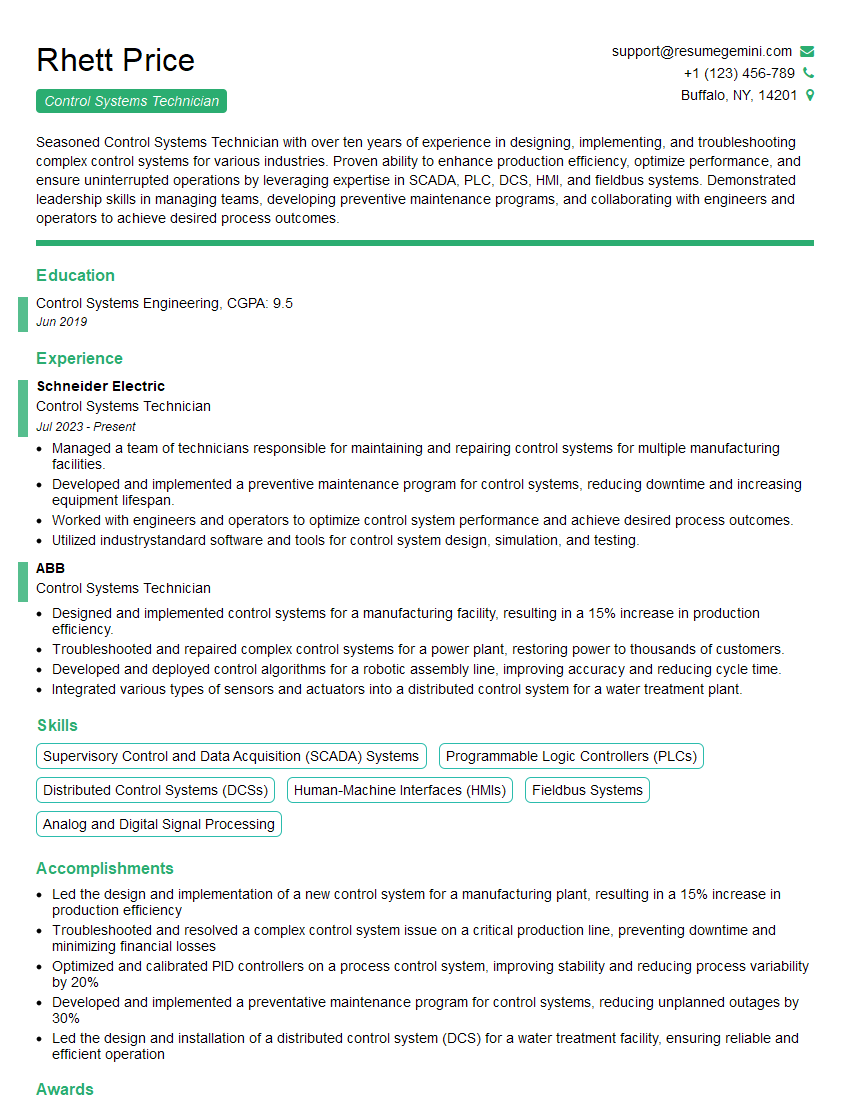
Control Systems Technician Resume Sample

Electrical Maintenance Technician Resume Sample
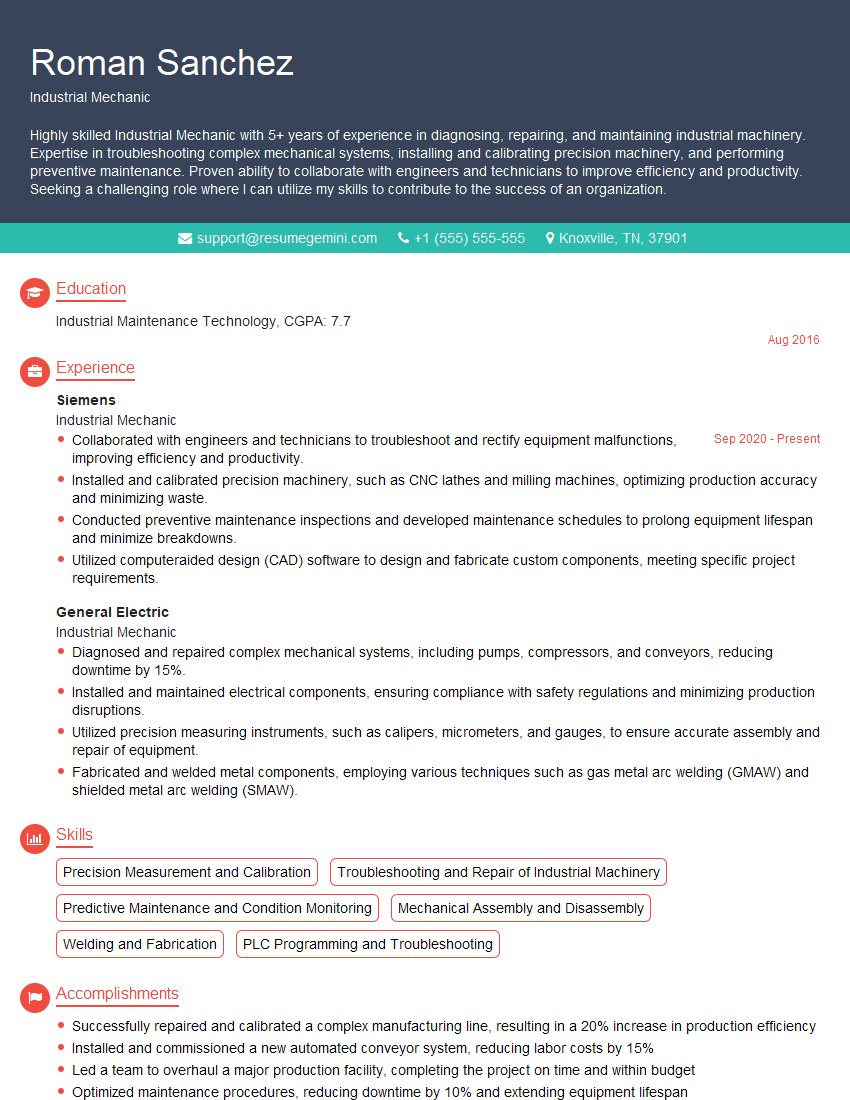
Industrial Mechanic Resume Sample
Explore more articles
Users Rating of Our Blogs
Share Your Experience
We value your feedback! Please rate our content and share your thoughts (optional).
What Readers Say About Our Blog
To the interviewgemini.com Webmaster.
Very helpful and content specific questions to help prepare me for my interview!
Thank you
To the interviewgemini.com Webmaster.
This was kind of a unique content I found around the specialized skills. Very helpful questions and good detailed answers.
Very Helpful blog, thank you Interviewgemini team.