Interviews are more than just a Q&A session—they’re a chance to prove your worth. This blog dives into essential Motor Control Wiring interview questions and expert tips to help you align your answers with what hiring managers are looking for. Start preparing to shine!
Questions Asked in Motor Control Wiring Interview
Q 1. Explain the different types of motor starters.
Motor starters are devices that control the starting and stopping of electric motors. They protect the motor and the electrical system from damage during start-up and operation. There are several types, each suited for different applications and motor sizes:
- Direct-On-Line (DOL) starters: These are the simplest type, directly connecting the motor to the power supply. They’re inexpensive but can cause high inrush currents, potentially damaging the motor and power system. Suitable for smaller motors where the high inrush current isn’t a significant concern.
- Star-Delta starters: These reduce the starting current by initially connecting the motor windings in a star configuration (lower voltage) before switching to a delta configuration (full voltage) once the motor reaches a certain speed. This significantly reduces the inrush current compared to DOL starters, making them suitable for larger motors.
- Autotransformer starters: Similar to Star-Delta, these use an autotransformer to reduce the voltage applied to the motor during starting, thereby lowering the inrush current. They provide smoother starting than DOL but are more complex and expensive.
- Soft starters: These use power electronics to gradually increase the voltage applied to the motor, resulting in a smooth start with minimal inrush current and reduced mechanical stress on the motor and connected equipment. They are ideal for applications requiring gentle starts, such as large pumps or conveyor systems.
- Variable Frequency Drives (VFDs): These are the most sophisticated type, offering precise control over the motor’s speed and torque. They provide smooth starts and stops, energy efficiency improvements, and precise control over the motor’s operation. Excellent for applications demanding speed regulation and precise torque control.
Q 2. Describe the function of a motor control center (MCC).
A Motor Control Center (MCC) is a centralized assembly of motor starters, protective devices, and other control components for multiple motors. Think of it as a sophisticated distribution board specifically designed for motor control. It provides a safe and organized way to manage and control a large number of motors in an industrial setting. Key functions include:
- Protection: MCCs incorporate overcurrent protection devices (circuit breakers, fuses) to safeguard motors and the electrical system from faults.
- Control: They house the motor starters, enabling remote starting, stopping, and monitoring of motors.
- Organization: MCCs provide a neat and easily accessible arrangement of motor control components, simplifying maintenance and troubleshooting.
- Safety: They are designed with safety features, such as interlocks and proper grounding, to protect personnel.
Imagine a large factory with dozens of motors driving pumps, conveyors, and other equipment. An MCC centralizes the control and protection of all these motors in a single, well-organized unit, ensuring safe and efficient operation.
Q 3. What are the safety precautions when working with motor control circuits?
Working with motor control circuits requires strict adherence to safety procedures to prevent electrical shock, burns, and other hazards. Key precautions include:
- Lockout/Tagout (LOTO): Always lock out and tag out the power supply before working on any motor control circuit. This ensures that the circuit is completely de-energized and prevents accidental energization.
- Personal Protective Equipment (PPE): Wear appropriate PPE, including safety glasses, insulated gloves, and safety shoes, to protect against electrical hazards and potential injuries.
- Proper grounding: Ensure that the motor and control circuits are properly grounded to prevent electrical shock.
- Testing procedures: Use appropriate test equipment, such as voltage detectors and multimeters, to verify that the circuit is de-energized before working on it. Never assume a circuit is safe.
- Training: Only qualified and trained personnel should work on motor control circuits.
- Awareness of potential hazards: Be aware of the potential hazards associated with high voltage, high current, and moving parts.
Safety should be the paramount concern when working with any electrical equipment. A moment of carelessness can have severe consequences.
Q 4. How do you troubleshoot a motor that won’t start?
Troubleshooting a motor that won’t start involves a systematic approach. Here’s a step-by-step process:
- Check power supply: Verify that power is available at the motor’s terminal using a voltmeter. Check fuses, circuit breakers, and any other components in the power supply path.
- Inspect motor windings: Use a multimeter to check for continuity and insulation resistance in the motor windings. Look for any signs of damage or overheating.
- Examine motor starter: Inspect the motor starter for any visible damage or loose connections. Check the overload relays and thermal protectors.
- Check control circuit: If the motor is controlled by a PLC or other control system, check the control logic and wiring. Look for any faults or errors in the control system.
- Test the motor starter: If possible, try bypassing the starter to see if the motor will start directly from the power supply. If this works, the fault is likely in the starter itself. If not, the problem is likely with the motor or power supply.
- Check for mechanical issues: Ensure the motor shaft is free to rotate. Check for any obstructions or binding that could be preventing the motor from starting.
Remember to always follow proper safety precautions before attempting any troubleshooting procedures. If you’re unsure about anything, contact a qualified electrician.
Q 5. Explain the difference between DOL and Star-Delta starters.
Both DOL and Star-Delta starters are used to start induction motors, but they differ significantly in how they manage the starting current:
- DOL (Direct-On-Line): This method directly connects the motor to the full line voltage. It’s simple and inexpensive but results in a high inrush current (typically 6-8 times the full-load current) that can stress the motor and power system. Suitable only for smaller motors.
- Star-Delta: This method initially connects the motor windings in a star configuration, reducing the voltage applied to the motor by a factor of √3 (approximately 1.73). After the motor reaches a certain speed, the connections are switched to a delta configuration, applying full line voltage. This significantly reduces the starting current, typically to 3-4 times the full-load current, making it suitable for larger motors.
Think of it like this: DOL is like slamming on the gas pedal in a car – immediate acceleration but hard on the engine. Star-Delta is like gradually accelerating, gentler on the engine and the car.
Q 6. What are the different types of motor protection devices?
Motor protection devices are crucial for safeguarding motors from damage and ensuring safe operation. Common types include:
- Overload relays: These protect the motor from excessive current due to overload conditions. They trip and disconnect the motor when the current exceeds a predetermined value.
- Thermal protectors: These are built into some motors and provide protection against excessive heating. They are typically bimetallic strips that open the circuit when the motor temperature reaches a dangerous level.
- Circuit breakers: These provide both overload and short-circuit protection. They quickly disconnect the circuit in case of a short circuit or excessive current.
- Fuses: Similar to circuit breakers, these melt and open the circuit if excessive current flows. They are typically used for lower-current applications.
- Ground fault circuit interrupters (GFCIs): These protect against ground faults, which can occur if a live wire comes into contact with a grounded surface. They immediately disconnect the circuit, minimizing the risk of electric shock.
Q 7. How do you select the appropriate motor starter for a given application?
Selecting the appropriate motor starter depends on several factors:
- Motor size and type: Larger motors require starters capable of handling high inrush currents. Different motor types (e.g., induction, synchronous) may require specific starter types.
- Starting torque requirements: Applications requiring high starting torque may necessitate a starter that provides adequate torque during startup (e.g., a VFD).
- Starting current limitations: In some cases, the power system may have limitations on the starting current. Star-Delta or soft starters can help reduce inrush current within these limits.
- Speed control requirements: If precise speed control is necessary, a VFD is the best option.
- Budget and complexity: DOL starters are the simplest and least expensive, while VFDs are the most complex and expensive.
- Environmental considerations: Harsh environments may require starters with higher protection ratings (IP ratings).
For instance, a small fan motor might only need a simple DOL starter, whereas a large industrial pump might require a sophisticated soft starter or VFD to manage high inrush current and provide smooth operation.
Q 8. Describe the function of a soft starter.
A soft starter is a device used to control the starting torque and inrush current of an AC motor. Imagine trying to start a large truck – you wouldn’t just slam the gas pedal to the floor! A soft starter does a similar job for motors, gently ramping up the voltage to the motor, reducing the mechanical stress and electrical strain. This prevents damage to the motor, the driven equipment, and the electrical system.
Instead of directly applying full voltage, a soft starter uses thyristors (electronic switches) to gradually increase the voltage supplied to the motor. This controlled acceleration reduces the high inrush current characteristic of direct-on-line (DOL) starting. Think of it as a smooth, controlled acceleration instead of a sudden jolt. This is particularly beneficial for large motors driving heavy loads, like pumps or conveyors, where high starting currents can cause significant issues.
A typical soft starter includes components like a control circuit, thyristor modules, and a heat sink. The control circuit determines the rate of voltage increase, while the thyristors handle the switching. The heat sink dissipates heat generated by the thyristors during operation.
Q 9. Explain the operation of a Variable Frequency Drive (VFD).
A Variable Frequency Drive (VFD), also known as an inverter, is a sophisticated motor control device that adjusts the frequency and voltage supplied to an AC motor. Unlike a soft starter which only controls the starting, a VFD allows for precise control of the motor’s speed and torque over its entire operating range. It achieves this by converting fixed-frequency AC power into variable-frequency AC power.
The process typically involves several stages: rectification (converting AC to DC), DC bus filtering (smoothing the DC current), and inversion (converting DC back to variable-frequency AC). The VFD uses a microprocessor to precisely control the output frequency and voltage based on the desired motor speed and torque. This allows for fine-tuned control, enabling applications like precise positioning, speed regulation, and energy savings. For example, in a conveyor system, a VFD can adjust the speed based on the demand, ensuring optimal efficiency.
Imagine a car with a continuously variable transmission (CVT). The CVT allows for seamless adjustments to the gear ratio, optimizing engine speed and power for various situations. A VFD performs a similar function for AC motors, allowing for optimal performance at any speed.
Q 10. What are the advantages and disadvantages of using a VFD?
Advantages of using a VFD:
- Precise speed control: Enables fine-tuned adjustment of motor speed.
- Soft starting: Reduces mechanical stress and electrical strain on the motor and system.
- Energy savings: Optimized operation reduces energy consumption.
- Improved motor efficiency: By running the motor at the optimal speed for the task, energy waste is reduced.
- Reduced maintenance: Smoother operation extends motor lifespan.
Disadvantages of using a VFD:
- Higher initial cost: VFDs are more expensive than simpler motor starters.
- Increased complexity: Requires more specialized knowledge for installation and maintenance.
- Potential for harmonic distortion: The non-sinusoidal output current can cause issues in the power system.
- Electromagnetic interference (EMI): VFDs can generate EMI, which may affect other equipment.
- Requires specialized motor: Some motors are not suitable for VFD control.
Q 11. How do you program a PLC to control a motor?
Programming a PLC (Programmable Logic Controller) to control a motor involves several steps. First, you need to understand the PLC’s input and output modules and how they interface with the motor and its associated devices (e.g., VFD, emergency stop button). The program itself uses ladder logic or structured text to define the control sequence.
A typical program might involve using digital inputs to represent start/stop commands (push buttons), and digital outputs to control the VFD’s start/stop and direction signals. Analog outputs can be used to control the VFD’s speed setpoint. The PLC’s internal timers and counters can be employed to implement timing functions like acceleration ramps or safety timeouts.
Example Ladder Logic (Conceptual):
Imagine a simple start/stop control using a PLC with a start pushbutton (input I1), a stop pushbutton (input I2), and a VFD start/stop output (output O1).
Start Pushbutton (I1) --(Normally Open)--[ ]-->(Output O1) --(VFD Start)-- Stop Pushbutton (I2) --(Normally Closed)--[ ]-->(Output O1)This simple ladder logic would start the VFD (O1) when the start pushbutton (I1) is pressed and stop it when the stop pushbutton (I2) is pressed. More sophisticated programs would include speed control, direction control, safety features, and error handling.
Q 12. Explain the concept of motor overload protection.
Motor overload protection is a crucial safety feature designed to prevent damage to a motor by shutting it down when it draws excessive current. This excessive current can be caused by various factors such as mechanical overload (too much load on the motor), stalled rotor, or internal motor faults. Think of it as a safety net for your motor.
Overload protection is typically achieved using either thermal overload relays or electronic overload protection within a VFD or motor starter. Thermal overload relays use a bimetallic strip that heats up when excessive current flows, causing the strip to bend and trip a switch. Electronic overload protection uses sensors to monitor the motor current and compare it against pre-set limits. If the current exceeds the limit for a specified duration, the motor is automatically shut down. This protection is vital to preventing motor burnout, which can lead to costly repairs or replacements.
In a real-world scenario, imagine a conveyor system overloaded with more material than it can handle. Without overload protection, the motor might overheat, potentially leading to failure and a production halt. Overload protection ensures the motor shuts down safely, preventing more severe damage.
Q 13. What are the different types of motor enclosures?
Motor enclosures are designed to protect the motor from various environmental factors, ensuring safety and longevity. Different enclosures offer varying degrees of protection, denoted by IP (Ingress Protection) ratings. Some common types include:
- Open type (IP00): Offers no protection against environmental factors, suitable only for indoor use in controlled environments.
- Drip-proof (IP22): Protects against dripping water and solid objects larger than 12mm.
- Totally enclosed (TEFC, IP66): Offers protection against dust and water jets, suitable for harsh environments.
- Explosion-proof (IP6X): Designed to prevent ignition of flammable materials in hazardous environments. This is often found in chemical plants or oil refineries.
- Washdown (IP67): Withstands high-pressure water cleaning, common in food and beverage processing.
The choice of motor enclosure depends heavily on the application and environmental conditions. For example, a motor in a clean, dry factory might use an open or drip-proof enclosure, while a motor exposed to water and dust in an outdoor setting would require a totally enclosed or washdown enclosure.
Q 14. How do you identify the different phases of a three-phase motor?
Identifying the phases of a three-phase motor is crucial for proper connection and operation. Incorrect phase sequence can result in damage to the motor. Several methods can be used:
- Using a phase rotation indicator: This is the most straightforward and reliable method. The indicator, often a simple device, will visually indicate the phase sequence (e.g., with lights or a rotating pointer).
- Using a multimeter: With the motor disconnected from the power supply, measure the resistance between each pair of motor leads. The resistance between any two leads should be roughly the same. Caution: Don’t use this method while the motor is energized!
- Using a motor analyzer:Advanced tools like motor analyzers can provide detailed information about motor windings and phase sequence.
It’s important to remember safety precautions. Always disconnect power before working on any electrical equipment. Incorrect phase sequence can cause the motor to run in reverse, causing significant problems or even damage. Correct phase identification ensures smooth and reliable motor operation.
Q 15. Describe the process of wiring a three-phase motor.
Wiring a three-phase motor involves connecting the motor’s three windings to a three-phase power supply. It’s crucial to follow the motor’s connection diagram precisely, as incorrect wiring can lead to damage or failure. The process generally involves identifying the three line terminals (usually labeled L1, L2, L3 or U, V, W) on the motor and matching them to the corresponding phases of the power supply. The connection method depends on the motor’s internal winding configuration – either delta (Δ) or wye (Y) – which is typically indicated on the motor nameplate.
Delta (Δ) Connection: In this configuration, the three motor windings are connected in a closed triangular shape. L1 connects to one end of winding 1, L2 to one end of winding 2, and L3 to one end of winding 3. The other ends of the windings are then connected together to form the closed triangle. This connection offers higher voltage per winding but lower current per winding.
Wye (Y) Connection: In this configuration, the three motor windings are connected at a common point, forming a ‘Y’ shape. The three line terminals (L1, L2, L3) connect to the ends of each winding, while the common point is left unconnected. This connection offers lower voltage per winding but higher current per winding.
Important Considerations: Always use appropriately sized conductors and protective devices (fuses or circuit breakers). Properly grounding the motor is essential for safety. Before connecting to power, visually inspect the motor and wiring for any damage. After completing the wiring, always verify the connections before energizing the motor. Incorrect wiring can result in reduced efficiency, motor overheating, and even a complete motor failure.
Career Expert Tips:
- Ace those interviews! Prepare effectively by reviewing the Top 50 Most Common Interview Questions on ResumeGemini.
- Navigate your job search with confidence! Explore a wide range of Career Tips on ResumeGemini. Learn about common challenges and recommendations to overcome them.
- Craft the perfect resume! Master the Art of Resume Writing with ResumeGemini’s guide. Showcase your unique qualifications and achievements effectively.
- Don’t miss out on holiday savings! Build your dream resume with ResumeGemini’s ATS optimized templates.
Q 16. Explain the importance of grounding in motor control circuits.
Grounding in motor control circuits is paramount for safety and proper operation. It provides a low-impedance path for fault currents to flow back to the source, preventing dangerous voltage buildup on the motor frame and associated equipment. This protects personnel from electric shock and equipment from damage. A properly grounded motor frame ensures that any stray electrical currents are safely diverted to ground instead of accumulating on the metal casing, which could cause electric shock if touched.
Consider this scenario: a short circuit occurs within the motor windings. Without proper grounding, the motor casing could become energized to a dangerous voltage. If someone were to touch the casing, they’d experience a severe electric shock. However, with a ground connection, the fault current flows directly to ground, preventing this dangerous voltage buildup. Grounding also helps to reduce electrical noise and interference in the control circuit, improving the overall reliability and performance of the motor system.
Q 17. What are the common causes of motor overheating?
Motor overheating is a common problem with several contributing factors. These can be broadly categorized as:
- Mechanical Issues: Inadequate lubrication, misalignment (between the motor shaft and the driven load), excessive load, bearing wear, and unbalanced rotor can generate friction and heat.
- Electrical Issues: Overloading the motor (drawing more current than its rated capacity), single-phasing (loss of one phase in a three-phase motor), voltage imbalance (unequal voltages across phases), and high resistance in windings (due to age or damage).
- Environmental Issues: Poor ventilation preventing heat dissipation, high ambient temperature, or the motor operating in a dusty environment.
Let’s consider an example: a motor operating continuously at 120% of its rated load will likely overheat due to electrical overload. This excessive current generates heat, exceeding the motor’s ability to dissipate it. Similarly, if a motor’s bearings are worn, increased friction will generate excessive heat, leading to overheating and potential damage.
Q 18. How do you troubleshoot a motor that is overheating?
Troubleshooting an overheating motor requires a systematic approach. It’s crucial to prioritize safety and de-energize the motor before beginning any inspection. Here’s a step-by-step process:
- Check the motor’s nameplate: Verify that the motor is not overloaded based on the load requirements and its rated capacity.
- Inspect for external signs: Look for signs of damage, such as loose connections, burnt insulation, or physical damage.
- Measure motor temperature: Use a non-contact thermometer to measure the motor’s winding and bearing temperatures. Compare these readings to the motor’s specifications.
- Check for mechanical issues: Inspect the bearings, couplings, and alignment for wear or damage.
- Measure motor current: Check the current draw of the motor using a clamp meter. Compare this reading to the motor’s rated current. Excessive current indicates an electrical overload.
- Inspect voltage levels: A three-phase motor needs balanced voltage across all three phases. If there are significant voltage imbalances, this can cause excessive heating in the windings.
- Check ventilation: Ensure adequate ventilation around the motor to allow for heat dissipation.
If you identify any issues, address them accordingly. If the problem persists, consider consulting a qualified electrician or motor repair technician for further diagnostics.
Q 19. Explain the concept of motor thermal protection.
Motor thermal protection is a crucial safety mechanism designed to prevent motor damage due to overheating. Thermal protection devices, such as thermal switches or relays, are integrated within the motor or its control circuit. These devices sense the motor’s temperature. If the temperature exceeds a predetermined safe limit, the device opens the motor’s power circuit, shutting it down to prevent further damage.
This protection is vital because prolonged overheating can degrade motor insulation, potentially leading to short circuits, fires, and complete motor failure. Thermal protectors come in various types; some are manually resettable, while others are automatic reset types that restart automatically once the motor cools down below the threshold. Modern motors frequently integrate such thermal protection directly into their design, providing robust and reliable overheating prevention. This preventative measure minimizes downtime and extends the life of the motor. For instance, a thermal overload relay could be wired into the motor’s control circuit to automatically trip if the motor’s temperature exceeds a safe level.
Q 20. Describe the function of a magnetic contactor.
A magnetic contactor is an electrically operated switch used in motor control circuits to remotely turn the motor on or off. It uses an electromagnetic coil to control the switching of heavier currents in the power circuit. When the coil is energized, it creates a magnetic field, attracting a movable armature which closes contacts, completing the power circuit to the motor. When the coil is de-energized, the armature springs back, opening the contacts and interrupting the power to the motor.
Think of it like a powerful relay, but designed to handle the higher currents involved in motor control. Contactors provide a safe and reliable method to control motors from a remote location, eliminating the need to manually switch large power cables. They are typically used in conjunction with other control devices like push-button switches, timers, and programmable logic controllers (PLCs). Contactors are rated by their current-carrying capacity and the voltage they can switch. Choosing the correct contactor based on the motor’s power requirements is critical for safe and efficient operation.
Q 21. What are the different types of motor brakes?
Motor brakes are used to quickly stop or hold a rotating motor. There are several types, each with its own characteristics and applications:
- Electromagnetic Brakes: These brakes use electromagnetism to engage or disengage the braking mechanism. When energized, they apply the braking force. When de-energized, the brake releases. They are fast acting and are commonly used in applications requiring quick stops. They come in various types, including spring-applied, electrically released, and solenoid-operated.
- Mechanical Brakes: These brakes use friction to stop the motor’s rotation, typically through a lever or shoe mechanism. They are often simpler and more robust than electromagnetic brakes but can be slower to engage.
- Regenerative Brakes: These brakes use the motor as a generator to slow down and stop the motor’s rotation. The generated energy is usually fed back into the power supply. They are very efficient in terms of energy recovery but require specific motor and control system configurations.
The choice of brake depends on factors such as the motor’s size, the required stopping time, and the available control system. For example, a large industrial machine might use an electromagnetic brake for fast stopping, while a smaller conveyor system might use a mechanical brake due to its simplicity and robustness. Regenerative braking is often preferred for applications that need frequent stopping, particularly in electric vehicles for better energy efficiency.
Q 22. How do you select the appropriate motor brake for a given application?
Selecting the right motor brake is crucial for safety and operational efficiency. It’s not a one-size-fits-all decision; you need to consider several factors. Think of it like choosing the right type of brakes for a car – you wouldn’t use the same brakes for a Formula 1 car as you would for a delivery truck.
- Holding Torque Requirement: This is the most critical factor. You need a brake capable of holding the motor’s load at rest, even under unexpected power loss. This requires calculating the maximum inertia of the motor and its load.
- Type of Motor: Different motor types (AC induction, DC, servo) have different braking characteristics, and the brake must be compatible. For example, a regenerative braking system is often preferred for servo motors to recapture energy.
- Brake Type: Common types include spring-applied, electrically-released brakes (most common for safety); and electrically-applied, spring-released brakes (often used for fail-safe applications). The choice depends on the desired safety level and application needs. Spring-applied brakes ensure the load is held in the event of power failure.
- Mounting and Size: Physical constraints and space limitations within the machine dictate the brake’s physical dimensions and mounting style.
- Environmental Conditions: Temperature, humidity, and potential exposure to corrosive substances can affect brake performance and lifespan. A brake suitable for an outdoor application will be different from one used indoors.
Example: In a conveyor system, a spring-applied, electrically-released brake would be suitable. In the event of a power failure, the spring would automatically engage the brake, preventing the conveyor from moving unexpectedly and potentially causing injury. Conversely, a precise positioning application might use a dynamically controlled brake integrated with the motor’s control system.
Q 23. Explain the process of commissioning a new motor control system.
Commissioning a new motor control system is a methodical process that ensures everything works correctly and safely. It’s akin to thoroughly testing a new car before taking it on a long journey.
- Pre-commissioning Checks: This involves verifying the wiring is correct according to the schematic, ensuring all components are properly installed, and checking for loose connections. Thorough visual inspection is crucial.
- Wiring Verification: Using a multimeter, check for correct voltage and continuity at all points. Ensure no shorts or open circuits exist. This often includes verifying the correct wiring of safety circuits like E-stops.
- Functional Testing: Begin with slow and incremental tests. Start with simple commands (e.g., motor start/stop), gradually increasing speed and load to observe performance under various conditions. This allows for early identification of potential issues.
- Safety System Testing: Rigorously test all safety features like emergency stops, limit switches, and interlocks. Ensure these functions operate as designed and shut down the system immediately in case of any emergency. The proper operation of safety systems is paramount.
- Load Testing: Subject the system to its full design load, monitoring temperature, current draw, and overall performance. Overload protection settings should also be verified.
- Documentation: A detailed commissioning report must be completed documenting all tests, findings, and adjustments made. This forms part of the system’s operational history and is vital for future maintenance.
Example: During load testing of a pump motor control system, we discovered that the current draw was exceeding the expected value, indicating a potential mechanical problem in the pump itself rather than an issue with the motor control system.
Q 24. What are the common safety standards related to motor control?
Safety is paramount in motor control. Several international and national standards govern the design, installation, and operation of motor control systems to ensure the safety of personnel and equipment. These standards evolve as technology progresses. The most important ones include:
- IEC 60204-1: This international standard specifies the safety of machinery – electrical equipment of machines. It covers aspects like electrical clearances, protection against electric shock, and the proper use of safety devices.
- NFPA 70 (National Electrical Code – NEC): This is the most widely used standard in North America, providing guidance on safe electrical installation practices relevant to motor controls.
- OSHA (Occupational Safety and Health Administration) Regulations: These regulations enforce workplace safety standards, including those related to electrical safety and machine guarding, which directly impact motor control systems.
- UL (Underwriters Laboratories) Standards: UL provides safety certifications for various electrical components used in motor control systems, ensuring compliance with established safety requirements.
Example: Correct implementation of lock-out/tag-out procedures during maintenance is a crucial safety measure that aligns with several of these standards. It prevents unexpected start-ups and reduces the risk of electrical shock or injury.
Q 25. Describe your experience with different types of motor control wiring diagrams.
Throughout my career, I’ve worked extensively with various types of motor control wiring diagrams, each serving a specific purpose. Understanding the nuances of each diagram type is crucial for effective troubleshooting and maintenance.
- Ladder Logic Diagrams: These are widely used in programmable logic controllers (PLCs). They use a graphical representation of logic gates and functions to control the motor. I am very proficient in interpreting and modifying such diagrams.
- Schematic Diagrams: These show the complete electrical connections of the system, including all components like motors, contactors, overload relays, and safety devices. They are essential for installation and troubleshooting.
- One-line Diagrams: These provide a simplified overview of the power system, useful for understanding the high-level power distribution and protection. While less detailed than schematics, they are useful for quickly grasping overall system architecture.
- Wiring Diagrams: These show the physical connections, often with terminal numbers and cable routing information, guiding the actual wiring process during installation.
Example: I recently worked on a project where the ladder logic diagram revealed a missing safety interlock in the motor start sequence. Using the schematic diagram, I was able to quickly identify the necessary components and wiring modifications to add the missing safety feature.
Q 26. Explain your experience troubleshooting motor control circuits using diagnostic tools.
Troubleshooting motor control circuits requires a systematic and methodical approach. Diagnostic tools are invaluable in pinpointing problems quickly and accurately.
- Multimeter: Essential for checking voltage, current, continuity, and resistance. I use it to verify power supply, check for shorts and open circuits, and test sensors.
- Clamp Meter: Used for measuring current without breaking the circuit, valuable for identifying overload situations and evaluating motor performance under load.
- Logic Analyzer/Oscilloscope: These more advanced tools are used for analyzing complex signals and waveforms within the control system, helping to diagnose intermittent faults and timing issues in the control logic.
- PLC Programming Software: Allows me to monitor the status of inputs and outputs, view program variables, and perform online diagnostics to troubleshoot PLC-related problems.
Example: I once diagnosed a motor that wouldn’t start by using a clamp meter. It showed no current draw, indicating either a lack of power to the motor or a problem with the motor itself. Further testing with a multimeter pinpointed a blown fuse in the motor control circuit.
Q 27. Describe your experience with various PLC programming software for motor control applications.
My experience encompasses several PLC programming software packages widely used for motor control applications. Each has its strengths and weaknesses. Proficiency in multiple platforms is crucial for versatility.
- Rockwell Automation RSLogix 5000: Extensively used for Allen-Bradley PLCs, which are a common choice in industrial settings. I’m proficient in developing, debugging, and maintaining control programs using this software.
- Siemens TIA Portal: A powerful platform for Siemens PLCs. I have experience in creating, commissioning, and troubleshooting motor control applications using this environment.
- Schneider Electric PL7: Used for programming Schneider Electric PLCs. I am comfortable working with this platform and understand its specific functionalities for motor control.
Example: In a recent project, I used RSLogix 5000 to implement a sophisticated motor control algorithm with speed regulation, torque monitoring, and safety interlocks for a large industrial robotic arm.
Q 28. How do you ensure the safety and efficiency of a motor control system throughout its lifecycle?
Ensuring safety and efficiency throughout the lifecycle of a motor control system requires proactive measures, regular maintenance, and a commitment to best practices. It’s like regularly servicing a car to maintain its performance and longevity.
- Regular Inspections: Periodic visual inspections and functional tests are essential to identify potential issues early on. This minimizes downtime and prevents safety hazards.
- Preventive Maintenance: A scheduled maintenance program ensures components like motor bearings, belts, and contactors are replaced or serviced before they fail, preventing unexpected breakdowns.
- Predictive Maintenance: Using sensors and data analysis, we can anticipate potential failures before they occur. This allows for timely intervention and reduces maintenance costs.
- Proper Documentation: Maintaining detailed records of maintenance activities, system modifications, and component replacements allows for improved tracking of the system’s health and operational history.
- Operator Training: Ensuring operators understand the system’s operational limits and safety procedures is crucial for safe operation and prevents user-induced errors.
Example: By implementing a predictive maintenance program utilizing vibration analysis of a motor, we were able to detect an impending bearing failure, schedule the repair before catastrophic failure, and prevent significant downtime.
Key Topics to Learn for Your Motor Control Wiring Interview
- Fundamentals of Electrical Circuits: Understanding Ohm’s Law, Kirchhoff’s Laws, and series/parallel circuits is crucial for analyzing motor control systems.
- Motor Types and Characteristics: Become familiar with AC induction motors, DC motors, and servo motors; understand their operating principles, torque curves, and speed control methods.
- Control Components and their Applications: Master the functionality of contactors, relays, overload relays, circuit breakers, and fuses within motor control circuits. Understand their role in safety and protection.
- Wiring Diagrams and Schematics: Practice reading and interpreting ladder diagrams, wiring schematics, and other visual representations of motor control systems. Be prepared to discuss the logic and functionality represented.
- Safety Regulations and Practices: Demonstrate your knowledge of relevant safety standards (e.g., NEC) and best practices for working with high-voltage equipment and motor control systems.
- Troubleshooting Techniques: Develop your problem-solving skills by practicing fault diagnosis in motor control circuits. Be prepared to discuss systematic approaches to identifying and resolving issues.
- Programmable Logic Controllers (PLCs): Familiarity with basic PLC programming and their application in motor control is highly valuable. Understand the role of input/output modules and ladder logic.
- Variable Frequency Drives (VFDs): Understanding the operation, benefits, and applications of VFDs for controlling motor speed and torque is essential in modern industrial settings.
- Motor Protection and Control Strategies: Discuss various methods for protecting motors from overcurrent, overheating, and other potential failures. Be ready to explain different control strategies (e.g., open-loop, closed-loop).
Next Steps
Mastering motor control wiring opens doors to exciting and rewarding careers in industrial automation, manufacturing, and maintenance. To maximize your job prospects, create a compelling and ATS-friendly resume that highlights your skills and experience. ResumeGemini is a trusted resource that can help you build a professional resume that stands out. They offer examples of resumes tailored specifically to Motor Control Wiring professionals, ensuring your qualifications shine. Take the next step towards your dream career – build a powerful resume with ResumeGemini today!
Maintenance Supervisor Resume Sample

Automation Engineer Resume Sample
Control Systems Engineer Resume Sample

Robotics Engineer Resume Sample

Automation Technician Resume Sample
Robotics Technician Resume Sample

Chief Electrician Resume Sample
Electrical Supervisor Resume Sample
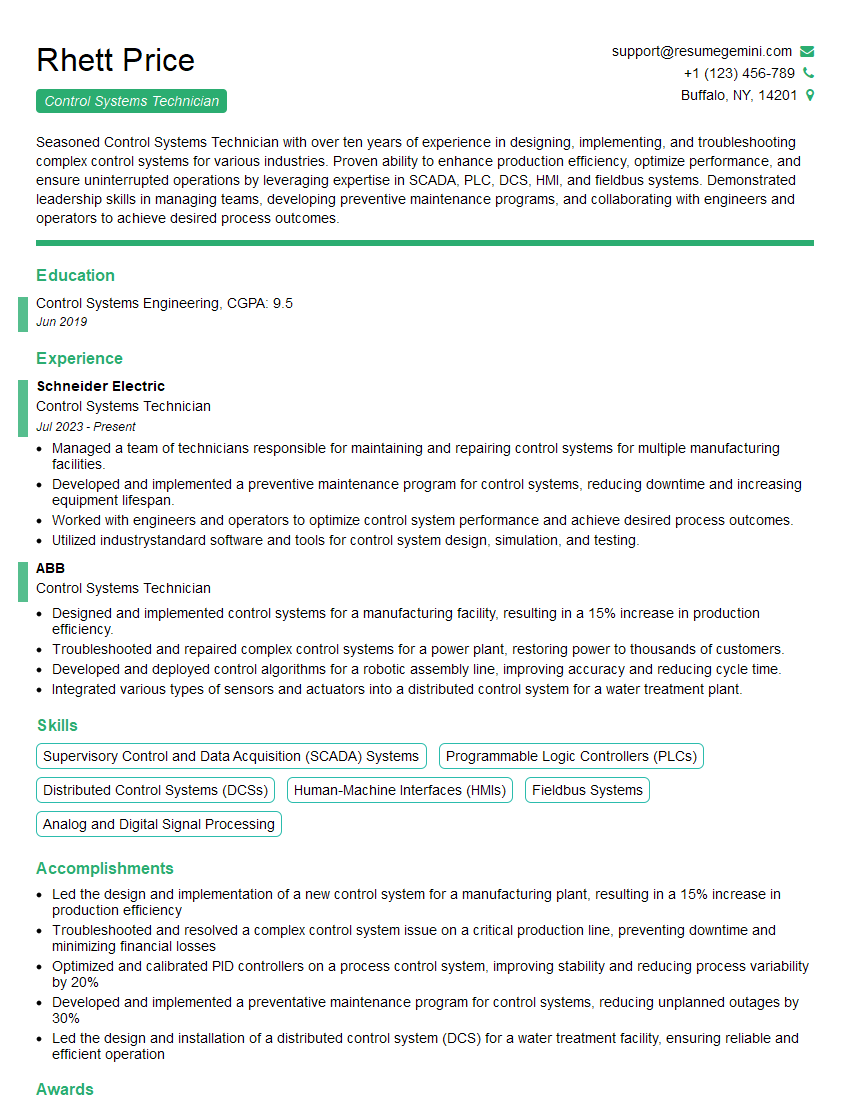
Control Systems Technician Resume Sample
Explore more articles
Users Rating of Our Blogs
Share Your Experience
We value your feedback! Please rate our content and share your thoughts (optional).
What Readers Say About Our Blog
To the interviewgemini.com Webmaster.
Very helpful and content specific questions to help prepare me for my interview!
Thank you
To the interviewgemini.com Webmaster.
This was kind of a unique content I found around the specialized skills. Very helpful questions and good detailed answers.
Very Helpful blog, thank you Interviewgemini team.