Cracking a skill-specific interview, like one for Music in Education, requires understanding the nuances of the role. In this blog, we present the questions you’re most likely to encounter, along with insights into how to answer them effectively. Let’s ensure you’re ready to make a strong impression.
Questions Asked in Music in Education Interview
Q 1. Describe your teaching philosophy in Music Education.
My teaching philosophy centers on the belief that music education is not just about learning notes and rhythms, but about fostering a lifelong love of music and developing well-rounded individuals. I strive to create a supportive and inclusive classroom where students feel empowered to explore their musicality, express themselves creatively, and develop essential skills such as collaboration, problem-solving, and critical thinking. My approach emphasizes active learning, hands-on experiences, and a balance between structured instruction and student-led exploration. I believe in celebrating individual strengths and providing personalized support to help every student reach their full potential, regardless of their prior experience or skill level. This includes nurturing intrinsic motivation through engaging activities and providing opportunities for student choice and autonomy.
Q 2. What methods do you use to differentiate instruction for diverse learners in music?
Differentiation is crucial in music education because students learn and progress at different paces and possess diverse learning styles. I employ a multi-faceted approach to meet these diverse needs. This includes:
- Differentiated instruction: Offering varied levels of complexity in assignments. For example, when learning a melody, some students might compose a simple variation while others create a more complex arrangement.
- Varied learning modalities: Incorporating activities catering to visual, auditory, and kinesthetic learners. This might involve using visuals like color-coded charts for rhythm, listening exercises for melodic dictation, and hands-on activities like composing with manipulatives.
- Flexible grouping: Utilizing whole-class, small-group, and individual instruction based on learning needs. This allows for targeted support and opportunities for peer learning.
- Assistive technologies: Employing technologies like music notation software or adaptive instruments to accommodate students with disabilities.
- Personalized learning goals: Collaborating with students to set achievable musical goals that align with their individual strengths and interests.
For instance, a student struggling with rhythm might receive extra practice with rhythm games, while a gifted student might be challenged with composing their own piece.
Q 3. How do you assess student progress in music effectively?
Effective assessment in music goes beyond just grades; it’s about evaluating a student’s overall musical growth and understanding. My approach employs a variety of methods:
- Performance assessments: Observing students’ musical performances, evaluating technical skills, musicality, and expressive qualities.
- Written assessments: Utilizing quizzes and tests to assess theoretical knowledge of music theory, history, and terminology.
- Portfolio assessments: Collecting student work—compositions, analyses, reflections—to demonstrate progress over time.
- Self and peer assessments: Empowering students to evaluate their own work and that of their peers, developing self-awareness and critical listening skills.
- Rubrics: Using clearly defined rubrics to provide students with transparent expectations and consistent evaluation criteria. These rubrics often include criteria like technical accuracy, musical expression, and creativity.
For example, I might use a rubric to assess a student’s composition, considering factors such as melodic interest, rhythmic variety, and harmonic progression. Regular feedback is provided throughout the process, not just at the end.
Q 4. Explain your approach to classroom management in a music setting.
Classroom management in a music setting requires a proactive and positive approach. I foster a respectful and engaging learning environment through:
- Establishing clear expectations and routines: Students understand procedures for entering and exiting the classroom, instrument handling, and group work.
- Building positive relationships: Creating a sense of community and belonging where students feel safe to take risks and express themselves.
- Utilizing positive reinforcement: Recognizing and rewarding positive behavior and effort through verbal praise, certificates, or small rewards.
- Proactive strategies: Implementing engaging activities to minimize disruptive behaviors. If a student is off-task, I might redirect them to a related activity or offer individual assistance.
- Addressing misbehavior constructively: When necessary, addressing misbehavior privately and consistently, focusing on restorative practices rather than punishment.
For example, I might use a ‘signal’ system for quiet time, instead of yelling across the room, making the transition smoother.
Q 5. What strategies do you employ to foster creativity and innovation in your music classes?
Fostering creativity and innovation is at the heart of my music teaching. I encourage students to explore their musical imaginations through:
- Improvisation activities: Providing opportunities for spontaneous musical expression, experimenting with sounds, rhythms, and melodies.
- Composition projects: Encouraging students to create their own musical pieces, allowing them to explore their own styles and ideas.
- Open-ended tasks: Presenting challenges with multiple solutions, promoting divergent thinking and originality.
- Collaboration and peer learning: Encouraging teamwork, where students learn from each other and build on each other’s ideas.
- Exploration of diverse musical styles and cultures: Broadening students’ musical horizons and inspiring them to think outside the box.
For example, I might ask students to compose a piece inspired by a specific emotion or event, or to create a sound collage using everyday objects.
Q 6. How do you integrate technology into your music curriculum?
Technology plays a significant role in enhancing my music curriculum. I integrate technology in various ways:
- Music notation software: Using programs like Sibelius or Finale to compose, edit, and print musical scores, allowing for a more professional approach to composition.
- Digital audio workstations (DAWs): Employing DAWs like GarageBand or Audacity to record, mix, and edit music, opening up avenues for recording performances and exploring sound design.
- Interactive music learning apps and websites: Utilizing resources like Teoria or Musictheory.net to supplement classroom instruction and provide personalized practice.
- Online music libraries and streaming services: Accessing a vast library of music to explore different genres, composers, and historical periods.
- Presentation software: Using PowerPoint or Google Slides for interactive lessons and presentations.
For example, students might use GarageBand to create a collaborative remix of a classical piece, enhancing their understanding of musical structure and arrangement.
Q 7. Describe your experience with various music assessment tools and rubrics.
My experience encompasses a wide range of music assessment tools and rubrics. I’ve utilized standardized tests like the Music Achievement Test (MAT) for broader assessments. However, I primarily rely on more formative and customized methods. I’ve developed rubrics for evaluating various aspects of musical performance, including technical proficiency, musicality, and interpretation. These rubrics are often tailored to the specific skills and objectives of a given assignment or performance. I also use checklists for assessing specific skills, like sight-reading or rhythmic accuracy. For composition, I use rubrics that consider creativity, originality, form, and technical execution. My experience shows that a blended approach – using both standardized tests to gauge general performance alongside tailored assessments that are more closely aligned with classroom activities – gives the most comprehensive understanding of each student’s progress. I find that clearly defined criteria and regular feedback – regardless of which rubric or tool is used – significantly improves student learning and reduces anxiety about assessments.
Q 8. How do you adapt your teaching to meet the needs of students with learning disabilities?
Adapting my teaching to students with learning disabilities requires a multifaceted approach focusing on individual needs. It’s not a ‘one-size-fits-all’ solution; I begin by collaborating closely with the student’s special education teacher and parents to understand their specific learning profile, including diagnoses like dyslexia, ADHD, or autism spectrum disorder. This collaboration helps me tailor my lessons to their strengths and address their challenges effectively.
Differentiated Instruction: I might provide different learning materials – for example, using visual aids alongside auditory ones for a student with auditory processing difficulties, or offering simplified sheet music for a student struggling with complex rhythms. I also break down complex musical tasks into smaller, manageable steps.
Multi-Sensory Learning: Music is inherently multi-sensory, but I consciously enhance this by incorporating kinesthetic activities like movement and dance, tactile experiences with instruments, and visual aids like color-coded charts for rhythm and notation. This helps students engage with the material on multiple levels.
Technology Integration: Technology plays a vital role. Software like GarageBand or other music creation tools can provide a more accessible and engaging learning environment for some students. Assistive technology, such as text-to-speech software, can also be invaluable.
Positive Reinforcement and Patience: Creating a supportive and encouraging environment is crucial. I celebrate small successes, offer regular positive feedback, and maintain a patient and understanding attitude. This builds their confidence and fosters a love for music.
For example, I worked with a student who had dyslexia. Instead of focusing solely on reading traditional sheet music, we utilized color-coded flashcards and rhythmic games to build a strong foundation in rhythm and pitch. Gradually, we introduced notation, always ensuring that the learning process felt accessible and rewarding.
Q 9. How do you incorporate music history and theory into your lessons?
Integrating music history and theory isn’t about rote memorization; it’s about fostering a deeper appreciation and understanding of the music we play. I weave these elements seamlessly into lessons, avoiding abstract lectures. I use a variety of approaches:
Contextual Learning: When learning a piece, I’ll introduce the composer’s life, the historical context of its creation, and relevant social influences. For example, when studying Baroque music, we might explore the societal impact of the patronage system or discuss the role of the church in shaping musical styles.
Active Listening: We actively listen to diverse musical styles and discuss their characteristics, focusing on elements of form, harmony, melody, and rhythm. This develops critical listening skills and an appreciation for musical nuances.
Hands-on Activities: I use interactive exercises and projects to illustrate theoretical concepts. For example, we might compose short pieces using specific chord progressions or analyze the form of a song by identifying its sections (verse, chorus, bridge).
Creative Projects: Students create presentations, artwork, or compositions inspired by historical periods or composers. This engages different learning styles and encourages deeper understanding.
I find that storytelling works wonders. Presenting historical facts as engaging narratives—humanizing composers and connecting music to significant historical events—makes the subject matter far more relatable and memorable for students.
Q 10. Explain your experience with developing and implementing music curriculum.
My experience in curriculum development involves a cyclical process of planning, implementation, assessment, and revision. It begins with a thorough understanding of the learning objectives, considering the students’ age, abilities, and interests. I then align the curriculum with relevant national and state standards.
Needs Assessment: I assess the current skill level of students and identify any gaps in their musical knowledge or abilities. This helps me tailor the curriculum to their needs.
Content Selection: I carefully select materials and activities that are both engaging and relevant, ensuring a balance between foundational skills and creative expression. This includes a diverse repertoire of musical styles, instruments, and activities.
Sequencing: The curriculum is sequenced logically, building upon prior knowledge and skills, to ensure a smooth and progressive learning experience.
Assessment: Continuous assessment throughout the year includes formative assessments (ongoing feedback) and summative assessments (final projects or performances). This provides valuable insights into student learning and helps me adjust my teaching strategies.
Revision and Refinement: Based on assessment data and student feedback, I regularly revise and refine the curriculum to improve its effectiveness.
For example, I once developed a curriculum focused on songwriting, incorporating elements of music theory, lyric writing, and recording techniques. The success of this curriculum led to its adoption by other schools in the district.
Q 11. How do you collaborate with other teachers and school staff?
Collaboration is essential for a thriving music program. I actively engage with other teachers and school staff in several ways:
Cross-Curricular Integration: I collaborate with language arts teachers to incorporate songs and poems into literature studies or with history teachers to explore the music of specific historical periods. This reinforces learning across subjects and provides a richer educational experience.
Shared Resources and Support: I share my resources and expertise with other teachers, while also seeking their support and advice when needed. This could involve sharing lesson plans, collaborating on school events, or seeking advice on classroom management.
Special Education Collaboration: Close partnership with special education staff is key to adapting my teaching to the needs of students with learning disabilities, as previously discussed. This often involves creating individualized education programs (IEPs) and modifying instruction to ensure all students can succeed.
Parent Communication: Open communication with parents is crucial, fostering a supportive learning environment for their children. This might involve regular newsletters, parent-teacher conferences, or performance showcases.
For instance, I worked with the drama teacher to stage a musical production, integrating the talents and skills of both our students. This collaboration provided invaluable learning experiences for all involved.
Q 12. Describe your experience with music performance and its role in your teaching.
My own musical performance experience profoundly informs my teaching. It provides me with practical insights into the challenges and rewards of musicianship, fostering empathy and understanding with my students.
Modeling Skills: My performance experience allows me to model proper techniques, musical expression, and stage presence for my students.
Relatable Experiences: I can share personal anecdotes about overcoming performance anxiety, dealing with setbacks, and the joy of collaborative music-making. This helps students connect with the material on a more personal level.
Performance Opportunities: I strive to provide ample performance opportunities for my students, including concerts, recitals, and informal showcases. This allows them to apply their skills, build confidence, and experience the joy of sharing their music with others.
Repertoire Selection: My performance background gives me a broad knowledge of diverse musical styles, enabling me to choose pieces that are both challenging and engaging for students of varying skill levels.
For example, my experience playing in various ensembles has given me the insight to effectively coach students in ensemble work, helping them understand the importance of listening, collaboration, and balance.
Q 13. What is your approach to building a positive and inclusive classroom environment in music?
Building a positive and inclusive classroom environment is paramount. It’s about creating a space where every student feels safe, respected, and valued, regardless of their musical abilities or backgrounds. My approach involves:
Respectful Communication: I encourage respectful communication among students, fostering a culture of collaboration and mutual support. This includes teaching active listening skills and conflict-resolution strategies.
Inclusive Activities: I design activities that cater to diverse learning styles and abilities, ensuring that all students can participate and succeed. This could involve providing options for individual, group, or collaborative work.
Celebrating Diversity: I celebrate the diverse musical backgrounds and experiences of my students, incorporating different musical genres and styles into our curriculum. This broadens their musical horizons and fosters appreciation for different cultures.
Positive Feedback: I provide regular positive feedback, focusing on effort and improvement rather than solely on achievement. This helps build students’ confidence and encourages a growth mindset.
Clear Expectations: I establish clear expectations for behavior and participation, ensuring that all students understand the rules and procedures of the classroom.
A specific example is how I implemented a peer-mentoring program, pairing more advanced students with those who were struggling. This helped to build confidence in both groups, creating a supportive and collaborative learning environment.
Q 14. How do you engage parents and the community in your music program?
Engaging parents and the community is crucial for building a strong music program. I use a variety of strategies:
Regular Communication: I maintain regular communication with parents through newsletters, emails, and parent-teacher conferences, keeping them informed about the curriculum, student progress, and upcoming events.
Performance Opportunities: I provide opportunities for students to showcase their talents through concerts, recitals, and informal performances. This allows parents and the community to witness the fruits of their children’s hard work and appreciate the program’s value.
Parent Involvement: I actively seek parent involvement in the music program, such as inviting parents to participate in classroom activities, assist with fundraising, or volunteer their time.
Community Outreach: I collaborate with local organizations and community groups to offer music performances or workshops, expanding the reach of the music program and enriching the cultural life of the community.
Fundraising: I actively participate in fundraising activities to support the music program, ensuring it has the necessary resources to thrive.
For instance, I organized a community concert featuring student performances, which attracted a large audience and generated positive media coverage, raising the profile of the school’s music program.
Q 15. Explain your experience using different teaching methodologies in music (e.g., Kodály, Orff, Dalcroze).
My approach to music education draws heavily on the strengths of various pedagogical methodologies. I’ve extensively used the Kodály method, focusing on rote learning, solfège (a system of singing syllables representing musical pitches), and a strong emphasis on folk music to build a solid musical foundation. For instance, I’ve used Kodály’s techniques to teach children to sing rounds and canons, gradually introducing them to more complex rhythmic and melodic patterns. The Orff approach, with its emphasis on improvisation and creative exploration using tuned and untuned percussion instruments, has been invaluable in developing rhythmic awareness and fostering creativity. I often incorporate Orff instruments into my classroom to allow for spontaneous musical expression during composition and performance activities. Finally, the Dalcroze method, which centers around movement and eurhythmics, helps develop a kinesthetic understanding of rhythm and musical phrasing. I frequently use movement exercises, such as interpreting musical dynamics through body language, to help students internalize musical concepts.
For example, in a lesson on musical form, I might start with a Kodály approach by teaching a simple folk song by rote. Then, I’d utilize Orff instruments to have students improvise variations on the melody, fostering creativity. Finally, I’d incorporate Dalcroze elements by having students move to represent different sections of the song, visually reinforcing the concept of verse, chorus, and bridge.
Career Expert Tips:
- Ace those interviews! Prepare effectively by reviewing the Top 50 Most Common Interview Questions on ResumeGemini.
- Navigate your job search with confidence! Explore a wide range of Career Tips on ResumeGemini. Learn about common challenges and recommendations to overcome them.
- Craft the perfect resume! Master the Art of Resume Writing with ResumeGemini’s guide. Showcase your unique qualifications and achievements effectively.
- Don’t miss out on holiday savings! Build your dream resume with ResumeGemini’s ATS optimized templates.
Q 16. How do you address student challenges and behavioral issues in a music classroom?
Addressing student challenges and behavioral issues requires a proactive and multifaceted approach. First, creating a positive and inclusive classroom environment is crucial. This means fostering mutual respect, establishing clear expectations, and ensuring that every student feels valued and heard. I use positive reinforcement strategies, praising effort and improvement rather than solely focusing on mistakes. For instance, I might use a sticker chart or a class reward system to encourage desired behaviors. When behavioral issues arise, I try to understand the underlying cause. Is the student struggling with the material? Are they feeling frustrated or excluded? Individual conversations, providing extra support, or adjusting instruction can often address these root causes.
In cases of more persistent issues, I collaborate with parents and school counselors to develop a comprehensive support plan. Consistency and fairness are essential; clear consequences for disruptive behavior are implemented, but always within a framework of understanding and support. For example, if a student is consistently off-task, I might work with them to create a personalized plan that includes regular check-ins and specific strategies for staying focused. Ultimately, a calm and understanding demeanor often de-escalates situations and allows for productive problem-solving.
Q 17. What resources and materials do you utilize in your music instruction?
My music instruction leverages a diverse range of resources and materials. This includes traditional instruments like recorders, xylophones, and ukuleles. I also utilize a variety of percussion instruments, both tuned and untuned, for creative exploration in the Orff style. A comprehensive collection of sheet music, songbooks, and musical scores are readily available for various skill levels and musical styles. Technology plays a significant role, with access to digital audio workstations like GarageBand for composition and recording, and educational music software that provides interactive exercises and games.
Beyond these, I incorporate many non-traditional materials. This can include readily available items such as containers, bottle caps, or even homemade instruments to stimulate creativity and foster problem-solving skills. Visual aids like charts, flashcards, and interactive whiteboards are essential for visual learners. Finally, I curate a library of age-appropriate music videos and recordings to expose students to a wide range of musical genres and styles.
Q 18. How do you ensure the safety of students during music activities?
Student safety is paramount in my classroom. Before beginning any activity, I provide clear instructions and demonstrations. I emphasize the correct handling of instruments and equipment, stressing the importance of careful movement and respectful interaction with fellow students. For example, before using percussion instruments, I demonstrate proper striking techniques and the importance of maintaining a safe distance from others. During activities involving movement, such as in Dalcroze exercises, I ensure there’s ample space for students to move freely without bumping into each other or objects.
Regular inspections of instruments and equipment ensure they are in good working order. Damaged instruments are immediately removed from use. I also establish a clear system for reporting injuries or accidents, ensuring immediate attention and documentation of any incidents. Risk assessments are conducted for each activity, particularly those involving potentially hazardous materials or equipment. The overall goal is a preventative approach; proactive safety measures ensure students can engage in musical activities with confidence and without fear of harm.
Q 19. What is your experience with music technology software and hardware (e.g., GarageBand, Sibelius)?
I am proficient in using various music technology software and hardware. GarageBand is a regular tool in my classroom, allowing students to compose, record, and edit their own music. It’s user-friendly and accessible, allowing even beginners to experiment with different sounds and instruments. I also have experience with Sibelius for notation, facilitating the creation of professional-looking scores and parts for student ensembles. This software is invaluable for teaching music composition and arranging. Beyond these, I am familiar with a range of other digital audio workstations (DAWs) and music notation software, adapting my approach to the specific needs of the students and the curriculum.
For example, I have used GarageBand to create class projects where students compose and record their own songs, working collaboratively and developing their skills in songwriting, arranging, and recording. In more advanced classes, Sibelius has been crucial for teaching students to write and arrange music for ensembles, developing their understanding of musical notation and orchestration.
Q 20. Describe your experience working with diverse musical styles and genres.
My experience encompasses a wide variety of musical styles and genres. I believe in exposing students to the rich tapestry of musical traditions, both from their own cultural backgrounds and from around the world. This includes exploring classical music, jazz, folk music, world music, and contemporary genres like pop and hip-hop. The curriculum is tailored to the students’ age and interests, gradually introducing them to more complex musical concepts and styles.
For example, I’ve used traditional folk songs to teach basic music theory concepts, then transitioned to jazz improvisation to develop creativity and musical expression. Introducing world music not only broadens musical understanding but also promotes cultural awareness and appreciation. By weaving in diverse styles, students are encouraged to appreciate the universality of music while recognizing its cultural richness. This approach fosters critical listening skills and a greater appreciation for the vast range of musical expression.
Q 21. How do you encourage student participation and engagement in music?
Encouraging student participation and engagement hinges on creating a fun, interactive learning environment. I use a variety of strategies to cater to different learning styles and preferences. This includes incorporating group activities, collaborative projects, and performance opportunities. Games and interactive exercises make learning engaging and memorable. I also give students choices in activities whenever possible, allowing them to explore their interests and passions.
For example, students might choose between composing a song, creating a musical game, or designing a stage set for a class performance. Regular feedback and encouragement build confidence and motivate students to participate actively. Performances, whether formal concerts or informal classroom showcases, provide a powerful incentive and allow students to experience the joy of sharing their music with others. By fostering a supportive and encouraging atmosphere, students are empowered to actively participate and develop a lifelong love for music.
Q 22. Explain your approach to providing feedback to students on their musical performance.
Providing feedback on musical performance is a crucial aspect of effective music education. My approach is multifaceted, focusing on both the technical aspects of the performance and the student’s overall musicality. I begin by identifying both strengths and areas needing improvement, framing this constructively to avoid discouragement.
I use a combination of verbal and written feedback. Verbal feedback is immediate and allows for dialogue; I’ll often point out specific moments, using terms students understand, like ‘the rhythm was a bit rushed here’ or ‘the phrasing could be more expressive’. Written feedback, provided after performances or rehearsals, allows for a more detailed analysis. I might use a checklist for technical elements (intonation, rhythm, articulation) and add comments on interpretation and musicality. For instance, I might write, ‘Excellent tone quality overall, but consider exploring dynamics more extensively to enhance emotional impact.’
Crucially, I encourage self-assessment. I ask students to reflect on their performance, identifying what they did well and what they could improve next time. This empowers them to take ownership of their learning. I strive to make feedback actionable, offering suggestions for improvement and tailored practice strategies. A recent example involved a student struggling with a particularly challenging passage in a Bach sonata; instead of just pointing out the errors, I broke down the passage into smaller sections, focusing on specific techniques like finger independence and even using metronome work to improve timing. This step-by-step approach yielded much better results than general criticism.
Q 23. How do you maintain a balance between theory and practical application in your music lessons?
Balancing theory and practical application is paramount. Theory provides the foundation, while practical application allows students to embody this knowledge. I avoid presenting theory in isolation. Instead, I weave it seamlessly into practical exercises. For example, when teaching about major and minor scales, I might begin with playing them, then analyze their structure on staff paper, and finally apply that knowledge in improvising short melodies.
I use a spiral curriculum approach, revisiting theoretical concepts repeatedly at increasing levels of complexity. This allows for deeper understanding and avoids overwhelming students with too much information at once. For instance, a basic understanding of harmony might be introduced when working on simple chord progressions in beginner-level pieces, then expanded upon later when analyzing more complex compositions by composers such as Mozart or Beethoven. This approach ensures that theory becomes a tool for musical expression, not an abstract subject to be memorized.
Assessments also reflect this balance. Practical performances comprise a significant part of the assessment, but written assignments and analyses of musical scores are also included, ensuring students are demonstrating a comprehensive understanding of both theoretical and practical aspects of music. I often incorporate creative projects, such as composing short pieces or arranging existing ones, to encourage active application of theoretical knowledge.
Q 24. How do you manage student assessments and record-keeping in a music program?
Maintaining detailed and organized student assessments and record-keeping is vital for tracking progress, identifying areas of strength and weakness, and informing future lesson planning. I use a combination of digital and physical tools. I maintain a digital portfolio for each student, using a spreadsheet to track performance grades, assignment scores, and attendance.
This spreadsheet includes columns for specific assessment criteria (e.g., technique, musicality, sight-reading) allowing me to track progress over time and easily identify trends. I also use a digital learning management system (LMS) to upload student work, share resources, and provide feedback. The LMS is particularly helpful for managing larger class sizes or ensembles, facilitating communication and allowing students to access materials remotely.
For physical records, I retain hard copies of student work and assessments, and I also keep anecdotal notes documenting student progress and observations made during lessons. This combination of digital and physical records ensures that I have a comprehensive and accessible record of each student’s development. The process is systematic – it’s a workflow built for efficiency and accuracy that is regularly reviewed and improved upon.
Q 25. Describe your experience with budgeting and resource allocation for a music program.
Budgeting and resource allocation are critical for maintaining a successful music program. My experience involves developing and managing budgets, prioritizing expenditures based on student needs and program goals. I typically start by identifying the program’s essential needs, such as instruments, sheet music, software, and repair/maintenance funds.
I then research potential funding sources, such as grants, school allocations, and fundraising activities. I use budgeting software to track expenses and revenue, making projections based on past spending and anticipated needs. For example, anticipating a large ensemble concert, the budget would include costs associated with renting a venue, purchasing additional music stands, and perhaps even paying a professional sound technician. Prioritization is key: When funds are limited, I prioritize resources essential to the core curriculum, possibly deferring less critical purchases. This requires strategic planning and a thorough understanding of the program’s priorities.
I’m adept at seeking out opportunities to secure additional resources. This can involve writing grant proposals, collaborating with community organizations, or organizing fundraising events, such as student concerts or instrument drives. The long-term success of the program depends on this proactive approach to resource management and secure funding.
Q 26. How do you stay up-to-date with current trends and best practices in Music Education?
Staying current in music education requires a proactive approach to professional development. I regularly attend conferences and workshops, both nationally and locally, to learn about new teaching methodologies, technologies, and best practices in the field.
I’m an active member of professional organizations such as the Music Educators National Conference (MENC), which provides access to publications, online resources, and networking opportunities with other educators. I regularly subscribe to music education journals and online publications, and I follow leading educators and researchers on social media platforms, keeping abreast of the latest research and trends.
I actively seek feedback from colleagues, observing their teaching styles and incorporating their insights into my practice. Moreover, I incorporate new technologies into my teaching, utilizing digital audio workstations (DAWs) for composition and performance, and incorporating online resources to supplement classroom activities. Continual learning keeps my approach to music education fresh, ensuring it remains engaging for my students and aligns with the evolving landscape of the field.
Q 27. What are your professional development goals in Music Education?
My professional development goals center around enhancing my skills in several key areas. I aim to deepen my expertise in music technology, specifically in utilizing DAWs and other digital tools to enhance student learning and creativity. This includes exploring innovative approaches to music composition and arranging using technology.
Furthermore, I want to refine my ability to differentiate instruction to better meet the diverse needs of all learners within my classroom. This will involve exploring various teaching methodologies and adaptive techniques to support students with varying levels of musical experience and learning styles.
Finally, I aspire to become a more effective mentor and collaborator with colleagues. I want to contribute to the broader music education community by sharing my knowledge and experience, both formally through presentations and informally through peer networking. These goals represent a commitment to continual growth and a dedication to improving the educational experiences of my students.
Key Topics to Learn for Your Music in Education Interview
- Music Learning Theories: Explore various approaches to music education, such as Kodály, Orff, Dalcroze, and their practical applications in diverse classroom settings.
- Curriculum Development & Assessment: Understand the principles of creating engaging and effective music curricula, aligning with learning objectives, and employing diverse assessment methods to track student progress.
- Classroom Management & Inclusive Practices: Develop strategies for creating a positive and inclusive learning environment, managing diverse learners’ needs, and fostering collaboration and creativity.
- Technology Integration in Music Education: Explore the use of technology (software, apps, hardware) to enhance music learning experiences and create innovative teaching methods.
- Music History & Theory Fundamentals: Demonstrate a solid understanding of fundamental music theory concepts and their historical context to effectively teach and contextualize musical experiences for students.
- Instrumental/Vocal Pedagogy: Showcase your expertise in teaching specific instruments or vocal techniques, demonstrating your ability to adapt your teaching style to different skill levels.
- Music Therapy Principles (if applicable): If relevant to the role, demonstrate knowledge of music therapy techniques and their application in educational settings.
- Collaboration & Communication: Highlight your ability to effectively communicate with students, parents, colleagues, and administrators, fostering positive relationships and collaboration within the school community.
- Problem-Solving & Adaptability: Be prepared to discuss how you address challenges in the classroom, adapt your teaching methods to different learning styles, and manage unexpected situations.
Next Steps
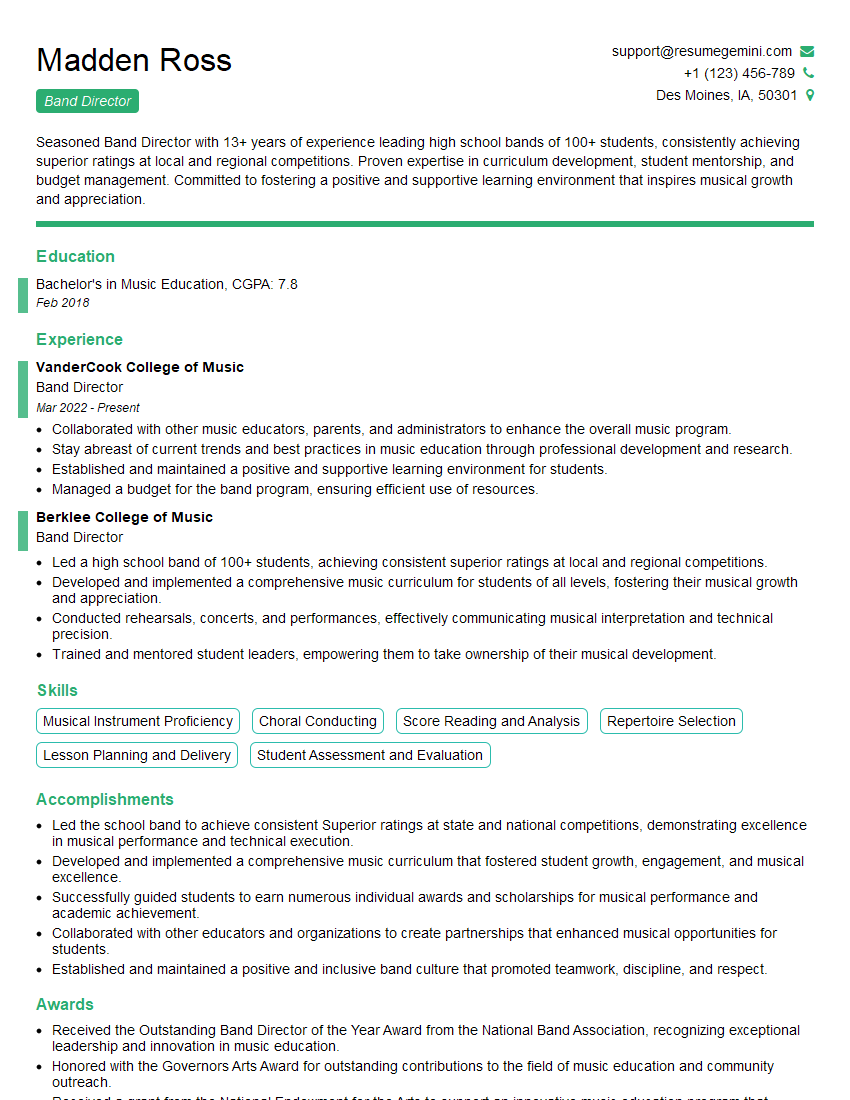
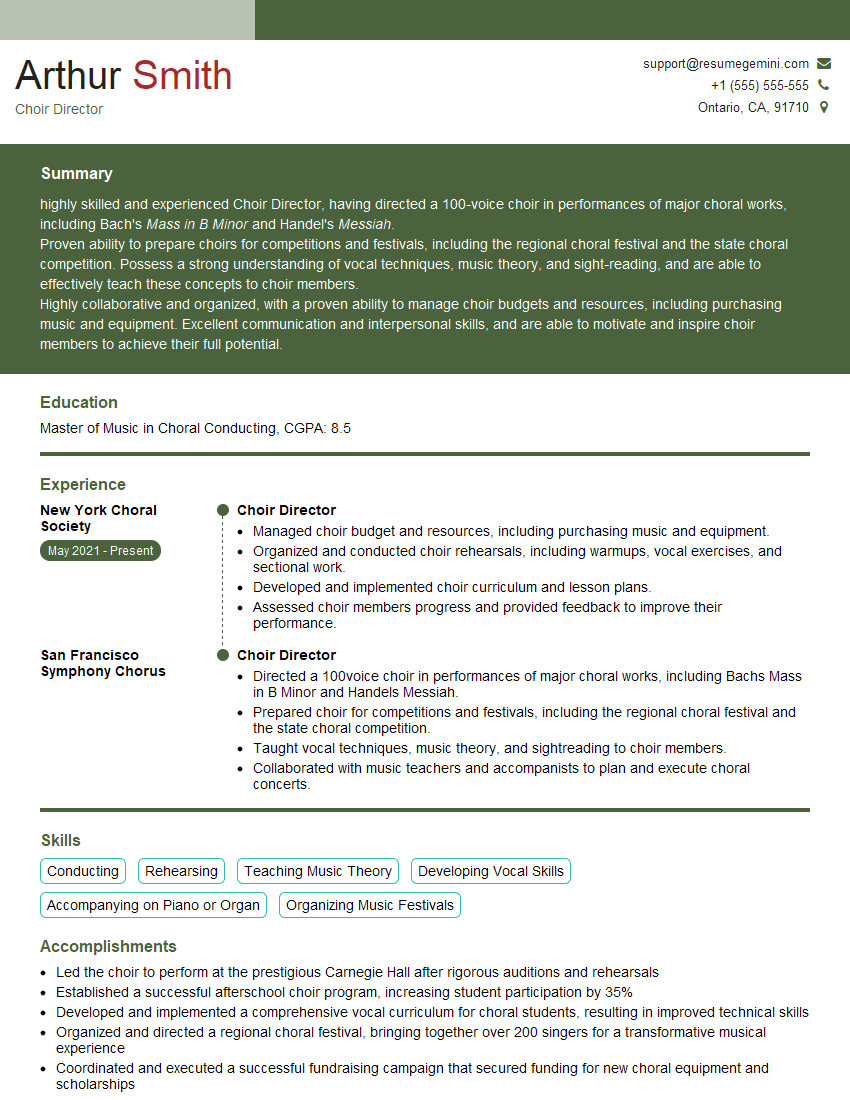
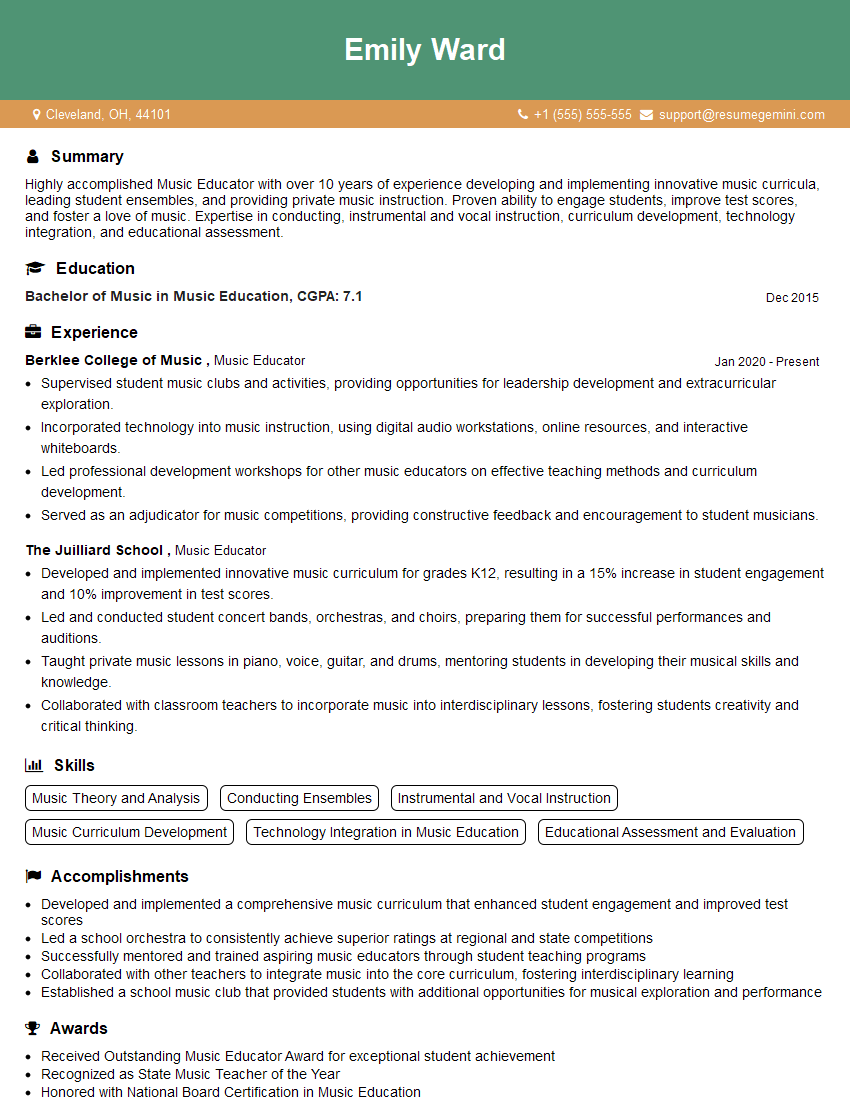
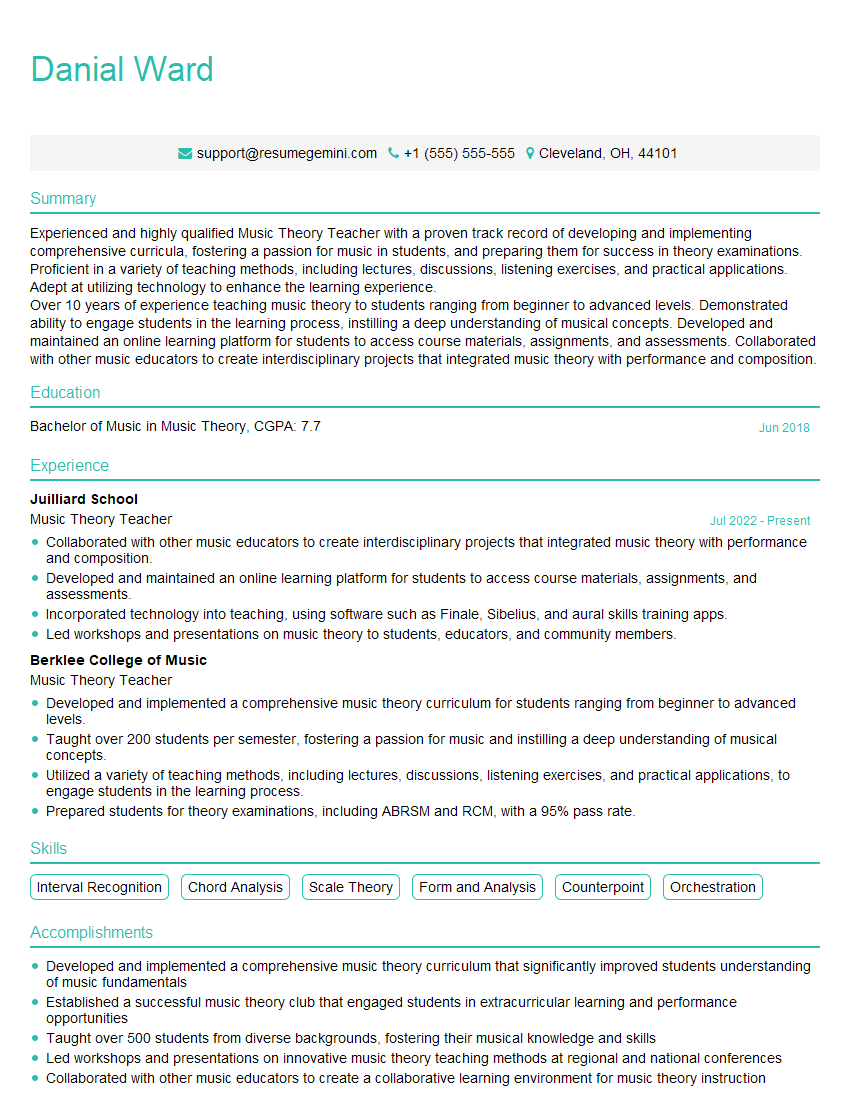
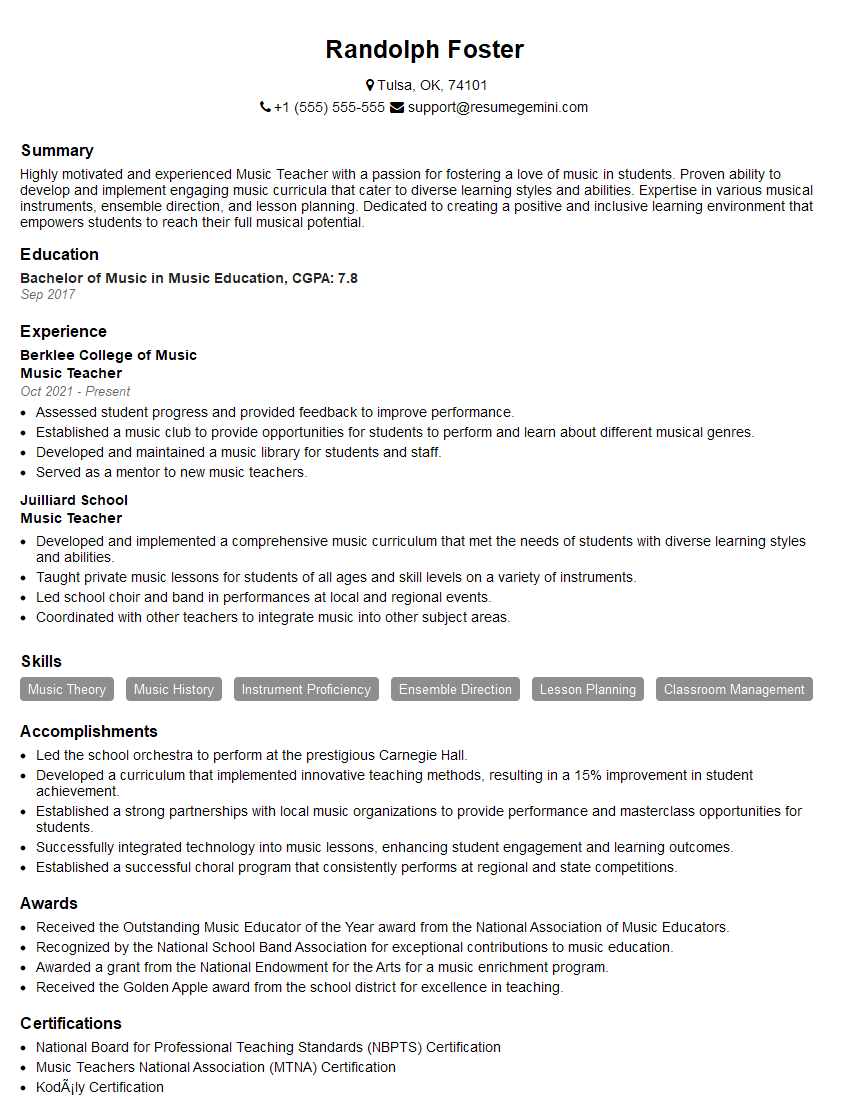
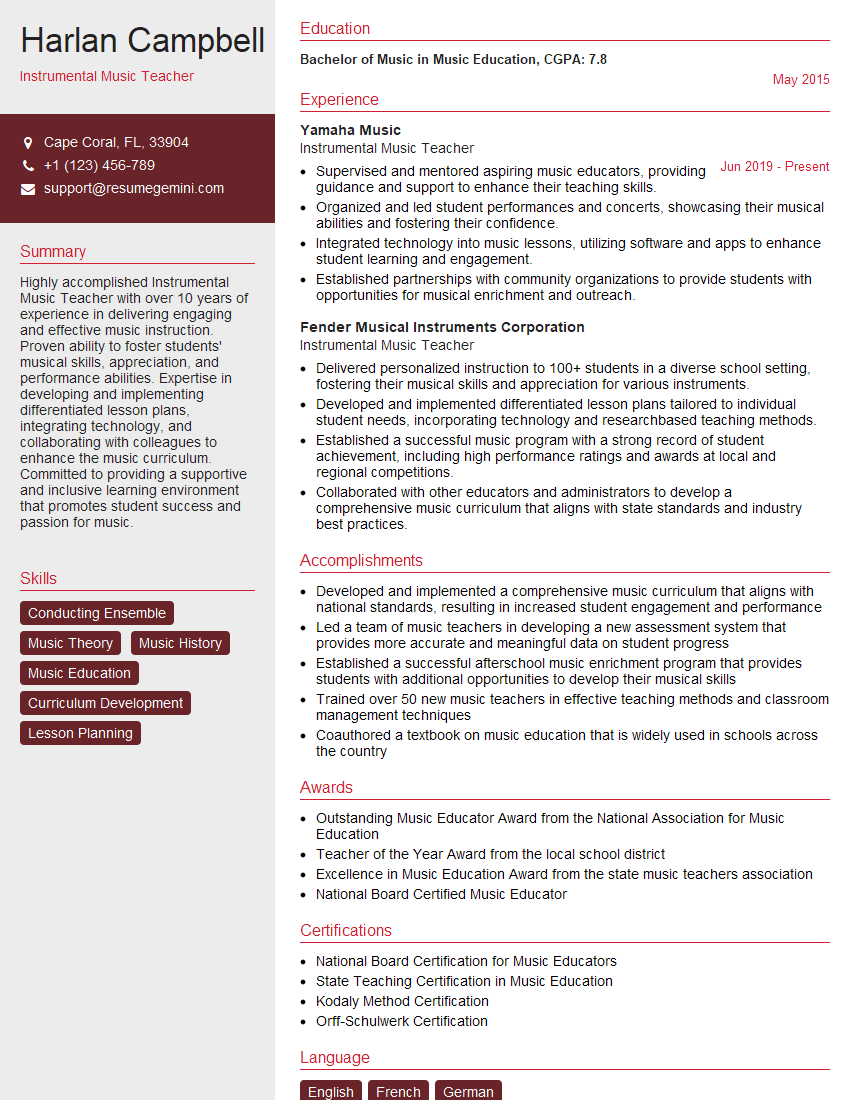
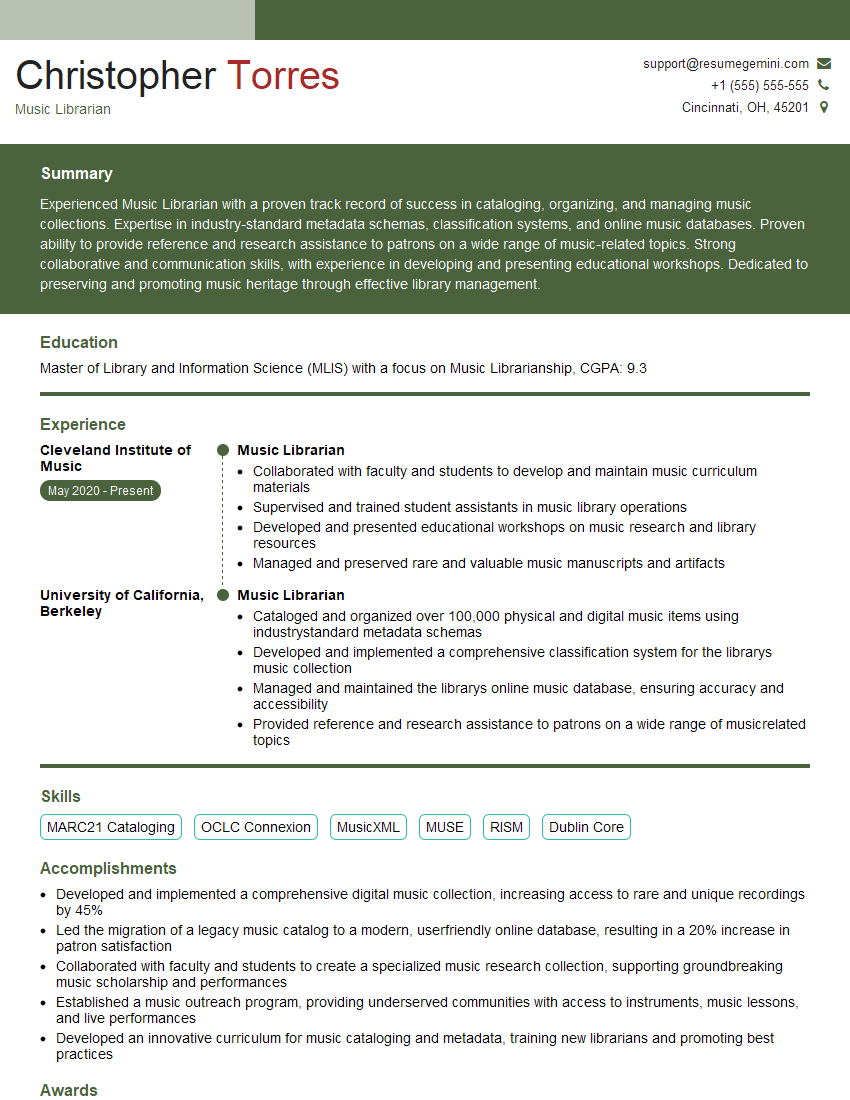
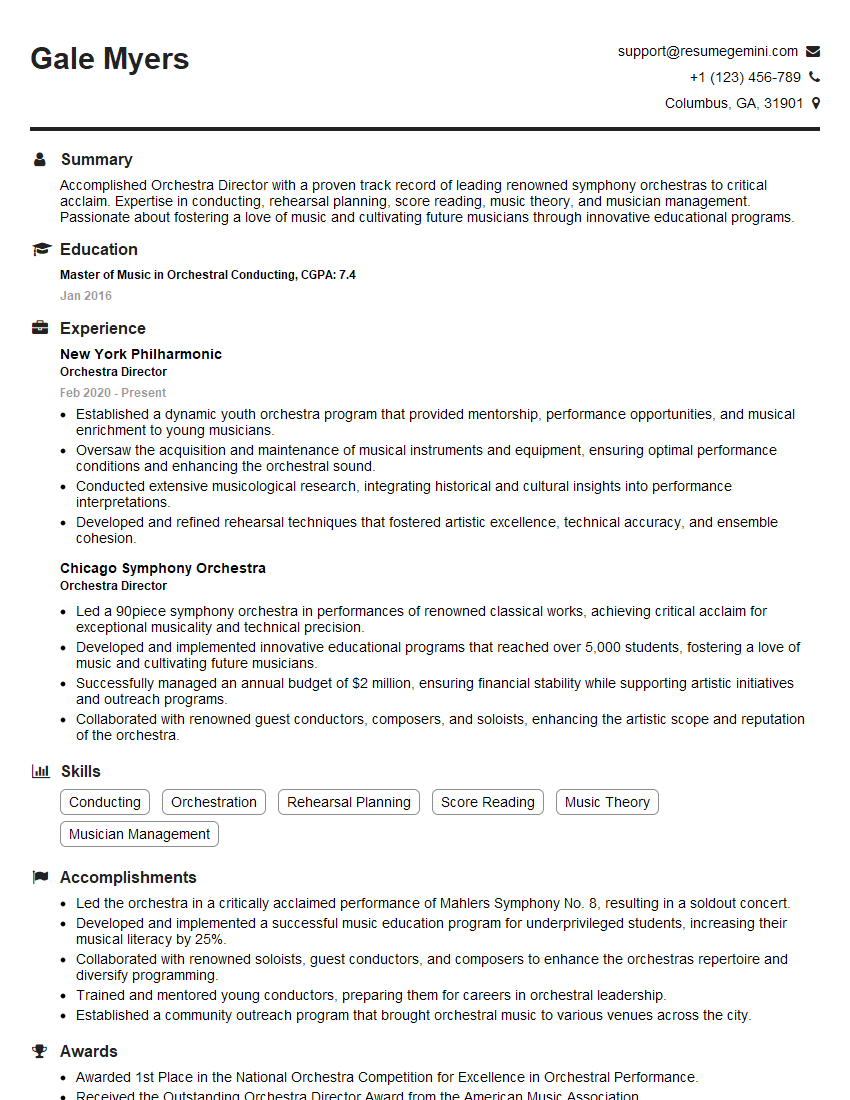
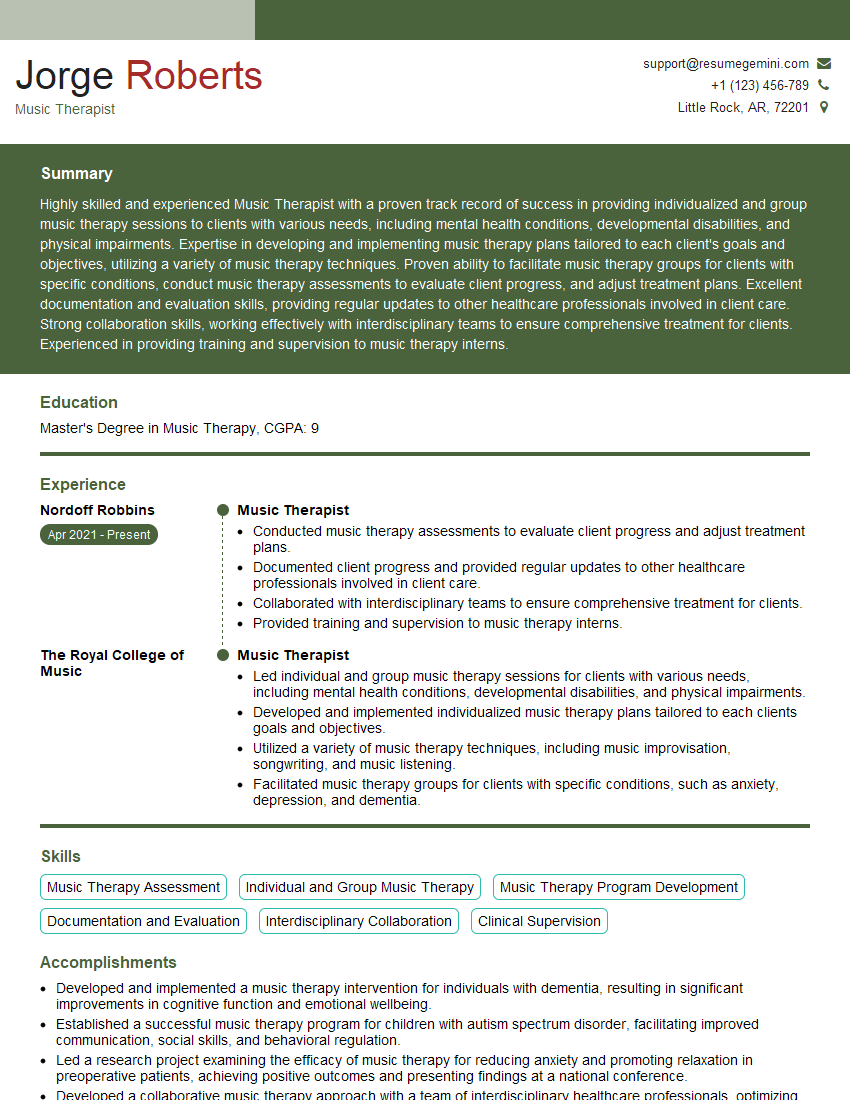
Mastering the art of Music in Education opens doors to a rewarding career filled with creativity and positive impact. A strong foundation in the key topics above will significantly enhance your interview performance and future career prospects. To maximize your job search success, creating a compelling and ATS-friendly resume is crucial. ResumeGemini is a trusted resource that can help you build a professional and impactful resume tailored to your specific skills and experience. We provide examples of resumes specifically designed for Music in Education professionals to guide you through the process. Invest in your future; craft a resume that showcases your passion and expertise in Music in Education.
Explore more articles
Users Rating of Our Blogs
Share Your Experience
We value your feedback! Please rate our content and share your thoughts (optional).
What Readers Say About Our Blog
To the interviewgemini.com Webmaster.
Very helpful and content specific questions to help prepare me for my interview!
Thank you
To the interviewgemini.com Webmaster.
This was kind of a unique content I found around the specialized skills. Very helpful questions and good detailed answers.
Very Helpful blog, thank you Interviewgemini team.