The right preparation can turn an interview into an opportunity to showcase your expertise. This guide to Oil Trading interview questions is your ultimate resource, providing key insights and tips to help you ace your responses and stand out as a top candidate.
Questions Asked in Oil Trading Interview
Q 1. Explain the difference between Brent Crude and WTI Crude.
Brent Crude and West Texas Intermediate (WTI) Crude are both benchmark crudes, but they differ significantly in their origin, quality, and trading locations, impacting their prices. Brent Crude, primarily sourced from the North Sea, is considered a sweeter (lower sulfur content) crude and is a global benchmark, often setting the price for other crudes worldwide. WTI, extracted primarily from the Permian Basin in the US, is also sweeter, but its trading hub is in Cushing, Oklahoma, making it more relevant to the North American market. Think of it like this: Brent is the global standard, while WTI is more of a regional indicator. The difference in sulfur content affects refining costs, and the location impacts transportation costs, ultimately influencing price differences between the two. Sometimes, Brent trades at a premium to WTI, and sometimes the opposite is true, depending on global supply and demand dynamics and geopolitical events.
Q 2. Describe the impact of OPEC decisions on oil prices.
The Organization of the Petroleum Exporting Countries (OPEC) wields considerable influence over global oil prices through its production quotas and strategies. OPEC’s decisions, often made in coordination with other major oil-producing nations (OPEC+), directly impact the supply of crude oil in the market. Reducing production, as OPEC has done at various times, generally leads to tighter supply, driving prices higher. Conversely, increasing production can flood the market, leading to lower prices. For example, the 2020 pandemic saw a massive drop in oil demand, prompting OPEC+ to drastically cut production to prevent a price collapse. This illustrates how OPEC’s actions can significantly mitigate price volatility or exacerbate it, depending on their strategy and the market context. Their influence isn’t absolute, however. Global demand, economic growth, and unexpected events like geopolitical instability still play a crucial role.
Q 3. How do geopolitical events affect the oil market?
Geopolitical events frequently disrupt the oil market, often causing sharp and unpredictable price swings. Wars, political instability in major oil-producing regions, sanctions, and even unexpected diplomatic shifts can all significantly impact supply chains, transportation routes, and investor sentiment. For instance, the Russian invasion of Ukraine in 2022 drastically altered the global energy landscape. Sanctions against Russia, a major oil and gas exporter, constrained supply, resulting in a significant price surge. This underscores the interconnectedness of geopolitics and oil markets – events far removed from a specific oil field can have immediate and substantial effects on price, availability, and overall market stability. Uncertainty is a key driver, with investors reacting to potential disruptions even before they fully manifest.
Q 4. Explain the concept of oil futures contracts.
Oil futures contracts are agreements to buy or sell a specific quantity of oil at a predetermined price on a future date. These contracts are traded on exchanges, allowing buyers and sellers to hedge against price risk or speculate on future price movements. Think of it as a promise to buy or sell a commodity at a set price in the future. For example, a refinery might buy oil futures contracts to lock in a price for future deliveries, protecting themselves against potential price increases. Conversely, an oil producer might sell futures contracts to guarantee a certain price for their future production, safeguarding against potential price declines. The contract specifications, including the type of crude oil, quantity, and delivery date, are standardized. The prices of these contracts fluctuate constantly based on market factors, such as supply, demand, geopolitical events, and overall economic conditions. The most prominent exchanges for trading oil futures include NYMEX (New York Mercantile Exchange) and ICE (Intercontinental Exchange).
Q 5. What are the key factors influencing natural gas prices?
Natural gas prices are influenced by a complex interplay of factors, notably weather patterns, supply and demand dynamics, and geopolitical events. Harsh winters, for instance, drive up demand for heating, pushing prices higher. Conversely, mild winters lead to lower demand and consequently, lower prices. The availability of natural gas storage also plays a significant role. Low storage levels can lead to price spikes as the market becomes more vulnerable to supply disruptions. Geopolitical events, much like their impact on crude oil, can severely impact natural gas prices – sanctions, pipeline disruptions, and political tensions in major gas-producing regions can significantly impact supply and subsequently prices. Finally, the increasing adoption of renewable energy sources and the associated competition can influence the long-term outlook for natural gas prices.
Q 6. Describe the role of hedging in oil trading.
Hedging in oil trading involves using financial instruments, primarily futures or options contracts, to mitigate the risk of price fluctuations. Imagine a refinery needing a consistent supply of crude oil; they can hedge by buying futures contracts, locking in a price for future deliveries and protecting themselves against price increases. Similarly, an oil producer can sell futures contracts to secure a minimum price for their output, protecting themselves from price declines. Hedging doesn’t eliminate the risk entirely; it aims to manage it by offsetting potential losses with gains from the hedging instrument. The effectiveness of hedging depends on various factors such as the accuracy of price forecasts and the chosen hedging strategy. It’s a vital risk management tool in the volatile world of oil trading, and traders with robust hedging strategies often fare better than those who don’t.
Q 7. Explain your understanding of contango and backwardation.
Contango and backwardation describe the relationship between the spot price (current market price) and future prices of oil. In contango, future prices are higher than the spot price, reflecting expectations of higher future prices (e.g., due to anticipated supply shortages). This creates an opportunity for traders to buy oil at the lower spot price and sell it later at the higher future price, profiting from the price difference. Conversely, backwardation occurs when future prices are lower than the spot price, usually signifying expectations of lower prices in the future (e.g., due to oversupply). This environment favors traders who can sell oil at the higher spot price and buy it back later at the lower future price. These market conditions influence trading strategies and storage decisions. For example, in contango, traders may hold onto oil in storage, profiting from the rising price difference, while in backwardation, there is less incentive to store oil as the future price is lower.
Q 8. How do you analyze oil market charts and indicators?
Analyzing oil market charts and indicators involves a multifaceted approach combining technical and fundamental analysis. Technical analysis focuses on price patterns, trends, and volume to predict future price movements. I utilize various charting tools, including candlestick charts, moving averages (e.g., 20-day, 50-day, 200-day), and relative strength index (RSI) to identify potential buy or sell signals. For example, a bullish engulfing pattern on a candlestick chart might suggest a potential price increase, while a bearish divergence between price and RSI could signal an upcoming price correction. Fundamental analysis, on the other hand, considers macroeconomic factors such as global economic growth, geopolitical events (e.g., OPEC+ production decisions, political instability in oil-producing regions), and supply chain disruptions. I use reports from organizations like the IEA and EIA to understand the current supply and demand dynamics and anticipate future shifts in the market.
I also incorporate other indicators, such as the oil futures curve (backwardation or contango) to assess market sentiment and potential price volatility. Backwardation indicates a tight market with higher demand than supply, often signifying price increases, while contango suggests ample supply with lower demand, often leading to price declines. Ultimately, my analysis integrates technical and fundamental insights to formulate a comprehensive view of the market and inform trading decisions.
Q 9. What are the risks associated with oil trading?
Oil trading is inherently risky, and several factors contribute to this volatility. Price volatility is a major risk, driven by geopolitical events, unexpected supply disruptions (e.g., hurricanes, pipeline outages, political conflicts), changes in global demand, and speculative trading. For instance, a sudden geopolitical crisis in a major oil-producing region can dramatically increase prices within hours. Another risk lies in the leverage used in trading. High leverage magnifies both profits and losses, leading to significant financial losses if the market moves against your position. Furthermore, unforeseen economic downturns, changes in government regulations, and unexpected technological advancements can all impact oil prices and trader portfolios. Finally, currency fluctuations add another layer of complexity and risk, particularly for traders operating in multiple currencies.
Q 10. How do you manage risk in oil trading?
Risk management is paramount in oil trading. My approach employs a multi-layered strategy. Firstly, I use position sizing to limit potential losses. This means carefully calculating the appropriate amount of capital to allocate to each trade based on my risk tolerance and the expected volatility. Secondly, I employ stop-loss orders to automatically exit a trade if the price moves against my position by a predetermined level. This prevents substantial losses during adverse market movements. Thirdly, diversification is key. I don’t focus solely on one type of oil or one market; instead, I diversify across different contracts (e.g., Brent crude, WTI crude), maturities, and even other energy commodities to reduce the impact of any single event. Fourthly, continuous monitoring of market conditions and news is crucial. Staying updated on geopolitical developments and economic indicators helps anticipate potential price shifts and adjust my trading strategy accordingly. Finally, regular portfolio review and adjustments based on performance and market changes are necessary to ensure risk mitigation remains effective.
Q 11. Describe your experience with different trading strategies.
My experience encompasses various trading strategies. I have utilized both short-term and long-term strategies, depending on market conditions and my investment objectives. For example, during periods of high volatility, I might employ short-term trading strategies such as day trading or swing trading, capitalizing on short-term price fluctuations. These require close market monitoring and quick decision-making. In contrast, during periods of relative stability, I may opt for long-term strategies like investing in oil ETFs or holding long-term futures contracts, focusing on long-term price appreciation. I also utilize quantitative strategies, relying on algorithmic models and statistical analysis to identify trading opportunities. These strategies involve backtesting and optimization to ensure their effectiveness and profitability. The choice of strategy depends heavily on the overall market conditions, the risk profile of the individual trade, and the investment horizon.
Q 12. Explain your understanding of supply and demand dynamics in the oil market.
Understanding supply and demand dynamics is fundamental to successful oil trading. Supply factors include OPEC+ production quotas, production capacity of non-OPEC countries, technological advancements in oil extraction (e.g., shale oil production), and geopolitical events affecting oil production (e.g., sanctions, conflicts). Demand is influenced by global economic growth, industrial activity, transportation needs, seasonal factors (e.g., increased heating oil demand in winter), and the adoption of alternative energy sources. The interplay between these factors constantly shifts the balance of supply and demand, affecting oil prices. For example, a sudden increase in global economic growth often leads to higher demand for oil, pushing prices up, assuming supply remains relatively constant. Conversely, a major disruption to oil production due to a natural disaster or geopolitical instability can lead to price spikes, even if demand remains stable.
Analyzing supply and demand requires monitoring various data sources, including production figures from oil-producing countries, inventory levels (e.g., API and EIA reports), and indicators of global economic activity. It’s crucial to anticipate potential shifts in supply and demand to effectively manage trading risks and opportunities. A thorough understanding of the dynamic relationship between these forces allows one to make informed trading decisions.
Q 13. What is your experience with oil price forecasting?
Oil price forecasting is inherently challenging due to the market’s susceptibility to unexpected geopolitical events and economic shocks. I employ a combination of quantitative and qualitative methods for forecasting. Quantitative methods include time series analysis, statistical modeling (e.g., ARIMA models), and machine learning algorithms. These models analyze historical price data and other relevant indicators to predict future price movements. However, I acknowledge the limitations of purely quantitative approaches and incorporate qualitative analysis to account for factors that are difficult to quantify, such as geopolitical risks and shifts in government policy. I leverage news analysis, expert opinions, and economic forecasts to assess the potential impact of qualitative factors on oil prices. It’s crucial to remember that no forecasting method is perfect, and forecasts should always be viewed as probabilities, not certainties. Regularly updating forecasts in light of new information is essential for improving their accuracy and mitigating risks.
Q 14. How do you evaluate potential investment opportunities in the energy sector?
Evaluating potential investment opportunities in the energy sector involves a thorough due diligence process. I start by assessing the company’s fundamentals, including its financial health (e.g., debt levels, profitability, cash flow), operational efficiency, management team, and competitive landscape. Next, I evaluate the specific project or asset being considered. This includes analyzing the project’s feasibility, its projected returns, and the associated risks (e.g., regulatory risks, environmental risks, operational risks). A crucial aspect is evaluating the sustainability and long-term viability of the project, particularly given the growing emphasis on environmental, social, and governance (ESG) factors. Further analysis includes examining the geopolitical and macroeconomic environment that could impact the project’s success. Finally, I compare the potential returns to the risks involved, taking into account my investment objectives and risk tolerance. Only after a comprehensive analysis that integrates financial, operational, regulatory, environmental, and geopolitical considerations will I make an investment decision.
Q 15. What is your experience with different oil derivatives?
My experience encompasses a wide range of oil derivatives, including but not limited to crude oil futures (WTI, Brent), refined product futures (gasoline, heating oil, diesel), options on these futures, and swaps. I’ve worked extensively with both physical and financial oil derivatives. For instance, I’ve been involved in structuring and executing complex swaps to manage price risk for a major refinery, hedging against potential price fluctuations in the gasoline market. My experience also includes trading options to capitalize on anticipated price volatility. I’m comfortable analyzing the nuances of each derivative’s payoff profile and choosing the most appropriate instrument for a given risk management or speculative strategy. I’ve also worked with less common derivatives like crack spreads (the difference between crude oil and refined product prices), which provide a unique way to profit from refinery margins.
Understanding the underlying asset’s price dynamics and market conditions are crucial for successful trading of these instruments. This involves a deep understanding of geopolitical factors, supply chain dynamics, and seasonality influences on demand.
Career Expert Tips:
- Ace those interviews! Prepare effectively by reviewing the Top 50 Most Common Interview Questions on ResumeGemini.
- Navigate your job search with confidence! Explore a wide range of Career Tips on ResumeGemini. Learn about common challenges and recommendations to overcome them.
- Craft the perfect resume! Master the Art of Resume Writing with ResumeGemini’s guide. Showcase your unique qualifications and achievements effectively.
- Don’t miss out on holiday savings! Build your dream resume with ResumeGemini’s ATS optimized templates.
Q 16. Explain your understanding of the refining process and its impact on product prices.
The refining process transforms crude oil into usable products like gasoline, diesel, jet fuel, and petrochemicals. It’s a complex and capital-intensive operation. The process involves several stages, including distillation, cracking, and treatment to remove impurities and meet product specifications. The efficiency and complexity of a refinery directly impact the cost of producing these refined products. For example, a refinery using advanced cracking techniques may produce higher yields of valuable products like gasoline, leading to lower production costs and, potentially, lower prices at the pump. Conversely, unforeseen issues like unplanned maintenance can significantly reduce output, leading to higher prices for refined products.
Changes in crude oil prices significantly influence the profitability of refining operations. If crude prices rise sharply, refinery margins might be squeezed unless refined product prices increase proportionally. This dynamic interaction between crude and refined product pricing drives the complexity of the market. I’ve seen first-hand how unexpected geopolitical events—a refinery closure due to conflict, for example—can instantly disrupt the supply chain and cause substantial price fluctuations. Understanding this relationship is critical in predicting and navigating product price movements.
Q 17. How do you interpret oil market news and reports?
Interpreting oil market news and reports requires a critical and multi-faceted approach. I begin by identifying the source’s reliability and potential bias. Then, I analyze the information within the broader context of the market. This means evaluating the data alongside fundamental factors such as global supply and demand dynamics, OPEC production quotas, inventory levels (crucial data from the EIA and IEA), and geopolitical events. News about a major pipeline disruption, for example, would be evaluated based on the pipeline’s capacity, the location of the disruption, and the potential for alternative routes. I also incorporate technical analysis, looking at price charts and using indicators to identify potential trading opportunities. Finally, I consider the market sentiment, gauging how traders are reacting to the news and adjusting my strategy accordingly. This holistic approach allows for informed decision-making.
For example, a report suggesting a decline in US crude oil inventories might initially be interpreted as bullish, pushing prices higher. However, if simultaneous reports indicate a surge in global production, that bullish sentiment could be offset, leading to a price stabilization or even a decline.
Q 18. Describe your experience using trading platforms and software.
I am proficient in using various trading platforms and software, including Bloomberg Terminal, Refinitiv Eikon, and proprietary trading systems. My experience extends from utilizing these platforms for market data analysis, order execution, and portfolio management to developing customized trading algorithms and backtesting strategies. I’m comfortable navigating complex order types (limit orders, stop-loss orders, etc.) and utilizing advanced charting and analytical tools. I understand the importance of data integrity and regularly conduct checks to ensure the accuracy and reliability of the data used in my trading activities. For example, I am adept at using the Bloomberg Terminal to access real-time market data, monitor inventory levels, and analyze various market indices and price relationships. I have also designed custom scripts within these platforms to automate routine tasks and improve efficiency.
Q 19. Explain your understanding of regulatory compliance in oil trading.
Regulatory compliance is paramount in oil trading. My understanding encompasses a wide array of regulations, including those related to commodity futures trading (like the Commodity Exchange Act), anti-money laundering (AML) regulations, and sanctions compliance. I’m familiar with the reporting requirements for transactions, especially concerning trades involving sanctioned entities or countries. I also stay abreast of evolving regulations and internal compliance policies to ensure all trading activities are conducted ethically and legally. For example, I understand the importance of maintaining accurate transaction records and ensuring all trades are executed in accordance with exchange rules and regulatory guidelines. I also recognize the potential ramifications of non-compliance, which can range from hefty fines to criminal charges. Proactive adherence to these regulations is central to a sustainable and successful trading operation.
Q 20. How do you handle stressful situations in a fast-paced trading environment?
The oil trading environment is inherently stressful and fast-paced. I’ve developed strategies to manage pressure effectively. This starts with thorough preparation and risk management planning. Before entering any trade, I carefully assess the potential risks and rewards and implement appropriate risk mitigation techniques. This involves setting stop-loss orders and diversifying my portfolio. During high-stress situations, I rely on a methodical approach, focusing on executing my pre-defined trading strategy rather than emotional decision-making. I also practice mindfulness techniques to stay calm and focused. When faced with significant market volatility, I take a step back to reassess the situation and adjust my strategy if needed. Clear communication with colleagues is also crucial in coordinating our response to unexpected market events. Regular self-assessment and continuous learning helps me refine my approach to handling stress and improving my resilience.
Q 21. What are the key performance indicators (KPIs) in oil trading?
Key Performance Indicators (KPIs) in oil trading are diverse and depend on the specific trading strategy and objectives. However, some common KPIs include:
- Return on Investment (ROI): Measures the profitability of trading activities relative to the capital invested.
- Sharpe Ratio: Assesses risk-adjusted returns, considering the volatility of the trades.
- Sortino Ratio: Similar to Sharpe Ratio, but focuses only on downside risk.
- Maximum Drawdown: Identifies the largest peak-to-trough decline in portfolio value, indicating risk exposure.
- Win Rate: The percentage of profitable trades versus losing trades.
- Average Trade Profit/Loss: The average profit or loss per trade, showcasing trade sizing and accuracy.
- Trading Frequency: The number of trades executed within a specified period.
By monitoring these KPIs, traders can assess the performance of their strategies, identify areas for improvement, and make informed decisions regarding risk management and investment strategies. Regular analysis of these KPIs allows for a data-driven approach to refining trading approaches.
Q 22. How do you stay updated on the latest developments in the oil market?
Staying abreast of the dynamic oil market requires a multi-faceted approach. I leverage a combination of resources to ensure I’m consistently informed. This includes:
- Real-time market data platforms: Platforms like Bloomberg Terminal and Refinitiv Eikon provide live price updates, news feeds, and analytical tools crucial for understanding market movements. I meticulously track key indicators like Brent and WTI crude prices, refining margins, and global production data.
- Industry publications and news sources: I regularly read publications such as the Wall Street Journal, Financial Times, Platts, and Argus Media for in-depth analysis, geopolitical insights, and market forecasts. These sources offer expert opinions and insights into potential disruptions to supply chains.
- Government reports and statistical agencies: Reports from the EIA (Energy Information Administration), OPEC (Organization of the Petroleum Exporting Countries), and IEA (International Energy Agency) offer valuable insights into global oil production, consumption, and inventory levels. Analyzing these reports allows for a macro-level understanding of market trends.
- Networking and industry events: Attending conferences, seminars, and networking events allows me to interact with other professionals, learn about emerging trends, and gain access to firsthand information. Discussions with analysts, traders, and producers provide valuable perspectives.
By combining these resources, I build a comprehensive understanding of market dynamics, allowing me to anticipate shifts and make informed trading decisions.
Q 23. Explain your understanding of the different types of oil storage.
Oil storage is crucial for managing supply and demand fluctuations. There are several types, each with its own characteristics:
- Above-ground storage tanks: These are the most common type, ranging from small tanks at refineries to massive terminals capable of holding millions of barrels. Material types vary (steel, concrete) depending on the stored product and environmental considerations. Location is key – proximity to refineries, pipelines, or ports impacts efficiency.
- Underground storage caverns: These are often salt caverns, offering significant capacity and protection from environmental factors. They are particularly suited for long-term storage. However, they have higher initial development costs and limitations on access.
- Floating storage units (FSUs): These are tankers modified for long-term storage at sea. They are highly mobile and useful during periods of high demand or logistical constraints, but weather conditions and maintenance can be factors.
The choice of storage depends on factors such as volume, storage duration, product type, and cost. For example, a trader managing short-term price fluctuations might use above-ground tanks near a refinery, whereas a long-term strategic investor might utilize underground caverns.
Q 24. What is your experience with oil transportation and logistics?
My experience with oil transportation and logistics encompasses the entire value chain. I’ve worked extensively with:
- Pipelines: I have experience negotiating pipeline capacity, understanding throughput limitations, and managing associated risks, including potential disruptions from weather or maintenance.
- Tankers (VLCCs, Suezmax, Aframax): I’m familiar with chartering processes, navigating freight markets, assessing vessel availability and suitability, and managing voyage risks such as delays and potential damage.
- Rail and trucking: These modes play a significant role, particularly for shorter distances or areas with limited pipeline infrastructure. I understand their limitations and associated costs.
- Logistics optimization: I have a strong understanding of optimizing transportation routes, scheduling deliveries, and managing documentation to ensure efficient and cost-effective delivery.
A memorable experience involved coordinating the movement of crude oil from a remote wellhead in Kazakhstan to a refinery in Europe, utilizing a complex combination of pipeline, rail, and tanker transport. This involved extensive planning, negotiation with multiple carriers, and real-time monitoring to mitigate potential delays and ensure timely delivery.
Q 25. Describe your understanding of the global oil supply chain.
The global oil supply chain is a complex network of exploration, production, refining, transportation, and marketing. It begins with exploration and production by oil companies, often in remote locations. The crude oil is then transported via pipelines, tankers, or rail to refineries. Refineries process crude oil into various products like gasoline, diesel, jet fuel, and petrochemicals.
These products are then distributed to consumers through a network of pipelines, tankers, trucks, and storage facilities. The entire process involves numerous stakeholders, including producers, refiners, traders, logistics providers, and consumers. Geopolitical events, economic conditions, and technological advancements significantly impact this supply chain. For example, sanctions imposed on a major oil-producing nation can drastically alter supply routes and market prices.
Understanding this complex interplay between production, processing, transportation, and distribution is vital for effective oil trading. Market dynamics are heavily influenced by the efficiency and stability of this supply chain.
Q 26. How do you assess the creditworthiness of counterparties?
Assessing counterparty creditworthiness is paramount in oil trading. It involves a multi-stage process:
- Financial statement analysis: I thoroughly review audited financial statements to assess profitability, liquidity, and leverage ratios. Key indicators include debt-to-equity ratios, current ratios, and working capital.
- Credit rating agencies: I utilize ratings from agencies like Moody’s, S&P, and Fitch to obtain an independent assessment of the counterparty’s creditworthiness.
- Industry reputation and track record: I research the counterparty’s history, reputation within the industry, and past performance in fulfilling contractual obligations.
- Due diligence: This involves verifying information provided by the counterparty, possibly including site visits or third-party verification. I also check for any legal issues or negative news.
- Credit insurance and guarantees: In high-risk situations, I might utilize credit insurance or seek bank guarantees to mitigate potential losses.
This comprehensive approach helps minimize risks and ensures that transactions are conducted with reliable and financially sound counterparties. A thorough credit assessment protects against potential defaults and financial losses.
Q 27. What are your strengths and weaknesses as an oil trader?
Strengths: My strengths lie in my analytical skills, my deep understanding of market dynamics, and my ability to manage risk effectively. I have a proven track record of successful trades, and I’m adept at identifying and capitalizing on market opportunities. My strong communication and negotiation skills allow me to build and maintain strong relationships with counterparties.
Weaknesses: Like any trader, I acknowledge that market volatility is inherently unpredictable. While I employ robust risk management strategies, there’s always a possibility of unforeseen circumstances impacting trades. I am also always striving to enhance my knowledge of emerging technologies and their impact on the oil industry.
I continuously work on mitigating my weaknesses through continuous learning and by actively seeking feedback to improve my decision-making processes. I view my weaknesses not as limitations, but as areas for ongoing growth and improvement.
Q 28. Describe your salary expectations.
My salary expectations are commensurate with my experience, skills, and the market rate for a senior oil trader with my qualifications. I’m open to discussing a competitive compensation package that reflects my contribution to the company’s success. I am more interested in a role that offers a strong growth trajectory and opportunities to enhance my skill set, rather than solely focusing on the base compensation.
Key Topics to Learn for Oil Trading Interview
- Crude Oil Market Fundamentals: Understanding supply and demand dynamics, OPEC’s influence, geopolitical risks, and their impact on pricing.
- Pricing Mechanisms & Benchmarks: Analyzing Brent, WTI, and other crude oil benchmarks; understanding futures contracts, swaps, and options.
- Trading Strategies & Risk Management: Exploring various trading strategies (e.g., arbitrage, spread trading, hedging), and implementing risk mitigation techniques.
- Market Analysis & Forecasting: Utilizing technical and fundamental analysis to predict price movements and make informed trading decisions. This includes interpreting market reports and economic indicators.
- Regulations & Compliance: Familiarity with relevant regulations and compliance procedures within the oil trading industry.
- Logistics & Physical Trading: Understanding the transportation, storage, and delivery aspects of oil trading, including pipelines, tankers, and storage facilities.
- Financial Modeling & Valuation: Proficiency in financial modeling techniques to evaluate potential trades and assess profitability.
- Data Analysis & Interpretation: Analyzing large datasets to identify trends, patterns, and anomalies impacting oil prices and trading opportunities.
- Portfolio Management & Optimization: Strategies for building and managing a diversified oil trading portfolio, balancing risk and return.
Next Steps
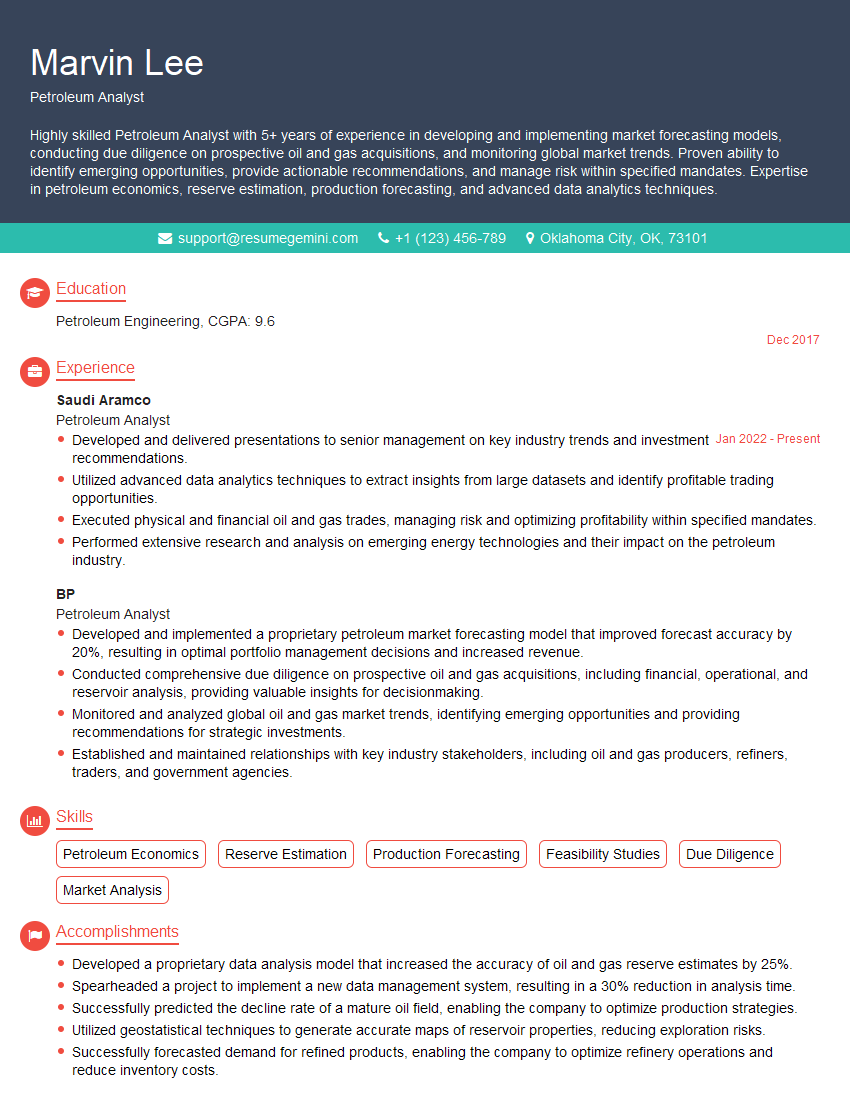
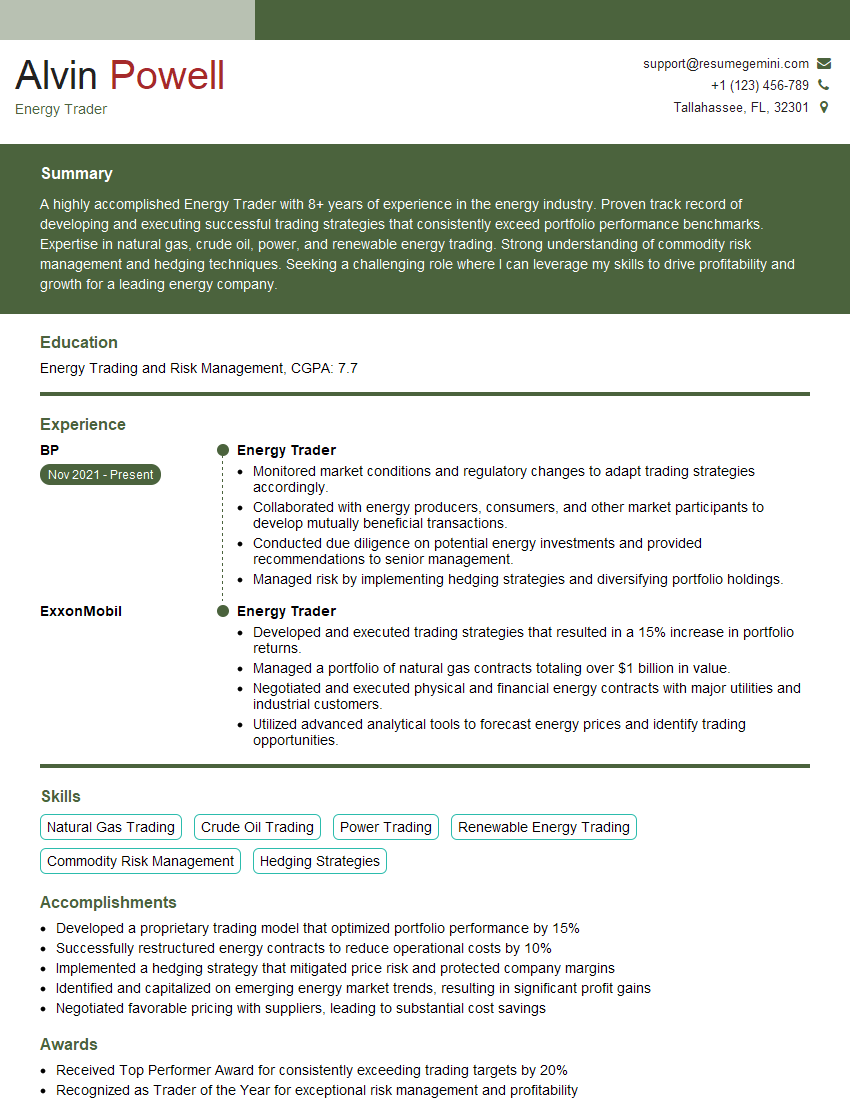
Mastering oil trading opens doors to a dynamic and rewarding career with significant earning potential and global exposure. To maximize your job prospects, it’s crucial to present yourself effectively. Creating an ATS-friendly resume is essential for getting your application noticed by recruiters and hiring managers. ResumeGemini is a trusted resource to help you build a professional and impactful resume, tailored to the specific demands of the oil trading industry. Examples of resumes optimized for oil trading roles are available to guide you.
Explore more articles
Users Rating of Our Blogs
Share Your Experience
We value your feedback! Please rate our content and share your thoughts (optional).
What Readers Say About Our Blog
To the interviewgemini.com Webmaster.
Very helpful and content specific questions to help prepare me for my interview!
Thank you
To the interviewgemini.com Webmaster.
This was kind of a unique content I found around the specialized skills. Very helpful questions and good detailed answers.
Very Helpful blog, thank you Interviewgemini team.