Are you ready to stand out in your next interview? Understanding and preparing for Order Picker Certification interview questions is a game-changer. In this blog, we’ve compiled key questions and expert advice to help you showcase your skills with confidence and precision. Let’s get started on your journey to acing the interview.
Questions Asked in Order Picker Certification Interview
Q 1. What safety procedures must be followed while operating an order picker?
Safety is paramount when operating an order picker. Before even starting, a thorough pre-operational check is crucial. This involves inspecting the machine for any mechanical issues, checking tire pressure and condition, ensuring the battery is adequately charged, and confirming the functionality of all safety devices like horns, lights, and brakes.
- Personal Protective Equipment (PPE): Always wear a high-visibility vest, safety shoes with steel toes, and gloves.
- Awareness of Surroundings: Maintain constant awareness of your surroundings, including other equipment, pedestrians, and obstacles. Slow down in high-traffic areas and use caution around corners and blind spots.
- Load Security: Ensure that loads are properly secured and balanced to prevent tipping or falling. Never overload the order picker beyond its specified weight capacity.
- Safe Operating Procedures: Follow all company-specific safety procedures and training guidelines. This includes understanding emergency shut-off procedures and reporting any accidents or near misses immediately.
- Proper Lifting Techniques: Avoid lifting heavy items manually; always use the order picker’s lifting mechanism. Never lift or move anything outside the order picker’s designated lift capacity.
Imagine this scenario: you’re navigating a busy warehouse. Failing to check your surroundings could lead to a collision with another machine or a worker. Similarly, overloading the picker could cause it to tip, resulting in serious injury or damage. These safety procedures are not just rules; they’re vital for your well-being and the safety of those around you.
Q 2. Explain the different types of order pickers and their applications.
Order pickers come in various types, each suited to different warehouse layouts and order fulfillment needs.
- Walkie Stackers/Rider Stackers: These are manually operated (walkie) or rider operated machines suitable for lower-level order picking and stacking pallets. They are compact and maneuverable, perfect for narrow aisles. Walkie stackers are excellent for smaller warehouses or those with less demanding order volumes. Rider stackers offer more productivity for larger tasks.
- Sit-Down Order Pickers: These provide a seated operating position, offering greater comfort and efficiency for extended picking operations. They are often equipped with a lifting platform that allows the operator to access higher shelves without excessive stretching or bending. Ideal for warehouses with multiple racking levels.
- Reach Trucks: These are used for high-rack storage and retrieval, allowing the operator to reach significantly higher heights. They are very efficient for large and vertically stacked warehouses but require more skill and training.
- Order Picker Trucks (with extendable arms and multiple levels): These are designed for multi-level order picking and are exceptionally efficient for high-volume fulfillment centers. This type of picker has multiple levels of trays or containers that allow operators to pick multiple items at once.
- Very Narrow Aisle (VNA) Trucks: These are specialized machines designed to operate in extremely narrow aisles, maximizing warehouse space utilization. They often require specialized training due to their complexity and precision needed to operate in limited spaces.
For instance, a small boutique might utilize a walkie stacker, while a large e-commerce fulfillment center might employ a combination of sit-down order pickers and reach trucks, depending on the layout and storage strategy.
Q 3. How do you ensure accuracy in order picking?
Accuracy in order picking is critical; errors lead to customer dissatisfaction, returns, and financial losses. Several strategies ensure accuracy:
- Double-Checking: Always double-check the order against the picking list. This is the most fundamental method and should be practiced consistently.
- Barcode Scanning: Using barcode scanners significantly reduces manual errors. The system verifies that the correct item is being picked.
- Voice-Picking Systems: Voice-directed picking systems guide operators through the picking process, minimizing errors and speeding up the workflow. The system uses voice prompts to inform the worker what to pick, thus eliminating the need for a paper picking list.
- Proper Lighting: Ensure adequate lighting to prevent misidentification of items.
- Organized Inventory: A well-organized warehouse with clear labeling and easily accessible items greatly reduces errors. This can be accomplished by using labels that are easy to read and located in clear sight.
- Regular Audits: Performing regular inventory audits can help identify and rectify discrepancies.
For example, I once worked in a warehouse where a voice-picking system drastically reduced our error rate from around 5% to under 1%.
Q 4. Describe your experience with warehouse management systems (WMS).
I have extensive experience with various Warehouse Management Systems (WMS), including SAP EWM and Oracle WMS. My experience spans across different aspects of WMS functionality, from order entry and management to inventory tracking, shipment tracking and reporting. I’m proficient in using WMS to optimize picking routes, manage inventory levels, and track key performance indicators (KPIs).
For example, in my previous role, I used SAP EWM to manage our warehouse operations. This involved configuring the system to optimize picking routes based on product location and order priorities. This resulted in a considerable reduction in the overall order fulfillment time. I’m also proficient in troubleshooting WMS related issues.
Q 5. How do you prioritize orders with different deadlines?
Prioritizing orders with different deadlines requires a strategic approach. I typically use a combination of techniques:
- Prioritization Matrix: I often create a prioritization matrix based on urgency and importance. Orders with the tightest deadlines and highest value are prioritized.
- First In, First Out (FIFO): For perishable goods or items with limited shelf life, FIFO is crucial. These items are processed first to avoid spoilage or obsolescence.
- WMS Functionality: Modern WMS systems often have built-in functionalities to prioritize orders based on various parameters, such as due date, customer importance, or order value.
- Batch Picking: Grouping orders with similar items or locations to optimize picking routes can be a very useful technique for managing order deadlines.
Imagine you have an order with a same-day delivery deadline and another with a longer lead time. The same-day delivery will be processed first. Understanding the nuances of different order types is key.
Q 6. What is your approach to handling damaged goods during order picking?
Handling damaged goods during order picking involves a precise procedure to ensure accuracy, safety and prevent further damage.
- Immediate Reporting: Report any damaged goods immediately to the supervisor using the company’s established reporting system. This could be an online system, a physical logbook or a verbal report depending on the workflow.
- Proper Documentation: Accurately document the damage, including the item’s SKU, quantity, type of damage, and potential cause. This is crucial for inventory control and potentially for insurance claims.
- Segregation: Separate damaged goods from undamaged ones to prevent further damage or contamination. The damaged goods must be properly stored to prevent further harm or loss of inventory.
- Safe Disposal/Return: Follow company procedures for disposal or return of damaged goods. This may involve returning them to the supplier or properly disposing of them in accordance with environmental regulations.
For example, if I found a box of cracked mugs during picking, I’d immediately report it, document the damage with photos if possible, and put the box aside, marked as ‘damaged,’ to prevent it from being shipped to the customer.
Q 7. How do you manage inventory discrepancies?
Inventory discrepancies are a common issue in warehousing. Effective management requires a systematic approach.
- Regular Cycle Counting: Regular cycle counting, rather than full annual inventories, is more efficient for identifying discrepancies early and promptly.
- WMS Integration: A well-integrated WMS is crucial for tracking inventory movements and flagging inconsistencies. The system should alert you to any differences between recorded and physical inventory levels.
- Root Cause Analysis: Investigate the causes of discrepancies. Common causes include data entry errors, incorrect picking, or theft. Understanding why discrepancies occur is critical to prevent recurrence.
- Physical Verification: When discrepancies are detected, perform a physical verification to confirm the actual inventory levels. It is important to perform frequent physical counts to verify the data in the WMS.
- Corrective Actions: Once the root cause is identified, implement corrective actions to address the issue and prevent it from happening again. This might involve additional training for pickers, improved data entry procedures, or increased security measures.
For example, if cycle counting reveals a shortage of a particular item, I’d investigate potential causes—was there a picking error, was the item damaged, or is there a problem with the inventory tracking system?
Q 8. Explain the process of verifying order accuracy before shipment.
Verifying order accuracy before shipment is crucial to ensure customer satisfaction and prevent costly returns. My process involves a multi-step verification system, starting even before I begin picking.
- Pre-Pick Verification: I carefully review the digital order on my RF scanner, checking the item numbers, quantities, and any special instructions. This initial check helps me identify any potential discrepancies early on.
- During Picking Verification: As I pick each item, I visually inspect it for damage or defects. I also double-check the quantity against the order and the item number against the label location. Think of it like a quality control check at every step.
- Post-Pick Verification: Once all items are gathered, I conduct a final verification against the order using the RF scanner. This confirms all items are present and in the correct quantities. This is like a final proofread before submitting an important document.
- Packaging and Labeling Verification: Finally, I ensure the items are properly packaged and labeled with the correct customer information and order number to avoid any confusion during shipping. This final check guarantees the order reaches its destination.
For example, if an order calls for 10 red widgets and 5 blue widgets, I meticulously check if I have indeed picked exactly 10 red and 5 blue. Any discrepancy triggers immediate investigation and correction.
Q 9. Describe your experience with RF scanners and other order picking technologies.
I’m highly proficient with RF scanners and other order picking technologies. My experience spans various systems, including voice-directed picking, light-directed systems, and handheld scanners with different operating systems.
RF scanners, specifically, are my everyday tools. I’m adept at using them to quickly locate items in the warehouse, scan barcodes to confirm selection, and update the system on the order’s progress in real-time. It’s like having a digital assistant guiding me through each order.
I’ve also worked with voice-directed picking systems which significantly increase efficiency and accuracy. The system verbally instructs where to go next and how many items to pick, reducing errors and speeding up the picking process.
Beyond the technology itself, I understand the importance of maintaining the equipment. I always ensure the scanner’s battery is charged and the system is updated, as part of my daily routine.
Q 10. How do you maintain a safe working environment while operating an order picker?
Safety is paramount in my work. Maintaining a safe working environment involves adhering to strict safety protocols and using proper techniques when operating the order picker.
- Pre-Operation Checks: Before operating the order picker, I always conduct a thorough safety check, inspecting the machine for any damage or malfunction. This is like pre-flight check for a pilot.
- Safe Operation Procedures: I strictly follow all speed limits, wear appropriate safety gear including safety shoes and high-visibility vests, and never overload the order picker. I’m cautious around other equipment and personnel, always maintaining a safe distance.
- Awareness of Surroundings: I am always aware of my surroundings, watching out for obstacles like pallets, equipment, and other workers. I avoid sudden stops or turns and use the horn to alert others when necessary.
- Reporting Hazards: If I identify any safety hazards or unsafe practices, I immediately report them to my supervisor. Preventing accidents before they happen is a top priority.
For instance, I ensure the load is balanced correctly on the order picker to prevent tipping. I never work under a raised load, and if a problem develops I stop immediately and report it.
Q 11. What is your strategy for maintaining productivity throughout the shift?
Maintaining productivity throughout a shift requires a combination of efficient strategies and physical stamina.
- Prioritization: I prioritize orders based on urgency and size. This ensures timely delivery of important orders and avoids unnecessary bottlenecks.
- Efficient Route Planning: I plan an optimal route within the warehouse to minimize travel time and maximize efficiency. It’s like mapping the shortest route on a delivery app.
- Consistent Pace: I maintain a consistent pace throughout the shift without rushing, prioritizing accuracy over speed. This approach ensures efficient work and helps avoid errors.
- Hydration and Breaks: I regularly hydrate and take short breaks to rest and avoid fatigue. This keeps me alert and focused for the duration of my shift.
- Problem-Solving: If I encounter any unexpected delays or obstacles, I promptly address them and communicate with my supervisor to find solutions. This proactive approach prevents productivity losses.
For example, I will group similar orders together to reduce travel time, and take brief, strategic rest periods to maintain focus and energy levels.
Q 12. How do you handle situations where orders are incomplete or missing items?
Handling incomplete or missing items requires a systematic approach to ensure accuracy and customer satisfaction.
- Immediate Reporting: I immediately report the issue to my supervisor, providing detailed information about the order and the missing item(s). Timely reporting allows for prompt resolution.
- Documentation: I carefully document the issue, including the order number, missing items, and any relevant information. This detailed record helps in resolving discrepancies.
- Investigation: I collaborate with my supervisor and inventory control team to investigate the cause of the discrepancy. This might involve checking inventory levels or reviewing the picking process for errors.
- Resolution: Once the issue is identified, I follow the established procedure to address it. This might involve locating the missing items, adjusting the order, or communicating with the customer about the delay.
For instance, if I discover that a box of stationery is missing from an order, I immediately inform my supervisor and provide the order number. Then, together, we investigate whether the box was not properly stocked or if a picking error occurred.
Q 13. What are the key performance indicators (KPIs) for an order picker?
Key Performance Indicators (KPIs) for an order picker measure efficiency, accuracy, and safety.
- Units Picked per Hour: This measures the number of units picked per hour, reflecting picking speed and efficiency.
- Order Accuracy Rate: This indicates the percentage of orders picked correctly, highlighting accuracy and attention to detail.
- Error Rate: This shows the number of errors made per unit or order, indicating areas needing improvement.
- Order Completion Rate: This measures the percentage of orders completed within the specified time frame.
- Safety Record: This monitors the number of safety incidents or near misses, highlighting commitment to safety protocols.
These KPIs provide valuable insights into performance and can be used to identify areas for improvement. For example, a low order accuracy rate might indicate a need for additional training on order picking procedures.
Q 14. How do you adapt to changes in order picking procedures or assignments?
Adapting to changes in order picking procedures or assignments is crucial for maintaining efficiency and meeting targets.
- Open Communication: I actively seek clarification from my supervisor on any changes in procedures or assignments. Clear instructions are vital for smooth transitions.
- Training and Learning: I readily participate in any training sessions on new procedures or technologies to ensure competence and efficiency in performing new tasks.
- Flexibility and Adaptability: I demonstrate flexibility in adapting to changing work schedules or assignments. A willingness to embrace change minimizes disruptions.
- Proactive Problem-Solving: If I encounter any challenges during the adaptation process, I promptly communicate them to my supervisor and collaborate to find effective solutions.
For instance, if a new warehouse management system is implemented, I actively participate in the training program and practice using the new system until I am comfortable and proficient. I would also seek help and clarification if I face challenges in navigating the new system.
Q 15. Describe your experience working in a fast-paced warehouse environment.
My experience in fast-paced warehouse environments has honed my ability to prioritize tasks, manage time effectively, and maintain accuracy under pressure. For instance, during peak season at my previous role at Acme Distribution, we saw a 40% increase in order volume. To cope, I implemented a system of prioritizing urgent orders based on delivery deadlines and customer importance, working collaboratively with my team to ensure all orders were processed efficiently and accurately. This involved constantly adapting to shifting priorities and maintaining a positive attitude, even when facing long hours and high demands. I thrive in this type of environment and I am adept at problem-solving quickly and efficiently to meet stringent deadlines.
I’m comfortable with using warehouse management systems (WMS) to track inventory and manage orders in real time. This allows for a streamlined workflow and minimizes errors. My proficiency in using RF scanners and other warehouse technology allows me to quickly locate and pick items, speeding up the overall process.
Career Expert Tips:
- Ace those interviews! Prepare effectively by reviewing the Top 50 Most Common Interview Questions on ResumeGemini.
- Navigate your job search with confidence! Explore a wide range of Career Tips on ResumeGemini. Learn about common challenges and recommendations to overcome them.
- Craft the perfect resume! Master the Art of Resume Writing with ResumeGemini’s guide. Showcase your unique qualifications and achievements effectively.
- Don’t miss out on holiday savings! Build your dream resume with ResumeGemini’s ATS optimized templates.
Q 16. How do you deal with challenging or demanding customers?
Dealing with challenging customers requires patience, empathy, and effective communication. I always start by actively listening to their concerns and acknowledging their frustration. I then try to understand the root cause of the problem – is it a delayed order, an incorrect item, or something else? Once I understand the issue, I work to find a solution, keeping the customer informed every step of the way. For example, if an order is delayed, I’ll proactively contact the customer to explain the reason for the delay and offer a realistic delivery timeframe. I believe transparency and clear communication are key to diffusing tense situations and maintaining positive customer relationships. If a solution is beyond my immediate authority, I escalate the issue to the appropriate supervisor, ensuring the customer is kept in the loop.
Q 17. What is your experience with different order picking methods (e.g., batch picking, zone picking)?
I have extensive experience with various order picking methods, including batch picking, zone picking, and wave picking. Batch picking is efficient for orders with multiple similar items; I’ve used this method successfully to reduce travel time within the warehouse. Zone picking, where each picker is assigned a specific area, is ideal for large warehouses and optimizing workflow. I’ve managed teams using this system, resulting in increased throughput and accuracy. Wave picking allows for the systematic release of orders to pickers, improving efficiency and reducing congestion. I’m comfortable adapting my picking approach to the specific needs of the order and the warehouse layout. I am also familiar with the use of pick-to-light systems and voice-picking technology, which further streamline the order picking process and reduce picking errors.
Q 18. How do you maintain a clean and organized work area?
Maintaining a clean and organized work area is crucial for safety and efficiency. I follow a 5S methodology (Sort, Set in Order, Shine, Standardize, Sustain) to keep my workspace tidy. This includes regularly clearing away unnecessary items, organizing supplies logically, sweeping or cleaning the floor, and ensuring proper storage of equipment. A clean workspace prevents accidents caused by tripping hazards or clutter and ensures items are easily accessible, leading to faster picking times. I also participate in regular warehouse clean-up initiatives and encourage my colleagues to maintain a clean and organized work environment.
Q 19. What steps do you take to prevent workplace accidents?
Preventing workplace accidents is a top priority for me. I adhere strictly to all safety regulations and company policies, including wearing appropriate safety gear such as safety shoes and high-visibility vests. I regularly inspect my equipment for any damage or malfunctions before using it. I am also trained in proper lifting techniques to prevent back injuries. Furthermore, I actively report any safety hazards I observe, no matter how minor they may seem. I believe that a proactive approach to safety is crucial to creating a safe and productive work environment. I also participate in regular safety training sessions to stay up-to-date on best practices.
Q 20. How do you handle equipment malfunctions?
If I encounter equipment malfunctions, my first step is to assess the situation and ensure my safety and the safety of those around me. If the malfunction is minor, I might be able to troubleshoot and fix it myself – for example, replacing a dead battery in an RF scanner. If the problem is more serious, I immediately report the issue to the maintenance team or my supervisor, clearly describing the problem and the equipment involved. I will then follow the company’s established procedure for reporting equipment malfunctions and await further instructions. In the meantime, I’ll find alternative ways to complete my tasks without compromising safety or efficiency.
Q 21. What is your experience with pallet stacking and wrapping techniques?
I have significant experience with pallet stacking and wrapping techniques. I’m adept at safely stacking pallets to the appropriate height, ensuring stability and preventing collapses. I understand the importance of distributing weight evenly to avoid accidents. I am proficient in using pallet wrapping machines to secure loads, ensuring they are stable during transport. I understand various wrapping patterns and choose the appropriate method for different types of goods. Safety is paramount; I always ensure that pallets are properly secured and stacked within the weight limits of the equipment and the warehouse racking system. I am also trained in the safe operation of forklifts and other materials handling equipment.
Q 22. How do you use a pick list effectively?
Effective pick list usage is crucial for order accuracy and efficiency. Think of a pick list as your roadmap through the warehouse. It provides a detailed inventory of items needed for each order, along with their locations. My approach involves:
- Careful Review: Before starting, I thoroughly review the pick list, noting any unusual items or quantities to avoid errors. I check for any special instructions or handling requirements.
- Logical Route Planning: I strategize my route through the warehouse to minimize travel time. This often involves grouping items by location to avoid unnecessary backtracking. Imagine it like planning the most efficient route on a map.
- Verification at Each Stop: At each location, I verify the item number, quantity, and condition against the pick list. I use a scanner to confirm the item and its location, minimizing manual entry errors. This step is non-negotiable; accuracy is paramount.
- Clear Marking: I clearly mark off each item as it’s picked, preventing double-picking or missing items. Using a pen or checkmark on the list offers immediate visual confirmation. For digital pick lists, I confirm each item through the software.
- Regular Checks: Throughout the picking process, I periodically re-check the pick list against the items gathered to ensure I haven’t missed anything.
For instance, if the pick list shows 10 units of item X, I carefully verify that I’ve accurately scanned and collected all 10 units before moving on. This meticulous approach helps ensure order accuracy and efficiency.
Q 23. How do you ensure the correct items are picked for each order?
Ensuring the correct items are picked is fundamental. It’s about building a system of checks and balances. I use a combination of techniques:
- Double-Checking: I always double-check the item number and description on the pick list against the physical item. This helps catch discrepancies early on.
- Barcode Scanning: Utilizing barcode scanners is crucial. It verifies the item identity and quantity with the pick list, reducing manual errors and boosting speed.
- Visual Inspection: I visually inspect the items for any damage or defects. If an item isn’t in the expected condition, I immediately report it to my supervisor. Think of it as a quality control check.
- Lot Number Verification: For items with lot numbers or expiry dates, I diligently check these against the pick list to ensure I’m picking the correct batch. This is vital in industries like food and pharmaceuticals.
- Quantity Confirmation: I count each item meticulously. If there’s a discrepancy between the quantity shown on the pick list and what’s available, I immediately notify my supervisor to resolve the issue and prevent sending the wrong amount.
For example, if the pick list specifies ‘Widgets – Model A, Lot 1234, Qty 20,’ I will scan each widget, verify it’s Model A, check the lot number, and ensure I have exactly 20 units. This methodical approach helps eliminate order errors.
Q 24. Explain the importance of following safety regulations in the warehouse.
Following warehouse safety regulations isn’t just a rule; it’s paramount for preventing injuries and maintaining a productive work environment. Negligence can lead to serious accidents. My approach involves:
- Proper Training: I ensure I’m properly trained on all safety procedures and equipment before operating them. This includes forklift operation, if applicable.
- Adherence to Rules: I strictly adhere to all company safety policies and guidelines, including the use of Personal Protective Equipment (PPE) like safety shoes, high-visibility vests, and safety glasses.
- Maintaining Orderliness: I keep my work area clean and organized, preventing slips, trips, and falls. Aisles remain clear and free from obstacles.
- Safe Equipment Handling: I carefully operate all warehouse equipment, ensuring that it’s in good working order and that I follow all safety protocols. This includes regular inspections and reporting any malfunctions.
- Reporting Hazards: If I identify any potential safety hazards, such as damaged equipment or spills, I immediately report them to my supervisor to prevent accidents. Proactive reporting is key.
For instance, I would never operate a forklift without proper training and certification, and I always use a spotter when maneuvering in tight spaces. Safety is everyone’s responsibility.
Q 25. Describe your experience with using various warehouse equipment, such as forklifts (if applicable).
During my previous role, I gained extensive experience operating various warehouse equipment, including electric pallet jacks, reach trucks, and forklifts. I hold a valid forklift certification and am proficient in safe operation and maintenance procedures. My experience includes:
- Forklift Operation: I’m skilled in operating sit-down and stand-up forklifts, performing tasks such as loading, unloading, stacking, and transporting pallets. I’m familiar with pre-operational checks, load securing techniques, and safe operating procedures.
- Electric Pallet Jack Usage: I’m comfortable using electric pallet jacks for moving and transporting smaller loads within the warehouse. I know how to perform pre-use checks and maintain safe operating procedures.
- Reach Truck Operation: My experience with reach trucks extends to safely and efficiently handling higher racking systems, optimizing storage space.
- Maintenance & Reporting: I’m trained on basic equipment maintenance and reporting any malfunctions or required repairs immediately to prevent accidents. Regular checks are part of my routine.
In one instance, I successfully navigated a tight space with a forklift, carefully maneuvering around obstacles to efficiently deliver a large shipment. My focus on safety and precision is unwavering.
Q 26. How do you prioritize tasks to meet deadlines and maintain efficiency?
Prioritizing tasks is essential for meeting deadlines and maximizing efficiency. My strategy is a blend of planning and flexibility:
- Understanding Deadlines: I begin by clearly understanding all deadlines for each order. This allows for proper allocation of time and resources.
- Urgency Assessment: I assess the urgency of each task, prioritizing those with the shortest deadlines or highest impact on overall order fulfillment.
- Task Grouping: I group similar tasks together to streamline the workflow. For example, I’ll pick all orders destined for the same delivery route together.
- Flexibility & Adaptation: I remain flexible and adapt my schedule as needed based on unexpected changes or priorities. Things don’t always go to plan; adaptability is crucial.
- Regular Monitoring: I regularly monitor my progress against the schedule, making adjustments as needed to ensure I stay on track. Timely adjustments prevent last-minute rushes.
For example, if I have several orders, some with urgent deadlines, I would prioritize those orders first, even if it means temporarily re-arranging my planned route. This proactive approach keeps me on schedule and avoids delays.
Q 27. How would you handle a situation where you discover an error in an order after it has been picked?
Discovering an error after picking requires immediate action and a focus on rectifying the situation while minimizing disruption. My steps would be:
- Immediate Notification: I’d immediately notify my supervisor or team lead about the error, providing detailed information about the order and the discrepancy.
- Accurate Documentation: I’d accurately document the nature of the error, the specific items involved, and the steps taken to correct it. This is crucial for traceability and accountability.
- Error Correction: Depending on the nature of the error, I’d either retrieve the incorrect items and replace them with the correct ones or follow established procedures for handling incorrect orders.
- Verification: Once corrected, I’d verify the accuracy of the order before it’s processed further to prevent recurring errors.
- Root Cause Analysis: I would work with my supervisor to identify the root cause of the error to prevent future occurrences. This could involve reviewing procedures, training, or equipment issues.
For instance, if I accidentally picked the wrong item, I would immediately report it, retrieve the incorrect item, locate the correct one, and re-check the entire order before proceeding. Prevention is always better than cure, but swift correction is key.
Q 28. How do you stay updated on current warehouse safety procedures and regulations?
Staying updated on warehouse safety procedures and regulations is crucial for maintaining a safe and productive work environment. My strategies include:
- Regular Training Sessions: I actively participate in all company-mandated safety training sessions, ensuring I remain up-to-date on all changes and best practices.
- Review of Safety Manuals: I regularly review company safety manuals and any updated policies. Familiarization ensures I’m aware of any changes.
- Team Communication: I engage in regular communication with colleagues and supervisors to discuss safety concerns and share any updates or best practices.
- Industry Publications & Websites: I sometimes consult relevant industry publications and websites to stay informed about emerging safety standards and best practices.
- Participation in Safety Meetings: I attend safety meetings to actively participate in discussions about safety improvements and address any concerns.
Staying abreast of evolving safety standards is not just a job requirement; it’s a personal commitment to ensuring a safe and healthy work environment for myself and my colleagues.
Key Topics to Learn for Order Picker Certification Interview
- Warehouse Safety Procedures: Understanding and applying safety regulations, including proper lifting techniques, equipment operation, and hazard identification. Practical application includes describing your experience with safety protocols in previous roles or hypothetical scenarios.
- Order Picking Methods: Mastering various order picking techniques (e.g., batch picking, zone picking, wave picking) and their practical applications in different warehouse environments. Be prepared to discuss the efficiency and suitability of each method.
- Inventory Management Systems: Familiarity with Warehouse Management Systems (WMS) and their role in order fulfillment. This includes understanding how to use scanners, pick lists, and other technologies to ensure accuracy and efficiency. Consider outlining your experience with different WMS platforms or your ability to quickly learn new systems.
- Order Accuracy and Quality Control: Demonstrating an understanding of the importance of accuracy in order picking and the processes involved in quality control. This includes discussing methods for minimizing errors and handling discrepancies.
- Productivity and Efficiency Strategies: Understanding how to optimize picking routes, manage time effectively, and contribute to overall warehouse productivity. Be ready to discuss strategies you’ve used or would employ to improve efficiency.
- Problem-Solving and Troubleshooting: Demonstrating the ability to identify and resolve problems encountered during the order picking process, such as missing items, damaged goods, or system errors. Prepare examples of how you’ve handled such situations in the past.
- Teamwork and Communication: Highlighting your ability to work effectively as part of a team and communicate clearly with colleagues and supervisors. This includes discussing your collaborative skills and experience working in a fast-paced environment.
Next Steps
Mastering Order Picker Certification significantly enhances your career prospects, opening doors to higher-paying roles and increased responsibilities within the logistics industry. To maximize your chances of landing your dream job, it’s crucial to present yourself effectively. Crafting an ATS-friendly resume is essential for getting noticed by recruiters. ResumeGemini is a trusted resource to help you build a professional and impactful resume that showcases your skills and experience effectively. Examples of resumes tailored to Order Picker Certification are available to help guide you. Take the next step toward your career success today!
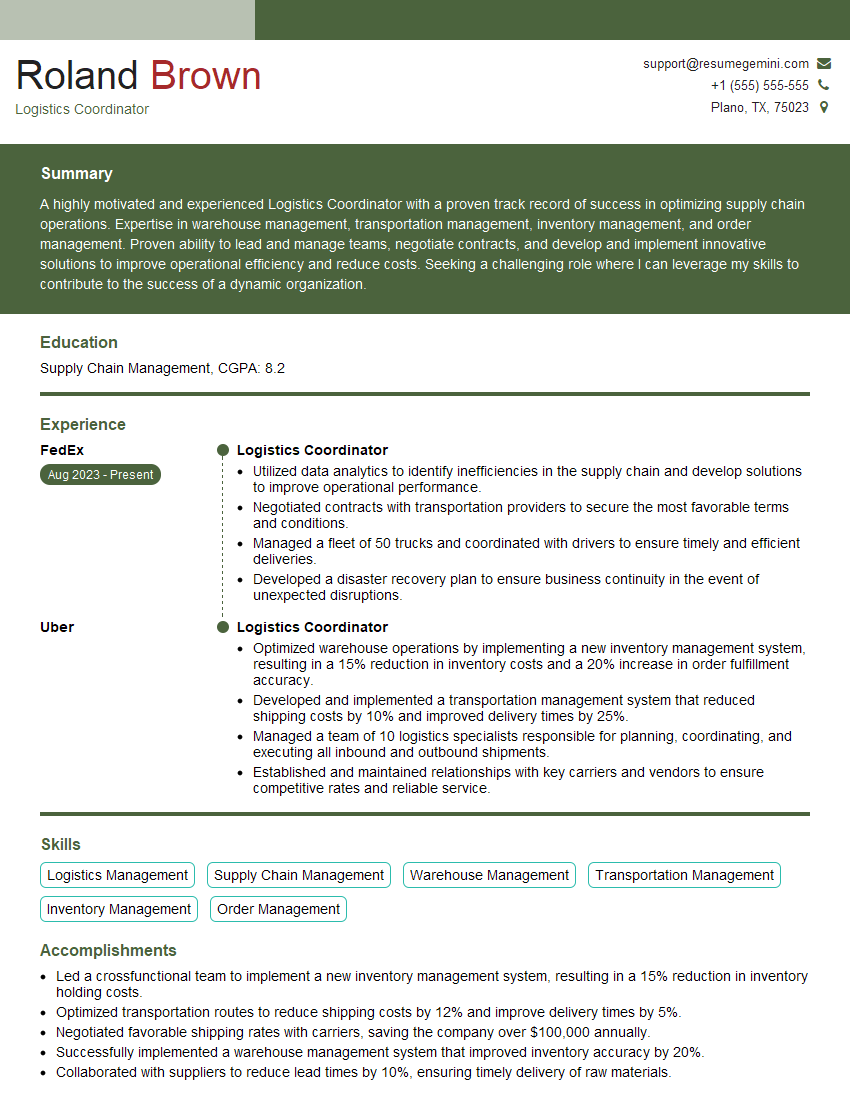
Logistics Coordinator Resume Sample
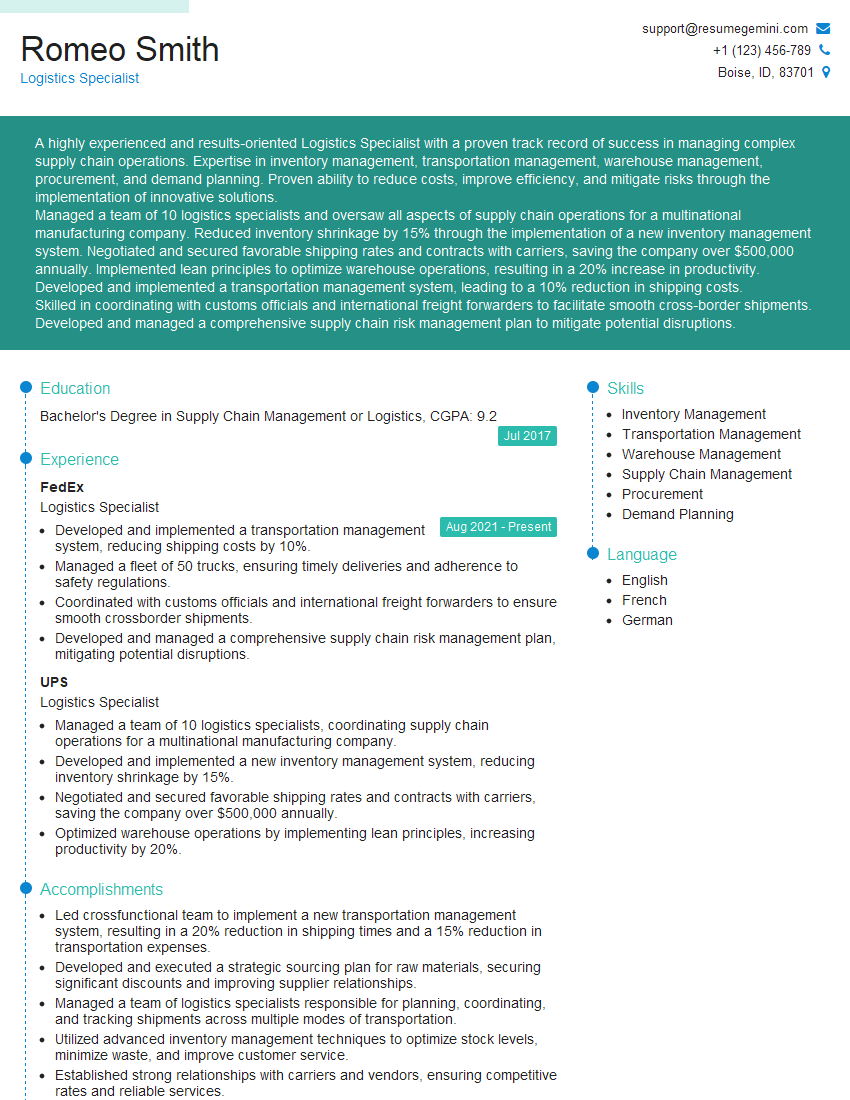
Logistics Specialist Resume Sample
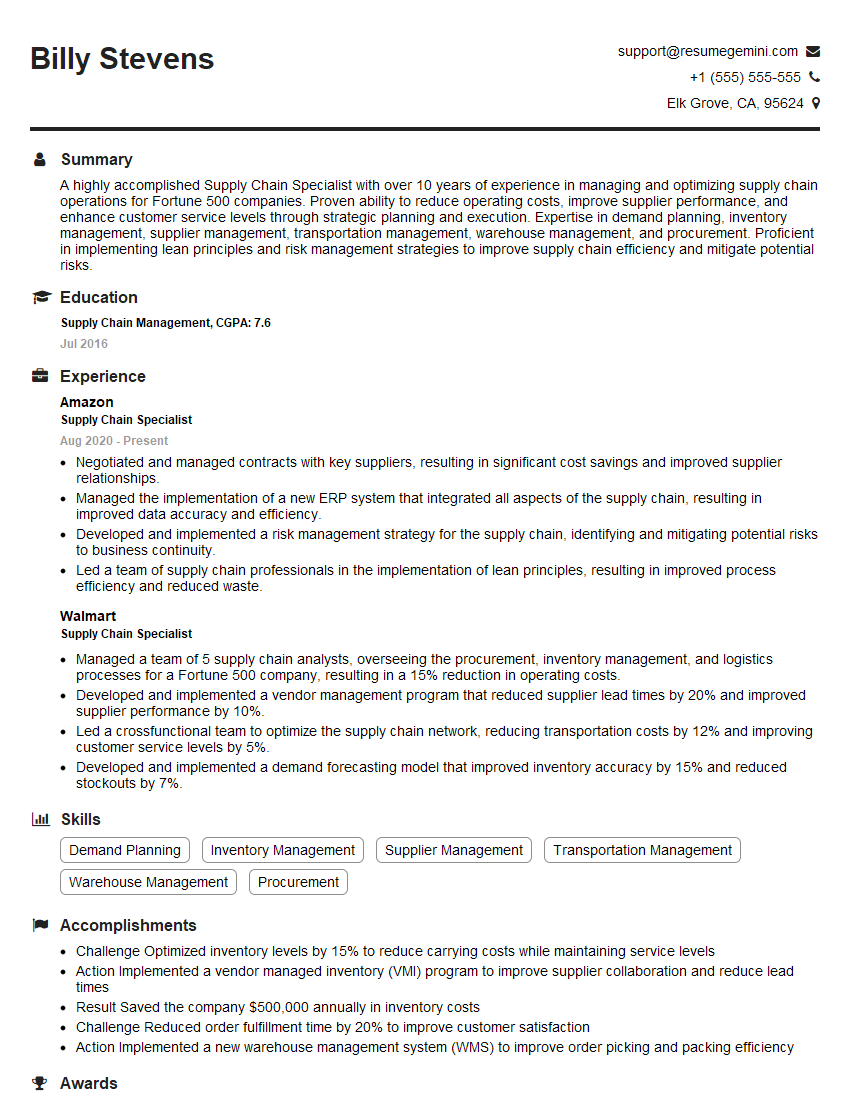
Supply Chain Specialist Resume Sample
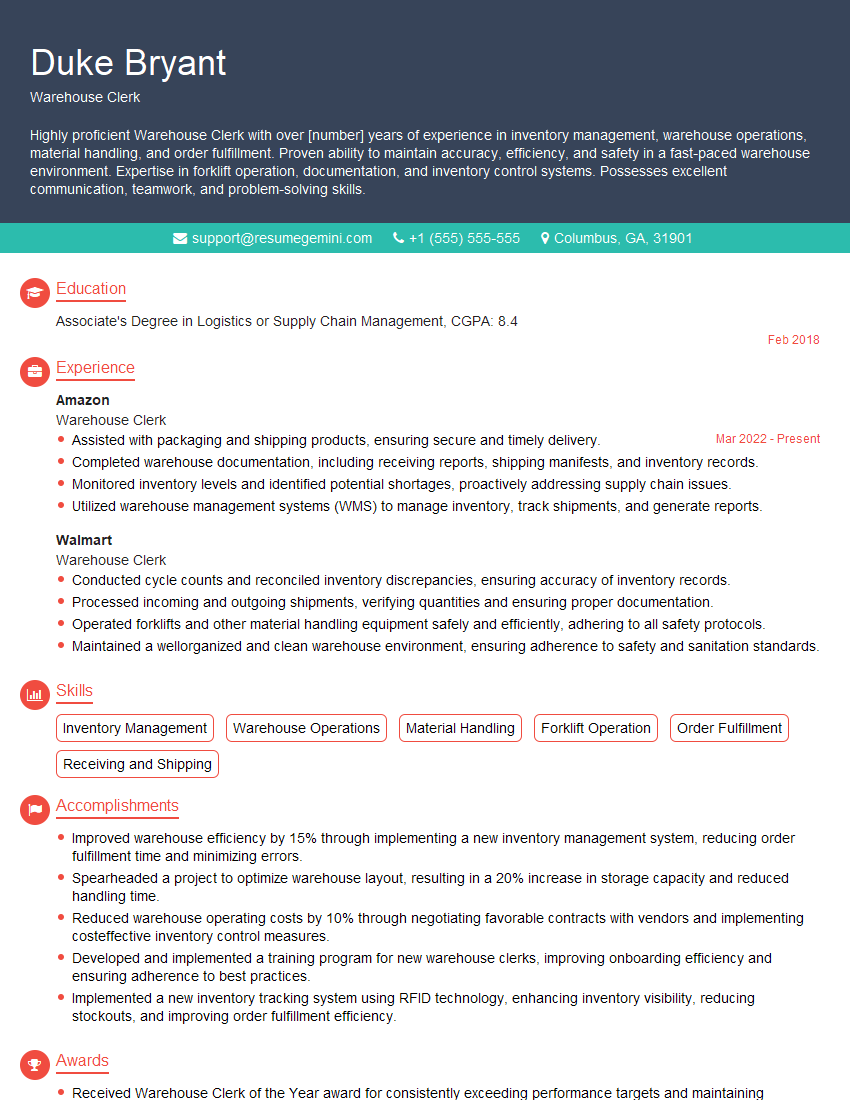
Warehouse Clerk Resume Sample
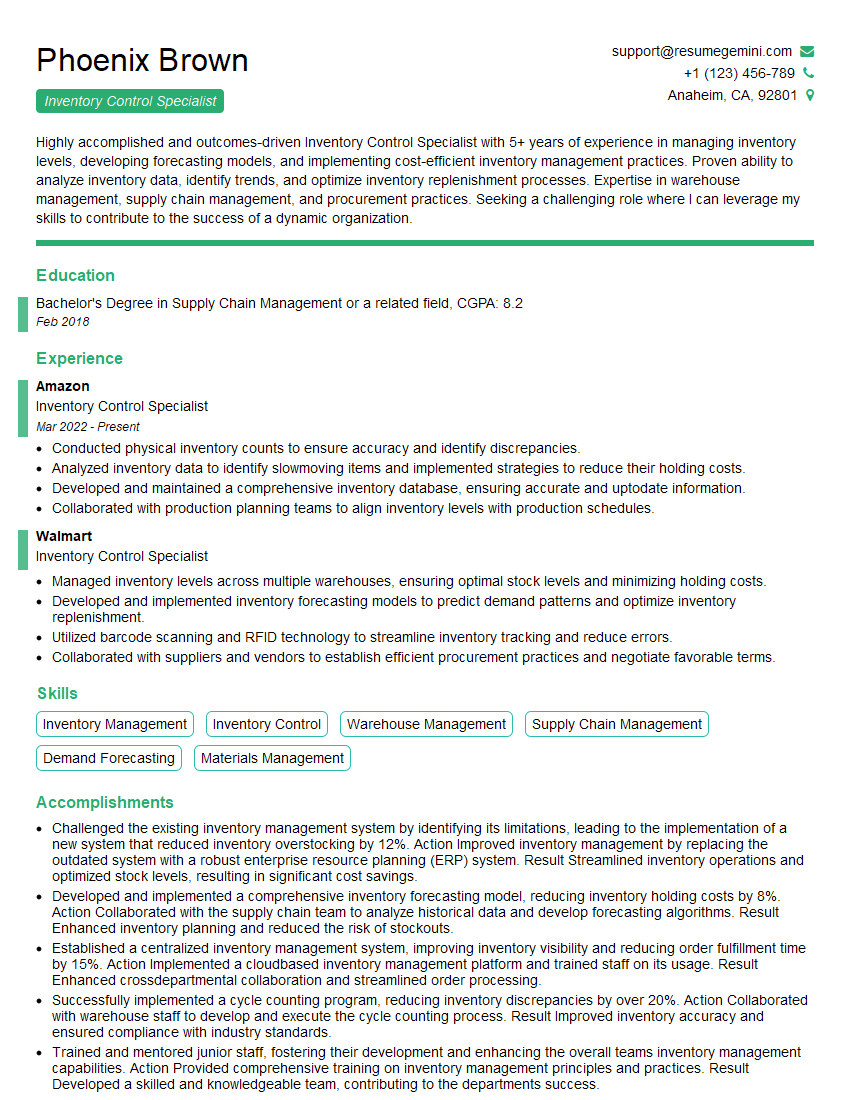
Inventory Control Specialist Resume Sample
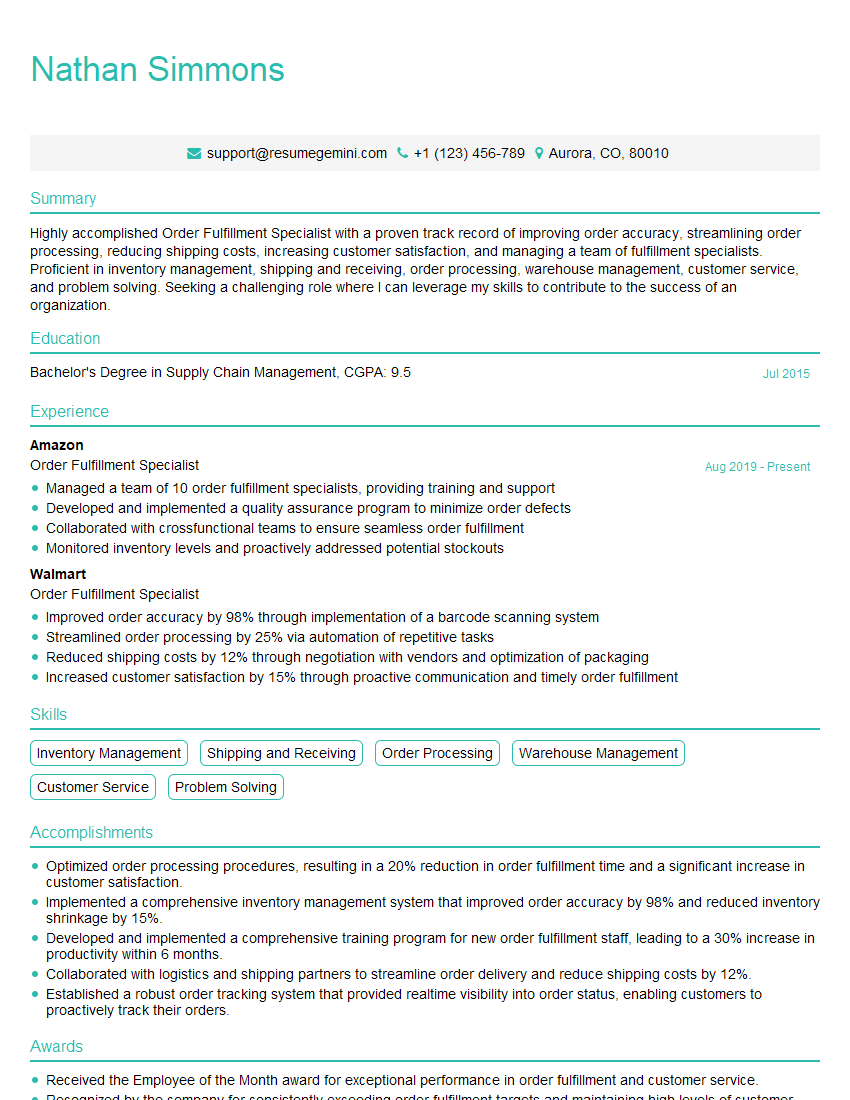
Order Fulfillment Specialist Resume Sample

Shipping and Receiving Clerk Resume Sample
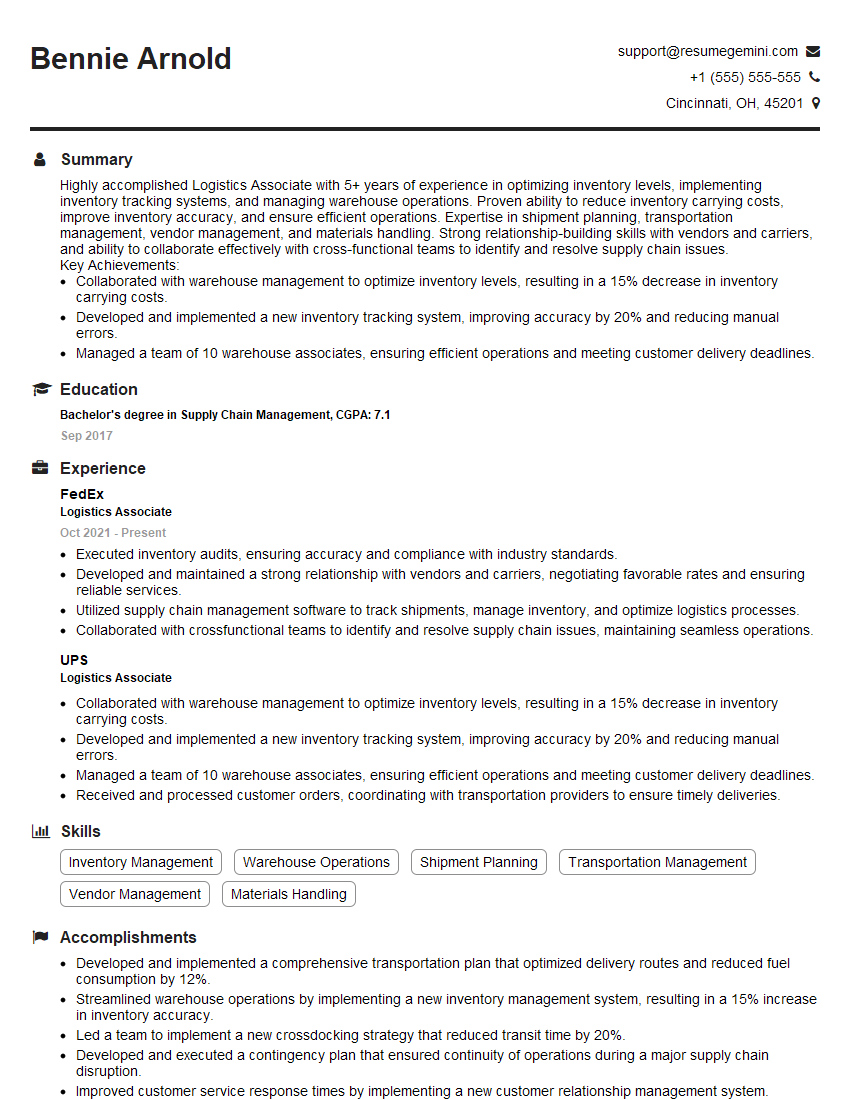
Logistics Associate Resume Sample
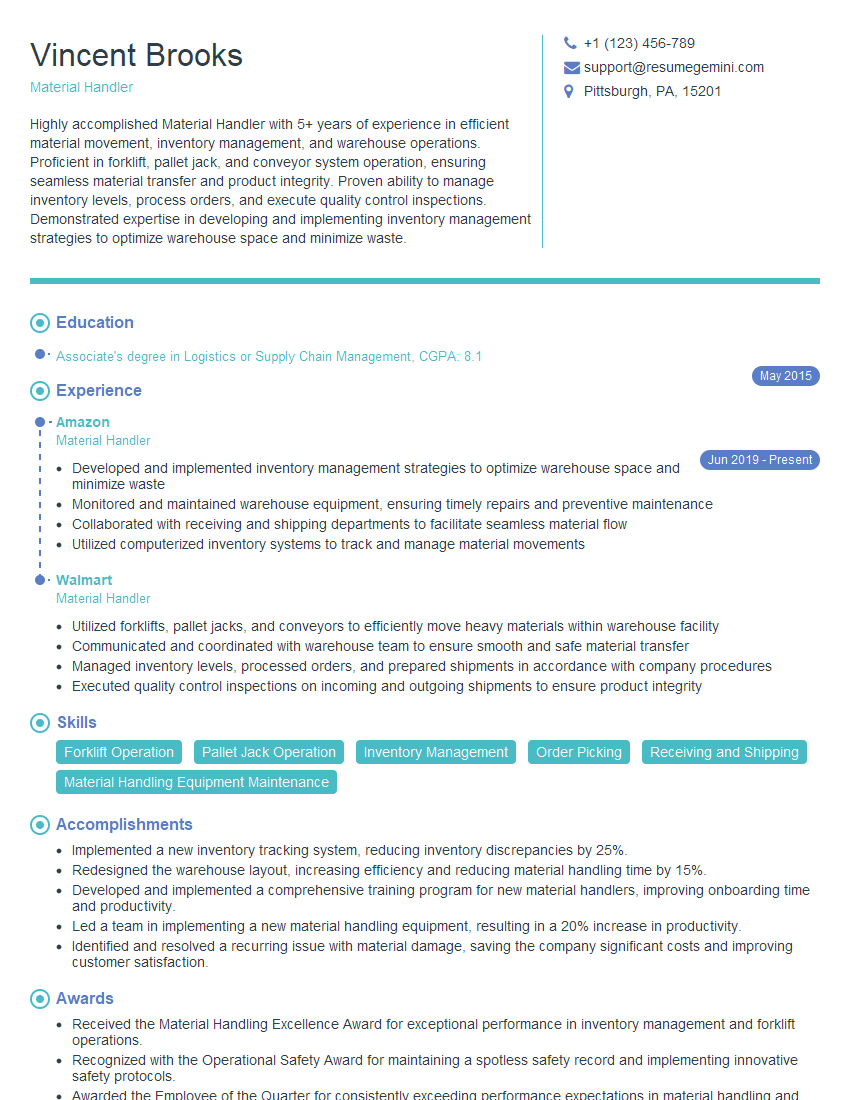
Material Handler Resume Sample
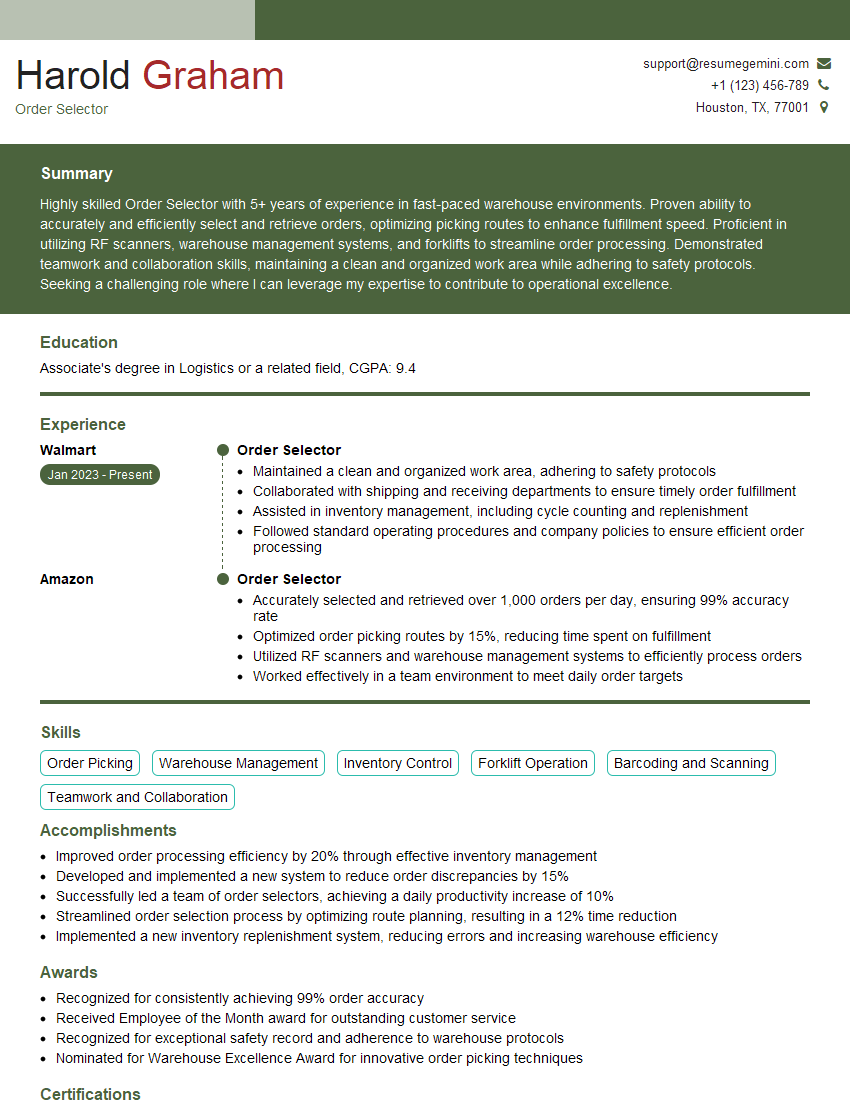
Order Selector Resume Sample
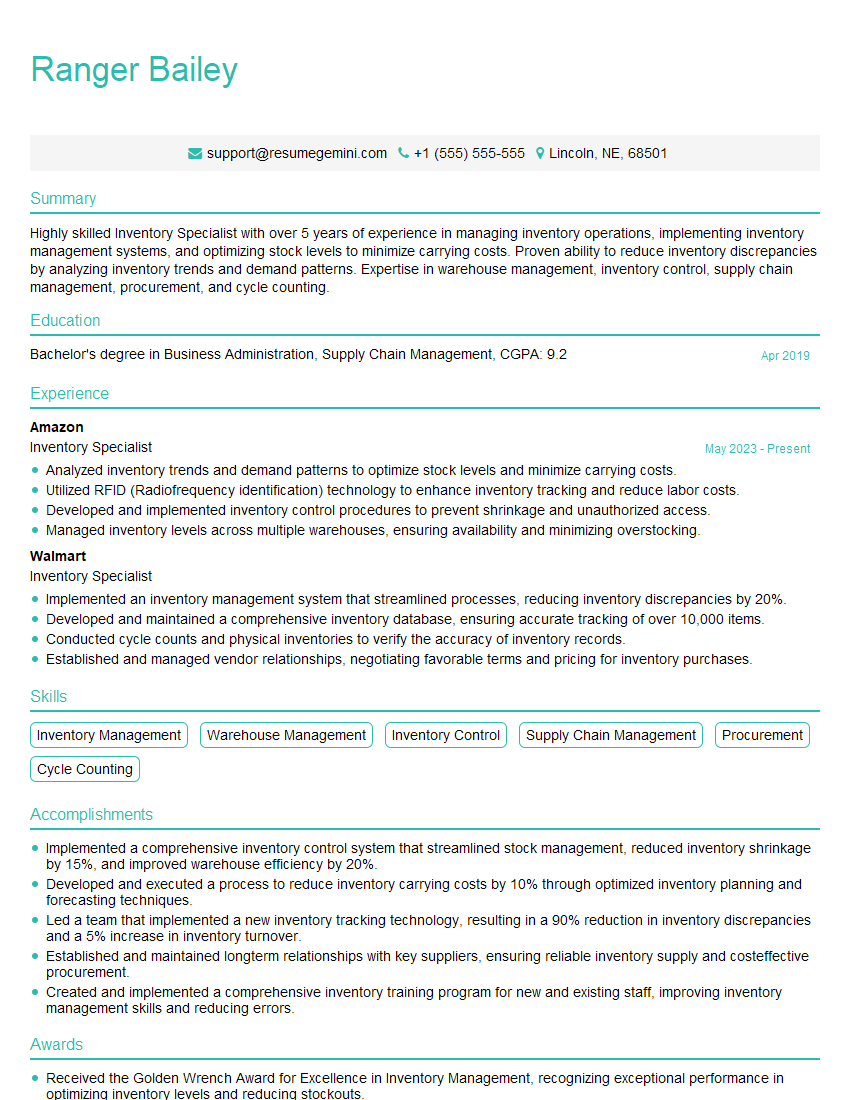
Inventory Specialist Resume Sample
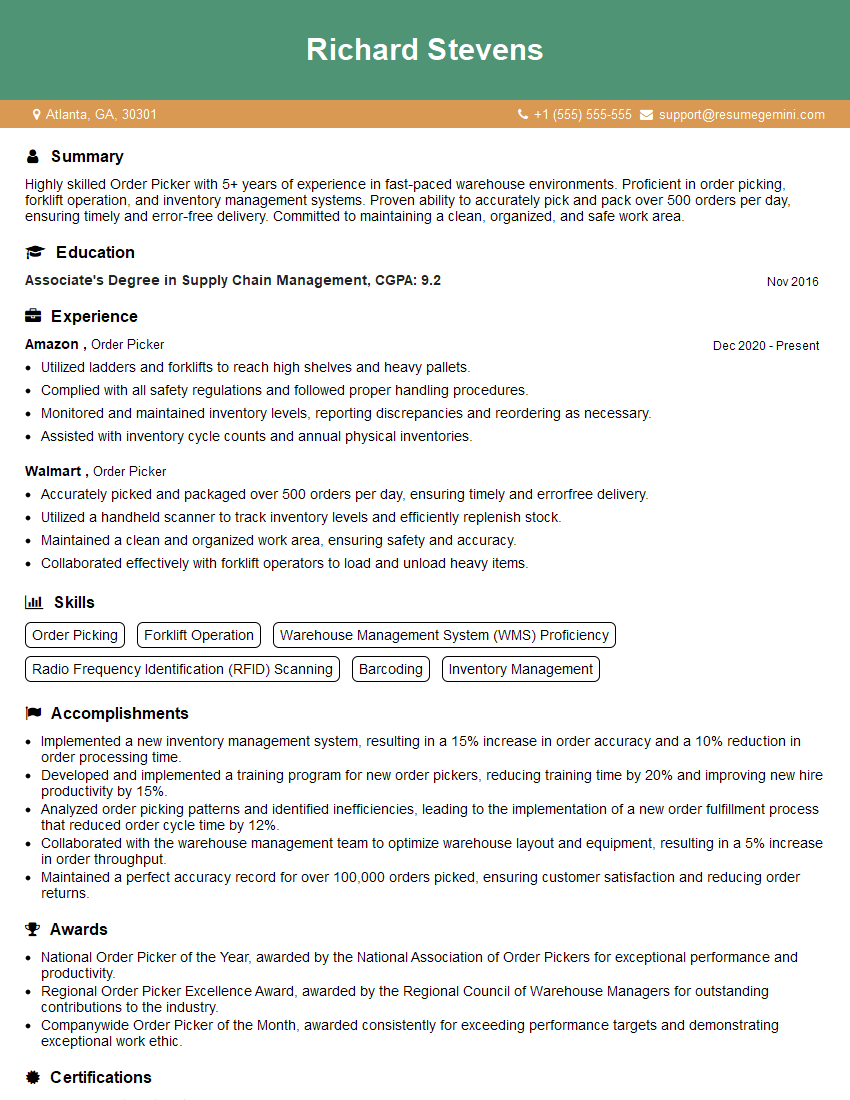
Order Picker Resume Sample
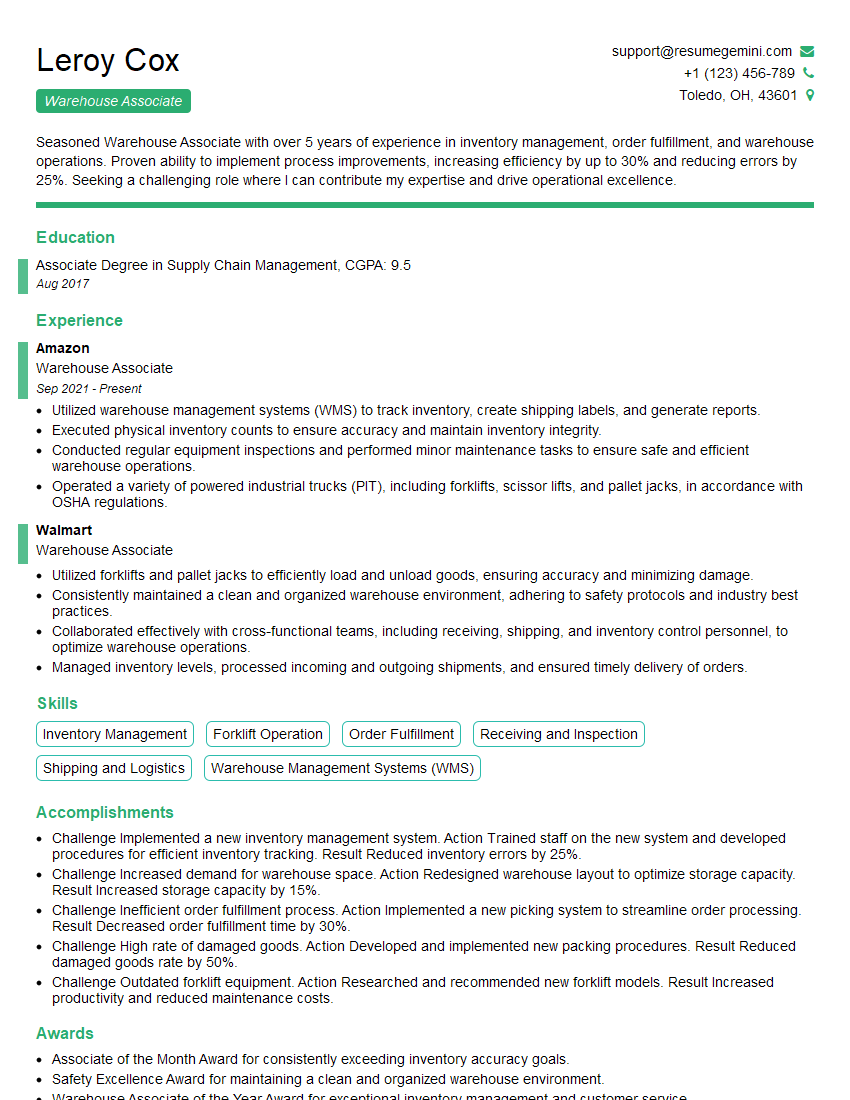
Warehouse Associate Resume Sample
Explore more articles
Users Rating of Our Blogs
Share Your Experience
We value your feedback! Please rate our content and share your thoughts (optional).
What Readers Say About Our Blog
To the interviewgemini.com Webmaster.
Very helpful and content specific questions to help prepare me for my interview!
Thank you
To the interviewgemini.com Webmaster.
This was kind of a unique content I found around the specialized skills. Very helpful questions and good detailed answers.
Very Helpful blog, thank you Interviewgemini team.