Interviews are opportunities to demonstrate your expertise, and this guide is here to help you shine. Explore the essential Ore Microscopy interview questions that employers frequently ask, paired with strategies for crafting responses that set you apart from the competition.
Questions Asked in Ore Microscopy Interview
Q 1. Describe the different types of ore microscopy techniques.
Ore microscopy employs various techniques to analyze the mineralogy and texture of ore samples. The primary distinction lies in the type of light used: reflected light and transmitted light microscopy.
- Reflected Light Microscopy (RLM): This is the dominant technique for opaque minerals, common in ore samples. It uses light reflected from the polished surface of the sample.
- Transmitted Light Microscopy (TLM): Used for transparent or translucent minerals, often in conjunction with RLM to analyze gangue minerals (unwanted minerals in the ore). Light passes *through* a thin section of the sample.
- Scanning Electron Microscopy (SEM): While not strictly ‘microscopy’ in the traditional sense, SEM is crucial for high-resolution imaging and elemental analysis. It uses a focused beam of electrons to scan the sample’s surface.
- Electron Probe Microanalysis (EPMA): This is a powerful technique coupled with SEM, providing quantitative chemical analysis of individual mineral grains, vital for precise mineral identification.
- Quantitative Microscopy: This involves using image analysis software to quantify aspects like mineral abundance, grain size, and liberation.
The choice of technique depends on the specific minerals present and the information sought. For example, studying a copper sulfide ore would heavily rely on RLM, while analyzing a sample containing quartz and feldspar might benefit from TLM.
Q 2. Explain the principles of reflected light microscopy.
Reflected light microscopy (RLM) relies on the principle that light reflected from a polished ore surface interacts with the mineral’s crystal structure, influencing how the light is reflected. This interaction determines the mineral’s color, reflectivity, and anisotropy (different optical properties in different directions).
Imagine shining a flashlight on a polished rock; different minerals will appear with varying brightness and color. RLM uses polarized light to enhance these differences. The reflected light passes through a series of polarizing filters (polarizer and analyzer) that allow us to observe properties like bireflectance (change in reflectivity with rotation of the stage) and pleochroism (change in color with rotation). These optical properties are key to mineral identification. For example, pyrite (iron sulfide) typically exhibits a strong brass-yellow color and reflectivity, while chalcopyrite (copper iron sulfide) shows a characteristic brass-yellow color with a slightly greenish tint under reflected light.
RLM systems often include accessories such as universal stages, which allow for precise rotation and measurement of optical properties, providing additional details for precise mineral identification.
Q 3. What are the applications of transmitted light microscopy in ore microscopy?
Transmitted light microscopy (TLM) in ore microscopy is primarily used to study transparent or translucent gangue minerals – those that are not the target mineral(s) of the ore. These are often silicates like quartz, feldspar, and calcite.
By preparing thin sections (thin slices of the rock, usually 30 micrometers thick), light can pass through, allowing us to examine their crystal structure, interference colors, and other optical characteristics under polarized light. This helps determine the gangue mineralogy, which is crucial for understanding the ore’s formation and processing characteristics. For example, the presence of certain clay minerals might indicate alteration processes that affect the ore’s grade or extractability. Analyzing the textural relationship between ore minerals and gangue minerals can provide insights into ore genesis and potential beneficiation processes.
In essence, TLM provides complementary information to RLM, leading to a more comprehensive understanding of the ore sample.
Q 4. How do you identify different minerals using ore microscopy?
Identifying minerals using ore microscopy involves a combination of techniques and observation. It’s like a detective’s work, using various clues to pinpoint the culprit (mineral).
- Reflected Light Properties: Color, reflectivity, bireflectance, and pleochroism under polarized light are the primary identifiers in RLM.
- Anisotropy: The variation of optical properties with crystallographic orientation. Minerals showing different colors or reflectivity when rotated on the microscope stage are anisotropic.
- Reflectivity Measurements: Precise measurements of reflectivity using a micro-reflectometer help differentiate minerals with similar colors.
- Etching Tests: Specific chemical etchants can react differently with various minerals, altering their surface and helping in identification.
- Microhardness Testing: Measures the resistance of a mineral to indentation, assisting in differentiation between minerals with similar optical properties.
- SEM-EDS: In cases where optical properties are insufficient for identification, SEM combined with energy-dispersive X-ray spectroscopy (EDS) provides elemental composition data, enabling accurate identification.
Experienced microscopists develop a keen eye for these characteristics, often building mental libraries of mineral appearances and properties. The identification process often involves comparing observed characteristics with known mineral properties listed in reference books and databases.
Q 5. Explain the concept of mineral liberation.
Mineral liberation refers to the degree to which individual mineral grains are physically separated from other minerals in an ore. It’s a critical concept in ore processing.
Imagine a cake with chocolate chips (your target mineral) mixed into the batter (gangue minerals). High liberation means the chocolate chips are largely separate and easily picked out. Low liberation implies the chocolate chips are tightly intertwined with the batter, making separation difficult. Similarly, in ore processing, highly liberated ore minerals are more easily separated from the unwanted gangue minerals through techniques like flotation or gravity separation.
Assessing liberation involves examining polished sections under the microscope. The percentage of mineral grains that are fully liberated (unmixed with other minerals) is quantified, providing essential data for optimizing the beneficiation process. Low liberation increases processing costs and reduces the efficiency of recovery of the desired mineral.
Q 6. What is the significance of grain size analysis in ore microscopy?
Grain size analysis in ore microscopy is crucial for understanding ore processing behavior and predicting the efficiency of mineral separation. Grain size significantly impacts the liberation of minerals.
Fine-grained ores (small mineral grains) often exhibit lower liberation, making separation challenging and requiring more intensive and expensive processing. Conversely, coarse-grained ores generally show higher liberation, simplifying separation and reducing processing costs.
Grain size distribution is assessed through microscopy, often using image analysis software to quantify the size and shape of mineral grains. This information is used in various ways: choosing appropriate processing techniques, estimating the energy required for liberation, and predicting the overall efficiency of mineral extraction. A detailed understanding of grain size is essential for process optimization and economic viability of mining operations. For example, a gold ore with fine-grained gold will require different processing than one with coarse gold.
Q 7. Describe the process of preparing a polished section for ore microscopy.
Preparing a polished section for ore microscopy is a crucial step, requiring meticulous care to obtain a high-quality surface suitable for microscopic examination.
- Sectioning: A representative piece of the ore sample is cut into a manageable size, usually using a diamond saw.
- Mounting: The sample is mounted in a resin block to provide a stable and even surface for grinding and polishing. This ensures that the whole sample, even irregularly shaped pieces, remains intact for analysis.
- Grinding: The mounted sample is ground using successively finer abrasive papers (e.g., silicon carbide papers of decreasing grit size), progressively removing material until a flat surface is achieved. Water is generally used as a lubricant during grinding to prevent overheating and clogging.
- Polishing: The sample is then polished using diamond pastes of decreasing particle size, achieving a mirror-like finish. This stage removes scratches and imperfections from the grinding process. The polishing stage is critical; an imperfect polish can obscure subtle mineralogical features. Final polishing might involve using a very fine alumina polishing compound.
- Cleaning: Finally, the polished section is thoroughly cleaned to remove any residual polishing compounds, ensuring a clear and artifact-free surface.
The quality of the polished section directly impacts the quality of microscopic observations. Scratches or pits can mask mineralogical features and lead to misidentification. Proper section preparation is paramount for accurate and reliable results in ore microscopy.
Q 8. How do you interpret a modal analysis from ore microscopy data?
Modal analysis in ore microscopy is a quantitative method to determine the relative abundance of different minerals in a rock sample. Imagine you’re baking a cake – modal analysis tells you the proportion of each ingredient (e.g., flour, sugar, eggs). In ore microscopy, we use a microscope to systematically examine a polished thin section of the ore. We count the area occupied by each mineral phase within a predefined area, typically using a grid or point counting method. This allows us to express the mineral composition as percentages.
For example, if we analyze a porphyry copper deposit, we might find 60% quartz, 30% feldspar, 5% chalcopyrite (copper mineral), and 5% other minerals. This information is crucial for understanding the ore grade and for designing efficient mineral processing strategies. We can also use this to track changes in mineral distribution in different parts of the deposit.
Q 9. Explain the use of image analysis software in ore microscopy.
Image analysis software revolutionizes ore microscopy, automating and accelerating data acquisition and interpretation. These programs can digitally capture images from the microscope, automatically identify and classify different minerals based on their optical properties (color, reflectivity, anisotropy), and quantify their relative abundances – significantly speeding up modal analysis. Imagine manually counting thousands of mineral grains under the microscope; image analysis software automates this tedious task, leading to much more efficient work.
Furthermore, these software packages can perform more advanced analyses, such as grain size distribution measurements, texture analysis (e.g., identifying banding or fracturing), and automated mineral liberation studies. Software like ImageJ, or specialized ore microscopy software, are frequently used, allowing for precise measurements and statistical analysis that would be practically impossible by hand.
Q 10. What are the limitations of ore microscopy?
While ore microscopy is a powerful technique, it has limitations. Firstly, it’s inherently a two-dimensional analysis of a three-dimensional sample. This means we’re only seeing a slice of the ore, potentially missing complex internal structures or mineral distributions. Secondly, the resolution is limited by the optical properties of the microscope and the sample preparation, so very fine-grained minerals or inclusions might be challenging to identify or quantify accurately.
Additionally, some minerals can be difficult to distinguish optically, particularly if they have similar optical properties. Lastly, preparing thin sections for microscopy is time-consuming and requires expertise. It’s crucial to consider these limitations and potentially complement ore microscopy with other analytical techniques for a comprehensive characterization of the ore.
Q 11. How does ore microscopy contribute to mineral processing optimization?
Ore microscopy plays a vital role in optimizing mineral processing. By accurately characterizing the mineralogy, texture, and liberation of valuable minerals, we can design more efficient and cost-effective extraction processes. For example, understanding the grain size and distribution of a valuable mineral like gold allows us to select the most appropriate comminution (crushing and grinding) techniques to liberate the gold from the gangue (waste rock). If gold is present in very fine particles, using excessive grinding might be unnecessary and could increase processing costs.
Similarly, identifying alteration minerals can help predict the behavior of an ore during processing; the presence of clay minerals, for instance, can indicate potential problems with filtration or flotation. By improving our understanding of the ore’s characteristics at a microscopic scale, we can make data-driven decisions regarding the entire process, minimizing waste and maximizing profitability.
Q 12. Describe different types of ore textures and their significance.
Ore textures are crucial because they reflect the geological processes that formed the ore deposit and can significantly impact its processing behavior. Think of it like a building; the arrangement of bricks (minerals) dictates the building’s strength and stability. Some common ore textures include:
- Massive: Minerals are randomly arranged, lacking any preferred orientation. This is common in some hydrothermal deposits.
- Banded: Minerals are arranged in alternating layers of different compositions. This is often seen in sedimentary or layered intrusions.
- Porphyritic: Larger crystals (phenocrysts) are surrounded by a finer-grained matrix. This indicates multiple stages of crystallization.
- Brecciated: The ore is fractured and cemented together, often indicative of tectonic activity.
Understanding these textures is vital for predicting the liberation of valuable minerals. For example, a banded texture might require different processing strategies compared to a massive texture.
Q 13. Explain the use of electron probe microanalysis (EPMA) in conjunction with ore microscopy.
Electron probe microanalysis (EPMA) complements ore microscopy by providing quantitative chemical analyses of individual minerals at a microscopic scale. Ore microscopy identifies minerals based on optical properties, but EPMA determines their precise chemical composition. Imagine you have a collection of colored marbles; microscopy can help you sort them by color, while EPMA identifies the exact materials they are made of.
This combination allows for precise mineral identification, especially for minerals that are optically similar. For example, distinguishing between different types of feldspars or amphiboles solely by optical properties can be challenging; EPMA provides the definitive chemical data to resolve such ambiguities. EPMA is therefore essential for detailed mineral characterization and understanding the chemical variations within a single mineral grain, providing critical information for mineral processing optimization.
Q 14. How do you identify alteration minerals using ore microscopy?
Identifying alteration minerals under the ore microscope relies on recognizing characteristic optical properties, such as color, pleochroism (color change with different orientations of light), birefringence (double refraction of light), and crystal habit. Alteration minerals are secondary minerals formed by the chemical alteration of primary minerals. Their presence signifies changes in the geological environment, often related to hydrothermal fluids or weathering.
For example, the alteration of plagioclase feldspar to clay minerals like kaolinite or sericite is readily identified by their characteristic low relief, low birefringence, and pearly luster. Similarly, chloritization of mafic minerals is recognized by the green color and distinct pleochroism of chlorite. The identification of these alteration minerals provides insights into the ore’s geological history and can affect its processing properties, for instance, indicating areas of potential leaching or increased reactivity.
Q 15. What is the role of ore microscopy in exploration geology?
Ore microscopy plays a crucial role in exploration geology by providing a detailed, microscopic view of ore samples. This allows geologists to identify and characterize the minerals present, understand their textural relationships, and assess the overall ore grade and potential for economic extraction. Think of it as a detective using a powerful magnifying glass to unravel the secrets of a rock sample.
For instance, identifying the presence of fine-grained gold within a pyrite matrix would be impossible without ore microscopy. Similarly, understanding the liberation characteristics of a sulfide ore is critical for efficient processing, and microscopy helps visualise this directly. It helps in early-stage exploration to assess the viability of a deposit and guide subsequent exploration activities.
Career Expert Tips:
- Ace those interviews! Prepare effectively by reviewing the Top 50 Most Common Interview Questions on ResumeGemini.
- Navigate your job search with confidence! Explore a wide range of Career Tips on ResumeGemini. Learn about common challenges and recommendations to overcome them.
- Craft the perfect resume! Master the Art of Resume Writing with ResumeGemini’s guide. Showcase your unique qualifications and achievements effectively.
- Don’t miss out on holiday savings! Build your dream resume with ResumeGemini’s ATS optimized templates.
Q 16. Explain the use of quantitative microscopy techniques.
Quantitative microscopy goes beyond simple visual identification. It employs image analysis software to quantitatively measure various aspects of the ore’s mineralogy. This includes determining the modal percentages of different minerals (how much of each mineral is present), grain size distributions, and the degree of mineral liberation.
Techniques like automated mineralogy utilize specialized software that can rapidly analyze hundreds of images, providing statistically significant data. Imagine counting thousands of individual mineral grains by hand; quantitative microscopy automates this process, providing far more accurate and comprehensive data much faster. This is particularly useful in optimizing ore processing strategies, estimating ore reserves, and understanding metallurgical characteristics.
Q 17. How do you determine the degree of mineral liberation?
The degree of mineral liberation refers to the extent to which valuable minerals are separated from gangue minerals (waste rock). A high degree of liberation means the valuable minerals are mostly independent grains, making them easier to separate during processing. Conversely, poor liberation implies the valuable mineral is finely intergrown with gangue minerals, hindering efficient separation.
We determine this using ore microscopy by analyzing polished sections of the ore. We visually assess the degree of intergrowth between valuable and gangue minerals. Quantitative microscopy techniques further refine this analysis by calculating the percentage of liberated grains. For example, if we’re assessing a copper ore, we might find that 80% of the chalcopyrite (copper sulfide) grains are liberated, indicating good potential for efficient copper recovery. This percentage is crucial for designing effective processing flowsheets.
Q 18. What are the safety precautions you need to take while using ore microscopy equipment?
Safety is paramount when working with ore microscopy equipment. Key precautions include:
- Eye protection: Always wear safety glasses or goggles to protect against potential eye injuries from flying debris or accidental spills.
- Proper handling of chemicals: Many polishing and etching solutions are corrosive or toxic. Always use appropriate personal protective equipment (PPE), such as gloves and lab coats, and work in a well-ventilated area. Dispose of chemicals properly according to safety regulations.
- Electrical safety: Ensure the microscope and related equipment are properly grounded to prevent electrical shocks. Never operate the equipment with wet hands.
- Sharp objects: Polishing samples involves using abrasive materials and sharp tools. Exercise caution to avoid cuts and abrasions. Dispose of used abrasive materials appropriately.
- Proper ventilation: Some sample preparation techniques (like etching) generate potentially harmful fumes. Ensure adequate ventilation to prevent inhalation of these fumes.
Q 19. Describe the different types of microscope objectives and their applications.
Microscopes use different objective lenses to achieve various magnifications and resolutions. Common types include:
- Low-power objectives (e.g., 4x, 10x): Used for initial overview and context, allowing you to see the overall texture and distribution of minerals in a large area.
- Medium-power objectives (e.g., 20x, 40x): Ideal for examining mineral grain shapes, sizes, and some textural relationships in more detail.
- High-power objectives (e.g., 100x, often oil immersion): Provide high magnification and resolution for detailed examination of individual mineral grains, allowing the identification of subtle features and inclusions. Oil immersion objectives improve resolution by minimizing light refraction.
The choice of objective depends on the specific task. For example, a low-power objective might be used to initially assess the degree of mineral liberation, while a high-power objective would be necessary to identify specific minerals based on their optical properties.
Q 20. How do you calibrate a microscope for accurate measurements?
Microscope calibration ensures accurate measurements. This is typically done using a calibrated stage micrometer, a slide with precisely etched lines of known distances (e.g., 100 μm).
Procedure:
- Place the stage micrometer on the microscope stage.
- Focus on the micrometer lines using a high-power objective.
- Measure the distance between a known number of lines (e.g., 10 lines) using the eyepiece micrometer (a reticle in the eyepiece with a scale).
- Calculate the calibration factor by dividing the known distance on the stage micrometer by the measured distance on the eyepiece micrometer. This factor converts eyepiece micrometer readings into real-world distances.
- Record the calibration factor for future measurements.
This calibration factor is then used to convert measurements taken with the eyepiece micrometer on unknown samples into actual dimensions. Regular calibration is essential for maintaining accurate data.
Q 21. How do you handle and store microscope samples correctly?
Proper handling and storage of microscope samples are crucial to preserving their integrity and preventing damage or contamination.
- Sample preparation: Once polished sections are prepared, they should be carefully cleaned and handled to avoid scratching or damaging the polished surface. Use lint-free cloths or lens paper to clean samples.
- Storage: Polished sections are best stored in protective cases or slide boxes to prevent damage and dust accumulation. Avoid storing them in direct sunlight or extreme temperatures.
- Labeling: Clearly label each sample with a unique identification number or code, including details about the sample’s origin and preparation. This prevents sample mix-ups and facilitates data management.
- Handling: Always handle samples by the edges to prevent fingerprints or damage to the polished surfaces.
Q 22. Explain the difference between reflected and transmitted light microscopy.
Reflected and transmitted light microscopy are two fundamental techniques in ore microscopy, differing primarily in how light interacts with the sample. In transmitted light microscopy, light passes through a thin, transparent sample (usually a polished thin section). This allows us to observe the internal structure and mineral relationships within the sample. Think of it like shining a flashlight through a translucent slice of a rock. We see the minerals’ colors and their arrangement. This is useful for identifying minerals with distinctive optical properties.
Reflected light microscopy, on the other hand, is used for opaque samples like most ore minerals. Light is reflected from the polished surface of the sample, and the reflected light is then analyzed. This allows us to examine the surface textures, mineral reflections, and other features not visible in transmitted light. Imagine shining a flashlight on a polished piece of metal; the way the light reflects reveals properties about the surface. This is crucial for identifying ore minerals based on their reflectivity and anisotropy.
In practice, we often use both techniques to fully characterize an ore sample. Transmitted light reveals the overall context and finer grain size relationships, while reflected light reveals the key ore minerals and their textural characteristics.
Q 23. How do you differentiate between different types of ore deposits using microscopy?
Microscopy plays a vital role in distinguishing between different ore deposit types. For instance, porphyry copper deposits often show characteristic alteration assemblages observable through microscopy. We might see sericite alteration (fine-grained white mica) replacing feldspars, indicating a hydrothermal alteration event. These alteration patterns are crucial for exploration and understanding the deposit’s genesis.
Sedimentary-hosted stratiform deposits (like many lead-zinc deposits) exhibit distinct textural features. Microscopy helps identify the sedimentary layering, the presence of replacement textures (where minerals replace one another), and the distribution of ore minerals within the sedimentary host rock. We may see fine-grained pyrite disseminated throughout the host rock, a characteristic feature of some of these deposits.
Epithermal gold deposits, often associated with volcanic activity, frequently show textures indicative of rapid mineral precipitation from hydrothermal fluids. We can observe these through microscopic examination of ‘crustiform’ banding of minerals or the presence of finely crystalline gold within quartz veins.
By carefully examining the mineral assemblages, textures, and alteration patterns observed under the microscope, we can build a comprehensive understanding of the ore-forming processes and confidently classify the deposit type.
Q 24. Describe your experience with different image analysis software.
I have extensive experience with several image analysis software packages, including ImageJ/Fiji (open-source), Zeiss ZEN (for Zeiss microscopes), and Leica LAS X (for Leica microscopes). My experience goes beyond simple image viewing; I routinely use these programs for quantitative analysis such as grain size measurements, mineral quantification (area percentage), and texture analysis. For instance, I used ImageJ/Fiji to perform automated grain size measurements on a large dataset of polished sections from a nickel sulfide deposit, enabling statistical analysis of the grain size distribution, information vital for metallurgical studies. Similarly, Leica LAS X was used for automated mineral identification and quantification in a complex gold-bearing quartz vein sample. These tools aren’t just about image processing; they are critical for extracting meaningful quantitative data from our microscopy observations.
Q 25. How would you troubleshoot a problem with a microscope?
Troubleshooting a microscope involves a systematic approach. First, I would check the most basic things: Is the microscope properly plugged in? Is the light source functioning? Are the objectives correctly seated?
If the image is blurry, I’d check the focus adjustments (coarse and fine) and ensure the correct objective is selected. If the image is dark, I might need to adjust the light intensity or condenser settings. Issues with the image quality might require cleaning the objectives or checking for any dust or debris on the optical path. If there are problems with specific features such as polarization, I’d systematically check the polarization components are correctly aligned.
For more complex issues, I’d consult the microscope’s manual or reach out to the manufacturer’s technical support for guidance. Sometimes, a simple cleaning is all it takes, but in other cases, there may be a more significant mechanical or optical problem requiring professional servicing. Keeping a logbook to note observations and troubleshooting steps is crucial for effective problem-solving and preventing future issues.
Q 26. How do you ensure the quality of your microscopy data?
Ensuring data quality in ore microscopy is paramount. This begins with meticulous sample preparation – ensuring a perfectly polished surface free from scratches and artifacts. Proper polishing techniques are essential to avoid misinterpretations of mineral properties. Next, I would ensure that the microscope is calibrated and regularly maintained. Calibration checks are done using standard materials to validate accuracy of measurements.
During image acquisition, I use standardized imaging parameters (e.g., consistent lighting, magnification, and exposure times) and maintain detailed documentation of the acquisition parameters. Multiple images are taken at different locations on the sample to ensure representativeness. Image analysis techniques are chosen carefully, and their assumptions are clearly stated. Finally, all the data and images are stored in a well-organized system using a standardized naming convention. This ensures traceability and facilitates easy retrieval and sharing of the data.
Q 27. Describe your experience with various sample preparation techniques.
My experience encompasses a broad range of sample preparation techniques crucial for ore microscopy. This includes creating polished sections, a process involving careful grinding and polishing of rock samples to produce a mirror-like surface suitable for reflected light microscopy. I’m also skilled in the preparation of thin sections, where samples are ground down to a thickness of approximately 30 microns, allowing for transmitted light microscopy. Proper orientation of the sample is important to optimize for the specific mineral assemblages. Beyond these standard techniques, I’m familiar with specialized methods such as impregnation techniques (for friable samples), ion milling (for high-resolution imaging), and techniques for preparing samples containing specific elements for electron probe microanalysis (EPMA) or other advanced microanalytical methods.
Q 28. What is your understanding of the latest advancements in ore microscopy?
Recent advancements in ore microscopy are significantly enhancing our capabilities. Automated image analysis software is becoming increasingly sophisticated, enabling high-throughput analysis of large datasets and advanced quantitative mineralogical assessments. Confocal microscopy allows for 3D visualization of samples, providing unprecedented insights into the internal structure of ore bodies and improving our understanding of ore textures and mineral relationships. The development of high-resolution techniques, such as electron backscatter diffraction (EBSD) and energy dispersive X-ray spectroscopy (EDS) coupled with microscopy provides compositional and crystallographic data at the micron scale.
Furthermore, the integration of machine learning algorithms in image analysis is revolutionizing our ability to identify minerals automatically and quantitatively estimate mineral abundances, accelerating data processing significantly. These advancements are leading to faster, more accurate, and more efficient mineral resource characterization, ultimately improving exploration and mining outcomes.
Key Topics to Learn for Ore Microscopy Interview
- Optical Mineralogy: Understanding the optical properties of ore minerals (e.g., reflectivity, bireflectance, pleochroism) and their identification using a reflected light microscope.
- Mineral Liberation and Texture Analysis: Analyzing polished sections to determine the degree of mineral liberation, grain size, and textural relationships between minerals, crucial for understanding ore processing.
- Quantitative Microscopy Techniques: Familiarity with image analysis software and techniques for measuring mineral abundances, grain size distributions, and other quantitative parameters.
- Ore Deposit Geology: Understanding the geological context of ore deposits and how microscopy contributes to interpreting ore genesis and exploration targets.
- Practical Application: Applying microscopy results to solve real-world problems in exploration, mining, and processing, such as optimizing ore beneficiation or assessing mineral resource estimates.
- Problem-Solving Approach: Developing a systematic approach to analyzing microscopic data, including identifying potential biases, uncertainties, and limitations of the techniques used.
- Advanced Techniques: Exploring advanced microscopy techniques such as electron probe microanalysis (EPMA) or scanning electron microscopy (SEM) and their applications in ore microscopy.
- Reporting and Communication: Clearly and effectively communicating microscopic observations and interpretations to both technical and non-technical audiences.
Next Steps
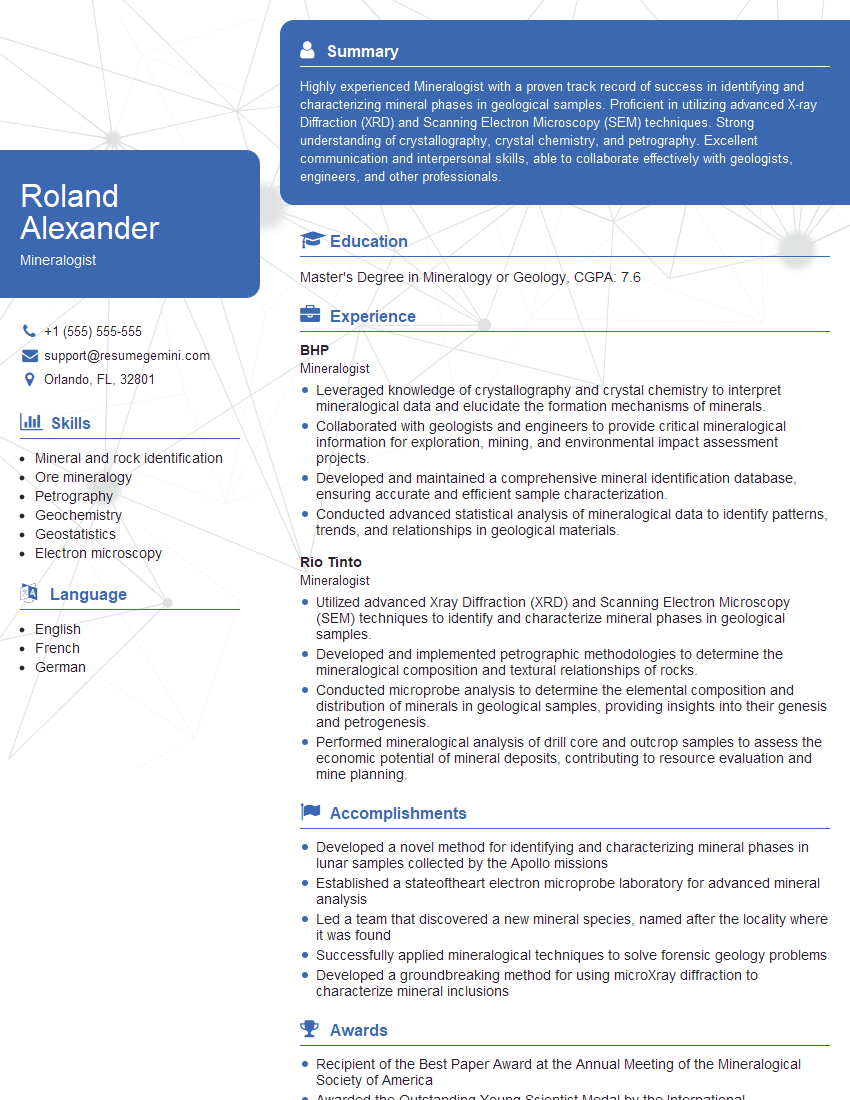
Mastering ore microscopy opens doors to exciting careers in exploration geology, mining engineering, and mineral processing. A strong understanding of these techniques is highly sought after by employers and significantly enhances your value in the industry. To maximize your job prospects, it’s crucial to present your skills effectively. Crafting an ATS-friendly resume is key to getting your application noticed. We recommend using ResumeGemini, a trusted resource for building professional resumes that are optimized for Applicant Tracking Systems (ATS). ResumeGemini provides examples of resumes tailored to Ore Microscopy roles, helping you showcase your expertise and land your dream job.
Explore more articles
Users Rating of Our Blogs
Share Your Experience
We value your feedback! Please rate our content and share your thoughts (optional).
What Readers Say About Our Blog
To the interviewgemini.com Webmaster.
Very helpful and content specific questions to help prepare me for my interview!
Thank you
To the interviewgemini.com Webmaster.
This was kind of a unique content I found around the specialized skills. Very helpful questions and good detailed answers.
Very Helpful blog, thank you Interviewgemini team.