The right preparation can turn an interview into an opportunity to showcase your expertise. This guide to Pouring and finishing concrete interview questions is your ultimate resource, providing key insights and tips to help you ace your responses and stand out as a top candidate.
Questions Asked in Pouring and finishing concrete Interview
Q 1. Explain the process of preparing a concrete sub-base.
Preparing a concrete sub-base is crucial for a durable and stable concrete structure. Think of it as building a strong foundation for your house – you wouldn’t want cracks appearing just because the ground underneath wasn’t properly prepared! The process involves several key steps:
Excavation: The existing ground is excavated to the required depth, typically determined by the project’s design and load-bearing requirements. This ensures a level and stable base.
Compaction: The excavated soil is compacted using a compactor to eliminate air pockets and ensure stability. This is vital; loose soil will settle over time, causing cracks in the concrete above. We often use a plate compactor for smaller jobs and a larger roller compactor for larger projects.
Base Material: A layer of compacted granular material, such as gravel or crushed stone, is laid down and compacted. This provides excellent drainage and further enhances stability. The thickness of this layer again depends on the project requirements and soil conditions.
Drainage: Proper drainage is vital to prevent water accumulation beneath the concrete, which can lead to frost heave and cracking. This may involve installing drainage pipes or creating a slope in the sub-base to direct water away.
For example, in a driveway project, a poorly compacted sub-base could lead to significant settling and cracking over time, requiring costly repairs. A well-prepared sub-base, however, ensures a long-lasting and crack-free driveway.
Q 2. Describe different concrete finishing techniques (e.g., hand troweling, power troweling).
Concrete finishing techniques aim to create a smooth, level, and aesthetically pleasing surface. The choice of technique depends on the project’s requirements and the desired finish. Here are some common methods:
Hand Troweling: This traditional method involves using hand tools like bull floats and steel trowels to smooth and level the concrete surface. It’s excellent for smaller areas and achieving a slightly textured finish. It requires skilled labor and is more labor-intensive than power troweling.
Power Troweling: This method uses a power trowel, a machine with rotating blades that smooth and polish the concrete surface. It’s efficient for large areas and produces a very smooth, highly polished finish. Different types of blades provide varying degrees of smoothness. Power troweling requires skilled operation and careful control to avoid creating unevenness or damaging the concrete surface.
Broomed Finish: A broom is used to create a textured surface, often used for driveways and walkways to improve traction. The texture also provides aesthetic appeal.
Exposed Aggregate Finish: The surface layer of concrete is washed away, revealing the aggregate (stones) underneath. This creates a decorative and durable finish, often used for architectural elements.
For instance, a high-traffic warehouse floor would benefit from power troweling for maximum durability and smoothness, while a residential walkway might only require a broomed finish for slip resistance.
Q 3. What are the common types of concrete admixtures and their purposes?
Concrete admixtures are chemicals added to the concrete mix to modify its properties. They significantly influence the final product’s strength, workability, and durability. Here are some common types:
Water reducers/superplasticizers: Increase workability without adding more water, leading to stronger concrete.
Air-entraining admixtures: Introduce tiny air bubbles into the mix, enhancing durability by improving resistance to freeze-thaw cycles. This is especially important in colder climates.
Accelerators: Speed up the setting and hardening time, useful in cold weather or when rapid completion is necessary.
Retarders: Slow down the setting time, providing more working time in hot weather or for large pours.
Corrosion inhibitors: Protect reinforcing steel from corrosion, extending the lifespan of reinforced concrete structures.
For example, in a large bridge pour, retarders help prevent premature setting, allowing for proper placement and consolidation of the concrete. In areas prone to freezing, air-entraining admixtures are crucial to prevent damage from freeze-thaw cycles.
Q 4. How do you ensure proper concrete consolidation during pouring?
Proper concrete consolidation is essential to eliminate air pockets and ensure a dense, strong, and durable final product. Imagine trying to build a sandcastle with air pockets – it wouldn’t be very stable! We achieve this through a combination of techniques:
Vibration: Using internal vibrators (needle vibrators) or external vibrators (form vibrators) to remove trapped air bubbles. This process is critical for larger pours to ensure proper compaction.
Rodding: Using long rods to poke and agitate the concrete, especially around rebar or in corners, to help remove air pockets.
Proper placement: Concrete should be poured in layers, and each layer should be consolidated before the next is added. This prevents segregation (separation of the cement paste and aggregates) and ensures a uniform mix.
Insufficient consolidation can lead to weak spots, honeycombing (voids within the concrete), and premature cracking. Over-vibration can also be detrimental, leading to segregation. It’s a balance we need to strike.
Q 5. What are the signs of improper concrete curing?
Improper concrete curing leads to reduced strength, durability, and increased susceptibility to cracking. Signs of improper curing include:
Cracking: Early or excessive cracking, often accompanied by surface dusting.
Surface scaling or dusting: Loss of surface material due to dehydration.
Reduced compressive strength: Concrete doesn’t achieve its design strength.
Color variations: Uneven color indicating inconsistent moisture content during curing.
Low durability: Increased susceptibility to wear and tear, chemical attack, and freeze-thaw damage.
For example, if concrete is allowed to dry out too quickly, it may not fully hydrate, leading to reduced strength and increased cracking. Maintaining consistent moisture is key to proper curing.
Q 6. Describe the process of finishing a concrete sidewalk.
Finishing a concrete sidewalk involves several steps, ensuring a smooth, level, and aesthetically pleasing surface:
Screeding: Using a screed (a long, straight board) to level the freshly poured concrete to the desired height.
Bull Floating: Using a bull float to smooth the surface, removing larger irregularities.
Troweling: Using hand or power trowels to further smooth and compact the surface, achieving the desired finish (smooth, broomed, etc.).
Edging: Using an edging tool to create neat, rounded edges along the sidewalk’s perimeter.
Jointing: Creating control joints (grooves) in the concrete at regular intervals to manage shrinkage and prevent cracking. These are usually cut with a concrete saw after the concrete has partially cured.
Curing: Keeping the concrete moist for an extended period to allow for proper hydration and strength development.
For a residential sidewalk, a broomed finish might be preferred for better traction. On a commercial property with higher traffic, a smoother finish achieved with power troweling may be more appropriate.
Q 7. How do you calculate the amount of concrete needed for a project?
Calculating the amount of concrete needed involves determining the volume of the area to be poured. This is typically done in cubic yards (yd³). Here’s the process:
Measure the dimensions: Accurately measure the length, width, and depth of the area to be poured. For example, a patio might be 10 feet long, 8 feet wide, and 4 inches deep. Note that all the dimensions must be in the same units.
Convert to cubic feet: Convert the dimensions to feet. 10 ft x 8 ft x (4 inches / 12 inches/foot) = 26.67 cubic feet.
Convert to cubic yards: Convert cubic feet to cubic yards by dividing by 27 (since there are 27 cubic feet in a cubic yard): 26.67 cubic feet / 27 cubic feet/yd³ ≈ 0.99 cubic yards.
Add waste factor: Always add a waste factor (typically 5-10%) to account for spillage, losses, and potential errors: 0.99 cubic yards * 1.05 (5% waste) ≈ 1.04 cubic yards.
You would then order 1.04 cubic yards of concrete. Remember that this is a simplified example. Complex shapes require more detailed calculations possibly involving breaking the project into smaller, more easily calculable sections.
Q 8. What are the safety precautions for working with concrete?
Safety is paramount when working with concrete. It’s a caustic substance and the process involves heavy machinery and demanding physical labor. Here’s a breakdown of key precautions:
- Personal Protective Equipment (PPE): This is non-negotiable. Always wear safety glasses or goggles to protect your eyes from splashes and dust. Hearing protection is vital due to the noise of mixers and other equipment. Durable work boots with steel toes are essential to prevent foot injuries. Gloves are crucial to protect your hands from the caustic nature of concrete and the abrasiveness of the tools. A hard hat is necessary on any job site, protecting you from falling objects.
- Respiratory Protection: Concrete dust can be harmful if inhaled. A dust mask is essential, especially in confined spaces or when working with dry concrete mixes. For larger projects or extended periods of exposure, a respirator should be used.
- Safe Handling of Materials: Always follow the manufacturer’s instructions when handling concrete and additives. Be aware of the potential hazards associated with the chemicals used and ensure adequate ventilation. Never add water to the powder – always add powder to the water.
- Equipment Safety: Regularly inspect all equipment before use to ensure it’s in safe working order. Never operate machinery without proper training. Follow lock-out/tag-out procedures when performing maintenance or repairs.
- Environmental Concerns: Concrete spills should be cleaned up immediately. Dispose of waste materials responsibly according to local regulations. Protect nearby vegetation and water sources from concrete runoff.
I once witnessed a colleague sustain a serious eye injury due to a lack of safety glasses. That incident reinforced the absolute necessity of unwavering adherence to safety protocols on every concrete job.
Q 9. Explain the importance of proper formwork in concrete placement.
Proper formwork is the backbone of successful concrete placement. It’s the temporary mold that shapes the concrete and provides structural support until it cures. Without it, you’ll have a misshapen, structurally unsound mess.
- Strength and Stability: Formwork must be strong enough to withstand the pressure of the wet concrete. It needs to be braced and properly supported to prevent collapse, especially for larger pours. Imagine building a house without scaffolding – impossible!
- Dimensions and Alignment: Precise dimensions and alignment are crucial for achieving the desired shape and size of the concrete structure. Any misalignment in the formwork directly translates to imperfections in the final product.
- Surface Finish: The surface of the formwork directly impacts the surface finish of the concrete. Smooth formwork creates a smoother concrete surface. Textured formwork produces a textured finish. If the formwork has gaps or imperfections they will be reflected in the concrete.
- Watertightness: Formwork should be watertight to prevent concrete leakage, which weakens the structure and compromises the finish. Leaky forms can lead to significant delays and rework.
On a recent project involving a complex curved wall, meticulous formwork design and construction were critical in achieving a smooth, precise finish. The attention to detail in the formwork directly translated into an aesthetically pleasing and structurally sound final product. Any corners cut here would have resulted in costly and time-consuming rework.
Q 10. How do you prevent cold joints in concrete?
Cold joints are weak points in concrete structures that occur when freshly poured concrete meets already-set concrete. They create planes of weakness and are prone to cracking and failure. Prevention is key:
- Continuous Pouring: The best way to avoid cold joints is to pour the concrete continuously whenever possible. Plan the placement strategy to minimise interruptions.
- Proper Timing: If continuous pouring isn’t feasible, ensure the concrete is placed before the initial pour sets. Key factors include ambient temperature and concrete mix design.
- Keyed Joints: If a break is unavoidable, create a keyed joint by creating a rough surface on the set concrete before pouring the new concrete. This interlocks the two sections and improves bonding.
- Cleaning: Thoroughly clean the set concrete surface before pouring the new batch to remove laitance (a weak layer on the surface) and ensure good adhesion.
- Proper Curing: Maintaining the proper moisture and temperature conditions during curing helps to prevent early shrinkage and cracking across joints.
I recall a project where we had to pour a large foundation in stages. By using keyed joints and carefully managing the timing between pours, we successfully prevented any cold joint issues, resulting in a strong and durable foundation.
Q 11. Describe your experience with different types of concrete (e.g., high-strength, fiber-reinforced).
My experience encompasses a wide range of concrete types, each with its unique properties and applications.
- High-Strength Concrete: I’ve worked extensively with high-strength concrete (HSC), used in applications requiring exceptional compressive strength, such as high-rise buildings and bridges. HSC often incorporates specialized admixtures and aggregates to achieve its increased strength. It requires careful handling and placement due to its high stiffness.
- Fiber-Reinforced Concrete (FRC): FRC is a great option for improving the concrete’s tensile strength and crack resistance, useful in applications where shrinkage cracking is a concern, like pavements and industrial floors. The fibers (steel, synthetic, or glass) are mixed into the concrete mix and provide reinforcement against cracking.
- Self-Consolidating Concrete (SCC): I have experience with SCC, which flows easily into complex formwork without vibration. It’s excellent for reducing labor costs and producing high-quality finishes. It needs careful monitoring during the mix design phase to obtain the correct flow characteristics.
- Ready-Mix Concrete: The majority of my work involves ready-mix concrete, which is delivered to the job site from a batching plant. It’s important to be familiar with the mix design specifications and to carefully monitor the quality of the delivered material.
A recent project required using high-strength, fiber-reinforced concrete for a high-traffic loading dock. This combination ensured both high compressive strength and excellent crack resistance, resulting in a durable and long-lasting structure.
Q 12. How do you address issues like cracking or surface imperfections in concrete?
Addressing cracking and surface imperfections in concrete requires a thorough understanding of the cause. Strategies vary depending on the severity and type of defect.
- Cracking: Hairline cracks are often cosmetic and can be treated with surface patching compounds. Larger cracks may indicate a more serious structural problem. They often require more extensive repair, sometimes involving underpinning or other structural strengthening measures.
- Surface Imperfections: Minor imperfections like small holes or surface roughness can be addressed using grinding, patching, and sealing techniques. For significant surface issues, the use of specialized coatings or overlays might be necessary.
- Causes of Defects: Understanding why defects occur is vital for fixing them. This involves evaluating factors like mix design, curing conditions, formwork quality, and load conditions.
In one project, we encountered significant cracking due to early shrinkage. We addressed this issue by implementing improved curing practices and using a crack-resistant concrete mix design on future projects. This prevented similar issues from arising in subsequent projects.
Q 13. What is the appropriate slump test range for various concrete applications?
The slump test measures the consistency of fresh concrete. The slump value is the vertical distance in inches that the concrete cone subsides after being lifted. The appropriate slump range varies depending on the application:
- Slabs and Pavements: Often require a slump of 2-4 inches. A lower slump is preferred for better control of surface finish and to reduce segregation.
- Beams and Columns: Typically require a slump of 3-6 inches. This allows the concrete to flow into and fill the formwork effectively.
- Walls and Footings: A slump range of 4-7 inches is often acceptable, allowing for proper consolidation while still managing segregation.
- Mass Concrete: Large pours might use a slightly higher slump to facilitate placement and consolidation. Lower slumps are always preferred where practical to prevent segregation.
It’s important to note that these ranges are guidelines. The optimum slump will depend on factors such as the concrete mix design, aggregate type, and placement methods. Always refer to the relevant standards and specifications for the project.
Q 14. Explain the importance of concrete air entrainment.
Air entrainment in concrete involves intentionally introducing tiny air bubbles into the mix. It significantly improves the concrete’s durability and resistance to damage caused by freeze-thaw cycles.
- Freeze-Thaw Resistance: The air voids act as cushions, accommodating the expansion of water as it freezes without causing significant stress on the concrete matrix. This prevents cracking and deterioration, extending the service life of the structure, particularly in cold climates.
- Increased Workability: Entrapped air makes the concrete mix more workable, improving its flow and reducing the need for excessive vibration during placement. This also promotes better consolidation of the concrete.
- Reduced Permeability: The air voids reduce the concrete’s permeability, making it less susceptible to the ingress of harmful substances, like chlorides (a major contributor to rebar corrosion). This greatly enhances the longevity of the structure.
- Improved Durability: The combination of increased freeze-thaw resistance, reduced permeability, and better workability translates to overall improved durability and a longer lifespan for the concrete structure.
Imagine pouring a sidewalk in a region with harsh winters. Air-entrained concrete would be essential to prevent cracking and deterioration caused by repeated freezing and thawing. It’s a critical factor in ensuring a long-lasting, safe, and functional pavement.
Q 15. Describe your experience with concrete sawing and grinding.
Concrete sawing and grinding are crucial for creating controlled cuts and achieving specific surface finishes in concrete structures. My experience encompasses a wide range of applications, from creating expansion joints to exposing aggregate for aesthetic purposes and preparing surfaces for overlays. I’m proficient in operating various saws, including walk-behind saws, hand-held saws, and specialized equipment like wire saws for intricate cuts in reinforced concrete. Grinding involves using different grits of diamond blades to achieve the desired level of smoothness, from a lightly textured finish to a highly polished surface. For instance, I once used a combination of sawing and grinding to create a decorative pattern on a large patio, carefully managing the depth and precision of each cut to ensure uniformity. Safety is paramount in these operations; I always adhere to strict safety protocols, including wearing appropriate personal protective equipment (PPE) like eye protection, hearing protection, and dust masks.
My expertise extends to understanding the different types of concrete and their impact on sawing and grinding operations. For example, high-strength concrete requires specialized blades and techniques to avoid blade damage. I’m also experienced in assessing the structural integrity of concrete before performing any sawing or grinding work to prevent unforeseen issues.
Career Expert Tips:
- Ace those interviews! Prepare effectively by reviewing the Top 50 Most Common Interview Questions on ResumeGemini.
- Navigate your job search with confidence! Explore a wide range of Career Tips on ResumeGemini. Learn about common challenges and recommendations to overcome them.
- Craft the perfect resume! Master the Art of Resume Writing with ResumeGemini’s guide. Showcase your unique qualifications and achievements effectively.
- Don’t miss out on holiday savings! Build your dream resume with ResumeGemini’s ATS optimized templates.
Q 16. How do you handle different weather conditions during concrete pouring and finishing?
Weather plays a significant role in concrete pouring and finishing. Extreme heat can lead to rapid evaporation of water, resulting in cracking and reduced strength, while cold temperatures can cause the concrete to freeze before it fully cures, compromising its durability. My approach involves careful planning and adaptation based on weather forecasts. For hot weather, we use techniques like applying a curing compound immediately after finishing to retain moisture and reduce evaporation. We also may schedule pours for cooler parts of the day or utilize shade structures. For cold weather, we employ methods like using heated water in the mix, insulating the concrete with blankets, and providing protection from freezing rain or snow. We monitor temperature closely and adjust our techniques accordingly, sometimes requiring the use of accelerators or retarders to modify the setting time of the concrete to suit the conditions.
I remember one particularly challenging project where we were pouring a large foundation in the midst of a sudden heatwave. By implementing a combination of techniques – early morning pours, using a curing compound, and misting the surface periodically – we successfully avoided significant cracking and ensured the concrete’s quality. Flexibility and adaptability are essential for successfully navigating varied weather challenges.
Q 17. Explain the process of reading and interpreting concrete mix designs.
Concrete mix designs are crucial for achieving the desired strength, workability, and durability of the concrete. They typically specify the proportions of cement, aggregates (sand and gravel), water, and any admixtures. Interpreting a mix design involves understanding the different components and their impact on the final product. For instance, a higher cement content usually leads to higher strength but may also reduce workability. The water-cement ratio is a critical factor influencing the strength and durability of the concrete; a lower ratio generally results in higher strength. Admixtures, such as air-entraining agents or accelerators/retarders, are added to modify the concrete’s properties according to specific project requirements.
A typical mix design might be represented as a ratio, such as 1:2:4 (cement:sand:gravel), or it may provide the exact weights of each component per cubic yard. I’m proficient in calculating the required quantities of materials based on the mix design and the volume of concrete needed for a project. Understanding the implications of variations in the mix design is vital for ensuring the quality of the finished product. For example, if the water content is too high, the concrete will be weaker and more prone to cracking.
Q 18. What tools and equipment are essential for concrete finishing?
A variety of tools and equipment are essential for efficient and high-quality concrete finishing. The specific requirements depend on the type of finish desired, but generally include:
- Power screeds: These machines level and consolidate the concrete over large areas.
- Hand floats: Used for smoothing and leveling smaller areas or hard-to-reach spots.
- Bull floats: Large, hand-held floats used to level and consolidate larger areas after power screeding.
- Trowels: Used to create the final surface texture, ranging from a smooth finish to a broom finish.
- Edgers: Create clean, crisp edges along the perimeter of the concrete slab.
- Groovers: Cut controlled grooves in the concrete for expansion and contraction control.
- Power trowels: Used to create a highly polished surface.
- Curing equipment: Includes curing compounds, plastic sheeting, and water spray systems to maintain moisture and temperature.
In addition to these hand tools and machinery, other essential equipment includes wheelbarrows, concrete buggies, hoses, and appropriate safety gear. The selection and proper use of these tools significantly impact the final quality and aesthetics of the concrete work. Experience allows me to efficiently choose and utilize the right tools for each specific task and desired outcome.
Q 19. How do you ensure the proper curing of concrete in different weather conditions?
Proper curing is crucial for developing the strength and durability of concrete. The process involves maintaining adequate moisture and temperature for a sufficient period after pouring. Different weather conditions require different curing strategies.
In hot, dry weather, rapid evaporation of moisture can cause cracking and reduced strength. Techniques like applying a curing compound, covering the concrete with wet burlap, or using a membrane curing system help to retain moisture and prevent excessive evaporation. Regular misting with water is another effective method. In cold weather, preventing freezing is paramount. Methods include using insulated blankets, applying a heated curing system, or using chemical accelerators to shorten the curing time. The duration of curing is also weather dependent, with colder temperatures extending the necessary curing period.
I’ve found that understanding the specific conditions and selecting the appropriate curing method is critical for long-lasting concrete. In one project involving a large parking lot poured during a prolonged heatwave, we used a combination of membrane curing and regular misting to ensure adequate moisture retention. This resulted in a durable, crack-free surface that withstood the test of time.
Q 20. Describe your experience working with different types of concrete forms.
My experience includes working with a variety of concrete forms, from simple plywood forms for residential projects to complex steel forms for large commercial structures. Each form type has its own advantages and disadvantages. Plywood forms are cost-effective and versatile but require careful construction and maintenance to prevent leakage and ensure straight edges. Steel forms are more durable and reusable, suitable for complex shapes and larger projects. They are more expensive but offer greater precision and longevity. I’m familiar with formwork design principles, including proper bracing, alignment, and tying to ensure the stability and integrity of the formwork throughout the concrete pouring process. This prevents issues such as formwork collapse or concrete misalignment resulting in costly repairs and rework.
I’ve worked with various form materials like aluminum forms, which are lightweight and easy to handle, and specialized forms for architectural concrete features, each demanding particular attention to detail and precision during form preparation, placement, and removal to create flawless surfaces. Proper formwork preparation, oiling, and cleanup are key steps that ensure clean concrete removal and minimize the need for surface repair.
Q 21. How do you manage a concrete pouring and finishing crew?
Managing a concrete pouring and finishing crew requires strong leadership, communication, and organizational skills. It involves planning the work, assigning tasks, ensuring safety, and maintaining quality control. Effective communication is crucial to coordinate the different stages of the process, ensuring that each team member understands their role and responsibilities. Clear instructions, regular briefings, and open communication channels prevent misunderstandings and ensure efficiency. Safety is paramount; I emphasize the importance of following safety procedures, wearing appropriate PPE, and using equipment correctly. Regular safety checks and toolbox talks are crucial elements of my management approach.
I use a combination of direct supervision, delegation, and teamwork to achieve optimal results. I empower team members to take ownership of their tasks and foster a collaborative environment where everyone feels valued and can contribute their expertise. Quality control measures are integrated throughout the process, from material selection to final finishing, ensuring the project meets the required specifications and standards. In short, effective team management is a critical factor determining the quality, efficiency, and safety of any concrete project.
Q 22. What is your experience with different types of concrete sealers?
My experience with concrete sealers is extensive, encompassing a wide range of products designed for various applications and concrete types. I’m familiar with acrylic sealers, which offer good UV protection and are relatively easy to apply; penetrating sealers, ideal for enhancing durability and resistance to staining; and epoxy sealers, providing superior protection against chemicals and abrasion, particularly useful in industrial settings. The choice depends heavily on the project’s requirements. For example, a decorative concrete patio might benefit from an acrylic sealer for its aesthetic appeal and ease of maintenance, while a warehouse floor might require a robust epoxy sealer to withstand heavy traffic and potential spills. I also have experience with siloxane-based sealers, which offer excellent water repellency.
I consider factors like the type of concrete (e.g., stamped, polished, exposed aggregate), the expected level of traffic, the climate, and the desired aesthetic finish when selecting a sealer. Proper surface preparation, including cleaning and allowing adequate drying time before application, is critical to ensure optimal sealer performance. I always follow manufacturer’s instructions meticulously for best results and longevity.
Q 23. Describe your experience with quality control and testing of concrete.
Quality control and testing are paramount in concrete work. My experience involves a multi-stage approach, starting from the initial mix design. This involves specifying the correct water-cement ratio to achieve the desired compressive strength. During the pouring process, I ensure proper consolidation to eliminate air pockets and achieve a uniform consistency. This often involves using vibration equipment. After pouring, I monitor the curing process carefully, ensuring adequate moisture retention to prevent cracking and achieve optimal strength development. This can involve using curing compounds or keeping the concrete wet for a specified time.
Testing involves taking concrete samples at various stages – cylinders for compressive strength testing and beams for flexural strength. These tests are performed in an accredited lab to ensure they meet the project specifications. I also visually inspect the finished product for imperfections such as surface cracks, honeycombing, or discoloration, addressing any issues promptly. I maintain detailed records of all testing and inspection results, providing a transparent audit trail for the project.
Q 24. How do you troubleshoot common problems encountered during concrete finishing?
Troubleshooting concrete finishing problems requires a systematic approach. For example, if I encounter surface cracks, I’d first investigate the cause – it could be due to rapid drying, insufficient curing, or an inadequate mix design. My response would involve identifying the root cause before implementing a solution. Rapid drying might require applying a curing compound; a poor mix might require adjustments in future pours. Similarly, if I see scaling or dusting, it might indicate a problem with the aggregate or curing process. The solution could be changing the aggregate or adjusting the curing methods.
For problems like honeycombing (voids within the concrete), I’d investigate the consolidation process – was enough vibration used? If not, adjustments in the technique and potentially the use of additional vibration equipment are necessary in future pours. I use my knowledge of concrete properties and the construction process to determine the cause and provide the most effective solution. Documentation and photo logging of any problems and their solutions are essential to aid future projects.
Q 25. What are the different types of concrete finishes?
There’s a wide variety of concrete finishes, each suited for different applications and aesthetic preferences. We have:
- Smooth finish: A basic finish, often used for floors and pavements where a clean, level surface is needed.
- Broomed finish: Created by brushing the concrete surface while it’s still wet, resulting in a textured, skid-resistant surface – ideal for driveways and walkways.
- Stamped concrete: Imprinting patterns onto the wet concrete to create decorative effects, mimicking natural stone or brick.
- Exposed aggregate: Washing away the cement paste from the surface to reveal the aggregate (stones, gravel), creating a unique and textured look.
- Polished concrete: Grinding and polishing the concrete surface to a high gloss, creating a smooth, reflective finish, perfect for commercial spaces.
- Stained concrete: Applying stains to the concrete surface to enhance its color and create decorative patterns.
The choice of finish depends on the project’s requirements, the desired aesthetic, and the intended use of the concrete structure.
Q 26. Explain your understanding of concrete strength and durability.
Concrete strength and durability are intrinsically linked and depend on several factors. Compressive strength, measured in psi (pounds per square inch), is a key indicator of concrete’s ability to withstand compressive forces. It’s influenced primarily by the water-cement ratio – less water means higher strength. The type and quality of cement and aggregates also play a crucial role. Durability is influenced by factors such as resistance to cracking, abrasion, freeze-thaw cycles, and chemical attack. Proper curing is essential for achieving both high strength and durability. A well-cured concrete is less prone to cracking and damage from environmental factors.
I use various methods to improve concrete strength and durability, including using high-quality materials, ensuring proper mix proportions, appropriate compaction techniques, and meticulously following curing procedures. Adding admixtures (chemicals that modify concrete properties) can also enhance specific properties, such as workability, strength, or durability. For instance, air-entraining admixtures are commonly used to improve freeze-thaw resistance in colder climates.
Q 27. Describe your experience with estimating material costs for concrete projects.
Accurately estimating material costs is crucial for successful concrete projects. My approach involves a detailed breakdown of all materials required, including cement, aggregates (sand, gravel), admixtures, and sealers. I utilize current market prices from reliable suppliers, considering factors like delivery costs and potential waste. I also factor in the project’s volume and the concrete mix design. For instance, a higher-strength concrete will require more cement, increasing the overall cost.
I use estimating software and spreadsheets to organize and manage cost data, ensuring accuracy and transparency. This allows for easy adjustments based on changes in material prices or project scope. Contingency is always factored in to account for potential unforeseen circumstances or material price fluctuations. Detailed material take-offs based on accurate measurements are critical for precise cost estimations. I always strive for clear and concise documentation of all cost calculations, ensuring the client fully understands the breakdown of expenses.
Q 28. How do you maintain safety regulations and standards when pouring and finishing concrete?
Safety is my top priority on every concrete pouring and finishing project. I adhere strictly to OSHA (Occupational Safety and Health Administration) regulations and all relevant industry standards. This includes providing and enforcing the use of appropriate personal protective equipment (PPE), such as hard hats, safety glasses, gloves, and steel-toed boots. I emphasize safe handling procedures for heavy equipment and materials. I implement traffic control measures to protect workers and the public around the worksite, ensuring clearly marked boundaries and appropriate signage.
Before starting any work, I conduct thorough site assessments to identify and mitigate potential hazards. This includes checking for underground utilities, ensuring proper access and egress points, and addressing any potential tripping hazards. Regular safety meetings with the crew are vital, and I encourage open communication to address any safety concerns. I maintain detailed safety records, including incident reports and training documentation. Proactive safety measures are essential, as it is far less costly and efficient to prevent accidents rather than to deal with the consequences afterward.
Key Topics to Learn for Pouring and Finishing Concrete Interviews
- Concrete Mix Design: Understanding the ratios of cement, aggregates, water, and admixtures to achieve desired strength, workability, and durability. Practical application includes calculating quantities for a specific job and identifying potential problems from improper mixing.
- Formwork Construction and Preparation: Proper setup, bracing, and sealing of formwork to ensure accurate dimensions and prevent leaks. Consider the impact of formwork design on the final concrete surface finish.
- Pouring Techniques: Safe and efficient methods for placing concrete, including using equipment like pumps and chutes. Troubleshooting issues like segregation and bleeding during the pouring process.
- Concrete Finishing Techniques: Mastering various finishing methods such as screeding, floating, troweling, and brooming to achieve desired surface texture and levelness. Understanding the impact of weather conditions on finishing.
- Curing and Protection: Proper curing methods to ensure concrete strength and durability, including techniques like water curing, membrane curing, and the use of curing compounds. Identifying and preventing common curing problems.
- Quality Control and Testing: Understanding basic concrete testing methods to ensure compliance with specifications. Interpreting test results and identifying potential issues.
- Safety Procedures and Regulations: Adherence to OSHA regulations and best practices for safety on the job site. Identifying and mitigating potential hazards related to concrete work.
- Tools and Equipment: Familiarity with various tools and equipment used in pouring and finishing concrete, including their proper operation and maintenance.
- Troubleshooting Common Problems: Identifying and resolving common problems encountered during concrete work, such as cracking, honeycombing, and surface defects. Developing problem-solving skills to address unexpected issues.
Next Steps
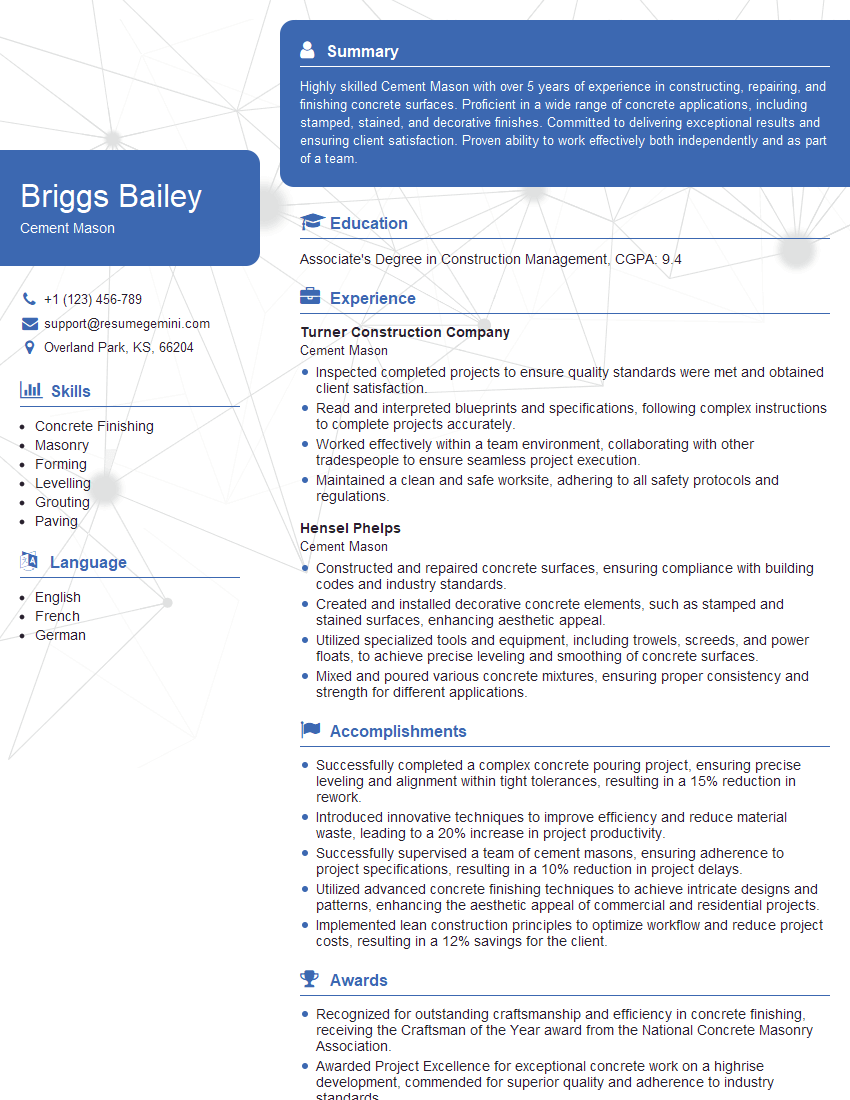
Mastering the art of pouring and finishing concrete opens doors to rewarding careers with excellent growth potential. Demand for skilled concrete workers remains consistently high, offering opportunities for advancement and higher earning potential. To maximize your job prospects, create a strong, ATS-friendly resume that showcases your skills and experience effectively. ResumeGemini is a trusted resource for building professional resumes that stand out. They provide examples of resumes tailored specifically to the Pouring and Finishing Concrete field, ensuring your application makes a lasting impression. Take the next step towards your dream career – build a winning resume today!






Explore more articles
Users Rating of Our Blogs
Share Your Experience
We value your feedback! Please rate our content and share your thoughts (optional).
What Readers Say About Our Blog
To the interviewgemini.com Webmaster.
Very helpful and content specific questions to help prepare me for my interview!
Thank you
To the interviewgemini.com Webmaster.
This was kind of a unique content I found around the specialized skills. Very helpful questions and good detailed answers.
Very Helpful blog, thank you Interviewgemini team.