Cracking a skill-specific interview, like one for Power Electronic Converters, requires understanding the nuances of the role. In this blog, we present the questions you’re most likely to encounter, along with insights into how to answer them effectively. Let’s ensure you’re ready to make a strong impression.
Questions Asked in Power Electronic Converters Interview
Q 1. Explain the working principle of a buck converter.
A buck converter, also known as a step-down converter, is a DC-to-DC power electronic converter that steps down a higher input voltage to a lower output voltage. Imagine it like a water faucet – you control the flow to get the desired pressure (voltage). It achieves this using a switching element (typically a MOSFET or IGBT), an inductor, a capacitor, and a diode.
The working principle involves rapidly switching the transistor on and off. When the transistor is ON, current flows through the inductor, storing energy in its magnetic field. When the transistor is OFF, the inductor’s stored energy is released through the diode, charging the capacitor and supplying the load. The average output voltage is controlled by the duty cycle of the switching signal, i.e., the percentage of time the transistor is ON. A higher duty cycle results in a higher average output voltage.
In essence: The inductor smooths the pulsed current, and the capacitor smooths the voltage ripple, providing a relatively stable DC output voltage. The duty cycle acts as a control knob to adjust the output voltage precisely. Think of it like carefully controlling the flow of water from the faucet to get the exact pressure you need.
Q 2. Describe the different types of power electronic converters and their applications.
Power electronic converters are broadly classified into several categories based on their input and output voltage and current characteristics. Here are some key types:
- DC-DC Converters: These convert a DC voltage to a different DC voltage. Examples include buck (step-down), boost (step-up), buck-boost (both step-up and step-down), and Cuk converters. Applications range from powering laptops and mobile devices to regulating voltages in renewable energy systems.
- AC-DC Converters (Rectifiers): These convert AC voltage to DC voltage. Common types include controlled rectifiers (like thyristor-based rectifiers) and uncontrolled rectifiers (like diode bridges). Applications include power supplies for various electronic devices and charging batteries.
- DC-AC Converters (Inverters): These convert DC voltage to AC voltage at a desired frequency and amplitude. They’re crucial for applications like solar power systems, uninterruptible power supplies (UPS), and electric vehicle motor drives.
- AC-AC Converters: These convert AC voltage of one frequency to AC voltage of another frequency. Examples include cycloconverters and matrix converters, often used in variable-speed motor drives and power factor correction.
The choice of converter depends on the specific application requirements, such as input/output voltage levels, power rating, efficiency needs, and control requirements.
Q 3. What are the advantages and disadvantages of different PWM techniques?
Pulse Width Modulation (PWM) is a technique used to control the average output of a switching converter by varying the width of the pulses. Several PWM techniques exist, each with its own advantages and disadvantages:
- Sine-PWM (SPWM): Generates a PWM waveform that closely resembles a sine wave, reducing harmonic distortion. Advantages: Low harmonic distortion, good for motor drives. Disadvantages: More complex implementation, higher switching losses for higher frequencies.
- Space-Vector PWM (SVPWM): Optimizes switching states to minimize harmonic distortion and reduce switching losses. Advantages: Lower harmonic distortion, reduced switching losses compared to SPWM. Disadvantages: More complex implementation.
- Triangle-PWM (TPWM): Compares a control signal to a triangular carrier wave. Advantages: Simple implementation. Disadvantages: Relatively high harmonic distortion.
The selection of a PWM technique depends on the specific application requirements and trade-offs between harmonic distortion, switching losses, and implementation complexity. For high-power applications where efficiency is paramount, SVPWM is often preferred. For simpler applications, TPWM might suffice.
Q 4. How do you select the appropriate switching frequency for a converter?
Selecting the appropriate switching frequency is a critical design consideration. It involves balancing several factors:
- Efficiency: Higher frequencies generally lead to smaller passive components (inductors and capacitors), but also increase switching losses. A sweet spot needs to be found where the reduction in component size outweighs the increased switching losses.
- EMI/EMC: Higher switching frequencies generate more electromagnetic interference (EMI), requiring careful filtering to meet electromagnetic compatibility (EMC) standards. This often involves adding EMI filters, increasing the cost and size of the converter.
- Controllability: The controller’s bandwidth and response time influence the suitable switching frequency. Higher frequencies can lead to instability if the controller cannot keep up.
- Audio Noise: Switching frequencies in the audible range can create annoying whining sounds. Selecting a frequency above the audible range is crucial for many applications.
A common approach involves starting with a frequency range based on the application (e.g., 20-100kHz for many DC-DC converters) and then iteratively optimizing the frequency through simulations and experimental testing to achieve the desired efficiency, EMI performance, and control stability.
Q 5. Explain the concept of duty cycle in a switching converter.
In a switching converter, the duty cycle (D) is the fraction of the switching period (T) during which the switching element is ON. It’s expressed as a percentage or a decimal value between 0 and 1. For instance, a duty cycle of 0.5 (or 50%) means the switch is ON for half the switching period and OFF for the other half.
The duty cycle directly influences the output voltage of the converter. In a buck converter, the output voltage (Vout) is approximately related to the input voltage (Vin) and duty cycle by the equation: Vout ≈ D * Vin
Precise control of the duty cycle is essential for regulating the output voltage. It’s achieved through various control techniques, such as pulse-width modulation (PWM) control, to maintain the desired output voltage even under varying load conditions.
Q 6. Describe the different types of power semiconductor devices and their characteristics.
Several power semiconductor devices are used in power electronic converters, each with its own characteristics:
- MOSFETs (Metal-Oxide-Semiconductor Field-Effect Transistors): These are voltage-controlled devices known for their fast switching speeds and relatively low on-resistance. They are widely used in high-frequency converters.
- IGBTs (Insulated Gate Bipolar Transistors): These combine the advantages of MOSFETs and bipolar junction transistors (BJTs), offering high voltage and current handling capabilities with relatively fast switching speeds. Ideal for high-power applications.
- Thyristors: These are current-controlled devices, including SCRs (Silicon Controlled Rectifiers), TRIACs, and GTOs (Gate Turn-Off Thyristors). They are commonly used in lower-frequency applications such as motor control and high-power rectifiers.
- Diodes: These are unidirectional current-blocking devices. Common types include fast recovery diodes, Schottky diodes, and PI-MOS diodes, each suited to different applications based on their switching speeds and voltage/current ratings.
The choice of device depends on the converter’s specifications, such as voltage and current ratings, switching frequency, and efficiency requirements. For instance, MOSFETs are preferred in high-frequency applications, while IGBTs are often chosen for high-power applications. Selecting the right device is critical for achieving optimal converter performance and reliability.
Q 7. How do you design a snubber circuit for a power electronic converter?
A snubber circuit is a protective network added across a switching device (like a MOSFET or IGBT) to reduce voltage and current stresses during switching transitions. This is vital to prevent damage to the switching device and improve converter efficiency.
A common snubber circuit configuration includes a resistor (R) and a capacitor (C) in series, connected in parallel across the switching device. When the switch turns OFF, the capacitor absorbs the energy stored in the parasitic inductance of the circuit, preventing voltage spikes. The resistor dissipates the energy stored in the capacitor. The values of R and C are carefully chosen based on several factors, including the switching frequency, the parasitic inductance, and the voltage rating of the switching device.
Designing a snubber circuit typically involves these steps:
- Analyze the circuit: Determine the parasitic inductance and capacitance in the circuit that contribute to voltage and current overshoots during switching.
- Calculate component values: Use appropriate formulas to determine the values of the resistor and capacitor in the snubber circuit to effectively clamp the voltage overshoots and limit the current during turn-off. This often involves considering the switching speed and power rating of the device.
- Simulate and test: Use simulation tools to verify the design and confirm that the snubber circuit effectively reduces voltage and current stresses. Testing is essential to validate the simulation results and ensure that the snubber circuit meets the desired performance specifications.
Designing a snubber circuit requires a deep understanding of the switching characteristics of the power semiconductor device and the overall converter dynamics. Improper design can lead to inefficiency or inadequate protection, which can damage the converter components. Advanced snubber circuits utilize more sophisticated techniques to further improve efficiency and reduce losses.
Q 8. Explain the concept of electromagnetic interference (EMI) and how it is mitigated in power converters.
Electromagnetic Interference (EMI) refers to unwanted electromagnetic energy that interferes with the proper functioning of electronic devices. In power converters, the switching of high currents and voltages creates significant EMI, potentially disrupting nearby equipment or causing malfunction. Think of it like a noisy radio station interfering with your favorite music – the noise is the EMI.
Mitigation techniques focus on reducing the emission and improving the immunity of the converter. Common methods include:
- Shielding: Enclosing the converter in a metallic enclosure to block electromagnetic radiation.
- Filtering: Employing EMI filters (LC filters or more complex designs) at the input and output to attenuate high-frequency noise.
- Layout and Component Selection: Careful PCB design with appropriate grounding, short traces, and the use of low-EMI components. Placing sensitive components away from high-noise areas is critical.
- Switching Techniques: Using soft-switching techniques (like zero-voltage switching or zero-current switching) to reduce the rate of voltage and current changes, minimizing EMI generation.
- Common-Mode Chokes: These chokes suppress common-mode noise, which is a type of EMI that radiates more easily.
For example, a poorly designed switch-mode power supply in a medical device could generate enough EMI to interfere with nearby sensitive equipment, leading to incorrect readings or even malfunction. Proper EMI mitigation is crucial for safety and reliable operation.
Q 9. What are the different types of losses in a power converter and how are they minimized?
Losses in power converters reduce efficiency and generate heat. They can be broadly classified as:
- Conduction Losses: Losses in the semiconductor devices (IGBTs, MOSFETs, diodes) due to their on-state resistance. Think of it like friction in a mechanical system. These losses are proportional to the square of the current.
- Switching Losses: Losses that occur during the switching transitions of the semiconductor devices. These are due to the simultaneous presence of voltage and current during turn-on and turn-off. Reducing switching times is key to minimizing these losses.
- Core Losses (inductors and transformers): Losses in the magnetic cores due to hysteresis and eddy currents. These losses are dependent on the frequency and flux density in the core. Using low-loss core materials (like ferrite) is crucial.
- Capacitor Losses: Losses in the capacitors due to ESR (Equivalent Series Resistance) and ESL (Equivalent Series Inductance). These losses increase with frequency and current.
- Gate Drive Losses (for IGBTs and MOSFETs): Power consumed by the gate driver circuits to switch the devices. Efficient gate drivers minimize these losses.
Minimizing losses involves selecting components with low on-state resistance, using soft-switching techniques, employing efficient gate drive circuits, and optimizing the design of inductors and transformers for minimum core losses. For instance, the choice of a low-ESR capacitor can significantly reduce conduction losses in a DC-DC converter.
Q 10. Explain the concept of thermal management in power electronic converters.
Thermal management in power electronic converters is crucial for ensuring reliable and long-lasting operation. Excessive heat can degrade components, leading to performance degradation, malfunction, or even catastrophic failure. Think of it as maintaining a comfortable temperature for the ‘heart’ of your power supply.
Effective thermal management involves understanding the heat generated within the converter and efficiently dissipating this heat to the ambient environment. Techniques include:
- Heat Sinks: Passive cooling devices that increase the surface area for heat dissipation.
- Fans: Active cooling devices that force air across heat sinks, increasing cooling capacity.
- Liquid Cooling: A more sophisticated cooling technique that uses liquids to transfer heat more efficiently, especially suitable for high-power converters.
- Component Placement and Packaging: Strategically placing components and using appropriate packaging to facilitate heat flow.
- Thermal Interface Materials (TIMs): Using thermal pastes or pads to improve heat transfer between components and heat sinks.
Proper thermal design is essential for maintaining the junction temperature of semiconductor devices within safe operating limits, as specified by the manufacturer’s datasheet. Neglecting thermal management can result in premature failure and significantly reduce the lifespan of a converter.
Q 11. How do you perform a thermal analysis of a power converter?
Thermal analysis of a power converter involves determining the temperature distribution within the converter under different operating conditions. This helps in ensuring that the component temperatures remain within safe limits. It’s like taking the ‘temperature’ of your power supply’s components.
The process usually involves:
- Power Loss Calculation: Determining the power losses in each component using simulation tools or analytical methods. This requires knowledge of component parameters and operating conditions.
- Thermal Modeling: Creating a thermal model of the converter using software tools like ANSYS or COMSOL. This model considers factors like component thermal resistance, heat sink properties, and airflow.
- Simulation and Analysis: Running simulations to predict the temperature distribution within the converter under various operating scenarios (e.g., different load currents, ambient temperatures).
- Verification and Validation: Comparing simulated results with experimental measurements to validate the accuracy of the thermal model.
For instance, a simulation might show that a particular MOSFET is operating beyond its maximum junction temperature limit, indicating a need for design modifications, such as adding a larger heat sink or employing a different cooling technique.
Q 12. Explain the importance of power factor correction (PFC) in power converters.
Power Factor Correction (PFC) is a technique used to improve the power factor of a power converter, making it draw current from the mains in a sinusoidal waveform that is in phase with the voltage. A low power factor leads to increased current draw, higher losses in the power grid, and can even lead to penalties from the utility company.
Imagine a water pump – a high power factor is like the pump efficiently drawing water, while a low power factor is like it drawing water in short bursts, creating inefficient use of energy and higher stress on the pipes.
The importance of PFC lies in:
- Reduced Harmonic Distortion: Improving the waveform shape of the input current reduces harmonic distortion, which affects the quality of the power supply and can damage other equipment.
- Increased Efficiency: Improved power factor leads to reduced current draw, minimizing losses in the power grid and the converter.
- Compliance with Regulations: Many jurisdictions have regulations that limit harmonic distortion, making PFC mandatory for many power electronic devices.
In short, PFC is critical for building efficient and compliant power converters, reducing energy waste and ensuring grid stability.
Q 13. Describe different PFC topologies and their advantages and disadvantages.
Several PFC topologies exist, each with its advantages and disadvantages:
- Boost PFC: A widely used topology that elevates the input voltage to a higher DC level. It’s relatively simple but can have high voltage stress on the components.
- Buck-Boost PFC: Offers both boost and buck functionality, providing flexibility in input and output voltage levels. It’s more complex than the boost topology.
- Cuk PFC: A topology that achieves PFC with a single inductor, offering advantages in some applications. It’s more complex compared to Boost.
- Multi-phase PFC: Uses multiple phases to reduce input current ripple and improve efficiency, especially useful for high-power applications. This topology offers improved performance compared to single-phase converters but increases design complexity.
The choice of topology depends on factors like the input voltage range, required output voltage, efficiency requirements, size constraints, and cost considerations. For example, a boost PFC is often preferred in applications where a high DC voltage is required, while a multi-phase PFC might be chosen for high-power applications requiring low input current ripple.
Q 14. How do you design a control system for a power electronic converter?
Designing a control system for a power electronic converter involves selecting an appropriate control strategy and implementing it using hardware and software. It’s like the ‘brain’ of the power supply, managing the flow of energy efficiently and accurately.
The process typically involves:
- Defining Specifications: Establishing the desired performance characteristics, such as output voltage regulation, transient response, efficiency, and protection mechanisms.
- Choosing a Control Topology: Selecting a suitable control scheme, such as voltage-mode control, current-mode control, or hybrid control strategies. The choice depends on the specific converter topology and desired performance.
- Designing the Control Algorithm: Developing the control algorithm using techniques like proportional-integral (PI) control or more advanced control methods like predictive control or model-predictive control.
- Implementing the Control System: Implementing the control algorithm using microcontrollers, DSPs, or FPGAs. This involves writing firmware to execute the control algorithm and interface with the converter’s hardware.
- Testing and Validation: Thoroughly testing the implemented control system to verify that it meets the design specifications and performs reliably under various operating conditions.
For instance, a PI controller is often used for regulating the output voltage of a DC-DC converter, adjusting the duty cycle of the switching devices to maintain a stable output voltage despite variations in the load current. However, more advanced control techniques may be needed for applications demanding high-dynamic performance.
Q 15. Explain different control techniques for power converters (e.g., PI, PID, etc.).
Power converter control techniques aim to regulate the output voltage or current to a desired setpoint. Common methods include Proportional-Integral (PI) and Proportional-Integral-Derivative (PID) controllers. Imagine you’re driving a car – you want to maintain a certain speed. A PI controller is like using the accelerator and brake. The proportional term adjusts the output based on the current error (difference between desired and actual speed), while the integral term addresses any persistent error, like a hill. A PID controller adds a derivative term, anticipating future errors based on the rate of change of the error. This is like predicting the need to brake before a sharp turn.
PI Controller: Simple and widely used, but can suffer from steady-state error. The control law is:
u(t) = Kp*e(t) + Ki*∫e(t)dt, whereu(t)is the control signal,e(t)is the error,Kpis the proportional gain, andKiis the integral gain.PID Controller: Offers better performance than PI, addressing both steady-state and transient errors. The control law is:
u(t) = Kp*e(t) + Ki*∫e(t)dt + Kd*de(t)/dt, whereKdis the derivative gain.Other techniques: More advanced techniques include predictive controllers, model predictive control (MPC), and sliding mode control (SMC), offering enhanced performance but added complexity. These are crucial for applications needing precise control under dynamic conditions, like motor drives or grid-tied inverters.
Career Expert Tips:
- Ace those interviews! Prepare effectively by reviewing the Top 50 Most Common Interview Questions on ResumeGemini.
- Navigate your job search with confidence! Explore a wide range of Career Tips on ResumeGemini. Learn about common challenges and recommendations to overcome them.
- Craft the perfect resume! Master the Art of Resume Writing with ResumeGemini’s guide. Showcase your unique qualifications and achievements effectively.
- Don’t miss out on holiday savings! Build your dream resume with ResumeGemini’s ATS optimized templates.
Q 16. What are the challenges in designing high-frequency power converters?
Designing high-frequency power converters presents several challenges:
Increased Switching Losses: Higher switching frequencies lead to increased switching losses in semiconductors, requiring efficient devices and careful layout to minimize parasitic inductance and capacitance. This impacts efficiency and generates more heat.
Electromagnetic Interference (EMI): Fast switching generates significant EMI, necessitating careful design of EMI filters and shielded enclosures to meet regulatory standards and prevent interference with other electronic systems. Think of it like a radio station broadcasting very loudly and causing static on other channels.
Component Parasitics: At high frequencies, parasitic inductance and capacitance in components become more significant, affecting the converter’s performance and stability. Precise modeling and careful component selection are crucial.
Thermal Management: Higher switching losses lead to greater heat generation, demanding efficient heat sinks and thermal management strategies to prevent component failure. Effective cooling is paramount.
Cost and Complexity: High-frequency operation often requires more sophisticated control circuitry and higher-quality, more expensive components.
Q 17. Explain the concept of soft-switching techniques.
Soft-switching techniques aim to reduce switching losses in power converters by minimizing the rate of change of current and voltage during the switching transitions. Imagine turning a light switch slowly, reducing the spark, instead of flipping it rapidly. This is achieved by controlling the switching instants so that the voltage and current are near zero when the switch changes state.
Zero-Voltage Switching (ZVS): The switch is turned on when the voltage across it is zero, minimizing energy dissipation during turn-on. This is achieved by resonating the converter’s inductance and capacitance.
Zero-Current Switching (ZCS): The switch is turned off when the current through it is zero, minimizing energy dissipation during turn-off. This is achieved through resonant techniques similar to ZVS.
Quasi-Resonant Converters: These employ resonant circuits to achieve partial or complete soft-switching, providing a balance between switching losses and complexity.
Soft-switching leads to higher efficiency, lower EMI, and reduced thermal stress, making it highly desirable for high-power applications.
Q 18. How do you select the appropriate components for a power electronic converter?
Component selection in power electronic converters is crucial for performance, reliability, and cost-effectiveness. It’s a multifaceted process that involves considering several key factors:
Power Semiconductor Devices: Selection depends on voltage and current ratings, switching speed, switching losses, cost, and availability. Consider IGBTs (Insulated Gate Bipolar Transistors), MOSFETs (Metal-Oxide-Semiconductor Field-Effect Transistors), or SiC/GaN devices for high-frequency or high-power applications.
Passive Components: Inductors and capacitors must be rated for appropriate current, voltage, and frequency. Consider core material, size, and efficiency. For high-frequency operation, low-ESR (Equivalent Series Resistance) capacitors and low-ESL (Equivalent Series Inductance) inductors are crucial.
Magnetic Components: Transformer selection involves considering voltage and current ratings, core material (ferrite, powdered iron), efficiency, and leakage inductance. This impacts voltage regulation, EMI, and efficiency.
Control ICs: Selection depends on the control strategy, required features, and performance. Consider factors like processing speed, communication interfaces, and protection mechanisms.
Thermal Management Components: Heat sinks, fans, and thermal interface materials are crucial for effective heat dissipation, particularly in high-power applications. Poor thermal management can lead to premature component failure.
Component datasheets and simulations play a crucial role in ensuring appropriate selection. Component derating is also important to ensure reliable operation under various stress conditions.
Q 19. Explain the concept of harmonic distortion and how it is measured.
Harmonic distortion in power electronic converters refers to the presence of unwanted frequency components (harmonics) in the output voltage or current waveform, in addition to the fundamental frequency. Think of a pure musical note (fundamental frequency) becoming distorted with added unpleasant sounds (harmonics). These harmonics are multiples of the fundamental frequency. They can cause problems like increased losses in the power system, interference with other equipment, and reduced power factor.
Harmonic distortion is measured using several metrics:
Total Harmonic Distortion (THD): This represents the overall amount of harmonic distortion and is expressed as a percentage of the fundamental component. A lower THD indicates a cleaner waveform.
Individual Harmonic Components: The amplitude of each harmonic component is measured to identify specific contributors to distortion. This allows you to pinpoint problem areas within the circuit.
Measurement involves using specialized instruments like power analyzers or oscilloscopes, which can capture and analyze the waveforms. THD is calculated using spectral analysis techniques that decompose the waveform into its frequency components.
Q 20. How do you design a filter for a power electronic converter?
Filter design for power electronic converters aims to attenuate the harmonics and other unwanted frequency components present in the output waveform, producing a cleaner waveform that meets regulatory standards. The filter’s characteristics depend on the specific application and requirements. Imagine a coffee filter removing grounds from your coffee – the filter here removes the unwanted frequencies.
Filter design involves several steps:
Specify Requirements: Define the acceptable level of harmonic distortion, ripple voltage, and impedance.
Choose Filter Topology: Common topologies include LC (inductor-capacitor) filters, LCL (inductor-capacitor-inductor) filters, and more complex multi-stage filters. The choice depends on the application and the level of attenuation needed. Simple LC filters are common but LCL filters are better at suppressing certain harmonics.
Design Filter Components: Calculate the values of inductors and capacitors needed to achieve the desired attenuation at specific frequencies using filter design techniques and software tools.
Simulation and Testing: Simulate the filter’s performance using software like MATLAB/Simulink or PSIM to verify its effectiveness. Prototype testing is crucial to validate the design and make adjustments.
Filter design is an iterative process involving component selection, simulation, and experimental validation.
Q 21. Describe the different types of magnetic components used in power converters.
Magnetic components play a vital role in power converters, primarily as inductors and transformers. The choice of magnetic component depends on factors like operating frequency, power level, size constraints, and cost.
Ferrite Cores: Widely used due to their high permeability and relatively low cost. Different ferrite materials are optimized for different frequency ranges. They are excellent for lower power and mid-range frequency applications.
Powdered Iron Cores: Suitable for high-power and high-frequency applications due to their high saturation flux density and good temperature stability. They are typically more expensive than ferrite cores.
Nanocrystalline Cores: Offer excellent performance at high frequencies with low core losses. They are expensive and may be better suited for high efficiency applications requiring small size.
Amorphous Cores: Exhibit very low core losses and high permeability, but can be brittle and sensitive to stress. These are a niche choice reserved for high-frequency applications where minimizing losses is paramount.
The choice of core material directly impacts the converter’s efficiency, size, and cost. Careful selection is crucial to optimize the overall design.
Q 22. Explain the importance of protection circuits in power converters.
Protection circuits in power converters are absolutely crucial for ensuring the safe and reliable operation of the system and protecting it from potentially damaging events. Think of them as the ‘safety net’ for your converter. Without them, even a minor fault could lead to catastrophic failure, damaging components, or even posing a safety hazard.
These circuits safeguard against various issues such as overcurrent, overvoltage, short circuits, and other unforeseen events. They typically involve a combination of sensors, monitoring circuitry, and protective devices that quickly react to abnormal conditions and take corrective action, often by disconnecting the power supply or limiting the current flow.
Q 23. Describe different protection techniques against overcurrent, overvoltage, and short circuit.
Different protection techniques target specific faults:
- Overcurrent Protection: This prevents excessive current flow, which can overheat and damage components. Common methods include fuses, circuit breakers, and current limiting circuits. For example, a fast-acting fuse will blow if the current exceeds its rating, quickly isolating the faulty section.
- Overvoltage Protection: This protects against voltage spikes that can damage semiconductor devices. Techniques include clamping circuits (using Zener diodes or Metal-Oxide Varistors – MOVs), crowbar circuits (short-circuiting the output to ground), and voltage limiting circuits. MOVs, for instance, shunt excessive voltage to ground, absorbing the energy and protecting sensitive electronics.
- Short Circuit Protection: This responds to a direct short circuit between the converter’s output terminals. Similar to overcurrent protection, fuses and circuit breakers are employed. In some sophisticated converters, active current limiting techniques, where the converter’s control system actively reduces the current, are also used.
Often, a combination of these techniques is employed to ensure comprehensive protection. The choice depends on the specific converter topology, application requirements, and cost constraints.
Q 24. How do you perform fault diagnosis in a power electronic converter?
Fault diagnosis in power electronic converters is a systematic process. It often starts with identifying the symptoms – for instance, the converter shuts down unexpectedly, or there are unusual noises or smells. Then, a structured approach is used:
- Data Acquisition: Collect data from various sensors within the converter, including current, voltage, temperature, and possibly gate signals. This data helps pinpoint the area of the problem.
- Symptom Analysis: Analyze the collected data to identify the type of fault. For example, a sudden drop in output voltage might indicate a short circuit, while sustained overcurrent could signal a faulty component.
- Isolation and Testing: Once the suspected fault area is identified, isolate the section for further testing. This could involve using a multimeter to check component values, or more advanced techniques like oscilloscope measurements to analyze waveforms.
- Component Replacement: After identifying the faulty component(s), replace them. It’s crucial to use components with the correct specifications.
- Verification and Retesting: After replacement, verify that the fault is resolved and retest the entire system to ensure correct operation.
Advanced diagnostic techniques might involve using specialized software and embedded systems for real-time monitoring and fault detection. In some cases, sophisticated algorithms, such as artificial intelligence, are being used to improve accuracy and speed of fault diagnosis.
Q 25. Explain the concept of efficiency and how it is measured in power converters.
Efficiency in a power converter refers to how effectively it converts input power into useful output power. It’s a crucial factor, especially in applications where energy saving is important. Think of it as the percentage of energy that makes it to its intended use, with the rest lost as heat.
Efficiency (η) is calculated as:
η = (Pout / Pin) * 100%
where Pout is the output power and Pin is the input power. Losses occur due to various factors including conduction losses in semiconductors and passive components, switching losses in the semiconductor devices, magnetic losses in inductors and transformers, and parasitic capacitances and inductances.
Improving efficiency is critical for reducing operating costs, minimizing heat dissipation, and improving the overall performance and lifespan of the system. Techniques for improving efficiency involve using high-efficiency components, optimizing switching frequencies, and employing advanced control strategies.
Q 26. Describe your experience with simulation tools for power electronics (e.g., PSIM, MATLAB/Simulink).
I have extensive experience using both PSIM and MATLAB/Simulink for power electronics simulation. PSIM is particularly useful for its intuitive interface and specialized libraries for power electronic components. I’ve used it extensively to model and simulate various converters, including buck, boost, and inverters, analyzing their performance under different operating conditions. This includes detailed modeling of semiconductor switching characteristics, and loss calculations. For instance, I simulated a three-phase inverter for a motor drive application in PSIM, optimizing the control algorithm to minimize harmonic distortion.
MATLAB/Simulink, on the other hand, offers a more powerful and flexible environment for system-level simulations, allowing for integration with other control systems and signal processing blocks. I’ve utilized Simulink extensively for advanced control algorithm design and verification, particularly for complex systems like grid-tied inverters, where a detailed model of the grid interactions is required. In one project, I developed a robust control strategy in Simulink for a bidirectional DC-DC converter used in a renewable energy application, using Simulink’s model-based design capabilities to validate the control strategy before physical implementation.
Q 27. Explain a challenging project you worked on involving power electronics and how you overcame its difficulties.
One challenging project involved designing a high-efficiency, high-power density DC-DC converter for an electric vehicle application. The primary challenge was meeting stringent efficiency requirements (above 98%) while maintaining a compact size and managing thermal constraints at high power levels. This required careful component selection, optimization of the switching frequency, and the implementation of advanced control techniques.
We initially faced difficulty meeting the efficiency target using a conventional design. To overcome this, we explored several strategies, including:
- Optimized switching strategy: We implemented a novel soft-switching technique to reduce switching losses significantly.
- Advanced gate driver: We used a fast gate driver to minimize turn-on and turn-off times of the MOSFETs.
- Thermal management: We designed a highly effective heat sink and cooling system to keep the temperature within acceptable limits.
- Component selection: We carefully selected high-efficiency components, including MOSFETs and inductors, to minimize conduction losses.
Through a combination of these strategies, we successfully achieved the desired efficiency and power density targets. This project taught me the importance of a holistic approach to power electronics design, considering not just individual components but also the overall system integration and thermal management.
Key Topics to Learn for Power Electronic Converters Interview
- Power Semiconductor Devices: Understand the characteristics and operation of MOSFETs, IGBTs, thyristors, and diodes. Consider their switching behavior, losses, and thermal management.
- Converter Topologies: Master the principles and applications of various converter topologies such as buck, boost, buck-boost, and Cuk converters. Analyze their voltage and current waveforms, and understand their advantages and disadvantages.
- Control Techniques: Familiarize yourself with different control strategies including PWM (Pulse Width Modulation), hysteresis control, and feedback control methods. Be prepared to discuss their stability and performance.
- Power Factor Correction (PFC): Understand the importance of PFC and the various techniques used to achieve it, such as boost PFC and active PFC. Be ready to discuss their impact on efficiency and harmonic reduction.
- DC-DC Converters: Explore different types of DC-DC converters, their applications in various systems (e.g., renewable energy, electric vehicles), and their design considerations.
- AC-DC Converters (Rectifiers): Understand different rectifier topologies, including uncontrolled and controlled rectifiers. Analyze their input and output waveforms, and discuss their efficiency and harmonic content.
- DC-AC Converters (Inverters): Explore different inverter topologies, such as single-phase and three-phase inverters. Analyze their output waveforms, harmonic content, and control strategies.
- Magnetic Components: Gain a working knowledge of the design and selection of inductors and transformers for power electronic converters. Understand core losses, saturation, and leakage inductance.
- Modeling and Simulation: Develop proficiency in simulating power electronic converters using tools like MATLAB/Simulink or PSIM. Be able to analyze their performance under different operating conditions.
- Practical Applications: Be ready to discuss real-world applications of power electronic converters, such as renewable energy systems, electric vehicle drives, and industrial motor control.
Next Steps
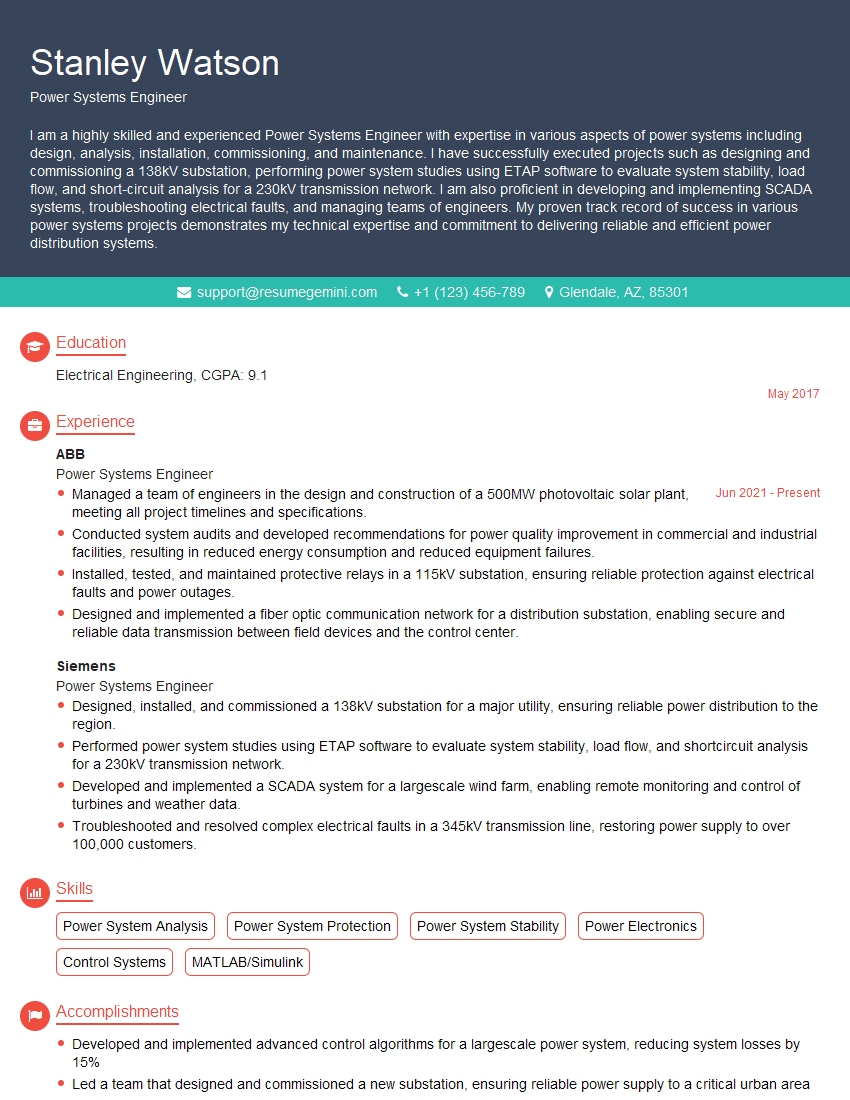
Mastering Power Electronic Converters opens doors to exciting careers in diverse and rapidly growing fields. A strong understanding of these concepts is highly sought after by employers. To maximize your job prospects, create an ATS-friendly resume that effectively highlights your skills and experience. ResumeGemini is a trusted resource for building professional resumes that get noticed. We offer examples of resumes tailored specifically to the Power Electronic Converters field to help you get started. Let us help you showcase your expertise and land your dream job!
Explore more articles
Users Rating of Our Blogs
Share Your Experience
We value your feedback! Please rate our content and share your thoughts (optional).
What Readers Say About Our Blog
To the interviewgemini.com Webmaster.
Very helpful and content specific questions to help prepare me for my interview!
Thank you
To the interviewgemini.com Webmaster.
This was kind of a unique content I found around the specialized skills. Very helpful questions and good detailed answers.
Very Helpful blog, thank you Interviewgemini team.