Unlock your full potential by mastering the most common Power Electronics and Controls interview questions. This blog offers a deep dive into the critical topics, ensuring you’re not only prepared to answer but to excel. With these insights, you’ll approach your interview with clarity and confidence.
Questions Asked in Power Electronics and Controls Interview
Q 1. Explain the difference between a buck, boost, and buck-boost converter.
Buck, boost, and buck-boost converters are all DC-DC converters, meaning they change the voltage level of a direct current (DC) source. The key difference lies in their output voltage relative to their input voltage.
- Buck Converter: A buck converter steps down the input voltage. Imagine it like a water tap – you can control the flow (current) and reduce the pressure (voltage). It achieves this by using a switch (typically a MOSFET or IGBT) to control the amount of time the input voltage is connected to the output. The average output voltage is always less than the input voltage. Example: Converting a 12V battery to 5V for powering a microcontroller.
- Boost Converter: A boost converter steps up the input voltage. This is like using a pump to increase the water pressure. It uses an inductor to store energy during the switch’s on-time and releases it to the output during the off-time, resulting in a higher output voltage than the input. Example: Generating a higher voltage from a low-voltage solar panel.
- Buck-Boost Converter: A buck-boost converter can step up or step down the input voltage, depending on the duty cycle of the switch. It’s more complex than the buck or boost, but offers greater flexibility. The output voltage has opposite polarity to the input voltage. Example: A negative voltage supply from a positive input.
All three converters use inductors and capacitors to smooth out the output voltage and current, resulting in a relatively constant DC output despite the switching action.
Q 2. Describe the operation of a three-phase inverter.
A three-phase inverter converts DC power to three-phase AC power. This is crucial for driving three-phase AC motors, which are highly efficient and prevalent in industrial applications. The inverter uses six switching devices (typically IGBTs or MOSFETs) arranged in a bridge configuration (two switches per phase). These switches are rapidly turned on and off, creating a pulse-width modulated (PWM) waveform. The switching pattern controls the magnitude and frequency of the AC output.
The operation involves sequentially switching the devices to create a three-phase voltage waveform. Consider a simplified example: if you imagine each phase as a sinusoidal wave, the inverter cleverly switches the transistors to approximate this waveform by switching between positive and negative DC rails.
Different PWM techniques are employed to generate high-quality AC output, reducing harmonics and improving motor performance. Space vector modulation (SVM) is a popular method known for its efficiency. The control system often involves a microcontroller or digital signal processor (DSP) to manage the switching sequence based on desired parameters such as frequency and amplitude.
Q 3. What are the different types of motor control techniques?
Motor control techniques aim to precisely manage the speed, torque, and position of an electric motor. Several techniques exist, categorized broadly as:
- Scalar Control (V/f Control): This simple method maintains a constant V/f ratio (voltage to frequency) to control motor speed. While easy to implement, it’s less efficient and precise than vector control, especially at low speeds or varying loads.
- Vector Control (Field-Oriented Control): A more sophisticated technique that independently controls the stator flux and torque components. This leads to better dynamic response, higher efficiency, and precise control over torque and speed, especially during transient conditions. It is computationally more intensive.
- Direct Torque Control (DTC): This method directly controls the motor’s torque and flux by switching the inverter devices based on calculated torque and flux errors. It offers quick dynamic response, but can result in higher torque ripple.
The choice of technique depends on the application’s requirements. Scalar control might suffice for less demanding applications, while vector control is preferred for high-performance applications such as robotics or industrial automation where precise control is paramount.
Q 4. Explain the concept of Pulse Width Modulation (PWM) and its applications.
Pulse Width Modulation (PWM) is a technique used to generate a variable average voltage from a fixed DC voltage source. This is achieved by rapidly switching the DC voltage on and off, controlling the ‘duty cycle’ – the ratio of on-time to the total period. The average output voltage is proportional to the duty cycle.
Imagine a light bulb: You can’t easily change the brightness continuously, but you can rapidly turn it on and off. The faster you switch, and the higher the duty cycle, the brighter the bulb appears. PWM effectively mimics a variable voltage by varying the average voltage.
Applications of PWM:
- Motor Control: PWM is extensively used in motor drives to control the motor’s speed and torque.
- DC-DC Converters: PWM regulates the output voltage in buck, boost, and buck-boost converters.
- Lighting Control: PWM is used to control the brightness of LED lights, allowing for dimming and energy saving.
- Audio Amplifiers: Class D audio amplifiers employ PWM to generate high-efficiency audio signals.
Q 5. How do you select appropriate switching devices for a power converter?
Selecting appropriate switching devices for a power converter involves careful consideration of several factors:
- Voltage and Current Ratings: The device must withstand the maximum voltage and current stresses in the converter’s operation. Safety margins are crucial.
- Switching Frequency: Higher switching frequencies often lead to smaller components, but require devices with faster switching speeds. This impacts switching losses.
- Switching Losses: Losses during the switching transitions contribute to heat generation. Selecting devices with low switching losses is crucial for efficiency.
- Conduction Losses: Losses due to current flowing through the device when it’s on. This is directly related to the device’s on-resistance (RDS(on) for MOSFETs).
- Cost and Availability: Balancing performance with cost is always important. The chosen device needs to be readily available.
- Thermal Considerations: The device’s thermal characteristics, including its junction temperature and thermal resistance, directly influence the need for and design of the heat sink.
A thorough analysis of the converter’s operating conditions and requirements is necessary before selecting the appropriate switching device. Simulation tools often aid in this process.
Q 6. What are the advantages and disadvantages of using different power semiconductor devices (IGBTs, MOSFETs, etc.)?
IGBTs (Insulated Gate Bipolar Transistors) and MOSFETs (Metal-Oxide-Semiconductor Field-Effect Transistors) are commonly used power semiconductor devices, each with its strengths and weaknesses:
- IGBTs:
- Advantages: Higher voltage and current handling capability than MOSFETs, lower conduction losses at higher currents.
- Disadvantages: Slower switching speeds, higher switching losses compared to MOSFETs, more susceptible to shoot-through currents (concurrent conduction of both transistors in a half-bridge configuration).
- MOSFETs:
- Advantages: Fast switching speeds, lower switching losses, simpler gate drive circuitry.
- Disadvantages: Lower voltage and current handling capability compared to IGBTs, higher conduction losses at higher currents, can experience significant voltage drop with increasing currents.
The choice between IGBTs and MOSFETs depends on the specific application requirements. For high-power applications requiring high current handling capability, IGBTs might be preferred, despite their slower switching speed. Conversely, for applications demanding high switching frequency and low switching losses, MOSFETs are often the better choice, even if they might have higher conduction losses. SiC and GaN devices offer improvements over traditional silicon devices in both parameters, particularly higher switching frequencies and lower conduction losses. However, they are currently more costly.
Q 7. Explain the design considerations for a heat sink in a power electronics application.
Heat sink design in power electronics is critical for managing the heat generated by power semiconductor devices and ensuring reliable operation. Several key considerations are involved:
- Thermal Resistance: Minimizing the thermal resistance between the device, heat sink, and ambient environment is essential. This involves selecting a heat sink with a low thermal resistance, ensuring good thermal contact between the device and heat sink (using thermal paste), and providing adequate airflow.
- Surface Area: A larger surface area allows for more efficient heat dissipation. The heat sink design should maximize surface area while maintaining mechanical integrity and weight considerations.
- Material Selection: Aluminum is commonly used due to its good thermal conductivity and relatively low cost. Other materials such as copper offer even better thermal conductivity, but are often more expensive and heavier.
- Airflow: Natural convection can be sufficient for low-power applications. However, for high-power applications, forced air cooling using fans or other means is typically necessary. Heat sink design should be optimized for the chosen cooling method.
- Mounting: Proper mounting of the heat sink is essential for effective heat transfer. The mounting method should ensure good mechanical contact and prevent vibrations that could disrupt the thermal interface.
- Ambient Temperature: The ambient temperature significantly influences the heat sink’s performance. The design should account for the highest expected ambient temperature.
Thermal analysis using simulation software can help optimize heat sink design and ensure adequate cooling to prevent overheating and device failure. Often a balance between cost, size, and thermal performance needs to be reached.
Q 8. Describe different types of power losses in a power converter and how to minimize them.
Power losses in a power converter are a critical concern, impacting efficiency and potentially leading to overheating and component failure. They can be broadly categorized into conduction losses, switching losses, and other miscellaneous losses.
- Conduction Losses: These are caused by the inherent resistance of components like transistors, diodes, and inductors. Current flowing through these components generates heat (Ploss = I²R). Minimizing these losses involves selecting components with low on-resistance (RDS(on) for MOSFETs, for example) and operating at lower currents whenever possible. Careful thermal design, including heatsinks, is also crucial.
- Switching Losses: These arise during the transition between the on and off states of switching devices. They include turn-on and turn-off losses, which involve energy dissipated during the switching transient. Minimizing these losses requires employing fast switching devices, gate drivers with optimized drive waveforms, and techniques like soft-switching (e.g., zero-voltage switching or zero-current switching) to reduce the overlap between voltage and current during switching.
- Other Losses: These include core losses in inductors and transformers (hysteresis and eddy current losses), gate drive losses (power consumed by the gate driver circuitry), and losses in capacitors (dielectric losses). Minimizing these requires selecting components with low core losses, efficient gate drivers, and low-ESR (Equivalent Series Resistance) capacitors.
Example: In a high-frequency DC-DC converter, careful selection of MOSFETs with low RDS(on) and the implementation of a soft-switching technique like zero-voltage switching (ZVS) can significantly reduce both conduction and switching losses, leading to a higher efficiency converter.
Q 9. How do you analyze the stability of a closed-loop control system?
Analyzing the stability of a closed-loop control system in power electronics involves assessing its response to disturbances and ensuring it doesn’t oscillate uncontrollably or become unstable. Several methods can be employed:
- Bode Plot Analysis: This classical technique uses the frequency response of the open-loop transfer function to determine gain and phase margins. Sufficient gain margin (typically >6dB) and phase margin (typically >45°) indicate stability. A Bode plot visually shows the system’s response across various frequencies.
- Root Locus Analysis: This method plots the locations of the closed-loop poles as a system parameter (e.g., gain) is varied. Stability is assessed by observing whether the poles remain in the left-half of the s-plane (for continuous-time systems). A root locus plot helps visualize how the system’s poles change with variations in parameters.
- Nyquist Stability Criterion: This criterion uses the Nyquist plot of the open-loop transfer function. Stability is determined by examining the number of encirclements of the -1 point by the Nyquist plot. This method is particularly useful for systems with time delays.
- State-Space Analysis: For more complex systems, a state-space representation can be used. Eigenvalues of the system matrix determine stability. Negative real parts of the eigenvalues indicate stability.
Example: In a buck converter control system, a Bode plot analysis of the open-loop transfer function can be performed to determine the gain and phase margins. If the margins are insufficient, the controller parameters (e.g., proportional gain, integral gain) can be adjusted to achieve acceptable stability margins.
Q 10. Explain different control strategies for DC-DC converters (e.g., voltage mode, current mode).
DC-DC converters employ various control strategies to regulate the output voltage or current. Two common methods are:
- Voltage Mode Control: This method uses a feedback loop to compare the actual output voltage to a reference voltage. The error signal is then processed by a controller (typically a PI or PID controller) to generate a control signal that adjusts the duty cycle of the switching device. It’s simpler to implement but can suffer from instability at higher switching frequencies or with slow load changes.
- Current Mode Control: This approach involves an inner current loop and an outer voltage loop. The inner loop controls the inductor current, ensuring it follows a predefined reference waveform. The outer voltage loop then regulates the output voltage by adjusting the current reference. This method offers better dynamic response and faster transient performance compared to voltage mode control but can exhibit sub-harmonic oscillations if not carefully designed.
Other control strategies include:
- Average Current Mode Control: A variation of current mode control that averages the inductor current over a switching cycle, reducing the sensitivity to noise.
- Peak Current Mode Control: The inductor peak current is used for feedback, offering simplicity but potentially more sensitive to noise than average current mode.
Example: A typical application of voltage mode control is in a low-cost, low-power DC-DC converter for a mobile phone, while current mode control might be preferred for high-power applications requiring fast transient response, such as those found in servers.
Q 11. What are the different types of filters used in power electronics?
Filters are essential components in power electronics, used to reduce noise, harmonics, and unwanted frequency components. Common types include:
- LC Filters: These are passive filters using inductors (L) and capacitors (C) to attenuate high-frequency noise. Various configurations exist, including L, C, LC, and Π (pi) filters, each with different characteristics in terms of attenuation and impedance.
- Active Filters: These employ active components like operational amplifiers (op-amps) to provide greater flexibility in filter design, enabling higher attenuation and more precise control over the filter’s characteristics. They can also provide functionalities not possible with passive filters.
- Digital Filters: These are implemented using digital signal processors (DSPs) or microcontrollers. They offer high flexibility and precision but require A/D and D/A conversion. They’re particularly useful for adaptive filtering and advanced control algorithms.
- EMI/RFI Filters: These specialized filters are designed to suppress electromagnetic interference (EMI) and radio frequency interference (RFI). They often use combinations of inductors, capacitors, and ferrite beads to attenuate a wide range of frequencies.
Example: An LC filter is commonly used at the output of a switching power supply to reduce high-frequency switching noise and ensure compliance with EMI standards. Active filters might be employed for more advanced applications, such as noise cancellation in sensitive instrumentation.
Q 12. Explain the concept of power factor correction and its importance.
Power factor correction (PFC) is a technique to improve the power factor of a load, making it draw current more in phase with the voltage. A low power factor means the current waveform is distorted, leading to higher current demands on the power grid and increased losses in the distribution system.
Importance of PFC:
- Reduced Current Demand: Higher power factor reduces the peak current drawn from the mains, allowing for smaller and less expensive wiring and components.
- Improved Efficiency: Lower current reduces losses in the power distribution network.
- Compliance with Standards: Many jurisdictions have regulations mandating minimum power factor requirements for electrical equipment.
- Reduced Harmonics: PFC reduces harmonic distortion, improving the overall quality of the power grid.
Methods for PFC:
- Passive PFC: This uses passive components like capacitors and inductors to improve the power factor, but it is generally less effective than active methods.
- Active PFC: This employs a boost converter or other switching topologies to actively shape the input current waveform to be sinusoidal and in phase with the input voltage, significantly improving the power factor.
Example: In a high-power AC-DC power supply, an active PFC circuit, typically a boost converter with a control system that shapes the input current, is used to achieve a power factor close to unity (1.0), maximizing efficiency and meeting regulatory standards.
Q 13. How do you design a robust and efficient power supply for a specific application?
Designing a robust and efficient power supply for a specific application requires a systematic approach:
- Define Specifications: This involves identifying the required output voltage, current, power, efficiency, size constraints, and environmental conditions (temperature, humidity, etc.).
- Select Topology: Choose an appropriate converter topology (e.g., buck, boost, buck-boost, flyback, forward) based on the input and output voltage levels and power requirements. Consider efficiency and cost implications of each topology.
- Component Selection: Select components (switching devices, inductors, capacitors, transformers) considering their specifications (voltage, current, power ratings, efficiency, temperature characteristics), costs, and availability. Use simulation tools to verify component selections.
- Control System Design: Design a suitable control system to regulate the output voltage or current, ensuring stability and meeting transient response requirements. Choose appropriate control algorithms (voltage mode, current mode, etc.) and controller parameters.
- Thermal Management: Design a robust heat sink system to ensure the converter operates within safe temperature limits. Consider factors like ambient temperature, power dissipation, and thermal resistance.
- Protection Mechanisms: Implement protection circuits to safeguard the converter from overcurrent, overvoltage, short circuits, and other potential faults.
- Testing and Validation: Thoroughly test the design under various operating conditions to verify it meets the specified requirements and demonstrate its robustness. This includes efficiency testing, transient response testing, and safety testing.
Example: Designing a power supply for a server would involve considerations such as high power output, high efficiency, low noise, and redundancy features. A modular design using multiple smaller power supplies could be implemented for improved reliability.
Q 14. Describe different methods for protecting power electronics circuits from overcurrent, overvoltage, and short circuits.
Protecting power electronics circuits from various faults is critical for ensuring reliable and safe operation. Common protection methods include:
- Overcurrent Protection: This typically employs fuses, current limiters, or overcurrent relays to disconnect the circuit or limit the current flow if it exceeds a predefined threshold. This prevents damage to components due to excessive current.
- Overvoltage Protection: This uses Zener diodes, avalanche diodes, or voltage-sensitive switches to clamp the voltage to a safe level. This protects sensitive components from damage due to overvoltage transients.
- Short-Circuit Protection: Similar to overcurrent protection, short-circuit protection can use fuses or current limiters to interrupt the circuit if a short circuit occurs. It’s crucial to protect against catastrophic failures from short circuits.
- UVLO (Under-Voltage Lockout): This feature prevents the converter from starting or operating if the input voltage falls below a minimum threshold. This protects the converter from damaging low-voltage conditions.
- OVP (Over-Voltage Protection): This protects against excessively high output voltages. A feedback loop compares the output voltage with a reference; if it exceeds the limit, a shutdown signal is triggered.
- Thermal Protection: This uses thermal fuses or thermal sensors to shut down the converter if the temperature exceeds a safe operating temperature, preventing damage due to overheating.
Example: A typical switching power supply will incorporate a fuse for short-circuit protection, a current limiter to prevent overcurrent, a Zener diode or TVS (Transient Voltage Suppressor) diode for overvoltage protection, and a thermal shutdown circuit to protect against overheating.
Q 15. Explain the use of feedback control in power electronics.
Feedback control is crucial in power electronics for achieving precise and stable operation. Think of it like a thermostat regulating your home’s temperature. The desired temperature is the setpoint, and the actual temperature is the feedback. The controller compares these two and adjusts the heating/cooling system (the power electronic converter) to minimize the difference or error.
In power electronics, we often use Proportional-Integral-Derivative (PID) controllers. A PID controller uses three terms:
- Proportional (P): Responds to the current error. A larger error results in a larger corrective action.
- Integral (I): Addresses accumulated error over time, eliminating steady-state error (persistent offset between setpoint and actual value).
- Derivative (D): Predicts future error based on the rate of change of the error, improving response speed and stability.
For example, in a DC-DC converter, feedback control is used to regulate the output voltage. A voltage sensor measures the output voltage, and the controller adjusts the duty cycle of the switching elements to maintain the desired voltage. Without feedback control, variations in load or input voltage would significantly affect the output voltage, leading to unstable or unreliable operation.
Career Expert Tips:
- Ace those interviews! Prepare effectively by reviewing the Top 50 Most Common Interview Questions on ResumeGemini.
- Navigate your job search with confidence! Explore a wide range of Career Tips on ResumeGemini. Learn about common challenges and recommendations to overcome them.
- Craft the perfect resume! Master the Art of Resume Writing with ResumeGemini’s guide. Showcase your unique qualifications and achievements effectively.
- Don’t miss out on holiday savings! Build your dream resume with ResumeGemini’s ATS optimized templates.
Q 16. What are the challenges of high-frequency switching in power converters?
High-frequency switching offers several advantages, like reduced size and weight of passive components, but it also presents challenges:
- Increased Switching Losses: Higher frequencies mean more switching transitions per unit of time, leading to higher power losses in the semiconductor switches (MOSFETs, IGBTs).
- Electromagnetic Interference (EMI): Faster switching generates high-frequency electromagnetic emissions, which can interfere with other electronic circuits. Effective EMI filtering becomes crucial and complex.
- Circuit Parasitics: At higher frequencies, parasitic inductances and capacitances in the circuit become more significant, affecting the switching waveforms and potentially leading to instability. Careful layout and component selection are critical.
- Driver Circuit Complexity: Driving switches at higher frequencies requires faster and more precise gate drivers, adding to circuit complexity and cost.
- Thermal Management: The increased switching losses necessitate efficient thermal management, often requiring larger heatsinks or more sophisticated cooling techniques.
Consider a resonant converter operating at several MHz. The EMI generated needs careful management through proper shielding, filters, and layout techniques. Moreover, the semiconductor switch needs to withstand high-frequency switching stresses, demanding specialized devices.
Q 17. Explain the concept of soft switching techniques and their benefits.
Soft switching techniques aim to reduce switching losses by turning on and off the semiconductor switches when the voltage or current across them is zero or near-zero. This minimizes the energy dissipated during the switching transitions. Think of it like smoothly shifting gears in a car – less abrupt changes mean less wear and tear (and wasted energy).
Several soft-switching techniques exist:
- Zero-Voltage Switching (ZVS): Switches are turned on when the voltage across them is zero, eliminating turn-on switching losses.
- Zero-Current Switching (ZCS): Switches are turned off when the current through them is zero, minimizing turn-off losses.
Benefits:
- Reduced Switching Losses: This leads to higher efficiency and reduced heat generation.
- Lower EMI: Softer transitions reduce the high-frequency noise generated during switching.
- Smaller Passive Components: The increased efficiency allows for smaller inductors and capacitors.
An example of a soft-switching converter is a resonant converter which utilizes resonant circuits to shape the voltage and current waveforms, allowing for ZVS or ZCS operation. These are often used in high-power applications where efficiency is paramount.
Q 18. Describe the different types of magnetic components used in power electronics (e.g., transformers, inductors).
Magnetic components are fundamental in power electronics, playing roles in energy storage, transformation, and filtering. Common types include:
- Transformers: Used for voltage transformation (stepping up or down), isolation, and impedance matching. They have a primary winding and one or more secondary windings, coupled through a magnetic core.
- Inductors: Store energy in a magnetic field and are used for energy storage, filtering, current limiting, and shaping waveforms. They typically consist of a coil of wire wound around a magnetic core.
- Common-Mode Chokes: These suppress common-mode noise (noise current flowing in the same direction in multiple conductors) which is particularly important for reducing EMI.
- Current Transformers (CTs): Used for current sensing; they produce a smaller current proportional to the current in the primary winding, facilitating current measurement and control.
Different core materials (ferrites, powdered iron, etc.) are chosen based on frequency, power level, and specific application requirements. The core material significantly impacts the inductor’s or transformer’s characteristics.
Q 19. How do you choose the appropriate size and rating for magnetic components?
Choosing the right size and rating for magnetic components is critical for efficient and reliable operation. The process involves several steps:
- Determine the operating conditions: This includes the operating frequency, current, voltage, temperature, and desired inductance or turns ratio.
- Calculate the required component parameters: Use appropriate formulas to determine the necessary inductance, core size, and wire gauge based on the operating conditions.
- Consider the core material: Select a core material appropriate for the operating frequency and power level, balancing cost and performance. Ferrites are common for higher frequencies, while powdered iron cores might be suitable for lower frequencies and higher currents.
- Select a suitable component: Based on the calculated parameters, choose a commercially available component with sufficient margin for safety and to account for uncertainties.
- Verify the selection through simulation or prototyping: Simulate the design using appropriate software or build a prototype to validate performance under actual operating conditions.
For example, in designing a buck converter, the inductor must be sized to ensure sufficient energy storage to minimize output voltage ripple and avoid saturation. Undersizing can lead to excessive ripple and potential core saturation, while oversizing increases cost and size.
Q 20. Explain different types of power electronic systems used in renewable energy applications.
Power electronic systems are essential for integrating renewable energy sources into the grid. Common types include:
- Solar Inverters: Convert DC power from solar panels to AC power compatible with the grid. These can be single-phase or three-phase, and various topologies (e.g., grid-tied inverters) are used depending on the application.
- Wind Turbine Converters: Handle the variable speed and voltage output from wind turbines. These converters often use a combination of rectifier, DC-DC converter, and inverter stages for optimal grid integration.
- Fuel Cell Inverters: Convert the DC output of fuel cells into AC grid power, similar to solar inverters. These often require more robust control schemes due to fuel-cell system dynamics.
- Battery Chargers/Dischargers: Manage energy storage and flow from batteries, which often serve as a buffer for intermittent renewable sources. These systems usually employ bidirectional DC-DC converters for charging and discharging operations.
These systems ensure efficient power conversion, grid synchronization, and protection against grid faults. The specific choice of topology and control algorithm depends on the renewable source’s characteristics and grid requirements.
Q 21. What are the challenges in integrating renewable energy sources into the power grid?
Integrating renewable energy sources into the power grid presents several challenges:
- Intermittency: Solar and wind power are inherently intermittent, meaning their output fluctuates depending on weather conditions. This requires sophisticated grid management strategies to maintain stability.
- Voltage and Frequency Regulation: The variable nature of renewable sources can impact grid voltage and frequency, necessitating fast-acting control systems to maintain stability.
- Grid Stability: Large-scale integration of renewable energy can affect grid stability and increase the risk of blackouts. Advanced grid control techniques and energy storage solutions are vital to mitigate these risks.
- Power Quality: Renewable energy sources can introduce harmonics and other power quality issues into the grid, requiring effective filtering and compensation methods.
- Protection and Safety: Ensuring the safety of both the grid and the renewable energy systems requires robust protection mechanisms to prevent faults and damage.
For instance, a sudden decrease in solar power generation due to cloud cover requires rapid response from the grid to prevent voltage sags. This often involves sophisticated control systems that combine renewable energy sources with conventional power plants and energy storage systems.
Q 22. Describe the operation of a battery management system (BMS).
A Battery Management System (BMS) is essentially the brain of a battery pack, responsible for monitoring and controlling its operation to ensure safety, performance, and longevity. Think of it as a sophisticated ‘health monitor’ for your battery.
Its key functions include:
- Cell Voltage Monitoring: Each individual cell within a battery pack is monitored for its voltage. This is crucial because inconsistencies can lead to overcharging or over-discharging of individual cells, impacting performance and lifespan. A BMS continuously monitors these voltages to ensure they remain within safe operating limits.
- Temperature Monitoring: High or low temperatures can severely degrade battery performance and safety. The BMS incorporates temperature sensors to monitor the temperature of each cell or groups of cells, triggering protective actions if temperatures exceed safe thresholds.
- State of Charge (SOC) Estimation: The BMS estimates the remaining charge in the battery pack based on cell voltage, current, and temperature data. This is essential for providing accurate range information in electric vehicles and preventing deep discharges.
- State of Health (SOH) Estimation: Over time, batteries degrade. The BMS tracks parameters like capacity fade and internal resistance to estimate the remaining health of the battery. This helps in predicting battery life and enabling proactive maintenance.
- Charging and Discharging Control: The BMS controls the charging and discharging process, ensuring that the current and voltage remain within safe limits to prevent damage. It communicates with the charging system and the vehicle’s power electronics to manage the energy flow.
- Safety Protection: Perhaps the most critical function, the BMS incorporates various safety mechanisms such as over-current, over-voltage, under-voltage, and over-temperature protection. If any of these thresholds are exceeded, the BMS will immediately shut down the battery to prevent damage or hazards.
For example, in an electric vehicle, the BMS ensures that the battery pack is charged safely and efficiently, preventing damage from overcharging or rapid discharging. It also provides the driver with accurate information about the battery’s state of charge, allowing them to plan their journeys effectively.
Q 23. Explain different control strategies for electric vehicle (EV) powertrains.
Electric vehicle (EV) powertrain control strategies aim to optimize performance, efficiency, and driver experience. Several strategies exist, often used in combination:
- Open-Loop Control: This simpler approach uses pre-determined control signals based on driver inputs (e.g., accelerator pedal position). While easy to implement, it lacks precision and adaptability to changing conditions.
- Closed-Loop Control (Feedback Control): This approach incorporates feedback from sensors (e.g., motor speed, torque) to adjust the control signals, ensuring accurate tracking of desired performance. PID (Proportional-Integral-Derivative) controllers are commonly used for their robustness and ability to handle disturbances.
- Field-Oriented Control (FOC): This advanced technique is widely used in AC motor drives. It precisely controls the magnetic flux and torque of the motor by decoupling the control of the stator currents into flux-producing and torque-producing components. This allows for highly efficient and responsive motor control, maximizing torque and minimizing losses. This is frequently used in EVs for optimal performance.
- Direct Torque Control (DTC): Another method for AC motor control, DTC directly controls the motor torque and flux by switching the inverter’s power switches based on a switching table. DTC offers fast response and robust performance, but might produce more switching losses compared to FOC.
- Predictive Control: More computationally intensive, predictive control algorithms use models of the system to predict future behavior and optimize control actions accordingly. This leads to improved efficiency and performance, particularly in managing complex interactions within the powertrain.
The choice of strategy depends on factors like the type of motor (AC or DC), the required performance level, the computational resources available, and the cost constraints. Many modern EVs use a combination of these strategies to achieve optimal performance and efficiency.
Q 24. What are the considerations for designing a power electronics system for an electric vehicle?
Designing a power electronics system for an electric vehicle requires careful consideration of several key factors:
- Efficiency: Minimizing energy losses is crucial for maximizing the vehicle’s range. This involves selecting components with high efficiency and employing advanced control strategies to optimize energy flow.
- Power Density: Electric vehicles require high power outputs in a compact space. Power density is therefore a critical consideration, leading to the use of advanced components like wide bandgap semiconductors (SiC, GaN) for higher switching frequencies and lower losses.
- Thermal Management: High power densities generate significant heat. Effective thermal management is critical to ensure reliable operation and prevent component damage. This requires careful design of heat sinks, cooling systems, and component placement.
- Reliability and Durability: The power electronics system must withstand harsh operating conditions, including vibrations, temperature fluctuations, and potential abuse. Robust design and component selection are critical for ensuring long-term reliability.
- Cost: Balancing performance, efficiency, and reliability with cost is essential. This involves making careful trade-offs between different component options and design approaches.
- Safety: The system must incorporate safety features such as over-current protection, over-voltage protection, and fault detection mechanisms to prevent damage to the vehicle and ensure passenger safety. This often involves redundancy and fail-safe designs.
- Electromagnetic Compatibility (EMC): The power electronics system must comply with EMC standards to prevent interference with other electronic systems in the vehicle and to avoid generating electromagnetic emissions that could cause interference to external devices.
For example, the choice of semiconductor switches (IGBTs, MOSFETs, SiC MOSFETs, GaN FETs) significantly impacts efficiency and cost. Selecting a suitable cooling system (e.g., liquid cooling, air cooling) is crucial for managing heat dissipation effectively.
Q 25. Explain the use of digital signal processors (DSPs) and microcontrollers in power electronics control.
Digital Signal Processors (DSPs) and microcontrollers are essential for implementing advanced control algorithms in power electronics systems. They provide the computational power needed for real-time control and data processing.
- DSPs: DSPs are specialized processors optimized for handling numerical computations quickly and efficiently. They are particularly well-suited for implementing complex control algorithms like Field-Oriented Control (FOC) or predictive control, which require extensive calculations in real-time. A high-speed, floating-point DSP is often the cornerstone of high-performance control systems in EVs.
- Microcontrollers: Microcontrollers are more general-purpose processors that are often used for tasks such as communication, sensor interfacing, and low-level control functions. They can handle simpler control algorithms and manage the overall system functionality, interacting with the DSP for more complex computations. They also offer cost advantages over DSPs in situations where the computational demands are less stringent.
In a typical power electronics system, the DSP might handle the core control algorithm for the motor, while the microcontroller manages communication with the BMS, monitors sensor readings, and handles safety functions. They work together to create a robust and efficient control system. For example, in an EV’s inverter, the DSP might execute the FOC algorithm, while the microcontroller handles CAN bus communication, diagnostic monitoring, and fault handling.
//Example Code Snippet (Conceptual): //DSP code (Simplified FOC algorithm) float Ia, Ib, Ic; //Stator currents float Vd, Vq; //Desired d-q axis voltages // ... FOC calculations using Ia, Ib, Ic to determine Vd, Vq... // ... Generate PWM signals based on Vd, Vq ...
Q 26. Describe your experience with power electronics simulation software (e.g., PSIM, MATLAB/Simulink).
I have extensive experience using both PSIM and MATLAB/Simulink for power electronics simulations. These tools are invaluable for designing, analyzing, and verifying power electronic circuits before physical implementation. They allow for faster prototyping and help in identifying potential issues early in the design process.
In PSIM, I’ve modeled various converters such as DC-DC converters (buck, boost, buck-boost), DC-AC inverters (PWM, space vector modulation), and AC-DC rectifiers. I have utilized its powerful built-in component libraries to quickly assemble and simulate complex systems. I’ve found PSIM particularly useful for detailed analysis of waveforms and circuit behavior under different operating conditions. This has helped me in optimizing control parameters and identifying potential problems with switching patterns or component sizing.
MATLAB/Simulink, with its extensive toolboxes, allows for a higher level of abstraction and control. I’ve used it extensively for control algorithm design and verification, developing and testing control strategies using Simulink’s block diagrams. The ability to integrate MATLAB’s powerful numerical computation capabilities with Simulink’s modeling environment is invaluable for analyzing system performance and optimizing control parameters. I’ve used Simulink to create comprehensive models incorporating both the power electronics and the control systems for complete system simulations, helping me test everything from transient response to steady-state efficiency.
One specific project involved modeling a three-phase inverter for an electric vehicle using Simulink. Through extensive simulations, I optimized the PWM switching strategy to minimize harmonic distortion and improve efficiency. This led to a significant reduction in losses and improved overall system performance.
Q 27. Explain your understanding of electromagnetic compatibility (EMC) in power electronics.
Electromagnetic Compatibility (EMC) in power electronics is crucial for ensuring that a system doesn’t emit excessive electromagnetic interference (EMI) and is not susceptible to external electromagnetic interference. Power electronic converters, due to their switching nature, can generate significant EMI in the form of conducted and radiated emissions. These emissions can interfere with other electronic devices, causing malfunction or even damage.
Several considerations are essential for EMC design in power electronics:
- EMI Filtering: Input and output filters are used to attenuate conducted EMI. These filters typically consist of inductors, capacitors, and sometimes common-mode chokes.
- Shielding: Metal enclosures or conductive coatings are used to reduce radiated EMI. The effectiveness of shielding depends on the frequency of the emissions and the design of the enclosure.
- PCB Layout: Careful PCB layout design is essential to minimize EMI. This includes techniques like proper grounding, minimizing loop areas, and using shielded wires. A well-planned PCB layout can significantly reduce both conducted and radiated noise.
- Component Selection: Choosing components with low EMI characteristics is important. This often involves considering factors like the component’s parasitic capacitance and inductance.
- Switching Techniques: Employing soft-switching techniques can reduce EMI. These techniques aim to reduce the rate of change of current and voltage (dv/dt and di/dt), thus reducing the amount of EMI generated.
Non-compliance with EMC standards can lead to product rejection, safety issues, and regulatory fines. Therefore, thorough EMC testing and design are critical for the success of any power electronics system, particularly in safety-critical applications such as automotive.
Q 28. Describe your experience with different power electronics testing and measurement techniques.
My experience with power electronics testing and measurement encompasses a range of techniques, covering both hardware and software aspects.
- Waveform Acquisition: I’m proficient in using oscilloscopes, current probes, and voltage probes to acquire high-resolution waveforms of voltages and currents within power electronic circuits. This is essential for verifying circuit behavior, measuring switching losses, and identifying potential problems.
- Power Measurement: I’ve utilized power analyzers to measure power efficiency, input power, output power, and power factor. Accurate power measurement is essential for assessing the performance of power electronic converters.
- EMC Testing: I have conducted EMC testing to verify compliance with international standards. This involves using specialized equipment such as EMI receivers, conducted emission test equipment, and radiated emission test chambers.
- Thermal Testing: I’ve performed thermal testing to evaluate the thermal performance of power electronic components and systems. This involves using thermal cameras, thermocouples, and other thermal measurement techniques.
- Software-Based Testing: In conjunction with simulations, I frequently use software tools for data analysis and visualization, allowing me to process large datasets from testing, identify trends, and correlate simulation results with experimental measurements.
One notable project involved testing a high-power DC-DC converter. Using a combination of oscilloscopes, current probes, and power analyzers, we were able to pinpoint a switching loss issue that was not apparent in the initial simulations. By carefully analyzing the waveforms and identifying specific problematic switching events, we were able to modify the control algorithm and significantly improve the efficiency of the converter. This highlights the importance of comprehensive testing and measurement in developing reliable and high-performance power electronics systems.
Key Topics to Learn for Power Electronics and Controls Interview
- Power Semiconductor Devices: Understand the operating principles, characteristics, and limitations of MOSFETs, IGBTs, and other power switches. Consider their applications in various power electronic converters.
- DC-DC Converters: Master the analysis and design of buck, boost, buck-boost, and Cuk converters. Be prepared to discuss their control strategies (e.g., PWM, voltage-mode control) and efficiency considerations.
- AC-DC Converters (Rectifiers): Familiarize yourself with uncontrolled and controlled rectifiers, including single-phase and three-phase configurations. Understand their harmonic analysis and power factor correction techniques.
- DC-AC Converters (Inverters): Study the operation of various inverter topologies (e.g., H-bridge, multilevel inverters). Understand pulse width modulation (PWM) techniques and their impact on harmonic content and switching losses.
- Motor Drives: Gain a strong understanding of motor control techniques, such as vector control and field-oriented control, for both AC and DC motors. Be ready to discuss their implementation and performance characteristics.
- Power System Analysis: Develop your skills in analyzing power systems, including fault analysis, power flow studies, and stability analysis. This is crucial for understanding the interaction of power electronics with the grid.
- Control Systems Theory: Review fundamental concepts like transfer functions, stability analysis (Bode plots, Nyquist plots, root locus), and controller design (PID, state-space control). Apply these concepts to the control of power electronic converters.
- Digital Control and Microcontrollers: Understand the implementation of control algorithms using digital signal processors (DSPs) or microcontrollers. Be prepared to discuss real-time control and digital signal processing techniques.
- Power System Harmonics and Filtering: Understand the generation and mitigation of harmonics in power systems. Be familiar with different filtering techniques used to reduce harmonic distortion.
- Renewable Energy Integration: Familiarize yourself with the role of power electronics in integrating renewable energy sources (solar, wind) into the grid. Understand the challenges and solutions related to grid stability and power quality.
Next Steps
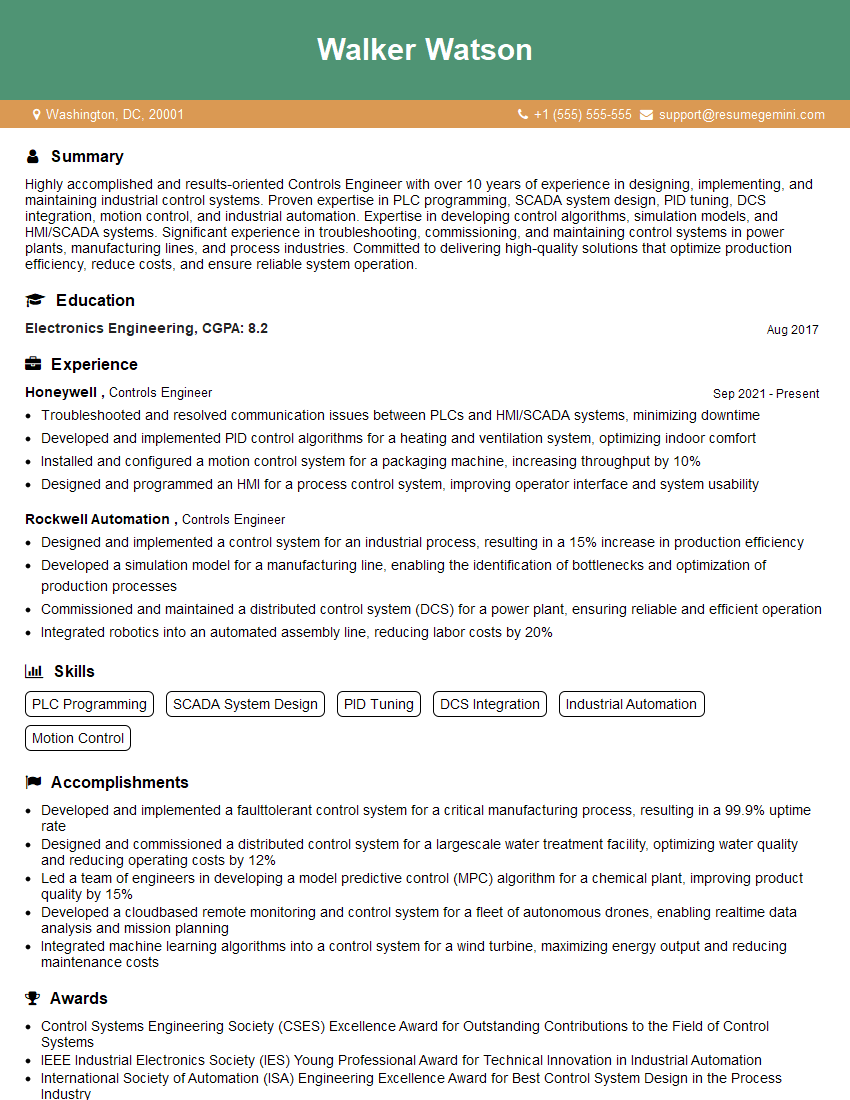
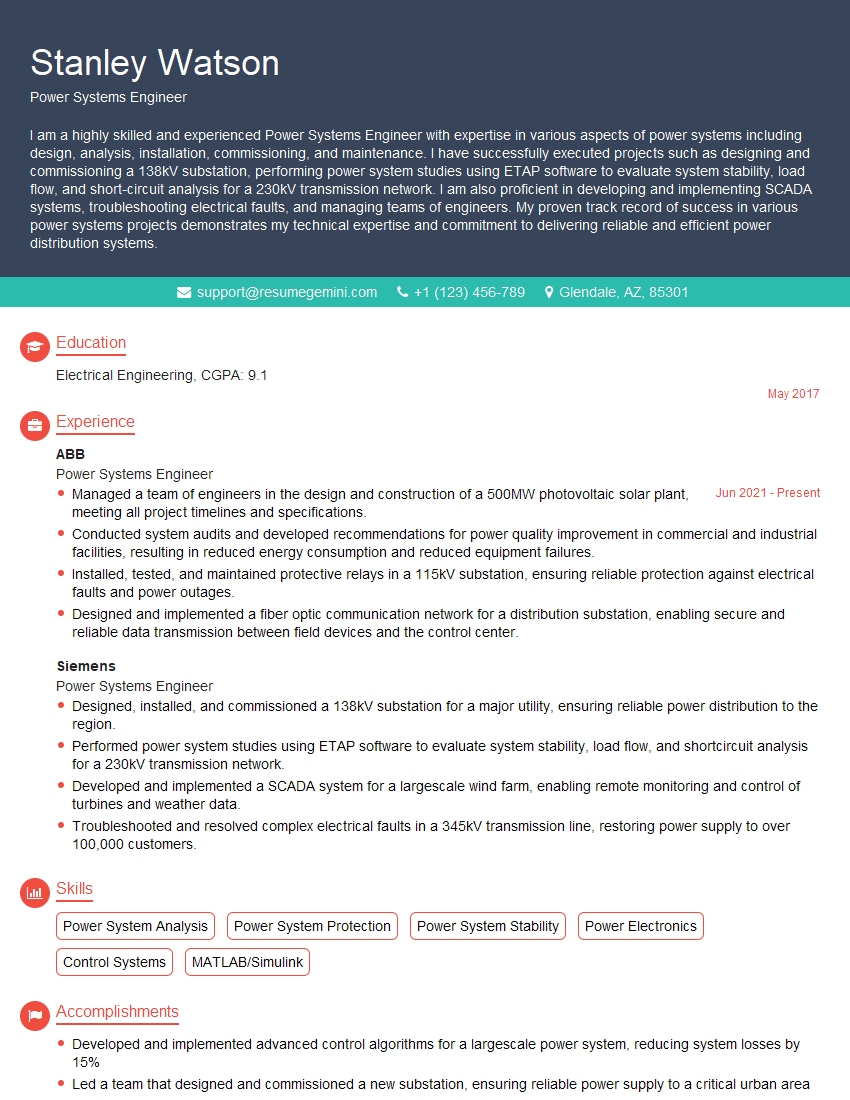
Mastering Power Electronics and Controls opens doors to exciting and impactful careers in various industries, offering significant growth potential. To maximize your job prospects, create an ATS-friendly resume that highlights your skills and experience effectively. ResumeGemini is a trusted resource to help you build a professional and impactful resume. We provide examples of resumes tailored to Power Electronics and Controls to guide you through the process. Invest the time to craft a compelling resume – it’s your first impression with potential employers!
Explore more articles
Users Rating of Our Blogs
Share Your Experience
We value your feedback! Please rate our content and share your thoughts (optional).
What Readers Say About Our Blog
To the interviewgemini.com Webmaster.
Very helpful and content specific questions to help prepare me for my interview!
Thank you
To the interviewgemini.com Webmaster.
This was kind of a unique content I found around the specialized skills. Very helpful questions and good detailed answers.
Very Helpful blog, thank you Interviewgemini team.