Feeling uncertain about what to expect in your upcoming interview? We’ve got you covered! This blog highlights the most important Proficient in Art Therapy Assessment interview questions and provides actionable advice to help you stand out as the ideal candidate. Let’s pave the way for your success.
Questions Asked in Proficient in Art Therapy Assessment Interview
Q 1. Describe your experience using different art therapy assessment tools.
My experience with art therapy assessment tools is extensive and spans various modalities. I’m proficient in using both standardized and informal assessment methods. Standardized tools like the Draw-a-Person test (DAP), the Kinetic Family Drawing (KFD), and the House-Tree-Person (HTP) provide a structured framework for evaluating specific aspects of a client’s emotional and psychological functioning. For instance, the DAP can reveal self-perception and body image issues through the details of the drawing, while the KFD illuminates family dynamics and individual roles within the family system.
Alongside standardized tests, I frequently utilize informal assessments, which offer greater flexibility and adaptability. This involves observing the client’s spontaneous art-making process – their choice of materials, color palette, and overall approach – to gain insights into their emotional state and cognitive functioning. For example, a client using primarily dark, muted colors and depicting isolated figures might suggest feelings of depression or social isolation. Conversely, vibrant colors and dynamic compositions could indicate a more positive outlook and energy level. I also incorporate client self-report through open-ended questions about their artwork, fostering a collaborative and meaningful assessment process.
Q 2. How do you integrate art therapy assessment findings into treatment planning?
Integrating art therapy assessment findings into treatment planning is crucial for developing targeted and effective interventions. The assessment provides a holistic view of the client’s strengths and challenges, guiding the selection of appropriate therapeutic techniques and goals. For instance, if a client’s HTP reveals a distorted or neglected figure of the self, this informs the therapeutic focus on building self-esteem and self-acceptance. We might use techniques like affirmation exercises, positive self-portrait creation, and mindfulness practices to address these issues.
The assessment also guides the choice of art materials and therapeutic activities. A client expressing anxiety through restless, frantic drawings might benefit from exercises involving controlled movements like sculpting with clay or meticulous drawing with fine-tipped markers. This allows them to translate their anxiety into a more manageable and controlled expression. Regular review and reassessment of the art work during the course of therapy allows for adjustments to be made in the treatment plan as the client progresses, ensuring the therapy remains relevant and effective.
Q 3. What are the ethical considerations when using art therapy assessments?
Ethical considerations are paramount in art therapy assessment. Maintaining client confidentiality is of utmost importance, adhering to HIPAA regulations and relevant professional guidelines. This includes secure storage of artwork and assessment records, obtaining informed consent before commencing any assessment, and respecting client autonomy in choosing whether or not to participate in specific activities. Additionally, ensuring cultural sensitivity and avoiding biases in interpretation is crucial, especially when working with diverse populations.
Another critical ethical consideration lies in accurately interpreting and reporting assessment results. Avoid making sweeping generalizations or diagnoses based solely on art therapy assessments; it should be integrated with other clinical information. It’s important to maintain objectivity and avoid projecting personal biases onto the client’s work. Furthermore, the therapist must be mindful of the potential for the assessment process itself to be emotionally challenging for the client and provide appropriate support and debriefing as needed.
Q 4. Explain your understanding of projective art techniques and their limitations.
Projective art techniques, such as the Rorschach inkblot test or the incomplete sentence blank, utilize ambiguous stimuli to elicit unconscious thoughts and feelings. The underlying assumption is that the client’s response reflects their inner world and personality. For example, a client’s interpretation of an inkblot as a frightening monster might suggest underlying anxieties or fears. These techniques offer valuable insights into the client’s emotional state, particularly when verbal communication is limited or difficult.
However, projective art techniques have limitations. Their interpretation is subjective and relies heavily on the therapist’s clinical judgment and experience, which can lead to potential biases. The validity and reliability of these techniques have been debated extensively, and they are not always suitable for all clients or clinical situations. Standardized scoring systems exist, but the interpretive process remains complex and multifaceted, requiring extensive training and experience. It’s crucial to use these methods judiciously and integrate the findings with other assessment data for a more comprehensive understanding.
Q 5. How do you interpret nonverbal communication in art therapy assessments?
Interpreting nonverbal communication in art therapy assessments involves attending to a multitude of cues beyond the final artwork itself. The process of art-making is as informative as the product. This includes observing the client’s choice of materials, color selection, the pressure and speed of their strokes, their body language, and any verbalizations made throughout the session. For instance, a client meticulously erasing parts of their drawing could suggest feelings of self-doubt or perfectionism, while hesitant or slow movements might point to emotional inhibition or anxiety.
The spatial arrangement of elements on the page can also be highly significant. A drawing crowded with details might indicate feelings of overwhelm or chaos, while a sparsely populated image could suggest feelings of isolation or emptiness. Combining these observational data with the client’s verbal self-report and other assessment tools allows for a richer and more nuanced understanding of their internal experience. It is crucial to approach these observations with a holistic perspective and avoid premature conclusions.
Q 6. Compare and contrast different art therapy assessment methods.
Art therapy assessment methods range from structured, standardized tests to informal, open-ended approaches. Standardized tests like the DAP, HTP, and KFD offer quantitative data allowing for comparisons against normative samples, but they may lack the depth and context of less structured methods. Their strength lies in offering a common framework for comparison, while their weakness is in the potential limitation of a rigid structure, not accounting for individual differences in cultural or developmental context.
In contrast, informal assessments, including observation of the art-making process and open-ended discussions about the artwork, provide richer qualitative data. These methods prioritize the client’s unique experience and allow for greater flexibility and adaptability to individual needs. However, their subjective nature requires careful attention to ensure objectivity and avoid bias. The choice of assessment method depends on the specific clinical questions, the client’s needs and abilities, and the therapist’s experience and expertise. Ideally, a combination of both approaches provides the most comprehensive assessment.
Q 7. How do you adapt your assessment approach for clients with diverse needs (e.g., age, cultural background, disability)?
Adapting my assessment approach for clients with diverse needs is essential for culturally sensitive and ethical practice. When working with children, I use age-appropriate materials and tasks, focusing on play-based and less demanding activities. For adolescents, I might incorporate more abstract and expressive techniques, acknowledging their developmental stage and evolving sense of self. With older adults, I consider physical limitations and adapt activities accordingly, ensuring comfort and accessibility.
Cultural background significantly impacts interpretation. I actively engage in cultural self-reflection to mitigate biases and ensure that I don’t misinterpret cultural nuances in the client’s artwork. This includes seeking additional information from the client about their cultural context and drawing on relevant cultural resources. For clients with disabilities, I adjust the assessment approach to accommodate their specific needs. This might involve using alternative materials, modifying instructions, or employing assistive technologies to facilitate participation. Collaboration with other professionals involved in the client’s care is key to ensure a comprehensive and supportive assessment process.
Q 8. How do you ensure confidentiality and client rights during the assessment process?
Confidentiality and client rights are paramount in art therapy assessments. I begin by clearly explaining the limits of confidentiality, outlining situations where mandated reporting is necessary (e.g., child abuse, threats of harm). This informed consent process is documented. I always obtain written consent before starting any assessment and ensure the client understands their rights, including the right to refuse participation at any point, access their records, and withdraw from therapy. I store all assessment materials securely, both physically and electronically, adhering to HIPAA and other relevant regulations. For example, I use password-protected electronic files and locked cabinets for physical materials. Anonymization techniques are used when sharing case examples for educational or supervisory purposes, removing any identifying information.
Q 9. Describe a situation where you had to modify an assessment based on client response.
During an assessment with a young client struggling with grief following the loss of a pet, I initially planned to use a structured drawing prompt focusing on family. However, the child became visibly distressed and refused to draw. Recognizing this, I modified the assessment. We shifted to a less structured approach, using play therapy materials alongside art supplies. The child then spontaneously began building a small animal ‘cemetery’ with clay, which opened up a pathway for processing their feelings about loss. This demonstrates the flexibility needed to adapt assessments to the individual needs and responses of each client; rigidity can be counterproductive. Observing nonverbal cues and adapting the approach is crucial.
Q 10. What are the key indicators of trauma in art therapy assessments?
Indicators of trauma in art therapy assessments are often subtle yet significant. They may include recurrent themes of violence, abuse, or neglect in artwork. For instance, repeated depictions of dark, chaotic scenes or figures in distress suggest potential trauma. Clients might exhibit difficulty with self-representation, depicting themselves as small, fragmented, or absent altogether. Use of dark or muted colors, self-harm imagery, or excessively detailed depictions of wounds can also be indicative. Furthermore, behavioural observations, such as anxiety, hypervigilance, or emotional dysregulation during the session, can provide contextual clues. It’s crucial to remember that these indicators should not be interpreted in isolation; a comprehensive assessment involves integrating art-based information with other clinical data obtained through conversation and other methods.
Q 11. How do you assess for cognitive functioning using art therapy techniques?
Assessing cognitive functioning through art requires a nuanced approach. It’s not about directly measuring IQ but observing cognitive processes through creative tasks. I might use tasks that involve following instructions to create specific art pieces. This assesses attention, planning, and sequencing. I can also analyze the complexity of their designs, the use of spatial organization, and the ability to integrate different visual elements. For example, asking a client to draw a person or a landscape enables observation of their ability to reproduce details, maintain proportions, and differentiate between foreground and background. Difficulties in these areas could suggest cognitive challenges. This always must be interpreted in conjunction with other assessments.
Q 12. How do you differentiate between normal developmental stages and potential pathology in children’s artwork?
Differentiating normal developmental stages from potential pathology in children’s art involves considering developmental norms and comparing artwork to age-appropriate expectations. For instance, simplistic drawings are common in younger children. However, persistent primitive style in an older child might warrant further investigation. Analyzing the content and themes is equally important. While fantastical elements are expected, persistently dark or disturbing themes should raise concerns. The child’s emotional engagement with the artwork is also considered. For example, intense negativity or emotional detachment might signal underlying issues. Using standardized developmental art scales and referencing age-appropriate art samples helps inform this process. It’s essential to integrate clinical interviews and behavioral observations to arrive at a comprehensive diagnosis.
Q 13. Discuss the role of creativity and symbolic representation in art therapy assessments.
Creativity and symbolic representation are cornerstones of art therapy assessment. The creative process itself provides valuable insights. For example, observing the client’s choice of materials, their process, and their emotional expression during the act of creation reveals much about their personality and emotional state. Symbolic representation is especially significant, as the unconscious often manifests through artwork. Clients use color, shape, size, and composition to convey emotions, ideas, and experiences that they might struggle to articulate verbally. Interpreting these symbols requires careful consideration of the context, the client’s narrative, and the therapist’s understanding of symbolic language in art. For example, a recurring symbol of a locked door might represent feelings of isolation and confinement.
Q 14. How do you document and report your art therapy assessments?
Documentation in art therapy assessments is comprehensive and detailed. I record all relevant information, including the client’s demographics, referral information, and the goals of the assessment. Each session includes detailed notes on the client’s verbal and nonverbal behavior, the art-making process, and interpretations of their artwork. Photographic documentation (with client consent) is crucial for capturing the artwork itself. Formal assessments like standardized scales are included. The final report integrates all these elements, providing a concise summary of the findings, recommendations for intervention, and a discussion of the limitations of the assessment. Maintaining thorough records is vital for ensuring accurate clinical decision-making, facilitating communication with other professionals, and ensuring adherence to professional standards and ethical guidelines.
Q 15. What are some common misinterpretations in art therapy assessments, and how can they be avoided?
Misinterpretations in art therapy assessments often stem from imposing preconceived notions onto the artwork, rather than understanding it within the client’s unique context. For instance, a dark and intense drawing might be mistakenly labeled as indicative of severe depression, when in reality, it could represent a powerful emotional release or exploration of shadow aspects of the self for the client. Another common pitfall is focusing solely on symbolic interpretations without considering the client’s verbal account and the process of art creation.
- Avoiding Misinterpretations: To mitigate this, I employ a multi-faceted approach. First, I establish a strong therapeutic relationship built on trust and open communication, allowing the client to feel safe sharing their thoughts and feelings about their artwork. Second, I utilize a holistic approach that combines analysis of the artwork’s formal elements (color, line, composition), symbolic meaning, and the client’s narrative about the creative process. I ask open-ended questions like, “Tell me about this piece,” “What were you feeling as you created this?” and “What does this element represent to you?” instead of directly offering interpretations.
- Example: A client presented a chaotic collage with starkly contrasting colors. While a superficial interpretation might suggest internal turmoil, exploring the client’s process revealed that the collage represented the exhilarating, though initially disorienting, experience of moving to a new city. The contrasting colors, the client explained, symbolized the stark differences between their old and new lives, the chaos representing the excitement and challenge of the transition.
Career Expert Tips:
- Ace those interviews! Prepare effectively by reviewing the Top 50 Most Common Interview Questions on ResumeGemini.
- Navigate your job search with confidence! Explore a wide range of Career Tips on ResumeGemini. Learn about common challenges and recommendations to overcome them.
- Craft the perfect resume! Master the Art of Resume Writing with ResumeGemini’s guide. Showcase your unique qualifications and achievements effectively.
- Don’t miss out on holiday savings! Build your dream resume with ResumeGemini’s ATS optimized templates.
Q 16. What are the strengths and weaknesses of using standardized assessments in art therapy?
Standardized assessments in art therapy, like the Draw-a-Person test or the Kinetic Family Drawing, offer valuable strengths in terms of providing a structured framework for comparison and objective data. Their established norms and scoring systems enable us to compare a client’s responses to a larger population, facilitating preliminary observations about potential psychological issues. However, standardized tests have limitations. They can be culturally biased, lack the nuanced understanding of individual experiences, and may not capture the richness and complexity of human expression that art offers.
- Strengths: Objectivity, standardized scoring, comparison to norms, efficient data collection.
- Weaknesses: Limited contextual understanding, potential for cultural bias, risk of oversimplifying complex issues, reduction of art to quantifiable data.
- Practical Application: I selectively use standardized assessments as one tool within a broader assessment approach. The results are interpreted cautiously, considering the client’s unique background and the overall therapeutic relationship. I place greater emphasis on the client’s narrative, the creative process, and the artwork’s unique qualities to create a more comprehensive understanding.
Q 17. How do you handle resistance or reluctance from a client during an art therapy assessment?
Resistance or reluctance during an art therapy assessment is common and often reflects underlying anxieties or concerns. It’s not a sign of failure, but an opportunity to understand the client’s apprehension. Instead of pushing, I gently explore the reasons for the resistance.
- Handling Resistance: I might say, “I understand that you might not feel comfortable with this right now. What’s making you hesitate?” or offer alternative art mediums or activities. Perhaps drawing feels too pressure-inducing; sculpting with clay might be a more comfortable alternative. Sometimes, simply offering a longer period of acclimation and building trust before introducing more formal assessment techniques is crucial.
- Building Rapport: I prioritize creating a safe and non-judgmental space. I might begin with a conversation about art in general, their hobbies, or preferred art materials, focusing on building connection and trust before directly engaging in assessment-related tasks.
- Example: A client initially refused to participate in a drawing task, stating they hadn’t drawn since childhood. Instead of insisting, I engaged them in a collaborative collage activity, using pre-cut magazine images. This allowed them to explore their feelings and experiences without the pressure of direct creation, and eventually, they opened up about their anxieties surrounding self-expression.
Q 18. Explain your approach to analyzing themes and patterns in clients’ artwork.
Analyzing themes and patterns in client artwork is a crucial component of art therapy assessment. I adopt a holistic approach, considering both formal elements (e.g., color choices, line quality, composition) and content (subject matter, symbols, narrative). I avoid solely relying on symbolic interpretations, integrating the client’s verbal account and the process of art creation for a complete understanding.
- Systematic Analysis: My approach involves a step-by-step process. First, I observe the artwork’s formal qualities: Is the composition balanced or chaotic? Are the colors vibrant or muted? Is the line work precise or loose? Next, I note the content: What is depicted? Are there recurring symbols or images? Finally, I integrate these observations with the client’s narrative during the art-making process and subsequent discussions. For instance, a client might say the vibrant colors represent joy, even if the subject matter depicts a challenging situation.
- Identifying Patterns: Over several sessions, I look for recurring themes, symbols, or emotional expressions in the artwork. Consistent use of specific colors, recurring imagery, or similar compositional styles can reveal significant patterns in the client’s emotional experience or unconscious processes.
- Example: A client consistently used dark, muted colors and depicted small, isolated figures in their artwork across several sessions. Through discussion, we discovered this reflected feelings of loneliness and isolation. The small figures represented their sense of helplessness, and the muted colors mirrored their emotional state. Changes in color palette and figure size across subsequent sessions allowed us to monitor their progress and improvement.
Q 19. How do you use art therapy assessments to track client progress?
Art therapy assessments are not a one-time event but a continuous process used to track client progress. I use a combination of methods to document and evaluate change over time.
- Serial Artworks: Comparing artwork from different sessions allows for direct observation of changes in style, color, content, and composition. Shifts in these areas can provide valuable insights into the client’s emotional and psychological progress.
- Client Self-Reflection: Regularly prompting clients to reflect on their artwork and discuss changes they observe in their creations helps them understand their own progress and reinforces their self-awareness.
- Quantitative Measures: While not solely relying on quantitative data, certain objective measures, such as the number of colors used, the size of figures, or the complexity of composition, can be tracked to provide supplementary evidence of progress.
- Therapeutic Goals: The assessment’s main goal is to track progress toward established therapeutic goals. Whether it’s improved emotional regulation, increased self-esteem, or reduced anxiety, art therapy assessments serve as a visual and narrative indicator of success toward these aims.
Q 20. Discuss the importance of rapport-building in art therapy assessments.
Rapport-building is fundamental to successful art therapy assessments. It’s the foundation upon which trust and open communication are built. Without a strong therapeutic alliance, clients may be hesitant to fully engage or express themselves authentically.
- Importance: A strong rapport ensures clients feel safe enough to explore their feelings and experiences through art. It creates a non-judgmental space where they can express themselves without fear of criticism or negative evaluation. This is crucial for obtaining accurate and meaningful information during assessment.
- Strategies: I build rapport by actively listening to the client, validating their feelings, showing genuine interest in their lives and their artwork, and maintaining a flexible and collaborative approach. I adapt my methods and techniques to suit each individual’s needs and preferences.
- Example: Before initiating a formal assessment, I might engage in informal conversations with the client about their hobbies, interests, or experiences with art to create a comfortable and relaxed atmosphere. This helps me understand their personality, communication style, and preferred methods of expression, allowing me to tailor the assessment process to their individual needs.
Q 21. Describe your understanding of the relationship between art therapy assessment and diagnosis.
Art therapy assessment and diagnosis are related but distinct. While art therapy assessment provides valuable data to inform a diagnosis, it doesn’t directly replace formal diagnostic procedures such as clinical interviews or psychological testing.
- Assessment’s Role: Art therapy assessment offers a unique perspective by accessing non-verbal communication and unconscious processes. It can provide supplementary information that complements traditional diagnostic methods. For example, recurring themes of isolation in a client’s artwork might suggest a potential diagnosis of social anxiety disorder, prompting further investigation through other means.
- Limitations: Art therapy assessment should not be the sole basis for a diagnosis. A licensed mental health professional must use a variety of methods to make a comprehensive diagnosis that adheres to established diagnostic criteria (e.g., DSM-5, ICD-11).
- Collaboration: In many cases, art therapists collaborate with other mental health professionals to integrate findings from art therapy assessments into the overall diagnostic picture. This collaborative approach ensures a holistic and accurate understanding of the client’s situation.
Q 22. How do you address countertransference in the context of art therapy assessment?
Countertransference, in art therapy, refers to the therapist’s unconscious emotional reactions to the client, often triggered by the client’s artwork or verbalizations. It’s crucial to recognize and manage this to ensure objective assessment. Addressing countertransference involves a multifaceted approach. Firstly, self-reflection is paramount. I regularly engage in personal supervision and journaling to explore my own emotional responses and identify potential biases. This allows me to understand how my feelings might be influencing my interpretation of the client’s art. Secondly, maintaining professional boundaries is essential. This includes setting clear therapeutic goals and sticking to the established structure of the sessions. If I find my emotional responses interfering with my ability to remain objective, I might need to discuss this with my supervisor or consult another professional for a second opinion. Finally, transparency, when appropriate, can be beneficial. If I feel my emotions are impacting the therapeutic process, I might gently explore these feelings with the client within the ethical parameters of our professional relationship, framing the discussion around my responsibility to provide unbiased care. For example, if a client’s artwork evokes a strong feeling of sadness in me, I might reflect on whether this is a projection of my own experiences or a genuine reflection of the client’s emotional state, making sure to not impose my emotions onto my client’s interpretation.
Q 23. Explain your experience using qualitative and quantitative data in art therapy assessments.
Integrating both qualitative and quantitative data is key to a comprehensive art therapy assessment. Qualitative data, rich in descriptive detail, comes from interpreting the client’s artwork itself: color choices, imagery, symbolism, composition, and the process of creation. For instance, repetitive use of dark colors might suggest depression, while vibrant colors could point to energy and hope. I analyze the artwork’s emotional tone, narrative content, and formal elements, using a phenomenological approach to understand the client’s subjective experience. Quantitative data, on the other hand, involves more measurable aspects. I might track the client’s progress using standardized scales for symptoms, such as anxiety or depression. I may also use standardized art therapy assessment tools that allow scoring and quantification of the client’s responses. For instance, I might use a structured drawing test to assess certain aspects of cognitive functioning. Then, I carefully integrate both qualitative and quantitative data. The qualitative data gives depth and meaning to the quantitative findings. For example, high scores on a depression scale could be understood better through qualitative analysis of the client’s artwork depicting themes of isolation and despair. This holistic approach creates a more accurate and nuanced picture of the client’s mental state.
Q 24. How do you ensure cultural sensitivity in your art therapy assessments?
Cultural sensitivity is crucial in art therapy. I begin by educating myself about the client’s cultural background, including their beliefs, values, and artistic traditions. This might involve researching their specific culture or simply engaging in open dialogue with the client. I ensure that the materials and the assessment methods respect their cultural context. For example, I wouldn’t use materials that are culturally inappropriate or might evoke negative feelings. Moreover, my interpretations must be culturally informed. Understanding the symbolism and meanings that specific images or colors might hold in the client’s culture is key to avoiding misinterpretations. For example, what might be viewed as a negative symbol in one culture might have a completely different meaning in another. I make sure to consider these cultural nuances to avoid misinterpreting the client’s expression. Finally, I am mindful of the power dynamics inherent in the therapeutic relationship and work to build a collaborative and respectful partnership built on mutual understanding and trust.
Q 25. What professional development activities have you undertaken to improve your art therapy assessment skills?
I actively pursue continuous professional development to refine my art therapy assessment skills. I regularly attend workshops and conferences focused on specific assessment tools and techniques, like the Draw-A-Person test or the use of projective art techniques. I also participate in continuing education programs specializing in cultural competency and trauma-informed care within the framework of art therapy. Supervision is another crucial aspect of my professional development; regular meetings with experienced art therapists help me examine my own practice, gain feedback on my assessment interpretations, and stay up-to-date on best practices. Moreover, I actively read peer-reviewed journal articles and research publications on art therapy assessment to stay informed about new developments and methodologies. This ongoing professional learning ensures that my skills are honed and my assessments are informed by the most current evidence-based practices.
Q 26. How do you maintain ethical standards when interpreting art therapy assessments?
Maintaining ethical standards during interpretation is critical. My interpretations are grounded in evidence-based practice, and I clearly document my assessment procedures and rationale. I am careful to avoid making definitive diagnostic statements based solely on art therapy assessments; instead, I integrate these findings with other clinical information. This prevents over-reliance on art and ensures a more holistic perspective. I adhere strictly to client confidentiality, maintaining the privacy and dignity of their creative expressions. I always discuss my interpretations with clients to ensure that they resonate with their experiences and to offer opportunities for clarification. This ensures that my work aligns with client self-determination and emphasizes transparency and collaboration in the therapeutic process. I am also mindful of potential biases and actively work to minimize their influence on my interpretations, and regularly reflect on my own work to ensure the ethical standards of the profession are upheld.
Q 27. What are the limitations of art therapy assessment and how do you address them?
Art therapy assessment, while powerful, has limitations. One significant limitation is the subjective nature of interpretation; there is no single, universally accepted method for interpreting art. My interpretations are informed by my clinical experience and theoretical understanding, however, it’s vital to acknowledge the inherent subjectivity involved. Another limitation stems from the potential for client response bias; clients might consciously or unconsciously create artwork to convey a specific impression. Additionally, some individuals might find it difficult to engage with art therapy or express themselves creatively. To address these limitations, I employ multiple assessment methods, combining art-based assessments with other clinical data (e.g., interviews, psychological testing). This triangulation of information helps me create a more robust and accurate understanding of the client’s situation. I openly discuss these limitations with clients, emphasizing that art therapy is one piece of a larger clinical puzzle, fostering transparency and collaboration in the assessment process. I also employ a flexible approach, adapting my methods based on each client’s unique needs and preferences, acknowledging that every individual has their unique style and communication.
Key Topics to Learn for Proficient in Art Therapy Assessment Interview
- Theoretical Frameworks: Understanding various theoretical models underpinning art therapy assessment, such as psychodynamic, humanistic, cognitive-behavioral, and trauma-informed approaches. Consider their strengths and limitations in different clinical contexts.
- Assessment Methods: Mastering a range of assessment techniques, including projective methods (e.g., drawing, painting, collage), expressive therapies, and the interpretation of symbolic meaning within the client’s artwork. Practice analyzing diverse artistic expressions.
- Ethical Considerations: Demonstrating a strong understanding of ethical guidelines and best practices in art therapy assessment, including confidentiality, informed consent, cultural sensitivity, and appropriate boundaries.
- Diagnostic Application: Knowing how art therapy assessments inform diagnostic processes, contributing to a comprehensive understanding of the client’s psychological state and informing treatment planning. Be prepared to discuss case examples.
- Integration with Other Modalities: Understanding how art therapy assessment integrates with other therapeutic approaches and assessment methods (e.g., psychological testing, interviews) to create a holistic understanding of the client.
- Cultural Competency: Demonstrating awareness and sensitivity to diverse cultural backgrounds and their influence on artistic expression and interpretation. Be prepared to discuss strategies for culturally responsive assessment.
- Interpretative Skills: Sharpening skills in analyzing and interpreting symbolic meaning in art, considering both the content and the process of art creation. Practice articulating your interpretations clearly and professionally.
- Case Conceptualization: Developing the ability to integrate assessment data into a comprehensive case conceptualization, outlining the client’s presenting problem, strengths, and potential treatment goals.
- Documentation and Reporting: Understanding the importance of clear, concise, and ethical documentation of assessment findings, including the creation of professional reports.
Next Steps
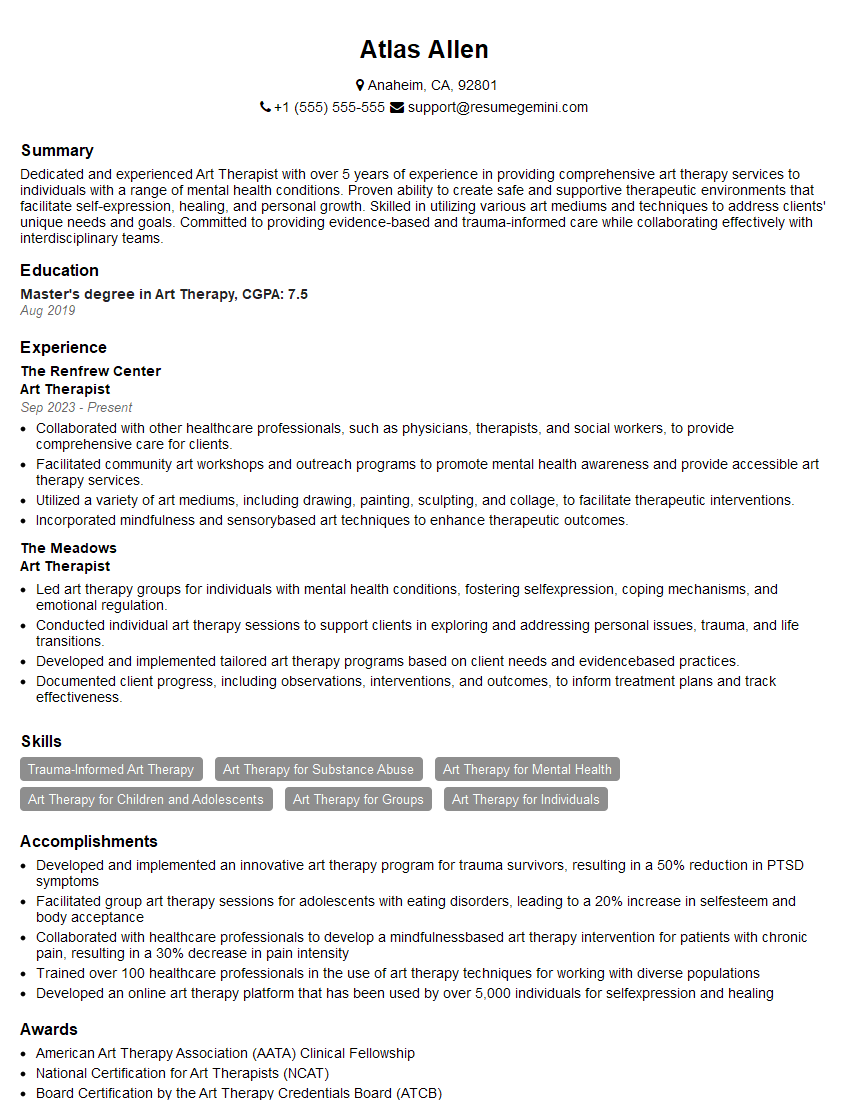
Mastering proficient art therapy assessment is crucial for career advancement, opening doors to diverse and impactful roles within the field. A well-crafted resume is your first impression; ensure yours is ATS-friendly to maximize your chances of landing interviews. ResumeGemini is a trusted resource to help you build a compelling and effective resume that showcases your skills and experience. Examples of resumes tailored to highlighting proficiency in art therapy assessment are available, empowering you to present your qualifications in the best possible light.
Explore more articles
Users Rating of Our Blogs
Share Your Experience
We value your feedback! Please rate our content and share your thoughts (optional).
What Readers Say About Our Blog
To the interviewgemini.com Webmaster.
Very helpful and content specific questions to help prepare me for my interview!
Thank you
To the interviewgemini.com Webmaster.
This was kind of a unique content I found around the specialized skills. Very helpful questions and good detailed answers.
Very Helpful blog, thank you Interviewgemini team.