The right preparation can turn an interview into an opportunity to showcase your expertise. This guide to Proposal Development and Sales Support interview questions is your ultimate resource, providing key insights and tips to help you ace your responses and stand out as a top candidate.
Questions Asked in Proposal Development and Sales Support Interview
Q 1. Describe your experience in developing compelling proposals.
Developing compelling proposals is about more than just listing services; it’s about crafting a narrative that resonates with the client’s needs and demonstrates a clear understanding of their challenges. My approach focuses on three key elements: understanding the client’s context, highlighting value, and presenting a clear and concise solution.
- Understanding the Client’s Context: Before writing a single word, I thoroughly research the client, their industry, and their specific situation. This involves analyzing their website, recent news articles, and any available public information to gain a comprehensive understanding of their goals, challenges, and priorities. For example, if a client is a non-profit, I’d focus on the impact of my proposed solution on their community.
- Highlighting Value: It’s not enough to simply list features; I focus on the benefits and how those benefits directly address the client’s needs. I use quantifiable results whenever possible, demonstrating a return on investment (ROI) or cost savings. For instance, instead of saying ‘We provide marketing services,’ I’d say ‘Our targeted marketing campaign increased our client X’s lead generation by 30% in the first quarter.’
- Clear and Concise Presentation: The proposal itself needs to be easy to read and understand. I use clear language, strong visuals, and a logical flow to guide the reader through the proposal. This includes using headings, bullet points, and concise paragraphs to ensure readability.
I’ve consistently received positive feedback on my proposals, with clients praising their clarity, persuasiveness, and relevance to their specific needs. One client even commented that my proposal was ‘the best they’d ever seen,’ which speaks to the impact of a well-crafted document.
Q 2. Explain your process for identifying client needs and incorporating them into a proposal.
Identifying client needs and incorporating them into a proposal is a crucial step. My process involves a combination of active listening, insightful questioning, and thorough research. It’s a collaborative process, not a one-way communication.
- Active Listening During Discovery Calls: I actively listen to the client’s needs, concerns, and expectations during initial consultations. I pay close attention to their language, tone, and underlying messages to understand their true requirements, often beyond what is explicitly stated.
- Insightful Questioning: I employ a range of open-ended and clarifying questions to probe deeper into their needs and uncover hidden requirements. This helps uncover their pain points and understand their desired outcomes.
- Thorough Research and Analysis: Post-discovery, I analyze all gathered information – including notes from calls, company documents, and competitor analysis – to create a comprehensive understanding of the client’s situation and identify the best solutions.
- Proposal Tailoring: The information gathered is directly used to tailor the proposal. I focus on addressing the client’s specific concerns, showcasing how my proposed solution will meet their unique needs, and demonstrating a clear understanding of their priorities. This makes the proposal more relevant and persuasive.
For example, during a proposal for a software implementation, I would delve into the client’s existing systems, their team’s technical skills, and their budgetary constraints to tailor a solution that seamlessly integrates with their existing infrastructure and meets their specific timeline and budget requirements.
Q 3. How do you manage multiple proposals simultaneously while maintaining quality?
Managing multiple proposals simultaneously requires a structured approach and robust organizational skills. My approach relies on prioritizing tasks, effective time management, and utilizing appropriate tools.
- Prioritization: I prioritize proposals based on factors such as deadline, potential revenue, and client importance. This ensures that high-priority proposals receive the necessary attention.
- Project Management Tools: I use project management software (like Asana or Trello) to track deadlines, manage tasks, and assign responsibilities for each proposal. This provides a centralized location for all proposal-related documents and communications.
- Time Blocking: I dedicate specific blocks of time to work on each proposal, minimizing context switching and maximizing efficiency. This helps maintain focus and prevents burnout.
- Templates and Reusable Content: I use templates and reusable content for common sections, reducing duplication and saving time. This also ensures consistency across proposals.
- Regular Review and Adjustment: I regularly review my progress on all proposals, adapting my schedule as needed to meet deadlines and address unexpected challenges.
This structured approach allows me to manage multiple complex proposals effectively, consistently delivering high-quality work, regardless of the workload.
Q 4. What software or tools do you use for proposal development and management?
My toolkit for proposal development and management includes a blend of software and tools designed to maximize efficiency and quality.
- Proposal Software: I utilize proposal software like PandaDoc or Proposify for creating visually appealing and interactive proposals, streamlining the process from creation to delivery and tracking. These tools often include features like e-signatures and analytics.
- Project Management Software: As mentioned earlier, Asana or Trello help me organize tasks, track deadlines, and collaborate effectively on multiple proposals simultaneously.
- CRM (Customer Relationship Management): A CRM system (Salesforce, HubSpot) is crucial for managing client information, tracking communication, and maintaining a detailed record of the proposal process.
- Microsoft Office Suite: This remains an essential part of my workflow, used for document creation, spreadsheet management (for budgeting and cost analysis), and presentation creation.
- Grammar and Style Checkers: Tools like Grammarly ensure that proposals are free of grammatical errors and inconsistencies, enhancing professionalism.
The specific tools I employ often depend on the project’s needs and the client’s preferences, but this combined approach ensures I have the right tools for every aspect of the proposal development process.
Q 5. How do you ensure proposals are compliant with client requirements and legal guidelines?
Ensuring proposal compliance is paramount. My process includes a multi-stage review to guarantee adherence to both client requirements and relevant legal guidelines.
- Thorough Review of Client Requirements: I meticulously review the client’s RFP (Request for Proposal) or any other documentation to fully understand their specific requirements and specifications. This includes reviewing any legal clauses or specific instructions.
- Legal Review (When Necessary): For complex projects or high-value proposals, I involve legal counsel to review the document and ensure compliance with relevant laws and regulations. This might involve data privacy laws (GDPR, CCPA), contract law, or industry-specific compliance standards.
- Internal Review Process: A standardized internal review process is in place to ensure consistency, accuracy, and completeness. This involves multiple checks for errors, inconsistencies, and missing information before submission.
- Version Control: I meticulously track changes and revisions using version control systems to maintain clarity and auditability. This ensures that the final submitted document accurately reflects the most up-to-date information and revisions.
By implementing this rigorous compliance process, I significantly reduce the risk of legal issues and ensure that the proposal accurately represents both the client’s needs and my capabilities while abiding by all applicable regulations.
Q 6. Describe your experience with RFP (Request for Proposal) responses.
RFP responses require a strategic and highly organized approach. My experience with RFPs involves a deep understanding of the requirements, meticulous response crafting, and a focus on clear and concise communication.
- Thorough RFP Analysis: I begin by meticulously analyzing the RFP to identify key requirements, deadlines, and evaluation criteria. This often involves creating a checklist or matrix to ensure complete coverage of all requested information.
- Structured Response: The response is structured to follow the RFP’s format and address each requirement directly. I avoid ambiguity and use clear, concise language. Each section is tailored to the specific question or prompt.
- Team Collaboration: For complex RFPs, I leverage team expertise, assigning tasks based on individual skills and knowledge. This ensures that the response is comprehensive and accurate. Collaboration tools facilitate efficient information sharing and feedback.
- Proofreading and Quality Control: Multiple rounds of proofreading and quality control checks are conducted to ensure accuracy, grammatical correctness, and adherence to formatting guidelines.
Successfully responding to RFPs involves demonstrating not only competence but also a strong understanding of the client’s needs and the ability to clearly articulate a solution that meets those needs. I have a proven track record of successfully winning contracts through carefully crafted RFP responses.
Q 7. How do you handle objections or challenges during the proposal process?
Handling objections and challenges during the proposal process is a critical skill. My approach emphasizes proactive communication, empathetic listening, and a solutions-oriented mindset.
- Anticipate Objections: Before submitting the proposal, I anticipate potential objections based on the client’s feedback during discovery calls and the information gathered during research. This proactive approach allows me to address concerns before they are raised.
- Empathetic Listening: When objections arise, I actively listen to the client’s concerns without interruption, demonstrating empathy and understanding. This shows respect for their perspective and builds rapport.
- Address Objections Directly and Honestly: I directly address each objection, providing clear, concise explanations and solutions. I avoid defensiveness and focus on providing value and building trust.
- Offer Alternative Solutions: If an objection cannot be directly refuted, I offer alternative solutions or modifications to the proposal to address the client’s concerns and find common ground.
- Follow Up: After addressing objections, I follow up with the client to ensure that their concerns have been fully resolved and they are satisfied with the proposed solution.
By handling objections professionally and effectively, I build stronger client relationships and increase the likelihood of securing the contract. It’s about turning potential roadblocks into opportunities for further collaboration and mutual understanding.
Q 8. Explain your strategy for creating persuasive pricing models.
Creating a persuasive pricing model is about more than just slapping a number on a page; it’s about aligning value with cost. My strategy begins with a deep understanding of the client’s needs and the value our solution provides. I don’t just focus on the price; I focus on the return on investment (ROI).
- Value-Based Pricing: I start by identifying the key benefits our solution offers and quantifying them in terms of cost savings, increased efficiency, or revenue generation for the client. For example, if we’re offering software that streamlines a process, I would calculate the time saved and translate that into a dollar amount, showcasing the potential ROI.
- Competitive Analysis: I thoroughly research the competitive landscape to understand market pricing and position our offering strategically. This isn’t about undercutting; it’s about demonstrating superior value for the price.
- Tiered Pricing: I often propose tiered pricing models, offering different packages with varying levels of features and support to cater to diverse client needs and budgets. This provides flexibility and allows the client to choose the option that best fits their requirements.
- Transparency and Justification: The pricing model needs to be clear and easily understood. I provide detailed explanations for each cost element, justifying the price based on the value delivered. This builds trust and credibility.
For instance, in a recent proposal for a project management software, I presented three pricing tiers: Basic, Pro, and Enterprise. Each tier had a clear price point, a detailed feature list, and a calculation showing the projected ROI based on anticipated time savings and increased team efficiency. This approach resonated well with clients, leading to higher conversion rates.
Q 9. How do you collaborate with sales teams to support proposal development?
Collaboration with sales teams is crucial for successful proposal development. I view myself as an extension of the sales team, not just a support function. My approach involves:
- Early Involvement: I participate in initial sales calls and discovery meetings to gain a thorough understanding of the client’s needs and the sales strategy. This ensures the proposal aligns perfectly with the sales pitch and addresses the client’s specific pain points.
- Information Gathering: I work closely with sales representatives to collect all necessary information, including client requirements, budget constraints, and timelines. This involves regular check-ins and seamless communication throughout the proposal development process.
- Content Creation and Review: I draft the proposal, ensuring it is clear, concise, and compelling. I then work with the sales team to review the draft, incorporate their feedback, and refine the messaging to align with their sales approach.
- Feedback Incorporation: I value the sales team’s insights and expertise in understanding client dynamics and sales cycles. Their input ensures the proposal resonates with the client on a personal level.
- Presentation Support: I assist in preparing presentation materials and support the sales team during client presentations, ensuring a consistent and professional image.
In one project, collaborating closely with the sales team allowed us to tailor the proposal to reflect the client’s specific priorities and concerns, leading to a successful closing. The sales team’s knowledge of the client’s unspoken needs was invaluable in shaping the proposal’s content and tone.
Q 10. Describe your experience with proposal revisions and feedback incorporation.
Proposal revisions are an integral part of the process; they reflect a commitment to perfecting the proposal and addressing client concerns. My approach involves a systematic process:
- Understanding Feedback: I carefully review all feedback, paying attention to both constructive criticism and specific requests for changes. I prioritize feedback based on its impact on the overall persuasiveness and clarity of the proposal.
- Organized Revisions: I track all revisions using a version control system (like Google Docs or similar) to maintain a clear history of changes. This ensures accountability and allows for easy rollback if needed.
- Collaborative Revisions: I work closely with the sales team and other stakeholders to discuss and incorporate the revisions. This ensures we are all aligned on the final version of the proposal.
- Proofreading and Quality Check: Before finalizing the revised proposal, I meticulously proofread it for errors in grammar, spelling, and formatting. This demonstrates professionalism and attention to detail.
I remember a project where the client initially expressed concern about the pricing. Through iterative revisions and clear justifications of the value proposition, we successfully addressed their concerns and secured the deal. The ability to listen, revise, and re-present strengthened the client relationship.
Q 11. How do you track the progress and success of your proposals?
Tracking proposal progress and success is crucial for continuous improvement. My approach involves a combination of tools and strategies:
- CRM Integration: I use a Customer Relationship Management (CRM) system to track the status of each proposal, including key milestones, deadlines, and next steps. This provides a centralized view of all proposals and their progress.
- Proposal Tracking Spreadsheet: I maintain a spreadsheet that tracks key metrics such as proposal submission date, client response date, win/loss status, and reasons for wins or losses. This provides valuable data for future analysis.
- Regular Reporting: I provide regular reports to management and the sales team on proposal performance, highlighting key trends and areas for improvement.
- Win/Loss Analysis: I conduct regular win/loss analyses to understand what worked well in successful proposals and what could be improved in unsuccessful ones. This process informs future proposal development and strategies.
By consistently tracking proposal performance, we can identify trends, improve our proposal writing, and ultimately increase our win rate. This data-driven approach allows for continuous refinement of our strategies.
Q 12. How do you measure the effectiveness of a proposal?
Measuring the effectiveness of a proposal goes beyond simply whether it resulted in a win or loss. I use a multi-faceted approach:
- Win Rate: The percentage of proposals that result in a successful sale is a primary indicator of effectiveness. A consistently high win rate suggests effective proposal development strategies.
- Client Feedback: Gathering feedback from clients, both those who awarded us the business and those who didn’t, is essential. This provides valuable insights into what resonated and what could be improved.
- Sales Cycle Length: A shorter sales cycle suggests a clear and compelling proposal that effectively communicated value and minimized client hesitation.
- Proposal Response Time: A quick response from clients indicates that the proposal was engaging and easily understood.
- Contract Value: Higher contract values secured after successful proposals demonstrate our ability to position high-value solutions effectively.
For example, a high win rate coupled with positive client feedback suggests the proposals are well-crafted and effectively address client needs. A low win rate, combined with negative feedback on pricing, might indicate the need to revisit our pricing strategies.
Q 13. What metrics do you use to assess proposal performance?
To assess proposal performance, I utilize several key metrics:
- Proposal Response Rate: The percentage of proposals that receive a response from the client, positive or negative.
- Proposal Win Rate: The percentage of proposals that result in a successful contract.
- Average Deal Size: The average value of contracts secured through successful proposals.
- Sales Cycle Length: The time taken from proposal submission to contract signing.
- Client Satisfaction Score (CSAT): Measured through post-sale surveys, gauging client satisfaction with the proposal process and the solution itself.
- Cost per Proposal: This metric helps to assess the efficiency of the proposal development process.
Analyzing these metrics together gives a comprehensive understanding of proposal effectiveness. For example, a low response rate might suggest issues with outreach or proposal clarity, while a low win rate might signal problems with pricing or value proposition.
Q 14. Explain your experience working with different proposal templates and formats.
My experience encompasses a wide range of proposal templates and formats. I’m proficient in adapting to different client preferences and industry standards.
- RFP/RFI Response: I have extensive experience responding to Request for Proposals (RFPs) and Request for Information (RFIs), understanding the specific requirements and formatting guidelines of each. This includes customizing the proposal to align with the scoring criteria and demonstrating a thorough understanding of the client’s evaluation process.
- Custom Proposals: I’m adept at creating customized proposals tailored to specific client needs and preferences, going beyond standard templates to develop persuasive narratives that highlight the unique value proposition for each client.
- Presentation-Style Proposals: I have experience creating visually engaging proposals that incorporate graphics, charts, and multimedia elements to enhance readability and impact.
- Software & Tools: I’m proficient in using various proposal software tools, including tools like Proposify, PandaDoc, and others to streamline the proposal development process and enhance collaboration.
Adaptability is key. Each client and each project demands a unique approach. I’ve successfully delivered proposals in various formats—from formal, detailed documents to concise, visually driven presentations—always ensuring the proposal is tailored to the specific client and the context of the opportunity.
Q 15. How do you tailor proposals to specific client audiences?
Tailoring proposals to specific client audiences is crucial for maximizing their impact. It’s not about creating a generic document; it’s about crafting a personalized narrative that resonates with each client’s unique needs, challenges, and priorities. This involves a deep understanding of the client’s industry, their business goals, and their preferred communication style.
- Thorough Research: Before writing a single word, I conduct thorough research on the client. This includes reviewing their website, annual reports, recent news articles, and social media presence to gain a comprehensive understanding of their business, culture, and values.
- Identify Key Pain Points: I identify the specific problems the client is facing and how my proposed solution directly addresses those pain points. This involves highlighting the benefits of my solution and demonstrating a clear return on investment (ROI).
- Adapt Language and Tone: The language and tone of the proposal must be tailored to the client’s communication style. For a technical client, I will use precise and technical language; for a less technical audience, I’ll employ clear, concise language, avoiding jargon whenever possible.
- Focus on Client Value Proposition: The proposal should clearly articulate the value proposition for the client. This means focusing on the specific benefits they will receive from selecting my solution, rather than simply listing features.
For example, a proposal for a tech startup will differ significantly from a proposal for a large, established corporation. The startup might value innovation and agility, while the corporation might prioritize stability and proven track record. My approach ensures the proposal speaks directly to each client’s specific concerns and aspirations.
Career Expert Tips:
- Ace those interviews! Prepare effectively by reviewing the Top 50 Most Common Interview Questions on ResumeGemini.
- Navigate your job search with confidence! Explore a wide range of Career Tips on ResumeGemini. Learn about common challenges and recommendations to overcome them.
- Craft the perfect resume! Master the Art of Resume Writing with ResumeGemini’s guide. Showcase your unique qualifications and achievements effectively.
- Don’t miss out on holiday savings! Build your dream resume with ResumeGemini’s ATS optimized templates.
Q 16. Describe your approach to managing proposal deadlines and timelines.
Managing proposal deadlines and timelines effectively requires a structured approach and meticulous planning. My method involves breaking down the entire process into smaller, manageable tasks with clearly defined deadlines. I utilize project management tools like Gantt charts or project management software to visualize the timeline and track progress.
- Detailed Work Breakdown Structure (WBS): I create a detailed WBS that outlines all the tasks involved in proposal development, from research and writing to design and final review. This ensures nothing is overlooked.
- Realistic Scheduling: I allocate realistic timeframes for each task, considering potential delays and unforeseen circumstances. I don’t overcommit and build in buffer time for unexpected challenges.
- Regular Check-ins: I schedule regular check-ins with the team (if applicable) to monitor progress, address any roadblocks, and make necessary adjustments to the timeline. This ensures we stay on track and meet the deadline.
- Communication is Key: Open and consistent communication with the client is essential. I keep them informed of progress and any potential delays, proactively addressing concerns before they escalate.
For instance, if a proposal requires extensive research, I’ll allocate sufficient time for that stage and inform the client accordingly. This prevents last-minute rushes and ensures the final product is of high quality.
Q 17. How do you prioritize tasks and manage competing demands when working on multiple proposals?
Prioritizing tasks and managing competing demands when working on multiple proposals simultaneously requires a strategic approach and efficient time management. I utilize a combination of techniques to effectively juggle multiple projects.
- Prioritization Matrix: I use a prioritization matrix (like Eisenhower Matrix – Urgent/Important) to categorize tasks based on their urgency and importance. This helps me focus on the most critical tasks first.
- Time Blocking: I allocate specific time blocks for each proposal, dedicating uninterrupted time to focused work. This minimizes context switching and improves productivity.
- Project Management Software: I utilize project management software to track progress, manage deadlines, and allocate resources across multiple proposals. This provides a clear overview of all projects and their status.
- Delegation (if applicable): Where possible, I delegate tasks to team members, ensuring each person is working on their strengths and contributes effectively.
Imagine I’m working on three proposals simultaneously – one for a government agency, one for a non-profit, and one for a private company. By using a prioritization matrix, I’d identify the most critical tasks for each and schedule dedicated time blocks to work on them effectively, ensuring that each proposal receives the attention it deserves.
Q 18. How do you maintain the quality and consistency of your proposals?
Maintaining the quality and consistency of proposals is paramount. My approach involves establishing clear style guidelines and utilizing templates and review processes.
- Style Guide: I develop or utilize a comprehensive style guide that outlines formatting, tone, language, and branding guidelines. This ensures consistency across all proposals.
- Templates: I use well-designed templates to standardize the structure and formatting of proposals. This speeds up the writing process and ensures a professional look and feel.
- Review Process: I implement a thorough review process, involving multiple levels of review to catch errors and ensure the proposal is clear, concise, and persuasive. This often includes a peer review and a final check by myself.
- Quality Control Checklist: I use a detailed quality control checklist to ensure all elements of the proposal are included and meet the required standards before submission.
Think of it like building a house; a style guide is the architectural blueprint, a template is the pre-fabricated framework, and the review process is the final inspection. Each step contributes to ensuring the final product is well-built and of high quality.
Q 19. What strategies do you use to ensure accurate and complete proposals?
Ensuring accurate and complete proposals requires meticulous attention to detail and a systematic approach. I utilize a combination of strategies to ensure nothing is missed.
- Detailed Outline: I create a detailed outline before starting the writing process. This ensures all necessary sections are included and the information flows logically.
- Data Verification: I meticulously verify all data and figures used in the proposal, using multiple sources to ensure accuracy. This includes double-checking statistics, references, and financial projections.
- Fact-Checking: I rigorously fact-check all claims and statements to ensure they are accurate and supported by evidence. This includes citing sources and providing supporting documentation.
- Internal Review: I conduct a thorough internal review to catch any errors or omissions before submitting the proposal. This helps to identify any inconsistencies or gaps in the information.
For example, before including any financial projections, I’ll verify the data with the finance department and ensure all calculations are accurate. This meticulous approach prevents inaccuracies and builds credibility with the client.
Q 20. How do you handle unexpected changes or challenges during the proposal development process?
Handling unexpected changes or challenges during the proposal development process requires flexibility, adaptability, and effective communication.
- Flexibility: I maintain flexibility in my approach, acknowledging that changes may occur. This might involve adjusting the timeline, refining the scope of the proposal, or adjusting the strategy.
- Proactive Communication: I communicate any changes or challenges promptly to the client and relevant stakeholders. This ensures everyone is informed and involved in finding solutions.
- Problem-Solving: I adopt a problem-solving approach, identifying the root cause of the challenge and developing creative solutions to mitigate the impact.
- Contingency Planning: I develop contingency plans to address potential challenges proactively. This helps minimize disruptions and ensures the project stays on track.
For example, if a key piece of information becomes unavailable, I will promptly inform the client and explore alternative solutions, perhaps adjusting the timeline or offering a revised approach. Transparency and adaptability are crucial in such situations.
Q 21. How familiar are you with different proposal writing styles (e.g., persuasive, informative, technical)?
I am proficient in various proposal writing styles, adapting my approach based on the client and the specific context. Understanding the nuances of each style ensures the proposal effectively conveys the message and achieves its intended purpose.
- Persuasive Writing: This style focuses on convincing the client of the value of the proposed solution. It emphasizes benefits, uses strong calls to action, and employs compelling language.
- Informative Writing: This style prioritizes providing clear, concise, and factual information. It focuses on presenting data, explaining complex concepts, and maintaining objectivity.
- Technical Writing: This style is used when dealing with technical details and specifications. It requires precise language, detailed explanations, and a clear understanding of the subject matter.
For instance, a proposal for a new software system would require technical writing to explain its features and capabilities, while a proposal for a marketing campaign would benefit from a persuasive style to showcase the potential ROI. I adapt my style to meet the specific needs of each proposal and client, always ensuring clarity and effectiveness.
Q 22. Describe your experience with proposal presentation and delivery.
Proposal presentation and delivery are critical for securing deals. My approach focuses on tailoring the presentation to the specific audience and their needs, ensuring a clear and compelling narrative. I begin by understanding the client’s priorities and concerns, then structure the presentation to directly address them. This includes using visuals, data, and concise language to highlight key benefits and value propositions. I practice my delivery to ensure a confident and engaging presentation style, leaving ample time for Q&A and addressing any objections proactively. For example, in a recent presentation to a potential tech client, I used interactive dashboards to demonstrate the projected ROI of our proposed solution, rather than relying solely on static data. This visual approach significantly enhanced their understanding and increased their confidence in our proposal.
Following the presentation, I always follow up with a detailed summary document, reiterating key points and answering any outstanding questions. This ensures the client has a readily accessible resource for review after the meeting, strengthening their understanding and facilitating a smoother decision-making process.
Q 23. How do you build rapport and trust with clients during the proposal process?
Building rapport and trust is paramount. I achieve this by actively listening to the client’s needs, demonstrating genuine interest in their challenges, and offering tailored solutions that reflect a deep understanding of their business. This involves asking insightful questions, not just about their immediate requirements but also about their long-term goals and strategic objectives. For instance, asking about their company culture and working style helps build a deeper connection and enables a more effective collaboration. I also prioritize transparency and honesty throughout the process, addressing any concerns openly and directly. Establishing clear communication channels and readily available means for them to reach me are also vital. Building a relationship is about more than just selling a service; it’s about partnering with the client to achieve their objectives.
Q 24. What is your approach to handling pricing negotiations?
Pricing negotiations require a strategic approach that balances value and profitability. I begin by clearly articulating the value proposition of our solution and its direct impact on the client’s bottom line. This often involves quantifying the return on investment (ROI) or demonstrating cost savings. I then present a well-justified price, detailing the components and rationale behind each cost element. During negotiations, I’m prepared to explore different pricing models (e.g., tiered pricing, value-based pricing) to find a mutually agreeable solution. I avoid making concessions easily, focusing instead on adding value and exploring alternatives that benefit both parties. For example, I might offer a phased implementation or a tailored service package to adjust the pricing based on the client’s budget and specific requirements. The goal is to reach a win-win scenario where the client perceives fair value and we maintain a healthy profit margin.
Q 25. How do you use data analytics to inform proposal development decisions?
Data analytics play a crucial role in shaping effective proposals. I use data to identify market trends, understand client needs, and tailor solutions that meet specific demands. For example, using CRM data to analyze past projects helps understand client preferences, leading to the creation of highly targeted proposals. Web analytics can provide insights into competitor offerings, enabling us to highlight our unique advantages. By leveraging these data insights, I can create more compelling proposals, strengthen our value proposition, and increase our chances of winning the business. We might use data visualizations to showcase market trends, demonstrate the effectiveness of our solutions, and justify our pricing strategy, thus increasing the proposal’s persuasive power.
Q 26. How do you stay current with best practices in proposal development and sales support?
Staying current in this field requires continuous learning. I actively participate in industry conferences, webinars, and online courses, regularly reviewing industry publications and best-practice guides. I also network with other proposal professionals through industry groups and online communities, sharing knowledge and staying updated on the latest tools and techniques. Subscribing to relevant newsletters and attending workshops focused on sales strategies and proposal writing enhances my expertise. This continuous learning ensures that my proposals are not only effective but also incorporate the latest industry best practices, resulting in a higher win rate.
Q 27. Explain your experience with proposal automation tools.
I have extensive experience using proposal automation tools, including software like RFPIO and PandaDoc. These tools streamline the proposal development process, allowing for greater efficiency and consistency. Using these tools, I can create templates, manage content libraries, and automate repetitive tasks, reducing the time required for proposal creation and enabling me to focus on the strategic aspects of proposal writing. The ability to track proposal progress and collaborate effectively with team members is also greatly improved. For example, using content libraries ensures brand consistency across all proposals, and the automated workflows reduce the risk of errors and omissions, ultimately improving the quality and efficiency of our proposal process.
Q 28. Describe a challenging proposal project and how you successfully resolved it.
One challenging project involved a complex proposal for a large-scale software implementation. The client had conflicting requirements and a tight deadline. To address this, I implemented a phased approach, initially focusing on delivering a minimum viable product (MVP) that addressed the core needs. This allowed us to demonstrate value quickly and gain client buy-in. We also utilized agile methodologies, adapting the proposal and implementation plan as needed to accommodate the client’s changing requirements. Frequent communication and proactive updates were crucial in maintaining transparency and building trust. By focusing on collaboration and addressing the client’s concerns promptly, we not only met the deadline but also exceeded the client’s expectations, resulting in a successful project and a long-term partnership.
Key Topics to Learn for Proposal Development and Sales Support Interview
- Understanding Client Needs: Analyze RFPs (Requests for Proposals) to identify key requirements and translate them into compelling proposals. Practice active listening and questioning techniques to clarify client needs during pre-proposal discussions.
- Proposal Structure and Content: Master the art of crafting a persuasive narrative. Learn how to structure proposals logically, incorporating compelling case studies, relevant data, and clear value propositions. Practice writing concise and impactful content.
- Pricing Strategies and Cost Analysis: Develop a strong understanding of various pricing models and their applications. Learn to perform accurate cost estimations and justify pricing decisions effectively.
- Collaboration and Teamwork: Understand the dynamics of working within a sales team. Practice effective communication and collaboration skills to ensure all proposal components align seamlessly.
- Sales Support Techniques: Learn how to provide effective support to the sales team throughout the sales cycle, including pre-sales activities, proposal follow-up, and post-sales support. Develop skills in CRM software and sales tools.
- Presentation and Delivery: Practice presenting proposals confidently and effectively. Master the art of tailoring your delivery to different audiences and handling potential objections.
- Proposal Metrics and Analysis: Learn to track key proposal metrics, analyze their performance, and use insights to improve future proposals. Understand the importance of win rates and proposal effectiveness.
Next Steps
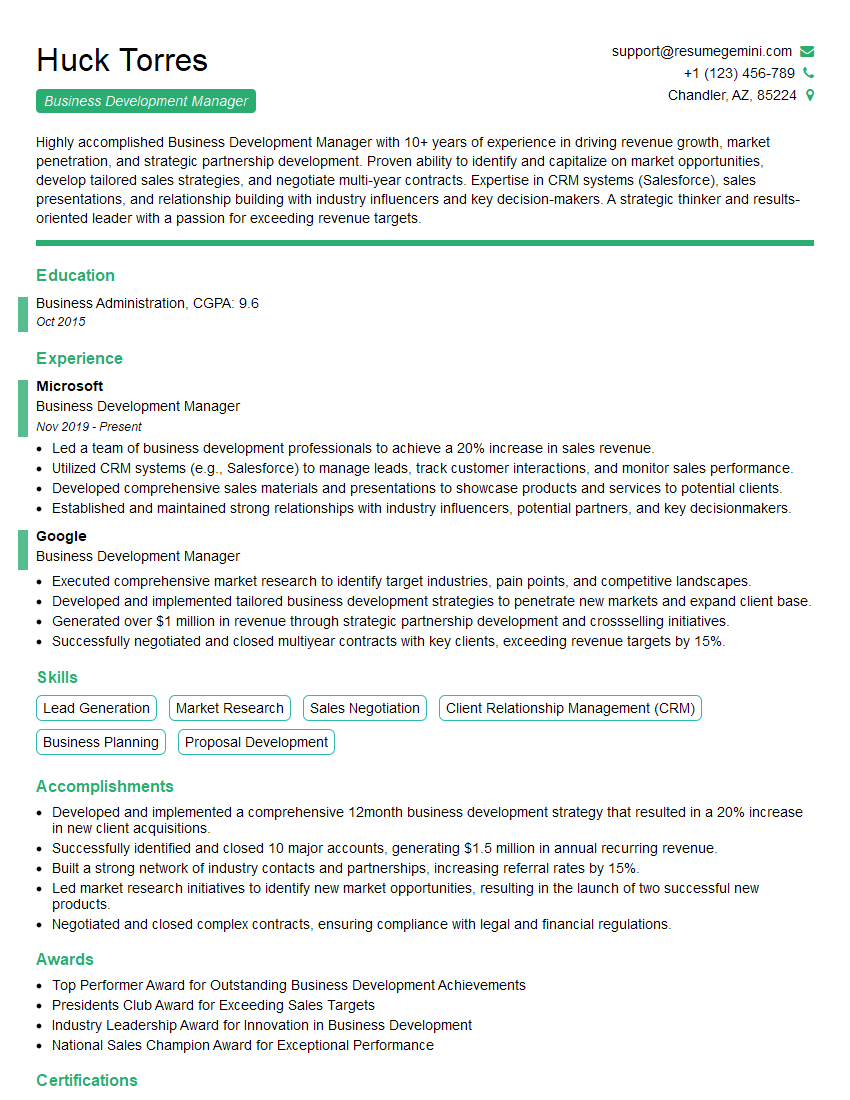
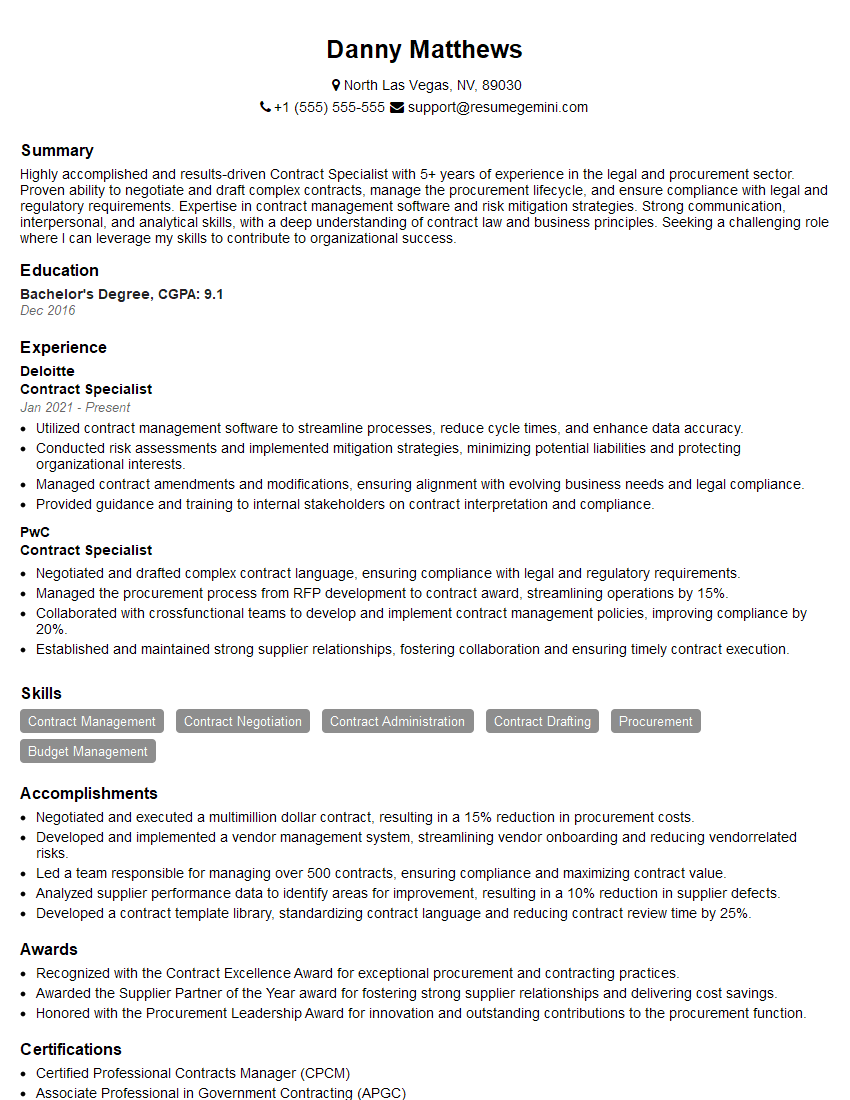
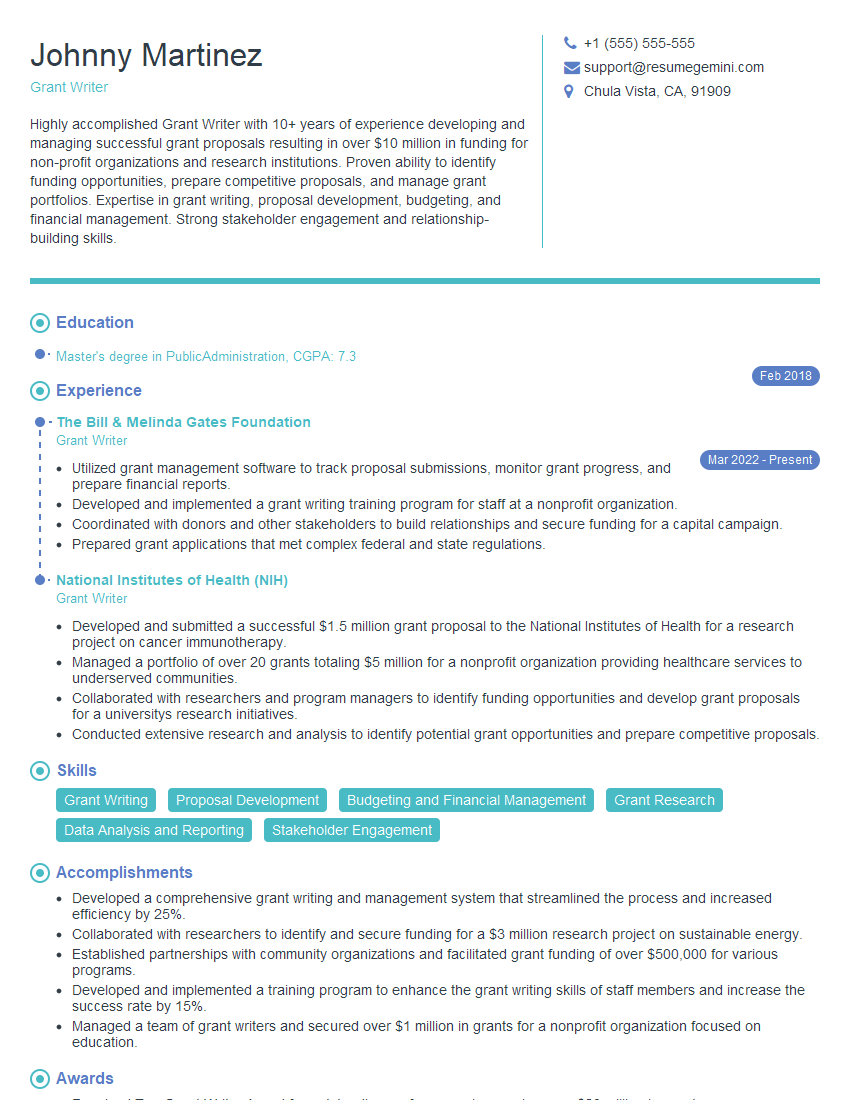
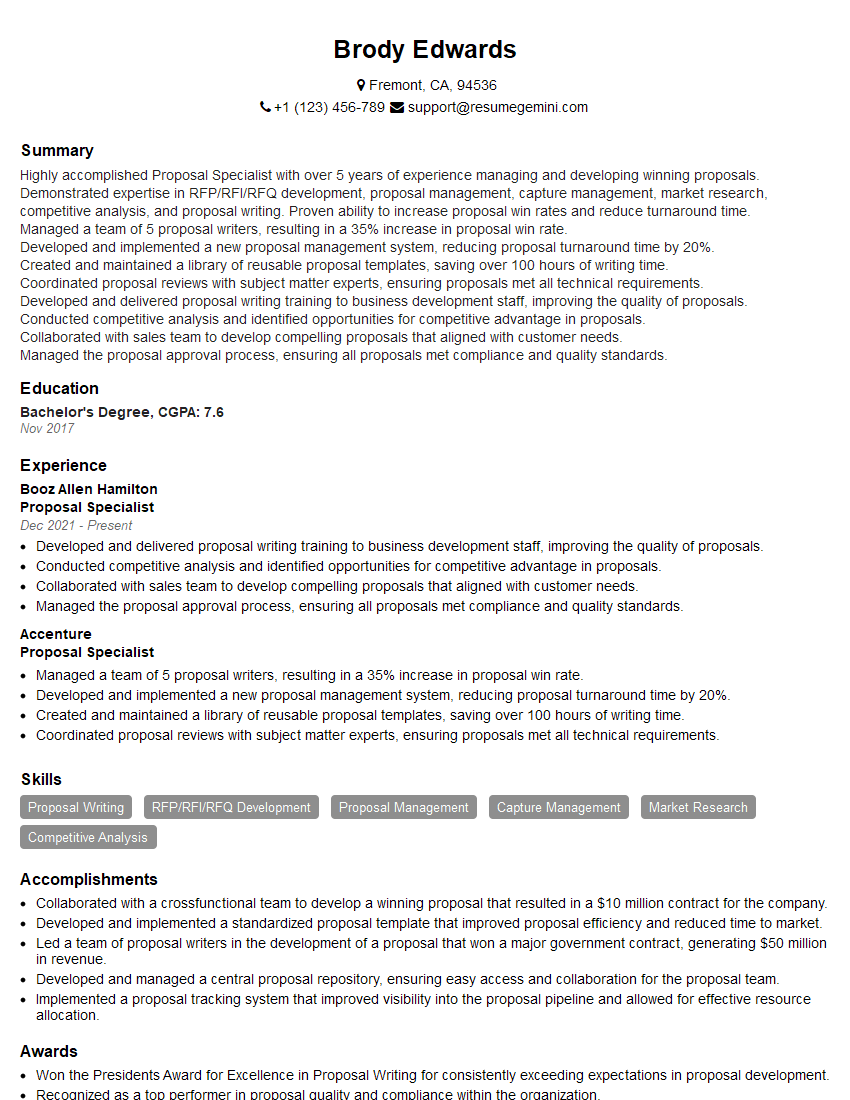
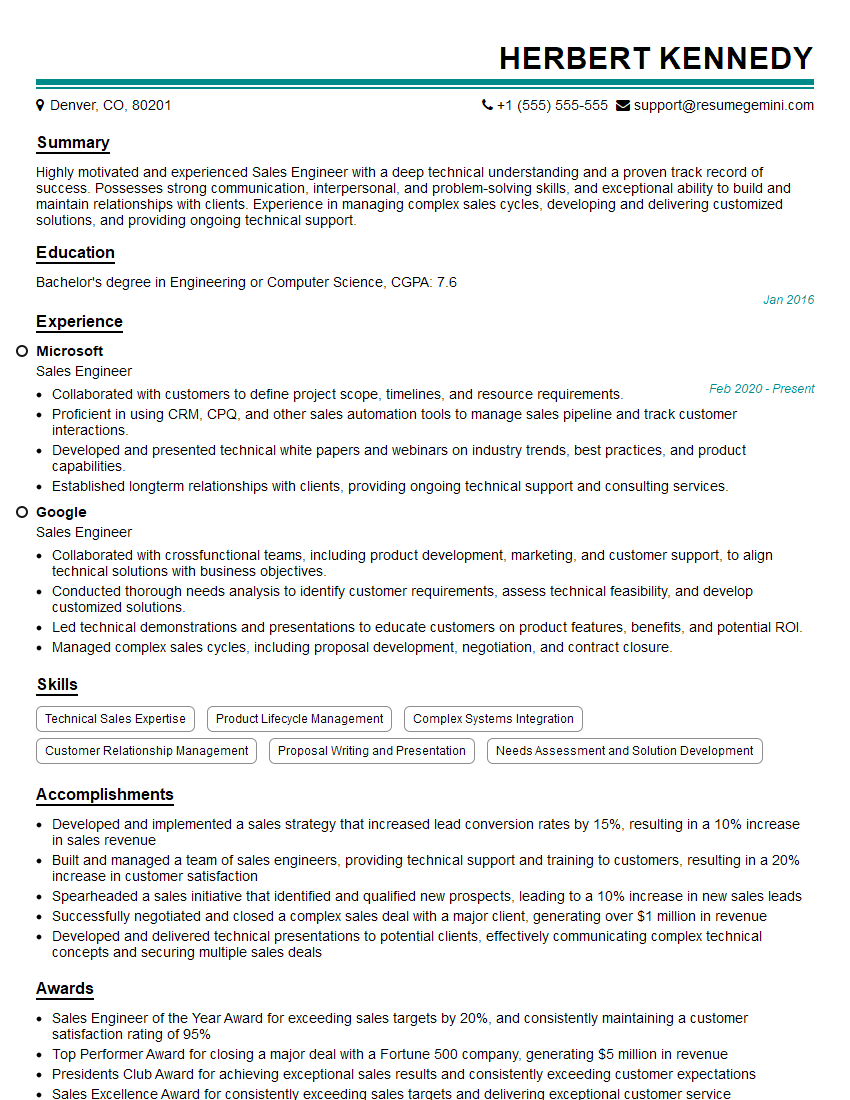
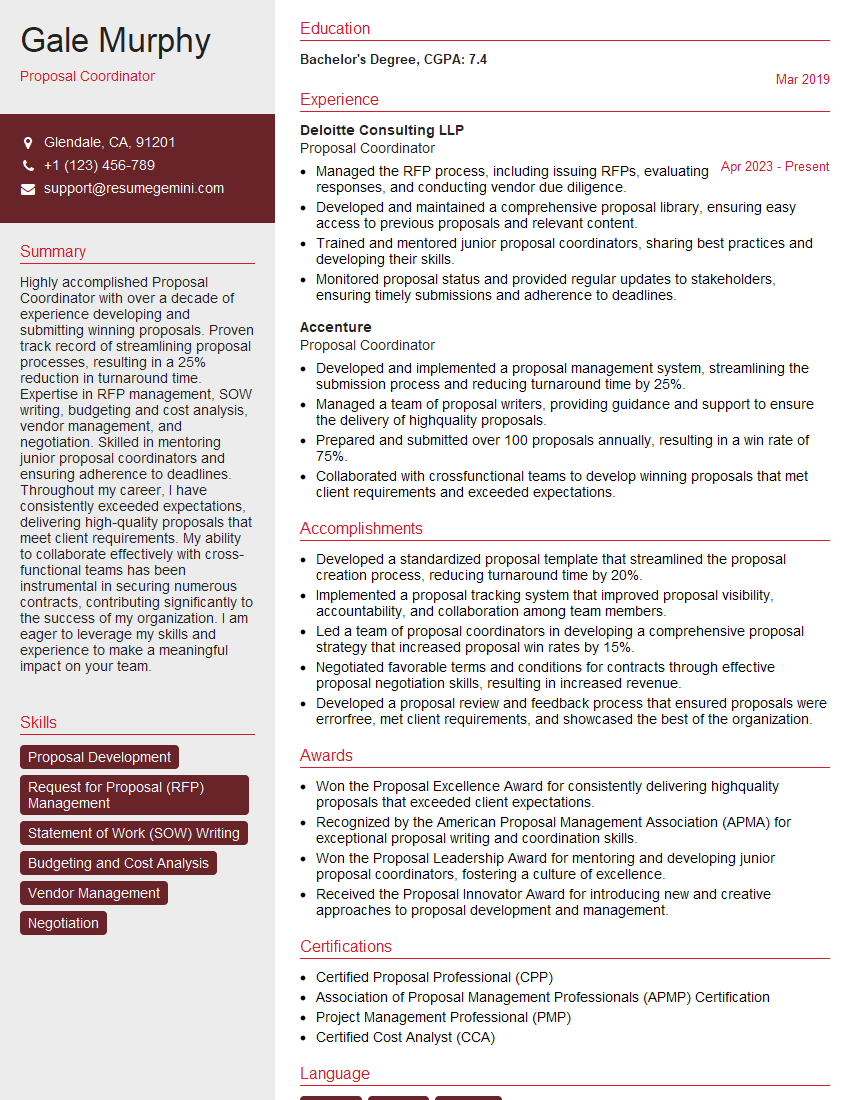
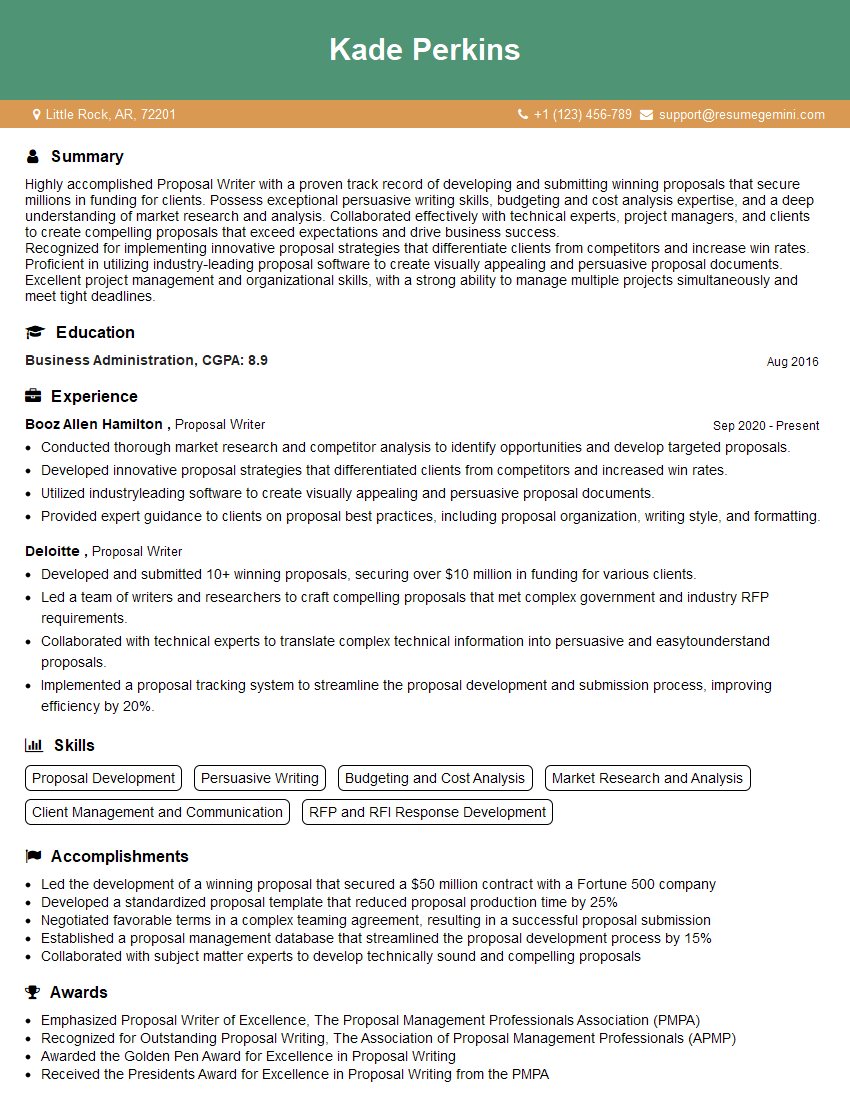
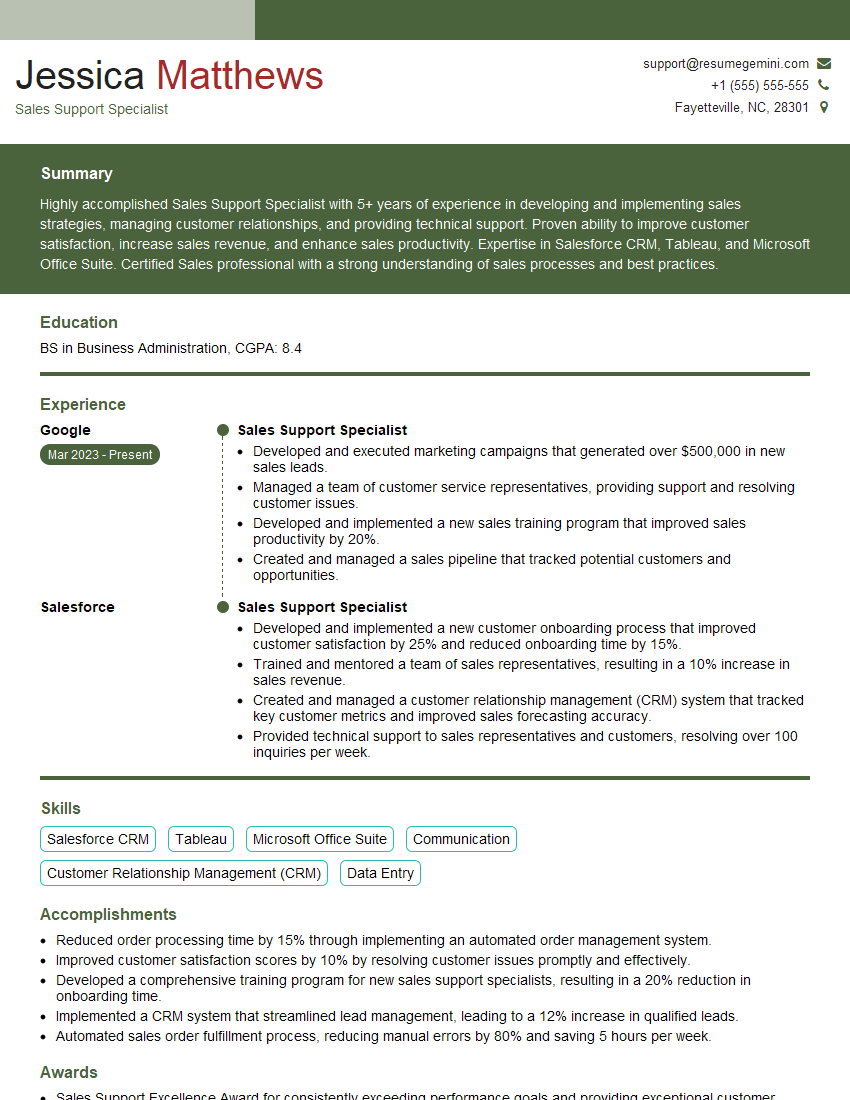
Mastering Proposal Development and Sales Support is crucial for career advancement in sales, marketing, and business development. These skills are highly sought after and directly translate to increased earning potential and career progression. To maximize your job prospects, invest time in crafting a strong, ATS-friendly resume that highlights your relevant skills and experience. ResumeGemini is a trusted resource that can help you build a professional and impactful resume tailored to your specific career goals. Examples of resumes tailored to Proposal Development and Sales Support are provided to help you get started.
Explore more articles
Users Rating of Our Blogs
Share Your Experience
We value your feedback! Please rate our content and share your thoughts (optional).
What Readers Say About Our Blog
To the interviewgemini.com Webmaster.
Very helpful and content specific questions to help prepare me for my interview!
Thank you
To the interviewgemini.com Webmaster.
This was kind of a unique content I found around the specialized skills. Very helpful questions and good detailed answers.
Very Helpful blog, thank you Interviewgemini team.