Preparation is the key to success in any interview. In this post, we’ll explore crucial Repairing and maintaining concrete structures interview questions and equip you with strategies to craft impactful answers. Whether you’re a beginner or a pro, these tips will elevate your preparation.
Questions Asked in Repairing and maintaining concrete structures Interview
Q 1. Describe your experience with various concrete repair techniques, including patching, overlaying, and crack repair.
Concrete repair is a multifaceted field, and I’ve extensive experience across various techniques. Patching involves filling small surface defects or holes. This is often done with a high-strength mortar, carefully matched to the existing concrete’s color and texture for a seamless finish. I’ve used this method extensively on sidewalks and building facades, often employing techniques to ensure proper bonding with the existing substrate. Overlayment, on the other hand, involves applying a new layer of concrete over a larger area, usually to improve surface condition, increase load-bearing capacity, or address significant deterioration. I’ve been involved in overlay projects on bridge decks and industrial floors, where careful consideration of thickness, mix design, and curing is crucial. Finally, crack repair varies based on crack width and type. For hairline cracks, epoxy injection is often the solution. For wider cracks, specialized repair mortars are required, often combined with stitching or dowelling for structural integrity. I’ve repaired cracks in everything from swimming pool decks to structural columns, ensuring the selection of repair material aligns with the severity and cause of the crack.
Example: On a recent project involving a severely cracked warehouse floor, we employed a combination of crack injection with epoxy resin for smaller cracks and a full-depth repair with a high-performance polymer-modified mortar for wider, more structurally compromising cracks, followed by a surface overlay for overall leveling and durability.
Q 2. Explain the different types of concrete admixtures and their impact on concrete properties.
Concrete admixtures are chemical substances added to the concrete mix to modify its properties. They play a significant role in achieving desired performance characteristics. Different admixtures serve different purposes. For instance, water reducers decrease the water content needed for a given workability, leading to increased strength and durability. Superplasticizers are high-range water reducers, allowing for extremely high workability with reduced water content. Air-entraining admixtures incorporate tiny air bubbles into the mix, enhancing freeze-thaw resistance. Accelerators speed up the setting and hardening process, beneficial in cold weather or when quick turnaround is crucial. Retarders, conversely, slow down the setting time, useful in hot weather or for large pours. Corrosion inhibitors protect reinforcement steel from corrosion, prolonging the lifespan of the structure. Finally, shrinkage-reducing admixtures minimize cracking during the curing process. The selection of admixtures depends heavily on the specific requirements of the project, the environmental conditions, and the desired performance characteristics of the final concrete.
Example: In a recent project involving a high-performance concrete floor subjected to significant freeze-thaw cycles, we used a combination of air-entraining and shrinkage-reducing admixtures to ensure its durability and prevent cracking.
Q 3. How do you assess the severity of concrete deterioration and choose the appropriate repair method?
Assessing concrete deterioration requires a systematic approach. It starts with a thorough visual inspection to identify cracks, spalling, delamination, and other visible damage. This is then often followed by non-destructive testing methods, such as rebound hammer testing to assess the concrete’s compressive strength, or even more advanced techniques like ground-penetrating radar to assess internal damage. Based on this assessment, the extent and severity of the deterioration are classified. Minor surface cracking may only require patching, while severe spalling or structural cracking necessitates more extensive repairs like overlayment or even structural strengthening. The choice of repair method depends on factors like the severity of damage, the structural significance of the element, the environmental conditions, and budget constraints. We always prioritize cost-effective solutions that provide long-term durability.
Example: A small surface crack in a non-structural element might be repaired with a simple epoxy injection, whereas severe spalling on a bridge deck might require extensive repairs involving hydro-demolition, structural assessment, reinforcement repair, and concrete overlay.
Q 4. What are the common causes of concrete cracking and spalling?
Concrete cracking and spalling are common issues stemming from various causes. Cracking can result from shrinkage during curing (due to insufficient hydration or rapid drying), overloading, thermal expansion and contraction, foundation settlement, or chemical reactions within the concrete. Spalling, on the other hand, often indicates more severe problems, frequently caused by freeze-thaw cycles (water freezing and expanding within the concrete), alkali-aggregate reaction (chemical reaction between the cement and aggregates), or corrosion of embedded reinforcement steel. Poor mix design, improper curing, or inadequate construction practices also significantly contribute to both cracking and spalling.
Example: Repeated freeze-thaw cycles in a poorly designed concrete pavement can lead to extensive spalling, while foundation settlement can cause significant cracking in a building’s foundation walls.
Q 5. Describe your experience with different types of concrete testing methods (e.g., compressive strength, rebound hammer).
I have extensive experience with various concrete testing methods. Compressive strength testing is a standard method to determine the concrete’s ability to withstand compressive loads. A cylindrical sample is subjected to increasing compressive force until failure, providing a measure of its strength. Rebound hammer testing, a non-destructive method, measures the rebound of a hammer impacting the concrete’s surface, indicating its relative hardness and strength. This is often used for in-situ assessment. Other methods include coring (extracting a sample for laboratory testing), ultrasonic pulse velocity testing (measuring the speed of sound waves through the concrete to assess its integrity), and chloride content testing (measuring the chloride ion concentration to evaluate reinforcement corrosion risk).
Example: Before deciding on a repair strategy for a deteriorated bridge deck, we employed both coring for laboratory compressive strength testing and rebound hammer testing to assess the condition across the entire surface.
Q 6. How do you ensure the proper curing of concrete repairs?
Proper curing is essential for achieving the designed strength and durability of concrete repairs. It involves maintaining adequate moisture and temperature for a sufficient period to allow for complete hydration of the cement. Methods include keeping the surface wet by ponding, applying curing compounds, using plastic sheeting, or employing fogging systems. The specific curing method depends on factors such as weather conditions, the type of repair, and the size of the repaired area. The curing period is typically specified by the material manufacturer and should be carefully followed to ensure the repair’s long-term performance. Insufficient curing can lead to cracking, reduced strength, and premature deterioration.
Example: For a large concrete overlay project, we used a combination of ponding and curing compound application to ensure sufficient moisture retention and prevent premature drying, ensuring that the new concrete properly bonded to the existing structure.
Q 7. What safety precautions do you take when working with concrete repair materials?
Safety is paramount in concrete repair work. This involves adherence to stringent safety protocols, including the use of appropriate personal protective equipment (PPE) such as safety glasses, gloves, respirators (to prevent inhalation of cement dust), hard hats, and safety footwear. Proper handling and storage of repair materials is also crucial, following the manufacturer’s guidelines. We ensure that the work area is properly secured and marked, especially when working at heights or near traffic. I always maintain awareness of potential hazards, such as falling objects, chemical spills, and electrical risks. Regular safety meetings and training are essential to reinforce safe working practices and prevent accidents.
Example: On a recent high-rise building repair, we implemented a comprehensive safety plan that included detailed fall protection measures, designated work zones with clear safety signage, and regular toolbox talks to address specific safety concerns related to working at heights and exposure to chemical materials.
Q 8. Explain your understanding of different types of concrete sealers and their applications.
Concrete sealers are crucial for protecting concrete structures from various environmental factors and extending their lifespan. They come in several types, each with specific applications.
- Acrylic Sealers: These are water-based, breathable sealers offering good UV protection and stain resistance. They’re ideal for driveways, patios, and walkways where some moisture permeability is desirable to prevent hydrostatic pressure buildup.
- Epoxy Sealers: These are two-part, high-performance sealers known for their exceptional durability and chemical resistance. They’re frequently used in industrial settings, garages, or areas exposed to harsh chemicals or heavy traffic. They provide a hard, glossy finish.
- Polyurethane Sealers: Offering a balance between durability and breathability, these are suitable for various applications. They provide good resistance to abrasion and chemicals and are often used for both interior and exterior surfaces.
- Silicone Sealers: These provide excellent water repellency and are often chosen for vertical surfaces or areas prone to water damage. They are particularly useful in preventing efflorescence (salt deposits).
Choosing the right sealer depends on the specific requirements of the project, including the type of concrete, the level of exposure to environmental elements, and the desired aesthetic outcome. For example, a highly trafficked industrial floor would benefit from an epoxy sealer, while a decorative patio might be better suited for an acrylic sealer.
Q 9. How do you handle unexpected challenges during a concrete repair project?
Unexpected challenges are commonplace in concrete repair. My approach is systematic and involves several steps:
- Assessment: Carefully evaluate the unexpected issue. Is it a change in subsurface conditions? Unforeseen reinforcement? A hidden void? Detailed documentation and photography are essential.
- Problem Definition: Clearly define the nature and extent of the problem. This involves understanding its impact on the structural integrity and the overall project timeline.
- Solution Development: Develop a solution based on my experience and knowledge, considering the best practices for the specific issue. This might involve consulting with specialists, reviewing relevant literature, or performing additional testing.
- Implementation: Implement the chosen solution carefully, documenting all steps taken. This is critical for future reference and for ensuring accountability.
- Review: Once the solution is implemented, it’s crucial to monitor its effectiveness and make adjustments as needed. This iterative approach ensures long-term success.
For instance, I once encountered unexpected voids beneath a seemingly solid concrete slab during a repair. After a thorough investigation, we used epoxy injection to fill the voids, restoring the structural integrity before proceeding with the surface repair. Open communication with the client is crucial throughout this process.
Q 10. What software or tools do you use to plan and execute concrete repair projects?
Effective planning and execution of concrete repair projects rely on a combination of software and tools. I utilize:
- AutoCAD or Revit: For creating detailed 2D and 3D models of the concrete structure, allowing for precise measurements and the planning of repair strategies. This is particularly helpful for complex repairs.
- Project Management Software (e.g., Asana, Microsoft Project): To track progress, manage tasks, and maintain communication amongst the team. This ensures all aspects of the project are efficiently managed.
- Specialized Concrete Analysis Software: Software capable of performing structural analyses can help determine the extent of damage and inform repair decisions. This often involves finite element analysis (FEA).
- Mobile Devices and Apps: On-site documentation with photography, video, and annotation apps to capture and share vital information.
In addition to software, physical tools are indispensable. These include measuring devices (tapes, lasers), drilling equipment, specialized grinding tools for surface preparation, and mixing equipment for repair materials. The combination of software for planning and physical tools for execution enables efficient and effective repairs.
Q 11. Explain your experience with epoxy injection techniques.
Epoxy injection is a powerful technique for repairing cracks and voids in concrete structures. It involves injecting a low-viscosity epoxy resin under pressure into the damaged area to fill the void and restore structural integrity. I have extensive experience using this technique for various applications.
The process typically involves:
- Crack Cleaning: Thoroughly cleaning the crack to remove debris, dust, and loose concrete to ensure proper adhesion of the epoxy.
- Drilling Injection Ports: Drilling small holes at intervals along the crack to create injection points.
- Injection: Injecting the epoxy resin into the crack under pressure using a specialized pump. The pressure ensures the epoxy penetrates the entire crack.
- Curing: Allowing the epoxy to cure fully according to the manufacturer’s instructions. This ensures proper strength development.
- Port Sealing: Sealing the injection ports once the epoxy has cured.
I’ve successfully used epoxy injection to repair cracks in foundations, bridge decks, and other critical structural elements. The key to success is selecting the appropriate epoxy resin for the specific application and ensuring proper injection pressure and curing conditions.
Q 12. Describe your understanding of carbon fiber reinforcement in concrete repair.
Carbon fiber reinforced polymers (CFRP) are increasingly used in concrete repair due to their high strength-to-weight ratio and excellent durability. CFRP sheets or fabrics are bonded to the concrete surface using a specialized epoxy adhesive, effectively creating a composite material that significantly strengthens the concrete element.
My experience involves utilizing CFRP for strengthening concrete beams, columns, and other structural members that have suffered from cracking or deterioration. The process generally involves:
- Surface Preparation: Thorough cleaning and preparation of the concrete surface to ensure proper adhesion of the epoxy.
- Epoxy Application: Applying a layer of epoxy adhesive to the concrete surface.
- CFRP Placement: Carefully placing the CFRP sheet or fabric onto the epoxy adhesive, ensuring proper alignment and eliminating air bubbles.
- Consolidation: Using rollers or other tools to consolidate the CFRP and remove any trapped air.
- Curing: Allowing the epoxy adhesive to cure completely according to manufacturer specifications.
CFRP reinforcement provides excellent tensile strength, which is particularly useful in addressing flexural cracking or shear failure in concrete structures. It’s a lightweight solution that minimizes disruption to the existing structure.
Q 13. How do you prepare a concrete surface for repair?
Proper surface preparation is paramount for successful concrete repair. A poorly prepared surface will lead to poor adhesion of the repair material and ultimately failure of the repair. The process typically involves these steps:
- Cleaning: Removing all loose debris, dust, dirt, oil, grease, and other contaminants from the surface using appropriate methods such as wire brushing, sandblasting, or high-pressure water cleaning. The goal is to expose sound concrete.
- Crack Preparation: For cracks, this might involve widening and cleaning the crack to remove any unsound material. This allows for better penetration of the repair material.
- Moisture Removal: Ensuring the surface is dry. Excessive moisture can inhibit proper curing of the repair material. This might involve using dehumidifiers or allowing sufficient drying time.
- Roughening: Creating a rough surface profile to improve mechanical bonding between the existing concrete and the repair material. This might involve using a chipping hammer, needle gun, or scarifying tools.
- Priming (if necessary): Applying a primer to enhance adhesion, depending on the type of repair material being used.
The specific steps and methods will vary depending on the extent of the damage and the type of repair being undertaken. But careful surface preparation ensures a durable and long-lasting repair.
Q 14. What is your experience with different types of concrete coatings?
Concrete coatings offer a wide range of properties and applications. My experience encompasses various types:
- Epoxies: Offer excellent chemical and abrasion resistance, ideal for industrial floors, garages, and areas subject to heavy wear and chemical spills. They typically provide a glossy finish.
- Polyurethanes: Provide good durability, flexibility, and UV resistance, making them suitable for both interior and exterior applications such as parking decks and decorative surfaces. They offer a range of finishes.
- Acrylics: Water-based, relatively low-cost options offering good color retention and UV protection. Suitable for driveways, patios, and areas where less demanding performance is required.
- Polyaspartic: High-performance coatings known for their rapid curing time and exceptional durability. Often used in high-traffic areas or where quick turnaround is essential.
- Sealers (as discussed previously): While sometimes categorized separately, sealers also act as a type of coating, offering protection against water and other environmental factors.
The selection of the appropriate coating is crucial and depends on factors such as the intended use of the concrete surface, the expected level of wear, the desired aesthetics, and the budget. For example, a food processing plant would require an epoxy coating for its chemical resistance, while a decorative walkway might utilize an acrylic coating.
Q 15. Describe your experience with concrete demolition and removal techniques.
Concrete demolition and removal is a crucial first step in many repair and renovation projects. My experience encompasses a wide range of techniques, selected based on the specifics of the structure and the surrounding environment. This includes both manual methods and the use of heavy machinery.
Manual methods are often preferred for smaller projects or situations where precision is paramount. This can involve using jackhammers, hand-held demolition tools, and even careful chiseling for intricate work. For example, I recently used hand tools to carefully remove damaged sections of a historic building’s foundation to avoid compromising the structural integrity of the surrounding areas.
Mechanical methods are more efficient for large-scale demolition. This could include the use of excavators with hydraulic breakers, specialized concrete crushers, or even controlled explosions (in very specific and carefully planned circumstances, with all necessary permits). On a recent highway overpass repair, we used a hydraulic breaker mounted on an excavator to efficiently remove severely damaged sections of the deck before undertaking repairs.
Beyond the actual demolition, the safe removal of debris is equally important. This involves proper disposal according to local regulations, often including recycling or crushing the concrete for reuse in other projects.
Career Expert Tips:
- Ace those interviews! Prepare effectively by reviewing the Top 50 Most Common Interview Questions on ResumeGemini.
- Navigate your job search with confidence! Explore a wide range of Career Tips on ResumeGemini. Learn about common challenges and recommendations to overcome them.
- Craft the perfect resume! Master the Art of Resume Writing with ResumeGemini’s guide. Showcase your unique qualifications and achievements effectively.
- Don’t miss out on holiday savings! Build your dream resume with ResumeGemini’s ATS optimized templates.
Q 16. How do you manage the budget and timeline of a concrete repair project?
Managing the budget and timeline of a concrete repair project requires meticulous planning and consistent monitoring. It starts with a thorough assessment of the damage, which informs the scope of work and the required materials. I typically develop a detailed breakdown of costs, including labor, materials (cement, aggregate, reinforcement, etc.), equipment rental, and disposal fees.
A realistic timeline is created, factoring in potential delays due to weather, material procurement, or unforeseen complications. Regular progress meetings are crucial to identify any deviations from the plan and implement corrective actions. For instance, if material delivery is delayed, we might adjust the schedule or explore alternative materials without compromising quality.
I leverage project management software to track expenses, monitor progress against the timeline, and communicate effectively with clients and subcontractors. Transparent communication and proactive problem-solving are essential to keeping projects on track and within budget.
Q 17. Explain your understanding of different types of concrete aggregates and their impact on concrete performance.
Concrete aggregates significantly impact the performance of concrete. Aggregates are the inert granular materials that make up the bulk of concrete, typically sand and gravel or crushed stone. Different types of aggregates possess varying properties, influencing the concrete’s strength, durability, and workability.
Coarse aggregates (e.g., gravel, crushed stone) contribute significantly to compressive strength. The size and shape of the coarse aggregate affect the packing density and overall strength. Angular aggregates generally result in stronger concrete than rounded aggregates.
Fine aggregates (sand) influence the workability and flow of the concrete mix. The fineness modulus, which indicates the particle size distribution, is important for achieving a proper mix. Poorly graded sand can lead to weak concrete.
Lightweight aggregates (e.g., expanded shale, pumice) are used when reducing the weight of the concrete is crucial, such as in precast elements for high-rise buildings or roof structures. They generally offer lower compressive strength than traditional aggregates.
The selection of aggregates should be based on a comprehensive understanding of the project’s requirements, including the desired strength, durability, and aesthetic qualities. Improper aggregate selection can result in a variety of problems, from reduced strength and increased cracking to poor workability and early deterioration.
Q 18. Describe your experience working with different types of concrete reinforcement (e.g., rebar, fiber reinforcement).
Reinforcement is critical to ensuring the structural integrity of concrete elements. My experience includes working with various types of reinforcement, each suitable for specific applications.
Rebar (Reinforcing steel bars) is the most common type. The grade and diameter of the rebar are chosen based on the anticipated stresses. We ensure proper placement and spacing according to design specifications to create a robust reinforcement cage. Recently, I oversaw the installation of epoxy-coated rebar in a coastal structure to enhance corrosion resistance.
Fiber reinforcement, such as steel fibers or synthetic fibers, is increasingly used to enhance the tensile strength, crack resistance, and impact resistance of concrete. It is particularly advantageous in situations where conventional rebar is impractical, like in thin sections or shotcrete applications. I have used fiber-reinforced concrete in several projects, including pavements and repair overlays where the enhanced toughness was a considerable benefit.
Proper installation and detailing of reinforcement are paramount to ensure the effectiveness of the reinforcement and the overall structural integrity of the concrete element. In both cases, careful quality control is needed to verify the correct placement and quantity of reinforcing materials.
Q 19. What are the common causes of corrosion in concrete structures?
Corrosion in concrete structures is a major concern, leading to significant deterioration and reduced lifespan. Several factors contribute to this:
- Carbonation: Atmospheric carbon dioxide reacts with the concrete’s alkaline environment, reducing its pH and making it less protective of the embedded steel reinforcement. This leads to the depassivation of the steel, initiating corrosion.
- Chloride ingress: Chlorides, often from de-icing salts or seawater, penetrate the concrete and disrupt the protective passive layer on the steel, causing corrosion. This is a particularly significant problem in coastal and winter climates.
- Sulfate attack: Sulfates in soil or groundwater react with the cement paste, causing expansion and cracking which compromises the structure and may also expose the rebar to corrosion.
- Alkali-aggregate reaction: A chemical reaction between certain aggregates and the alkaline components of cement causes expansion and cracking, weakening the concrete and potentially exposing reinforcement to corrosion.
Understanding the causes of corrosion is vital for effective mitigation strategies.
Q 20. How do you prevent future concrete deterioration?
Preventing future concrete deterioration involves a multi-faceted approach, focusing on both design and maintenance.
- Proper design and mix proportions: Using durable cement types, selecting appropriate aggregates, and designing adequate concrete cover over reinforcement are crucial to enhance resistance to various forms of deterioration. A well-designed structure is less susceptible to cracking and ingress of harmful substances.
- Effective waterproofing: Implementing proper waterproofing techniques, such as applying coatings or membranes, helps prevent moisture penetration and associated damage. This is particularly important in areas exposed to water or aggressive chemicals.
- Regular inspection and maintenance: Periodic inspections are crucial to identify early signs of deterioration and address problems before they become major issues. Simple repairs, such as patching cracks, can significantly extend the lifespan of a concrete structure.
- Corrosion protection: Using corrosion inhibitors or employing methods such as cathodic protection can help slow down or prevent corrosion in existing reinforced concrete structures.
A proactive approach involving careful selection of materials, proper design, and regular maintenance significantly prolongs the service life of concrete structures.
Q 21. Describe your experience with documenting concrete repair work.
Accurate documentation of concrete repair work is crucial for legal, insurance, and maintenance purposes. My approach involves a combination of photographic and written documentation.
Photographs: I take comprehensive photos throughout the repair process, capturing the initial damage, the preparation stages, the application of materials, and the final result. These are clearly labeled and timestamped, providing a visual record of the work completed.
Written documentation: This includes detailed reports outlining the scope of work, materials used, methods employed, and any challenges encountered. I also note the date of the repair, the location of the damage, and the responsible parties involved. This documentation might also include specifications for ongoing maintenance.
As-built drawings: For larger repairs, I often produce as-built drawings that accurately reflect the changes made to the original structure. This is essential for future maintenance or modification works.
The goal is to create a comprehensive and easily understandable record that accurately reflects the repairs performed. This provides a valuable reference for future maintenance and helps ensure the longevity of the repaired structure. All documentation is stored securely and digitally backed up.
Q 22. Explain your understanding of building codes and regulations related to concrete repair.
Building codes and regulations related to concrete repair are crucial for ensuring structural safety and longevity. These codes, which vary by location (e.g., ACI 301 in the US, BS 8007 in the UK), dictate acceptable repair methods, materials, and quality standards. They address everything from crack repair techniques to the minimum compressive strength required for patching materials. For instance, a code might specify the maximum allowable deflection for a repaired beam or the required testing procedures to verify the bond strength between the new and existing concrete. Ignoring these codes can lead to structural failure, legal issues, and costly rework. My experience involves regularly reviewing relevant codes before initiating any project, ensuring all our work complies with local ordinances and best practices. We maintain updated code books and conduct regular training for our team on the latest revisions.
Q 23. How do you ensure the quality control of concrete repair work?
Quality control in concrete repair is paramount. It’s not just about aesthetics; it’s about structural integrity. We employ a multi-faceted approach. This begins with meticulous preparation, including thorough assessment of the damage, selection of appropriate materials based on the nature of the defect and the environment, and precise surface preparation. During the repair process, we conduct regular in-situ tests, such as compressive strength tests on cores taken from the repaired sections. We also document every step of the process – from material delivery to final finishing – with detailed photographs and logs. After the repair is complete, we conduct a final inspection, often with a third-party inspector to verify that the repair meets all specifications and code requirements. This documentation serves not only for quality control but also for future maintenance and repair reference. Think of it like a medical chart for the structure – a detailed history that helps track its health and facilitate timely interventions.
Q 24. Describe your experience working on large-scale concrete repair projects.
I’ve been involved in several large-scale concrete repair projects, including the rehabilitation of a multi-story parking garage and the restoration of a major bridge section. In the parking garage project, we addressed widespread spalling, cracking, and corrosion of reinforcement. This required a phased approach, involving careful planning, staging of work, and close coordination with the building management to minimize disruption. We used specialized techniques like carbon fiber reinforcement to strengthen weakened sections and epoxy injection to repair cracks. The bridge project demanded even more stringent safety protocols, requiring extensive scaffolding, traffic control, and close collaboration with structural engineers. These large-scale projects highlight the importance of meticulous planning, risk assessment, and a strong team. They also showcased the effectiveness of advanced repair techniques in extending the lifespan of critical infrastructure.
Q 25. What are the challenges associated with repairing concrete in harsh environments (e.g., extreme temperatures, high humidity)?
Repairing concrete in harsh environments presents significant challenges. Extreme temperatures, for example, can affect the curing process of repair materials. High temperatures can lead to rapid drying and cracking, while low temperatures can slow down the curing and reduce the strength of the repair. High humidity can interfere with the proper setting of cement-based materials and promote corrosion of steel reinforcement. To mitigate these issues, we select specialized repair materials designed to withstand the specific environmental conditions. This might include using rapid-setting concrete in cold climates or employing high-performance polymers in humid conditions. We also adjust our work schedule to avoid the most extreme times of day, use protective coverings where necessary, and employ techniques such as pre-heating or post-curing to ensure proper material performance. For instance, on a project in a desert climate, we used a special curing compound to prevent rapid moisture loss, and scheduled our work during cooler evening hours.
Q 26. Describe your experience with using different types of concrete patching materials.
My experience encompasses a wide range of concrete patching materials, including: cement-based mortars, epoxy-based mortars, polymer-modified mortars, and fiber-reinforced concrete. The choice depends heavily on the type and extent of damage, environmental conditions, and aesthetic requirements. Cement-based mortars are cost-effective for minor repairs, but might not be suitable for aggressive environments. Epoxy mortars offer superior bonding and strength but are more expensive. Polymer-modified mortars provide improved durability and flexibility. Fiber-reinforced concrete improves the tensile strength and crack resistance of the repair. For example, in a project with significant structural damage, we used fiber-reinforced concrete to provide enhanced durability and strength. For a visually sensitive repair in a historical building, we matched the color and texture of the existing concrete very precisely using a specialized polymer-modified mortar.
Q 27. How do you manage a team of workers during a concrete repair project?
Managing a team during concrete repair projects requires strong leadership, clear communication, and a commitment to safety. I begin by clearly outlining the project scope, timelines, and safety protocols to each team member. Regular team meetings are crucial to address challenges, provide updates, and ensure everyone is on the same page. I emphasize the importance of proper training and the use of appropriate safety equipment. Open communication fosters a collaborative environment where everyone feels comfortable raising concerns or suggesting improvements. I believe in fostering a positive and respectful team environment; a motivated team is a productive team. One project where clear communication was particularly key involved complex sequencing for multiple repair crews in a busy airport. By thoroughly briefing each team, outlining potential obstacles, and encouraging team communication, we completed the project on time and without incident.
Q 28. Explain your experience with the use of specialized equipment in concrete repair.
Specialized equipment is essential for efficient and effective concrete repair. I have extensive experience with equipment such as: concrete saws for controlled demolition, shotcrete machines for applying concrete to vertical or overhead surfaces, vacuum-assisted concrete removal systems for precise material extraction, and various grinding and polishing equipment for surface preparation and finishing. We also use specialized testing equipment, including compressive strength testing machines and ultrasonic testing devices to evaluate the strength and integrity of the repaired concrete. For instance, on a project involving extensive under-slab repair, we utilized a vacuum-assisted system to remove the damaged material without causing additional cracks or compromising the structural integrity of the slab. Proper use and maintenance of this specialized equipment is crucial, ensuring both worker safety and the quality of the repair.
Key Topics to Learn for Repairing and Maintaining Concrete Structures Interview
- Concrete Properties & Defects: Understanding compressive strength, tensile strength, durability, and common defects like cracking, spalling, and corrosion. Practical application: Identifying the root cause of concrete deterioration in a given structure.
- Repair Techniques: Familiarization with various repair methods including patching, surface treatments, epoxy injection, and carbon fiber reinforcement. Practical application: Selecting the appropriate repair method based on the type and severity of damage and budget constraints.
- Materials & Specifications: Knowledge of different concrete mixes, admixtures, and repair materials (e.g., epoxy mortars, concrete patching compounds). Practical application: Specifying the correct materials for a particular repair job, considering factors like environmental conditions and structural requirements.
- Inspection & Assessment: Techniques for conducting thorough inspections, using non-destructive testing methods (NDT) like ultrasonic testing and ground penetrating radar. Practical application: Developing a detailed repair plan based on a comprehensive structural assessment.
- Safety Regulations & Procedures: Adherence to OSHA and other relevant safety regulations during concrete repair work. Practical application: Implementing safety protocols on a construction site to minimize risks and ensure worker safety.
- Cost Estimation & Project Management: Developing accurate cost estimates for concrete repair projects and managing resources effectively. Practical application: Creating a detailed project timeline and budget, considering material costs, labor costs, and potential delays.
- Sustainable Repair Practices: Understanding environmentally friendly repair methods and the use of sustainable materials. Practical application: Choosing repair options that minimize environmental impact and promote sustainability.
Next Steps
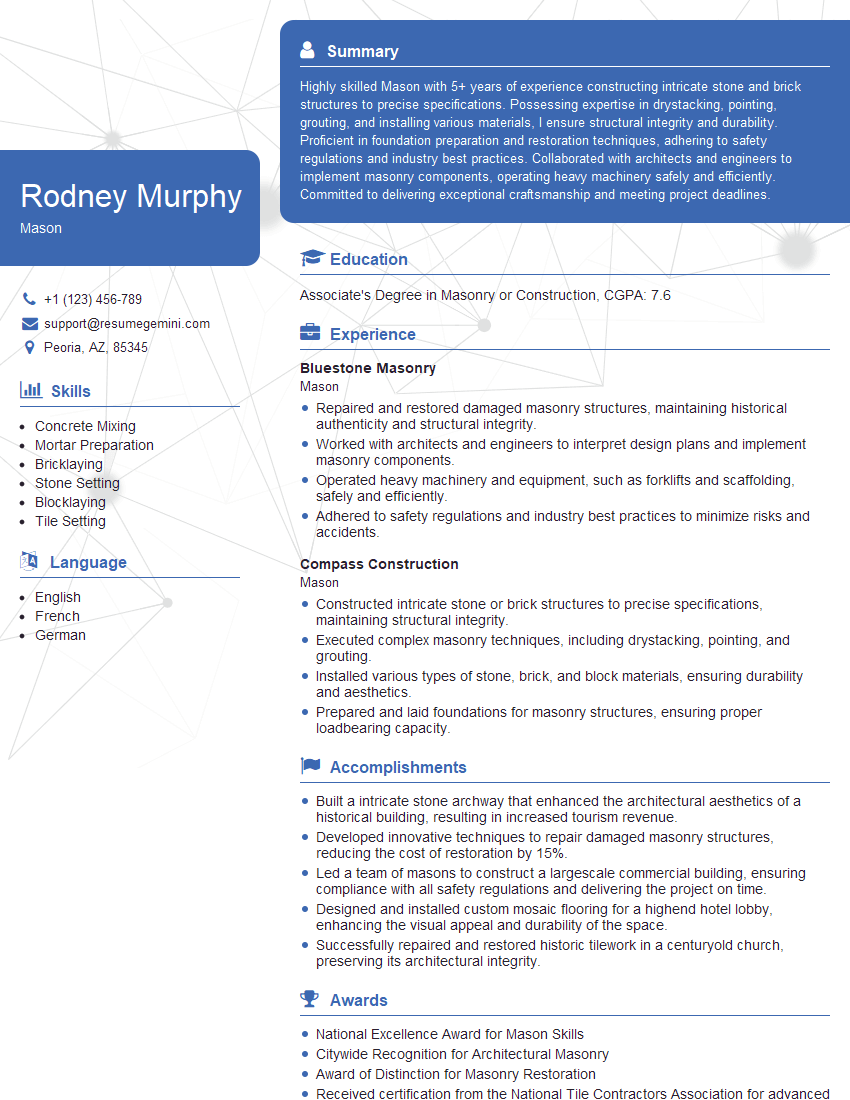
Mastering the repair and maintenance of concrete structures is crucial for career advancement in the construction industry, opening doors to specialized roles and higher earning potential. A strong resume is your key to unlocking these opportunities. Creating an ATS-friendly resume is essential to ensure your application gets noticed by recruiters. ResumeGemini is a trusted resource to help you build a professional and impactful resume that highlights your skills and experience effectively. Examples of resumes tailored to Repairing and maintaining concrete structures are available to guide you through the process.



Explore more articles
Users Rating of Our Blogs
Share Your Experience
We value your feedback! Please rate our content and share your thoughts (optional).
What Readers Say About Our Blog
To the interviewgemini.com Webmaster.
Very helpful and content specific questions to help prepare me for my interview!
Thank you
To the interviewgemini.com Webmaster.
This was kind of a unique content I found around the specialized skills. Very helpful questions and good detailed answers.
Very Helpful blog, thank you Interviewgemini team.