Preparation is the key to success in any interview. In this post, we’ll explore crucial Reverse Osmosis System Operation interview questions and equip you with strategies to craft impactful answers. Whether you’re a beginner or a pro, these tips will elevate your preparation.
Questions Asked in Reverse Osmosis System Operation Interview
Q 1. Explain the principle of reverse osmosis.
Reverse osmosis (RO) is a water purification technology that uses a semipermeable membrane to remove ions, molecules, and larger particles from water. Think of it like a super-fine sieve. Imagine trying to separate sand from water using a very fine mesh – only the water passes through, leaving the sand behind. RO works similarly, but at a molecular level. A pressure higher than the osmotic pressure is applied to the water, forcing it through the membrane. The dissolved salts and other impurities are largely rejected by the membrane, leaving behind clean, purified water (permeate). The concentrated stream of rejected impurities is called the concentrate or brine. This process is ‘reverse’ because osmosis naturally moves water from an area of low solute concentration (pure water) to one of high solute concentration (salty water), whereas RO uses pressure to reverse this natural flow.
Q 2. Describe the different types of membranes used in RO systems.
RO membranes are typically made of thin-film composite materials. The most common types include:
- Cellulose Acetate (CA): An older technology, CA membranes are relatively inexpensive but less durable and have a lower salt rejection rate compared to newer materials. They’re typically used in less demanding applications.
- Thin-Film Composite (TFC): This is the dominant membrane type used today. TFC membranes consist of multiple layers, offering high salt rejection, better fouling resistance, and longer life spans. They are more expensive initially but are cost-effective over their operational lifetime. Different TFC membranes are optimized for various water qualities and applications.
- Spiral Wound Membranes: The most common configuration, these membranes are wrapped around a central core to maximize surface area within a compact module. They’re highly efficient for large-scale water treatment.
- Hollow Fiber Membranes: These membranes are thin tubes, offering high surface area to volume ratio, making them useful for smaller applications like point-of-use systems. They are highly susceptible to fouling.
The selection of the appropriate membrane depends on factors like water quality, desired permeate quality, operating pressure, and budget. For example, a system treating brackish water would require a membrane with higher salt rejection than one treating only slightly contaminated water.
Q 3. What are the key parameters monitored in an RO system?
Several key parameters are continuously monitored to ensure optimal RO system performance and prevent issues. These include:
- Permeate Flow Rate: This indicates the amount of purified water produced. A significant drop suggests potential problems.
- Permeate Conductivity or TDS (Total Dissolved Solids): Measures the purity of the permeate water. High values signify poor salt rejection.
- Feed Pressure: The pressure applied to the feed water. It needs to be sufficient to overcome osmotic pressure but not so high that it damages the membranes.
- Concentrate Flow Rate: Monitors the rejection stream. Changes can highlight issues with membrane performance or system blockage.
- Differential Pressure across the Membrane: This shows the pressure difference between the feed and permeate sides, indicating membrane fouling or scaling.
- Membrane Temperature: Elevated temperatures can accelerate membrane degradation.
- pH of Feed and Permeate: Extreme pH values can damage the membrane or cause scaling.
Monitoring these parameters allows for early detection of issues and proactive maintenance, preventing costly downtime and membrane failure. Real-time data logging and automated alerts are crucial in modern RO system operation.
Q 4. How do you troubleshoot low permeate flow in an RO system?
Low permeate flow in an RO system is a common problem with various potential causes. Troubleshooting involves a systematic approach:
- Check Feed Pressure: Ensure the feed pressure is adequate and consistent. A low pressure will directly affect permeate flow.
- Inspect Pre-treatment Filters: Clogged pre-filters (sediment, carbon) restrict water flow to the membranes. Replace or clean them as needed.
- Check for Membrane Fouling: Fouling (accumulation of organic or inorganic matter) on the membrane surface reduces permeability. Regular cleaning is vital. Visual inspection of the membranes is recommended, where possible.
- Examine the Concentrate Flow Rate: A significantly lower than expected concentrate flow suggests a possible blockage in the concentrate line.
- Assess Membrane Integrity: A damaged or degraded membrane will exhibit reduced flow. Membrane integrity testing might be necessary.
- Verify Pump Operation: A malfunctioning high-pressure pump will directly result in decreased permeate flow.
Following this procedure will often pinpoint the source of the low flow. A combination of factors is also possible. For example, a partially fouled membrane coupled with low feed pressure can drastically reduce permeate flow.
Q 5. What are the causes of high salt passage in an RO system?
High salt passage (low salt rejection) in an RO system indicates that the membranes are not effectively removing dissolved salts from the feed water. This can be caused by several factors:
- Membrane Fouling or Scaling: Deposits on the membrane surface hinder its ability to reject salt.
- Membrane Degradation: Age and exposure to harsh chemicals can degrade membrane performance, allowing more salt to pass through.
- High Feed Water Temperature: Increased temperature reduces membrane efficiency.
- Excessive Feed Flow Rate: A high flow rate might not allow sufficient contact time for salt removal.
- Insufficient Operating Pressure: Low pressure prevents effective salt rejection.
- Membrane Damage: Physical damage or cracks in the membrane will compromise its ability to reject salts.
- Wrong membrane type for the water quality: An incorrectly chosen membrane might be unsuitable for the levels of specific ions in the feed water.
Addressing these issues requires a comprehensive approach combining regular cleaning, monitoring of operating parameters, and timely membrane replacement when necessary.
Q 6. Explain the process of cleaning and sanitizing RO membranes.
Cleaning and sanitizing RO membranes are crucial for maintaining performance and preventing microbial growth. The process usually involves several steps:
- Pre-rinse: Flush the system with clean water to remove loose debris.
- Cleaning: Use a chemical cleaning solution to remove scale, fouling, and biological matter. The specific cleaning agent depends on the type of fouling. Common cleaning agents include citric acid, sodium hypochlorite, and specialized cleaning solutions. Cleaning procedures are generally provided by the membrane manufacturer.
- Rinse: Thoroughly rinse the system with clean water after cleaning to remove any residual cleaning chemicals.
- Sanitization: Use a sanitizing agent, typically sodium hypochlorite solution, to eliminate bacteria and other microorganisms. Again, follow the manufacturer’s recommendations closely.
- Final Rinse: A final rinse with clean water ensures that all chemicals are completely removed before resuming operation.
The cleaning and sanitizing frequency depends on factors like feed water quality, operating conditions, and the membrane type. Over-cleaning can damage membranes, while insufficient cleaning leads to reduced performance and premature failure. It’s important to carefully follow the manufacturer’s recommended cleaning procedures to ensure the membrane’s longevity and optimal water quality.
Q 7. How do you prevent membrane fouling in an RO system?
Membrane fouling is a major challenge in RO system operation. Preventing it requires a multi-pronged approach:
- Effective Pre-treatment: Install and maintain proper pre-treatment systems, such as sediment filters, activated carbon filters, and multimedia filters, to remove suspended solids, organic matter, and chlorine. This is arguably the single most important preventive measure.
- Regular Cleaning: Implement a scheduled cleaning program based on monitoring parameters like differential pressure and permeate quality. Prompt cleaning prevents fouling from becoming severe and irreversible.
- Optimized Operating Parameters: Maintain the correct feed pressure, flow rate, and temperature to minimize fouling potential.
- Proper Membrane Selection: Choose a membrane designed for the specific feed water quality and anticipated fouling characteristics.
- Regular Monitoring: Continuously monitor key parameters to detect early signs of fouling.
- Anti-scalant treatment (if necessary): In waters prone to scaling, an anti-scalant can be added to inhibit the formation of mineral deposits.
Proactive measures to prevent fouling significantly extend membrane life and reduce operating costs. A well-maintained pre-treatment system coupled with a diligent cleaning schedule is the cornerstone of a successful fouling prevention strategy. Regular maintenance visits from qualified service personnel can also greatly improve membrane longevity.
Q 8. Describe the role of pre-treatment in RO systems.
Pretreatment in a reverse osmosis (RO) system is crucial. Think of it as preparing the water for a grand entrance into the RO membrane – a delicate filter that removes dissolved salts and other impurities. Without proper pretreatment, these impurities can foul or damage the membrane, reducing its lifespan and efficiency. This translates directly to higher operating costs and lower water quality.
Pretreatment aims to remove or reduce several key contaminants: suspended solids (like silt and sediment), chlorine (which can damage the membrane), organic matter (which can foul the membrane), and excessive hardness (which can lead to scaling).
Q 9. What are the different types of pre-treatment processes used?
Several pretreatment processes exist, often used in combination, depending on the source water quality. Common methods include:
- Sediment Filtration: This removes larger suspended solids using sand, gravel, or cartridge filters. Imagine it as a sieve, preventing large particles from reaching the RO membrane.
- Carbon Filtration: Activated carbon filters remove chlorine and organic compounds. Think of this as a sponge, adsorbing unwanted chemicals.
- Softening: This process reduces water hardness, typically using ion exchange resins. This prevents scaling, where minerals precipitate and clog the membrane – like when hard water leaves deposits on your showerhead.
- Ultrafiltration (UF): A membrane-based process that removes even smaller particles than sediment filters. It’s a more advanced filtering step before the RO membrane.
- Multimedia Filtration: A combination of different filter media (sand, anthracite, garnet) for enhanced particle removal.
Q 10. How do you identify and address scaling issues in an RO system?
Scaling, the buildup of mineral deposits on RO membranes, is a significant operational challenge. Identifying scaling often involves monitoring:
- Pressure drop across the RO elements: A steadily increasing pressure drop suggests scaling is restricting water flow.
- Permeate conductivity: Higher conductivity indicates that the membrane’s salt rejection is decreasing due to scaling.
- Visual inspection: Examining the membrane elements (if possible) can reveal white or colored deposits characteristic of scaling.
Addressing scaling involves various strategies:
- Chemical Cleaning (Acid Cleaning): Using acids like citric acid to dissolve the mineral deposits. This is a common and effective solution, but it requires careful control of chemical concentrations and procedures.
- Regular Cleaning Cycles: Implementing a planned maintenance schedule to perform regular cleaning and prevent severe scaling buildup. Prevention is key!
- Anti-scalant Chemicals: Adding chemicals to the feed water that inhibit scaling. These chemicals prevent mineral precipitation on the membrane surface.
- Optimized Pretreatment: Ensuring that the source water is appropriately softened and pre-filtered to minimize scaling potential.
Q 11. Explain the importance of pressure control in RO systems.
Pressure control is paramount in RO systems because the process relies on applying pressure higher than the osmotic pressure of the feed water. Osmotic pressure is the natural tendency of water to move from a less concentrated to a more concentrated solution. RO reverses this process by pushing water through a membrane against this natural tendency.
Insufficient pressure leads to low permeate production and poor salt rejection. Excessive pressure can damage the membrane. Therefore, a precise balance is critical. Automated pressure control systems are commonly employed to maintain optimal operating pressure based on factors like feed water pressure, permeate flow, and membrane characteristics.
Q 12. What is the significance of recovery rate in RO system performance?
The recovery rate signifies the percentage of feed water that becomes permeate (the purified water). A higher recovery rate means more purified water produced from a given amount of feed water, leading to higher efficiency and lower water wastage. However, increasing the recovery rate also leads to higher concentrations of rejected salts in the concentrate stream, which can increase the risk of scaling and membrane fouling. Therefore, the optimal recovery rate is a balance between maximizing water production and minimizing membrane fouling and scaling.
For example, a recovery rate of 75% means that for every 100 liters of feed water, 75 liters are converted to permeate while 25 liters are discharged as concentrate.
Q 13. How do you calculate the rejection rate of an RO system?
The rejection rate is the percentage of a specific solute (like salt) that the RO membrane removes from the feed water. It’s calculated as:
Rejection Rate (%) = [(Concentration of solute in feed water - Concentration of solute in permeate) / Concentration of solute in feed water] * 100
For example, if the feed water has a salt concentration of 1000 ppm, and the permeate has a salt concentration of 100 ppm, the rejection rate is: [(1000 - 100) / 1000] * 100 = 90%. This indicates that the membrane effectively removes 90% of the salt present in the feed water.
Q 14. Describe the different types of pumps used in RO systems.
Various pump types are used in RO systems, each serving a specific purpose. Common choices include:
- High-pressure pumps: These are essential for forcing water across the RO membrane. Centrifugal pumps are commonly used, but other types like positive displacement pumps (e.g., diaphragm pumps) may be used for specific applications requiring high pressure and precise flow control.
- Boost pumps: These increase the pressure of the feed water to the high-pressure pumps. They are typically located upstream of the high-pressure pumps.
- Permeate pumps: These are used to transport the purified water to storage or distribution systems. They usually operate at lower pressures compared to high-pressure pumps.
- Concentrate pumps: These pumps move the concentrated brine stream from the RO system, often for disposal or further treatment.
Q 15. How do you maintain the chemical dosing system in an RO system?
Maintaining a chemical dosing system in an RO system is crucial for optimal performance and membrane protection. It involves regular checks, accurate adjustments, and careful handling of chemicals. This typically includes antiscalants to prevent mineral scaling on the membrane and biocides to control microbial growth.
- Regular Inspection: Daily visual checks of chemical tanks for levels and leaks. Checking the dosing pumps for proper operation and consistent flow rate. Examining the injection points for blockages or leaks.
- Accurate Dosing: Regular calibration of the dosing pumps to ensure the correct concentration of chemicals is being injected based on feed water quality and system flow rate. This often involves using a conductivity meter or other appropriate measuring instrument.
- Chemical Handling: Always following the manufacturer’s safety data sheets (SDS) for handling and storage of chemicals. Proper personal protective equipment (PPE), such as gloves, goggles, and respirators, should always be worn.
- Record Keeping: Meticulous record keeping of chemical additions, pump calibrations, and any observed issues is vital for troubleshooting and optimization.
- Preventative Maintenance: Regular cleaning and maintenance of the dosing system components – this may include replacing worn parts or filters.
For instance, I once encountered a situation where inaccurate dosing led to scaling on the membranes. By carefully recalibrating the pumps and adjusting the antiscalant concentration based on the feed water analysis, we restored optimal system performance and extended the membrane lifespan.
Career Expert Tips:
- Ace those interviews! Prepare effectively by reviewing the Top 50 Most Common Interview Questions on ResumeGemini.
- Navigate your job search with confidence! Explore a wide range of Career Tips on ResumeGemini. Learn about common challenges and recommendations to overcome them.
- Craft the perfect resume! Master the Art of Resume Writing with ResumeGemini’s guide. Showcase your unique qualifications and achievements effectively.
- Don’t miss out on holiday savings! Build your dream resume with ResumeGemini’s ATS optimized templates.
Q 16. What safety precautions are necessary when working with an RO system?
Safety is paramount when working with an RO system. High-pressure systems pose significant risks, and handling chemicals requires caution. Here are some essential precautions:
- Pressure Relief: Always ensure the system is depressurized before performing any maintenance or repairs. Never attempt to work on a pressurized system.
- Lockout/Tagout (LOTO): Employ LOTO procedures to prevent accidental startup during maintenance. This involves physically locking out the power and other control mechanisms.
- Personal Protective Equipment (PPE): Always wear appropriate PPE, including safety glasses, gloves, and closed-toe shoes. Depending on the chemicals used, respirators might also be necessary.
- Confined Space Entry: If working in confined spaces, follow all confined space entry procedures, including atmospheric monitoring and proper ventilation.
- Emergency Procedures: Be familiar with emergency shutdown procedures and the location of emergency equipment, such as eyewash stations and safety showers.
- Chemical Handling: Always follow the manufacturer’s safety data sheets (SDS) for all chemicals used in the system. Proper storage and handling are critical.
Ignoring these precautions can lead to serious injuries, including high-pressure fluid injections, chemical burns, and electrical shocks. Safety must always be the top priority.
Q 17. Explain the process of replacing an RO membrane.
Replacing an RO membrane is a critical procedure requiring careful planning and execution. It’s crucial to follow the manufacturer’s instructions for your specific membrane model. The process generally involves these steps:
- System Shutdown and Depressurization: Completely shut down the RO system and release all pressure. This is crucial for safety.
- Disassembly: Carefully remove the pressure vessels containing the membranes. This usually involves removing clamps, gaskets, and end caps.
- Membrane Removal: Gently remove the old membranes, paying close attention to avoid damage to the membrane housing or new membranes. Note the orientation of the membranes for correct reinstallation.
- Cleaning: Thoroughly clean the pressure vessels and O-rings to remove any residual scale, debris, or biofouling. Using appropriate cleaning solutions and following manufacturer’s recommendations is essential.
- Membrane Installation: Carefully install the new membranes, ensuring proper orientation and sealing. Inspect O-rings for damage before reassembling.
- Reassembly: Reassemble the pressure vessels, ensuring all components are correctly seated and tightened to the manufacturer’s specifications.
- System Startup and Flushing: Gradually start up the system, monitoring pressures and flows. Flush the system with clean water to remove any debris or air bubbles.
- Performance Monitoring: Closely monitor the system’s performance after the replacement, observing key parameters like permeate flow, rejection rate, and pressure drop.
Improper installation can lead to membrane damage or premature failure. Each step must be completed accurately to ensure the longevity and efficiency of the new membrane.
Q 18. How do you interpret the data from an RO system’s data logger?
An RO system’s data logger provides valuable insights into system performance and helps identify potential problems. The data typically includes parameters such as permeate flow, concentrate flow, feed pressure, permeate pressure, concentrate pressure, conductivity, and temperature.
Interpretation: Analyzing the data involves comparing current readings to historical data and established baseline values. Trends and anomalies in these parameters are crucial. For instance:
- Decreasing permeate flow: This could indicate membrane fouling, scaling, or increasing feed water TDS.
- Increasing pressure drop: Suggests membrane fouling or a problem with the pre-treatment system.
- High concentrate conductivity: Indicates low rejection rate, potentially due to membrane degradation or improper chemical dosing.
Sophisticated data loggers can provide graphical representations of these parameters, making it easier to identify trends. I regularly utilize this data for preventative maintenance scheduling and to pinpoint issues before they become significant problems. A sudden drop in permeate flow, for example, prompted a thorough membrane inspection which revealed a significant amount of scaling.
Q 19. Describe your experience with troubleshooting RO system alarms.
My experience with troubleshooting RO system alarms involves a systematic approach. First, I identify the specific alarm triggered and its corresponding parameter. Then, I use a combination of data analysis and physical inspection to determine the root cause.
- High Pressure Alarm: This could be due to membrane fouling, a clogged pre-filter, or a faulty pressure gauge. I would check the pre-filters and pressure gauges first, and then investigate membrane condition if the issue persists.
- Low Flow Alarm: Potential causes include membrane fouling, blocked valves, or a leak in the system. A methodical check of valves, flow meters, and membrane integrity would be conducted.
- High Conductivity Alarm: This usually indicates a low rejection rate, possibly caused by membrane failure, scaling, or improper chemical dosing. I would check the membrane integrity, chemical dosing levels, and the system’s cleaning history.
A key strategy is to utilize the data logger’s historical data to identify trends preceding the alarm, which often provides crucial clues. I recall one instance where a recurring high-pressure alarm was eventually traced back to a slow leak in a feed water valve, not immediately obvious from a visual inspection alone.
Q 20. How do you perform preventative maintenance on an RO system?
Preventative maintenance is essential for ensuring the longevity and efficiency of an RO system. It involves a scheduled program of inspections, cleaning, and part replacements. This reduces unexpected downtime and extends the lifespan of costly components.
- Regular Inspections: Visual inspections of all components, including pumps, valves, pipes, pressure vessels, and membranes. Checking for leaks, corrosion, and blockages.
- Pre-filter Changes: Regularly replace pre-filters based on manufacturer’s recommendations and water quality. This prevents contamination from reaching the membranes.
- Membrane Cleaning: Perform chemical cleaning of the membranes based on a scheduled program to remove scaling and fouling. This significantly extends membrane lifespan.
- Chemical Dosing System Maintenance: Regularly check and calibrate chemical dosing pumps, and replenish chemicals as needed. Inspect for leaks and ensure proper functionality.
- Pump Maintenance: Check pumps for wear and tear, lubricate as needed, and replace worn parts. This prevents premature failure.
- Data Logger Review: Regularly review the data logger to identify emerging trends and potential issues.
A well-defined preventative maintenance program significantly reduces the risk of unexpected failures and costly repairs, maximizing the ROI of the RO system. I always emphasize a proactive approach to maintenance, prioritizing routine checks over reactive troubleshooting.
Q 21. What are the common causes of RO membrane failure?
RO membrane failure can stem from various causes. Understanding these causes is crucial for implementing effective preventative measures.
- Scaling: Mineral deposits accumulating on the membrane surface, restricting water flow and reducing efficiency. This is often due to insufficient antiscalant dosing or poor pre-treatment.
- Fouling: Organic matter, such as bacteria, algae, and silt, adhering to the membrane surface. This reduces permeate flow and membrane efficiency. Regular cleaning and appropriate pre-treatment are essential.
- Chemical Attack: Exposure to incompatible chemicals can damage the membrane structure. Following manufacturer’s guidelines on chemical compatibility is crucial.
- Physical Damage: Mechanical damage from improper handling, installation, or system pressure surges. Careful handling and proper installation procedures are vital.
- Oxidative Stress: Exposure to oxidizing agents like chlorine can degrade the membrane material over time. Chlorine removal pre-treatment is often necessary.
- Membrane Age: Even with proper maintenance, membranes have a finite lifespan and will eventually degrade. Regular monitoring and replacement based on manufacturer’s recommendations are necessary.
Many membrane failures can be prevented or mitigated through diligent maintenance and appropriate pre-treatment. Identifying the root cause of a failed membrane is key to preventing future failures.
Q 22. How do you manage waste brine disposal from an RO system?
Waste brine disposal is a crucial aspect of responsible RO system operation. Brine, the highly concentrated reject stream from the RO process, contains salts and other contaminants removed from the feed water. Improper disposal can harm the environment. Management strategies vary depending on local regulations and the brine’s characteristics.
- Evaporation Ponds: A common method, especially in arid regions. Brine is collected in lined ponds where the sun evaporates the water, leaving behind concentrated salts. This requires significant land area and can pose environmental risks if not properly managed (e.g., leaching into groundwater).
- Deep Well Injection: Brine is injected into deep, permeable geological formations. This is a viable option only if suitable formations are available and the injection process is carefully monitored to prevent contamination of groundwater.
- Recycling and Reuse: In certain industrial settings, the brine can be treated and reused in processes where high salinity is tolerable, reducing the overall waste volume. For example, in some cooling towers or industrial processes.
- Membrane technologies (e.g., forward osmosis): Advanced techniques can further concentrate the brine reducing the volume needing disposal.
- Treatment and discharge to a sewer system: This requires meeting stringent discharge permits and often pre-treatment of the brine to meet regulatory limits for contaminants.
Choosing the appropriate method requires careful consideration of factors like brine volume, salinity, local regulations, environmental impact, and cost-effectiveness. For example, in a coastal plant, discharge might be more feasible than in an inland location. In my experience, effective brine management involves a combination of techniques, and ongoing monitoring to ensure environmental compliance.
Q 23. What are the energy efficiency considerations for RO systems?
Energy efficiency is paramount in RO system operation, significantly impacting both operational costs and environmental footprint. The primary energy consumer is the high-pressure pumps needed to overcome the osmotic pressure. Several strategies can boost efficiency:
- Energy-efficient pumps: Utilizing variable frequency drives (VFDs) allows pump speed optimization based on system demands, minimizing energy consumption during periods of low flow. Selecting high-efficiency pump designs is also crucial.
- Optimized pressure management: Maintaining the optimal operating pressure across the membranes is essential. Too low a pressure reduces permeate flow, while excessively high pressure increases energy use and could damage the membranes.
- Energy recovery devices (ERDs): These devices capture energy from the high-pressure brine stream and reuse it to pre-pressurize the feed water, significantly reducing the energy required by the main high-pressure pumps. They’re particularly effective in large-scale systems. Imagine it like reusing the energy of a bouncing ball—reducing the energy needed to get it to its next bounce.
- Membrane selection: Choosing membranes with high salt rejection at lower operating pressures translates to better energy efficiency. Newer membrane technologies continuously improve in this area.
- System design and layout: Proper piping design and minimizing pressure drops throughout the system reduce energy waste.
In my past projects, implementing ERDs alone often resulted in a 30-40% reduction in energy consumption. Continuous monitoring of energy usage, regular maintenance of pumps and membranes, and data-driven optimization are key to maintaining high energy efficiency.
Q 24. Describe your experience with different types of RO system configurations.
I’ve worked with various RO system configurations, each tailored to specific needs and water quality parameters. These include:
- Single-pass systems: These are relatively simple and cost-effective, suitable for smaller applications with less stringent water quality requirements. The feed water passes through the membrane stages once.
- Multi-pass systems: These systems recirculate the concentrate (rejected water) through the membrane stages multiple times to improve recovery rates, meaning more treated water is produced from the same input volume. They are often found in applications where water conservation is a concern.
- Pressure-driven systems: The most common type, utilizing high-pressure pumps to force water through the membranes.
- Electrodialysis Reversal (EDR): While not strictly RO, EDR is sometimes used in conjunction with RO to enhance removal of specific ions (e.g., salts).
- Forward Osmosis (FO): A relatively new technology that uses a draw solution to create an osmotic pressure gradient, pushing water through a semi-permeable membrane. Often used as a pre-treatment or combined with RO in some applications. It can be advantageous where high energy efficiency is critical.
The choice depends on factors like desired product water quality, recovery rate, available energy, and capital cost constraints. For instance, a desalination plant might benefit from a large multi-stage system with energy recovery, while a small industrial application might use a simpler single-pass system.
Q 25. How do you ensure the quality of the treated water produced by the RO system?
Ensuring treated water quality involves a multi-faceted approach, combining proper system operation with rigorous testing and monitoring.
- Pre-treatment: This is critical in removing suspended solids, colloids, and other contaminants that can foul the RO membranes, reducing their efficiency and lifespan. Pre-treatment steps might include filtration (sand, multimedia, carbon), chemical addition (coagulants, flocculants), and softening.
- Regular membrane cleaning: Chemical cleaning protocols are essential to remove foulants that build up on the membrane surface over time. The cleaning frequency depends on feed water quality and operating conditions.
- Online monitoring: Instrumentation for measuring parameters like permeate flow, pressure, and conductivity allows real-time tracking of system performance and early detection of potential problems.
- Regular testing: Samples of feed water, concentrate, and permeate are regularly analyzed to verify that the system is meeting its design specifications for salt rejection, flow rate, and other quality parameters.
- Post-treatment (optional): Depending on the desired end-use, additional treatment may be required. This might include disinfection (UV, chlorination) or further polishing to remove trace contaminants.
In my experience, a proactive maintenance schedule and a systematic approach to quality control are essential for producing consistent, high-quality treated water. A well-maintained system should produce water that meets or exceeds the specified standards, which are typically defined by the plant’s end-users or regulatory agencies. For example, drinking water should consistently meet all relevant potable water regulations and standards.
Q 26. What are the environmental impacts of RO systems?
RO systems, while providing clean water, do have environmental impacts that must be considered:
- Energy Consumption: High-pressure pumps are energy-intensive, contributing to greenhouse gas emissions. This impact can be mitigated by improving energy efficiency as discussed earlier.
- Brine Disposal: As previously mentioned, improper brine disposal can contaminate surface and groundwater. Sustainable brine management is crucial to minimizing this impact.
- Membrane Replacement: RO membranes have a finite lifespan and require periodic replacement, generating waste. Recycling and proper disposal of old membranes are important.
- Chemical Use: Chemicals used for cleaning and pre-treatment can have environmental impacts if not handled and disposed of properly. Minimizing chemical usage through optimized cleaning protocols and the use of environmentally friendly chemicals is a key concern.
- Water Consumption: Although RO produces clean water, it also generates waste brine. Improving recovery rates and selecting suitable membrane technologies can minimize overall water consumption.
Minimizing the environmental footprint of RO systems requires a holistic approach, integrating efficient design, operation, and waste management practices. Lifecycle assessments (LCAs) can help quantify the environmental impact and identify areas for improvement. For example, selecting energy-efficient equipment and exploring opportunities for brine reuse can substantially reduce the overall environmental burden.
Q 27. Explain your experience with automation and control systems in RO plants.
Automation and control systems are vital for the efficient and reliable operation of RO plants, particularly in large-scale facilities. My experience includes working with Programmable Logic Controllers (PLCs), Supervisory Control and Data Acquisition (SCADA) systems, and advanced process control strategies.
- PLC-based control: PLCs manage the automated control of individual components such as pumps, valves, and chemical dosing systems. They ensure proper sequencing of operations and respond to changes in process conditions.
- SCADA systems: These provide a centralized platform for monitoring and controlling the entire plant, allowing operators to oversee multiple parameters in real time, from a single location. They also facilitate data logging and historical analysis for optimization purposes.
- Advanced Process Control (APC): APC strategies use sophisticated algorithms to optimize the RO process based on real-time data and predictive modeling. This can significantly improve energy efficiency and product water quality.
- Remote Monitoring: Modern systems often incorporate remote monitoring capabilities, allowing off-site access and management of the plant. This can be particularly useful for smaller plants that don’t have on-site personnel available 24/7.
In several projects, I’ve implemented automated cleaning cycles, optimized pressure control strategies through APC, and developed alarm and notification systems to prevent production disruptions and ensure timely responses to process issues. These systems not only improve efficiency and reliability but also reduce the workload on plant operators.
Q 28. How would you handle a sudden drop in permeate pressure?
A sudden drop in permeate pressure is a critical issue in RO systems, often indicating a problem that needs immediate attention. My approach would involve a systematic troubleshooting process:
- Identify the affected stage: First, determine which stage (or stages) of the RO system is experiencing the pressure drop. This helps narrow down the potential causes.
- Check for fouling: Membrane fouling is a common cause of pressure drop. Check the differential pressure across the membranes in the affected stage. A significant increase indicates fouling which may require cleaning.
- Inspect for leaks: Check all piping, fittings, and seals in the system for leaks which can reduce the system pressure.
- Verify pump operation: Ensure that the high-pressure pumps are operating correctly and delivering the required flow and pressure. Check for any pump issues such as cavitation or insufficient priming.
- Evaluate pre-treatment: Inadequate pre-treatment can lead to increased fouling. Review pre-treatment parameters and consider adjustments.
- Check membrane integrity: If other causes are ruled out, membrane damage (e.g., cracks, tears) could be the culprit. This often necessitates membrane replacement or repair.
- Review operating parameters: Investigate if there were any recent changes in feed water quality or operating parameters that could have caused the pressure drop.
The exact procedure would depend on the specific system configuration and available instrumentation. Effective troubleshooting requires a good understanding of the RO system’s hydraulics and a systematic approach. The key is to quickly identify the root cause and take appropriate corrective action to restore optimal system operation. For example, if we identify a leak in a pressure vessel, we might isolate that section and begin repair while implementing alternate operation to minimize production downtime.
Key Topics to Learn for Reverse Osmosis System Operation Interview
- Membrane Technology: Understanding different membrane types (e.g., thin-film composite, spiral-wound), their characteristics, and selection criteria for specific applications. Practical application: Troubleshooting membrane fouling and optimizing cleaning procedures.
- System Design and Components: Familiarize yourself with the key components (pre-treatment, high-pressure pumps, RO membranes, post-treatment) and their functions within the overall system. Practical application: Analyzing system schematics and identifying potential points of failure.
- Water Chemistry and Pretreatment: Mastering the principles of water chemistry and their impact on RO system performance. Understanding various pretreatment methods (e.g., filtration, softening) and their effectiveness. Practical application: Interpreting water quality reports and adjusting pretreatment strategies to optimize RO efficiency.
- Operation and Maintenance: Gain a thorough understanding of daily operational procedures, including monitoring parameters (pressure, flow, TDS, etc.), troubleshooting common issues, and performing routine maintenance tasks. Practical application: Developing a preventative maintenance schedule and optimizing system performance based on real-time data analysis.
- Troubleshooting and Problem Solving: Develop a systematic approach to diagnosing and resolving common RO system problems, such as low permeate flow, high salt passage, and membrane fouling. Practical application: Using diagnostic tools and interpreting data to pinpoint the root cause of system malfunctions.
- Data Analysis and Reporting: Learn to collect, analyze, and interpret data from RO system monitoring to assess performance, identify trends, and optimize operation. Practical application: Generating reports to demonstrate system efficiency and identify areas for improvement.
- Safety Procedures and Regulations: Understand relevant safety protocols and regulations related to RO system operation and maintenance. Practical application: Ensuring safe operation and compliance with industry standards.
Next Steps
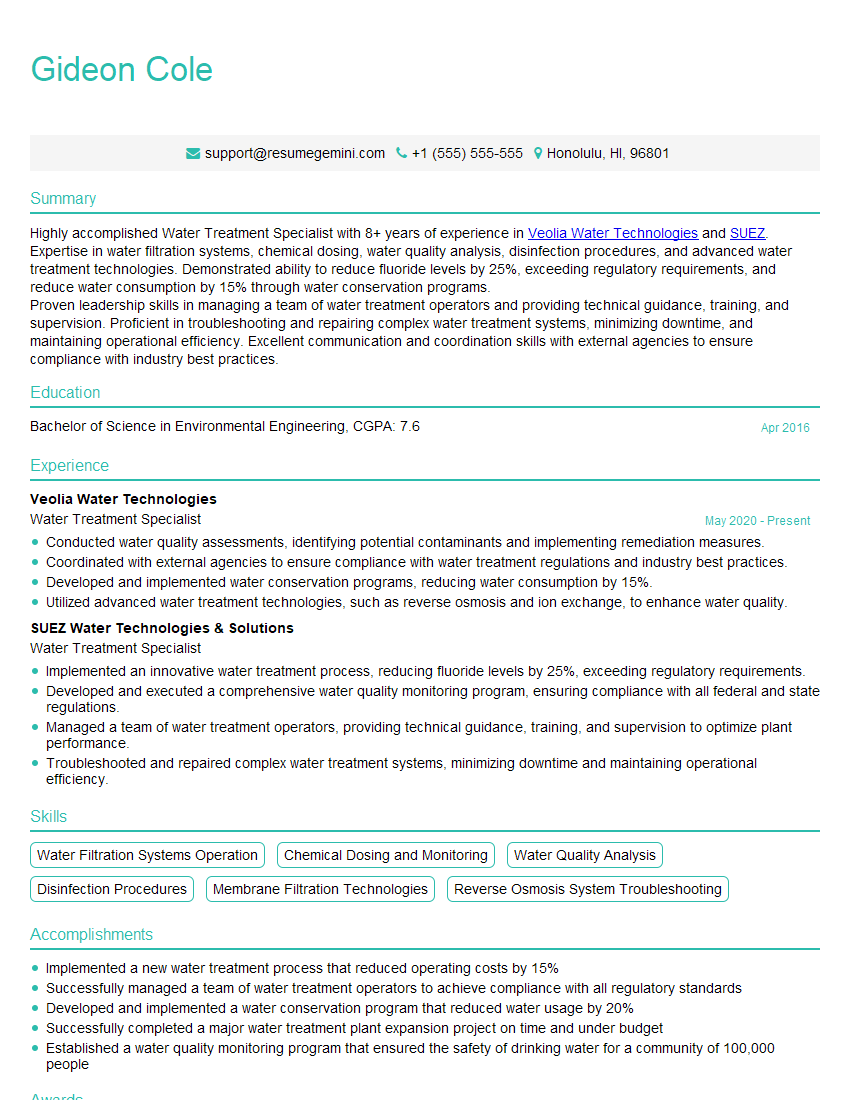
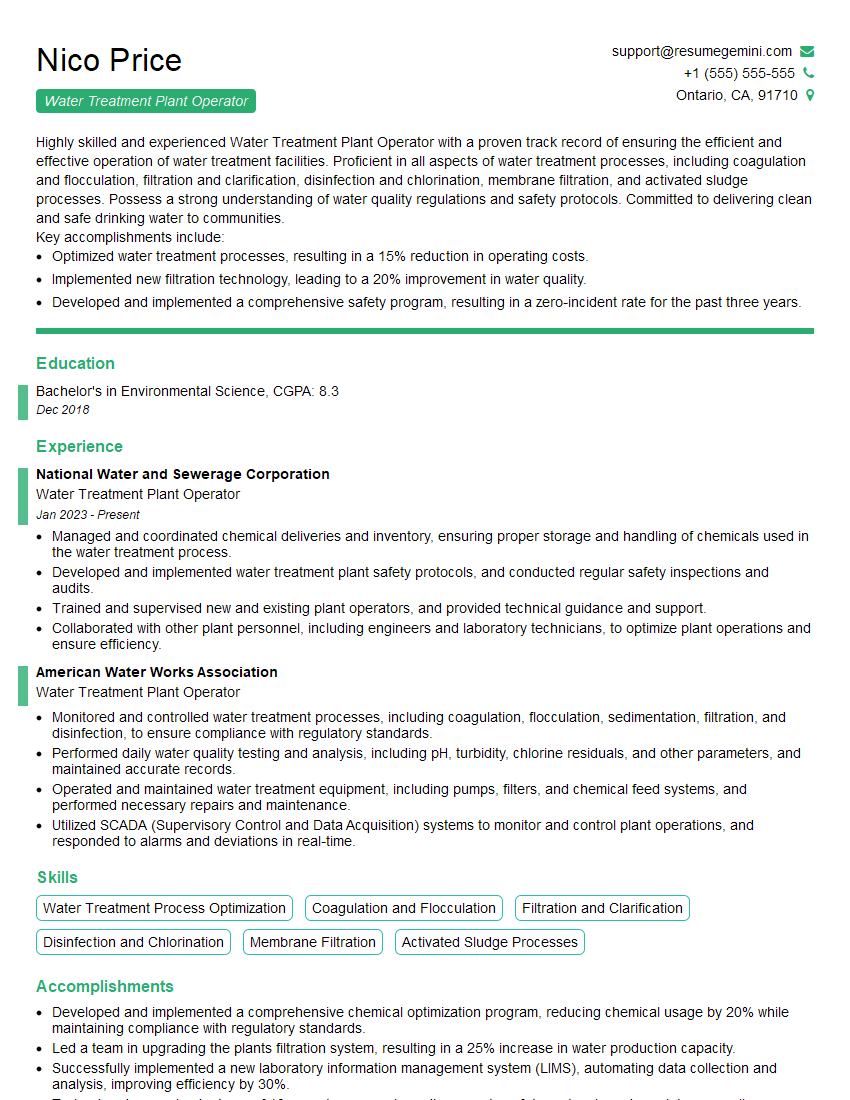
Mastering Reverse Osmosis System Operation is crucial for advancing your career in water treatment and related fields. A strong understanding of these principles opens doors to higher-paying positions and leadership roles. To enhance your job prospects, it’s vital to create a resume that is both ATS-friendly and highlights your skills effectively. ResumeGemini is a trusted resource to help you build a professional and impactful resume that showcases your expertise in Reverse Osmosis System Operation. Examples of resumes tailored to this specific field are available to help guide you.
Explore more articles
Users Rating of Our Blogs
Share Your Experience
We value your feedback! Please rate our content and share your thoughts (optional).
What Readers Say About Our Blog
To the interviewgemini.com Webmaster.
Very helpful and content specific questions to help prepare me for my interview!
Thank you
To the interviewgemini.com Webmaster.
This was kind of a unique content I found around the specialized skills. Very helpful questions and good detailed answers.
Very Helpful blog, thank you Interviewgemini team.