Feeling uncertain about what to expect in your upcoming interview? We’ve got you covered! This blog highlights the most important Rock climbing and canyoneering interview questions and provides actionable advice to help you stand out as the ideal candidate. Let’s pave the way for your success.
Questions Asked in Rock climbing and canyoneering Interview
Q 1. Explain the different types of climbing anchors and their appropriate uses.
Climbing anchors are crucial for safety in rock climbing and canyoneering. They are the points where ropes are attached to secure climbers during various maneuvers. Several types exist, each suited to specific situations and gear.
- Natural Anchors: These utilize existing features like solid boulders, large trees (with proper assessment of root systems), or sturdy rock formations. The key is ensuring they can withstand significant force in multiple directions. Example: Two large, wedged boulders forming a natural V-shape.
- Artificial Anchors: These are installed by climbers using various gear. Examples include:
- Bolts: Permanently placed metal bolts drilled into rock. These are very strong, reliable anchors.
- Camming Devices (cams): These mechanically expand inside cracks, providing secure placement. Their effectiveness depends heavily on crack geometry.
- Nuts: Metal wedges that are placed in cracks. They are more suited for smaller cracks than cams.
- Hexentric nuts (hexes): Similar to nuts but hexagonal in shape, offering better versatility in placement.
- Tricams: Three-sided devices used in less-than-ideal cracks.
- Combination Anchors: Often the safest and most reliable option. This involves using multiple types of anchors, distributing the load and creating redundancy. A good combination might involve two bolts and two cams, allowing for backup in case of one point failing.
The choice of anchor depends on factors such as rock quality, crack systems, available gear, and the type of climb. It is crucial to always have redundancy and adequate strength for the intended load.
Q 2. Describe your experience with various belaying techniques.
I’m proficient in both the “figure-8” and the “ATC” (or similar belay device) belay techniques. The figure-8 is a simple and reliable method suitable for beginners, but it requires careful attention to rope management. The ATC offers more friction control, making it ideal for various situations, including rappelling and managing heavier loads.
My experience includes belaying in various climbing environments, from gym settings to outdoor crack climbing and multi-pitch ascents. I’ve regularly practiced belaying techniques under supervision, and I’m very familiar with proper rope handling, communication, and emergency procedures. For instance, I’ve used the ATC device to effectively control a climber descending a challenging 100-meter multi-pitch route, managing rope drag and maintaining constant communication with my partner. A thorough understanding of how much friction is needed to control the descent is critical here. I also often incorporate backup belay devices for additional safety and redundancy, especially in precarious situations.
Q 3. What are the key safety considerations when rappelling?
Rappelling, while exhilarating, demands meticulous attention to safety. Key considerations include:
- Anchor System: The anchor must be incredibly strong and redundant. It’s essential to have multiple points of attachment to distribute the load. A single point of failure can be catastrophic.
- Rope Inspection: Before each rappel, a thorough rope inspection is vital to identify any damage, wear, or abrasions. A damaged rope is a serious safety hazard.
- Proper Technique: Correct body positioning and controlled descent are paramount. Avoid unnecessary swinging or jerking movements.
- Backup Systems: Having a backup rappel device or system in place provides an additional level of safety in case of primary equipment failure. A secondary rappel device can be a lifesaver.
- Communication: Clear communication with the belayer/partner is crucial, especially in challenging environments. Using hand signals and verbal cues helps maintain safety and avoid misunderstandings.
- Environmental Factors: Consider weather conditions and potential hazards such as loose rock or vegetation that could interfere with rappelling.
I always conduct a thorough pre-rappel check involving all these aspects, even if the conditions seem straightforward, making a mental checklist of all steps before each descent.
Q 4. How do you assess the risk of rockfall in a climbing area?
Assessing rockfall risk involves a combination of observation, experience, and knowledge. I look for several factors:
- Slope Angle: Steeper slopes are inherently more prone to rockfall.
- Rock Type and Structure: Fractured, weathered, or loose rock is much more likely to fall. The presence of unstable scree slopes is a major red flag.
- Recent Weather Conditions: Heavy rain or freeze-thaw cycles can weaken rock and increase the likelihood of rockfall. Fresh cracks in rocks are also a sign of potential instability.
- Human Activity: Climbing routes in areas of recent activity can be hazardous. Previous rockfalls or loose rock dislodged by other climbers is a warning sign.
- Vegetation: The presence of sparse or poorly rooted vegetation can signify unstable soil and a higher risk of rockfall.
By considering these factors, I develop a risk assessment that will determine whether to proceed with the climb and what precautions are necessary. If there are many risks, I will choose a safer alternative.
Q 5. What are the signs of rock instability?
Signs of rock instability can be subtle but critical to recognize. Here are some key indicators:
- Loose Rocks and Scree: The presence of loose rocks, especially in large quantities, indicates a potentially unstable slope.
- Visible Cracks and Fractures: Cracks and fractures in the rock face indicate weakness and potential for failure.
- Weathered Rock: Rock that appears weathered, discolored, or eroded is generally weaker and more prone to breaking.
- Sound of Loose Rock: When tapping on a rock, any loose or hollow-sounding areas are warning signs.
- Recent Rockfalls: Evidence of previous rockfalls, such as fallen debris or fresh scars on the rock face, suggests ongoing instability.
- Unusual Sounds: Sounds like cracking or shifting rocks indicate potential instability.
If I observe any of these signs, I will take extra precautions, such as altering the climbing route or abandoning the climb entirely. Safety is paramount.
Q 6. Explain the process of selecting and setting up a safe anchor system.
Selecting and setting up a safe anchor system is a multi-step process that demands careful attention to detail. Here’s a breakdown:
- Anchor Selection: Choose solid and reliable anchor points. Consider redundancy and strength. Aim for at least two independent anchor points.
- Gear Selection: Select appropriate climbing gear for the anchor, based on the chosen anchor points (bolts, cams, nuts, etc.). Ensure all gear is in good condition.
- Anchor Placement: Place the chosen gear securely and efficiently. Cam placement should be checked for solid placement and ensure that the cam is fully seated.
- Load Distribution: Distribute the load across multiple anchor points. Avoid relying on a single point.
- Redundancy: Use multiple pieces of gear per anchor point or multiple anchor points altogether. This provides safety in case of failure of one anchor point.
- Equalization: Equalize the load between multiple anchor points using a variety of techniques (e.g., cordelette, master point). This ensures that no single anchor point bears excessive stress.
- Testing: Before relying on the anchor system, apply a controlled and substantial amount of weight to each anchor point, and to the entire system as a whole. This can be done through weight-testing with the climbers weight.
Throughout the entire process, I maintain constant awareness of potential hazards and ensure that the anchor system remains secure and safe.
Q 7. How do you communicate effectively with a climbing partner?
Effective communication with a climbing partner is crucial for safety and efficiency. I utilize a combination of verbal and non-verbal cues:
- Clear and Concise Verbal Communication: Before beginning a climb, we discuss the plan, potential hazards, and emergency procedures. During the climb, I communicate clearly about my progress, any difficulties encountered, and any changes in the plan.
- Hand Signals: Hand signals are essential for communication, especially during the climb. Standard climbing signals (e.g. ‘climbing,’ ‘lowering,’ ‘belay on,’ ‘take’ and ‘off belay’) should be explicitly reviewed and practiced.
- Regular Check-Ins: I regularly check in with my partner to confirm that they’re comfortable and that everything is proceeding as planned. I ensure I am familiar with my partner’s climbing abilities and experience.
- Emergency Procedures: We agree on emergency procedures and know how to respond to unexpected situations, such as a fall or equipment failure.
- Active Listening: Active listening is critical. I pay close attention to my partner’s responses and address any concerns promptly.
Clear and consistent communication helps build trust and reduces the risk of accidents. I always emphasize the importance of open communication, so that any safety concerns can be highlighted and discussed.
Q 8. Describe your experience with different types of climbing protection.
My experience with climbing protection encompasses a wide range of systems, each suited to different climbing styles and environments. In sport climbing, I’m proficient with quickdraws, utilizing various locking carabiners to ensure secure clipping to pre-placed bolts. For trad climbing (traditional climbing), I’m skilled in placing and removing various types of protection, including nuts, cams (cams are spring-loaded devices that expand to fit cracks), and hexes. Understanding the proper placement and functionality of each piece is paramount to safety. I also have experience with different types of anchors, including building them from natural features like trees and boulders, employing techniques like equalizing multiple protection points for redundancy. Finally, I’m familiar with using different types of ropes, from dynamic ropes that stretch to absorb impact forces to static ropes for rappelling and canyoning, as well as the appropriate knotting techniques for each scenario.
For example, on a recent trad climb, I encountered a challenging section with only small cracks. I carefully selected and placed a variety of cams and nuts, ensuring each piece was properly seated and offered solid protection. Regular inspection and testing of the placement is crucial, particularly under load. Another time, while setting up a top-rope anchor, I utilized two separate trees to create a redundant system which shared the load in case one failed. The use of master points and redundant systems is vital when relying on natural features.
Q 9. What are the key differences between top-roping, lead climbing, and trad climbing?
Top-roping, lead climbing, and trad climbing are distinct climbing styles with crucial differences in safety and technique. In top-roping, the rope runs from the climber, up to an anchor point above, and back down to a belayer at the base. This is the safest form, as the climber is always protected by the rope from above. Lead climbing involves the climber clipping into pre-placed bolts as they ascend, placing the climber at greater risk if they fall. The climber leads the route, and the belayer pays out slack to protect the fall. Trad climbing, or traditional climbing, is more adventurous and requires the climber to place their own protection in cracks and fissures as they climb. This necessitates a high level of skill in both climbing and protection placement. This makes falls more consequential, needing careful planning and skillful placement of protection.
Imagine top-roping as driving on a well-maintained highway. Lead climbing is like driving a race car on a twisty mountain road. Trad climbing is navigating a rough, unmarked trail in a 4×4 vehicle – you’re entirely responsible for selecting your path and ensuring the safety of the vehicle.
Q 10. How do you identify and mitigate hazards in a canyon?
Hazard identification in a canyon is a multi-faceted process requiring experience, pre-trip planning, and adaptability. Before entering a canyon, I carefully study topographic maps, hydrological data (water flow rate and volume), and weather forecasts. I look for potential hazards like flash flood risks, steep drops, slippery surfaces, and unstable rock formations. On-site, constant vigilance is crucial. I assess the stability of rock above and below, the presence of debris, and any signs of recent water flow. Water levels are especially important, and changes in conditions can quickly transform relatively benign canyons into dangerous environments.
Mitigation involves using appropriate techniques and gear. For example, flash floods are a significant risk, and avoiding canyons during or after rain is crucial. In case of rapid water flow, I always communicate with my team, check for possible escape routes, and consider turning back. Proper rope management and use of appropriate equipment for rappelling are crucial to mitigating hazards during descents.
Q 11. What are the essential pieces of equipment for canyoneering?
Essential canyoneering equipment is crucial for a safe and successful trip. This includes, but is not limited to: a helmet, harness, ropes (dynamic and static), carabiners (locking and non-locking), belay device, rappelling device (e.g., ATC or similar), slings, anchors, waterproof bags for personal belongings, and a first-aid kit. Appropriate footwear (water shoes or canyoning-specific boots) is also needed. A wetsuit or drysuit may be necessary depending on the water temperature. In addition, communication devices (e.g., radios) are important for keeping track of the team, and a detailed map and compass, a GPS device are also necessary. Finally, a personal locator beacon (PLB) is highly recommended for emergencies.
It is important to note that the specific equipment needed can vary based on the canyon’s specific challenges. A thorough assessment of the canyon characteristics before the trip is essential to selecting the appropriate equipment.
Q 12. Explain the procedures for safe canyon descent and ascent.
Safe canyon descent and ascent require meticulous planning and execution. Descent usually involves rappelling, which demands careful rope management, secure anchor points, and proper belaying techniques. Before setting up a rappel, I meticulously check all equipment, inspect the anchor, and ensure that the rope is correctly coiled and free from knots or kinks. During the rappel, constant communication with my partner is key. For ascent, we might use handlines, fixed ropes, or a combination of climbing and scrambling techniques. Depending on the challenge, different climbing strategies and gear might be required. We usually have a second rope (redundancy) for rappelling and backup options for ascent. In every scenario, thorough planning and risk assessment is critical to mitigate all potential hazards. We always have escape routes planned out as a backup for any difficulties.
For example, on one rappel, I discovered a loose rock near the anchor point. Instead of continuing, I carefully removed the rock, securing the area before starting the descent, demonstrating the emphasis on constant vigilance and a willingness to adjust the plan if necessary.
Q 13. Describe your experience with different canyoning techniques (e.g., rappelling, swimming, hiking).
My experience with canyoning techniques is comprehensive. Rappelling is my most frequently used technique, as it’s essential for overcoming vertical drops. I am proficient in various rappelling techniques, including single and double rope rappelling, and using different types of rappel devices. Swimming is often necessary to navigate deep pools or waterfalls, requiring strong swimming skills and an understanding of water currents. Hiking and scrambling are often used to access and traverse canyons, requiring good fitness and navigational skills. I also have experience in navigating through tight squeezes and using different climbing techniques to overcome obstacles.
For instance, during a recent canyon trip, we had to navigate a section with strong currents. I used a combination of swimming and careful maneuvering along the canyon walls to avoid getting swept away, highlighting the necessity for adaptability and resourcefulness.
Q 14. How do you assess water levels and flow in a canyon?
Assessing water levels and flow in a canyon involves a combination of pre-trip planning and on-site observation. Pre-trip assessment involves checking hydrological data, looking at historical flow data, and consulting local sources such as rangers or other experienced canyoneers. On-site observation involves visually assessing the water level and flow rate, looking for signs of recent high water (debris lines, water stains). It’s also important to check the weather forecast, as even a light shower can quickly increase water levels in a canyon. We often use a flow meter if a more quantitative measure is required, and pay attention to signs of potential dangers like debris or undercut banks.
A good example is checking upstream of a section before entering. If water levels are rising, or the flow is too strong, that should be a clear indication to find an alternate route or wait out for conditions to improve. Safety always comes first when making this assessment.
Q 15. What are the signs of flash floods in a canyon?
Flash floods in canyons are incredibly dangerous and can develop rapidly with little warning. Several signs indicate an impending flash flood. The most crucial is a sudden and significant increase in water flow downstream. This might be visually apparent as a rapidly rising water level or a noticeable increase in the volume and velocity of the water. Listen for changes in the sound of the water – a roaring increase in sound suggests a significant increase in water volume further upstream. Also, look for debris, such as branches, logs, or sediment, rushing downstream. This is a strong indicator that a surge of water is on its way. Changes in the weather are also critical; heavy rain in the upper watershed, even many miles away, can lead to a dangerous increase in the canyon’s water levels within minutes. A dark, ominous sky upstream is a very serious warning sign. Remember, never underestimate the power of nature; even a seemingly small amount of rain can quickly cause devastating flash floods in a canyon.
Example: During a canyoneering trip in Zion National Park, we heard a dramatic increase in the roar of the river from miles away. Although the water level in our immediate vicinity appeared normal at that moment, we immediately initiated our pre-planned escape route, as the increased sound was a clear indicator of a rapidly approaching flash flood.
Career Expert Tips:
- Ace those interviews! Prepare effectively by reviewing the Top 50 Most Common Interview Questions on ResumeGemini.
- Navigate your job search with confidence! Explore a wide range of Career Tips on ResumeGemini. Learn about common challenges and recommendations to overcome them.
- Craft the perfect resume! Master the Art of Resume Writing with ResumeGemini’s guide. Showcase your unique qualifications and achievements effectively.
- Don’t miss out on holiday savings! Build your dream resume with ResumeGemini’s ATS optimized templates.
Q 16. How do you handle unexpected situations during a canyoneering trip?
Unexpected situations are part and parcel of canyoneering. My approach emphasizes preparedness and a calm, methodical response. Before any trip, I thoroughly research the canyon, including weather forecasts, recent rainfall data, and potential hazards. We always have a detailed escape plan, multiple communication devices (satellite messenger, radio), and a comprehensive first-aid kit. If an unexpected situation arises, the first step is assessing the danger: Is it a life-threatening emergency (e.g., flash flood, serious injury), or a manageable challenge (e.g., equipment malfunction)? Communication is key; if we have cell service, we contact emergency services. Otherwise, we use our satellite messenger. We use our pre-planned escape strategy to get out of the dangerous area. Prioritizing safety and avoiding unnecessary risk is paramount. In many cases, simple problem-solving skills coupled with extensive prior planning are enough to overcome unexpected issues. We always maintain a calm and positive attitude to keep our team focused and effective.
Example: Once, while rappelling, my partner’s rope got stuck in a narrow slot. Instead of panicking, we carefully assessed the situation, communicating calmly. We used our extra gear to carefully free the rope, and this demonstrated the importance of redundant equipment and efficient communication skills.
Q 17. Describe your experience with rescue techniques in climbing and canyoneering.
My experience with rescue techniques is extensive. I’ve completed multiple wilderness first responder courses and advanced swiftwater rescue training. In climbing, I’m proficient in various self-rescue and partner rescue techniques, including using Z-pulleys and other mechanical advantage systems. In canyoneering, my skills extend to swiftwater rescue and rope systems appropriate for canyon environments. I’m familiar with techniques for hauling injured individuals, constructing anchors in challenging terrain, and safely traversing challenging terrain while carrying an injured person. My training emphasizes a risk-mitigation approach, prioritizing safe and efficient rescue techniques over potentially hazardous improvisation.
Example: I once assisted in a rescue where a climber suffered a lower leg injury. We used a three-pulley system to safely lower the injured climber down the cliff face, ensuring their safety throughout the process. The pre-planned rescue systems and training we had done played a vital role in ensuring success.
Q 18. How do you perform a self-rescue in a climbing scenario?
Self-rescue in climbing depends heavily on the specific situation. However, common techniques include using a prusik knot to ascend a fixed rope. A prusik is a friction knot that can be moved along a rope under load, allowing you to climb. Another method involves using a self-belay system, potentially with additional gear, to retrieve yourself from an awkward position or a fall. Before attempting any self-rescue, always carefully assess the situation, making sure the self-rescue technique is safe and appropriate to your circumstances and available equipment.
Example: If I were to fall and get stuck on a ledge, I would utilize a prusik on my climbing rope to ascend, providing a secure and controlled ascent back to safety. I would evaluate the angle of the rope, the security of the anchor point, and the condition of the rope itself before attempting the ascent.
Q 19. How do you perform a partner rescue in a climbing scenario?
Partner rescue techniques are critical in climbing. The most common involves using a Z-pulley system for mechanical advantage. This system allows you to lift a heavy load (your injured partner) with significantly less effort. Other methods include using ropes, anchors, and various knots to create a system that safely lowers or raises an injured climber. Before attempting any partner rescue, both climbers should be proficient in knot tying, rope handling, and rescue techniques, and also have a thorough understanding of the risks involved. Always prioritize safety and efficient rescue methods.
Example: In a scenario where my partner falls and is injured, I’d establish a secure anchor point, set up a Z-pulley system, and carefully lower my partner to a safe location. It’s very important to have backup systems and contingency plans in place and to practice these scenarios frequently with your partner.
Q 20. How do you use a Z-pulley system?
A Z-pulley system is a mechanical advantage system used to reduce the force required to lift a heavy weight. It uses a pulley and two strands of rope to create a 2:1 mechanical advantage, meaning you only need to pull with half the weight’s force. The system is named because of the ‘Z’ shape the rope creates when set up. To use it, you establish an anchor point, thread the rope through the pulley, and create a system that uses the pulley to redirect the force, effectively multiplying your effort. This is incredibly valuable in rescue situations where lifting an injured climber is needed. Proper anchoring and rope management are crucial for safe and effective operation.
Example: In a rescue scenario where a heavy load needs to be raised, the Z-pulley system becomes very helpful by making it much easier to lift the weight with the same input force.
Q 21. Describe your experience with various knot tying techniques (e.g., figure eight, bowline, prusik).
My knot-tying proficiency is fundamental to my safety and effectiveness in climbing and canyoneering. I’m adept at tying various knots, including the figure eight, bowline, prusik, and many others. The figure eight is primarily used for stopping a rope on a harness or belay device. The bowline is a strong, easy-to-tie loop knot with a variety of applications, from anchoring to making loops in a rope. The prusik, as mentioned previously, is a crucial knot for self-rescue and ascending ropes. It is crucial to know how to tie these knots quickly and securely under pressure, and to always double-check your work before relying on a knot for safety. Regular practice is essential for maintaining proficiency and safety.
Example: I routinely practice tying all my essential climbing knots, even simple ones, in varied conditions. I do this to maintain consistent, quick, and accurate knot tying even under stress.
Q 22. Explain the importance of gear inspection and maintenance.
Gear inspection and maintenance are paramount in rock climbing and canyoneering; they directly impact safety and the longevity of your equipment. A failure in your gear can have catastrophic consequences. My inspection routine is meticulous and follows a checklist.
- Harnesses: I check for wear and tear on webbing, stitching, buckles, and leg loops. Any abrasion or damage, no matter how small, requires replacement.
- Ropes: I look for fraying, cuts, and unusual stiffness or softness, indicating internal damage. I regularly check the rope’s sheath for cuts, and I never use a rope that’s been damaged.
- Carabiners: I examine them for gate function, checking for smooth opening and closing, and look for any deformation or wear on the gate or body. I avoid using carabiners with even minor bending.
- Belay devices: I ensure the device functions smoothly, is free of damage and that the cam is in excellent condition.
- Other Gear: This includes helmets, quickdraws, slings, ascenders, and descenders. Each piece gets a thorough visual check for wear and tear.
Beyond visual inspection, I follow manufacturer recommendations for cleaning and storage. Ropes, for example, should be regularly washed and dried to remove dirt and grime. Proper storage, away from direct sunlight and moisture, extends their lifespan. Regular maintenance isn’t just about safety, it’s about responsible use and extending the life of often expensive gear.
Q 23. How do you manage a client with anxieties or phobias while climbing or canyoneering?
Managing client anxieties is crucial. I start by building trust through open communication and demonstrating my expertise and calm demeanor. I never pressure a client to do anything they’re uncomfortable with. For instance, if a client has a fear of heights, we’ll start with low-level climbs and gradually increase the difficulty.
- Gradual Exposure: We might practice skills on the ground first before attempting them on a wall.
- Positive Reinforcement: I emphasize the client’s accomplishments and celebrate small victories.
- Distraction Techniques: Focusing on technique and problem-solving can sometimes distract from the fear itself.
- Breathing Exercises: Controlled breathing can help manage anxiety symptoms.
- Communication: Open, honest communication about their fears allows me to understand their needs and tailor the experience accordingly.
For phobias, it might be helpful to suggest working with a therapist specializing in exposure therapy before engaging in climbing or canyoneering activities. Safety is the top priority, and if a client’s anxiety is overwhelming, we might need to adjust the plan or even postpone the activity.
Q 24. What are your strategies for dealing with difficult or challenging clients?
Dealing with difficult clients requires patience, diplomacy, and clear communication. I always strive to understand their perspective. Some clients might be demanding or have unrealistic expectations. In such cases, I re-iterate safety procedures, clearly explain limitations, and manage expectations proactively.
- Set Clear Expectations: Before the activity, I clearly communicate the itinerary, the skill level required, and potential challenges.
- Active Listening: I listen carefully to their concerns and address them directly and respectfully.
- Problem-Solving: I work collaboratively to find solutions that meet their needs while maintaining safety.
- Professional Boundaries: I maintain professional boundaries throughout the experience, respecting both my role and the client’s boundaries.
- Referrals: In extreme cases, if I believe I can’t provide a safe and enjoyable experience, I’m not afraid to refer the client to another guide who might be a better fit.
Ultimately, the goal is to find a balance between meeting the client’s desires and ensuring everyone’s safety and enjoyment. Sometimes, this means compromising, but never compromising safety.
Q 25. Describe a time you had to make a difficult decision regarding safety in the field.
During a canyoneering trip, we encountered a sudden flash flood. We were halfway down a narrow canyon when the water level rose rapidly, making the normal exit route impassable. The decision was whether to attempt a risky ascent or wait it out in a potentially precarious location.
After assessing the situation – the rising water level, the stability of the location we were in, the capabilities of my clients, and weather forecasts – I chose to wait. I found a relatively safe spot above the waterline, explained the risks and rationale to my clients, and we waited for the flood to subside. We had to be patient, manage our supplies and emotional well-being. Luckily, the flood eventually receded, allowing for a safe exit. This reinforced for me the importance of constant environmental monitoring, preparedness for unexpected events, and clear communication in high-pressure situations.
Q 26. What is your experience with first aid and wilderness emergency response?
I possess a Wilderness First Responder (WFR) certification and have completed extensive training in wilderness emergency response. My first aid knowledge covers a wide range of injuries and illnesses, including those specific to climbing and canyoneering accidents like fractures, sprains, lacerations, hypothermia, and heatstroke.
Beyond technical skills, I’m proficient in risk assessment, scene management, and evacuation procedures. This includes understanding different evacuation techniques such as using ropes and other climbing gear for rescue, and knowing when and how to utilize satellite communication devices in remote areas. Regular refresher courses are essential for maintaining the highest standards of medical knowledge and emergency response procedures.
Q 27. How do you stay up-to-date with current best practices and safety standards in climbing and canyoneering?
Staying current is crucial in this field. I do this by actively participating in professional development.
- Professional Organizations: I’m a member of the American Mountain Guides Association (AMGA) and participate in their educational programs.
- Conferences and Workshops: Attending industry conferences and workshops allows me to learn about the latest techniques, equipment, and safety standards.
- Continuing Education: I complete regular continuing education courses, including first aid and rescue training updates.
- Peer Learning: I engage in peer learning through discussions with other guides and staying informed about industry best practices.
- Literature Reviews: I read relevant articles and publications to stay updated on research and advancements in the field.
Staying abreast of new developments ensures I provide the safest and most effective services to my clients.
Q 28. Describe your understanding of Leave No Trace principles.
Leave No Trace (LNT) principles are fundamental to my practice. They aim to minimize the environmental impact of our activities. I teach these principles to my clients and strictly adhere to them myself.
- Plan Ahead and Prepare: Knowing the route, weather conditions, and carrying out all necessary equipment beforehand reduces impact.
- Travel and Camp on Durable Surfaces: Staying on established trails and campsites minimizes vegetation damage.
- Dispose of Waste Properly: Packing out all trash, including human waste (if necessary utilizing a WAG bag), is non-negotiable.
- Leave What You Find: Respecting natural and cultural artifacts by leaving everything undisturbed.
- Minimize Campfire Impacts: Using stoves instead of campfires when possible reduces environmental damage. If a campfire is necessary, I follow proper protocols for fire construction and suppression.
- Respect Wildlife: Observing wildlife from a distance, leaving them undisturbed in their natural habitat.
- Be Considerate of Other Visitors: Minimizing noise and leaving areas cleaner than we found them ensures a pleasant experience for everyone.
LNT is more than just a set of rules; it’s a responsibility towards preserving our access to these beautiful places for generations to come.
Key Topics to Learn for Rock Climbing and Canyoneering Interviews
- Rock Climbing: Knot Tying and Anchor Systems: Understanding various knots (e.g., figure eight, clove hitch) and their applications in building safe and efficient anchor systems is crucial. Practical application includes demonstrating knowledge of redundancy and load distribution in climbing setups.
- Canyoneering: Rappelling Techniques and Safety Procedures: Mastering controlled rappelling techniques, including proper rope management and braking methods, is essential. Practical application involves explaining risk mitigation strategies and emergency procedures in canyon environments.
- Route Planning and Navigation (Both Disciplines): Discuss the importance of pre-trip planning, including route selection, assessing environmental hazards (weather, terrain), and employing navigation tools (maps, compass). Practical application involves describing how to adapt plans based on changing conditions.
- Gear Selection and Maintenance: Demonstrate understanding of appropriate gear selection for different climbing and canyoneering scenarios. Practical application includes explaining gear maintenance and inspection procedures to prevent equipment failure.
- Risk Assessment and Management (Both Disciplines): Explain the process of identifying and mitigating potential hazards in climbing and canyoneering. Practical application includes describing decision-making processes in challenging situations and communicating potential risks to team members.
- Rescue Techniques (Both Disciplines): Understanding basic rescue techniques for common climbing and canyoneering accidents is vital. Practical application includes describing self-rescue and partner-rescue strategies.
- Environmental Awareness and Leave No Trace Principles: Demonstrate knowledge of responsible outdoor ethics, including minimizing environmental impact and respecting natural areas. Practical application involves describing best practices for minimizing your impact on the environment.
Next Steps
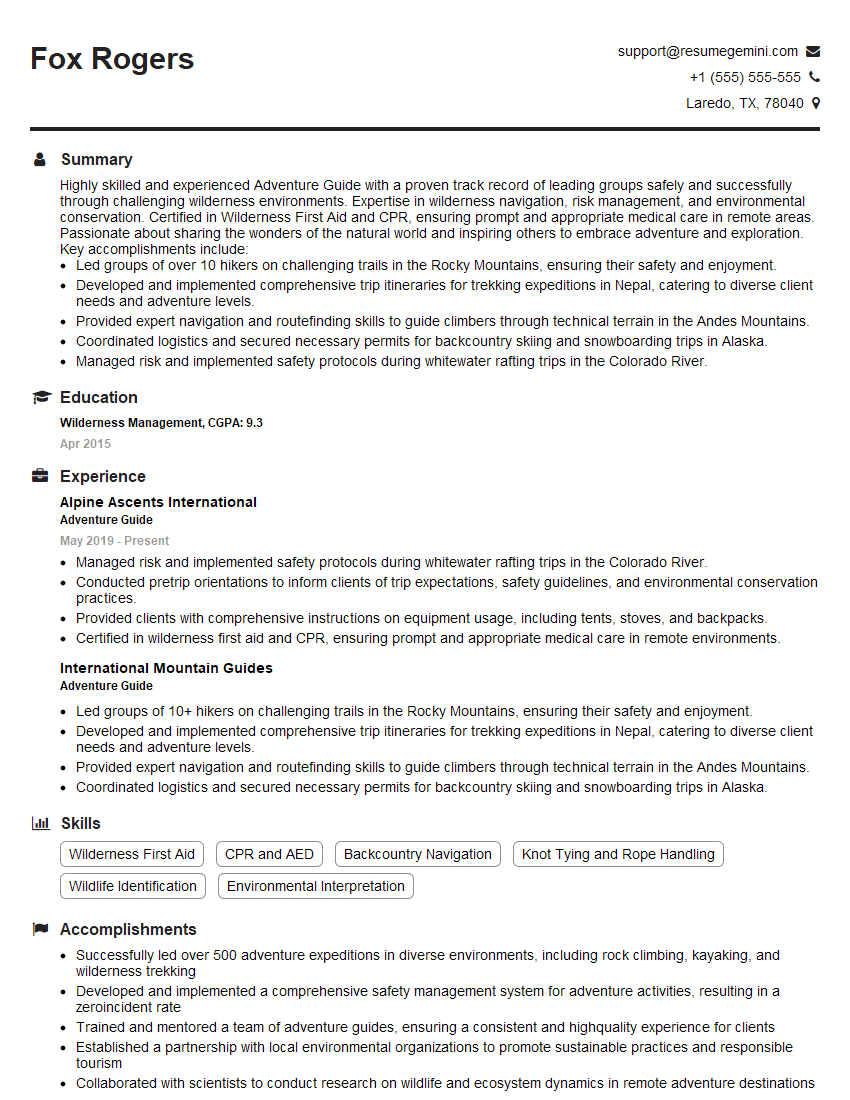
Mastering rock climbing and canyoneering skills demonstrates valuable attributes highly sought after by employers: problem-solving abilities, teamwork, risk management expertise, and a commitment to safety. These skills translate directly to many professional fields. To maximize your job prospects, create a strong, ATS-friendly resume that highlights these transferable skills. ResumeGemini is a trusted resource to help you build a professional resume that stands out. We provide examples of resumes tailored to the rock climbing and canyoneering industries to help you get started.
Explore more articles
Users Rating of Our Blogs
Share Your Experience
We value your feedback! Please rate our content and share your thoughts (optional).
What Readers Say About Our Blog
To the interviewgemini.com Webmaster.
Very helpful and content specific questions to help prepare me for my interview!
Thank you
To the interviewgemini.com Webmaster.
This was kind of a unique content I found around the specialized skills. Very helpful questions and good detailed answers.
Very Helpful blog, thank you Interviewgemini team.