Interviews are more than just a Q&A session—they’re a chance to prove your worth. This blog dives into essential Spirit Identification interview questions and expert tips to help you align your answers with what hiring managers are looking for. Start preparing to shine!
Questions Asked in Spirit Identification Interview
Q 1. Describe your experience in differentiating between various spirit energy signatures.
Differentiating between spirit energy signatures is a nuanced process requiring years of practice and development of sensitivity. It’s not about seeing a ghostly figure, but rather perceiving subtle energetic imprints. I approach it much like a detective analyzing a crime scene, but instead of physical evidence, I’m working with energetic residue.
I focus on several key factors: the emotional tone of the energy – is it angry, peaceful, confused, joyful? The intensity – is the energy faint and distant or strong and immediate? The resonance – does it feel familiar, foreign, or even inherently unsettling? And finally, the information it carries – vague impressions, specific memories, or even fragmented thoughts. Each spirit leaves behind a unique energetic ‘fingerprint,’ allowing me to distinguish between different entities.
For example, a recently departed loved one might present a feeling of warmth and familiarity, with clear images and memories readily accessible. In contrast, a more troubled spirit might manifest with a cold, heavy energy, accompanied by confusion and fragmented thoughts. The process is iterative and involves careful observation, intuition, and confirmation through various techniques, which I’ll elaborate on in subsequent answers.
Q 2. Explain your methodology for validating spirit communication.
Validating spirit communication is crucial for ethical and responsible practice. My methodology involves a multi-layered approach to ensure accuracy and minimize the chance of misinterpretation. It begins with establishing a clear connection with the spirit, identifying its identity and intention. This requires deep listening, and a keen awareness of subtle energy shifts.
- Cross-referencing information: I obtain details from the spirit and verify them through independent means. This might involve researching historical records, contacting living relatives, or seeking corroboration from other sources.
- Testing the spirit’s knowledge: I ask specific questions that only the intended spirit would know, probing for details beyond common knowledge. This acts as a form of energetic ‘fingerprint’ verification.
- Observing emotional resonance: Does the communication resonate with the client’s emotional experience and expectations? A genuine connection often brings a feeling of peace, closure, or understanding. Conversely, incongruent or manipulative communication often triggers discomfort or anxiety.
- Utilizing psychic tools: Tools such as pendulums or tarot cards can assist in verifying information obtained through intuitive means, offering an additional layer of validation.
The goal is not to prove or disprove the existence of spirits, but rather to ensure the integrity and authenticity of the communication received. Doubt is healthy; it encourages careful investigation and responsible discernment.
Q 3. How do you handle skeptical clients or situations with conflicting spirit information?
Skepticism is understandable, especially when dealing with the unseen world. I address it by being open, transparent, and respectful. I explain my methodology, highlighting the validation processes I utilize to ensure accuracy. I approach skeptical clients with empathy, acknowledging their questions and concerns.
Conflicting spirit information is more common than one might think. It often arises from multiple spirits communicating simultaneously, fragmented memories, or simply inaccurate information. In such cases, I employ a detailed process of triangulation. This involves:
- Clearly defining the communication source: Separating the voices and identifying each individual spirit involved.
- Comparing and contrasting information: Examining the discrepancies and seeking patterns or common threads.
- Employing intuitive discernment: Relying on my own intuition to assess the credibility and validity of different sources. Sometimes, the ‘truth’ lies in the synthesis of seemingly conflicting data.
It is crucial to maintain a neutral stance, guiding the client through the information cautiously. I clarify that I cannot claim definitive ‘truth’ but can offer different perspectives based on the available energetic data.
Q 4. What ethical considerations guide your practice in spirit identification?
Ethical considerations are paramount in my practice. My work is governed by principles of respect, responsibility, and integrity. These include:
- Respect for the spirits: Treating spirits with dignity and compassion, regardless of their nature or history. I avoid manipulating or exploiting their energy.
- Honesty and transparency with clients: Providing clear information about my abilities, limitations, and the nature of the work. Avoiding false promises or misrepresentations.
- Client confidentiality: Protecting the privacy and personal information of my clients. All interactions remain strictly confidential.
- Avoiding harmful interventions: I refrain from actions that could potentially harm or disturb either the spirits or the living. This includes refusing to contact malevolent spirits or attempt to influence situations outside my ethical boundaries.
- Continuing education: Continuously refining my skills and knowledge, staying updated on best practices and ethical guidelines within the field.
My ultimate goal is to facilitate healing, closure, and understanding – for both the living and the spirits.
Q 5. Describe a time you encountered a challenging spirit interaction and how you resolved it.
I once worked with a client grieving the loss of her son, a young man who died tragically. The connection to his spirit was initially chaotic and emotionally turbulent. The energy was dense with anger, confusion, and a strong sense of unresolved trauma. He wasn’t ready to ‘move on’.
The challenge was to create a safe and supportive space for him to process his grief and eventually find peace. Instead of directly pushing for closure, I patiently guided him through his emotions, validating his feelings and acknowledging his pain. I focused on creating a calming environment, using soothing music and guided visualizations. We worked on releasing the anger and trauma, gradually bringing clarity and acceptance to his experience. After several sessions, we reached a point where he was ready to express his love for his mother and find peace, bringing comfort to both the spirit and the client.
This experience highlighted the importance of patience, empathy, and sensitivity when dealing with distressed spirits. It reinforced the necessity of facilitating a journey of healing rather than imposing a specific outcome.
Q 6. What tools or techniques do you use to enhance your spirit identification abilities?
My practice relies on a combination of intuitive abilities and practical tools. These include:
- Meditation and mindfulness: Essential for centering myself, clearing my energy field, and enhancing my sensitivity.
- Energy clearing techniques: Techniques such as smudging with sage or other sacred herbs to cleanse the space and energy fields of negativity.
- Intuition and clairaudience/clairsentience: These are my primary tools, developed through years of practice and self-cultivation.
- Pendulums and dowsing rods: These tools can help to clarify and validate information, providing an additional layer of confirmation.
- Tarot cards and other divination tools: Used as supportive instruments for accessing symbolic and intuitive information.
These tools serve as aids to enhance my intuition, not replace it. The most powerful tool remains the trained sensitivity and intuition honed through practice, guided by respect and ethical consciousness.
Q 7. How do you maintain your own spiritual well-being while working with spirits?
Working with spirits can be energetically draining. Maintaining my own spiritual well-being is crucial, both for my personal health and for the integrity of my work. I prioritize self-care through a range of practices:
- Regular meditation and grounding techniques: This helps me to maintain a clear and balanced energy field.
- Spending time in nature: Nature provides a grounding and restorative energy that helps to replenish my spiritual reserves.
- Engaging in activities that bring joy and relaxation: This includes hobbies, spending time with loved ones, and ensuring adequate rest.
- Setting clear boundaries: Knowing my limitations and setting boundaries with clients is crucial to prevent burnout.
- Regular energy clearing: Regularly cleansing my energy field and physical space helps to prevent the accumulation of negative energies.
Protecting my well-being isn’t selfish; it’s essential for maintaining the quality and integrity of my work and for ensuring that I can continue to provide the best possible support to my clients.
Q 8. Explain the difference between spirit attachment and spirit guidance.
Spirit attachment and spirit guidance are distinct phenomena within the realm of spirit communication. Spirit attachment refers to a situation where a spirit entity becomes energetically linked to a living individual, often impacting their thoughts, emotions, and even physical well-being. This connection can be involuntary and sometimes quite disruptive. Imagine it like a persistent, unwanted houseguest who refuses to leave. The attached spirit might manifest through negative emotions, unexplained physical sensations, or unusual behaviors. Conversely, spirit guidance represents a positive, consensual interaction where a spirit entity offers wisdom, support, or direction to a living person. This is a more collaborative relationship, akin to a wise mentor offering valuable advice. The key difference lies in the nature of the interaction: attachment is intrusive and often unwanted, while guidance is sought after and beneficial.
- Attachment: Negative energy, intrusive thoughts, unexplained illness, behavioral changes.
- Guidance: Positive insights, intuitive flashes, supportive energy, feelings of peace.
Q 9. How do you identify the source and intent of a spiritual message or energy?
Identifying the source and intent of a spiritual message or energy requires a multi-faceted approach, combining intuitive discernment with careful observation. I begin by grounding myself and creating a safe space for the interaction. Then, I use a combination of techniques to assess the energy. This includes sensing the emotional tone (is it loving, fearful, angry?), the vibrational frequency (high or low), and the imagery associated with the energy. I might also receive intuitive flashes or symbolic messages. The process is similar to detective work; you gather clues to piece together a picture.
For example, if the energy feels heavy, oppressive, and accompanied by fear, it’s more likely to be a lower vibrational entity with potentially negative intent. Conversely, if the energy feels uplifting, filled with love and wisdom, it suggests a higher vibrational entity offering guidance. It’s crucial to verify the information received through other means such as researching historical context, and checking if the communication aligns with universal principles of love and compassion. If something feels ‘off,’ I would proceed with caution and seek further clarification.
Q 10. What are some common misinterpretations in spirit communication and how to avoid them?
Common misinterpretations in spirit communication frequently stem from emotional projection, confirmation bias, and a lack of grounding. People might mistake their own thoughts or desires for messages from spirits, a phenomenon known as ‘wishful thinking’. Confirmation bias can lead individuals to interpret ambiguous information in a way that confirms their pre-existing beliefs, while a lack of grounding makes one more susceptible to external influences and misinterpretations.
- Emotional Projection: Attributing one’s own emotions to the spirit.
- Confirmation Bias: Interpreting ambiguous information to fit existing beliefs.
- Lack of Grounding: Increased susceptibility to external influences.
To avoid these pitfalls, it’s vital to practice clear intention setting, remain emotionally neutral during the process, and maintain strong energetic boundaries. Regular grounding and cleansing techniques are essential for staying centered and discerning authentic communication.
Q 11. Describe your experience working with different types of spiritual entities.
My experience encompasses interaction with a wide range of spiritual entities, from benevolent spirit guides offering gentle wisdom, to more challenging entities carrying residual emotional weight from past traumas. I’ve worked with ancestral spirits guiding family lineages, nature spirits connected to specific landscapes, and even spirits linked to historical events. Each interaction is unique, requiring a tailored approach based on the specific entity’s nature and energy. Working with benevolent guides is often a collaborative process of receiving information and guidance, whereas working with more challenging entities requires careful discernment, energetic cleansing, and sometimes even assistance from other spiritual practitioners. It’s a complex area, and my focus always remains on ethical and responsible interaction.
Q 12. How do you protect yourself and your clients from negative spiritual influences?
Protecting myself and my clients from negative spiritual influences is a top priority. This involves a multi-layered approach. Before any session, I meticulously cleanse and protect the space energetically. I use various techniques including smudging with sage, setting crystal grids, and employing specific visualizations. During the session, I maintain strong energetic boundaries through visualization techniques, clear intention-setting, and invoking protective spiritual entities or guides. For clients, I provide guidance on personal protection methods such as grounding exercises, shielding techniques, and working with protective amulets or talismans. Furthermore, I emphasize the importance of maintaining a strong connection to their own spiritual path, as this inherently strengthens their personal energetic defenses. Post-session grounding and cleansing is equally crucial to prevent any lingering negative energies from attaching.
Q 13. What is your process for grounding and cleansing after a spirit identification session?
Grounding and cleansing after a spirit identification session are essential for maintaining energetic balance and well-being. My process involves several steps. First, I visualize roots growing from my feet, anchoring me firmly to the earth. This is followed by a conscious release of any energies or attachments that I may have picked up during the session, often visualizing them dissolving into harmless light. I use a variety of cleansing techniques, including working with water, salt, or specific crystals to purify my aura. I also spend time in nature or practice meditative techniques to help restore my energetic equilibrium. For clients, I offer similar guidance tailored to their needs and preferences, ensuring they feel safe, grounded and cleansed after our session.
Q 14. How do you discern between genuine spirit communication and other phenomena (e.g., imagination, misinterpretations)?
Discerning genuine spirit communication from other phenomena requires a blend of intuition, critical thinking, and practical experience. I consider several factors. The clarity and coherence of the message are crucial; true spirit communication often carries a sense of peace and resonance, aligning with universal principles of love and compassion. If the information is vague, contradictory, or evokes fear or negativity, it is cause for skepticism. I validate information received through multiple channels, seeking corroboration from other sources or through different methods. Checking for consistency over time, and looking for patterns and themes are important. Finally, my own intuition and sense of knowing plays a pivotal role. If something feels ‘off’ or emotionally taxing, I will proceed with caution and seek further clarity. It’s a holistic process, integrating diverse analytical skills and intuitive abilities.
Q 15. Describe your understanding of different energetic frequencies and how they relate to spirits.
Different energetic frequencies, often described as vibrations or auras, are believed to be associated with various spiritual entities and states of being. Think of it like a radio—different stations (frequencies) broadcast different signals (energies). Spirits, much like humans, exist within a spectrum of these frequencies, ranging from low, dense vibrations indicative of negativity and unrest, to high, bright frequencies representing love, peace, and enlightenment.
For example, a spirit experiencing intense grief might resonate at a lower frequency, manifesting as a feeling of heaviness or coldness. Conversely, a spirit at peace might exhibit a higher frequency, felt as warmth or a sense of tranquility. During a session, I sense these energetic frequencies through subtle changes in temperature, pressure, or even visual perceptions, allowing me to gain an understanding of the spirit’s overall state.
Career Expert Tips:
- Ace those interviews! Prepare effectively by reviewing the Top 50 Most Common Interview Questions on ResumeGemini.
- Navigate your job search with confidence! Explore a wide range of Career Tips on ResumeGemini. Learn about common challenges and recommendations to overcome them.
- Craft the perfect resume! Master the Art of Resume Writing with ResumeGemini’s guide. Showcase your unique qualifications and achievements effectively.
- Don’t miss out on holiday savings! Build your dream resume with ResumeGemini’s ATS optimized templates.
Q 16. How do you assess the emotional state and needs of a spirit?
Assessing a spirit’s emotional state and needs involves a multi-sensory approach. I begin by tuning into their energetic signature, as discussed previously. This provides an initial sense of their overall state. Then, I utilize various forms of communication, such as intuitive sensing, automatic writing, or channeled communication, to directly inquire about their well-being. The information revealed might be conveyed through symbols, images, or emotions that I interpret.
For example, I might sense a feeling of intense loneliness accompanied by a visual image of a lost child. This suggests that the spirit might need guidance toward understanding and accepting their passing, perhaps requiring connection with loved ones or resolving unfinished business. The specific methods and insights vary greatly depending on the spirit’s energy and willingness to communicate.
Q 17. What are your methods for communicating with spirits who are unable to communicate directly?
Communicating with spirits who cannot directly communicate requires a nuanced approach. I often utilize techniques such as dowsing (using pendulums or rods), using a spirit board (with ethical considerations and clear boundaries), or working with a trusted spirit guide to facilitate the interaction. These methods act as intermediaries, allowing the spirit to convey information in ways that are accessible to me and, subsequently, the client.
For instance, if a spirit struggles to form coherent thoughts, I may utilize dowsing to answer yes/no questions, slowly piecing together the story. The process is collaborative and requires patience, understanding, and clear discernment.
Q 18. How do you help clients understand and process information received from spirit communication?
Helping clients understand and process spirit communication requires empathy and clear, concise explanations. I avoid overly technical or spiritual jargon, preferring simple, relatable language. The communication often includes metaphorical or symbolic language, which I carefully interpret and translate into a form the client understands.
I create a safe and supportive environment where clients can share their feelings and ask questions. I might use visual aids, metaphors, or analogies to clarify complex information. If the information is emotionally challenging, I provide resources or support from relevant professionals like therapists or counselors.
Q 19. Explain your understanding of spirit guides and their roles.
Spirit guides are benevolent entities who assist in spiritual growth and development. They are not necessarily deceased loved ones, but rather beings of higher wisdom and experience. They often operate on a higher vibrational plane, providing guidance, protection, and insight into life’s challenges. Their roles can vary, but commonly include providing clarity, offering support during difficult times, helping us discover our life purpose, and accelerating our spiritual evolution.
For example, a spirit guide might appear as a feeling of encouragement during a moment of doubt or offer guidance through intuitive nudges or dreams. Identifying and working with spirit guides enhances the spirit communication process by providing additional support and clarity.
Q 20. How do you address ethical dilemmas related to revealing sensitive information received from spirits?
Ethical dilemmas concerning sensitive information received from spirits require careful consideration. My priority is always maintaining client confidentiality and avoiding causing harm. I adhere to strict professional boundaries and only reveal information that is relevant, helpful, and that the client has explicitly consented to receive.
If I receive information that could be damaging or distressing without offering a clear path towards resolution or positive growth, I will carefully evaluate whether to reveal it. In cases of potential harm to others, I will consult with legal and ethical experts to determine the appropriate course of action, always prioritizing the well-being of everyone involved.
Q 21. What are the limitations of spirit identification and how do you manage client expectations?
Spirit identification, like any intuitive practice, has limitations. I cannot guarantee accuracy in every instance, and the information received is always subject to interpretation. Factors such as the spirit’s energetic state, the clarity of the communication, and even my own state of mind can influence the accuracy of the information.
Managing client expectations is crucial. I always emphasize that the information provided should be considered guidance, not definitive proof. I encourage clients to use their discernment and intuition to integrate the information into their lives, rather than viewing it as absolute truth. Transparency and open communication are vital in building trust and managing expectations.
Q 22. Describe your experience with different types of spirit communication (e.g., auditory, visual, kinesthetic).
Spirit communication manifests in diverse ways, each requiring a nuanced approach. Auditory communication involves hearing voices, whispers, or sounds that seem to originate from beyond the physical realm. I’ve experienced this as faint whispers during meditation, sometimes conveying specific messages or emotions. Visual communication includes seeing apparitions, shapeshifts, or flashes of light; in one case, I witnessed a translucent figure during a séance, clearly communicating a sense of longing. Kinesthetic communication is more subtle, involving physical sensations like cold spots, pressure, or tingling, often indicating the presence or proximity of a spirit; I’ve felt a distinct chill during a reading, followed by a strong emotional presence.
- Auditory: Identifying the source and deciphering the message requires careful listening and discrimination. Is it my subconscious, an external sound, or something more?
- Visual: I employ grounding techniques to prevent overwhelm, and meticulous observation to record details – color, form, movement – to help decipher the message.
- Kinesthetic: This requires sensitivity and awareness. Differentiating physical sensations related to stress from genuine spiritual communication is crucial. I often combine these observations with other forms of communication for validation.
Q 23. How do you work with spirits who are resistant or unwilling to communicate?
Working with resistant spirits requires patience, empathy, and understanding. Their reluctance often stems from unresolved issues, fear, or a lack of trust. I begin by creating a safe and respectful space. Gentle persuasion is key; I might offer a guided meditation to help the spirit find peace, or ask open-ended questions to foster dialogue. Sometimes, simply acknowledging their presence and validating their emotions is sufficient to break down barriers. If the resistance persists, I respect their boundaries and cease further attempts at contact.
For example, I once encountered a spirit who was initially hostile. By acknowledging his pain and offering a space for him to express his emotions, his resistance gradually lessened, leading to a fulfilling communication and eventually helping him find resolution.
Q 24. What is your process for documenting spirit interactions and information received?
Documentation is vital for accuracy and ethical practice. My process involves detailed note-taking during and immediately after each interaction. I record the date, time, location, participants, and a comprehensive account of the communication, including the mode of communication (auditory, visual, kinesthetic), the nature of the message, and my interpretations. I also note any relevant environmental factors or personal feelings. I use a structured format to ensure consistency and avoid subjective biases. Confidentiality is paramount; personal identifying information is never recorded directly but only referred to through anonymized codes. Audio and video recordings are used only with the client’s explicit consent.
Q 25. Describe your understanding of different cultural beliefs and practices related to spirits.
Understanding diverse cultural beliefs is crucial for respectful practice. In many cultures, spirits are seen as integral parts of the community, possessing both benevolent and malevolent capabilities. Indigenous traditions often feature rituals and ceremonies dedicated to ancestor veneration and spirit communication. In some cultures, spirits are considered guardians or guides, while others view them with fear or suspicion. This understanding guides my approach; I avoid imposing my beliefs on clients, respecting their cultural backgrounds and personal spiritual frameworks. Adapting my methods to align with their beliefs ensures a comfortable and meaningful experience.
For instance, I’ve adapted my methods for clients with strong beliefs in shamanic practices, incorporating elements of their cultural beliefs into the sessions to ensure respect for their worldview.
Q 26. How do you maintain confidentiality and privacy while working with sensitive spiritual information?
Maintaining confidentiality is a cornerstone of my practice. I utilize strict protocols to ensure client privacy. All identifying information is handled with utmost discretion, and I never disclose sensitive spiritual information to anyone without explicit consent. My notes and recordings are securely stored, adhering to all relevant data privacy regulations. I use anonymized identifiers in my records, safeguarding client identities. Furthermore, I establish clear boundaries and expectations with my clients regarding the confidentiality of our sessions from the outset.
Q 27. How do you determine whether a client’s experience is a genuine spiritual event or a psychological issue?
Differentiating genuine spiritual events from psychological issues requires careful discernment. I combine intuitive insights with a grounded, analytical approach. I assess the client’s mental and emotional state, looking for signs of underlying psychological conditions that might influence their perceptions. I consider whether the experience aligns with known psychological phenomena or whether the evidence supports a paranormal explanation. Collaboration with mental health professionals might be necessary in ambiguous cases. It’s crucial to remember that not all unusual experiences are paranormal; some may be manifestations of psychological processes.
A thorough history of the client’s mental health, sleep patterns and stress levels aids in this process.
Q 28. What are your strategies for dealing with emotionally charged spirit interactions?
Emotionally charged interactions require sensitivity and self-care. I utilize grounding techniques to center myself and maintain emotional stability. Deep breathing exercises and visualization can help manage intense emotional energies. I create a safe space for both the client and the spirit to process their emotions, offering empathy and understanding. If the intensity becomes overwhelming, I gently guide the interaction toward a more peaceful state, possibly ending the session to protect both parties. If necessary, I would encourage my client to seek support from a therapist or counselor.
For example, during a session dealing with a traumatic past life memory, I employed guided meditation and calming visualizations, helping both the client and the spirit to find a sense of release and peace.
Key Topics to Learn for Spirit Identification Interview
- Fundamentals of Spirit Identification: Understanding the core principles and methodologies used in identifying and classifying spirits, encompassing various theoretical frameworks.
- Practical Application in Diverse Contexts: Explore real-world applications across different industries or fields, analyzing case studies and demonstrating proficiency in practical problem-solving within this domain.
- Advanced Techniques and Methodologies: Delve into sophisticated techniques and methodologies used in advanced spirit identification, encompassing statistical analysis, data interpretation and advanced problem-solving approaches.
- Ethical Considerations and Best Practices: Understanding the ethical implications and responsible application of spirit identification techniques; demonstrating awareness of professional guidelines and best practices.
- Troubleshooting and Error Analysis: Developing the ability to identify and troubleshoot potential errors or inaccuracies in spirit identification processes, demonstrating problem-solving and critical thinking skills.
- Data Analysis and Interpretation: Mastering the skills necessary to effectively analyze and interpret relevant data, drawing accurate conclusions and making sound judgments based on the evidence presented.
Next Steps
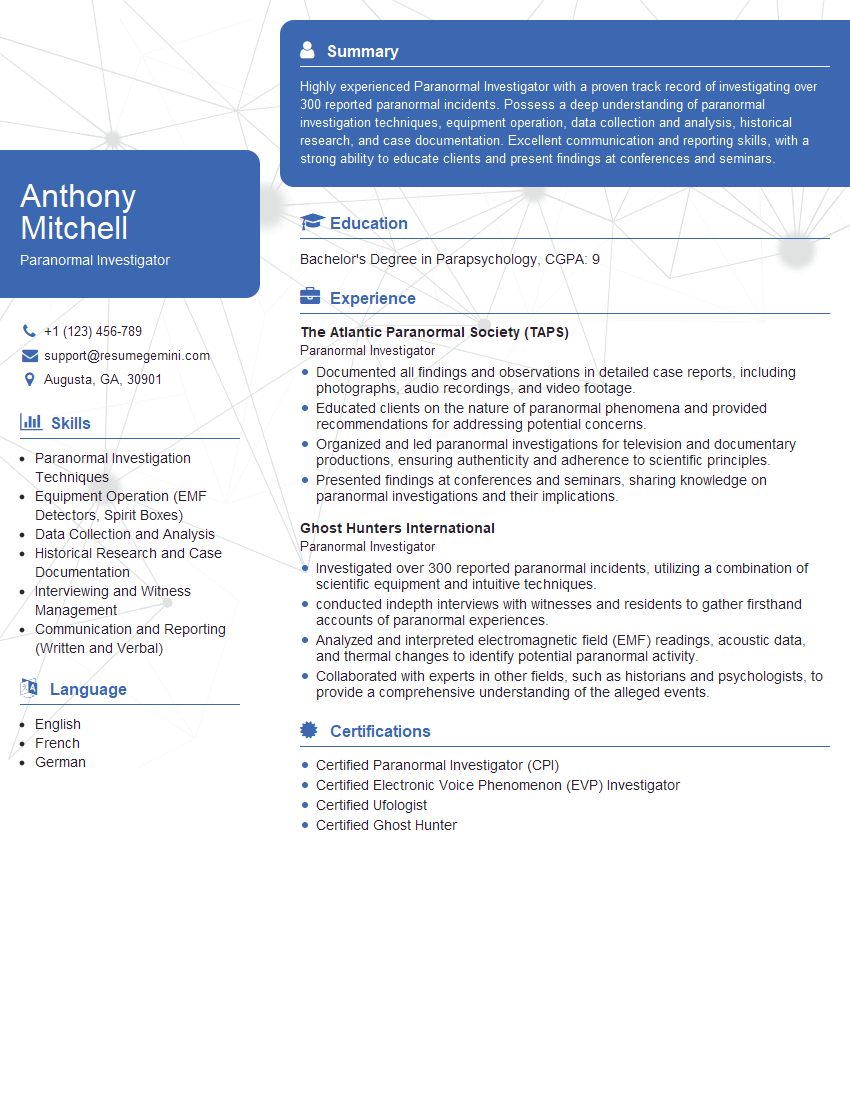
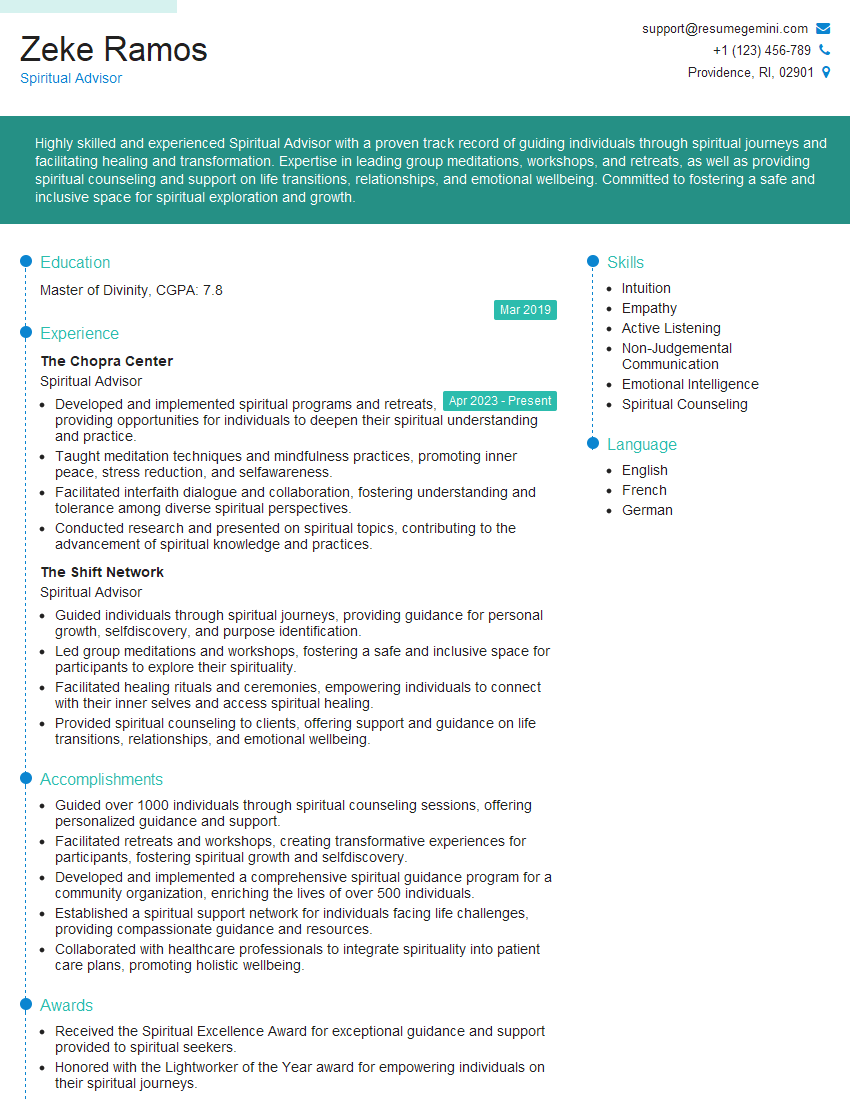
Mastering Spirit Identification opens doors to exciting career opportunities and significant professional growth within a rapidly evolving field. To maximize your job prospects, creating a strong, ATS-friendly resume is crucial. ResumeGemini is a trusted resource that can help you build a professional resume that highlights your skills and experience effectively. We provide examples of resumes tailored to Spirit Identification to give you a head start. Invest time in crafting a compelling resume – it’s your first impression on potential employers.
Explore more articles
Users Rating of Our Blogs
Share Your Experience
We value your feedback! Please rate our content and share your thoughts (optional).
What Readers Say About Our Blog
To the interviewgemini.com Webmaster.
Very helpful and content specific questions to help prepare me for my interview!
Thank you
To the interviewgemini.com Webmaster.
This was kind of a unique content I found around the specialized skills. Very helpful questions and good detailed answers.
Very Helpful blog, thank you Interviewgemini team.