Unlock your full potential by mastering the most common Statistical Modeling for Remote Sensing interview questions. This blog offers a deep dive into the critical topics, ensuring you’re not only prepared to answer but to excel. With these insights, you’ll approach your interview with clarity and confidence.
Questions Asked in Statistical Modeling for Remote Sensing Interview
Q 1. Explain the difference between supervised and unsupervised classification in remote sensing.
In remote sensing, both supervised and unsupervised classification aim to categorize pixels in satellite imagery based on their spectral characteristics. However, they differ fundamentally in how they achieve this.
Supervised classification requires training data – a set of pixels where the land cover type (e.g., forest, water, urban) is already known. We use this labeled data to train a statistical model (e.g., maximum likelihood, support vector machine) that learns the relationship between spectral values and land cover classes. The model then predicts the class of unlabeled pixels in the image. Think of it like teaching a child to identify different fruits by showing them examples of apples, oranges, and bananas. Once they learn the differences, they can identify new fruits.
Unsupervised classification, on the other hand, doesn’t use pre-labeled data. Algorithms like k-means clustering group pixels based on their spectral similarity, revealing natural clusters or patterns in the data without prior knowledge of the classes. This is more akin to letting the child group similar fruits together based on their observation alone—they may not know the exact names, but they’ll group apples with apples and oranges with oranges.
In essence, supervised classification is more accurate when you have sufficient training data, while unsupervised classification is useful for exploratory data analysis when labeled data is scarce or you want to discover hidden patterns in your data.
Q 2. Describe your experience with various image processing techniques used before statistical modeling.
Before applying statistical modeling, robust image preprocessing is crucial. My experience encompasses a wide range of techniques, including:
- Atmospheric correction: Removing atmospheric effects (scattering, absorption) to obtain true surface reflectance, often using tools like FLAASH or ATCOR. This is essential for accurate classification as atmospheric interference can significantly skew spectral signatures.
- Geometric correction: Registering images to a common geographic coordinate system, ensuring accurate spatial alignment using techniques like orthorectification and georeferencing. Incorrect alignment can lead to misclassification and errors in spatial analysis.
- Radiometric calibration: Converting digital numbers (DNs) from satellite sensors into meaningful physical units (e.g., reflectance, radiance) using sensor-specific calibration parameters. This ensures consistent and comparable measurements across different images and sensors.
- Data filtering: Removing noise and artifacts from images using techniques such as median filtering, low-pass filtering, and principal component analysis (PCA) for dimensionality reduction. Noise reduction improves the overall quality of the data and the performance of subsequent statistical models.
- Image segmentation: Dividing the image into homogeneous regions based on spectral or spatial characteristics. This can improve classification accuracy by creating meaningful units for analysis. Methods like edge detection and watershed segmentation are frequently employed.
I’m proficient in using software like ENVI, ArcGIS, and R for these processing steps, tailoring the approach to the specific sensor data and the research question.
Q 3. How do you handle outliers in remote sensing datasets?
Outliers in remote sensing data can be caused by various factors, including sensor errors, atmospheric effects, or unusual ground features. Ignoring them can significantly bias statistical models. My approach to handling outliers involves a multi-step process:
- Visual inspection: Initial screening using histogram analysis and image visualization to identify potential outliers. This helps determine if outliers are genuinely anomalous or simply represent a less-common but valid phenomenon.
- Statistical methods: Applying robust statistical measures like the median instead of the mean, which is less sensitive to outliers. Box plots can be used to visually identify potential outliers based on interquartile range (IQR).
- Spatial filtering techniques: Employing filters that smooth out isolated anomalies, such as median filters or more sophisticated methods like adaptive filters that take into account local variations. Careful consideration is needed to avoid over-smoothing real features.
- Data transformation: Applying transformations (e.g., logarithmic or Box-Cox transformations) to reduce the influence of outliers and normalize the data distribution.
- Removal (with caution): In some instances, after careful evaluation, extreme outliers might be removed. However, this should be done judiciously with proper documentation and justification, as removing genuine data points can lead to loss of valuable information.
The choice of outlier handling method depends on the dataset, the nature of the outliers, and the specific statistical model used. It’s always a good practice to compare results obtained with different approaches to ensure robustness.
Q 4. What are the common statistical distributions used in remote sensing data analysis?
Remote sensing data frequently follows specific statistical distributions. Common choices include:
- Normal distribution (Gaussian): Often used to model continuous data like spectral reflectance values, assuming the data is symmetrically distributed around the mean. However, many remote sensing variables might not strictly follow a normal distribution.
- Gamma distribution: Useful for modeling positively skewed data, such as biomass or vegetation indices. It often provides a better fit than the normal distribution for many environmental variables.
- Exponential distribution: This distribution is appropriate for modeling the time until an event occurs or the distance between events, which can be relevant for some remote sensing applications (e.g., analyzing the spacing of trees).
- Beta distribution: Suitable for modeling proportions or percentages, such as fractional vegetation cover, as it is constrained between 0 and 1.
- Log-normal distribution: Used when the logarithm of a variable follows a normal distribution. This is often the case with data exhibiting a wide range and positive skew.
Understanding the underlying distribution of the data is essential for selecting appropriate statistical models and ensuring the validity of statistical inferences. Model diagnostics, such as Q-Q plots, are used to assess goodness-of-fit.
Q 5. Explain the concept of spatial autocorrelation and its implications for statistical modeling.
Spatial autocorrelation refers to the dependence between observations in spatial proximity. In remote sensing, this means that neighboring pixels are often more similar than pixels farther apart. For example, pixels representing a forest are more likely to be surrounded by other forest pixels compared to pixels representing a field.
Implications for statistical modeling: Ignoring spatial autocorrelation can lead to inaccurate statistical inferences. Standard statistical methods assume independent observations; violating this assumption leads to inflated type I error rates (false positives), underestimated standard errors, and potentially biased parameter estimates. For instance, a model might incorrectly predict a higher variability in land cover classification if it fails to account for the spatial clustering of similar land cover types.
Addressing spatial autocorrelation: Several techniques address this issue:
- Geostatistical methods: Techniques such as kriging explicitly model spatial dependence during interpolation or prediction.
- Spatial regression models: Models like spatial autoregressive (SAR) or spatial error (SEM) models incorporate spatial dependence into regression frameworks.
- Spatial filtering: Filtering techniques can reduce the impact of spatial autocorrelation by smoothing the data, but this may also lead to the loss of valuable information.
Choosing the appropriate method depends on the nature of the spatial dependence and the research question. It is crucial to test for spatial autocorrelation before modeling and to select appropriate models to account for this dependency.
Q 6. What are some common challenges in applying statistical models to remote sensing data?
Applying statistical models to remote sensing data presents several challenges:
- High dimensionality: Remote sensing data often involves many spectral bands, leading to high dimensionality and potential for overfitting in statistical models. Dimensionality reduction techniques are often employed.
- Mixed data types: Datasets may include both continuous and categorical variables, requiring careful consideration in model selection and data preprocessing.
- Spatial heterogeneity: Spatial autocorrelation and non-stationarity (variations in statistical properties across space) complicate model building and interpretation.
- Data volume: Remote sensing images are often very large, demanding significant computational resources and efficient algorithms.
- Data uncertainty: Sensor errors, atmospheric effects, and other sources of uncertainty introduce noise and bias into the data, potentially impacting model accuracy.
- Availability of ground truth data: For supervised learning, acquiring sufficient and accurately labeled ground truth data can be expensive and time-consuming.
Successfully addressing these challenges requires careful data preprocessing, appropriate model selection, and rigorous validation procedures.
Q 7. How do you assess the accuracy of your statistical models in remote sensing?
Assessing the accuracy of statistical models in remote sensing is crucial. Methods depend on the type of model (supervised vs. unsupervised).
For supervised classification:
- Error matrices (confusion matrices): These matrices compare predicted classes to reference data, providing measures of overall accuracy, producer’s accuracy (correct classification of a given class), user’s accuracy (correct identification of a predicted class), and the Kappa coefficient (accounts for chance agreement).
- ROC curves and AUC: For binary classification problems, these assess the trade-off between sensitivity and specificity at various classification thresholds.
For unsupervised classification:
- Visual inspection: Examining the resulting clusters to assess their coherence and interpretability with respect to the underlying phenomena.
- Silhouette analysis: This evaluates the quality of clustering by measuring how similar a data point is to its own cluster compared to other clusters.
General approaches:
- Cross-validation: Partitioning the data into training and validation sets to evaluate model generalization ability and prevent overfitting.
- Independent test datasets: Applying the model to a completely independent dataset to assess its performance on unseen data. This is often the most reliable measure of accuracy.
A thorough accuracy assessment is essential for ensuring reliable results and sound conclusions from remote sensing data analysis.
Q 8. Discuss the advantages and disadvantages of different regression models used in remote sensing.
Regression models are crucial in remote sensing for predicting variables of interest from remotely sensed data. Several models exist, each with its strengths and weaknesses. Let’s compare a few common ones:
- Linear Regression: This is the simplest model, assuming a linear relationship between the predictor (remote sensing data) and the response (e.g., crop yield). Advantages: Easy to understand and implement, computationally efficient. Disadvantages: Assumes linearity, which is often not the case in complex remote sensing phenomena. It can be highly sensitive to outliers.
- Multiple Linear Regression: An extension of simple linear regression, using multiple predictor variables. Advantages: Can capture more complex relationships than simple linear regression. Disadvantages: Still assumes linearity, can suffer from multicollinearity (high correlation between predictor variables), and needs a large dataset for reliable estimates.
- Polynomial Regression: Models non-linear relationships by fitting a polynomial function to the data. Advantages: Can capture curvilinear relationships. Disadvantages: Prone to overfitting, especially with high-degree polynomials; can be unstable with noisy data.
- Support Vector Regression (SVR): A powerful technique that uses support vectors to define a regression function. Advantages: Effective in high-dimensional spaces, robust to outliers. Disadvantages: Computationally expensive, choice of kernel function is crucial and can impact performance.
- Random Forest Regression: An ensemble method that combines multiple decision trees. Advantages: Handles non-linear relationships well, robust to outliers, less prone to overfitting than single decision trees. Disadvantages: Can be computationally intensive, results can be difficult to interpret compared to simpler models.
The choice of the optimal model depends heavily on the specific application, the nature of the data, and the desired level of complexity. For instance, if the relationship between spectral indices and biomass is approximately linear, linear regression might suffice. However, for more complex relationships, like those involving land cover change, more advanced methods like Random Forest or SVR might be necessary.
Q 9. Describe your experience with time series analysis in remote sensing applications.
Time series analysis is essential for monitoring dynamic processes like deforestation, urban sprawl, or crop growth using remote sensing data collected over time. My experience involves using various techniques, including:
- Trend analysis: Identifying long-term changes in vegetation indices using techniques like linear or non-linear regression over time.
- Seasonal decomposition: Separating seasonal variations from long-term trends using methods such as moving averages or more sophisticated approaches like STL decomposition.
- Change detection: Detecting abrupt changes (e.g., due to wildfire) through methods like differencing or ratioing of images from different time points, often followed by classification algorithms to identify and map the change.
- Time series modeling: Using Autoregressive Integrated Moving Average (ARIMA) models or more advanced models like state-space models to predict future values or to understand the underlying dynamics in the data. For instance, I once used ARIMA models to predict crop yields based on NDVI time series, providing early warnings for potential harvest shortfalls.
In a project involving forest monitoring in the Amazon, I used MODIS time series data to detect deforestation events. By combining time series analysis with object-based image analysis (OBIA), I accurately mapped the extent and timing of deforestation, enabling better monitoring and conservation efforts.
Q 10. Explain how you would choose appropriate statistical methods for different types of remote sensing data (e.g., multispectral, hyperspectral).
The choice of statistical method depends significantly on the characteristics of the remote sensing data.
- Multispectral data: This type of data usually involves a few spectral bands (e.g., Landsat, Sentinel). Simpler methods like linear or multiple linear regression or classification algorithms (e.g., Support Vector Machines, Random Forest) are often suitable. Principal Component Analysis (PCA) can be used for dimensionality reduction before applying regression models.
- Hyperspectral data: This data contains hundreds of contiguous spectral bands, providing much richer information. More advanced techniques are required, often involving dimensionality reduction techniques (like PCA, or more sophisticated methods like sparse PCA, or band selection) to handle the high dimensionality before applying regression models or classification methods. Partial Least Squares Regression (PLSR) is often a preferred choice for regression due to its ability to handle collinear predictors. Other techniques include spectral unmixing and advanced classification methods.
For example, in a study analyzing hyperspectral data for mineral mapping, we applied PCA to reduce the dimensionality and then used PLSR to predict mineral concentrations. In contrast, for classifying land cover using multispectral data, a Random Forest classifier was deemed more suitable due to its robustness and ability to handle noisy data.
Q 11. How do you handle missing data in a remote sensing dataset?
Missing data is a common issue in remote sensing due to cloud cover, sensor malfunctions, or other factors. Strategies for handling missing data include:
- Complete Case Analysis: Removing all samples with missing data. This is simple but can lead to significant loss of information if missingness is not random (Missing Not at Random or MNAR). This is usually not a good strategy unless you have a very small amount of missing data.
- Imputation: Replacing missing values with estimated values. Methods include mean imputation (replacing with the average value), regression imputation (predicting missing values using regression models), k-Nearest Neighbors imputation (using values from similar samples), and multiple imputation which generates several plausible imputed datasets.
- Model-based approaches: Some models, like those using maximum likelihood estimation, can explicitly handle missing data during the model fitting process.
The best approach depends on the pattern of missing data and the characteristics of the dataset. For instance, in a time series analysis, using spatiotemporal imputation techniques, which consider both spatial and temporal correlations, would be preferable to a simple imputation method. The choice should always be carefully considered, with justifications provided, to prevent biased or unreliable results.
Q 12. What are the key assumptions of various statistical models you have used?
Key assumptions of various statistical models used in remote sensing include:
- Linear Regression: Linearity, independence of errors, homoscedasticity (constant variance of errors), normality of errors.
- Multiple Linear Regression: All assumptions of linear regression, plus no multicollinearity among predictor variables.
- Polynomial Regression: Less stringent assumptions than linear regression, but still assumes independence of errors.
- Random Forest: Relatively few assumptions, but the performance depends heavily on the quality and size of the training data.
- Support Vector Regression: Less sensitive to violations of assumptions compared to linear regression, but the choice of kernel function is crucial.
It is important to assess these assumptions using diagnostic tools, such as residual plots and tests of normality. Violations of these assumptions can lead to biased or unreliable results; remedial measures, such as data transformations or using robust methods, should be considered when assumptions are violated.
Q 13. How do you validate and verify the results of your statistical modeling?
Validating and verifying statistical models in remote sensing involve several steps:
- Model assessment: Using metrics like R-squared, RMSE (Root Mean Squared Error), MAE (Mean Absolute Error) to quantify the model’s performance on the training data. Cross-validation techniques like k-fold cross-validation provide a more robust evaluation of model generalization ability.
- Independent validation: Testing the model on a separate dataset that was not used during model training. This is crucial to assess the model’s ability to generalize to unseen data and provides a more realistic assessment of its performance in real-world applications.
- Uncertainty assessment: Quantifying the uncertainty associated with model predictions. This can involve calculating confidence intervals, or through techniques like bootstrapping.
- Spatial validation: In the case of geospatial data, assessing the spatial accuracy of the model’s predictions using metrics like the kappa coefficient or overall accuracy for classification or root mean square error for continuous variables. This might involve ground truth data or using high resolution imagery as a reference.
For example, in a land cover classification project, we used a stratified random sample of ground truth data for independent validation. We assessed the model’s accuracy using the overall accuracy and kappa coefficient, along with a confusion matrix to examine the sources of errors.
Q 14. What software or programming languages are you proficient in for statistical modeling in remote sensing?
I am proficient in several software and programming languages for statistical modeling in remote sensing:
- R: A powerful statistical programming language with extensive packages for remote sensing data processing and analysis (e.g.,
raster,sp,rgdal). I frequently use R for statistical modeling and visualization. - Python: Another versatile language with libraries like
scikit-learn(for machine learning),numpy,pandas,rasterio, andgeopandas, providing similar capabilities to R in remote sensing analysis. - ENVI/IDL: A commercial software widely used for remote sensing image processing, with built-in capabilities for statistical analysis.
- MATLAB: Another powerful software, commonly used for signal processing and image analysis, with toolboxes relevant for remote sensing data.
My choice of software depends on the specific project requirements and the availability of suitable tools. For example, I might prefer R for its extensive statistical packages and powerful visualization capabilities, while Python’s versatility makes it suitable for more complex workflows.
Q 15. Describe your experience with geostatistical methods like kriging.
Geostatistical methods, particularly kriging, are crucial for interpolating spatially referenced data like those obtained from remote sensing. Kriging leverages the spatial autocorrelation – the similarity of values at nearby locations – to produce a more accurate estimate of a variable at unsampled locations than simple averaging. Think of it like predicting the temperature across a region based on measurements at a few weather stations; kriging accounts for the fact that nearby stations are likely to have more similar temperatures than those far apart.
My experience encompasses various kriging techniques, including ordinary kriging (OK), which assumes a constant mean, and universal kriging (UK), which models the mean as a function of known covariates. I’ve used these methods extensively in projects involving soil property mapping (e.g., predicting soil moisture content from sparsely distributed sensor readings), interpolation of remotely sensed vegetation indices (e.g., filling gaps in NDVI data due to cloud cover), and creating continuous surfaces from point data of pollutants.
In practice, I utilize geostatistical software packages such as ArcGIS Geostatistical Analyst and R packages like gstat. The process involves exploring the spatial autocorrelation using variograms or correlograms to inform the choice of kriging parameters. The output is not just a map of interpolated values but also associated uncertainty estimates, crucial for understanding the reliability of the predictions. For instance, in a soil moisture mapping project, understanding the uncertainty allows us to identify areas where additional sampling might be needed.
Career Expert Tips:
- Ace those interviews! Prepare effectively by reviewing the Top 50 Most Common Interview Questions on ResumeGemini.
- Navigate your job search with confidence! Explore a wide range of Career Tips on ResumeGemini. Learn about common challenges and recommendations to overcome them.
- Craft the perfect resume! Master the Art of Resume Writing with ResumeGemini’s guide. Showcase your unique qualifications and achievements effectively.
- Don’t miss out on holiday savings! Build your dream resume with ResumeGemini’s ATS optimized templates.
Q 16. Explain your understanding of change detection using remote sensing data and statistical analysis.
Change detection in remote sensing involves identifying differences in land cover or other features over time using data acquired at different dates. Statistical analysis plays a vital role in quantifying and interpreting these changes. Simple methods like image differencing can highlight areas of change, but more sophisticated approaches provide robust results.
I often employ techniques like post-classification comparison, where I classify images from different time periods and then compare the resulting land cover maps statistically. This allows me to calculate the area and extent of land cover change and assesses the statistical significance of those changes. For example, analyzing changes in deforestation using Landsat data over 20 years. I also use regression-based methods to model the relationship between remotely sensed data and land cover changes; this enables prediction of future changes.
Furthermore, advanced statistical models, such as time series analysis (e.g., ARIMA models) and Markov chain models, can incorporate temporal dependencies in remote sensing data to understand change dynamics and provide more accurate forecasts. I consider the specific application and data characteristics when choosing the most suitable approach – for instance, high temporal resolution data could be leveraged with time series analysis while lower temporal resolution may necessitate the post-classification comparison. The statistical analysis also helps to quantify uncertainties and potential biases in the change detection process.
Q 17. Discuss the role of spatial resolution in influencing your choice of statistical methods.
Spatial resolution significantly impacts the choice of statistical methods. High spatial resolution data (e.g., very high-resolution imagery from WorldView or Pleiades) offer detailed information about the spatial heterogeneity of a phenomenon. This allows for the application of methods that can capture fine-scale spatial patterns. For instance, object-based image analysis (OBIA) and geostatistical methods that explicitly model spatial autocorrelation are well-suited for high-resolution data.
Conversely, coarser spatial resolution data (e.g., MODIS or AVHRR) often requires more aggregated statistical approaches. It might necessitate the use of coarser spatial units for analysis and simpler statistical models that focus on characterizing regional trends rather than fine-scale variability. Pixel-based methods might be more appropriate and computationally efficient. For example, analyzing deforestation rates at a regional scale might be better handled with a coarser resolution dataset and simpler statistical approaches compared to studying a localized forest patch using higher resolution data.
In essence, the choice of statistical methods needs to match the spatial scale of the phenomenon under investigation and the capability of the data to capture that scale. Ignoring this aspect can lead to misinterpretations or inaccurate conclusions.
Q 18. How do you handle the impact of atmospheric effects on the accuracy of your statistical models?
Atmospheric effects, such as scattering and absorption, significantly impact the accuracy of remote sensing data. Ignoring these effects can introduce biases in statistical models. My approach involves a multi-pronged strategy to address this challenge.
First, I leverage atmospheric correction techniques to pre-process the remotely sensed data. This involves using atmospheric models or empirical methods to remove or minimize the effects of the atmosphere. Popular methods include Dark Object Subtraction (DOS) and more sophisticated radiative transfer models. These models require ancillary data, such as atmospheric profiles (often gathered from weather stations).
Second, I often include atmospheric variables (e.g., aerosol optical depth, water vapor content) as explanatory variables in my statistical models. This helps to account for the remaining atmospheric effects that are not perfectly removed during pre-processing. Essentially, I treat atmospheric influence as a source of variability. This often requires using more robust statistical models that can handle large amounts of data.
Third, I incorporate uncertainty analysis in the assessment of model accuracy, recognizing that residual atmospheric effects may introduce errors even after corrections. This involves quantifying the propagation of uncertainties associated with atmospheric correction and model parameters.
Q 19. How do you select relevant predictor variables for your models?
Selecting relevant predictor variables for remote sensing models is a crucial step that greatly influences model accuracy and interpretability. My approach combines prior knowledge, exploratory data analysis, and statistical methods.
I begin by using my domain expertise to identify potential predictor variables relevant to the target variable. For instance, if I’m modeling vegetation health, I might consider spectral indices (NDVI, EVI), topographic variables (elevation, slope), climate data (temperature, precipitation), and soil properties. This process involves reviewing the literature and understanding the processes that influence the target variable.
Next, I perform exploratory data analysis (EDA) using techniques like correlation analysis and scatter plots to visually inspect the relationships between potential predictors and the target variable. This helps to identify potential collinearity (discussed in the next question) and to screen out predictors with weak or non-linear relationships.
Finally, I employ statistical techniques such as stepwise regression, principal component analysis (PCA), or other feature selection algorithms to objectively select the most relevant predictors. These techniques can help to identify the most informative variables while minimizing redundancy and improving model parsimony. I might compare models using different sets of predictors to evaluate their predictive performance, using metrics such as R-squared and RMSE. I always strive for a balance between model complexity and predictive accuracy.
Q 20. Describe your experience with model calibration and validation techniques.
Model calibration and validation are essential for ensuring the reliability and generalizability of statistical models in remote sensing. Calibration involves adjusting model parameters to optimize its performance on a training dataset. Validation, on the other hand, assesses how well the calibrated model performs on an independent dataset.
My typical approach involves splitting the available data into three subsets: a training set (used for calibration), a validation set (used for tuning and comparing model performance), and a testing set (used for a final, independent evaluation). I use various techniques for model calibration, including least-squares regression, maximum likelihood estimation, and Bayesian methods. The choice depends on the specific model and data distribution.
For model validation, I utilize several metrics, including the root mean square error (RMSE), mean absolute error (MAE), R-squared, and the coefficient of determination (R²). These metrics quantify the model’s predictive accuracy and goodness-of-fit. Cross-validation techniques, such as k-fold cross-validation, are also frequently employed to provide a more robust estimate of model performance and reduce the risk of overfitting.
Furthermore, I visually assess model outputs and residuals to check for patterns or anomalies that suggest model misspecification or biases. This approach helps to ensure that the model is not only accurate but also provides a meaningful representation of the underlying process.
Q 21. Explain how you would address multicollinearity in your remote sensing data.
Multicollinearity, the presence of high correlation between predictor variables, can negatively impact the stability and interpretability of statistical models. In remote sensing, this is common due to the strong spectral correlations between different bands of imagery.
My approach to addressing multicollinearity involves several steps: First, I assess the extent of multicollinearity using correlation matrices and variance inflation factors (VIFs). High VIF values (typically above 5 or 10) indicate severe multicollinearity.
Second, I employ various techniques to mitigate the problem. One common approach is to use principal component analysis (PCA) to create uncorrelated linear combinations of the original predictor variables. The principal components often represent latent factors capturing the major sources of variation in the data and reduce the dimensionality while eliminating the multicollinearity. Another technique is to carefully select a subset of predictor variables based on VIF values or other feature selection methods, ensuring that variables exhibiting high correlation are not included simultaneously in the model.
Third, I may utilize ridge regression or lasso regression, which are regularization techniques that can improve model stability and reduce the effects of multicollinearity by adding penalties to the model coefficients. These methods help to shrink the coefficients towards zero, effectively reducing the influence of highly correlated predictors. The choice of method and parameter tuning is determined by model performance and interpretability.
Q 22. What are the different types of errors you encounter in remote sensing and how do you address them?
Remote sensing data is susceptible to various errors, broadly categorized as systematic and random errors. Systematic errors are consistent and predictable, stemming from instrument calibration issues, atmospheric effects, or geometric distortions. Random errors, on the other hand, are unpredictable and fluctuate, influenced by sensor noise or variations in environmental conditions.
- Systematic Errors: Addressing these requires careful pre-processing. Geometric distortions are corrected through georeferencing and orthorectification. Atmospheric effects like scattering and absorption are mitigated using atmospheric correction models like FLAASH or ATCOR. Instrument calibration errors are minimized by using well-calibrated sensors and applying radiometric corrections.
- Random Errors: These are often managed using statistical techniques. Filtering methods, like median filtering, can remove impulsive noise. Smoothing techniques, such as moving average filters, can reduce random variations. Robust statistical methods, less sensitive to outliers, like median instead of mean, are employed in data analysis.
For example, in analyzing NDVI (Normalized Difference Vegetation Index) data, a systematic error might be introduced by inconsistent solar illumination across the image. We’d correct this using techniques like topographic normalization. Random errors, like sensor noise, might be reduced by applying a spatial filter to smooth the NDVI values.
Q 23. Describe your experience working with large remote sensing datasets.
I have extensive experience working with large remote sensing datasets, often exceeding terabytes in size. My workflow typically involves leveraging cloud computing platforms like Google Earth Engine or AWS for storage and processing. These platforms allow for parallel processing, significantly reducing processing time for computationally intensive tasks. For example, I recently worked on a project involving analysis of Landsat imagery covering an entire country. Efficient data handling was crucial. We employed techniques like data tiling and cloud-optimized GeoTIFFs to optimize data access and processing speed. Furthermore, I am proficient in using tools like GDAL and Python libraries (e.g., Rasterio, xarray) to handle, manipulate, and analyze these large datasets efficiently.
Specifically, I’ve developed expertise in handling the challenges of data volume, processing time, and storage. My experience includes developing automated workflows to process large datasets, leveraging parallel processing capabilities of cloud computing platforms, and implementing efficient data structures and algorithms for handling large arrays of spatial data.
Q 24. How do you communicate complex statistical results to a non-technical audience?
Communicating complex statistical results to a non-technical audience requires a shift in perspective. Instead of focusing on technical details, I prioritize clear and concise visualizations and analogies.
- Visualizations: Charts, graphs, and maps are essential for conveying patterns and trends. I avoid using jargon, focusing instead on what the data shows in simple terms. For example, instead of stating ‘the R-squared value is 0.85’, I might say ‘the model explains 85% of the variability in the data’.
- Analogies and Storytelling: Relating statistical findings to everyday scenarios makes them more relatable. For example, if I’m explaining a correlation coefficient, I might use the analogy of ice cream sales and temperature. I also use storytelling to weave a narrative around the data, guiding the audience through the key findings and implications.
- Focus on Implications: The most important aspect is highlighting the practical implications of the findings. What do the results mean for decision-making? What actions should be taken based on the analysis?
For instance, when presenting deforestation analysis, instead of dwelling on statistical significance tests, I’d show maps highlighting areas of deforestation, emphasizing the percentage change over time and its environmental impact.
Q 25. Discuss the ethical considerations involved in using remote sensing data.
Ethical considerations in using remote sensing data are crucial. The data’s potential for surveillance and privacy violation necessitates careful attention.
- Privacy: High-resolution imagery can identify individuals or sensitive locations, raising privacy concerns. Anonymization techniques or data aggregation are crucial to protect identities.
- Bias and Fairness: Algorithms used to process remote sensing data can perpetuate existing biases, leading to unfair or discriminatory outcomes. Careful algorithm design and data validation are needed to mitigate bias.
- Data Ownership and Access: Clear guidelines and regulations are essential to address data ownership and access rights. Proper attribution and respect for indigenous knowledge are crucial.
- Transparency and Accountability: The methods used for data collection, processing, and analysis should be transparent and readily auditable. This builds trust and accountability.
For example, in agricultural monitoring, using remote sensing data to identify individual farms’ yields needs careful consideration of farmers’ rights and potential misuse of the information.
Q 26. What are some emerging trends in statistical modeling for remote sensing?
Several emerging trends are shaping statistical modeling in remote sensing:
- Deep Learning: Convolutional Neural Networks (CNNs) and other deep learning architectures are increasingly used for image classification, object detection, and change detection. Their ability to automatically learn complex patterns from data is revolutionizing remote sensing analysis.
- Spatio-temporal Modeling: Advanced models that explicitly account for spatial and temporal dependencies in remote sensing data are gaining traction. This allows for more accurate predictions and analyses of dynamic phenomena like deforestation or urban expansion. Examples include spatio-temporal autoregressive models and deep learning architectures.
- Integration of Multi-Source Data: Combining remote sensing data with other data sources, such as climate data, socio-economic data, and in-situ measurements, is becoming increasingly common. This allows for more comprehensive and insightful analyses.
- Explainable AI (XAI): There’s a growing emphasis on developing explainable AI models for remote sensing. This allows for greater understanding and trust in the models’ predictions and helps to identify potential biases or errors.
For instance, deep learning models are now commonly used to map land cover types with high accuracy, significantly improving upon traditional classification methods.
Q 27. How do you stay updated with the latest advancements in remote sensing and statistical modeling?
Staying updated is crucial in this rapidly evolving field. My strategies include:
- Regularly attending conferences and workshops: Events like the IEEE International Geoscience and Remote Sensing Symposium (IGARSS) offer opportunities to learn about the latest research and network with experts.
- Reading peer-reviewed journals and publications: Journals such as Remote Sensing of Environment and IEEE Transactions on Geoscience and Remote Sensing are valuable sources of information.
- Following online communities and forums: Online platforms provide access to discussions, tutorials, and the latest research findings.
- Taking online courses and workshops: Platforms like Coursera and edX offer courses on various aspects of remote sensing and statistical modeling.
I also actively participate in open-source projects and contribute to the development of new tools and techniques.
Q 28. Describe a challenging project involving statistical modeling in remote sensing and how you overcame the challenges.
One challenging project involved predicting crop yields using multispectral satellite imagery. The challenge lay in the high variability of crop growth due to factors like weather, soil conditions, and farming practices. Traditional regression models performed poorly.
To overcome this, I employed a hierarchical Bayesian model that incorporated spatial and temporal dependencies. The model accounted for variations at different spatial scales (e.g., individual fields versus entire regions) and across time. It also integrated ancillary data, like weather patterns and soil properties. This approach significantly improved prediction accuracy compared to simpler models. Furthermore, we validated our model using independent datasets and carefully assessed its uncertainty. The Bayesian framework allowed for quantification of uncertainty which is crucial for decision making. The project showcased the power of integrating advanced statistical modeling with remote sensing for complex agricultural applications.
Key Topics to Learn for Statistical Modeling for Remote Sensing Interview
- Fundamental Statistical Concepts: Regression analysis (linear, generalized linear, mixed-effects), time series analysis, spatial statistics (geostatistics, spatial autocorrelation), Bayesian methods. Understanding the underlying assumptions and limitations of each method is crucial.
- Remote Sensing Data Preprocessing: This includes atmospheric correction, geometric correction, radiometric calibration, and data filtering techniques. A strong understanding of how these steps impact subsequent statistical modeling is essential.
- Image Classification and Segmentation: Mastering supervised and unsupervised classification techniques (e.g., maximum likelihood, support vector machines, k-means clustering) and their application in remote sensing. Focus on evaluating classifier performance and handling class imbalance.
- Change Detection: Familiarize yourself with methods for detecting changes over time using remote sensing data, including pre- and post-event comparisons and time series analysis. Understanding different change detection metrics is vital.
- Spatial-Temporal Modeling: Explore techniques combining spatial and temporal aspects of remote sensing data. This might involve spatiotemporal regression models or hidden Markov models. Be prepared to discuss the challenges of handling spatial and temporal dependencies.
- Model Validation and Uncertainty Quantification: Learn how to assess the accuracy and reliability of statistical models used in remote sensing. Discuss methods like cross-validation, bootstrapping, and error propagation.
- Practical Application in Specific Domains: Prepare examples of how statistical modeling has been applied in areas such as precision agriculture, environmental monitoring, disaster response, or urban planning using remote sensing data. Be ready to discuss case studies.
- Programming Skills: Demonstrate proficiency in statistical software packages (R, Python with libraries like scikit-learn, and geospatial libraries like GDAL and GeoPandas) for data manipulation, analysis, and visualization.
Next Steps
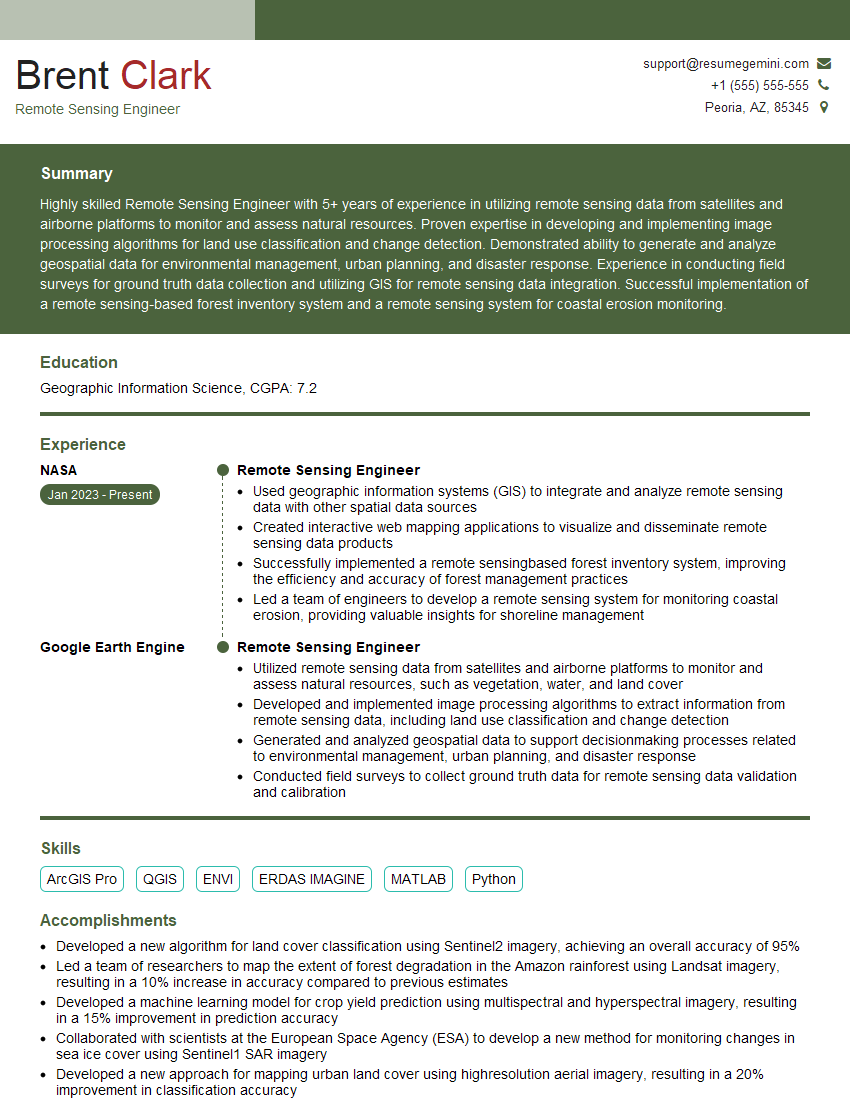
Mastering Statistical Modeling for Remote Sensing opens doors to exciting career opportunities in various sectors, offering significant growth potential and the chance to contribute to impactful research and applications. To maximize your job prospects, building a strong and ATS-friendly resume is critical. ResumeGemini is a trusted resource that can help you craft a professional and effective resume showcasing your skills and experience. ResumeGemini provides examples of resumes tailored to Statistical Modeling for Remote Sensing, allowing you to create a compelling document that highlights your qualifications for your target roles. Invest time in crafting a resume that accurately reflects your expertise and resonates with potential employers – it’s a key step towards landing your dream job.

Explore more articles
Users Rating of Our Blogs
Share Your Experience
We value your feedback! Please rate our content and share your thoughts (optional).
What Readers Say About Our Blog
To the interviewgemini.com Webmaster.
Very helpful and content specific questions to help prepare me for my interview!
Thank you
To the interviewgemini.com Webmaster.
This was kind of a unique content I found around the specialized skills. Very helpful questions and good detailed answers.
Very Helpful blog, thank you Interviewgemini team.