Interviews are opportunities to demonstrate your expertise, and this guide is here to help you shine. Explore the essential Structural steel design principles interview questions that employers frequently ask, paired with strategies for crafting responses that set you apart from the competition.
Questions Asked in Structural steel design principles Interview
Q 1. Explain the different types of steel connections used in structural steel design.
Steel connections are crucial for transferring loads between different structural members. The choice of connection depends on factors like load magnitude, type of load (tension, compression, shear, bending), member size, and aesthetic considerations. Here are some common types:
- Bolted Connections: These are prevalent due to their ease of fabrication and erection. They can be simple (bearing type) or high-strength (friction type), depending on the bolt grade and tightening method. Friction type connections rely on clamping force to transfer loads, while bearing type connections rely on shear and bearing strength of the bolt and connected members.
- Welded Connections: These offer high strength and stiffness, resulting in compact and efficient joints. Different welding techniques exist, like fillet welds (for transferring shear) and butt welds (for transferring axial and bending loads). Proper weld design requires considering weld size, configuration, and material properties.
- Riveted Connections: While less common now due to the advancements in welding and bolting, riveted connections are still found in older structures. They involve hot-driven rivets, creating a permanent connection.
- Pin Connections: These are used where rotation is permitted or required, such as in trusses or pin-connected columns. They utilize pins to transfer shear loads.
For example, a simple bolted connection might be sufficient for a light-duty beam-to-column connection, while a complex welded connection would be necessary for a high-rise building’s primary frame.
Q 2. Describe the process of designing a steel column for axial load and bending moment.
Designing a steel column for axial load and bending moment (combined loading) involves a step-by-step process:
- Determine Loads: Calculate the axial load (P) and bending moment (Mx and My) acting on the column, considering dead loads, live loads, and any other relevant forces.
- Select a Section: Choose a suitable steel section based on initial estimations. Consider factors like available section sizes, material properties (yield strength, and modulus of elasticity), and constructability.
- Effective Length: Determine the effective length (K*L) of the column, where K is the effective length factor, and L is the unbraced length. The value of K depends on the column’s end conditions (fixed, pinned, free).
- Check for Slenderness: Calculate the slenderness ratio (KL/r), where r is the radius of gyration. This determines the column’s susceptibility to buckling. If the slenderness ratio exceeds a critical value, the column will be considered slender and more prone to buckling under load. Different design codes may have specific thresholds for defining slender columns.
- Interaction Check: Perform an interaction check using appropriate design equations or software to ensure that the combined effects of axial load and bending moment do not exceed the column’s capacity. This is typically an iterative process. These equations consider the column’s capacity for axial load and flexural strength.
- Check for Local Buckling: Verify that the selected section is adequately resistant to local buckling, which is the failure of individual elements within the section. This is especially critical for thin-walled sections.
- Check for Shear: Ensure the column can withstand the shear forces.
- Design Details: Add details for connections, ensuring sufficient strength and stability to facilitate the load transfer.
A common design software (e.g., RISA or STAAD) is employed to automate many of these calculations and checks, which can be incredibly computationally intensive.
Q 3. How do you account for the effects of wind load in the design of a steel structure?
Wind load is a significant lateral load that must be considered in steel structure design. It acts as a dynamic force, exerting pressure on the building’s surfaces. The process generally involves:
- Wind Load Determination: Wind loads are calculated according to relevant building codes (e.g., ASCE 7 in the US). The calculations consider factors such as the building’s location (wind exposure category), height, shape, and surrounding topography. Specialized software might be used to conduct sophisticated wind analysis on complex geometries.
- Structural Model: The structure is modeled using software to simulate its response to wind loads. This considers various load combinations and potential failure scenarios.
- Analysis: The software performs a structural analysis to determine the internal forces (moments, shears, axial loads) due to the wind loads. It considers how the structure dynamically reacts to wind gusts.
- Design: Based on the results of the analysis, the structural elements are designed to withstand the wind-induced forces. This may involve increasing member sizes, adding bracing, or implementing wind-resisting systems (like shear walls or moment frames).
Ignoring wind loads can lead to catastrophic structural failures. For instance, tall buildings or structures in areas prone to high winds require robust wind-resistant design to withstand potential damage.
Q 4. What are the different types of steel sections available and their applications?
A variety of steel sections are available, each suited to different applications. Here are a few examples:
- Wide-Flange (W) Sections: These are the most common sections used for beams and columns. They have a high moment of inertia, providing excellent bending resistance. Their shape is optimized to efficiently handle bending loads in both directions (strong and weak axes).
- Hollow Structural Sections (HSS): These offer high strength-to-weight ratios and are often used for architectural elements, railings, and tubular columns. They have both circular and rectangular profiles.
- Channels (C): These asymmetrical sections are used for beams and purlins in roofing systems. Often they are used as supporting members or in secondary framing.
- Angles (L): These are used for bracing, connection elements, and as smaller structural members.
- Tees (WT): These are used similarly to channels and angles.
- I-Sections: These sections, like wide-flange shapes, are optimized for bending.
The choice of steel section depends on the specific application. For example, a wide-flange section might be chosen for a primary beam carrying significant loads, while a hollow structural section could be selected for a railing due to its aesthetic appeal and strength-to-weight ratio.
Q 5. Explain the concept of effective length in the design of steel columns.
Effective length is a crucial concept in column design. It represents the length of an equivalent pin-ended column that has the same buckling strength as the actual column with its specific end conditions (how it’s restrained at each end). A column fixed at both ends will have a lower effective length than a column that’s pinned at both ends, and a column with one end fixed and the other end free will have the largest effective length.
The effective length (K*L) is calculated by multiplying the unsupported length (L) of the column by a factor (K), known as the effective length factor. This factor accounts for the different end conditions. For example:
- K = 1.0: Both ends pinned
- K = 0.5: Both ends fixed
- K = 2.0: One end fixed, one end free
The effective length is critical because it directly influences the column’s buckling strength, as a longer effective length results in lower buckling capacity. Design codes provide charts or equations for determining effective length factors based on the specific boundary conditions and bracing systems of the column.
Q 6. How do you check for stability and buckling in steel structures?
Stability and buckling checks are essential in steel structure design to prevent sudden and catastrophic failures. The process typically involves:
- Slenderness Ratio: Calculate the slenderness ratio (KL/r) for each member. A high slenderness ratio indicates a greater likelihood of buckling. The radius of gyration (r) accounts for the distribution of the section’s area.
- Buckling Capacity: Determine the buckling capacity of the member using appropriate design equations or software. These equations consider the member’s geometry, material properties, and effective length. There are separate equations for different buckling modes (flexural, torsional, and flexural-torsional buckling).
- Interaction Check (Combined Loading): If the member is subject to combined loads (axial load, bending moment, shear), an interaction check is required to verify that the combined stresses do not exceed the member’s capacity. This often involves using interaction equations defined in relevant design codes.
- Local Buckling: Check for local buckling of individual elements within the section, especially for thin-walled sections. This often involves comparing the actual stresses to allowable stresses based on local buckling curves.
- Lateral-Torsional Buckling: For beams with significant unbraced lengths, check for lateral-torsional buckling, where the beam bends sideways and twists simultaneously.
Failure to properly check for stability and buckling can lead to structural collapse, so these checks are fundamental to ensuring the safety and serviceability of the structure.
Q 7. Describe the design process for a steel beam subjected to combined bending and shear.
Designing a steel beam subjected to combined bending and shear involves a careful consideration of both load types. The process is iterative and typically involves:
- Load Calculation: Calculate the bending moments (Mx and My) and shear forces (Vx and Vy) acting on the beam using structural analysis techniques. This can be hand calculation for simple beams or using more advanced software for complex systems.
- Section Selection: Choose a suitable steel section that is capable of resisting the bending moments and shear forces. Start with a preliminary selection based on experience or simple estimations.
- Bending Stress Check: Verify that the bending stresses due to the bending moments do not exceed the allowable bending stress of the chosen section. This is often done by comparing the calculated bending stresses with the yield strength of the steel multiplied by a safety factor.
- Shear Stress Check: Verify that the shear stresses due to the shear forces do not exceed the allowable shear stress of the section. The allowable shear stress is calculated based on material properties and section geometry.
- Interaction Check: If necessary, perform an interaction check to ensure that the combined effects of bending and shear do not exceed the capacity of the section. This may involve utilizing specific interaction equations or charts provided in design codes.
- Deflection Check: Verify that the maximum deflection of the beam due to bending does not exceed the allowable deflection limits specified in the design code or project requirements.
- Details: Include sufficient details for connections to the supporting structures, ensuring that the connection strength is sufficient to transfer the loads.
Software is commonly used to streamline and iterate the design and check procedures for such combined loading conditions. Failure to properly account for combined bending and shear can result in premature failure of the beam.
Q 8. What are the key considerations for designing steel connections to resist seismic loads?
Designing steel connections for seismic loads requires prioritizing ductility and energy dissipation to prevent catastrophic failure during an earthquake. We need to ensure the connection can withstand significant deformations without fracturing. This is achieved through several key considerations:
Ductile Design: We favor connections with significant ductility, such as moment-resisting connections that allow for controlled yielding and energy absorption. Think of it like a shock absorber in a car – it absorbs the impact of bumps and prevents damage to the vehicle.
Strong and Stable Connections: The connection must maintain its strength and stability even under significant lateral loads. This often involves using high-strength bolts, welded connections, or a combination of both. We avoid brittle failure mechanisms by carefully selecting materials and detailing.
Proper detailing: Detailed drawings ensure that the connection is accurately fabricated. Welds must be properly sized and located, and bolts must be properly tightened. For example, detailing should minimize stress concentrations that might initiate cracks.
Redundancy: Designing connections with some redundancy means if one element fails, another is in place to carry the load, preventing a complete collapse. Think of it like multiple support beams under a bridge; if one fails, the rest should still hold.
Compliance with Seismic Codes: We always design to meet or exceed the requirements outlined in relevant seismic design codes, such as those published by the American Society of Civil Engineers (ASCE).
For example, a moment-resisting frame connection might use welded flanges and high-strength bolts in the shear plane to resist both bending and shear forces during a seismic event. The connection would be detailed to ensure that yielding occurs in a controlled manner in the beams, not in the connection itself.
Q 9. How do you select appropriate bracing members for a steel structure?
Selecting appropriate bracing members depends heavily on the specific structural system and loading conditions. The goal is to provide stability and prevent lateral-torsional buckling or overall instability of the structure. The process involves:
Load Determination: First, we determine the magnitude and direction of lateral loads (wind, seismic, etc.).
Member Selection: Based on the calculated loads, we select brace members that have sufficient strength and stiffness. This typically involves selecting a suitable steel section (e.g., angles, channels, or tubes). The choice depends on factors such as available space, material cost, and ease of fabrication. The member’s slenderness ratio plays a vital role here.
Connection Design: The bracing members must be properly connected to the main structural frame. This usually involves using bolted or welded connections. The strength of these connections should be at least equal to the strength of the brace itself. For example, using high-strength bolts with adequate edge distances ensures that the connection does not fail before the brace.
Buckling Considerations: Braces are susceptible to buckling under compression. We ensure that the brace is adequately designed to resist buckling by considering its slenderness ratio and the applicable buckling curves from AISC specifications.
Code Compliance: The design must comply with relevant building codes and standards.
For example, in a tall building, K-bracing or diagonal bracing might be selected for its high stiffness. However, in a smaller structure, a simpler system of bracing might suffice. A careful evaluation of the structure’s overall stability is crucial before finalizing brace selection.
Q 10. Explain the role of fire protection in steel structure design.
Fire protection is critical in steel structure design because steel loses strength significantly at elevated temperatures. At a certain temperature, it loses most of its yield strength, potentially leading to collapse. Fire protection aims to prevent or delay this strength loss. Common methods include:
Spray-applied fire-resistive materials (SFRM): These materials are sprayed onto the steel members to provide thermal insulation.
Intumescent coatings: These coatings expand when exposed to heat, creating a protective char layer that insulates the steel.
Encasement in concrete: Enclosing steel members in concrete provides excellent fire protection.
Fire-resistant boards: These are non-combustible materials that are attached to the steel members.
The required level of fire protection depends on the building’s occupancy and fire rating requirements specified by the relevant building codes. For instance, a high-rise residential building will necessitate a higher level of fire protection compared to a single-story warehouse.
Proper design ensures that the chosen fire protection method is compatible with the structural system and does not compromise the structural integrity of the building. This requires considering factors such as weight, thermal expansion, and corrosion protection.
Q 11. Describe different methods for detailing and checking steel connections.
Detailing and checking steel connections is a crucial step ensuring safety and structural integrity. Several methods exist:
Manual Detailing: This involves creating detailed drawings of the connection using engineering software or drafting tools. We carefully check for proper weld sizes, bolt patterns, and other geometric parameters. This method demands considerable expertise and attention to detail.
Computer-Aided Design (CAD): Software like Tekla Structures or AutoCAD are widely used for creating detailed 3D models of the connections. These tools facilitate accurate detailing and allow for efficient clash detection between different components. We can also run finite element analyses (FEA) to validate the design.
Connection Design Software: Specialized software packages are available that automate many aspects of connection design, such as determining bolt sizes, weld sizes, and checking for strength and stability. For instance, a beam-column connection might be designed to resist moment, shear, and axial loads using these programs.
AISC Manuals and Specifications: These resources provide design procedures, load tables, and limit states that are essential for checking the adequacy of steel connections. Checking compliance with these standards is mandatory in almost all jurisdictions.
Finite Element Analysis (FEA): For complex connections, FEA can provide a detailed stress analysis that verifies the connection’s performance under different loading conditions. This is particularly useful for verifying the behavior of complex weld geometries or non-standard details.
Regardless of the detailing method, thorough checking is crucial. This typically involves verifying that the connection satisfies all relevant code requirements, considering both strength and serviceability limit states.
Q 12. What is the significance of AISC (American Institute of Steel Construction) standards in steel design?
The American Institute of Steel Construction (AISC) standards are the cornerstone of steel design in North America and are widely referenced globally. These standards provide:
Design Specifications: AISC provides detailed design specifications that dictate the allowable stresses, design procedures, and safety factors for steel structures. These ensure that steel structures are designed to withstand the expected loads safely and reliably.
Load and Resistance Factor Design (LRFD): The AISC adopts LRFD, a probabilistic approach that considers uncertainties in materials, loads, and fabrication processes. This enhances the reliability of design decisions.
Steel Section Properties: AISC provides comprehensive tables of steel section properties (like area, moment of inertia, section modulus), simplifying the design calculations.
Connection Design Guidelines: AISC offers guidance on the design of various steel connections, including bolted, welded, and composite connections.
Stability Design Provisions: AISC provides extensive provisions for checking the stability of steel members, preventing phenomena like buckling and lateral-torsional buckling.
Using AISC standards is crucial for ensuring structural integrity, compliance with building codes, and the overall safety of steel structures. They provide a consistent and reliable framework for structural engineers.
Q 13. Explain the concept of load path in structural steel design.
The load path in structural steel design describes the route that loads take from their point of application to the foundation. Understanding the load path is paramount because it ensures that loads are transferred efficiently and safely to the supporting elements. Disruptions in the load path can lead to structural failure.
Imagine a simple building frame: the load on a roof beam (due to the roof weight and snow) gets transferred to the supporting columns, then down to the beams and finally to the foundation. Any interruption (e.g., a missing connection) can cause the loads to concentrate in unexpected places.
A well-defined load path involves:
Continuous and Uninterrupted Flow: Loads must flow smoothly from element to element.
Adequate Strength of Members: Each element along the load path must have enough strength to resist the loads acting upon it.
Proper Connections: Connections between members must be strong enough to transfer loads effectively without failing.
For instance, a design flaw causing a break in the load path might lead to an unexpected collapse of a portion of the structure, causing significant damage or even loss of life. A clear understanding of the load path, achieved through careful analysis and appropriate design, is crucial for a robust and safe steel structure.
Q 14. How do you determine the required strength of steel members?
Determining the required strength of steel members is a crucial step in structural steel design. It involves a multi-step process:
Load Determination: The first step is to accurately determine all loads acting on the steel members. This includes dead loads (the weight of the structure itself), live loads (occupancy, snow, etc.), and environmental loads (wind, seismic, etc.). Load combinations, as defined in the relevant design codes, must be considered.
Analysis: A structural analysis is performed to determine the internal forces (axial force, shear force, bending moment) acting on each member. This can be done using hand calculations for simple structures or sophisticated computer-aided analysis tools for complex ones. For example, finite element analysis is often used for complex geometries and loading conditions.
Design Strength Determination: Using the relevant design codes (like AISC), we calculate the required strength of each member. This typically involves determining the factored load effects (loads multiplied by appropriate load factors) and comparing those effects against the member’s resistance. This often necessitates selecting a suitable steel section to ensure sufficient strength.
Checking for Limit States: We verify that the design satisfies different limit states, which include strength, stability, and serviceability. For example, we would check that a column does not buckle under compression or that the member’s deflection under load does not exceed the allowable limits.
Material Properties: The yield strength and ultimate tensile strength of the chosen steel are crucial for calculating member capacity. The material properties are usually obtained from the material certification provided by the steel manufacturer.
The required strength is expressed in terms of the member’s resistance to the various internal forces. This ensures that the structure is strong enough to withstand the anticipated loads safely and reliably. If the member’s strength is less than required, we select a larger member or adjust the design appropriately.
Q 15. Discuss different types of steel failures and how to prevent them.
Steel failures can broadly be categorized into two main types: yielding and fracture. Yielding occurs when the steel’s elastic limit is exceeded, leading to permanent deformation. Fracture, on the other hand, is a complete separation of the material. Both can be brittle or ductile depending on factors like material properties, stress state, and temperature.
- Yielding: Prevented by ensuring that the design stresses remain below the yield strength of the steel. This involves proper selection of steel grade, appropriate safety factors, and accurate load calculations. For example, in designing a column, we need to ensure that the axial compressive stress remains below the allowable stress (yield strength divided by a safety factor).
- Fracture: This is often due to stress concentrations, fatigue, or flaws in the material. Preventing fracture involves careful detailing to avoid sharp corners and stress raisers, using appropriate weld designs, and ensuring thorough quality control during material selection and fabrication. Regular inspections for cracks or other defects are crucial. Imagine a beam with a sharp notch – this will dramatically reduce its fracture strength.
- Brittle Fracture: This happens suddenly with minimal plastic deformation, often at low temperatures. It’s avoided by choosing steels with sufficient toughness and impact resistance for the anticipated environmental conditions. Using low-carbon steel at low temperatures is important.
- Ductile Fracture: This involves significant plastic deformation before failure. While less sudden, it still needs to be managed. It’s mitigated by ensuring sufficient ductility in the steel, which is usually built into design codes.
Ultimately, preventing steel failures hinges on a comprehensive approach encompassing robust design, rigorous quality control, and regular inspections.
Career Expert Tips:
- Ace those interviews! Prepare effectively by reviewing the Top 50 Most Common Interview Questions on ResumeGemini.
- Navigate your job search with confidence! Explore a wide range of Career Tips on ResumeGemini. Learn about common challenges and recommendations to overcome them.
- Craft the perfect resume! Master the Art of Resume Writing with ResumeGemini’s guide. Showcase your unique qualifications and achievements effectively.
- Don’t miss out on holiday savings! Build your dream resume with ResumeGemini’s ATS optimized templates.
Q 16. Explain the importance of weld design and inspection in steel construction.
Weld design and inspection are paramount in steel construction because welds are critical connection points. A poorly designed or executed weld can compromise the structural integrity of the entire system. It is like the glue holding together the structural parts.
- Weld Design: This involves selecting appropriate weld types (e.g., fillet welds, groove welds), sizes, and locations based on the forces and moments acting on the connection. Design codes like AWS D1.1 provide guidance on weld details and strength calculations. For instance, a lap joint might require multiple fillet welds, with their sizes determined by the shear force acting on the connection.
- Weld Inspection: Visual inspection is fundamental, looking for cracks, porosity, or undercuts. More sophisticated methods include radiographic testing (RT), ultrasonic testing (UT), and magnetic particle testing (MT), providing detailed insights into internal weld quality. This ensures that welds meet the required standards and don’t have flaws that might lead to premature failure. Imagine the potential catastrophe of a poorly inspected weld failing in a skyscraper under high wind load.
Both aspects are critical for structural safety. Regular quality control ensures that welds are both efficient and reliable, providing long-term structural performance.
Q 17. How do you account for fatigue in the design of steel structures?
Fatigue in steel structures arises from repeated cyclic loading, eventually leading to crack initiation and propagation, even under stresses much lower than the yield strength. Accurately accounting for fatigue is crucial for long-term structural integrity, especially in applications with dynamic loads like bridges and offshore structures.
The design process typically involves:
- Determining the stress range: This entails analyzing the cyclic loading patterns to find the maximum and minimum stresses experienced in each loading cycle.
- Calculating fatigue life: Using appropriate S-N curves (Stress-Number of cycles to failure curves) for the specific steel grade and detail category, we estimate the number of cycles the structure can withstand before fatigue failure. These curves are obtained experimentally and are available in various codes and standards.
- Applying safety factors: Conservative safety factors are applied to the fatigue life to compensate for uncertainties in the load estimation, material properties, and construction quality. The resulting design should ensure an adequate fatigue life well beyond the structure’s expected service life.
- Detailing for fatigue resistance: Fatigue crack initiation is often linked to stress concentrations. Design details minimizing stress raisers, such as smooth transitions between components, are vital. For example, using generous fillet radii at weld connections to prevent sharp corners is important.
Software tools like finite element analysis (FEA) are invaluable for accurately modelling stress patterns under cyclic loads, helping to identify potential fatigue hotspots.
Q 18. What are the different types of steel used in construction and their properties?
Several types of steel are employed in construction, each with distinct properties tailored to specific applications. The selection often balances cost, strength, weldability, and corrosion resistance.
- Mild Steel (A36): A common, relatively inexpensive, and easily weldable steel with moderate strength. Used for many structural applications, such as beams, columns, and simple connections.
- High-Strength Low-Alloy (HSLA) Steels: Offer higher strength than mild steel for the same weight, leading to smaller sections and reduced material costs. Commonly used for larger structures or where weight reduction is beneficial.
- Weathering Steel (Corten Steel): Possesses excellent corrosion resistance due to the formation of a protective oxide layer. Often used for exterior applications, reducing the need for painting or other corrosion protection.
- Stainless Steel: Renowned for its exceptional corrosion resistance, making it suitable for applications where aesthetics are important or corrosion is a major concern, such as cladding or architectural features. It is also stronger and more durable than other types of steel.
The selection of the correct steel depends largely on structural demands and project specifics. For example, in a corrosive environment, stainless steel might be the most appropriate, but its higher cost must be factored in.
Q 19. Explain the process of analyzing a steel frame using software.
Analyzing a steel frame using software, typically involves employing finite element analysis (FEA) software. The process begins with geometric modeling and then involves several steps:
- Geometric Modelling: The steel frame is modeled in the software, accurately representing its geometry, member sizes, and connections. This is done using the software’s built-in tools, often involving precise input of dimensions and material properties.
- Material Property Definition: The elastic modulus (Young’s modulus), Poisson’s ratio, and yield strength of the steel are inputted. These values are obtained from material test reports or standard specifications.
- Boundary Conditions: Supports (fixed, hinged, roller, etc.) are defined, representing how the frame interacts with its foundation. For example, a column’s base might be fixed, while a beam might be simply supported at its ends.
- Load Application: Loads (dead loads, live loads, wind loads, seismic loads, etc.) are applied to the model according to the structural code requirements. This often involves distributing loads across members, accounting for load combinations defined by relevant building codes.
- Mesh Generation: The software divides the frame into smaller elements for analysis. This process, called meshing, is crucial for the accuracy and efficiency of the analysis. A finer mesh provides greater accuracy but increases computational cost.
- Solution: The software numerically solves the system of equations governing the structural behaviour of the frame, determining the displacements, stresses, and internal forces (axial forces, shear forces, bending moments) in each member.
- Result Interpretation: The results are post-processed to determine if the design meets the required safety factors, ensuring that stresses and displacements are within allowable limits. This often involves checking for compliance with relevant codes and standards.
Software like ETABS, SAP2000, and RISA-3D are commonly used for these analyses.
Q 20. What are the common design considerations for steel roof structures?
Steel roof structures present unique design considerations due to their susceptibility to wind, snow, and seismic loads. Key factors include:
- Wind Load Resistance: Wind loads can generate significant uplift forces on the roof, requiring careful consideration of bracing, connections, and anchoring. Properly designed purlins and girts are critical for distributing wind loads.
- Snow Load Capacity: Accumulated snow can place substantial dead loads on the roof, particularly in cold climates. Design needs to account for these loads, ensuring that the roof framing possesses sufficient strength to avoid collapse.
- Seismic Performance: In seismic zones, the roof structure must be designed to resist seismic forces, limiting damage and preventing collapse. This often involves careful detailing of connections and the use of ductile materials and connections.
- Drainage: Effective drainage is crucial to prevent water accumulation, which can lead to corrosion and structural damage. Proper slopes and gutter systems need to be designed to ensure adequate drainage.
- Corrosion Protection: Steel is susceptible to corrosion, particularly in exposed conditions. Appropriate corrosion protection measures, such as galvanizing, painting, or using weathering steel, are needed to enhance durability.
- Material Selection: The selection of appropriate steel grades and sections is essential for ensuring strength and stability while considering cost-effectiveness.
Careful consideration of these aspects is essential to ensure a safe and durable steel roof structure.
Q 21. Describe your experience with steel detailing software.
I have extensive experience with Tekla Structures, a leading steel detailing software. My proficiency encompasses model creation, detailing of connections, generating fabrication drawings, and producing NC (numerical control) data for automated fabrication.
I have been involved in numerous projects, ranging from small industrial buildings to large-scale commercial structures. My responsibilities have included:
- Model Creation: Building accurate 3D models of steel structures based on engineering drawings and specifications.
- Connection Detailing: Creating detailed drawings of connections, ensuring they meet both structural and fabrication requirements.
- Drawing Production: Generating fabrication drawings, including shop drawings, general arrangement drawings, and erection drawings.
- NC Data Generation: Preparing numerical control data for various fabrication processes, such as cutting, drilling, and welding.
- Clash Detection: Utilizing software tools to detect and resolve potential clashes between different components in the steel structure.
- Collaboration: Working collaboratively with engineers and fabricators to ensure that the models and drawings are accurate and suitable for fabrication.
My expertise in Tekla Structures enables me to produce high-quality, accurate, and efficient steel detailing deliverables, contributing to the successful construction of projects. I’m also familiar with other programs such as SDS/2, but Tekla is my preferred choice due to its versatility and advanced features.
Q 22. How do you verify the stability of a steel structure?
Verifying the stability of a steel structure is crucial to ensure it can withstand loads without collapsing. This involves assessing both global and local stability. Global stability considers the overall structure’s resistance to buckling or overturning, while local stability focuses on individual components like columns or beams resisting buckling or yielding.
We use several methods for verification:
- Load Analysis: Determining all loads acting on the structure (dead loads, live loads, wind loads, seismic loads). This is done using structural analysis software.
- Stability Analysis: Using appropriate methods like eigenvalue analysis (for buckling) or non-linear analysis to determine the critical loads and assess the structure’s stability under various load combinations.
- Code Checks: Verifying that the design satisfies relevant building codes, such as the American Institute of Steel Construction (AISC) specifications. These codes provide allowable stresses and design requirements.
- Buckling Checks: Evaluating the slenderness ratios of columns and beams to ensure they are within the limits defined by codes. This involves calculating the effective length of members, which depends on the boundary conditions.
- Second-Order Analysis: For structures that are susceptible to significant geometric nonlinearities (large deformations), a second-order analysis is necessary to account for the effects of P-Delta moments (axial load multiplied by lateral displacement).
For example, in designing a tall building frame, we might perform an eigenvalue buckling analysis to determine the lowest buckling load and ensure it significantly exceeds the anticipated service loads. We’d also conduct second-order analysis to account for the amplified bending moments caused by the building’s overall deflection under gravity loads.
Q 23. Explain the importance of considering material properties in steel design.
Material properties are paramount in steel design because they dictate the strength, ductility, and overall behavior of the structure under load. Using incorrect material properties leads to unsafe designs.
We consider several key properties:
- Yield Strength (Fy): The stress at which the steel begins to deform plastically. This value is critical in determining the capacity of structural members.
- Ultimate Tensile Strength (Fu): The maximum stress the steel can withstand before fracture. Useful in fracture mechanics analysis.
- Modulus of Elasticity (E): A measure of the steel’s stiffness, which determines its deflection under load. This is vital for calculating deflections and stresses.
- Poisson’s Ratio (ν): Relates the lateral strain to the axial strain, important for advanced analyses.
Imagine designing a bridge girder. If we underestimate the yield strength of the steel, the girder might yield under anticipated traffic loads, leading to structural failure. Accurate material properties are essential for safe and reliable designs, often verified through mill test reports supplied by the steel manufacturer.
Q 24. Describe your experience in working with construction drawings.
I have extensive experience interpreting and utilizing construction drawings in steel structure design projects. My experience encompasses a wide range of projects, from small industrial buildings to high-rise structures.
I am proficient in reading and understanding various drawing types, including:
- Architectural Drawings: These provide the overall building layout and dimensions, which help determine structural requirements.
- Structural Drawings: These include detailed steel member sizes, connection details, and fabrication specifications. I carefully review these for completeness and accuracy.
- Shop Drawings: These show the detailed fabrication plans for each steel component, ensuring they meet design specifications and detailing standards. I review these to ensure they match the structural design intent.
- Erection Drawings: These illustrate the sequence of steel erection, crucial for on-site coordination and safety.
I use these drawings to verify dimensions, material specifications, connection types, and overall structural integrity. I’ve often identified discrepancies between drawings and resolved these through collaboration with architects, fabricators, and contractors. A recent project involved spotting a missing brace in the shop drawings, preventing a potential stability issue during construction. My ability to thoroughly review and understand construction drawings ensures the successful and safe execution of steel projects.
Q 25. How do you calculate the deflection of a steel beam?
Calculating the deflection of a steel beam depends on the beam’s loading, geometry, and material properties. Several methods are available, depending on the complexity of the problem.
For simply supported beams under common load cases, we can use simple beam formulas:
- Concentrated Load at Mid-span:
δ = (PL³)/(48EI) - Uniformly Distributed Load:
δ = (5wL⁴)/(384EI)
Where:
δ= deflectionP= concentrated loadw= uniformly distributed loadL= beam spanE= modulus of elasticity of steelI= moment of inertia of the beam’s cross-section
For more complex loading or support conditions, we use advanced methods, such as:
- Integration Method: Solving the differential equation of bending.
- Moment-Area Method: Using geometric properties of the bending moment diagram to determine deflection.
- Finite Element Analysis (FEA): Utilizing software to simulate the beam’s behavior under load, providing precise deflection predictions for complex geometries and loading conditions.
For example, when designing a floor beam, we’d use these formulas or FEA to ensure the deflection is within acceptable limits specified by the codes to avoid excessive vibrations or damage to finishes.
Q 26. What are some common problems encountered during steel construction and how can they be avoided?
Common problems during steel construction include:
- Dimensional Errors: Incorrect fabrication or erection can lead to misalignment and instability. This is mitigated through careful quality control during fabrication and erection, and through precise surveying during construction.
- Corrosion: Exposure to the elements can cause corrosion, reducing the structural capacity. Protective coatings like paint or galvanizing are essential. Proper detailing to avoid trapped moisture is crucial.
- Weld Defects: Poor welding techniques can create weak points. Rigorous quality control during welding, including non-destructive testing (NDT), is vital.
- Connection Issues: Improperly designed or installed connections can fail under load. Accurate shop drawings and skilled installation are crucial. Careful selection of connection types based on load requirements is paramount.
- Material Degradation: Using steel that does not meet the specified requirements can lead to unexpected failures. Thorough verification of steel mill test reports is necessary.
These problems can be avoided through meticulous planning, quality control at every stage, adherence to design specifications, and the use of skilled and experienced contractors. Regular inspections during construction are also important to detect and rectify problems promptly.
Q 27. Explain the process of designing a steel moment connection.
Designing a steel moment connection involves carefully considering the forces it must transfer – primarily bending moments and shear forces. The type of connection depends on the structural behavior and design requirements.
The design process generally follows these steps:
- Determine Load Requirements: Analyze the structure to ascertain the bending moments and shears the connection must resist.
- Select Connection Type: Choose an appropriate connection based on factors like load magnitude, space constraints, and constructability. Common types include bolted connections, welded connections, and hybrid connections.
- Design Components: Determine the size and shape of the plates, angles, and other components needed to transfer the loads. This often involves iterative calculations to ensure adequate strength and stability.
- Check Strength and Ductility: Verify that the connection meets the required strength and ductility provisions specified by relevant codes (like AISC). This often involves checking for bolt shear, bearing, and tension, as well as weld strength and local buckling.
- Detailing: Create detailed shop drawings to guide the fabrication and erection process. These must be clear, accurate, and fully dimensioned to avoid errors during construction.
For example, a simple bolted moment connection might involve using appropriately sized plates and bolts to transfer moments and shears. A more complex connection for a high-rise structure would likely involve multiple plates, angles, and welds, demanding detailed finite-element analysis to ensure the integrity of the connection.
Q 28. What are your experiences with various analysis methods for steel structures (e.g., linear elastic, non-linear)?
I have experience with various analysis methods for steel structures, including linear elastic and non-linear analyses. The choice of method depends on the complexity of the structure and the loading conditions.
Linear Elastic Analysis: This is a relatively simple method assuming the structure behaves linearly (stress is proportional to strain) and remains within its elastic range. It is suitable for many steel structures where deflections remain small. I use linear elastic analysis frequently for initial design and preliminary checks, often utilizing software like RISA or ETABS.
Non-linear Analysis: This accounts for material non-linearity (yielding of steel), geometric non-linearity (large deflections), or both. It’s essential when dealing with significant loads or structures prone to substantial deformations, such as those subjected to extreme wind or seismic loads. Non-linear analysis provides more accurate predictions of ultimate strength and failure modes. I’ve used this for high-rise buildings and structures with complex behavior, using advanced software like ABAQUS or ANSYS.
Other methods: Depending on the specific project, I may also employ methods like plastic analysis (to evaluate ultimate strength), second-order analysis (accounting for P-Delta effects), and stability analysis (for buckling checks). The selection of the optimal method ensures the design’s accuracy, reliability, and safety.
Key Topics to Learn for Structural Steel Design Principles Interview
- Loads and Load Paths: Understanding dead loads, live loads, wind loads, seismic loads, and how they transfer through the structure. Practical application: Analyzing load combinations according to relevant building codes.
- Material Properties: Familiarizing yourself with the mechanical properties of steel (yield strength, tensile strength, modulus of elasticity) and how they influence design choices. Practical application: Selecting appropriate steel grades for specific design requirements.
- Stress and Strain Analysis: Mastering fundamental concepts of stress, strain, and the relationship between them (Hooke’s Law). Practical application: Performing hand calculations or using software to determine stresses in structural members.
- Beam Design: Understanding bending moments, shear forces, and deflection in beams. Practical application: Designing beams to meet specified strength and deflection limits. Exploring different beam sections (I-beams, wide-flange beams, etc.).
- Column Design: Understanding buckling behavior and design considerations for compression members. Practical application: Selecting appropriate column sections and checking for buckling failure based on code requirements.
- Connection Design: Understanding different types of connections (bolted, welded, etc.) and their design considerations. Practical application: Designing connections that ensure adequate strength and stability.
- Stability and Lateral Torsional Buckling: Understanding the importance of bracing and lateral stability in structural steel design. Practical application: Analyzing and designing bracing systems to prevent instability.
- Code Compliance: Familiarity with relevant building codes (e.g., AISC) and their application in structural steel design. Practical application: Ensuring designs meet all applicable code requirements.
- Software Proficiency: Demonstrating experience with relevant structural analysis and design software (e.g., RISA, ETABS). Practical application: Using software to analyze complex structures and generate design drawings.
- Practical Problem Solving: Ability to apply theoretical knowledge to solve real-world design problems, using both analytical methods and software tools. Practical application: Demonstrating an understanding of design assumptions and limitations.
Next Steps
Mastering structural steel design principles is crucial for career advancement in the engineering field, opening doors to challenging and rewarding projects. An ATS-friendly resume is key to getting your application noticed. Use ResumeGemini to create a powerful resume that highlights your skills and experience effectively. ResumeGemini offers examples of resumes tailored to structural steel design principles, helping you showcase your qualifications in the best possible light.
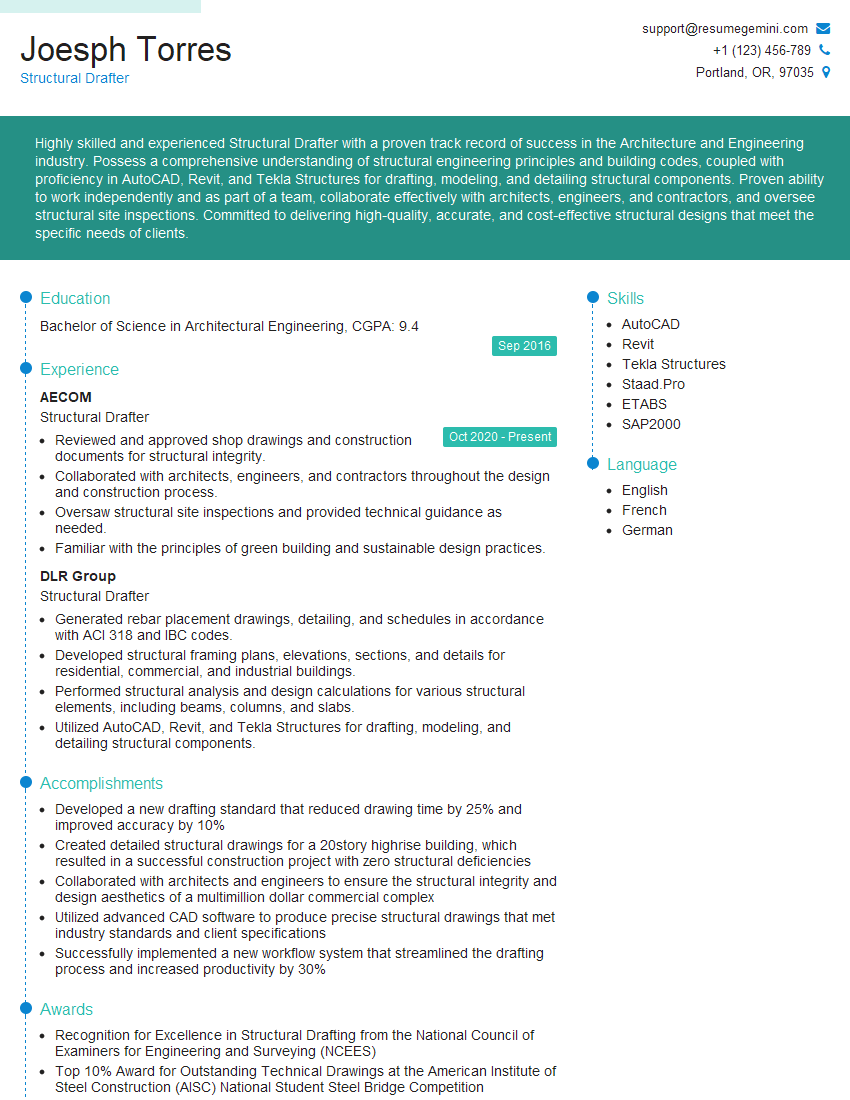

Explore more articles
Users Rating of Our Blogs
Share Your Experience
We value your feedback! Please rate our content and share your thoughts (optional).
What Readers Say About Our Blog
To the interviewgemini.com Webmaster.
Very helpful and content specific questions to help prepare me for my interview!
Thank you
To the interviewgemini.com Webmaster.
This was kind of a unique content I found around the specialized skills. Very helpful questions and good detailed answers.
Very Helpful blog, thank you Interviewgemini team.