Cracking a skill-specific interview, like one for Supervised Learning for Remote Sensing, requires understanding the nuances of the role. In this blog, we present the questions you’re most likely to encounter, along with insights into how to answer them effectively. Let’s ensure you’re ready to make a strong impression.
Questions Asked in Supervised Learning for Remote Sensing Interview
Q 1. Explain the difference between supervised and unsupervised learning in the context of remote sensing.
In remote sensing, both supervised and unsupervised learning aim to extract meaningful information from satellite or aerial imagery. However, they differ fundamentally in how they achieve this.
Supervised learning requires a labeled dataset, meaning each image pixel or patch is already tagged with its corresponding land cover class (e.g., forest, water, urban). The algorithm learns to map image features (e.g., spectral values) to these known classes, enabling it to predict the classes of unseen pixels. Think of it like teaching a child to identify different fruits by showing them labeled examples of apples, oranges, and bananas. The child learns the visual features associated with each fruit and can then identify new fruits based on those learned characteristics.
Unsupervised learning, in contrast, works with unlabeled data. The algorithm identifies patterns and structures within the data without prior knowledge of the classes. This is analogous to giving the child a basket of assorted fruits and asking them to group them based on similarities they observe. Clustering algorithms are often used in unsupervised learning, grouping similar pixels together based on spectral characteristics or spatial relationships, though we may need further analysis to interpret the meaning of these groups.
Q 2. Describe various supervised learning algorithms commonly used in remote sensing image classification (e.g., SVM, Random Forest, CNN).
Several supervised learning algorithms excel in remote sensing image classification. Here are some prominent examples:
- Support Vector Machines (SVMs): SVMs aim to find the optimal hyperplane that maximally separates different classes in the feature space. They are effective for high-dimensional data and can handle non-linear relationships through kernel functions. Think of it as drawing a line (or hyperplane in higher dimensions) to best divide different land cover types in a feature space defined by spectral bands.
- Random Forest: This ensemble learning method combines multiple decision trees, improving accuracy and robustness compared to a single decision tree. It’s less prone to overfitting and offers good performance across a variety of datasets. Think of it like having a panel of experts, each with their own classification method, voting on the final classification of a pixel.
- Convolutional Neural Networks (CNNs): CNNs are deep learning models designed to extract hierarchical features from images. They are particularly powerful for analyzing spatial patterns and textures in remote sensing images. The ability to learn spatial features directly from the image makes them very suitable for complex remote sensing tasks. They are like sophisticated image recognition engines, able to learn complex patterns from pixels and their surrounding contexts.
Q 3. What are the advantages and disadvantages of using Support Vector Machines (SVMs) for remote sensing image classification?
Advantages of SVMs in remote sensing:
- Effective in high-dimensional spaces, which is common in remote sensing with multiple spectral bands.
- Relatively robust to outliers.
- Can handle both linear and non-linear classification tasks using kernel functions.
Disadvantages of SVMs in remote sensing:
- Computationally expensive for very large datasets.
- Parameter tuning (e.g., kernel type, regularization parameter) can be challenging and requires careful optimization.
- The resulting decision boundary can be difficult to interpret.
For example, while SVMs might be ideal for classifying a small region with detailed spectral data, their computational cost could become a problem when dealing with very large, high-resolution satellite imagery of entire countries. In such scenarios, a Random Forest or carefully designed CNN might be more efficient.
Q 4. How do you handle class imbalance in a remote sensing dataset?
Class imbalance, where some land cover classes have significantly fewer samples than others (e.g., a few buildings in a vast agricultural area), is a common challenge in remote sensing. This can bias the model towards the majority classes. Here are some strategies to address this:
- Resampling techniques: Oversampling the minority classes (creating synthetic samples) or undersampling the majority classes can balance the dataset. Careful implementation is vital to avoid overfitting or loss of information.
- Cost-sensitive learning: Assign higher misclassification costs to the minority classes during model training. This encourages the model to pay more attention to correctly classifying the under-represented classes.
- Ensemble methods: Random Forest, as mentioned earlier, is naturally robust to class imbalance. Other ensemble techniques can also be effective.
- Data augmentation: Create variations of existing minority class samples through techniques like rotation, flipping, or adding noise to increase their representation in the training dataset.
The choice of technique depends on the severity of the imbalance and the characteristics of the dataset. Experimentation with multiple approaches is often necessary.
Q 5. Explain the concept of feature engineering in remote sensing. Provide examples.
Feature engineering is the process of creating new features from existing ones to improve the performance of a machine learning model. In remote sensing, this involves transforming raw spectral data into more informative features that better capture the characteristics of different land cover types.
Examples:
- Spectral indices: Combine multiple spectral bands to highlight specific phenomena. The Normalized Difference Vegetation Index (NDVI) = (NIR – Red) / (NIR + Red) is a classic example, highlighting vegetation density.
- Textural features: Capture spatial patterns within the image. Gray-level co-occurrence matrices (GLCMs) can be used to extract texture information, providing features such as contrast, homogeneity, and entropy.
- Principal Component Analysis (PCA): Reduces the dimensionality of the data by transforming it into a set of uncorrelated principal components, retaining the most important variance. This helps in reducing computational complexity while preserving essential information.
- Geospatial features: Incorporating external data, such as elevation, slope, or distance to roads, can significantly enhance classification accuracy.
Effective feature engineering requires domain expertise and experimentation to identify features most relevant to the specific classification task.
Q 6. Describe different methods for evaluating the performance of a supervised learning model in remote sensing (e.g., accuracy, precision, recall, F1-score, Kappa coefficient).
Evaluating a supervised learning model’s performance involves assessing its ability to accurately classify unseen data. Several metrics are commonly used:
- Overall accuracy: The proportion of correctly classified pixels to the total number of pixels.
- Producer’s accuracy (recall): The proportion of correctly classified pixels for a specific class, out of all pixels actually belonging to that class. A high producer’s accuracy for a class indicates that the model does well at identifying all instances of that class.
- User’s accuracy (precision): The proportion of correctly classified pixels for a specific class out of all pixels classified as that class. A high user’s accuracy for a class indicates that when the model predicts a class, it is likely correct.
- F1-score: The harmonic mean of precision and recall, providing a balanced measure of performance, particularly useful for imbalanced datasets.
- Kappa coefficient: Measures the agreement between the model’s predictions and the ground truth, accounting for chance agreement. A higher Kappa value signifies better performance.
The choice of metrics depends on the specific application and the relative importance of different classes. For example, in a medical imaging application, high recall might be prioritized to ensure that no cases are missed, while in a less critical application, overall accuracy might be more important.
Q 7. How do you select the optimal number of features for a remote sensing classification task?
Selecting the optimal number of features is crucial for preventing overfitting (too many features leading to poor generalization) and maintaining computational efficiency. Several techniques can be used:
- Feature ranking: Rank features based on their importance using techniques like recursive feature elimination (RFE) or filter methods. Select the top-ranked features. This involves a process where you iteratively remove the least important features and evaluate the model’s performance until you find the optimal number.
- Cross-validation: Train and evaluate the model with different subsets of features and choose the subset that yields the best performance using k-fold cross-validation or similar methods. You split your data into multiple folds and evaluate the model’s performance on each fold with different feature subsets.
- Dimensionality reduction techniques: PCA, as mentioned earlier, can reduce the dimensionality while retaining the most important information. Other techniques such as Linear Discriminant Analysis (LDA) can also be used.
- Wrapper methods: These methods involve using a search algorithm to find the best subset of features, based on the performance of a model trained on those features. They are more computationally expensive than filter methods, but generally produce better results.
The best approach depends on the dataset size, computational resources, and desired level of accuracy. Often a combination of these methods is employed.
Q 8. Explain the importance of data preprocessing in remote sensing image classification.
Data preprocessing in remote sensing image classification is crucial because raw satellite imagery is rarely ready for direct use in machine learning algorithms. Think of it like preparing ingredients before cooking – you wouldn’t throw raw chicken and flour directly into the oven! Preprocessing enhances the quality and consistency of your data, leading to more accurate and reliable classification results. It essentially bridges the gap between the raw sensor readings and a format suitable for algorithm training.
Q 9. What are the common preprocessing steps for remote sensing imagery before applying supervised learning algorithms?
Common preprocessing steps include:
- Atmospheric Correction: Removing atmospheric effects (e.g., scattering, absorption) that distort the spectral signature of surface features. Imagine trying to identify a flower through a hazy window – atmospheric correction clears that haze.
- Geometric Correction: Correcting for geometric distortions caused by sensor viewing angles and Earth’s curvature. This ensures that pixels accurately represent their real-world location. Think of straightening a slightly skewed photograph.
- Radiometric Calibration: Converting digital numbers (DNs) from the sensor into physically meaningful units (e.g., reflectance, radiance). This standardizes the brightness values across different images and sensors. It’s like calibrating your kitchen scale to ensure accurate measurements.
- Noise Reduction: Filtering out random variations (noise) in the image data that can obscure important features. This is like removing static from a radio signal.
- Data Transformation: Applying transformations such as principal component analysis (PCA) to reduce dimensionality or enhance feature separability. PCA can be thought of as summarizing the most important information from a large dataset into fewer, more meaningful variables.
Q 10. How do you handle missing data in a remote sensing dataset?
Handling missing data in remote sensing is a common challenge. Methods depend on the nature and extent of the missing data. Strategies include:
- Deletion: Removing rows or columns with missing values. This is simple but can lead to significant information loss if missing data is extensive.
- Imputation: Filling in missing values using various techniques. Common methods include using the mean, median, or mode of the available data for that band (simple imputation), or using more sophisticated techniques like k-Nearest Neighbors (k-NN) which considers the values of nearby pixels. For example, if a pixel’s reflectance value in the red band is missing, k-NN would estimate it based on the values of its neighboring pixels.
- Interpolation: Estimating missing values based on the spatial patterns in the surrounding data. This is often more effective than simple imputation for spatially continuous data. Imagine filling a hole in a painting based on the colors around it.
The best method depends on the dataset and the amount of missing data. Simple techniques are suitable for small amounts of missing data, while more advanced methods are necessary for larger gaps.
Q 11. Describe the process of training and validating a supervised learning model for remote sensing data.
Training and validating a supervised learning model for remote sensing involves several steps:
- Data Splitting: Divide the dataset into training, validation, and testing sets. Typically, a 70/15/15 split is used. The training set is used to train the model, the validation set is used to tune hyperparameters and prevent overfitting, and the testing set is used for final model evaluation.
- Model Selection: Choose an appropriate supervised learning algorithm (e.g., Support Vector Machine, Random Forest, Convolutional Neural Network). The choice depends on the characteristics of the data and the specific problem.
- Training: Train the selected model using the training dataset. This involves feeding the model input features (e.g., spectral bands, texture features) and their corresponding ground truth labels (e.g., land cover classes).
- Validation: Evaluate the model’s performance on the validation set using appropriate metrics (e.g., accuracy, precision, recall, F1-score, Kappa coefficient). Use this information to tune hyperparameters and avoid overfitting.
- Testing: Once satisfied with the performance on the validation set, evaluate the final model’s performance on the unseen testing dataset to get an unbiased estimate of generalization ability.
Remember, rigorous validation is key to ensuring the model generalizes well to new, unseen data. It’s like testing a recipe on a different oven before presenting it to your guests – you want to ensure it works consistently.
Q 12. What are the common challenges encountered when applying supervised learning to remote sensing data?
Challenges in applying supervised learning to remote sensing data include:
- High dimensionality: Remote sensing images often have many spectral bands, leading to the curse of dimensionality (too many features compared to the number of samples).
- Data imbalance: Some land cover classes may be represented by far fewer samples than others. This can lead to biased models that perform poorly on the under-represented classes.
- Spatial autocorrelation: Nearby pixels are often correlated, violating the assumption of independence in many machine learning algorithms. This needs to be handled through techniques like stratified sampling or specialized algorithms.
- Computational cost: Processing large remote sensing datasets can be computationally expensive, requiring significant computing resources.
- Label acquisition: Obtaining accurate and sufficient ground truth labels can be challenging, time-consuming, and expensive.
Q 13. How do you choose the appropriate supervised learning algorithm for a specific remote sensing problem?
Choosing the right algorithm depends on several factors including data characteristics (number of samples, dimensionality, class distribution) and the specific problem. There’s no one-size-fits-all answer. Consider:
- Support Vector Machines (SVM): Effective for high-dimensional data and good for classification problems with well-separated classes.
- Random Forest (RF): Robust to noise, handles high dimensionality well, and provides feature importance estimates.
- Convolutional Neural Networks (CNNs): Excellent for image data, can automatically learn complex spatial features, but require significant computational resources and large datasets.
- k-Nearest Neighbors (k-NN): Simple and easy to implement, but can be computationally expensive for large datasets.
Experimentation with different algorithms and careful evaluation of their performance on your specific dataset is essential.
Q 14. Explain the concept of hyperparameter tuning and its importance in supervised learning for remote sensing.
Hyperparameter tuning is the process of optimizing the parameters of a machine learning algorithm that are not learned during the training process. Think of it as fine-tuning the knobs and dials of a machine to get optimal performance. In remote sensing, this is critical because these parameters significantly influence the model’s accuracy and generalization ability.
For example, the number of trees in a Random Forest or the learning rate in a neural network are hyperparameters. Techniques for hyperparameter tuning include:
- Grid Search: Systematically testing different combinations of hyperparameter values.
- Random Search: Randomly sampling hyperparameter values. Often more efficient than grid search.
- Bayesian Optimization: Using a probabilistic model to guide the search for optimal hyperparameters.
Effective hyperparameter tuning leads to a model that is well-suited to the specific data and problem, maximizing its performance and minimizing the risk of overfitting or underfitting.
Q 15. What are different methods for hyperparameter tuning (e.g., Grid Search, Random Search, Bayesian Optimization)?
Hyperparameter tuning is crucial for optimizing the performance of supervised learning models. It involves finding the best settings for parameters that are not learned from the data itself, but are set before the learning process begins. Three common methods are:
- Grid Search: This method exhaustively tries all possible combinations of hyperparameters within a predefined range. Imagine a grid where each axis represents a hyperparameter and each cell represents a specific combination. The model is trained for each combination, and the best performing set is selected. It’s thorough but can be computationally expensive, especially with many hyperparameters.
- Random Search: Instead of trying every combination, random search randomly samples hyperparameter combinations from the specified ranges. This is often more efficient than grid search, as it’s less likely to get stuck in local optima and can find good solutions with fewer trials. Think of it as randomly throwing darts at the hyperparameter space instead of systematically searching every point.
- Bayesian Optimization: This sophisticated method uses a probabilistic model to guide the search for optimal hyperparameters. It learns from previous evaluations to intelligently select promising combinations, focusing on areas of the hyperparameter space likely to yield better results. It’s more computationally expensive upfront but often converges to good solutions faster than grid or random search.
For example, in a Support Vector Machine (SVM), hyperparameters like C (regularization parameter) and gamma (kernel coefficient) need tuning. A grid search might test C in [0.1, 1, 10] and gamma in [0.01, 0.1, 1], leading to 9 model trainings. Random search would randomly pick values from these ranges, potentially needing fewer trials to find a good combination.
Career Expert Tips:
- Ace those interviews! Prepare effectively by reviewing the Top 50 Most Common Interview Questions on ResumeGemini.
- Navigate your job search with confidence! Explore a wide range of Career Tips on ResumeGemini. Learn about common challenges and recommendations to overcome them.
- Craft the perfect resume! Master the Art of Resume Writing with ResumeGemini’s guide. Showcase your unique qualifications and achievements effectively.
- Don’t miss out on holiday savings! Build your dream resume with ResumeGemini’s ATS optimized templates.
Q 16. Describe different types of remote sensing data (e.g., multispectral, hyperspectral, LiDAR).
Remote sensing data comes in various forms, each capturing different aspects of the Earth’s surface. Key types include:
- Multispectral Imagery: This data consists of images acquired across multiple, relatively broad, spectral bands. Common examples include Landsat and Sentinel imagery, which capture data in visible and near-infrared wavelengths, enabling vegetation analysis, land cover classification, etc. Think of it like a multi-layered photograph, each layer representing a different spectral band.
- Hyperspectral Imagery: Hyperspectral data provides images with hundreds of narrow, contiguous spectral bands, giving much finer spectral detail than multispectral data. This allows for precise identification of materials based on their unique spectral signatures. Imagine a highly detailed spectrogram providing extensive information about the composition of materials.
- LiDAR (Light Detection and Ranging): LiDAR uses laser pulses to measure distances to the Earth’s surface, creating a 3D point cloud. This data is incredibly useful for creating digital elevation models (DEMs), identifying structures, and analyzing vegetation height. Imagine a detailed 3D scan of the terrain.
Each data type has its strengths and weaknesses, and the choice depends on the specific application. For instance, multispectral data is readily available and suitable for broad-scale land cover mapping, while hyperspectral data is ideal for precise material identification but might be more expensive and challenging to process.
Q 17. Explain the concept of spatial autocorrelation and how it impacts supervised learning in remote sensing.
Spatial autocorrelation refers to the tendency of nearby observations in spatial data to be more similar than those further apart. In remote sensing, this means pixels representing adjacent areas on the Earth’s surface are likely to have similar spectral values and associated land cover classes. This is intuitive: a forest pixel is more likely to be surrounded by other forest pixels than, say, a water pixel.
Spatial autocorrelation significantly impacts supervised learning because it violates the independence assumption underlying many statistical methods. If the model learns patterns from spatially autocorrelated data, it might overfit to local patterns and fail to generalize well to unseen areas. This can lead to inaccurate predictions and inflated accuracy estimations.
Q 18. How do you address the issue of spatial autocorrelation in your model?
Addressing spatial autocorrelation involves techniques that account for the spatial dependency in the data. Common approaches include:
- Spatial filtering: Techniques like moving average filters can smooth the data, reducing spatial autocorrelation before model training.
- Geostatistical methods: Incorporating spatial weights matrices into regression models (e.g., spatial lag or spatial error models) explicitly accounts for spatial relationships.
- Segmentation: Dividing the image into relatively homogenous regions based on spectral similarity can help mitigate spatial autocorrelation by creating more independent training units.
- Sampling strategies: Employing stratified random sampling or other methods that ensure spatial representativeness of the training data can also reduce the impact of autocorrelation.
For example, a commonly used spatial error model is a simple extension of the standard linear regression model that adds a spatially autocorrelated error term. This allows the model to explicitly model the spatial dependency, leading to more accurate and robust estimations. The choice of method depends on the nature and strength of the spatial autocorrelation and the specific modeling goals.
Q 19. What is the role of cloud computing in large-scale remote sensing data analysis?
Cloud computing plays a vital role in large-scale remote sensing data analysis due to the sheer volume and complexity of data involved. Remote sensing satellites generate terabytes, even petabytes, of data daily. Cloud computing provides the necessary infrastructure to handle this:
- Scalability: Cloud platforms like AWS, Google Cloud, and Azure offer on-demand computing resources, allowing researchers to scale their analysis to the needed level.
- Storage: Cloud storage solutions provide affordable and scalable storage for massive datasets.
- Parallel processing: Cloud computing enables parallel processing of remote sensing data, significantly reducing processing time.
- Accessibility: Researchers can access and process data from anywhere with an internet connection.
For instance, processing a large hyperspectral dataset for land cover classification would be impractical on a local machine but can be efficiently managed using cloud-based computing services, leveraging parallel processing to speed up computationally intensive algorithms. The availability of pre-trained deep learning models and frameworks on cloud platforms further facilitates this process.
Q 20. How can you improve the generalization ability of your supervised learning model?
Improving the generalization ability – a model’s ability to perform well on unseen data – is key. Several strategies can enhance this:
- Data augmentation: Artificially expanding the training dataset by creating variations of existing data (e.g., rotations, flips, noise addition for images) can improve model robustness.
- Cross-validation: Techniques like k-fold cross-validation provide a more reliable estimate of model performance on unseen data by dividing the data into folds, training on some and testing on others.
- Regularization: Methods like L1 or L2 regularization penalize complex models, reducing overfitting and improving generalization.
- Feature selection/engineering: Carefully selecting relevant features and potentially creating new features (feature engineering) can lead to a simpler and more generalizable model.
- Model selection: Choosing an appropriate model architecture that matches the complexity of the data is crucial. A too-simple model might underfit, while a too-complex model might overfit.
For example, in a land cover classification task, data augmentation might involve rotating satellite images and slightly changing their brightness to create new training samples, leading to a more robust model that’s less sensitive to minor variations in the imagery.
Q 21. Discuss the ethical considerations of using supervised learning in remote sensing.
Ethical considerations in using supervised learning for remote sensing are paramount. We must address:
- Bias in data: Training data might reflect existing societal biases, leading to discriminatory outcomes. For instance, if training data for poverty mapping is skewed geographically, the model might inaccurately predict poverty in under-represented areas.
- Privacy concerns: High-resolution imagery can potentially identify individuals or sensitive locations. Careful anonymization or data masking techniques are necessary to protect privacy.
- Transparency and accountability: The model’s decision-making process should be transparent and auditable to ensure fairness and prevent misuse. This includes clear documentation of data sources, model training, and validation procedures.
- Misinterpretation and misuse: Models might be misinterpreted or misused if not properly contextualized. For example, land cover classifications should not be interpreted as definitive statements without considering the inherent uncertainties associated with the model and data.
Addressing these requires careful consideration of data collection, model development, and deployment. Open communication with stakeholders, and thorough ethical reviews are essential to ensure responsible use of supervised learning in remote sensing.
Q 22. Explain the difference between pixel-based and object-based image analysis.
Pixel-based and object-based image analysis (OBIA) are two distinct approaches to extracting information from remote sensing imagery. Pixel-based analysis treats each pixel as an independent unit, classifying it based on its spectral signature. Think of it like assigning a label (e.g., ‘forest,’ ‘water,’ ‘urban’) to each individual dot in a very detailed picture. This is computationally simpler but can struggle with mixed pixels, where a single pixel represents multiple land cover types.
Object-based image analysis, on the other hand, groups pixels into meaningful objects (segments) based on spectral and spatial characteristics. Instead of analyzing individual pixels, we analyze these ‘objects’ – for instance, a single segment could represent a whole building or a tree crown. This allows us to capture spatial context and overcome the limitations of mixed pixels, leading to more accurate classifications, especially in heterogeneous landscapes.
For example, a pixel-based approach might struggle to correctly classify a pixel containing both grass and a small portion of a building. OBIA would likely segment these areas into separate objects, resulting in a more accurate classification of ‘grass’ and ‘building’.
Q 23. Describe the workflow of object-based image analysis using supervised learning.
The workflow of object-based image analysis (OBIA) using supervised learning typically involves several key steps:
- Image Segmentation: The initial step is to segment the imagery into meaningful objects. Algorithms like multiresolution segmentation or watershed segmentation are commonly used. The goal is to create segments that correspond to real-world features.
- Feature Extraction: Once segmented, features are extracted from each object. These can include spectral features (e.g., mean, standard deviation of spectral bands), shape features (e.g., area, perimeter, circularity), and textural features (e.g., GLCM-derived features). These features act as the input to the supervised learning model.
- Training Data Preparation: A labeled dataset is created where each object is manually assigned a class label (e.g., ‘forest,’ ‘water’). This is crucial for supervised learning. The quality of this training data directly impacts the model’s accuracy.
- Model Training and Selection: A supervised learning algorithm (e.g., Support Vector Machines, Random Forests, or even deep learning models) is trained on the feature vectors and class labels. Different algorithms may be tested and compared to select the best performing model for the specific task.
- Classification and Accuracy Assessment: The trained model classifies the remaining unlabeled objects. Finally, the accuracy of the classification is evaluated using metrics such as overall accuracy, producer’s accuracy, and user’s accuracy.
Q 24. How can deep learning techniques, like Convolutional Neural Networks (CNNs), be applied to remote sensing data?
Convolutional Neural Networks (CNNs) are particularly well-suited for processing remote sensing data due to their ability to automatically learn spatial hierarchies from imagery. CNNs utilize convolutional layers that extract features directly from the image pixels, making them ideal for analyzing the spatial patterns and textures present in satellite or aerial imagery.
In remote sensing applications, a CNN typically takes a remote sensing image (or a patch of it) as input. The convolutional layers learn filters that detect edges, textures, and other relevant features at different scales. These features are then passed through pooling layers to reduce dimensionality and increase robustness to small variations in the input image. Finally, fully connected layers map the learned features to the desired output classes, such as land cover types or objects of interest. The network is trained using a labeled dataset, enabling it to accurately classify new, unseen images.
Q 25. Compare and contrast different CNN architectures for remote sensing image classification.
Several CNN architectures have proven effective for remote sensing image classification. Some common examples include:
- AlexNet, VGGNet: These classical CNN architectures provide a strong foundation but might require significant computational resources for high-resolution remote sensing images.
- ResNet, Inception: These architectures incorporate residual connections or inception modules to address the vanishing gradient problem during training, allowing for deeper networks and better performance. Residual connections improve training stability and enable the training of deeper networks.
- U-Net: Specifically designed for segmentation tasks, U-Net excels at capturing detailed spatial information, making it suitable for precise delineation of objects.
The choice of architecture depends on factors like the dataset size, image resolution, computational resources, and the specific classification task. For example, U-Net is preferred when precise segmentation boundaries are required, while ResNet might be more suitable for large-scale classification tasks with high-resolution images.
Q 26. What are the advantages and disadvantages of using deep learning for remote sensing compared to traditional machine learning methods?
Deep learning, especially using CNNs, offers several advantages over traditional machine learning methods in remote sensing:
- Automatic Feature Extraction: CNNs automatically learn relevant features from the data, eliminating the need for manual feature engineering, which can be time-consuming and requires expertise.
- High Accuracy: Deep learning models often achieve higher accuracy compared to traditional methods, especially when dealing with complex data or a large number of classes.
- Handling High-Dimensional Data: CNNs can effectively handle high-dimensional data such as high-resolution remote sensing images.
However, deep learning also has some disadvantages:
- Data Requirements: Deep learning models require a large amount of labeled data for effective training. Obtaining such data can be expensive and time-consuming.
- Computational Cost: Training deep learning models can be computationally expensive, requiring significant computational resources and time.
- Black Box Nature: The internal workings of deep learning models can be difficult to interpret, making it challenging to understand why a particular classification decision was made.
Q 27. How can transfer learning improve the performance of deep learning models in remote sensing?
Transfer learning is a powerful technique that leverages pre-trained models to improve the performance of deep learning models in remote sensing, especially when labeled data is scarce. Instead of training a CNN from scratch, a pre-trained model (e.g., trained on ImageNet) is used as a starting point. The initial layers of the pre-trained model, which have learned general features like edges and textures, are often transferable to remote sensing tasks. These pre-trained weights are then fine-tuned on a smaller remote sensing dataset, significantly reducing training time and improving accuracy, even with limited data.
Imagine you’ve already learned to ride a bicycle. Transfer learning is like using that knowledge to learn to ride a motorcycle. You don’t need to learn everything from scratch; you can leverage your existing skills and focus on learning the differences.
Q 28. Describe a real-world application of supervised learning in remote sensing that you are familiar with.
One real-world application I’m familiar with is the use of supervised learning for crop type classification. Researchers and agricultural companies utilize satellite imagery (e.g., Landsat, Sentinel) to monitor and classify different crop types across vast agricultural regions. A labeled dataset of satellite image patches, where each patch is annotated with the corresponding crop type (e.g., wheat, corn, soybeans), is used to train a supervised learning model (often a CNN). The trained model can then automatically classify crop types across large areas, providing valuable information for precision agriculture, yield prediction, and crop monitoring.
This information is crucial for optimizing irrigation, fertilizer application, and pest management, ultimately leading to increased crop yields and more efficient resource utilization. For example, by identifying areas with specific crop stress, farmers can take timely action to minimize potential losses.
Key Topics to Learn for Supervised Learning for Remote Sensing Interview
- Classification Algorithms: Understand the strengths and weaknesses of various supervised learning algorithms (e.g., Support Vector Machines, Random Forests, Neural Networks) commonly used in remote sensing applications. Consider the impact of algorithm choice on accuracy and computational efficiency.
- Feature Engineering and Selection: Learn how to extract meaningful features from remotely sensed data (e.g., spectral indices, texture features). Master techniques for dimensionality reduction and feature selection to improve model performance and reduce computational complexity. Discuss strategies for handling noisy or missing data.
- Model Evaluation Metrics: Be prepared to discuss various metrics used to evaluate the performance of supervised learning models in remote sensing, including accuracy, precision, recall, F1-score, and the kappa coefficient. Understand the trade-offs between these metrics and their relevance to specific application contexts.
- Image Preprocessing Techniques: Demonstrate knowledge of essential preprocessing steps like atmospheric correction, geometric correction, and noise reduction, and their influence on classification accuracy. Be ready to discuss the rationale behind choosing specific preprocessing methods.
- Practical Applications: Be ready to discuss real-world applications of supervised learning in remote sensing, such as land cover classification, object detection, change detection, and precision agriculture. Prepare examples showcasing your understanding of the challenges and solutions involved in each application.
- Hyperparameter Tuning and Optimization: Understand techniques for optimizing the performance of supervised learning models, such as cross-validation, grid search, and randomized search. Be able to discuss strategies for preventing overfitting and ensuring model generalizability.
- Deep Learning for Remote Sensing: Familiarize yourself with the application of Convolutional Neural Networks (CNNs) and other deep learning architectures to remote sensing problems. Discuss the advantages and limitations of deep learning approaches compared to traditional machine learning methods.
Next Steps
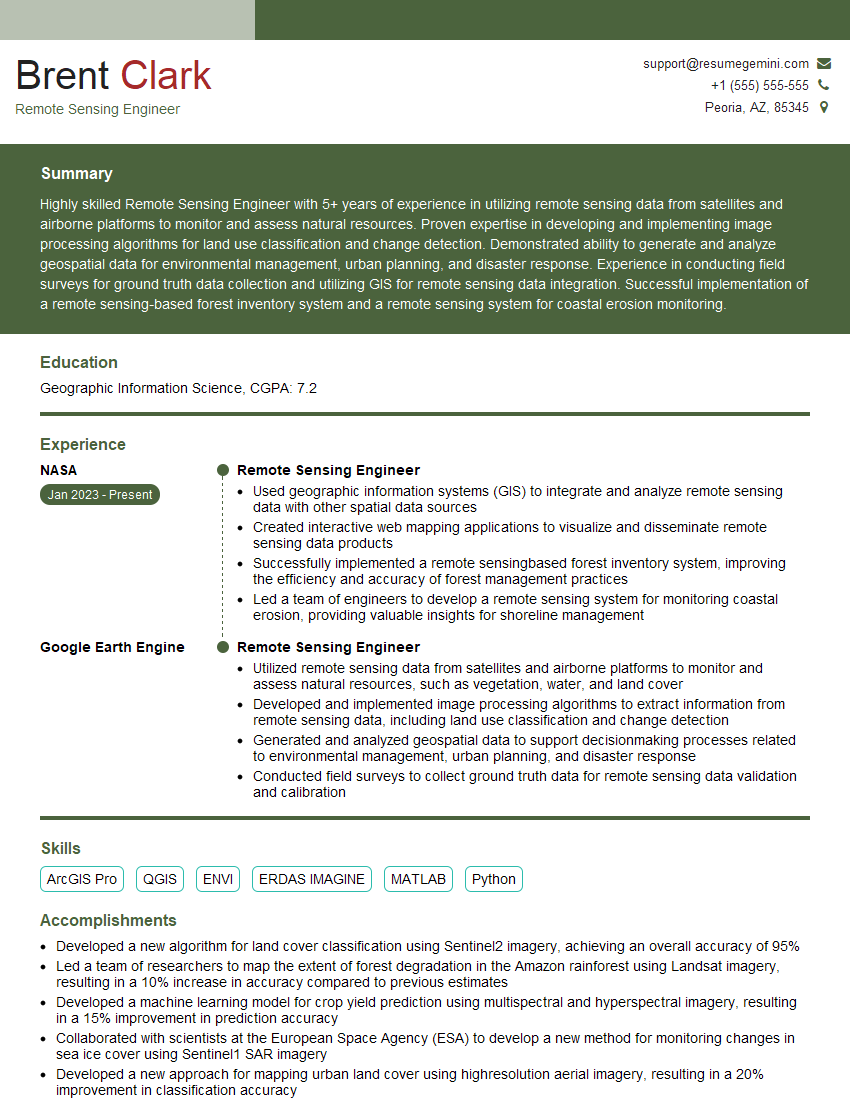
Mastering supervised learning for remote sensing significantly enhances your career prospects in this rapidly growing field, opening doors to exciting roles in environmental monitoring, urban planning, and precision agriculture. To maximize your job search success, crafting an ATS-friendly resume is crucial. ResumeGemini is a trusted resource that can help you build a professional and impactful resume, ensuring your qualifications shine. Examples of resumes tailored to Supervised Learning for Remote Sensing are available, showcasing best practices for this specialized field. Invest time in building a strong resume – it’s your first impression on potential employers.




Explore more articles
Users Rating of Our Blogs
Share Your Experience
We value your feedback! Please rate our content and share your thoughts (optional).
What Readers Say About Our Blog
To the interviewgemini.com Webmaster.
Very helpful and content specific questions to help prepare me for my interview!
Thank you
To the interviewgemini.com Webmaster.
This was kind of a unique content I found around the specialized skills. Very helpful questions and good detailed answers.
Very Helpful blog, thank you Interviewgemini team.