Every successful interview starts with knowing what to expect. In this blog, we’ll take you through the top Switchgear Installation interview questions, breaking them down with expert tips to help you deliver impactful answers. Step into your next interview fully prepared and ready to succeed.
Questions Asked in Switchgear Installation Interview
Q 1. Explain the different types of switchgear.
Switchgear comes in various types, broadly categorized by voltage level, application, and construction. Let’s explore some key distinctions:
- Metal-Clad Switchgear: This is a robust, self-contained unit with all components enclosed in metal cabinets for safety and protection. It’s commonly used in industrial settings and substations due to its high voltage capacity and protection from environmental factors. Think of it as a heavily armored security system for electrical power.
- Metal-Enclosed Switchgear: Similar to metal-clad, but often with less robust construction and potentially less complete internal compartmentalization. They provide good protection but might have exposed components in certain areas.
- Air Insulated Switchgear (AIS): These systems use air as the primary insulation medium between components. They’re generally lower voltage and commonly seen in smaller industrial facilities or commercial buildings. Because they’re not as tightly enclosed, they’re easier to inspect and maintain.
- Gas Insulated Switchgear (GIS): These use sulfur hexafluoride (SF6) gas as an insulator, boasting superior insulation properties compared to air. GIS is frequently found in high-voltage applications where space is limited, such as substations in densely populated areas. SF6 gas is extremely efficient but requires special handling due to its environmental impact.
- Vacuum Circuit Breaker Switchgear: This type utilizes vacuum circuit breakers, known for their fast interruption capabilities and minimal maintenance needs. They’re suitable for a wide range of applications, from industrial plants to commercial settings.
The choice of switchgear type hinges on factors like voltage level, fault current capacity, environmental conditions, space constraints, and budget. Each type is designed for specific needs and offers a unique balance of safety, performance, and cost.
Q 2. Describe the safety precautions you take during switchgear installation.
Safety is paramount during switchgear installation. We follow a rigorous protocol that prioritizes both worker and equipment safety. This starts with a thorough risk assessment that identifies all potential hazards, including electrical shock, arc flash, and falling objects. We then implement measures to mitigate those risks:
- Lockout/Tagout (LOTO) Procedures: Before any work begins, we completely de-energize the switchgear and apply LOTO devices to prevent accidental energization. This is critical and meticulously documented.
- Personal Protective Equipment (PPE): All personnel wear appropriate PPE, including insulated gloves, arc flash suits, safety helmets, and safety glasses. The type and level of PPE depends on the specific task and voltage level.
- Proper Training and Certification: Our team is highly trained and certified to work on high-voltage equipment. They possess a thorough understanding of safety procedures and emergency response protocols.
- Work Permits and Supervision: All work is authorized through a formal work permit system, with competent supervision throughout the entire process. This ensures compliance with safety regulations and best practices.
- Grounding and Bonding: We establish a solid ground connection to the switchgear frame and all conductive parts to prevent electrical shock and dissipate stray currents.
- Safe Working Practices: Maintaining a clear and organized workspace, ensuring adequate lighting, and using insulated tools are crucial components of our safety practices.
A culture of safety is ingrained in our team, with regular safety meetings and training to reinforce these procedures and promote a proactive safety attitude.
Q 3. What are the common causes of switchgear failure?
Switchgear failures can stem from various causes, often related to age, environmental conditions, or operational issues. Some common culprits include:
- Wear and Tear: Over time, mechanical components like contacts and bearings wear down, leading to poor connections and increased resistance. This can generate heat and ultimately lead to failure.
- Environmental Factors: Exposure to moisture, dust, or extreme temperatures can degrade insulation and cause corrosion, impacting the switchgear’s reliability. A classic example is corrosion on busbars in humid environments.
- Overcurrent Conditions: Excessive current flow due to short circuits or overload can damage components like circuit breakers and busbars. This often leads to thermal damage or even explosions.
- Loose Connections: Poorly tightened connections create resistance, generating heat and eventually leading to component failure. Regular inspection and tightening are crucial for preventing this.
- Arcing Faults: Arcing can cause serious damage to internal components. This is why protective relay systems and arc flash mitigation are critical.
- Improper Installation or Maintenance: Deficiencies in initial installation or inadequate maintenance can significantly increase the risk of failure. This underscores the importance of qualified technicians for both installation and servicing.
Regular inspections, preventative maintenance, and the implementation of appropriate protective devices are essential in preventing or mitigating these failures.
Q 4. How do you ensure proper grounding and bonding during switchgear installation?
Grounding and bonding are critical for switchgear safety. Proper grounding provides a low-impedance path for fault currents, preventing dangerous voltage buildup on exposed metal parts. Bonding ensures equipotential connections between different metal parts to eliminate potential differences that could cause shock hazards. Here’s how we ensure both during installation:
- Grounding Electrode System: We start by ensuring a suitable grounding electrode system, often a ground rod or grid, connected to earth. The ground resistance is measured to confirm it’s within acceptable limits.
- Grounding Conductor: A heavy-gauge grounding conductor is run from the switchgear enclosure to the grounding electrode system. This conductor must be appropriately sized to handle fault currents.
- Bonding Conductors: Bonding conductors connect all metallic enclosures, frames, and other conductive parts within the switchgear system to ensure equipotential bonding. We meticulously check for any gaps or inadequate connections.
- Grounding Connections: All grounding connections are made using approved connectors and techniques. We perform a visual inspection and often resistance testing to verify secure connections.
- Regular Inspection: After installation, regular inspection of all grounding and bonding connections is critical. Corrosion or loosening over time can compromise the effectiveness of the system.
Ignoring grounding and bonding can lead to serious hazards, making it a fundamental safety aspect we never compromise on. The safety of personnel is our utmost priority, and this is a key way we assure that.
Q 5. Explain the process of testing and commissioning switchgear.
Testing and commissioning are crucial for ensuring the switchgear is functioning correctly and meets safety standards before energization. This multi-step process involves several stages:
- Pre-commissioning Inspection: A thorough visual inspection verifies that the switchgear has been installed according to specifications, with all connections secure and components undamaged.
- Insulation Resistance Testing: This measures the insulation resistance of the switchgear’s various components to ensure sufficient insulation integrity. Low resistance indicates potential insulation failures.
- Continuity Testing: Tests verify the continuity of grounding and bonding connections to confirm a low-resistance path to earth.
- High-Potential Testing: This involves applying a high-voltage test to the switchgear’s insulation, simulating potential fault conditions to identify weak points.
- Protective Relay Testing: The switchgear’s protective relays, which detect faults and trigger circuit breaker operation, undergo functional testing to verify their proper operation under various fault conditions.
- Circuit Breaker Testing: Circuit breakers are tested for their ability to interrupt fault currents effectively, verifying their timing and tripping characteristics.
- Functional Testing: After verifying all individual components, the entire system is functionally tested to ensure all control and protection systems are working in coordination.
- Commissioning Report: A detailed commissioning report documents all test results and confirms that the switchgear meets all required standards and specifications.
Thorough testing and commissioning are essential for the safe and reliable operation of the switchgear, avoiding potential hazards down the line.
Q 6. What are the different types of busbars used in switchgear?
Busbars are the main current-carrying conductors within switchgear. The choice of busbar type depends on factors like current capacity, voltage level, and space constraints. Here are some common types:
- Solid Copper Busbars: These are commonly used in lower voltage switchgear applications due to their high conductivity and relative ease of fabrication. They are often rectangular or square in shape.
- Hollow Copper Busbars: Hollow bars are also widely used and offer better cooling and potentially more efficient current carrying capacity than solid bars.
- Aluminum Busbars: Aluminum busbars offer advantages in weight and cost, but they possess a slightly lower conductivity than copper. They often require more careful design for reliable contact points.
- Tubular Busbars: Tubular bars provide excellent cooling and are suitable for high-current applications, particularly in high power switchgear.
- Clad Busbars: These busbars have a layer of aluminum or copper around a core of another material like steel. This increases the current carrying capacity while reducing overall weight.
The selection of a busbar type involves careful consideration of the required current carrying capacity, space restrictions, cost and environmental factors. Each type offers specific advantages and is designed to optimize performance based on the application.
Q 7. Describe your experience with different types of circuit breakers.
My experience encompasses a range of circuit breaker types, each with its own characteristics and advantages. I’ve worked with:
- Vacuum Circuit Breakers: These are highly reliable and require minimal maintenance. Their fast interruption capabilities make them ideal for applications where rapid fault clearing is essential.
- Air Circuit Breakers (ACBs): ACBs are common in low-to-medium voltage applications. They are relatively inexpensive but require more regular maintenance compared to vacuum circuit breakers.
- SF6 Circuit Breakers: Used primarily in high-voltage applications, these offer superior insulation properties, but the SF6 gas requires careful handling due to its environmental considerations.
- Oil Circuit Breakers: Though less common now due to fire hazards, they were once prevalent in high-voltage applications. Their design utilizes oil for arc quenching.
The selection of a circuit breaker type is influenced by factors such as voltage level, fault current capacity, operating frequency, and environmental considerations. Each type presents a unique combination of performance, maintenance requirements, and safety characteristics. Understanding their nuances is key to choosing the correct one for a particular application.
Q 8. How do you troubleshoot common switchgear problems?
Troubleshooting switchgear problems requires a systematic approach combining visual inspection, testing, and understanding the system’s behavior. It starts with safety – always ensure the switchgear is de-energized and locked out before commencing any work.
Common problems and troubleshooting steps:
- Alarms and Tripping: Investigate the fault indicators and relay settings. Check relay logs for event sequences. This might involve checking for overcurrent, ground faults, or other protection system activations. A simple example is a tripped breaker due to an overcurrent event. We’d check the load, verify the breaker’s settings, and inspect the wiring for any damage or loose connections.
- Unusual Noises: Buzzing, humming, or clicking sounds could indicate loose connections, arcing, or mechanical issues within the switchgear. Thorough visual inspection and infrared thermal imaging can pinpoint the source.
- Overheating: Infrared thermography is crucial here. Overheating components point towards high current, loose connections, or faulty components. Checking contact resistance is vital.
- Poor Contact: High resistance in connections leads to overheating and potential fire hazards. Tightening connections and checking for corrosion is essential. A multimeter is used to measure the resistance.
- Metering Issues: Inaccurate readings from current transformers (CTs) or potential transformers (PTs) might indicate faulty sensors or wiring problems. Testing and calibration are necessary.
Remember, thorough documentation of findings and corrective actions is crucial for future reference and maintenance planning.
Q 9. What are the safety regulations relevant to switchgear installation?
Switchgear installation is governed by stringent safety regulations, varying slightly depending on location and voltage levels (e.g., OSHA in the US, IEC standards internationally). These regulations prioritize worker safety and system reliability. Key regulations include:
- Lockout/Tagout (LOTO): Before any work, the switchgear must be completely de-energized, and LOTO procedures must be strictly followed to prevent accidental energization.
- Personal Protective Equipment (PPE): Appropriate PPE, including insulated tools, safety glasses, arc flash suits (for higher voltages), and hearing protection, is mandatory.
- Arc Flash Hazard Analysis: For high-voltage switchgear, a detailed arc flash hazard analysis is required to determine the appropriate PPE and safe working practices.
- Grounding and Bonding: Proper grounding and bonding techniques are critical to prevent electrical shock and equipment damage. This involves grounding the switchgear enclosure and bonding various components.
- Safe Working Distances: Maintaining adequate distances from energized components is crucial.
- Permit-to-Work Systems: A formal permit-to-work system is often required for high-risk tasks. This system documents all the necessary safety checks and approvals before starting any work.
- Training and Competency: Only qualified and trained personnel are allowed to work on switchgear.
Compliance with these regulations is not just a legal requirement; it’s a fundamental aspect of ensuring a safe working environment and preventing accidents.
Q 10. Explain the importance of proper documentation during switchgear installation.
Proper documentation during switchgear installation is vital for several reasons:
- Safety and Maintenance: Detailed records of the installation process, including wiring diagrams, testing results, and any modifications made, are crucial for safe maintenance and troubleshooting. Knowing the exact configuration of the system can prevent accidents during future work.
- Compliance and Audits: Comprehensive documentation proves adherence to relevant safety regulations and industry best practices. This is essential during audits and inspections.
- Troubleshooting and Repairs: Accurate documentation allows technicians to quickly understand the system’s configuration during troubleshooting and repairs, saving time and preventing errors.
- Warranty and Liability: Detailed records assist in resolving warranty claims and managing liability issues.
- System Upgrades and Modifications: Documentation provides the necessary information for future system upgrades, modifications, or expansions.
Imagine trying to troubleshoot a faulty circuit without a wiring diagram – a nightmare! Proper documentation ensures clarity and minimizes potential problems.
Q 11. How do you ensure the proper alignment and clearances during installation?
Ensuring proper alignment and clearances is paramount for safe and efficient switchgear operation. Misalignment can lead to poor contact, overheating, and potential failure. Clearances ensure sufficient space for insulation and prevent electrical arcing.
Methods for achieving proper alignment and clearances:
- Precise Measurements: Use accurate measuring tools, levels, and templates to ensure all components are precisely aligned according to the manufacturer’s specifications.
- Shimming and Adjustment: Shims are used to adjust the position of components to achieve perfect alignment. This is especially important for busbars and other critical components.
- Visual Inspection: Regular visual inspection throughout the installation process helps identify any misalignment issues early on.
- Verification Tools: Laser alignment tools can help ensure accurate alignment, especially in complex installations.
- Clearance Gauges: Specialized clearance gauges are used to verify that minimum clearances are maintained between components.
A small misalignment could lead to a cascading failure, causing significant downtime and potentially a safety hazard. Therefore, meticulous attention to detail is crucial in this phase.
Q 12. Describe your experience working with high voltage switchgear.
I have extensive experience working with high-voltage switchgear, specifically with voltages ranging from 15kV to 138kV. This involves working with gas-insulated switchgear (GIS) and air-insulated switchgear (AIS). My experience encompasses all aspects of high-voltage switchgear, including installation, commissioning, testing, maintenance, and troubleshooting.
Specific examples of projects:
- I was involved in the installation and commissioning of a 138kV GIS substation for a major power utility. This required meticulous planning, strict adherence to safety protocols, and specialized knowledge of GIS equipment.
- I led a team in the refurbishment of several 34.5kV AIS substations, addressing issues such as aging components and upgrading protection systems. This highlighted my project management skills as well as my expertise in high voltage equipment.
- I have conducted extensive high-voltage testing, including dielectric strength tests and partial discharge measurements. This ensures the switchgear’s safety and reliability.
Working with high-voltage switchgear necessitates a strong understanding of safety regulations, sophisticated testing techniques, and a meticulous approach. I am comfortable and proficient in managing such challenging projects.
Q 13. What is your experience with different types of protective relays?
My experience includes working with a wide range of protective relays, including overcurrent relays, differential relays, distance relays, and various types of specialized relays, such as busbar protection relays and transformer protection relays. I am familiar with both electromechanical and digital relays.
Key areas of expertise:
- Relay Coordination: I have extensive experience in coordinating protective relays within a power system to ensure selective and reliable protection. This involves understanding relay characteristics, fault analysis, and time-current curves.
- Relay Testing: I am proficient in using various methods to test protective relays, including testing with dedicated relay test sets. I understand different testing procedures needed for different relay types.
- Relay Setting Calculations: I can perform accurate relay setting calculations based on system parameters and fault current studies.
- Digital Relay Configuration: I have experience configuring digital relays, understanding their communication protocols, and integrating them into substation automation systems.
My knowledge of protective relays goes beyond basic understanding. I can implement advanced protection schemes that greatly enhance the safety and reliability of a power system.
Q 14. Explain the process of cable termination and connection in switchgear.
Cable termination and connection in switchgear is a critical step requiring precision and attention to detail. Incorrect termination can lead to poor connections, overheating, and potential failures. The process generally involves the following steps:
- Cable Preparation: The cable sheath and insulation are carefully stripped back to the required length. This process demands precision to avoid damaging the conductor.
- Conductor Preparation: The cable conductor is tinned (if necessary) to ensure a clean and reliable connection. Stranded conductors are often crimped using appropriate connectors.
- Connector Selection: The correct type and size of connector must be chosen to match the cable and the switchgear.
- Crimping and Termination: The connector is crimped onto the conductor using a hydraulic crimping tool to ensure a strong, reliable connection that meets the appropriate standards.
- Insulation and Sealing: Once the connection is made, appropriate insulation and sealing materials are applied to protect the connection from environmental factors and potential electrical faults.
- Testing: After the termination is complete, the connection is tested using a low-resistance meter to ensure the connection’s integrity and to verify the absence of high resistance.
A poorly terminated cable can be a significant safety hazard and can lead to equipment failure. Therefore, careful adherence to the manufacturer’s instructions and proper testing are critical steps in this process. Experience with various termination methods and connectors is paramount.
Q 15. How do you handle emergency situations during switchgear installation?
Emergency situations during switchgear installation are handled with a structured approach prioritizing safety. My first response is always to ensure the safety of myself and my team. This involves immediately isolating the affected section of the switchgear, if possible, and evacuating the area. We’d then assess the situation, identifying the root cause of the emergency. This could range from a minor equipment malfunction to a more serious electrical fault.
Depending on the nature of the emergency, we may call emergency services – fire department, paramedics, or utility company – and follow established emergency response procedures specific to the site. A post-incident report detailing the event, corrective actions, and preventative measures would be meticulously documented to avoid future occurrences. For example, if a fire breaks out during installation due to a short circuit, immediate fire suppression using available equipment and evacuation are top priorities before assessing the damage and contacting emergency services.
Regular safety training and drills are crucial in preparing for such scenarios. We maintain a detailed emergency contact list and ensure everyone on the team is familiar with their roles and responsibilities. This proactive approach minimizes downtime and ensures a swift, safe resolution.
Career Expert Tips:
- Ace those interviews! Prepare effectively by reviewing the Top 50 Most Common Interview Questions on ResumeGemini.
- Navigate your job search with confidence! Explore a wide range of Career Tips on ResumeGemini. Learn about common challenges and recommendations to overcome them.
- Craft the perfect resume! Master the Art of Resume Writing with ResumeGemini’s guide. Showcase your unique qualifications and achievements effectively.
- Don’t miss out on holiday savings! Build your dream resume with ResumeGemini’s ATS optimized templates.
Q 16. What software or tools are you familiar with for switchgear design or maintenance?
I’m proficient in several software applications and tools relevant to switchgear design and maintenance. For design, I extensively use AutoCAD Electrical for creating detailed schematics, wiring diagrams, and panel layouts. This software helps ensure accuracy and facilitates effective collaboration with engineers and clients. For 3D modeling of switchgear assemblies, I have experience with EPLAN Electric P8. It allows for a comprehensive visualization of the switchgear before installation, aiding in identifying potential conflicts early on.
On the maintenance side, I utilize asset management software like SAP PM (Plant Maintenance) to track maintenance schedules, record inspections, and manage spare parts. Furthermore, I’m familiar with various testing and diagnostic tools, including digital multimeters, insulation resistance testers, and partial discharge detectors, which are essential for ensuring switchgear is operating within acceptable parameters.
Q 17. Describe your experience with different types of switchgear manufacturers.
My experience encompasses a wide range of switchgear manufacturers, including ABB, Siemens, Schneider Electric, and GE. Each manufacturer has its unique design philosophies, component specifications, and documentation standards. For instance, ABB’s Unigear system differs significantly from Siemens’ 8PT system in terms of busbar configurations and protection relay integration. Understanding these differences is key to efficient installation and maintenance. I’ve worked on projects involving both low-voltage and high-voltage switchgear from these manufacturers, gaining experience with various protection schemes, control systems, and communication protocols. This broad exposure ensures I can adapt to any manufacturer’s specific requirements and seamlessly integrate their equipment into diverse power systems.
One project involved integrating a newly purchased ABB switchgear into an existing Siemens-based system. This required a deep understanding of both manufacturers’ systems to ensure compatibility and develop an effective integration plan. The project was completed successfully by meticulously studying each system’s technical specifications and documentation, and coordinating closely with the vendor’s technical support teams.
Q 18. How do you interpret electrical schematics and drawings?
Interpreting electrical schematics and drawings is fundamental to my work. I begin by identifying the key components, such as circuit breakers, busbars, transformers, and protective relays. Then, I trace the flow of power and signals through the system, understanding the purpose of each component and its interconnection with others. This involves identifying different symbols and notations, understanding the logic of control circuits, and comprehending the various protection schemes implemented. I also pay attention to the cable schedules and termination details.
For instance, understanding a one-line diagram allows me to visualize the overall power system and grasp the hierarchy of protective devices. Detailed wiring diagrams are then used to understand the actual physical connections and pathways of conductors. I use a combination of my experience and software tools like AutoCAD Electrical to assist in interpreting complex drawings, verifying all connections, and ensuring they conform to the specified design. Thorough understanding ensures the safe and correct installation process.
Q 19. What are the different types of earthing systems used in switchgear installations?
Several earthing systems are used in switchgear installations, each with its advantages and disadvantages. The choice depends on factors like the size and type of the installation, soil resistivity, and applicable standards.
- IT (Isolated system): This system uses a high impedance between the neutral and earth. It offers high safety but limits fault detection capabilities.
- TN-S (Terra-Neutral-Separate): This system has a separate neutral and earth conductor running throughout. It provides excellent fault protection and is widely used.
- TN-C-S (Terra-Neutral-Combined-Separate): The neutral and earth conductors are combined in some parts of the system and separate in others, often used in distribution networks.
- TT (Terra-Terra): The neutral point is earthed at the source, and the equipment enclosure is earthed locally. This system is frequently used where soil resistivity is high.
Proper earthing is critical for personnel safety, equipment protection, and system stability. Insufficient earthing can lead to dangerous touch voltages and equipment damage, whereas a poorly designed system can experience ground faults which damage critical equipment.
Q 20. Explain the importance of arc flash hazard mitigation in switchgear work.
Arc flash hazard mitigation is paramount in switchgear work. An arc flash is a dangerous electrical explosion that occurs when a short circuit takes place, resulting in a release of intense heat, light, and pressure. This can cause severe burns, hearing loss, and even fatalities. Therefore, minimizing the risk is crucial.
Mitigation strategies include:
- Proper lockout/tagout procedures: This ensures that power is completely isolated before any work is performed on the switchgear.
- Arc flash hazard analysis: This study calculates the potential arc flash energy based on system characteristics, providing crucial information for selecting appropriate PPE (Personal Protective Equipment).
- Use of appropriate PPE: This includes arc flash rated suits, face shields, and gloves to protect personnel from the intense energy released during an arc flash.
- Regular inspections and maintenance: This helps identify and correct potential hazards before they escalate into an arc flash event.
- Engineering controls: Designing the switchgear with features that minimize the likelihood of an arc flash, such as employing insulated busbars or employing arc-resistant equipment.
Ignoring arc flash hazards can lead to serious accidents. Following established safety protocols and investing in appropriate equipment are vital for ensuring the safety of personnel working with switchgear.
Q 21. How do you ensure compliance with relevant industry standards (e.g., IEC, IEEE)?
Compliance with relevant industry standards, such as those from the IEC (International Electrotechnical Commission) and IEEE (Institute of Electrical and Electronics Engineers), is non-negotiable. These standards provide guidelines for safe design, installation, operation, and maintenance of electrical equipment, including switchgear.
We ensure compliance by:
- Following the specifications outlined in the project documentation and adhering to all applicable codes and standards.
- Using certified and compliant components and materials. This ensures that all equipment meets the required safety and performance standards.
- Performing regular inspections and testing to verify that the installed switchgear continues to meet the specified standards throughout its lifespan.
- Maintaining detailed records of all installations, inspections, and tests for auditing purposes.
- Keeping updated on the latest revisions of standards and incorporating any necessary changes into our practices. Continuous professional development is crucial in this ever-evolving field.
Non-compliance can lead to safety hazards, equipment failures, and legal liabilities. Therefore, maintaining a strict adherence to the relevant standards is integral to our work process. This includes utilizing reputable third-party testing and certification where needed for components and completed installations.
Q 22. What are your experiences with different types of insulating materials used in switchgear?
Switchgear relies heavily on robust insulating materials to prevent electrical breakdowns and ensure safety. My experience encompasses a wide range of these materials, each with its own strengths and weaknesses. Common types include:
- Solid Insulating Materials: These are typically found in bushings, insulators, and barriers within the switchgear. Examples include porcelain, epoxy resin, and various types of plastics like polycarbonate and polyester. Porcelain, for instance, offers excellent dielectric strength and is resistant to high temperatures, making it ideal for high-voltage applications. Epoxy resins provide superior mechanical strength and can be molded into complex shapes, while plastics offer a good balance of properties and are often cost-effective.
- Gaseous Insulating Materials: SF6 (Sulfur hexafluoride) is the most prevalent gas used in modern switchgear. Its exceptional dielectric strength and arc-quenching capabilities allow for smaller and more compact designs compared to air-insulated switchgear. However, its environmental impact is a growing concern, leading to the exploration of alternative gases like air, vacuum, or mixtures.
- Liquid Insulating Materials: Mineral oil has been a traditional choice for many years, primarily in transformers and oil-filled circuit breakers within switchgear. It provides excellent dielectric strength and cooling properties. However, concerns about flammability and environmental impact have led to the increasing adoption of synthetic esters, which offer improved fire safety and biodegradability.
In my work, I’ve meticulously considered the specific application requirements – voltage level, environmental conditions, and safety standards – when selecting the appropriate insulating material. For example, in a coastal environment, I’d opt for materials with higher resistance to salt corrosion. Similarly, for high-voltage applications, dielectric strength would be a paramount consideration.
Q 23. Describe your experience with preventative maintenance of switchgear.
Preventative maintenance is crucial for the reliable and safe operation of switchgear. My approach involves a structured program combining regular inspections, testing, and cleaning.
- Visual Inspections: This includes checking for loose connections, signs of arcing or burning, corrosion, damage to insulation, and overall cleanliness. I use checklists to ensure thoroughness and consistency.
- Functional Testing: This involves testing protective relays, circuit breakers, and other components to verify proper operation. This can include testing the trip time of circuit breakers and the accuracy of protective relays using specialized test equipment.
- Partial Discharge Testing: This advanced technique helps detect early signs of insulation degradation that may not be visible during visual inspections. This can prevent catastrophic failures.
- Cleaning: Regular cleaning removes dust, dirt, and other contaminants that can compromise insulation and lead to overheating. This is especially important in dusty or humid environments.
- Thermal Imaging: Detecting hot spots using infrared cameras is essential to identify potential problems before they become significant.
I’ve successfully implemented these procedures in various settings, consistently improving equipment reliability and reducing the risk of unplanned outages. I document all maintenance activities meticulously, ensuring compliance with relevant safety regulations and creating a clear history for future reference.
Q 24. How do you manage a team during a switchgear installation project?
Managing a switchgear installation team requires strong leadership, communication, and organization. My approach focuses on:
- Clear Communication: I ensure that everyone understands the project goals, timelines, and individual responsibilities. This involves daily briefings and regular communication updates.
- Delegation and Empowerment: I delegate tasks effectively, assigning responsibilities based on individual skill sets and experience. I empower team members to make decisions and solve problems independently whenever possible.
- Safety First: Safety is paramount. I enforce strict adherence to safety regulations and conduct regular safety briefings. I foster a culture where everyone feels comfortable raising safety concerns.
- Collaboration and Teamwork: I encourage open communication and collaboration among team members. This promotes problem-solving and a positive work environment.
- Conflict Resolution: I address conflicts promptly and fairly, ensuring that all team members feel heard and respected.
On one particular project, I managed a team of ten electricians and engineers. By leveraging a collaborative approach, clear communication, and maintaining a safe working environment, we successfully completed the installation ahead of schedule and under budget.
Q 25. What are your problem-solving strategies when faced with unexpected challenges during installation?
Unexpected challenges during switchgear installation are inevitable. My problem-solving approach involves:
- Assessment and Analysis: The first step is to thoroughly assess the situation, identifying the root cause of the problem. This may involve consulting drawings, specifications, and relevant codes.
- Risk Assessment: I determine the potential impact of the issue and prioritize solutions to mitigate any safety risks.
- Solution Brainstorming: I engage the team in brainstorming potential solutions, considering various options and their feasibility.
- Implementation and Verification: Once a solution is selected, I implement it carefully, ensuring proper safety precautions. I verify that the solution is effective and does not create new problems.
- Documentation: I meticulously document the challenge, the chosen solution, and the results. This is crucial for learning from past experiences and preventing similar issues in the future.
For instance, during one installation, we discovered a discrepancy between the existing infrastructure and the design specifications. By carefully assessing the situation, we were able to develop a creative workaround that ensured the safety and functionality of the system without significant delays.
Q 26. Describe a time you had to troubleshoot a complex switchgear issue.
During a commissioning phase of a medium-voltage switchgear, we experienced intermittent tripping of a circuit breaker. Initial inspections revealed no obvious faults. This pointed to a more subtle problem.
My systematic troubleshooting approach involved:
- Systematic Elimination: I started by isolating potential problem areas – the breaker itself, the control circuitry, and the protective relays.
- Detailed Testing: We performed detailed tests on each component, including resistance measurements, insulation testing, and functional tests of the protective relays.
- Data Analysis: We analyzed trip logs and other data to identify patterns and clues. This revealed a correlation between high ambient temperature and the tripping events.
- Root Cause Identification: This led us to discover that the breaker’s thermal protection was set too sensitively for the high ambient temperatures in the location. The heat from the ambient conditions was triggering the thermal protection.
- Corrective Action: We adjusted the thermal setting of the breaker, resolving the intermittent tripping issue.
This experience emphasized the value of methodical investigation, detailed data analysis, and a collaborative approach to troubleshooting complex switchgear issues.
Q 27. How do you ensure the quality and accuracy of your work during installation?
Ensuring quality and accuracy is paramount in switchgear installation. My strategy involves a multi-layered approach:
- Strict Adherence to Standards: I ensure that all work adheres to relevant safety standards, industry best practices, and the project specifications. This involves diligent review of drawings, specifications and permits.
- Thorough Inspection: Every stage of the installation is carefully inspected, ensuring that all connections are tight, wiring is correct, and all components are properly installed.
- Testing and Commissioning: Rigorous testing and commissioning procedures are followed to verify that the switchgear operates correctly and meets all performance requirements. This includes various tests like insulation resistance, continuity, and functionality checks.
- Documentation: All work is meticulously documented, including installation procedures, test results, and any modifications. This ensures traceability and facilitates future maintenance and troubleshooting.
- Quality Control Checklists: Checklists are employed for every stage of the process, ensuring that nothing is missed.
This approach not only guarantees high-quality installations but also minimizes the risk of errors and ensures compliance with regulations, preventing potential hazards.
Q 28. Explain your experience with different types of switchgear control systems.
My experience encompasses a range of switchgear control systems, from simple electromechanical systems to sophisticated digital systems. These systems manage the operation and protection of the switchgear.
- Electromechanical Systems: These rely on relays, timers, and contactors to perform control functions. While simpler, they can be less flexible and difficult to troubleshoot. I have extensive experience working with these systems and their specific maintenance needs.
- Solid-State Relays: These offer improved reliability and flexibility over electromechanical relays. They’re often used in modern switchgear systems for control and protection functions.
- Programmable Logic Controllers (PLCs): PLCs provide highly flexible and sophisticated control capabilities, allowing for complex logic and automated sequences. I’ve worked extensively with PLC-based control systems in large industrial switchgear projects. This involves programming, configuration, and troubleshooting.
- Supervisory Control and Data Acquisition (SCADA) Systems: SCADA systems provide remote monitoring and control of switchgear, offering enhanced situational awareness and operational efficiency. I am familiar with integrating switchgear into SCADA systems, utilizing protocols like Modbus and Profibus.
My experience allows me to effectively select, install, and maintain various control systems based on project needs, ensuring optimal performance and reliability.
Key Topics to Learn for Switchgear Installation Interview
- Safety Procedures and Regulations: Understanding and applying relevant safety standards (e.g., OSHA, NEC) during all phases of installation.
- Switchgear Components and Functionality: Detailed knowledge of circuit breakers, busbars, protective relays, metering devices, and their interoperability.
- Installation Methods and Techniques: Proficiency in various installation techniques, including grounding, bonding, and cable termination, for different switchgear types.
- Wiring Diagrams and Schematics: Ability to interpret and implement complex wiring diagrams and schematics accurately and efficiently.
- Testing and Commissioning: Understanding the procedures for testing and commissioning switchgear to ensure proper functionality and compliance with standards.
- Troubleshooting and Maintenance: Ability to diagnose and resolve common switchgear problems, and perform routine maintenance tasks.
- Electrical Codes and Standards: In-depth knowledge of relevant electrical codes and standards (e.g., NEC, IEC) and their application in switchgear installations.
- Protective Relay Settings and Coordination: Understanding the principles of protective relay operation and the importance of proper coordination to ensure system protection.
- Arc Flash Hazard Mitigation: Knowledge of arc flash hazards and the implementation of safety measures to mitigate risks during installation and maintenance.
- Project Management Aspects: Understanding project timelines, resource allocation, and communication within a team environment for successful switchgear installations.
Next Steps
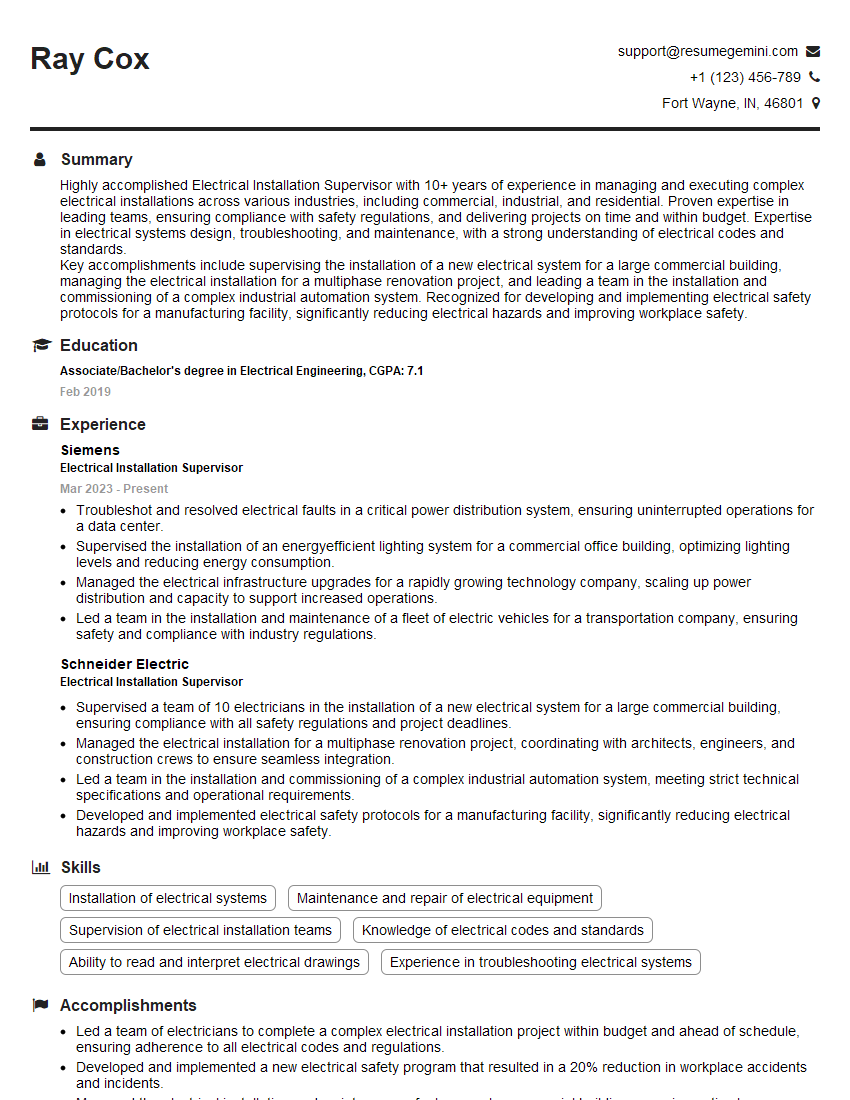
Mastering Switchgear Installation opens doors to rewarding careers in the power and energy sectors, offering excellent growth potential and diverse opportunities. To significantly boost your job prospects, crafting a strong, ATS-friendly resume is crucial. This ensures your application gets noticed by recruiters and hiring managers. We recommend using ResumeGemini, a trusted resource for building professional and impactful resumes. ResumeGemini provides examples of resumes tailored to Switchgear Installation, helping you showcase your skills and experience effectively.
Explore more articles
Users Rating of Our Blogs
Share Your Experience
We value your feedback! Please rate our content and share your thoughts (optional).
What Readers Say About Our Blog
To the interviewgemini.com Webmaster.
Very helpful and content specific questions to help prepare me for my interview!
Thank you
To the interviewgemini.com Webmaster.
This was kind of a unique content I found around the specialized skills. Very helpful questions and good detailed answers.
Very Helpful blog, thank you Interviewgemini team.