Interviews are opportunities to demonstrate your expertise, and this guide is here to help you shine. Explore the essential Tank Assembly interview questions that employers frequently ask, paired with strategies for crafting responses that set you apart from the competition.
Questions Asked in Tank Assembly Interview
Q 1. Describe your experience with different tank assembly methods.
Tank assembly methods vary significantly depending on the tank’s size, design, and intended application. My experience encompasses several key techniques:
- Roll Forming and Welding: This is common for large cylindrical tanks. Sheet metal is rolled into the desired cylindrical shape and then welded along the longitudinal seam. This method is highly efficient for producing consistent, large-diameter tanks. I’ve worked extensively on projects using this method, including the construction of several 100,000-gallon water storage tanks.
- Plate Welding: This involves assembling individual plates to create the tank structure. This is more versatile for complex shapes and smaller tanks. Precise cutting and welding are crucial, and I’ve developed expertise in ensuring minimal weld distortion.
- Modular Assembly: Larger tanks are sometimes assembled from pre-fabricated sections. This allows for faster on-site assembly and reduces the complexity of welding in confined spaces. I have experience managing projects using this approach, reducing overall project times by up to 30%.
- Bolted Construction: Some tanks, particularly smaller ones, utilize bolted construction. This method is faster than welding but offers less structural integrity for high-pressure applications.
The selection of the most suitable method depends on factors like material thickness, tank size, and the required structural strength.
Q 2. What types of welding techniques are you proficient in for tank assembly?
My welding proficiency extends to several essential techniques critical for robust and safe tank assembly:
- Gas Metal Arc Welding (GMAW): This is my go-to method for many tank applications, particularly with steel and stainless steel. It’s efficient and produces high-quality welds with good penetration. I’m certified in GMAW and consistently adhere to AWS D1.1 structural welding code.
- Gas Tungsten Arc Welding (GTAW): Also known as TIG welding, this offers superior control and is ideal for welding thin materials and achieving high-quality finishes. I use it frequently for critical welds and stainless-steel applications where aesthetics and corrosion resistance are paramount.
- Shielded Metal Arc Welding (SMAW): This is a versatile method, suitable for various materials and thicknesses. I use it in situations where GMAW or GTAW might be impractical, such as in environments with limited access.
I am highly proficient in selecting the appropriate welding technique for each specific task, ensuring optimal weld quality and structural integrity of the tank.
Q 3. Explain your understanding of tank pressure testing procedures.
Tank pressure testing is crucial to ensure structural integrity and prevent catastrophic failures. The process involves carefully pressurizing the tank to a level exceeding its design pressure and monitoring for leaks, deformations, or other anomalies. My understanding encompasses:
- Hydrostatic Testing: This involves filling the tank with water and pressurizing it to the designated test pressure. Water is used as it’s readily available, relatively inexpensive, and doesn’t pose a flammability hazard.
- Pneumatic Testing: This uses compressed air or an inert gas for pressurization. It’s faster than hydrostatic testing but requires more stringent safety precautions due to the potential for explosions if leaks occur. I strictly follow all relevant safety regulations, including the use of pressure-reducing valves and leak detection equipment.
- Test Pressure Calculation: Accurate calculation of the test pressure is vital. This involves considering factors like design pressure, safety factor, and material properties. I’m experienced in applying relevant codes and standards (e.g., ASME Section VIII) to make these calculations precisely.
Throughout the testing process, meticulous documentation of pressure readings, inspection findings, and any observed issues is maintained.
Q 4. How do you ensure quality control during tank assembly?
Quality control is paramount throughout the tank assembly process. My approach includes:
- Material Inspection: Checking for defects in the base material before fabrication. This includes visual inspections, dimensional checks, and sometimes chemical analysis.
- Weld Inspection: Visual inspection of welds for defects such as cracks, porosity, and lack of fusion. Non-destructive testing (NDT) methods like radiographic testing (RT) and ultrasonic testing (UT) are sometimes employed for critical welds.
- Dimensional Control: Regular checks to ensure the tank dimensions conform to the design specifications. Precise measurements are essential to prevent issues with sealing and structural integrity.
- Leak Testing: Prior to pressure testing, a preliminary leak test is conducted to identify any minor leaks in the welds or connections. This prevents wasted resources on major pressure tests for tanks with minor leaks.
- Documentation: Meticulous record-keeping of all inspection and testing results is essential for traceability and quality assurance.
By integrating these quality control measures, we significantly reduce the risk of defects and ensure a safe and reliable product.
Q 5. Describe your experience with different types of tank materials (e.g., steel, stainless steel).
My experience includes working with various tank materials, each with its own set of properties and applications:
- Carbon Steel: A cost-effective material suitable for many applications. However, its susceptibility to corrosion needs consideration, especially in harsh environments. I have worked on numerous projects using carbon steel, focusing on proper surface preparation and protective coatings.
- Stainless Steel: Offers superior corrosion resistance, making it ideal for applications involving chemicals or harsh weather. The different grades (e.g., 304, 316) offer varying levels of corrosion resistance and strength. I have extensive experience with stainless steel, including proper welding techniques to avoid sensitization and maintain corrosion resistance.
- Aluminum: Lightweight and corrosion-resistant, aluminum is used in specific applications where weight is a primary concern. I have experience welding and assembling aluminum tanks, focusing on the unique challenges of aluminum welding techniques.
Material selection is always based on the tank’s intended application, anticipated environmental conditions, and the required strength and durability.
Q 6. What safety protocols do you follow during tank assembly?
Safety is paramount in tank assembly. I always adhere to these protocols:
- Personal Protective Equipment (PPE): Consistent use of safety glasses, gloves, hearing protection, and appropriate clothing is non-negotiable. Welding-specific PPE, including welding helmets and flame-resistant clothing, is utilized when welding.
- Confined Space Entry Procedures: When working inside tanks, strict confined space entry protocols are followed, including atmospheric monitoring and the use of safety harnesses and respirators.
- Lockout/Tagout Procedures: To prevent accidental energization of equipment, lockout/tagout procedures are strictly followed during maintenance and repair work.
- Emergency Procedures: Emergency response plans are in place, including the location of fire extinguishers and emergency exits. Team members are trained in emergency procedures.
- Hot Work Permits: For tasks involving welding or other hot work, hot work permits are obtained, ensuring necessary safety precautions are taken before commencing work.
Regular safety training and compliance with all applicable regulations are essential to maintain a safe work environment.
Q 7. How do you handle discrepancies or errors during the assembly process?
Handling discrepancies or errors during assembly requires a methodical approach:
- Immediate Stoppage: Upon discovering a discrepancy, work is immediately halted to prevent further issues.
- Thorough Investigation: The root cause of the error is thoroughly investigated to understand why it occurred. This may involve reviewing blueprints, welding procedures, or inspection records.
- Corrective Action: Appropriate corrective action is taken, which may involve repairing the defect, replacing a faulty component, or modifying the assembly process to prevent recurrence.
- Documentation: All actions taken, including the nature of the discrepancy, corrective actions, and any changes made to the process, are meticulously documented.
- Retesting: After corrective actions are implemented, the affected section undergoes retesting to verify the repair and ensure the tank meets all required specifications.
A proactive approach to error detection and correction ensures the final product’s quality and safety.
Q 8. Explain your experience with blueprint reading and interpreting technical drawings.
Blueprint reading is fundamental to tank assembly. My experience encompasses interpreting various types of technical drawings, including orthographic projections, isometric views, and detailed assembly drawings. I’m proficient in understanding symbols, dimensions, tolerances, and material specifications. For example, I recently worked on a project involving a 5000-gallon stainless steel tank. The blueprints detailed the precise dimensions of each component – the cylindrical shell, the conical roof, the elliptical bottom, and the various nozzles and inlets – allowing for accurate cutting, shaping, and welding. Understanding section views was crucial for confirming the internal structure and pipe routing. Any discrepancy or ambiguity is carefully verified with engineering documentation before proceeding.
Q 9. Describe your experience with using various hand and power tools.
I’m highly skilled in using a wide range of hand and power tools common in tank assembly. This includes measuring tools like calipers and micrometers for precise measurements, cutting tools like plasma cutters and shears for accurate material preparation, and welding equipment like MIG and TIG welders for joining components. I’m also proficient with pneumatic and hydraulic tools for lifting and positioning heavy components. For example, when assembling the conical roof section of a large tank, I use a chain hoist and come-along to ensure precise placement before welding. Safe operation and regular maintenance of these tools are paramount to my workflow. I’m also comfortable using grinders, drills, and other hand tools for finishing and minor adjustments. My experience ensures efficient and accurate work, adhering to safety protocols at all times.
Q 10. How do you ensure the proper alignment and fit of tank components?
Ensuring proper alignment and fit of tank components is critical for structural integrity and leak prevention. This involves meticulous planning and precise execution. We use various methods, including laser alignment tools for precise positioning of large components. For example, when assembling the cylindrical shell, we carefully align each section using alignment pins and laser measurement to ensure concentricity and prevent misalignment. Shims are used to correct minor discrepancies. Jigging and fixtures are often employed for complex geometries, holding components in place during welding. Regular checks throughout the assembly process using plumb bobs, levels, and measuring tapes confirm proper alignment. Any deviation from specifications necessitates immediate corrective actions to maintain quality and prevent costly rework.
Q 11. What are the common challenges faced during tank assembly, and how have you overcome them?
Common challenges in tank assembly include material imperfections, dimensional variations, and welding difficulties. Material imperfections, like slight warping or pitting, require careful assessment and potential rework. Dimensional variations from the blueprint necessitate adjustments in fitting and sometimes, custom fabrication. Welding challenges, such as porosity or incomplete fusion, are addressed through proper welding techniques, preheating, and post-weld inspection. I’ve overcome these challenges by utilizing my experience in problem-solving, employing alternative techniques when necessary and collaborating closely with other tradespeople. For instance, when dealing with a warped plate, we may use a combination of heat treatment and careful bending to restore its shape before proceeding. This emphasizes the importance of thorough planning, continuous quality control, and flexibility in approaching unexpected issues.
Q 12. Explain your experience with troubleshooting assembly problems.
Troubleshooting is an integral part of tank assembly. I approach problems systematically, using a combination of visual inspection, dimensional checks, and testing. For example, if a leak develops after welding, I’d inspect the weld for imperfections, check for gaps or misalignment, and perform pressure testing to identify the source. Systematic troubleshooting involves checking the sequence of assembly, verifying component dimensions and specifications, and testing the function of each part. Documenting each step, including photographs and notes, helps in identifying the root cause and prevents similar problems in the future. My experience has equipped me to handle a wide variety of assembly issues, focusing on efficiency and accuracy to maintain project timelines and quality.
Q 13. How do you maintain a safe and efficient work environment during tank assembly?
Maintaining a safe and efficient work environment involves strict adherence to safety regulations and best practices. This starts with proper use of Personal Protective Equipment (PPE), such as safety glasses, gloves, hard hats, and hearing protection. Proper handling of materials and tools is crucial, avoiding hazards such as falling objects or accidental cuts. Regular inspections of the workspace, keeping it clean and organized, and maintaining a well-lit environment enhance safety and efficiency. We also utilize appropriate lifting equipment, such as forklifts and cranes, to prevent injuries associated with manual lifting. Safety briefings and training sessions are regularly conducted to keep the team informed about safety procedures and potential hazards.
Q 14. Describe your knowledge of different types of tank seals and gaskets.
Tank seals and gaskets are crucial for leak prevention. Different tank applications require different seal types. Common types include elastomeric seals (like rubber or silicone), metallic seals (like O-rings or gaskets made from various metals), and specialized seals for extreme temperature or pressure applications. The choice depends on the media being contained, pressure, temperature, and chemical compatibility. For example, in a food-grade tank, we might use FDA-approved silicone gaskets. In high-pressure applications, metallic gaskets might be necessary. Understanding the material properties, compression characteristics, and installation techniques of various seal types is essential to ensure a leak-free and safe system. Proper gasket selection and installation are critical to prevent leakage and maintain the integrity of the tank.
Q 15. How do you ensure the proper torque specifications are met during assembly?
Ensuring proper torque specifications during tank assembly is crucial for preventing leaks, structural failures, and ensuring the overall integrity of the tank. We achieve this through a multi-pronged approach.
Torque Wrenches: We utilize calibrated torque wrenches, both manual and electronic, to apply the precise amount of force specified in the engineering drawings and manufacturer’s instructions. Electronic wrenches offer the advantage of recording the torque applied for each bolt, providing a verifiable audit trail.
Calibration and Maintenance: Regular calibration of our torque wrenches is paramount. We follow a strict schedule, often using a certified calibration lab, to guarantee accuracy. Wrenches are also maintained according to manufacturer’s guidelines to prevent damage or malfunction.
Training and Procedures: Our assembly technicians receive comprehensive training on the proper use of torque wrenches and the importance of adhering to specified torque values. We have detailed written procedures that clearly outline the torque requirements for each component and connection type. This ensures consistency and reduces human error.
Visual Inspection: After tightening, a visual inspection is always conducted to check for any signs of damage to bolts or surrounding materials. This helps detect any issues early on.
For example, during the assembly of a large storage tank, we might encounter bolts requiring 150 ft-lbs of torque. The electronic torque wrench not only ensures we meet this value, but also records the data, allowing us to trace back and confirm the work done.
Career Expert Tips:
- Ace those interviews! Prepare effectively by reviewing the Top 50 Most Common Interview Questions on ResumeGemini.
- Navigate your job search with confidence! Explore a wide range of Career Tips on ResumeGemini. Learn about common challenges and recommendations to overcome them.
- Craft the perfect resume! Master the Art of Resume Writing with ResumeGemini’s guide. Showcase your unique qualifications and achievements effectively.
- Don’t miss out on holiday savings! Build your dream resume with ResumeGemini’s ATS optimized templates.
Q 16. Describe your experience with the use of automated assembly equipment.
I have extensive experience with automated assembly equipment, primarily robotic systems and automated welding machines. In my previous role, we utilized robotic arms to position and weld components during the construction of large process tanks. This automation significantly increased our efficiency and consistency.
Robotic Welding: Automated welding systems ensure precise and consistent weld quality, reducing the risk of human error that can lead to weaknesses in the tank structure. These systems offer programmable parameters to optimize weld penetration and bead profile.
Automated Material Handling: We’ve used automated guided vehicles (AGVs) and conveyor systems to move large tank components, improving safety and streamlining the workflow. This minimizes the risk of human injury associated with manual handling of heavy materials.
Data Acquisition and Monitoring: Many automated systems provide real-time data on performance, such as weld quality metrics or robot movement accuracy. This data is valuable for process optimization and predictive maintenance.
For instance, in one project, the integration of robotic welding cut our assembly time by 40% while simultaneously improving weld quality and reducing defects. It’s essential to have technicians skilled in programming and maintaining this equipment to maximize its effectiveness.
Q 17. How familiar are you with different tank coating and lining applications?
My familiarity with tank coating and lining applications is comprehensive. The choice of coating depends heavily on the tank’s intended use and the contents it will hold. Different materials offer varying degrees of corrosion resistance, chemical compatibility, and temperature tolerance.
Epoxy Coatings: Excellent chemical resistance and are often used in chemical storage tanks.
Polyurethane Coatings: Durable and abrasion-resistant, suitable for tanks holding abrasive materials.
Phenolic Coatings: High temperature resistance, making them ideal for high-temperature applications.
Fusible Epoxy Linings: Applied by melting and fusing the lining material to the tank wall, offering seamless protection.
I have experience in specifying, supervising the application, and inspecting the quality of various coatings. For example, in a project involving a tank for highly corrosive chemicals, we opted for a multi-layer epoxy coating system to ensure long-term protection and prevent leaks.
Q 18. What is your understanding of ASME standards related to tank construction?
I possess a strong understanding of ASME (American Society of Mechanical Engineers) standards relevant to tank construction, particularly Section VIII, Division 1, which covers the design, fabrication, and inspection of pressure vessels. This standard provides detailed requirements for materials, welding, inspections, and testing to ensure tank safety and reliability.
Material Specifications: ASME specifies allowable materials and their properties, ensuring that the tank can withstand the intended pressure and temperature conditions.
Welding Procedures: The standard sets strict requirements for welding procedures, including welder qualifications and non-destructive testing (NDT) to ensure weld quality.
Inspection and Testing: ASME mandates various inspections and tests throughout the fabrication process, including hydrostatic testing and radiographic inspection to verify the tank’s integrity.
Understanding these standards is critical to ensure the tank meets safety regulations and industry best practices. Non-compliance can lead to severe consequences, including catastrophic failure.
Q 19. How do you document and track the progress of tank assembly projects?
Effective documentation and progress tracking are crucial for managing tank assembly projects. We employ a combination of methods to ensure complete and accurate records are maintained throughout the process.
Project Management Software: We use software like Microsoft Project or Primavera P6 to create detailed project schedules, track tasks, assign resources, and monitor progress against the baseline plan.
Digital Documentation: We capture all critical information digitally, including engineering drawings, material certifications, inspection reports, and test results. This allows for easy access and sharing of information among project stakeholders.
Checklists and Forms: We use standardized checklists and forms to ensure that all necessary steps are followed during assembly and inspection. This helps maintain consistency and minimize errors.
Regular Progress Meetings: Regular meetings with the project team, client, and other stakeholders allow for open communication, problem-solving, and proactive management of potential issues.
This comprehensive approach ensures that we can accurately track the project’s progress, identify potential delays or problems early on, and provide clear and concise reporting to all involved parties.
Q 20. Describe your experience with working within tight deadlines and budgets.
I have extensive experience working within tight deadlines and budgets, often under pressure to deliver complex projects on time and within cost constraints. My approach is rooted in proactive planning, efficient resource allocation, and effective communication.
Detailed Project Planning: Thorough upfront planning is essential. This includes creating realistic schedules, identifying potential risks, and developing contingency plans.
Resource Optimization: Efficient use of personnel, materials, and equipment is critical. This often involves optimizing workflows and minimizing waste.
Effective Communication: Open communication with the team, clients, and suppliers is crucial to address issues promptly and avoid delays. Regular status reports and meetings keep everyone informed and aligned.
Problem-Solving: When facing challenges, I prioritize finding effective solutions quickly. This might involve adjusting the schedule, finding alternative resources, or negotiating with suppliers.
For example, on a project with a very tight deadline, we implemented a lean manufacturing approach to streamline the workflow, resulting in on-time delivery despite unexpected supply chain delays.
Q 21. Explain your understanding of non-destructive testing (NDT) methods used in tank inspection.
Non-destructive testing (NDT) methods are essential for ensuring the quality and integrity of tanks after fabrication and during periodic inspections. These methods allow us to detect flaws without damaging the tank.
Visual Inspection: A basic but essential method to detect surface cracks, corrosion, and other visible defects.
Radiographic Testing (RT): Uses X-rays or gamma rays to detect internal flaws like cracks, porosity, and inclusions in welds and base material.
Ultrasonic Testing (UT): Employs high-frequency sound waves to detect internal flaws and measure wall thickness. It’s particularly useful for detecting subsurface defects.
Magnetic Particle Testing (MT): Uses magnetic fields to detect surface and near-surface cracks in ferromagnetic materials.
Liquid Penetrant Testing (PT): A surface inspection method used to detect cracks and other surface-breaking defects.
The choice of NDT method depends on the type of tank, its material, and the potential types of defects. For example, radiographic testing is often employed to inspect welds in pressure vessels, while ultrasonic testing can be used to assess wall thickness and detect corrosion.
Q 22. How do you handle working at heights during tank assembly?
Safety is paramount when working at heights during tank assembly. We adhere strictly to all relevant safety regulations and utilize appropriate fall protection systems. This includes, but isn’t limited to, using harnesses with lifelines anchored securely to the structure, employing scaffolding with proper guardrails and toe boards, and utilizing appropriate personal protective equipment (PPE) like safety helmets and gloves. Before commencing any work at height, a thorough risk assessment is conducted, identifying potential hazards and implementing control measures. For example, during the installation of a large dome on a water storage tank, we’d use a comprehensive scaffolding system with multiple anchor points for lifelines, ensuring the safety of every team member involved in the lifting and positioning process.
Regular safety training is crucial and we conduct frequent refresher courses to ensure everyone is up-to-date on best practices and emergency procedures. This training covers everything from proper harness usage and equipment inspection to rescue techniques and emergency communication protocols. This proactive approach minimizes risks and ensures a safe working environment for everyone.
Q 23. What is your experience with using Computer-Aided Design (CAD) software for tank assembly?
I’m proficient in several CAD software packages, including AutoCAD, SolidWorks, and Inventor. My experience encompasses the entire design process, from initial conceptualization to detailed fabrication drawings. I’ve used CAD to design various tank components, including shells, roofs, foundations, and internal structures. This involves creating accurate 3D models, generating detailed fabrication drawings with dimensions and tolerances, and performing interference checks to ensure all components fit together seamlessly. For example, during the design of a chemical storage tank, I used SolidWorks to model the tank shell, the supporting structure, and the access platforms, ensuring proper clearances and structural integrity before proceeding to the fabrication stage. The ability to create detailed isometrics and section drawings has been particularly helpful in coordinating fabrication and installation processes.
Q 24. Describe your problem-solving skills in a tank assembly scenario.
Problem-solving is an integral part of tank assembly. My approach is systematic, combining practical experience with analytical skills. I typically begin by clearly defining the problem, gathering relevant data, and identifying potential causes. Then, I brainstorm possible solutions, evaluating each for feasibility, cost, and safety implications. I document my findings and solutions meticulously, which aids in both immediate problem resolution and future preventative measures. For instance, during the assembly of a large storage tank, we encountered a misalignment issue with a critical structural component. By analyzing the assembly drawings and performing onsite measurements, we determined that a minor error in the fabrication stage was the cause. We worked with the fabrication team to rectify the error, minimizing delays and ensuring the structural integrity of the tank.
I also value a collaborative approach to problem-solving, seeking input from experienced colleagues and utilizing diverse perspectives to find optimal solutions. This collaborative problem-solving approach leads to more robust and creative solutions.
Q 25. How do you contribute to a team environment in tank assembly?
I’m a strong believer in teamwork and collaboration. In tank assembly, effective teamwork is essential for completing projects safely and efficiently. I actively participate in team discussions, offering my expertise and readily assisting colleagues. I believe in open communication and ensuring everyone is informed and involved in the process. I also actively contribute to team building activities, fostering a positive and supportive environment. In one project, I successfully mediated a disagreement between two team members regarding a specific assembly technique, resolving the conflict and ensuring that the project remained on schedule. My commitment to teamwork promotes a smooth workflow and ultimately contributes to the successful completion of the project.
Q 26. Explain your experience with the installation and testing of tank components.
I possess extensive experience in the installation and testing of tank components, ranging from small-scale pressure vessels to large-capacity storage tanks. This includes the handling, positioning, and securing of various components like tank shells, roofs, nozzles, and internal structures, while adhering to strict safety protocols. I’m familiar with various testing methods, including hydrostatic testing, leak detection, and pressure testing, to ensure the structural integrity and leak-tightness of the assembled tank. For example, during the installation of a large oil storage tank, I oversaw the precise alignment and welding of the tank shell segments, ensuring that all joints met the required specifications. Subsequently, we performed a rigorous hydrostatic test, documenting all pressure readings and verifying the tank’s ability to withstand the designed operating pressures. This rigorous process guarantees the safe and reliable operation of the tank.
Q 27. What are your salary expectations for a Tank Assembly position?
My salary expectations are commensurate with my experience and qualifications, and also align with the industry standard for a Tank Assembly position of my level. I’m open to discussing this further once I have a better understanding of the full scope of responsibilities and benefits package associated with this role.
Q 28. Do you have any questions for me?
Yes, I have a few questions. First, could you describe the typical project timeline for tank assembly projects at your company? Secondly, what opportunities for professional development and advancement exist within the company?
Key Topics to Learn for Tank Assembly Interview
- Blueprint Reading and Interpretation: Understanding technical drawings, dimensions, and specifications crucial for accurate assembly.
- Material Handling and Safety Procedures: Safe and efficient handling of tank components, adherence to safety regulations and best practices.
- Welding and Joining Techniques (if applicable): Proficiency in relevant welding methods, understanding of weld quality inspection and joint integrity.
- Assembly Processes and Sequencing: Understanding the step-by-step assembly process, optimizing workflow for efficiency and quality.
- Quality Control and Inspection: Implementing quality checks at each stage, identifying and resolving assembly defects.
- Troubleshooting and Problem-Solving: Identifying and resolving common assembly issues, applying critical thinking to complex problems.
- Hydraulic and Pneumatic Systems (if applicable): Understanding the principles and operation of hydraulic and pneumatic components within the tank system.
- Testing and Commissioning: Understanding the procedures for testing assembled tanks to ensure functionality and safety.
- Teamwork and Communication: Effective collaboration with team members, clear and concise communication of issues and progress.
Next Steps
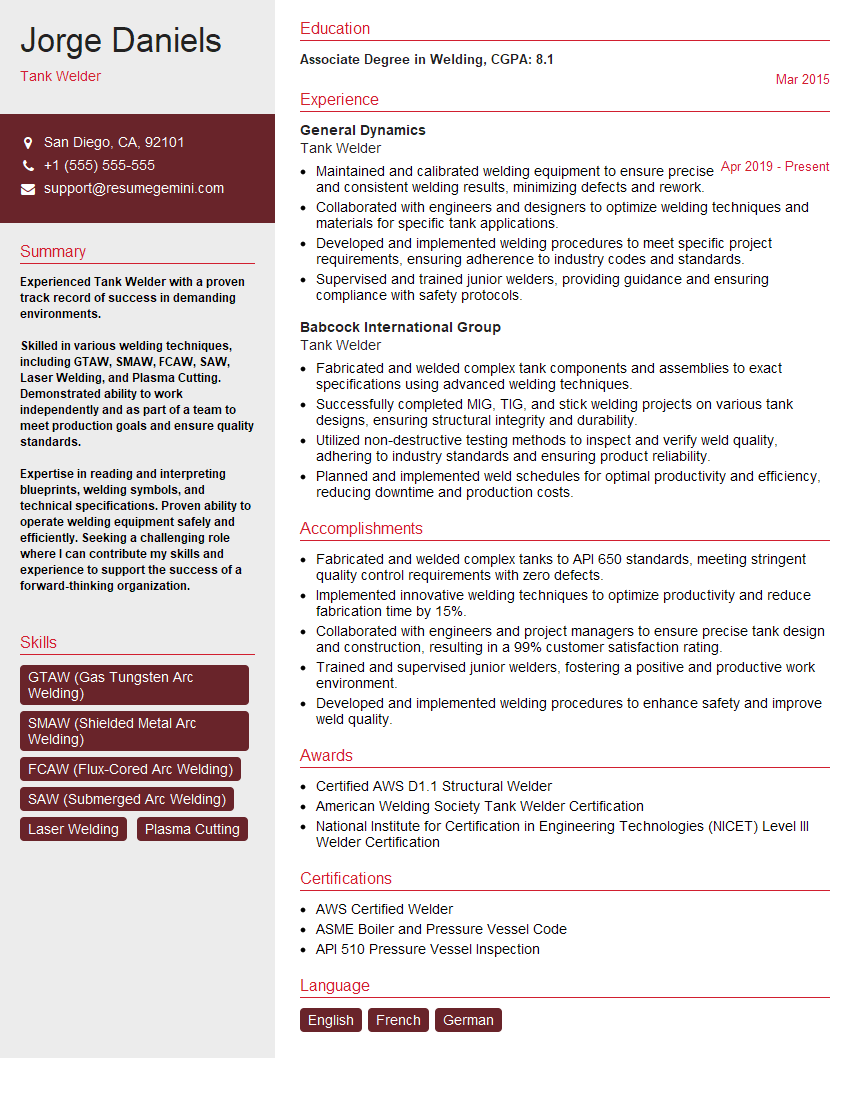
Mastering tank assembly skills opens doors to exciting career opportunities in a dynamic industry. Proficiency in this area demonstrates a valuable combination of technical expertise and practical problem-solving abilities, making you a highly sought-after candidate. To maximize your job prospects, creating a strong, ATS-friendly resume is crucial. ResumeGemini is a trusted resource to help you build a professional resume that highlights your skills and experience effectively. We provide examples of resumes tailored to the Tank Assembly field to guide you in showcasing your qualifications. Invest time in crafting a compelling resume – it’s your first impression on potential employers.

Explore more articles
Users Rating of Our Blogs
Share Your Experience
We value your feedback! Please rate our content and share your thoughts (optional).
What Readers Say About Our Blog
To the interviewgemini.com Webmaster.
Very helpful and content specific questions to help prepare me for my interview!
Thank you
To the interviewgemini.com Webmaster.
This was kind of a unique content I found around the specialized skills. Very helpful questions and good detailed answers.
Very Helpful blog, thank you Interviewgemini team.