Interviews are more than just a Q&A session—they’re a chance to prove your worth. This blog dives into essential Tapping and Finishing Drywall Joints interview questions and expert tips to help you align your answers with what hiring managers are looking for. Start preparing to shine!
Questions Asked in Tapping and Finishing Drywall Joints Interview
Q 1. Explain the different types of joint compound and their applications.
Joint compound, also known as drywall mud, comes in several types, each suited for different stages of the finishing process. The most common are:
- All-Purpose Compound: This is a versatile compound suitable for most applications, offering a good balance of working time and drying speed. It’s ideal for the initial taping and first few coats.
- Lightweight Compound: Lighter than all-purpose, it’s easier to sand, making it a good choice for multiple coats and final finishing where a smooth surface is crucial. It may require more coats due to its thinner consistency.
- Setting-Type Compound: This compound dries quickly, which can be advantageous for large projects where time is a factor. However, it has a shorter working time and requires more experience to avoid premature setting. It’s often used for specific tasks or in situations demanding rapid completion.
Choosing the right compound depends on the project’s scale, the desired finish, and your personal preference. For instance, I often start with all-purpose for the initial tape coat and then switch to lightweight for subsequent coats and the final sanding.
Q 2. Describe the process of taping drywall joints.
Taping drywall joints is the crucial first step in achieving a smooth wall. Here’s a breakdown of the process:
- Prepare the Joint: Ensure the drywall sheets are securely fastened and the joint is clean and free of debris. A slightly recessed joint is ideal for better mud adhesion.
- Apply the Tape: Use a self-adhesive fiberglass drywall tape, carefully pressing it into the joint to ensure good contact. Remove any air bubbles. I prefer using a 2-inch taping knife for this to cover the joint fully.
- First Coat of Mud: Apply a thin, even coat of joint compound over the tape, embedding it completely. Avoid overloading the tape. A 6-inch taping knife is a common tool for this step.
- Feathering: Extend the mud beyond the edges of the tape, gradually thinning it out to create a smooth, feathered edge that blends seamlessly with the drywall surface.
- Dry and Sand: Allow the mud to dry completely before carefully sanding smooth with a sanding sponge or a sanding block. I always use a light touch to avoid sanding through the mud or the paper.
This process ensures the tape is securely bonded and creates a base for subsequent coats.
Q 3. How do you achieve a smooth, seamless finish on drywall?
Achieving a perfectly smooth, seamless finish requires patience and attention to detail. It’s an iterative process involving multiple coats and careful sanding.
- Multiple Coats: Apply several thin coats of joint compound, allowing each coat to dry thoroughly before sanding. Thin coats prevent cracking and ensure a smoother finish. Each coat should be slightly wider than the previous one.
- Careful Sanding: Sand each coat until it’s perfectly smooth and flush with the surrounding surface. Use progressively finer grit sandpaper to refine the finish. I start with 100-grit and finish with 220-grit for the final touch.
- Proper Technique: Use a sanding block or sponge to maintain a consistent level and prevent uneven sanding. Work in a well-ventilated area to avoid inhaling dust.
- Final Inspection: Always inspect your work under various light angles to identify any imperfections or high spots that require additional sanding.
Remember, practice makes perfect. It takes experience to recognize the subtle differences that can make the difference between a good and an excellent finish.
Q 4. What tools and equipment are essential for drywall finishing?
The right tools are essential for efficient and high-quality drywall finishing. My essential toolkit includes:
- Taping Knives: A variety of sizes (6”, 8”, 12”) for different stages of the process. I use a flexible knife for reaching corners.
- Putty Knives: For filling nail holes and smaller imperfections.
- Sanding Sponges/Blocks: For smoothing out the dried compound. I prefer a sanding block for larger areas and a sponge for details.
- Sandpaper: Various grits (100, 120, 150, 220) for progressively finer sanding. I always use dust masks.
- Utility Knife: For cutting drywall tape to size.
- Mixing Bucket and Paddle: For mixing the joint compound thoroughly.
- Drop cloths and cleanup supplies:
Beyond these basics, other helpful tools include corner rollers, a drywall corner tool for consistent internal corner, and a vacuum cleaner with a HEPA filter to manage dust effectively.
Q 5. Explain the importance of proper surface preparation before applying joint compound.
Surface preparation is as important as the application itself. A poorly prepared surface can lead to adhesion problems, a less smooth finish, and increased sanding time. Before applying joint compound:
- Clean the surface: Remove any dust, debris, or loose particles from the drywall. A brush or vacuum with a brush attachment is ideal.
- Fill nail holes and other imperfections: Use spackle or joint compound to fill small holes and imperfections. This creates a more even surface for the taping process.
- Prime bare drywall (if necessary): Priming is sometimes required depending on the drywall type and ensures better paint adhesion. A drywall primer is best.
Time spent on proper preparation saves time and frustration later in the finishing process. A clean, even surface is the foundation for a professional finish.
Q 6. How do you handle different types of drywall corners (inside and outside)?
Handling drywall corners requires specific techniques. Inside and outside corners present different challenges:
- Inside Corners: These require careful application of the tape to ensure a neat, crisp corner. I use a corner tool to keep the tape straight and even, and then apply several thin coats of mud, ensuring even coverage without excess buildup.
- Outside Corners: These typically use metal corner bead. This bead is attached using joint compound, ensuring the bead is perfectly aligned. Multiple coats are required to ensure the bead is embedded and the corner is smooth and finished.
For both inside and outside corners, careful sanding is crucial to avoid sharp edges and create a smooth transition. The corner bead adds strength and protection to the corners.
Q 7. Describe your experience with applying multiple coats of joint compound.
Applying multiple coats of joint compound is the key to a flawless finish. Each coat serves a specific purpose:
- First Coat: Embeds the tape and provides a base for subsequent coats. It’s usually the thickest coat, covering the entire tape evenly.
- Second Coat: Broadens the coverage, feathering out the previous coat to create a smoother transition. Usually much thinner than the first.
- Subsequent Coats: These progressively build on the previous coats, gradually refining the surface. Each coat is thinner than the previous one, further smoothing out imperfections. I may apply 3-4 coats, depending on the severity of the joints.
The key is patience and letting each coat dry completely before sanding. Rushing the process can lead to cracks and an uneven finish. I often allow 24-hours between coats to ensure complete drying. Proper drying times can vary depending on humidity and temperature.
Q 8. What techniques do you use to prevent cracking and imperfections in the finished surface?
Preventing cracking and imperfections in drywall finishing is paramount. It’s a combination of technique, material selection, and attention to detail. Think of it like baking a cake – if you don’t follow the recipe carefully, you won’t get the desired result.
- Proper Joint Preparation: Before applying any joint compound, ensure the drywall seams are clean, tight, and free from debris. A poorly fitted seam is a recipe for disaster. I always use a sharp utility knife to remove any loose material or protruding edges.
- Thin Coats: Applying multiple thin coats of joint compound is far superior to applying one thick coat. Thick coats are more prone to cracking and shrinking as they dry. Think of it like building a wall brick by brick; each layer needs to set properly before adding the next.
- Feathering: Carefully feathering each coat is essential. This means blending the compound smoothly into the surrounding drywall surface to create a seamless transition. This avoids creating sharp edges that can become stress points and lead to cracking. I use a wide taping knife for the initial coat and progressively wider knives for subsequent coats.
- Appropriate Compound: Choosing the right joint compound is key. All-purpose compound is suitable for most applications, but for specific needs, like high-humidity areas, moisture-resistant compound is essential. Using the wrong compound can lead to premature failure.
- Taping Technique: Proper taping technique is critical. Overlapping the tape slightly is crucial. Ensuring the tape is fully embedded in the compound and there are no air bubbles minimizes cracking.
Q 9. How do you ensure proper drying time between coats of joint compound?
Ensuring proper drying time between coats is crucial for preventing cracking and ensuring a smooth finish. It’s all about patience; rushing the process will only lead to problems later. The drying time depends on several factors, including humidity, temperature, and the thickness of the coat.
As a general rule, I allow at least 2-4 hours for the compound to dry before applying the next coat in normal conditions. If the air is particularly humid or cold, I might extend this time up to 12 hours to allow full drying and curing. I always touch the surface; if it is still tacky, I wait longer before applying the next layer. It’s better to be safe than sorry. I learned this the hard way early in my career; it’s a lesson I’ll never forget. A rush job always ends up a more laborious repair later.
Q 10. What are the common problems encountered during drywall finishing, and how do you resolve them?
Common problems in drywall finishing are numerous but generally fall under these categories:
- Cracking: Often caused by insufficient drying time between coats, thick coats, poor joint preparation, or movement in the structure. Solution: Apply thin coats, allow adequate drying time, and properly prepare joints.
- Joint Compound Texture Issues: Uneven application, improper sanding, or using the wrong tool can lead to a rough or bumpy surface. Solution: Use the appropriate tools, apply even coats, and sand thoroughly.
- Mudding or Sagging: Too much compound applied at once can lead to sagging before drying. Solution: Apply thinner coats.
- Tape Showing Through: This can happen if the compound isn’t applied properly. Solution: Apply additional coats until the tape is completely covered.
- Holes or Imperfections: These are typically caused by poor initial taping or damage during the process. Solution: Carefully fill and sand to repair.
Problem solving is a significant aspect of my work. I’ve had to deal with everything from minor imperfections to significant damage. Each job is unique, and I adapt my approach depending on the specific issues.
Q 11. How do you determine the appropriate level of sanding needed?
Determining the appropriate level of sanding requires a keen eye and a good feel for the surface. Over-sanding can lead to thin areas and holes; under-sanding leaves an uneven texture. The goal is to create a smooth, flawless surface.
I start with a coarser grit sandpaper (e.g., 80 or 100 grit) to remove major imperfections. As I get closer to the final finish, I switch to a finer grit (e.g., 150 or 220 grit) to refine the surface. I frequently use a sanding sponge and block for flat surfaces and edges. I always check my work with a bright light at a low angle to catch any remaining imperfections. It’s like sculpting – you’re constantly refining the shape until it’s perfect.
Q 12. Describe your experience working with different types of drywall (e.g., fire-resistant, moisture-resistant).
I have extensive experience working with various drywall types, including standard drywall, fire-resistant drywall (Type X), and moisture-resistant drywall (greenboard). Each type requires slightly different techniques, especially concerning the type of joint compound I use, and drying time.
Fire-resistant drywall is denser and can require more effort to achieve a smooth finish. Moisture-resistant drywall, often used in bathrooms and kitchens, necessitates the use of appropriate moisture-resistant joint compound to prevent problems.
I always ensure I carefully follow the manufacturer’s recommendations for each specific type of drywall, adapting my techniques as needed for optimal results.
Q 13. Explain your understanding of safety regulations and procedures related to drywall finishing.
Safety is paramount in any construction job, and drywall finishing is no exception. I adhere strictly to all relevant OSHA safety regulations and site-specific safety guidelines. This includes, but isn’t limited to:
- Respiratory Protection: Wearing a properly fitted dust mask or respirator to prevent inhalation of drywall dust, which can be harmful to the lungs.
- Eye Protection: Safety glasses are mandatory to protect my eyes from flying debris during sanding.
- Hearing Protection: In certain situations where power tools are used extensively, earplugs or earmuffs may be needed.
- Proper Ventilation: Adequate ventilation helps to minimize dust accumulation and ensure a safe work environment.
- Fall Protection: If working at heights, appropriate fall protection measures must be in place.
I always prioritize safety and continuously look for ways to improve my safety practices. It’s not just about following regulations; it’s about making sure I go home safe every day.
Q 14. What is your experience with using different types of taping tools?
My experience with various taping tools is extensive. I’m proficient in using different types of knives, including 6-inch, 12-inch, and wider taping knives for applying compound, and various types of putties for filling holes and imperfections. The selection of the knife is dependent on both the area being worked on and the desired coat thickness.
I also have experience using various power tools such as orbital sanders for efficient sanding. Knowing which tools to use for different jobs is a key skill that comes with experience. I choose the right tool for the task at hand, ensuring efficiency and a high-quality finish. For example, a narrow knife is great for corners, while a wide knife is better for large flat surfaces.
Q 15. How do you manage your time effectively to meet deadlines on a drywall finishing project?
Effective time management on a drywall finishing project hinges on meticulous planning and prioritization. I begin by thoroughly reviewing the blueprints and specifications, breaking down the project into smaller, manageable tasks. This allows me to create a realistic timeline, factoring in potential delays. I use a combination of digital tools and physical checklists to track my progress. For instance, I might schedule specific tasks like taping and mudding for certain areas on particular days, allowing for sufficient drying time between coats. A crucial element is also proactive communication with the project manager and team members; early identification of potential roadblocks prevents delays.
For example, on a recent large-scale residential project, I meticulously scheduled each stage of the process, including material delivery, joint taping, mudding, sanding, and priming. This allowed me to complete the project ahead of schedule and within budget. I also regularly reviewed the schedule, making adjustments based on unforeseen circumstances like material shortages or weather delays.
Career Expert Tips:
- Ace those interviews! Prepare effectively by reviewing the Top 50 Most Common Interview Questions on ResumeGemini.
- Navigate your job search with confidence! Explore a wide range of Career Tips on ResumeGemini. Learn about common challenges and recommendations to overcome them.
- Craft the perfect resume! Master the Art of Resume Writing with ResumeGemini’s guide. Showcase your unique qualifications and achievements effectively.
- Don’t miss out on holiday savings! Build your dream resume with ResumeGemini’s ATS optimized templates.
Q 16. Describe your experience working as part of a team on drywall projects.
Teamwork is paramount in drywall finishing. My experience spans various team dynamics, from small, close-knit crews to larger projects with specialized roles. I believe in open communication and mutual respect. I’m comfortable taking initiative, contributing my expertise, and equally adept at collaborating effectively with others. I actively listen to my colleagues’ input, recognizing that diverse perspectives can lead to better solutions. My role is often to maintain quality control, guide less experienced team members, and ensure tasks are performed efficiently and safely.
On one project, a crucial section of drywall was damaged unexpectedly. Through quick communication and collaboration with the framing crew and project manager, we devised a solution, repaired the damage, and minimized project delays. My experience in quickly assessing situations and providing solutions makes me a valuable asset to any team.
Q 17. How do you handle difficult or challenging situations on a job site?
Challenging situations on a job site are inevitable. My approach focuses on problem-solving and maintaining a calm, professional demeanor. I assess the situation systematically, identifying the root cause before implementing a solution. This might involve consulting blueprints, discussing the issue with the team, or even reaching out to suppliers for technical assistance. Prioritizing safety is always my first concern. I never compromise on safety standards, even under pressure.
For instance, if we encounter a particularly difficult joint that’s proving resistant to proper finishing, I might research alternative techniques, consult with more experienced colleagues, or experiment with different tools and materials until we find a successful approach. Documentation of any such issues and their resolution is crucial for future reference and continuous improvement.
Q 18. How do you ensure consistent quality in your drywall finishing work?
Consistent quality is achieved through a combination of skilled techniques, attention to detail, and adherence to best practices. I utilize high-quality materials and ensure my tools are properly maintained and calibrated. Before starting, I always carefully inspect the drywall for any defects or inconsistencies. My application of joint compound is precise and even, ensuring smooth, seamless transitions between drywall panels. I pay meticulous attention to sanding, removing any ridges or imperfections, and ensuring a perfectly flat surface. Regular self-assessment and quality checks throughout the process are essential, catching errors before they become major problems.
Think of it like baking a cake: you wouldn’t just throw ingredients together; you’d follow a recipe precisely, using the right equipment and paying attention to each step. Drywall finishing is similar; precision and careful attention to detail lead to a consistently high-quality result.
Q 19. Describe your problem-solving approach when encountering unexpected issues during a project.
My problem-solving approach involves a methodical, step-by-step process. First, I identify the issue; next, I gather information to understand the root cause. Then I brainstorm potential solutions, evaluating the feasibility and potential consequences of each. I prioritize safety and efficiency, and finally, I implement the chosen solution, documenting the entire process. Following this, I evaluate the effectiveness of the solution, making adjustments if necessary. This systematic approach ensures thoroughness and reduces the risk of recurring issues.
For example, if a section of drywall shows signs of cracking after the initial mudding, I would investigate the cause (perhaps a faulty joint or movement in the structure), then apply additional reinforcing tape, re-mud, and sand to resolve the crack effectively and prevent recurrence.
Q 20. How do you stay updated with the latest techniques and advancements in drywall finishing?
Staying updated is crucial in this rapidly evolving field. I actively engage in professional development by attending industry workshops, trade shows, and online courses. I subscribe to relevant industry publications and join professional organizations to network with fellow professionals and stay abreast of new techniques and products. Reading manufacturers’ literature and researching online forums provides valuable insights into best practices and innovative solutions. Learning from experienced colleagues on the job is another important method of continuous learning.
For example, recently I learned about a new, low-VOC joint compound that reduces drying time and improves overall air quality on the job site, a significant improvement over traditional methods.
Q 21. What is your preferred method for cleaning up after completing drywall finishing work?
Cleanliness is paramount, both for the sake of maintaining a professional image and ensuring the longevity of the finished work. My cleanup process is thorough and systematic. I begin by removing all excess materials, such as discarded drywall pieces, packaging, and used tools. Then, I sweep and vacuum the work area, removing any dust and debris created during the finishing process. All tools and equipment are carefully cleaned and stored. Finally, I inspect the area for any remaining dust or imperfections, performing a final sweep if necessary. I believe in leaving the job site cleaner than I found it.
This meticulous cleanup not only leaves a good impression but also ensures that there are no lingering dust particles which could negatively impact the longevity or appearance of the finished drywall.
Q 22. Explain your knowledge of different types of drywall textures.
Drywall textures add character and can hide imperfections. They range from smooth, almost flawless finishes to heavily textured surfaces. Common types include:
- Smooth: A classic, clean look requiring meticulous taping and finishing. It highlights any imperfections, so precision is key.
- Orange Peel: A very fine, lightly textured finish that resembles an orange peel. It’s a popular choice for its ability to mask minor imperfections while still offering a relatively smooth surface.
- Knockdown: Created by applying a heavier coat of mud and then “knocking down” the peaks with a special tool. This results in a more pronounced texture that effectively hides flaws.
- Popcorn/Acoustic: A heavily textured finish often found in older homes. It provides sound insulation but is difficult to repair or repaint.
- Skip Trowel: A heavily textured finish created by dragging a trowel across the mud in a specific pattern. This creates a more dramatic, rustic look.
Choosing the right texture depends on the desired aesthetic, the condition of the drywall, and the overall style of the room. For instance, a smooth finish might be ideal for a modern bathroom, while a knockdown texture might be better suited for a rustic living room. I’ve extensive experience working with all these textures and am comfortable creating any desired finish.
Q 23. Describe your experience with skim coating.
Skim coating is applying a thin layer of joint compound over the entire surface of the drywall to create a smooth, even finish. It’s crucial for preparing surfaces for painting, especially if there are minor imperfections or inconsistencies. I’ve used skim coating extensively. My process involves:
- Preparation: Ensuring the drywall is clean, dry, and free of loose debris.
- Application: Using a wide knife to apply thin, even coats, allowing each coat to dry completely before applying the next. This usually requires multiple coats for a perfectly smooth surface.
- Sanding: Careful sanding between coats to remove any imperfections or ridges. Proper sanding is critical for a smooth, paintable surface.
- Priming: Once completely dry and smooth, a primer coat seals the surface and ensures even paint application.
One time, I was working on a project where the drywall had numerous small imperfections. Through meticulous skim coating and sanding, I created a flawless finish that the client was thrilled with. This highlights my dedication to achieving a high-quality result, no matter the initial condition of the surface.
Q 24. What is your experience with repairing damaged drywall?
Repairing damaged drywall is a routine part of my work. The approach depends on the type and extent of damage. I’m adept at handling a wide range of repairs, including:
- Small Holes: These are typically patched using joint compound and sanding until seamlessly blended.
- Large Holes: These may require cutting out the damaged section and replacing it with a new piece of drywall. Careful measuring and precise cutting are essential for a seamless repair.
- Cracks: These are often caused by settling or movement within the structure. Proper repair involves cleaning the crack, applying a flexible joint compound, and possibly reinforcing it with mesh tape to prevent recurrence.
- Water Damage: This often requires addressing the underlying cause of the damage before repairing the drywall itself. Mold remediation may be necessary.
I recently worked on a project where a section of drywall had been severely damaged by water. I carefully assessed the damage, ensured the moisture issue was resolved, and then meticulously repaired the drywall, ensuring a flawless and water-resistant finish. My experience ensures I can effectively handle a wide range of repair scenarios.
Q 25. How do you handle inconsistencies in drywall panels?
Inconsistencies in drywall panels, such as seams, gaps, and variations in texture, require careful attention to detail. My approach includes:
- Careful Taping: Using high-quality drywall tape to cover seams, ensuring a strong, smooth bond with the joint compound.
- Multiple Coats of Joint Compound: Applying multiple thin coats to build up a smooth surface over the seams, feathered to blend seamlessly with the surrounding drywall.
- Sanding: Meticulous sanding between coats to achieve a smooth, even surface. This prevents visible seams or ridges.
- Skim Coating (if needed): For more significant inconsistencies or texture variations, a skim coat ensures a uniform finish across the entire surface.
I once worked on a project where the drywall panels had noticeable variations in texture. Through careful taping, multiple coats of mud, and meticulous sanding, I was able to create a perfectly smooth and uniform surface, ready for painting, demonstrating my ability to address discrepancies effectively.
Q 26. Describe your experience working with different types of paints and primers on drywall.
My experience encompasses working with various paints and primers designed for drywall. Understanding their properties is crucial for achieving a long-lasting, high-quality finish. I’m familiar with:
- Oil-based Primers: Excellent for sealing porous surfaces and providing a good base for paint. They offer better adhesion and stain blocking but require longer drying times and solvents for cleanup.
- Water-based Primers: Easier to clean up and faster drying, they are suitable for many projects. They may require multiple coats for optimal coverage on heavily textured surfaces.
- Specialty Primers: These address specific issues like mold, mildew, or water damage, ensuring a durable and long-lasting paint job.
- Various Paint Types: I have worked with latex, acrylic, and other paints, selecting the appropriate type based on the project’s needs and desired finish.
I always consider the type of paint and primer needed to optimize the finish and durability, carefully choosing products based on the project’s specific conditions. For example, in a high-moisture area like a bathroom, I’d always use a mildew-resistant primer and paint.
Q 27. Explain your understanding of building codes and regulations related to drywall installation and finishing.
I have a thorough understanding of building codes and regulations related to drywall installation and finishing. This includes:
- Fire Resistance: Meeting code requirements for fire-resistant drywall in specific areas, such as hallways and near fireplaces.
- Moisture Resistance: Using appropriate moisture-resistant drywall in areas prone to high humidity, like bathrooms and kitchens.
- Accessibility Standards: Adhering to standards for accessibility, including proper installation of grab bars and other assistive devices.
- Lead-Based Paint Removal: Understanding and following proper procedures for lead-based paint removal and disposal, if necessary.
Compliance is paramount. My understanding of these regulations ensures the work I perform is safe, compliant, and up to code, prioritizing both client satisfaction and safety.
Q 28. What are your salary expectations for this position?
My salary expectations for this position are between $X and $Y per year, depending on the specifics of the role and benefits package. This is based on my experience and expertise in drywall finishing, as well as my proven ability to deliver high-quality results.
Key Topics to Learn for Tapping and Finishing Drywall Joints Interview
- Understanding Joint Types: Learn to identify and differentiate between various drywall joint types (e.g., butt joints, inside corners, outside corners) and their specific finishing requirements.
- Tape Application Techniques: Master the proper techniques for applying drywall tape, including embedding it smoothly and securely into the joint compound.
- Compound Mixing and Application: Understand the different types of joint compound, their application methods (e.g., knife techniques, trowel techniques), and achieving consistent thickness and coverage.
- Multiple Coat Application: Grasp the importance of applying multiple coats of compound, allowing for proper drying time between each coat for a seamless finish.
- Sanding Techniques: Develop proficiency in sanding techniques to achieve a smooth, even surface, minimizing imperfections and ensuring a professional finish. Understand different sanding tools and their applications.
- Troubleshooting Common Issues: Learn to identify and resolve common problems encountered during the tapping and finishing process, such as cracking, mudding, and uneven surfaces.
- Safety Procedures and Best Practices: Familiarize yourself with safety regulations and best practices related to drywall finishing, including proper use of tools and equipment, dust control, and personal protective equipment (PPE).
- Tools and Equipment: Demonstrate knowledge of various tools used in drywall finishing, including different types of knives, trowels, and sanding tools. Understand their purpose and proper use.
- Material Knowledge: Be familiar with different types of drywall, tape, and joint compound and their properties.
Next Steps
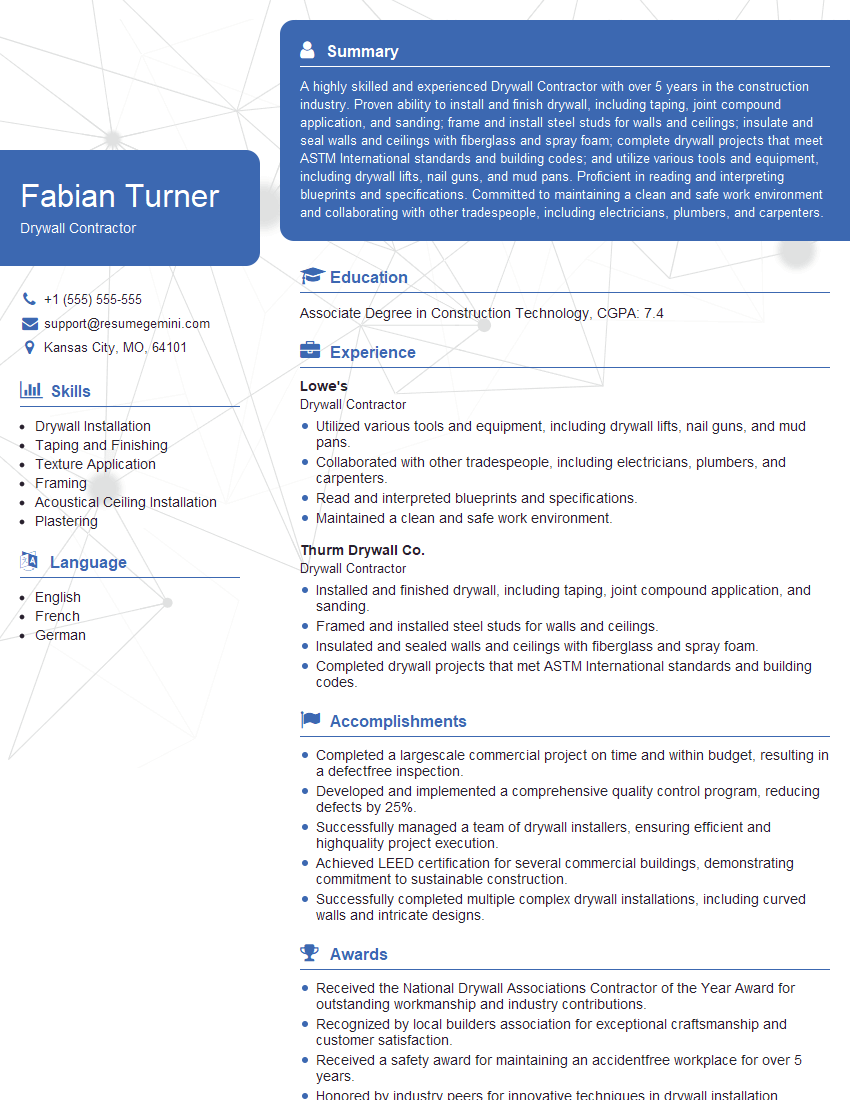
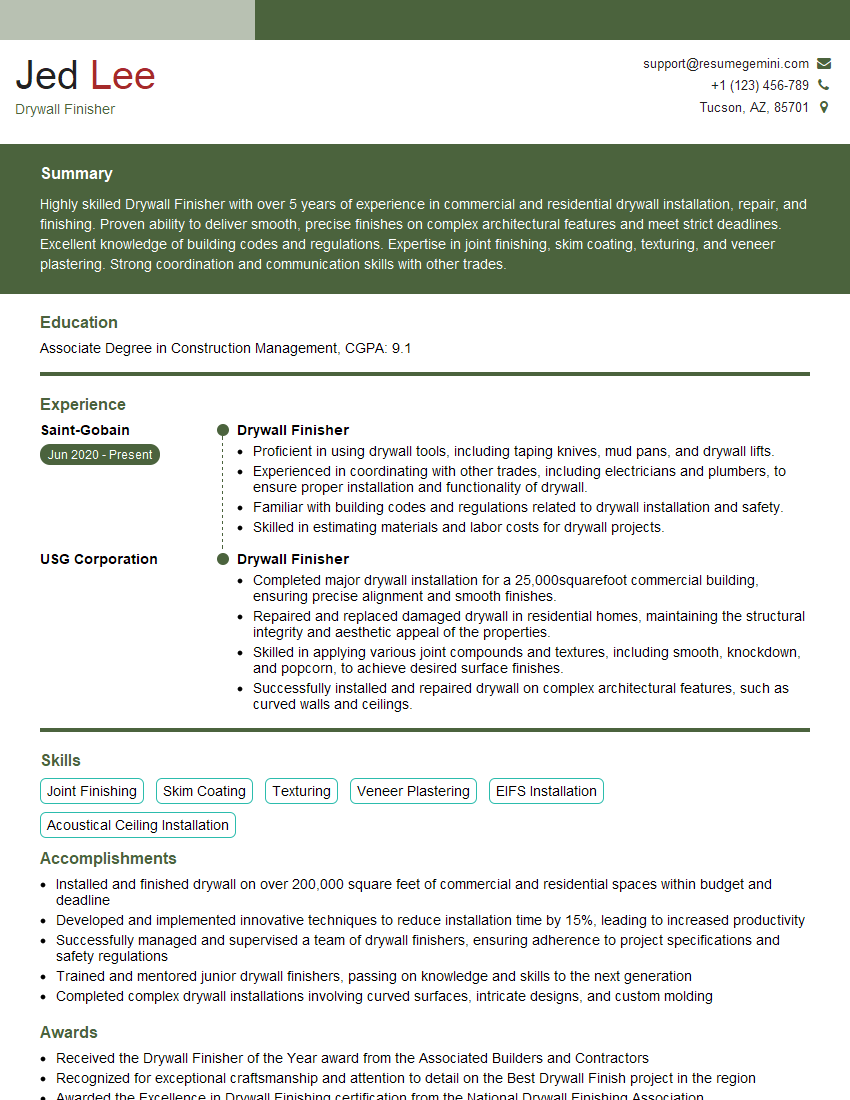
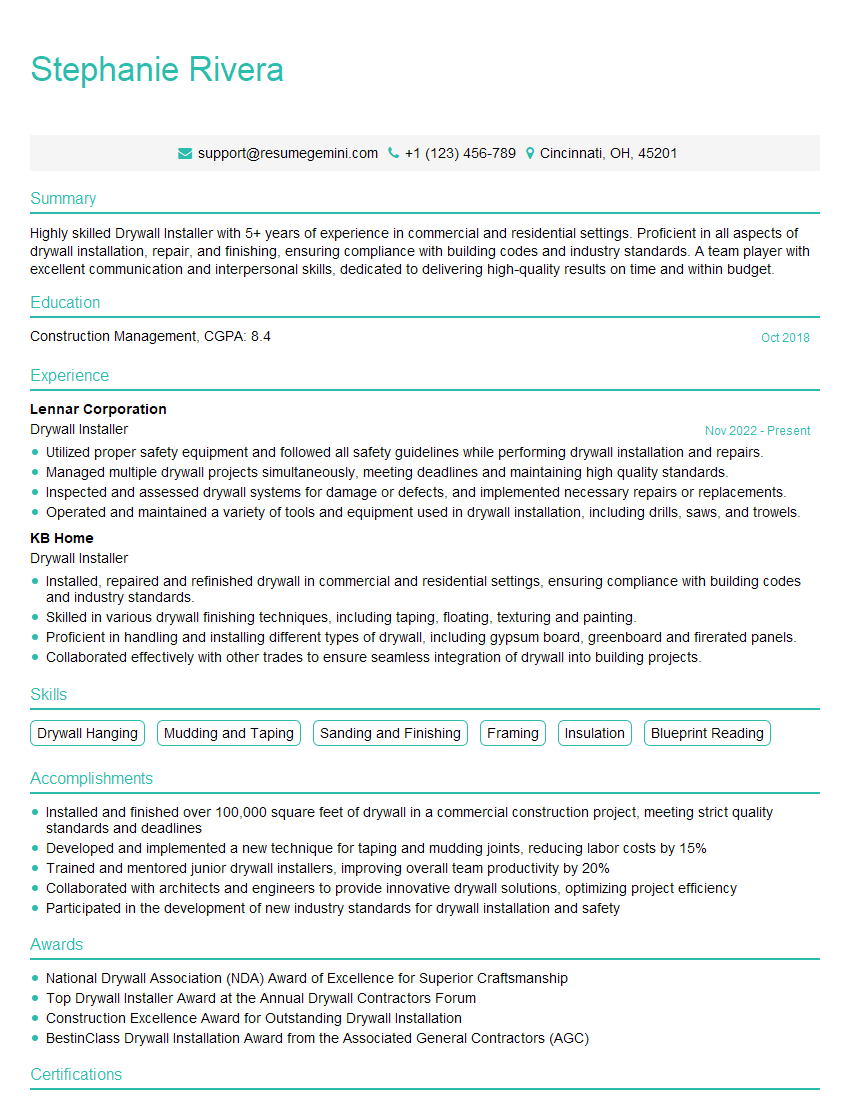
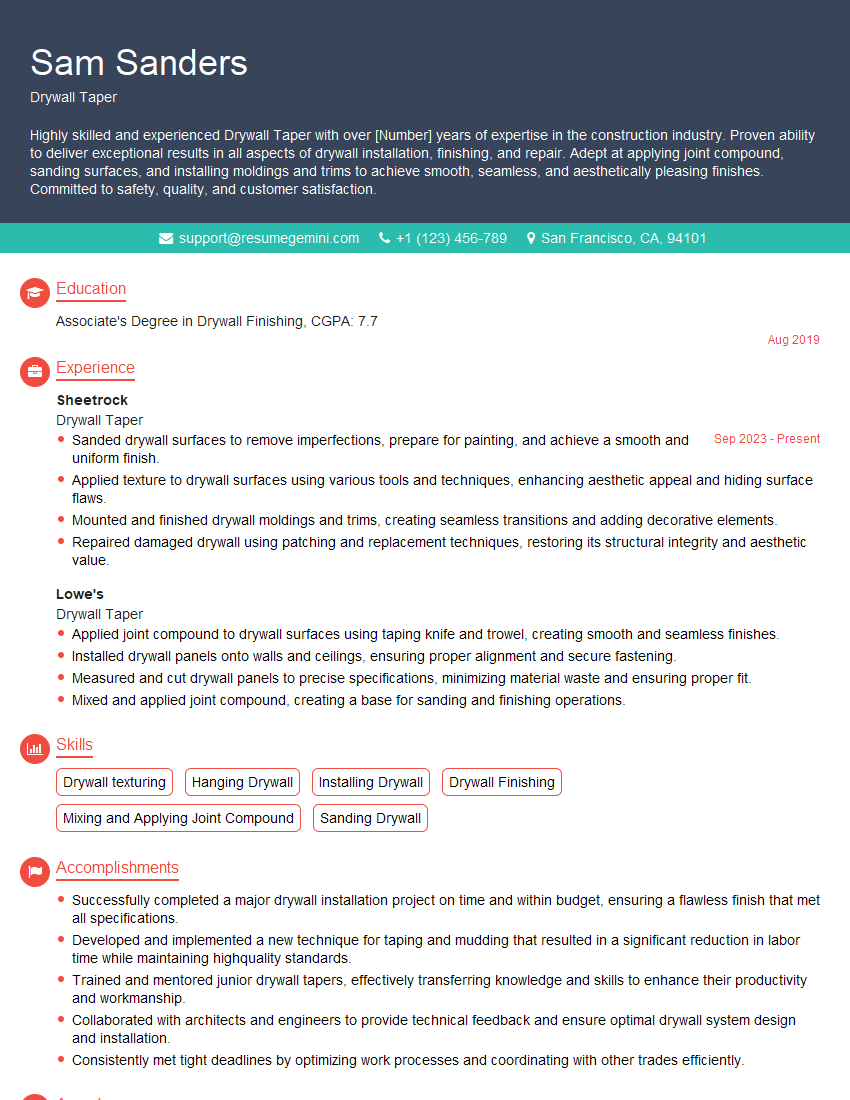
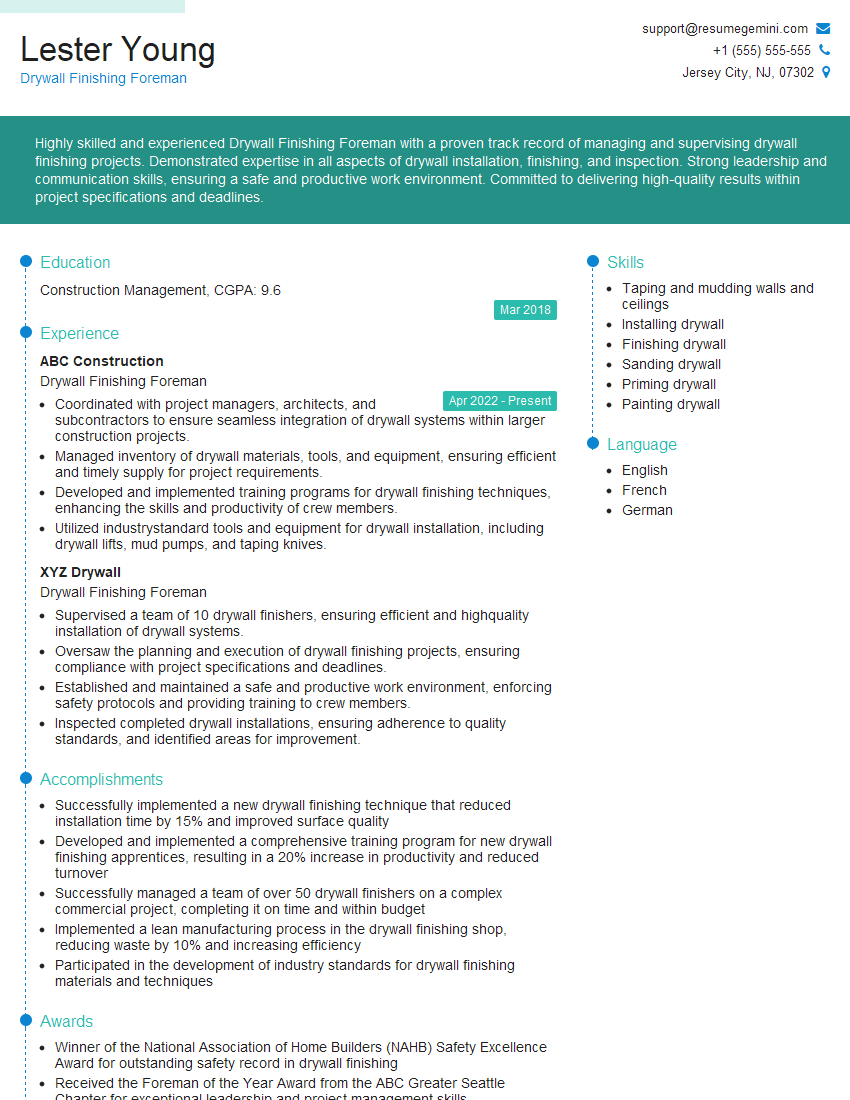
Mastering the art of tapping and finishing drywall joints is crucial for career advancement in the construction industry. A strong understanding of these techniques demonstrates skill and attention to detail, opening doors to higher-paying positions and greater responsibility. To increase your job prospects, creating a professional and ATS-friendly resume is essential. ResumeGemini is a trusted resource that can help you build a compelling resume that highlights your skills and experience effectively. Examples of resumes tailored to Tapping and Finishing Drywall Joints are available to guide you through the process.

Explore more articles
Users Rating of Our Blogs
Share Your Experience
We value your feedback! Please rate our content and share your thoughts (optional).
What Readers Say About Our Blog
To the interviewgemini.com Webmaster.
Very helpful and content specific questions to help prepare me for my interview!
Thank you
To the interviewgemini.com Webmaster.
This was kind of a unique content I found around the specialized skills. Very helpful questions and good detailed answers.
Very Helpful blog, thank you Interviewgemini team.