Are you ready to stand out in your next interview? Understanding and preparing for Tile Measuring interview questions is a game-changer. In this blog, we’ve compiled key questions and expert advice to help you showcase your skills with confidence and precision. Let’s get started on your journey to acing the interview.
Questions Asked in Tile Measuring Interview
Q 1. What are the common units of measurement used in tile installation?
In tile installation, we primarily use two units of measurement: square feet (sq ft) and square meters (sq m). Square feet are more common in the United States and some other countries, while square meters are the standard in many parts of the world. We also use linear measurements such as inches, feet, centimeters, and meters to measure individual tiles and the dimensions of the area to be tiled. Understanding these units is crucial for accurate estimations and preventing material shortages or excesses.
Q 2. Explain the process of calculating the total square footage needed for a tile project.
Calculating the total square footage needed involves measuring the area to be tiled. For simple rectangular or square areas, it’s straightforward: multiply the length by the width. For example, a room measuring 10 feet by 12 feet would require 120 sq ft of tile (10 ft * 12 ft = 120 sq ft). For more complex shapes, you might need to break the area down into smaller, simpler shapes (rectangles, triangles, etc.), calculate the area of each, and then sum them up. Always measure twice to ensure accuracy!
Consider this example: A bathroom floor consists of a rectangle (8ft x 6ft) and a semi-circle (diameter 4ft). You would calculate the rectangle area as 48 sq ft (8ft x 6ft). The semi-circle area is calculated as (π * r²) / 2, where r = 2ft (half the diameter). This results in approximately 6.28 sq ft. The total area is 54.28 sq ft.
Q 3. How do you account for waste when calculating tile quantities?
Waste is an unavoidable reality in tile projects. The amount of waste depends on several factors, including the tile size, layout pattern, the complexity of the area, and the skill of the installer. A common rule of thumb is to add 10% to 15% to your total square footage calculation to account for cuts, breakage, and mistakes. For more intricate designs or challenging installations involving many cuts, you might need to increase this percentage up to 20% or more. It’s always better to have extra tiles than to run short mid-project.
For instance, if your calculation shows you need 120 sq ft of tile, adding 10% would mean ordering an additional 12 sq ft (120 sq ft * 0.10 = 12 sq ft), resulting in a total order of 132 sq ft.
Q 4. What factors influence the choice of tile layout pattern?
The choice of tile layout pattern significantly impacts the final look and feel of a tiled area. Several factors influence this decision:
- Room shape and size: A running bond pattern works well in long hallways, while a herringbone might be better suited for a square room.
- Tile size and shape: Larger tiles generally work best in simpler patterns, while smaller tiles offer more design flexibility.
- Personal preference: Ultimately, the client’s aesthetic vision is paramount.
- Minimizing cuts: Patterns that minimize cuts can reduce waste and installation time. For example, brick patterns are more forgiving than diagonal ones
For example, a large, square room might look stunning with a large-format tile in a simple running bond pattern, while a smaller bathroom could benefit from a more detailed pattern with smaller tiles, potentially using decorative border tiles
Q 5. Describe different methods for measuring irregular surfaces.
Measuring irregular surfaces requires a more detailed approach. We often break down the area into smaller, manageable shapes – rectangles, triangles, and even trapezoids. For each shape, we use appropriate formulas to calculate the area. For highly irregular shapes, we might use a method called ‘grid’ measuring. This involves overlaying a grid of small squares onto the surface and counting the number of squares covered. This is less precise but can be helpful for very complex areas. Another method is using a digital measuring tool or creating a digital template for precise areas.
Example: To measure an irregularly shaped niche, divide it into a rectangle and a triangle. Measure and calculate the area of each shape and add the results together.
Q 6. How do you determine the number of tiles needed for a specific area, considering cuts and wastage?
Determining the number of tiles involves several steps:
- Calculate the total area: Measure the area to be tiled accurately.
- Determine the tile size: Know the dimensions of each tile in square feet or square meters.
- Calculate the number of tiles (without waste): Divide the total area by the area of one tile.
- Account for waste: Add the appropriate percentage (10%-20% or more depending on complexity) to the number of tiles calculated in step 3.
- Round up: Always round up to the nearest whole tile to avoid shortages.
Example: A 100 sq ft area with 1 sq ft tiles requires 100 tiles. Adding 10% waste requires 110 tiles (100 * 1.10 = 110).
Q 7. How do you account for diagonal cuts in your measurements?
Diagonal cuts require careful planning and measurement. The key is to account for the increased length of the diagonal compared to the sides. When calculating the area for a diagonally tiled section, you typically need to use the Pythagorean theorem (a² + b² = c²) to determine the length of the diagonal. Then use this diagonal measurement to determine the number of tiles needed along the diagonal line. Remember to account for extra waste due to the more complex cutting. For example a simple 45-degree diagonal cut will increase the needed tiles over the basic straightforward layout. This is because the cuts will not always fit into a standard grid pattern.
Q 8. How do you measure for tile around curves or complex shapes?
Measuring for tile around curves or complex shapes requires a more hands-on approach than simple rectangular areas. Instead of relying solely on measuring tape, we often use flexible measuring tapes to accurately follow the contours. For intricate curves, I’ll often use a combination of techniques. One method is to break down the curved surface into smaller, manageable segments – essentially approximating the curve with a series of short, straight lines. I’ll measure each segment carefully, recording the length and width. This segmented approach allows for a more precise calculation of the total tile area.
Another approach, particularly useful for radiused edges, involves using string or a flexible ruler to trace the curve. The length of the string gives us the arc length. We then need to determine the width of the area to be tiled. For circular areas, the formula for circumference (2πr) helps determine the amount of tile needed along the curved edge. I might also create a template from cardboard or another pliable material, carefully tracing the curve and using it to measure the tile quantity required. Finally, it’s crucial to add extra tile to account for cuts and potential waste during the installation.
For example, when tiling a curved shower wall, I’d segment the wall into sections based on its curves and use a combination of string and tape measures to determine the tile quantity required for each segment. I would add at least 10% extra to compensate for cuts and fitting around the curves.
Q 9. What tools and equipment are essential for accurate tile measurement?
Accurate tile measurement demands precision tools. My essential kit includes:
- Measuring Tape: A high-quality, retractable tape measure (at least 25 feet) with clear markings is indispensable. I prefer one with both metric and imperial units.
- Steel Ruler: A steel ruler (at least 12 inches or 30 cm) is crucial for precise, smaller measurements and checking squareness.
- Level: A torpedo level and a longer level are essential for ensuring perfectly horizontal and vertical lines – which is critical for a professional-looking tile installation.
- Square: A speed square or combination square helps ensure that corners are perfectly 90 degrees, leading to clean and accurate cuts.
- Chalk Line: A chalk line helps mark perfectly straight lines across large areas, ensuring consistent spacing between tiles.
- Pencil: A sharp pencil for marking measurements on tiles and surfaces.
Beyond the basic tools, a digital tile calculator can speed up the calculation of square footage, especially for complex projects. I also use a notebook to record all measurements meticulously and create detailed diagrams.
Q 10. How do you account for expansion and contraction of tiles?
Tile expansion and contraction, primarily due to temperature and humidity changes, is a crucial factor in preventing cracking and other installation issues. The solution is to leave expansion joints. These are gaps, typically 1/8 inch to 1/4 inch wide, that are incorporated into the tile layout. The size of the joint depends on the type of tile and the substrate.
These joints are left between walls and tile, around doorways, and even in large tile fields. They’re filled with grout or sealant, which is flexible and allows the tile to expand and contract without damaging itself or the surrounding structure. Ignoring expansion joints can lead to cracking or buckling of the tile installation. The exact expansion joint width is determined by consulting the manufacturer’s specifications for the specific tile being used. In practice, I’ll often use spacers to maintain uniform gaps during the installation process.
For example, installing large format porcelain tiles without proper expansion joints in a sun-drenched area is a recipe for disaster. The porcelain will expand in the heat, and without the joints, it will put undue stress on the tiles and the adhesive, eventually leading to cracking.
Q 11. Explain the importance of accurate measurements in tile installation.
Accurate measurements are the cornerstone of successful tile installation. Inaccurate measurements lead to a cascade of problems. In short: getting it wrong from the start makes the entire process more difficult and expensive. If you don’t measure accurately, you’ll likely:
- Waste tiles: You may order too many or too few tiles, leading to unnecessary expenses or delays.
- Create an unprofessional look: Inconsistent spacing or poorly cut tiles detract from the overall aesthetics of the project.
- Compromise structural integrity: Incorrect measurements, especially when dealing with complex layouts, could lead to structural problems and possible damage.
- Experience increased labor costs: Correcting errors mid-installation is time-consuming and expensive.
Precise measurements ensure a smooth workflow, reducing the likelihood of these issues and resulting in a high-quality, aesthetically pleasing outcome. It’s always better to spend extra time measuring than to redo the work later.
Q 12. How do you handle changes or revisions to tile project measurements?
Handling changes to measurements requires careful documentation and clear communication. If changes arise during a tile project, I first verify the reason for the alteration. Once understood, I meticulously re-measure the affected areas, updating my diagrams and calculations. All stakeholders, including clients and the installation team, need to be informed promptly about these changes. I clearly document any revisions, perhaps by adding a supplementary document or highlighting changes on the original measurement sheet.
For example, if a client decides to extend the tiled area mid-project, I’ll conduct new measurements for the extended portion. This will necessitate an updated tile order. I will then communicate this to the client, detailing any changes in cost or timeline. Transparency and clear documentation are critical in such scenarios. Ignoring these changes can cause delays, cost overruns, and project failure.
Q 13. Describe your experience with different types of tile and their measurement considerations.
My experience encompasses various tile types, each demanding specific measurement considerations. Ceramic tiles are relatively straightforward to measure, but their size and thickness variation should be accounted for. Porcelain tiles, known for their larger sizes, need even more careful measuring and attention paid to expansion joints. Natural stone tiles (marble, granite, etc.) often have significant variations in size and shape, requiring meticulous individual measurement and potentially more waste allowance.
Glass tiles, due to their fragility, require extra careful handling during measurement and installation. Mosaic tiles need calculations based on the sheet size rather than individual tiles. Furthermore, the substrate material also plays a role in measurement. For instance, measuring for tiles on a concrete substrate is different than measuring for tiles on a drywall surface due to differences in the substrates’ tolerances.
For example, when working with large format porcelain tiles, I typically add 10-15% extra to account for cuts and waste. With natural stone, I might need even more, depending on the specific stone and its variations.
Q 14. How do you communicate your tile measurements to other team members?
Effective communication of tile measurements is key to a smooth project. My approach involves several steps: I create detailed, annotated diagrams showing the layout and dimensions of the tiled areas. These diagrams clearly indicate the type and quantity of tiles needed for each section. All measurements are carefully recorded in both written form and in digital format. I usually use a spreadsheet to organize the data and ensure accuracy. I provide this detailed documentation to the entire team – installers, suppliers, and the client.
Clear communication also includes a verbal briefing. I discuss the measurements with the installation team, pointing out any nuances or tricky sections. This face-to-face discussion allows for clarification and ensures everyone is on the same page. I also maintain open communication with the client throughout the process, addressing any queries or modifications effectively. This collaborative approach minimizes errors and misunderstandings, contributing to a successful outcome.
Q 15. What are some common mistakes to avoid when measuring for tile?
Accurate tile measuring is crucial for a successful tiling project. Common mistakes often stem from rushing the process or overlooking small details. Here are some key errors to avoid:
- Inaccurate Measurements: Using a flimsy tape measure or not measuring twice (or even thrice!) can lead to significant errors. Always use a reliable, sturdy tape measure and double-check your measurements.
- Ignoring Wall Irregularities: Walls are rarely perfectly straight. Failing to account for bumps, curves, and uneven surfaces will lead to cutting issues and a messy final result. Carefully check for and document these irregularities.
- Neglecting Waste: Always add extra tile to your order to account for cuts, breaks, and mistakes. A general rule of thumb is to add 10-15%, but this can vary depending on the complexity of the design and the tile size and shape.
- Forgetting Grout Lines: Grout lines add to the overall dimensions. Failing to account for grout width in your calculations will result in either too few or too many tiles.
- Incorrectly Measuring Diagonal Lines: For diagonal layouts, using simple Pythagorean calculations is essential. Failure to do so accurately will result in significant discrepancies.
Remember, careful and methodical measurement is the foundation of a successful tiling job. Take your time and be precise!
Career Expert Tips:
- Ace those interviews! Prepare effectively by reviewing the Top 50 Most Common Interview Questions on ResumeGemini.
- Navigate your job search with confidence! Explore a wide range of Career Tips on ResumeGemini. Learn about common challenges and recommendations to overcome them.
- Craft the perfect resume! Master the Art of Resume Writing with ResumeGemini’s guide. Showcase your unique qualifications and achievements effectively.
- Don’t miss out on holiday savings! Build your dream resume with ResumeGemini’s ATS optimized templates.
Q 16. How do you deal with discrepancies in measurements?
Discrepancies in measurements are inevitable, especially when dealing with older buildings or uneven surfaces. Addressing these requires a systematic approach:
- Identify the Source: Pinpoint the reason for the discrepancy. Is it due to an uneven wall, a measurement error, or a difference between nominal and actual tile sizes?
- Adjust the Layout: Depending on the magnitude of the discrepancy and the tile design, you might need to adjust the layout slightly. This could involve making minor alterations to the cuts or using slightly smaller tiles in certain areas.
- Compromise with Cuts: Sometimes, strategically placed cuts can compensate for small discrepancies. It’s better to have several small, well-placed cuts than one large, awkward cut.
- Communicate with the Client: For larger discrepancies, it’s crucial to discuss the options with the client. They may need to accept a slight adjustment in the design or consider alternative tile choices.
The goal is to find the best solution that minimizes visual imperfections while maintaining the integrity of the design. Good communication and flexibility are key.
Q 17. How do you ensure the accuracy of your measurements?
Ensuring accurate measurements involves a combination of tools, techniques, and attention to detail. Here’s my approach:
- Use Quality Tools: A high-quality tape measure is essential. Look for one with a sturdy casing, clear markings, and a locking mechanism. A laser measure can also be incredibly helpful for larger areas.
- Measure Multiple Times: Always measure at least twice, and from different angles where appropriate, to ensure consistency. Taking additional measurements also helps to catch any errors.
- Check for Squareness: Use a square or level to verify the squareness of walls and corners. This is especially crucial for large areas.
- Account for Expansion Gaps: Allow for expansion and contraction of the tiles, especially in areas with temperature fluctuations. This usually involves leaving small gaps around the perimeter and between tiles.
- Document Everything: Keep detailed written records of your measurements and any adjustments made along the way. Draw a sketch of the area with all measurements clearly marked. Accurate documentation minimizes errors and facilitates adjustments.
By following these steps, you can significantly improve the accuracy of your measurements and minimize potential problems down the line.
Q 18. What is the difference between nominal and actual tile sizes?
The difference between nominal and actual tile sizes is a common source of confusion. The nominal size is the size the tile is advertised as—often rounded to the nearest convenient whole number. However, the actual size of the tile is the true measured dimension. This includes the manufacturing tolerances, which can result in slight variations between individual tiles. For instance, a tile might be nominally described as 12×12 inches but measure 11.875 x 11.875 inches.
Understanding this discrepancy is crucial because it impacts the calculation of the number of tiles needed. Always measure a few sample tiles from the box to get the actual size, then use the actual size for your calculations. Failing to do so can lead to over or under ordering and potentially design issues.
Q 19. How do you convert between different units of measurement (e.g., inches to centimeters)?
Converting between units of measurement is a simple yet essential aspect of tile measuring. The most common conversion is between inches and centimeters.
To convert inches to centimeters, multiply the measurement in inches by 2.54 (since 1 inch is equal to 2.54 centimeters).
Example: 12 inches * 2.54 cm/inch = 30.48 centimeters
To convert centimeters to inches, divide the measurement in centimeters by 2.54.
Example: 30 centimeters / 2.54 cm/inch = 11.81 inches
Accurate conversion is vital for working with tiles imported from different countries or when dealing with design specifications provided in different units.
Q 20. Explain your understanding of tile grout lines and how to factor them into measurements.
Tile grout lines are the spaces between individual tiles filled with grout. They are often overlooked, yet their width significantly affects the final dimensions. Failure to account for grout lines can lead to serious calculation errors.
The standard grout line width ranges from 1/16 inch to 1/4 inch (1.5mm to 6mm), depending on the tile size and type. Before calculations, you must determine the grout line width that you will be using. You must incorporate this width into all your calculations.
Example: If you’re using 12×12 inch tiles with a 1/8 inch grout line, each tile unit will actually measure 12.125 inches (12 inches + 1/8 inch on each side).
Therefore, when calculating the number of tiles needed for a 120-inch wide wall, you would use 12.125 inches as the unit size instead of just 12 inches.
Q 21. How do you create a detailed tile layout plan?
Creating a detailed tile layout plan is essential for a successful project. The process typically involves the following steps:
- Accurate Measurements: Start with extremely precise measurements of the area to be tiled. Document everything, including wall irregularities, door and window locations, and existing fixtures.
- Choose Tile Pattern: Select a suitable tile pattern based on the space’s dimensions and the client’s preferences (e.g., running bond, herringbone, diagonal).
- Sketch a Layout: Sketch a detailed layout of the tiling plan, indicating the position of each tile, including cuts. Consider the location and size of cuts to ensure that they’re visually appealing and placed strategically.
- Calculate Tile Quantities: Use the layout plan and actual tile sizes (including grout lines) to accurately calculate the number of tiles needed. Always add extra for cuts, breaks, and potential discrepancies.
- Material List: Create a comprehensive material list that includes the type and quantity of tiles, grout, adhesive, and other necessary materials.
- Refine and Verify: Review your plan carefully. Make adjustments if needed, double-checking all calculations. Before proceeding with the tiling, show the plan to the client for approval.
A well-executed tile layout plan prevents common tiling errors and ensures the project’s successful completion.
Q 22. How do you determine the correct number of tiles needed for a specific design?
Accurately determining the number of tiles needed is crucial for a successful tiling project. It involves more than just simple area calculations; it accounts for cuts, waste, and the chosen tile layout.
My process begins with precise measurements of the area to be tiled. I meticulously measure the length and width of each surface, accounting for any irregularities or obstacles. Then, I convert these measurements to square footage (or square meters). Next, I consider the size of the individual tiles, and calculate the number of tiles needed based on the area. However, this is just the starting point.
- Waste Factor: I always add a contingency for waste. This percentage varies depending on factors like the tile shape (complex shapes like hexagons generate more waste), the pattern (more complex patterns necessitate more cuts and therefore more waste), and the number of cuts required. A typical waste factor ranges from 5% to 15%, but it could be higher for intricate designs or challenging installations.
- Tile Layout: The chosen layout significantly influences waste. A running bond pattern typically generates less waste than a more complex herringbone or diagonal pattern. I always visualize the layout and estimate the cuts needed before finalizing the quantity.
- Breakage: It’s always prudent to account for potential breakage during transport, handling, or installation. Adding a few extra tiles as a buffer is a standard practice.
For example, if I’m tiling a 10ft x 12ft room with 1ft x 1ft tiles and using a simple running bond pattern, I would calculate 120 tiles (10 x 12). However, I would add a 10% waste factor (12 extra tiles) and a few extra tiles for breakage, bringing the total to approximately 135 tiles. This careful accounting prevents delays and extra expenses due to tile shortages.
Q 23. What are some software or tools you use for tile measurement calculations?
Technology plays a vital role in ensuring accurate and efficient tile measurement calculations. I regularly use several software tools and applications, each offering specific advantages:
- CAD Software (AutoCAD, SketchUp): These are excellent for complex projects requiring precise 2D or 3D modeling. I can input the room dimensions, tile sizes, and layout to obtain an accurate tile count and visualize the final result. This is especially helpful for large-scale projects or those with intricate designs.
- Tile Calculators (online and mobile apps): Several online and mobile apps provide user-friendly interfaces for calculating tile requirements. These apps often include features for calculating waste and different tile layouts, making the process quick and straightforward.
- Spreadsheets (Excel, Google Sheets): I use spreadsheets to organize and manage data, calculating tile quantities, tracking costs, and generating reports. This helps me maintain a structured and transparent record of my calculations.
Beyond software, I also rely on essential measuring tools like laser measures for accurate and quick distance measurements, especially in large areas. A good quality measuring tape is still essential for detailed measurements and verifying laser readings.
Q 24. How do you ensure the pattern of the tiles matches across different surfaces?
Maintaining consistent patterns across different surfaces requires careful planning and execution. It’s a critical aspect of creating a visually appealing and professional finish.
My approach begins with a detailed survey of the entire area, understanding the relationship between different surfaces. Then, I design the tile layout with the pattern’s repetition in mind. This involves calculating the required number of tiles for each surface based on the pattern’s repeating unit. For instance, if I’m using a pattern that repeats every three tiles, the layout is carefully designed to ensure this repetition continues seamlessly across adjacent surfaces. This might involve adjusting the size of tiles in certain sections to accommodate the pattern and make it work with the space available.
I always start tiling from a prominent and central point, establishing a baseline that ensures pattern continuity. I also use reference lines or markers on the floor or walls to guide the pattern’s alignment and to ensure it remains accurate as I continue laying tiles across different surfaces.
Communication is key; I discuss the pattern and its implications with the client before beginning to ensure we are both on the same page. This proactive approach prevents costly mistakes during the installation phase.
Q 25. What experience do you have with different tile materials (e.g., ceramic, porcelain, natural stone)?
My experience encompasses a wide range of tile materials, each with its unique characteristics influencing measurement and installation techniques:
- Ceramic Tiles: These are widely used and generally easy to work with. They are relatively consistent in size and shape, simplifying measurement. However, I must account for variations in individual tile size and ensure proper spacing to maintain a uniform appearance.
- Porcelain Tiles: Often denser and more durable than ceramic, porcelain tiles offer excellent water resistance. However, due to their hardness, precision cutting and handling are crucial to avoid chipping or breakage. This often means a more detailed measurement process to plan for the cuts.
- Natural Stone Tiles (Marble, Granite, Travertine): These are beautiful, but they come with some caveats. Natural stone tiles often have variations in size, color, and texture. Therefore, I always perform a more thorough measurement to determine the best possible arrangement, minimizing waste and maximizing the visual impact. I also account for the need for more careful handling and more grout to accommodate the variations in size.
Understanding the specific properties of each material is crucial for accurate measurement and preventing issues during installation. For instance, natural stone requires careful handling and potentially more grout to compensate for irregularities in size and shape, factors that would not significantly affect the calculation of ceramic tiles.
Q 26. How do you manage your time efficiently while performing tile measurements?
Efficient time management is vital for successful tile measuring. My approach combines meticulous planning with effective tools and techniques:
- Pre-Job Planning: I carefully review the project scope, including blueprints, tile specifications, and the client’s requirements. This helps me identify potential challenges and optimize my measurement strategy.
- Systematic Approach: I follow a systematic order in taking measurements, avoiding redundant actions. I use laser measuring tools to quickly obtain overall room dimensions, followed by more precise manual measurements of detailed areas and any irregularities.
- Organized Data Management: I document all measurements clearly and concisely, using spreadsheets or digital tools to maintain accurate records. This helps with future calculations and eliminates the need for repeating measurements.
- Prioritize Tasks: I prioritize tasks based on their urgency and complexity, ensuring critical measurements are taken first.
This combination of meticulous planning, systematic measurement, and organized record-keeping enables me to work efficiently and accurately, minimizing the time spent on the measurement phase of the project.
Q 27. Describe a situation where your accurate tile measurement prevented a costly mistake.
During a recent project involving a large-scale bathroom renovation with intricate mosaic tiles, a seemingly minor miscalculation could have resulted in a significant problem. The client had chosen a complex mosaic pattern requiring very precise measurements. If I had only estimated the number of tiles, there would have been a considerable shortage mid-installation, leading to delays in completing the project, added costs due to needing to re-order more tiles, and potential disruption to the client’s schedule.
However, my meticulous approach, which included using CAD software for precise layout planning and accounting for a higher-than-average waste factor given the intricacy of the mosaic design, prevented this. The accurate measurements ensured I had enough tiles on hand to complete the project without interruption, ensuring client satisfaction and adhering to project timelines. The difference between a successful project and a costly delay stemmed directly from the accuracy of my tile measurement.
Q 28. What are some safety considerations when measuring for tile installation?
Safety is paramount in any tiling project. During the measurement phase, specific safety precautions need to be observed:
- Personal Protective Equipment (PPE): When measuring in construction sites or areas under renovation, I always wear appropriate PPE, including safety glasses and sturdy footwear to protect against potential hazards.
- Safe Access: I never attempt to take measurements from precarious positions or without proper access. If a ladder or scaffolding is required, I use it safely and appropriately.
- Electrical Safety: I’m always cautious when working near electrical wiring or outlets. If I need to measure in such areas, I shut off the power or work with a qualified electrician to ensure my safety.
- Working at Heights: If I need to work at heights, I use appropriate fall protection measures, ensuring my safety is always prioritized.
- Site Awareness: I am constantly aware of my surroundings to avoid tripping hazards, exposed nails or sharp objects, and other potential dangers on the site.
By prioritizing safety, not only do I protect myself from harm but I also contribute to creating a safer environment for others working on the project.
Key Topics to Learn for Tile Measuring Interview
- Understanding Project Requirements: Accurately interpreting blueprints, sketches, and client specifications to determine tile needs.
- Calculating Tile Quantities: Mastering formulas to account for waste, cuts, and variations in tile sizes for accurate material ordering.
- Spatial Reasoning and Layout Planning: Visualizing tile patterns and arrangements within different spaces, optimizing for aesthetics and minimizing waste.
- Practical Application of Measurement Tools: Proficient use of measuring tapes, levels, and other tools to ensure precise measurements in diverse environments.
- Addressing Irregular Shapes and Complex Layouts: Developing problem-solving skills to handle challenging spaces requiring intricate cuts and pattern adjustments.
- Understanding Different Tile Types and Formats: Knowledge of various tile materials, sizes, and shapes to advise clients on appropriate choices.
- Estimating Labor and Material Costs: Developing skills to create accurate cost estimates for projects based on measurements and material pricing.
- Communicating Effectively with Clients and Contractors: Clearly conveying technical information to non-technical audiences in a professional and accessible manner.
- Safety Procedures and Regulations: Understanding and adhering to relevant safety guidelines while performing measurements and during project execution.
Next Steps
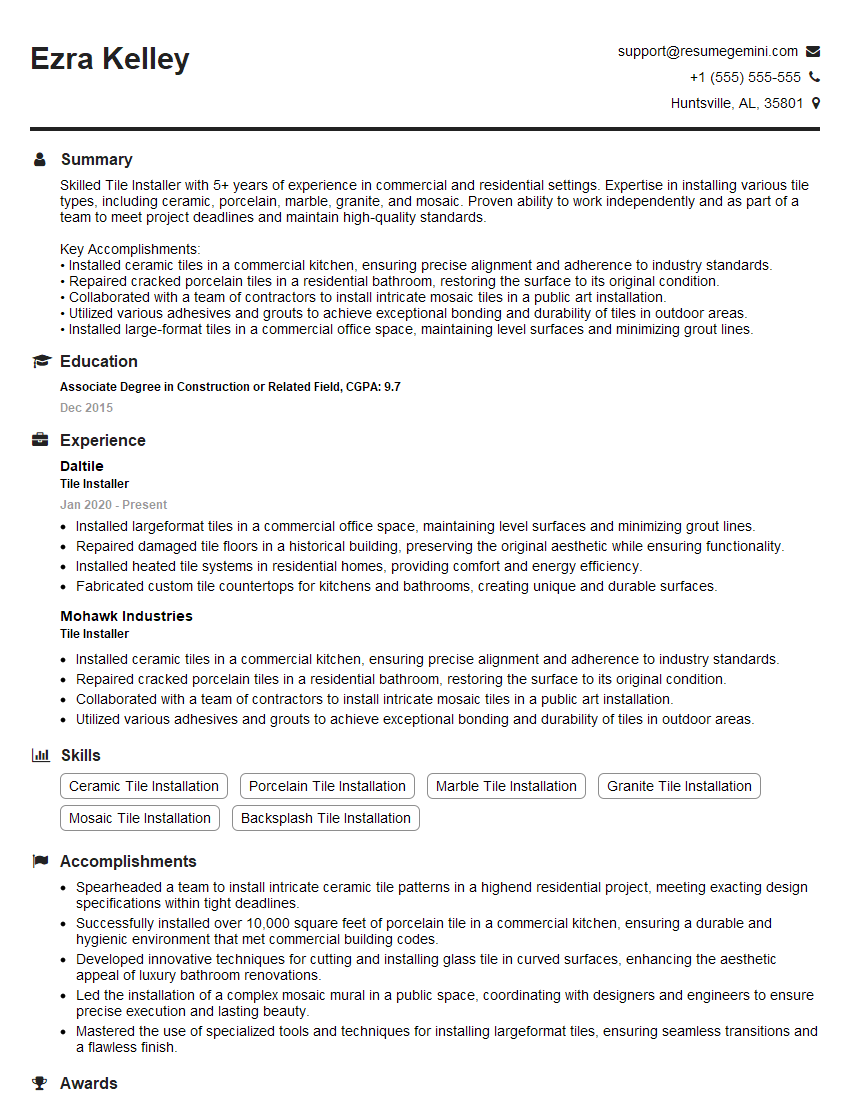
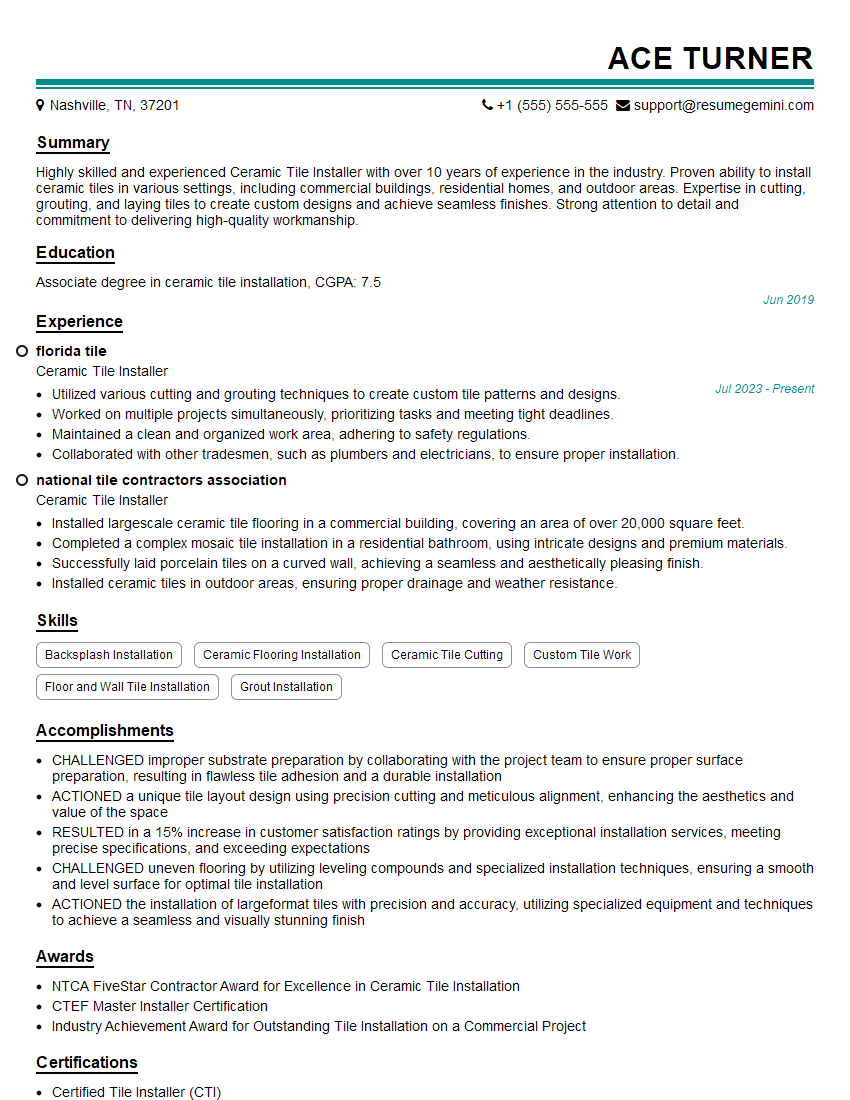
Mastering tile measuring is crucial for career advancement in the construction and design industries, opening doors to higher-paying roles and increased project responsibility. To significantly improve your job prospects, creating a strong, ATS-friendly resume is essential. ResumeGemini is a trusted resource that can help you build a professional and effective resume tailored to highlight your tile measuring skills. Examples of resumes specifically designed for the tile measuring field are available to guide you.

Explore more articles
Users Rating of Our Blogs
Share Your Experience
We value your feedback! Please rate our content and share your thoughts (optional).
What Readers Say About Our Blog
To the interviewgemini.com Webmaster.
Very helpful and content specific questions to help prepare me for my interview!
Thank you
To the interviewgemini.com Webmaster.
This was kind of a unique content I found around the specialized skills. Very helpful questions and good detailed answers.
Very Helpful blog, thank you Interviewgemini team.